What the cloud providers are actually doing under the hood — and how to replicate it with hardware you own, data you control, and architectures built for the real world
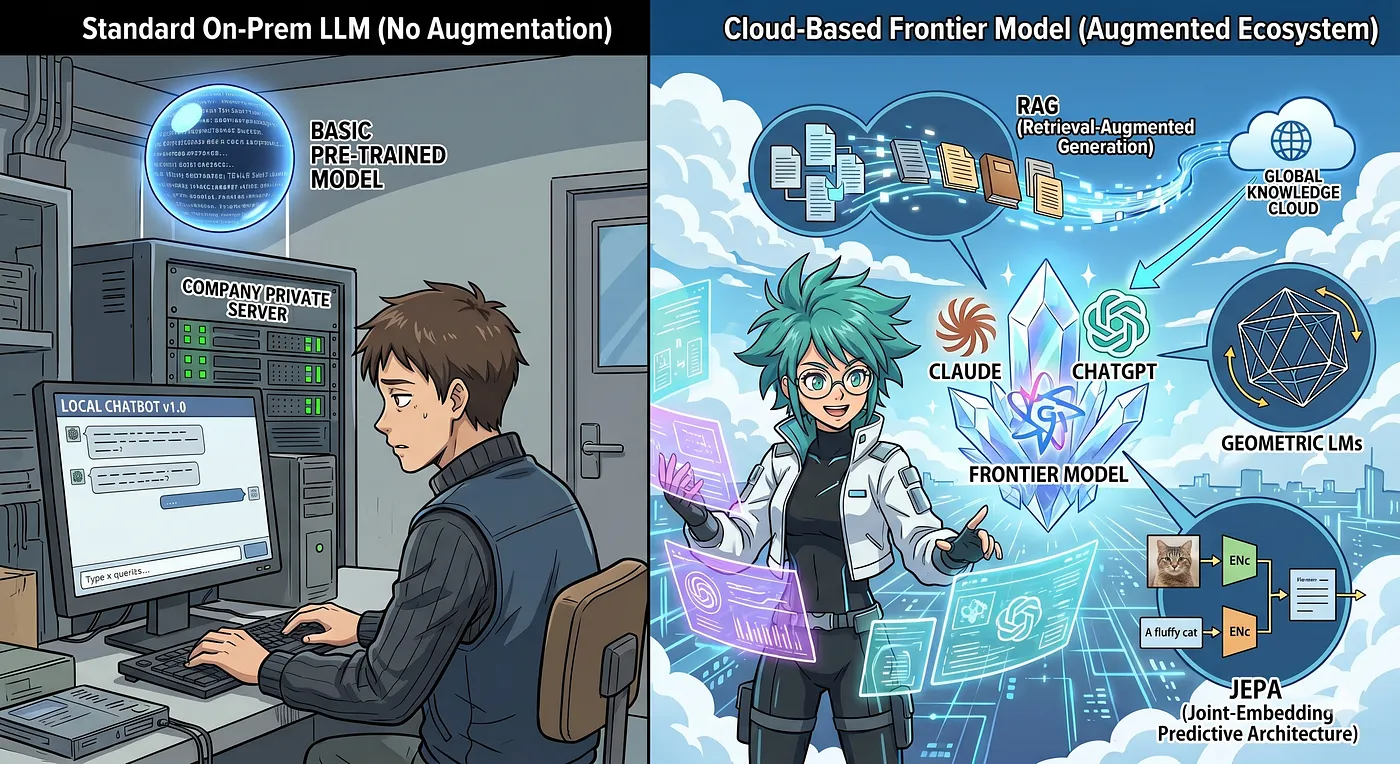
Why is the On-Prem Model giving Poor Quality Output compared to the Frontier? — Generated by Gemini
The Uncomfortable Truth About “Just Running a Model”
There is a version of on-premises AI that most organizations are building right now, and it is quietly underperforming in ways that are difficult to diagnose. The symptoms are familiar: the model gives confident-sounding answers that are subtly wrong, it struggles with multi-step reasoning tasks, it fails to connect patterns across large document libraries, and the outputs feel generic rather than precise. Stakeholders compare the results unfavorably to what they get from commercial cloud services, and the project starts losing momentum.
The problem is almost never the hardware. It is rarely the model weights. The problem is architectural. Organizations are deploying what amounts to a text prediction machine and expecting it to behave like an intelligent reasoning system. Those are two fundamentally different things, and the gap between them is not filled by buying more GPUs.
What the major commercial AI providers have built — and what most organizations do not realize when they run their first local inference server — is not simply a large language model. It is an entire ecosystem of supporting systems, control loops, filtering tiers, and verification architectures that surround the generative model and orchestrate its behavior. The model is the center of the system, but the intelligence comes from the architecture around it.
This article is about building that architecture yourself, on hardware you own, within your own network perimeter, without sending sensitive data to any external service. It is written for solutions architects, infrastructure engineers, and technology leaders who serve highly regulated industries and who need to understand not just what tools to install, but why each component of the system does the work it does.
What Is Actually Happening Inside a Commercial AI System
When a user submits a complex prompt to a leading commercial AI service and the interface shows a spinning indicator for several seconds before a response appears, most people assume the model is simply thinking hard. That intuition is partially correct, but the mechanism is far more structured than the metaphor implies.
The first thing that separates a frontier commercial model from a stock open-weight download is what happened before it was ever deployed. Leading providers invest heavily in shaping the geometric structure of their models’ internal representations during training and fine-tuning — ensuring that when the model processes a coherent sequence of domain-specific text, its internal states follow clean, directional paths through the representational space rather than noisy, wandering ones. This is not just a quality-of-life improvement. It is what allows frontier models to produce precise, reliable outputs in specialized domains while requiring far less labeled training data to get there. The model has been prepared for its domain, not merely exposed to it.
The second thing that separates a well-designed commercial system from a basic inference endpoint is what happens to raw data before it ever reaches the language model. Commercial providers do not feed everything into a single context window and hope for the best. They deploy upstream filtering architectures — joint embedding systems that compress high-volume, noisy inputs into compact abstract representations capturing only what is semantically meaningful. The language model receives a distilled summary of the world, not the world itself. This is why frontier systems can process vast organizational knowledge bases without drowning in irrelevance.
Commercial AI systems have also learned that simply generating the most probable next token, over and over, is not sufficient for tasks that require precision. Mathematical proofs fall apart. Legal analyses miss critical distinctions. Code contains subtle bugs that only appear at runtime. Leading providers have moved toward what researchers call test-time compute scaling: rather than committing to a single response, these systems generate multiple candidate reasoning paths simultaneously, evaluate the logical soundness of each step using a separate verification model, discard paths that fail the check, and return only the response that held up under scrutiny. This is the “thinking” that the spinning indicator represents.
For problems where the answer lives not in text but in the structure of relationships between things — regulatory frameworks, molecular configurations, counterparty exposure networks — frontier systems maintain external structured knowledge layers that the language model can query directly. Rather than inferring that two regulatory requirements are connected by reading descriptions of them, the system can traverse the actual connection in a relational database and return a structurally grounded answer. The language model reads the map instead of trying to reconstruct it from memory.
Finally, commercial systems deploy what are effectively agent loops with recursive orchestration — nested networks of specialized sub-processes that handle discrete sub-tasks, produce intermediate outputs, and pass structured results upward through a hierarchy to the coordinating model. This is why commercial AI can execute what appear to be extraordinarily complex, multi-step analytical tasks in a single session. It is not one model doing everything. It is a coordinated architecture of models, verifiers, and tools doing their individual jobs precisely and passing the results forward.
The good news for anyone building on-premises AI today is that every one of these techniques can be implemented locally, with currently available open-source software, on hardware that is commercially available at comparatively reasonable costs. The hardware picture is covered in detail in a companion piece here. The challenge is not access to the technology. The challenge is knowing that it exists and understanding how it all fits together.
The First Layer: Preparing Your Model Before It Goes Live
Most organizations treat model deployment as a download-and-serve operation. You pull an open-weights checkpoint from Hugging Face, drop it into vLLM, point your team at the endpoint, and call it done. That approach gets you a capable general-purpose model. What it does not get you is a model whose internal representations have been shaped by the specific language, logic, and structure of your domain. In a regulated industry, where terminology is precise, document structures are specialized, and the cost of a plausible-but-wrong answer can be significant, that gap matters.
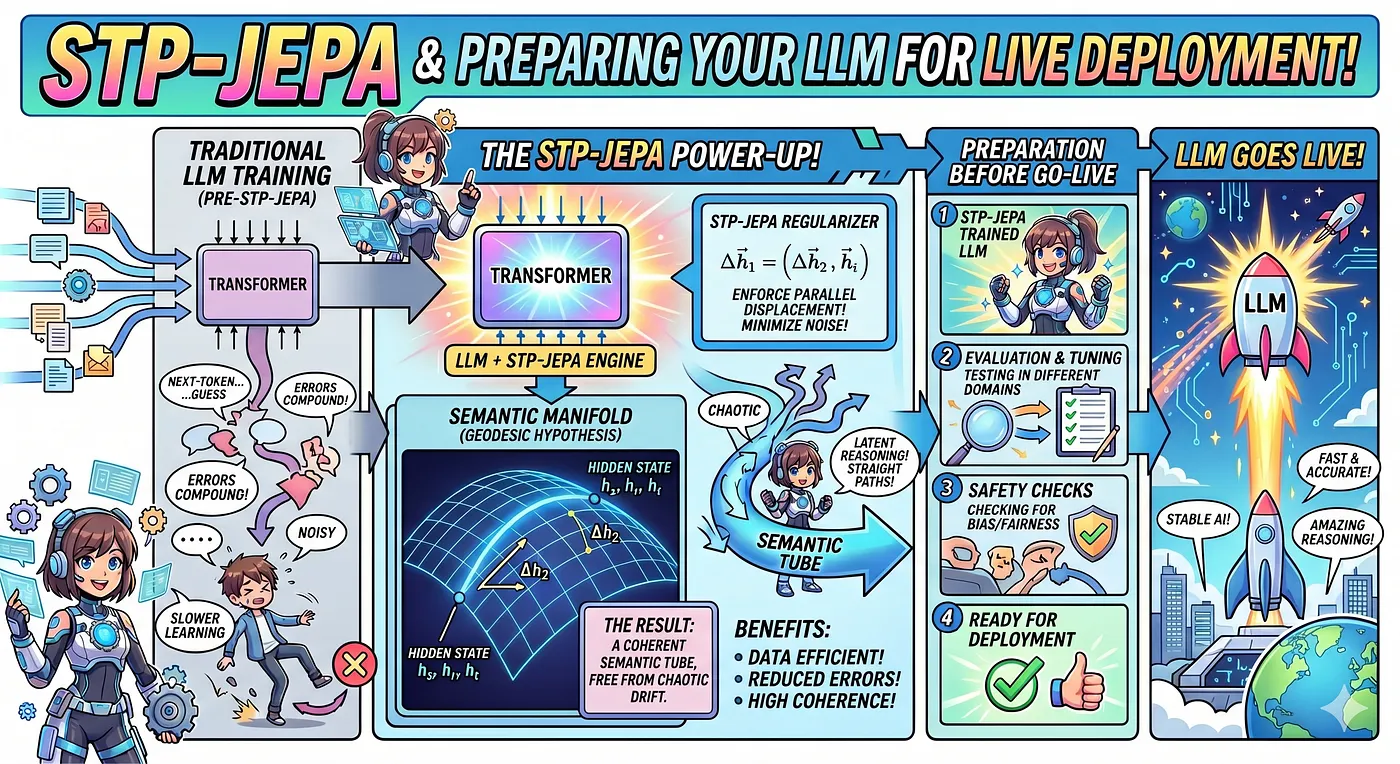
Illustrating STP-JEPA as an pre-training step for an LLM — Google Gemini
The technique that closes this gap most efficiently is called Semantic Tube Prediction, or STP-JEPA, introduced in a 2026 paper by Huang, Balestriero, and LeCun — research produced through NYU and LeCun’s Advanced Machine Intelligence program, the independent research venture he launched after departing Meta at the end of 2025. The core idea starts with a geometric observation about how a well-trained language model should behave: when the model processes a coherent sequence of text, its internal hidden states should follow a smooth, nearly straight-line path through the high-dimensional space of representations it has learned. Genuine semantic signal travels in a consistent direction. Statistical noise causes the path to wobble and deviate. STP adds a lightweight training constraint that penalizes those deviations, forcing the model’s internal trajectory to stay within a tight corridor — a semantic tube — around the straight-line path between meaning states. The result is a model whose representations are geometrically clean, with noise scrubbed out at the representational level rather than averaged away statistically.
The reason this matters for regulated industries specifically is what it does to fine-tuning data requirements. Fine-tuning a language model on domain-specific data is not optional if you want reliable, domain-accurate outputs — but assembling high-quality labeled training data in clinical, financial, or compliance-dense environments is slow, expensive, and subject to its own governance requirements. STP addresses this directly. Because it improves the signal-to-noise ratio of each training update, the model converges on the same quality of domain adaptation with a fraction of the labeled examples. In practical terms, models fine-tuned with STP have matched the accuracy of standard full-dataset fine-tuning using sixteen times less training data. For a team that can realistically annotate two hundred domain-specific examples rather than three thousand, this changes what is achievable.
Critically, none of this requires retraining the base model from scratch, and it does not require any changes to your serving infrastructure. The workflow is the one your team already knows. Download your chosen open-weights model — strong current options with permissive Apache 2.0 licensing include Gemma 4 from Google DeepMind and Qwen 3.5 from Alibaba, both available on Hugging Face; Meta’s Llama 4 family is also capable but carries its own community license terms worth reviewing with your legal team before committing — then run the fine-tuning job using the reference implementation published at github.com/galilai-group/llm-jepa. The STP loss is added as a single additional term on top of standard next-token prediction, with one coefficient to tune, typically set between 0.01 and 0.08. Combine it with LoRA using the built-in flag in the fine-tuning script, and the memory requirements drop to the point where the entire job runs on a single high-memory GPU. When the job finishes, merge the adapter back into the base weights and load the result into vLLM exactly as you would any other checkpoint. The serving layer sees a normal model file. There is no additional runtime component, no special inference setup, and no latency overhead at query time. What you gain is a model whose internal geometry reflects your domain — one that has been taught not just the vocabulary of your field, but the directional structure of how meaning moves through your domain’s specific language.
One practical note: the data efficiency gains are most pronounced when the domain language has a clean, consistent internal structure — regulatory text, clinical protocols, financial instrument definitions, and laboratory procedures all qualify. For noisier, more heterogeneous corpora, the gains are real but somewhat smaller. A short validation run on a held-out set before committing to a full fine-tuning pass is always worth the time.
The Second Layer: Filtering the World Before It Reaches the Model
Once your model is prepared and serving, the next challenge is what you feed it. The instinct in most on-premises deployments is to give the AI access to as much organizational data as possible — full document libraries, live sensor feeds, complete audit records — on the theory that more context produces better answers. In practice, this approach consistently produces slower, more expensive, and less accurate results. The reason is straightforward: standard language models process everything they receive, including all the noise, redundancy, and contextual irrelevance embedded in raw data. Feeding a model fifty pages of unfiltered telemetry is like asking your most experienced analyst to read every line of a raw server log before writing a summary. They could technically do it, but it wastes their best hours and buries signal under noise.
The architectural solution is a JEPA-style pre-processing tier deployed upstream of the language model. Joint Embedding Predictive Architectures, the family of models that Yann LeCun championed during his tenure leading Meta’s AI research lab and continues to advance through his independent Advanced Machine Intelligence program and his longstanding role as Silver Professor at NYU, do not generate outputs the way language models do. They work exclusively in latent space — encoding raw inputs as compact numerical summaries of their meaningful content and stripping out everything irrelevant in the process. A stream of industrial sensor readings that would fill thousands of tokens in a language model’s context window gets compressed by a JEPA encoder into a small set of dense embeddings capturing only the state changes and anomalies that actually matter. The language model never sees the raw feed. It receives only the digest.
Think of it the way a hospital’s monitoring system works when it is functioning correctly. Dozens of sensors produce continuous streams of data around the clock, but a clinician is only paged when the monitoring layer detects a meaningful deviation from expected ranges. Nobody asks the attending physician to review every heartbeat. The JEPA pre-processing tier plays the same role in your AI system — it watches everything so the expensive, capable model only gets involved when there is something worth reasoning about.
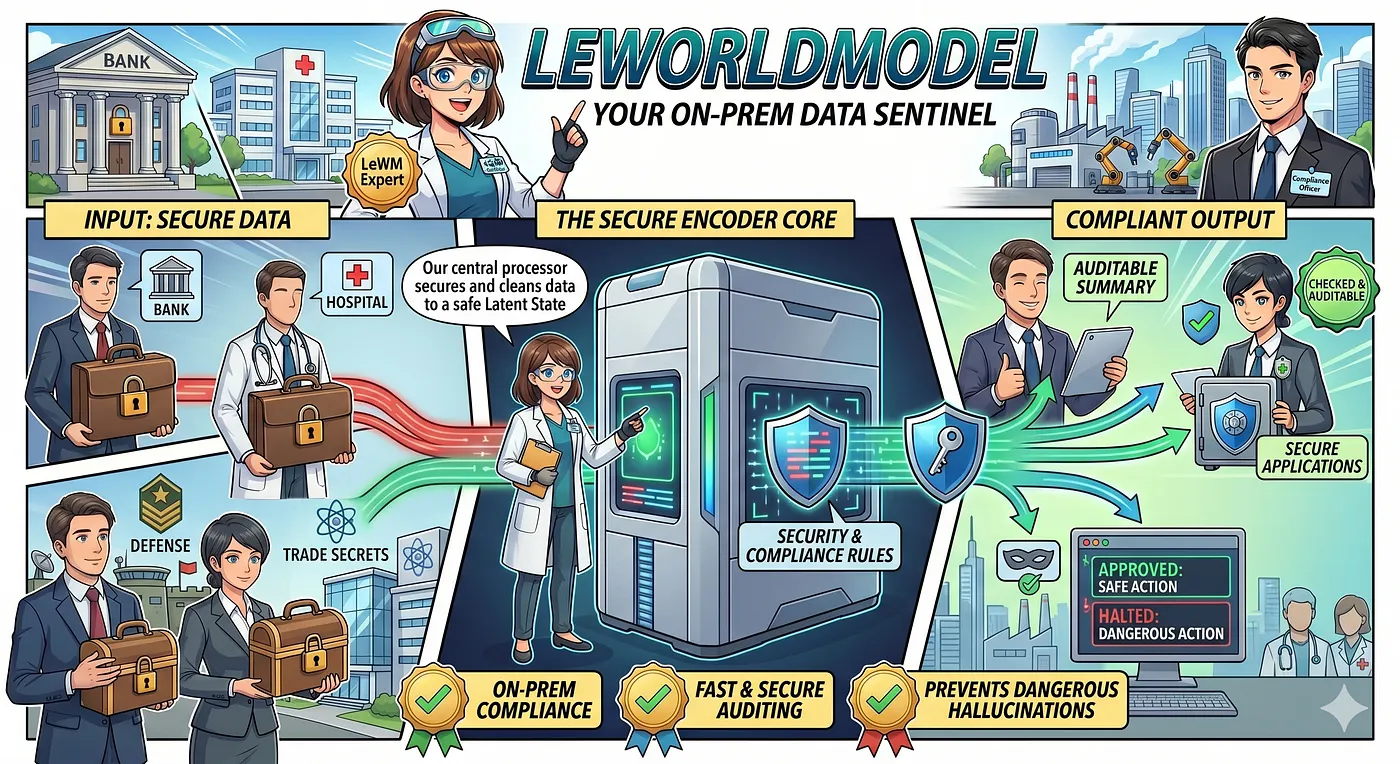
Capturing the Spirit of using LeWorldModel to pre-process Data — Google Gemini
For implementation, the most immediately accessible path for most organizations is not a full custom JEPA encoder but a purpose-selected domain embedding model feeding a vector database. Download a strong embedding model suited to your data type — sentence-transformers offers a wide range of domain-tuned options for text, and dedicated models exist for time-series, imaging, and structured data — and pair it with a vector database such as Qdrant, Milvus, or Weaviate, all of which are open source and run on commodity Linux hardware. Your raw data goes in, embeddings come out, and only the most semantically relevant chunks are retrieved into the language model’s context window for any given query. For organizations with the engineering capacity to go further, the LeWorldModel repository, originally developed through the NYU and FAIR collaboration, provides a reference implementation of a full end-to-end JEPA-based world model that can be adapted to specific sensor or telemetry domains. The performance difference between a raw context approach and a well-designed embedding pre-processing tier is not subtle — teams consistently report being able to run continuous monitoring workloads that were computationally infeasible before, at a fraction of the GPU cost.
The Third Layer: Making the Model Verify Its Own Reasoning
With a domain-adapted model receiving clean, filtered inputs, the third layer addresses the most common remaining failure mode: the model generates a confident, fluent, plausible-sounding answer that is nonetheless wrong. This is not a hallucination problem in the colloquial sense — it is a statistical problem. A language model, operating without additional constraints, will generate the most probable continuation of a sequence. For tasks requiring precise multi-step logic, the most probable answer and the correct answer are not the same thing. Regulatory cross-referencing, clinical protocol verification, financial risk calculation, and security architecture review all require chains of reasoning where every step needs to be sound, not just statistically likely.
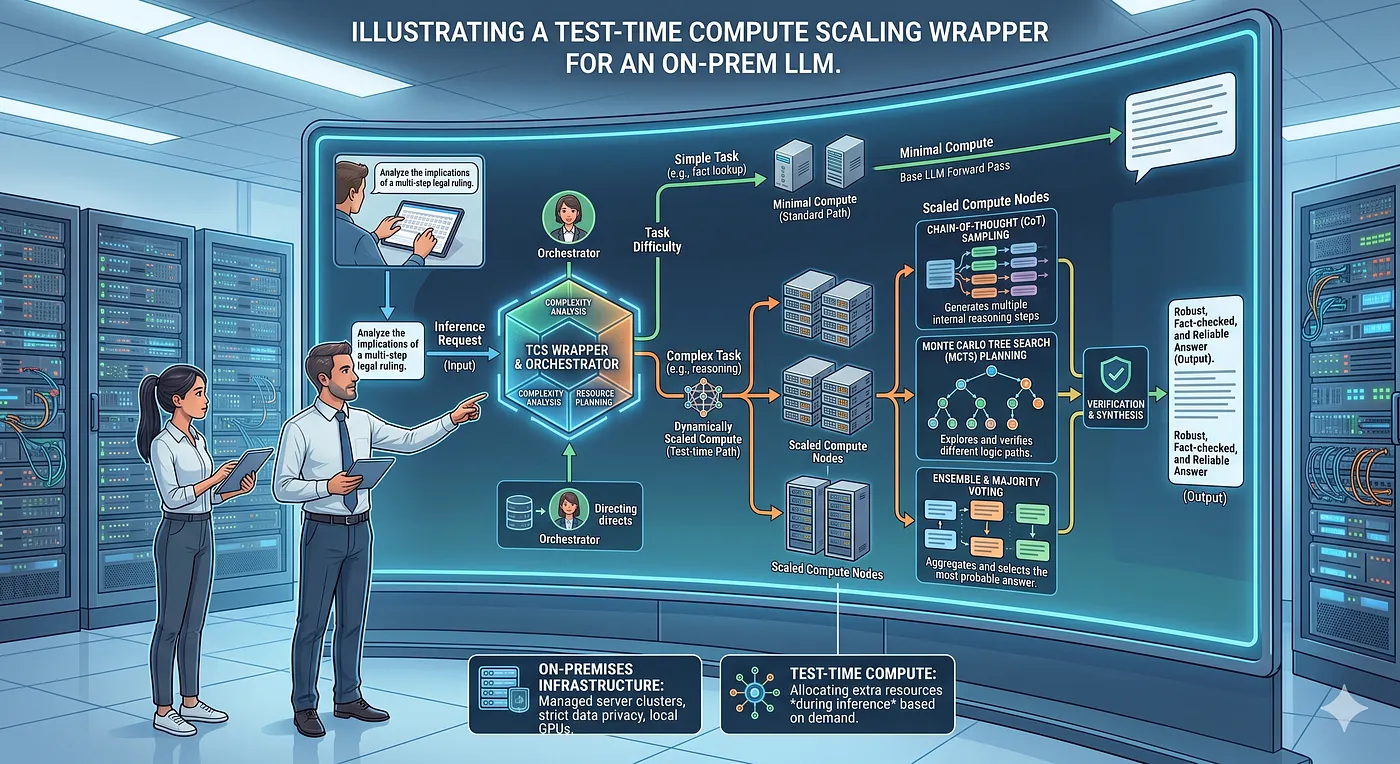
Test-Time Compute Scaling in an LLM — Google Gemini
Test-time compute scaling solves this by introducing a second, smaller model — a verifier or process reward model — that scores the quality of reasoning rather than accepting the first response the base model produces. The system works at the middleware layer, sitting between your interface and the language model. When a complex query arrives, the middleware instructs the base model to generate several distinct reasoning paths simultaneously, each representing a different logical approach to the problem. The verifier then evaluates each step of each path, not just the final conclusion but the logical soundness of every intermediate inference. Paths that produce weak or invalid reasoning at any step are identified early, discarded, and their compute budget reallocated to more promising candidates. The response the user receives comes from the path that held up best under this continuous scrutiny.
The implementation is simpler than it sounds. LangGraph is the most mature open-source framework for this kind of stateful, multi-path orchestration — download it via pip, define your reasoning graph with explicit state nodes, and configure the verifier as a scoring step between generation passes. For the verifier model itself, you do not need something large. Several compact open-weight models specifically trained for logical evaluation and step scoring are available on Hugging Face, in the one to eight billion parameter range, and they run comfortably alongside your base model on the same GPU hardware. For teams that prefer a more opinionated framework, DSPy provides a higher-level programming model for the same pattern and is particularly well suited to iterative prompt optimization during the initial deployment phase.
What you gain from this layer extends beyond raw accuracy. The verification loop generates a structured record of every reasoning path considered, the score each step received, and the rationale for selecting the final path. This happens as a natural byproduct of the orchestration architecture — you do not need to add a separate logging system to capture it. For regulated industries where explainability is a compliance requirement rather than a nice-to-have, this trace is the difference between an AI tool that can survive an audit and one that cannot. The output is not just an answer. It is a documented reasoning process.
The Fourth Layer: Querying Structure Directly
Language models reason about relationships by reading descriptions of them. For a great many tasks, this is sufficient. But there is a category of problem — common in regulated industries — where the relationships between things are the primary fact you need to reason over, and describing those relationships in prose is both lossy and slow. Regulatory frameworks are webs of requirements that reference each other. Molecular structures are three-dimensional spatial relationships between atoms. Counterparty exposure in financial derivatives is a network of obligations connecting dozens of entities in ways that compound and amplify in non-obvious directions. For these problems, asking a language model to infer structure from text is like asking someone to navigate a city by reading a description of the street layout rather than looking at a map.
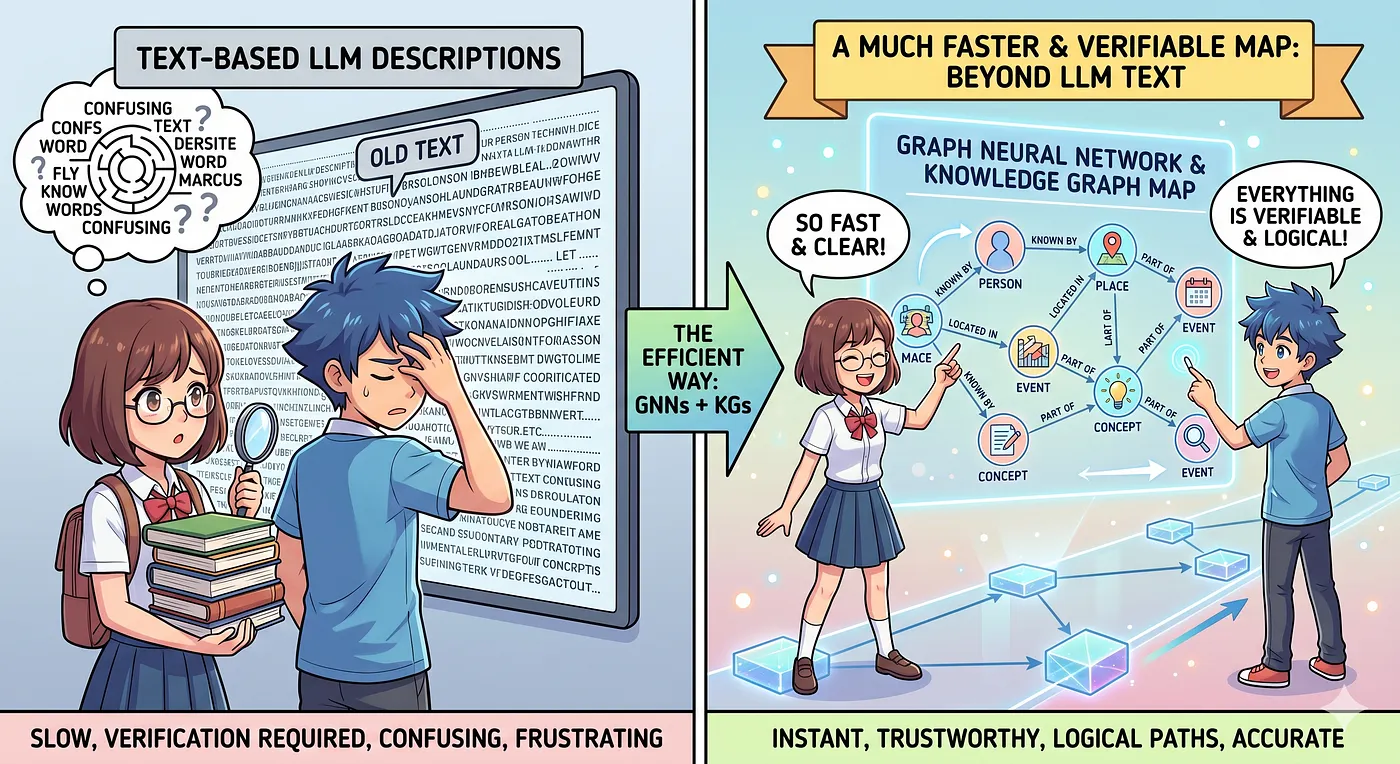
Using Graph Neural Networks and Knowledge Graph Infrastructure to Augment LLMs — Google Gemini
Graph neural networks and knowledge graph infrastructure give your AI system a map. A knowledge graph is a database that stores information as a network of explicitly defined entities and typed relationships rather than as rows of data or pages of text. It is queryable in the language of connections — not “find documents that mention regulation X” but “traverse all operational processes downstream of requirement X and return every one that has no corresponding control mapped to it.” A graph neural network trained on your domain can learn the structural patterns of that network — what configurations of relationships typically indicate risk, what topologies characterize compliant versus non-compliant states — and apply that learned structural reasoning to novel configurations it has not seen before.
For implementation, Neo4j is the practical starting point. It is a mature, enterprise-grade graph database with a free community edition, strong Python integration through the official driver, and extensive documentation for modeling regulatory and compliance domains. Pull it from the Neo4j website, define your entity and relationship schema in their Cypher query language, and load your structured domain data. PyTorch Geometric, installable via pip, provides the library for building and training graph neural network models on top of that data, including recent implementations of Graph-JEPA, a variant that encodes hierarchical relational structure into the geometry of the embedding space itself — particularly effective for molecular analysis and deeply nested regulatory hierarchies. The connection between the knowledge graph and your language model is implemented as a structured tool-calling interface: the language model formulates a graph query, passes it to the Neo4j layer, receives structured results, and incorporates them into its response. LangGraph and LangChain both have well-documented patterns for this integration.
The domains where this layer earns its keep most clearly in regulated settings are compliance gap analysis, where the graph encodes an entire regulatory framework as traversable structure and the model can identify what is connected to what and what is missing; pharmaceutical research, where molecular graphs enable property prediction before synthesis; and financial risk, where counterparty networks expose systemic exposure that aggregate metrics conceal. In each case, the model stops inferring structure from language and starts reading it directly.
The Fifth Layer: Acting Without Creating Risk
The first four layers address how your AI system knows things and how it reasons about them. This layer addresses how it does things — and specifically, how it executes complex, multi-step tasks over your live data and systems without the security team, the legal team, and the compliance team all arriving at your desk simultaneously.

Illustration of a Director Analyzing a Complex Workflow — Google Gemini
The problem with standard AI agent implementations in regulated environments is one of concentrated access and opacity. A naive agent is given broad access to your systems so it can perform a wide range of tasks. It operates as a single persistent process. Its intermediate steps are not individually logged or bounded. If it does something unexpected — calls a tool it should not have, writes to a record it should not have touched, or produces an incorrect intermediate result that influences every downstream step — there is no clean containment boundary. You end up either restricting the agent so narrowly that it cannot do useful work, or accepting an audit and security posture that no risk officer will sign off on.
The solution is to flip the model entirely. The root language model does not execute tasks. It plans them. When a complex, multi-step request arrives — audit this dataset, cross-reference these protocols, generate this compliance report — the root model reads the request as an architect reads a brief, breaks it into a structured set of discrete sub-tasks, and hands that plan to an orchestration layer. The orchestration layer then spins up a series of isolated, temporary worker processes, each assigned exactly one sub-task, given access only to the specific data and tools that sub-task requires, and configured to self-destruct when the work is done. The sub-agent runs its query or calculation, produces a structured summary of its result, passes that summary upward to the parent model, and is then terminated. The container is destroyed. The temporary data is cleared. The access that was granted for that sub-task is revoked. The next sub-agent starts from scratch with its own tightly scoped permissions.

The Director “summons” Ephemeral Sub-Agents to complete each task and report back — Google Gemini
For implementation, the orchestration layer runs on LangGraph, which provides a production-ready framework for stateful, graph-structured agent workflows with explicit state management between steps. The worker containers run on Podman with rootless containers for teams that want a lightweight, daemon-free setup, or on Kubernetes with namespace isolation for enterprise environments that already manage container workloads at scale. For the highest-security regulated environments — defense, clinical data, financial trading systems — add gVisor as the container runtime. gVisor interposes a user-space kernel between your container workloads and the host operating system, preventing container processes from making direct system calls to the host kernel even in the event of a container escape. It is available from Google as an open-source project and integrates cleanly with both Podman and Kubernetes. The entire stack runs on Linux, requires no proprietary licensing, and produces a complete structured audit trail of every sub-agent that was spawned, every tool call that was made, every data element that was accessed, and every result that was produced — generated automatically as a byproduct of the orchestration architecture.
What you gain is an AI system that takes consequential action over your sensitive data without creating the access sprawl, opacity, and blast radius that make legal and compliance teams right to be nervous. Each task is contained. Each step is logged. Each failure is isolated. And your core context window never bloats with intermediate state, because each sub-agent handles its slice of the work and returns only the summary that matters.
Optimizing Specifically for Regulated Environments
The architectural layers described above are improvements to any on-premises AI deployment. But regulated environments have specific additional requirements — around data handling, auditability, access control, and explainability — that warrant dedicated attention.

Thinking of Industry Regulations as an Exciting Challenge to Master — Google Gemini
The most important principle for deploying AI in a regulated environment is this: every decision the system makes that could affect an audit, a clinical outcome, a financial record, or a regulatory submission must be traceable to a source. This is not simply about logging the model’s final output. It means capturing the full reasoning chain — the candidate paths that were explored, the verifier scores that shaped the selection, the documents that were retrieved from the knowledge base and how they influenced the response, the sub-agent calls that were made and what data they accessed, and the final synthesis that produced the output. All of this should be stored as structured metadata that can be queried, reported on, and produced in response to a regulatory inquiry.
The test-time compute scaling layer described earlier generates this kind of reasoning trace as a natural byproduct of its operation. Making it accessible requires intentional logging infrastructure — a structured logging pipeline that captures the verification scores, path selections, and intermediate reasoning summaries into a searchable data store. OpenTelemetry is the current standard for structured observability in distributed systems, and it integrates with both the orchestration frameworks and the container runtime infrastructure described above.
Access control in a regulated AI system needs to be implemented at multiple levels simultaneously. The network perimeter controls who can reach the system at all. Role-based access controls on the RAG document library determine which documents are retrievable in response to which users’ queries. The agent orchestration layer enforces constraints on which tools and data sources each class of user can invoke through agent workflows. And the audit logging layer creates an immutable record of what each user actually accessed and when. Implementing all four of these layers is not optional in genuinely regulated environments — it is the minimum required to make the system auditable and compliant.
Data minimization is a principle that appears in virtually every major regulatory framework, from healthcare privacy regulations to financial data protection standards, and it has direct implications for AI architecture. The JEPA pre-processing tier described above is not just a performance optimization. It is also a data minimization mechanism. When raw sensor data or high-resolution imaging is processed by an encoder that produces only an abstract summary embedding, the raw data never enters the language model’s context. It never appears in a log file. It is never written to a temporary file that might be subject to a data access request. The system processes the meaning of the data without retaining the data itself, which is a meaningful compliance advantage.
Model fine-tuning and continuous learning need to be handled with particular care in regulated environments. The temptation is to continuously update the model’s weights as it processes organizational data, allowing it to become increasingly specialized over time. The problem is that a continuously learning model creates versioning and validation challenges that are inconsistent with regulatory requirements in most governed industries. In a clinical environment, for example, the behavior of an AI tool is typically required to be validated before deployment. A model that is learning continuously is effectively a new tool every day, and its behavior cannot be validated in the conventional sense.
The practical resolution is to adopt a deliberate fine-tuning and versioning workflow. The base model version is frozen for operational use. Fine-tuning runs on a separate, offline compute environment using curated, annotated training data that has been prepared and reviewed by domain experts. Candidate fine-tuned versions are validated against a test set before promotion to production. The production version is tagged and immutable. This workflow is standard in mature software engineering practice, and it maps directly onto the validation requirements of regulated industries.
Encryption and key management need to be addressed at three distinct points in the system: data at rest in the storage infrastructure, data in transit between system components, and data in use within the GPU memory during inference. The first two are well-understood problems with mature standard solutions. Encryption at rest for the NAS and workstation storage uses standard filesystem-level encryption with hardware security module integration for key management. Transport layer security for inter-component communication uses standard TLS with mutual certificate authentication. Data in use is a harder problem and an active area of development. Confidential computing platforms, including NVIDIA’s Hopper architecture with confidential compute capabilities, provide hardware-enforced memory encryption during inference, but the operational complexity of deploying and managing these environments is non-trivial. For most regulated environments today, a strong network segmentation and access control posture provides adequate protection for inference workloads, while confidential compute is reserved for the most sensitive specific use cases.
Bringing It Together: The Architecture as a Continuous System
It is worth stepping back and describing how all of these layers work together in practice, because the architecture is more than the sum of its parts.
A user on your research team submits a complex query. Perhaps they are asking the system to analyze whether a recent regulatory update from a federal agency creates any compliance gaps in the organization’s current protocols, and if so, to draft a summary report with citations.
The query enters the system at the orchestration layer. The root language model reads it and, rather than attempting to answer it in a single pass, recognizes it as a structured multi-step task. It breaks it into sub-tasks: retrieve the text of the relevant regulatory update, retrieve the relevant internal protocol documents, compare the two for structural gaps using the knowledge graph, and then synthesize a report.
The first layer’s work is already done before this query arrives — the model was fine-tuned on the organization’s regulatory corpus using STP, so its internal representations already reflect the geometric structure of compliance language. It knows how requirements relate to controls not just statistically, but directionally.
Ephemeral worker processes spin up to handle the retrieval tasks. Each one has access only to the specific data source it needs. The knowledge graph sub-agent at Layer Four queries the regulatory compliance graph and returns a structured list of identified gaps with source references. The JEPA pre-processing tier at Layer Two has already filtered any raw document telemetry or audit logs down to meaningful embeddings, so the language model’s context window receives clean, relevant summaries rather than raw bulk. The sub-agents terminate and their access is revoked.
The results are passed upward to the base language model, which now has a structured set of inputs from which to reason. The test-time compute scaling layer at Layer Three intercepts the generation task and instructs the model to produce several candidate report drafts using different analytical framings. The process reward model scores each draft at the step level, evaluating the logical soundness of each analytical claim. The highest-scoring draft is returned to the user.
The entire process — the fine-tuned model’s domain-aware representations, the clean filtered inputs, the candidate reasoning paths, the verifier scores, the knowledge graph queries, the sub-agent executions, and the final output — is captured as a structured audit trace in the logging infrastructure. If a compliance officer asks three months later what information the system accessed and how it reached its conclusions, the answer is available in queryable, structured form.
The user receives a report that is more accurate, more traceable, and more defensible than anything a standard inference endpoint could produce. And the entire process ran within the organization’s network perimeter, with no data leaving the building.
The Mindset Shift That Makes This Work
The most important conceptual change required to build on-premises AI systems that genuinely compete with commercial cloud services is to stop thinking about AI deployment as software installation and start thinking about it as systems architecture.
A language model is a remarkable artifact. It contains an enormous amount of compressed knowledge about language, reasoning patterns, domain facts, and procedural logic. But it is fundamentally a statistical machine. Left to operate alone, it will produce statistically plausible outputs, which is not the same as producing correct, traceable, and safe outputs.
The architectures described in this article — the STP fine-tuning layer, the JEPA pre-processing tier, the test-time verification loop, the geometric reasoning layer, and the ephemeral agent sandbox — are all mechanisms for imposing structure on the statistical machine. They take a powerful but undirected capability and give it direction, discipline, and accountability. This is the work that makes AI usable in environments where the consequences of error are measured in patient outcomes, regulatory exposure, or financial risk.
The hardware required to run this architecture exists today and is commercially available at prices that fit within enterprise budgets. The software tools required to build these layers are largely open source, actively maintained, and increasingly well documented. The knowledge required to design and implement the architecture is being developed and shared rapidly by a global community of engineers and researchers.
What remains is for the organizations that most need trustworthy AI — the hospitals, the financial institutions, the research labs, the regulated manufacturers — to commit to building the architecture rather than simply deploying the model. The tools are ready. The frameworks are ready. The hardware is well-understood. The question is whether the architectural ambition is there to match the moment. In these uncertain times of AI regulatory changes, public perception, and price inflation, the motivation is certainly present to realistically build and deploy on-premises AI infrastructure responsibly, and lead the way by creating a durable standard for highly regulated environments.
This article is intended as a practical orientation for technology architects and engineering leaders exploring on-premises AI deployment in regulated environments. Open-source software projects referenced are community-maintained and should be evaluated against your organization’s specific security and compliance requirements before deployment.