What a “casual” gacha game played by millions is really whispering about fate, creation, grief, and the freedom to become someone new.
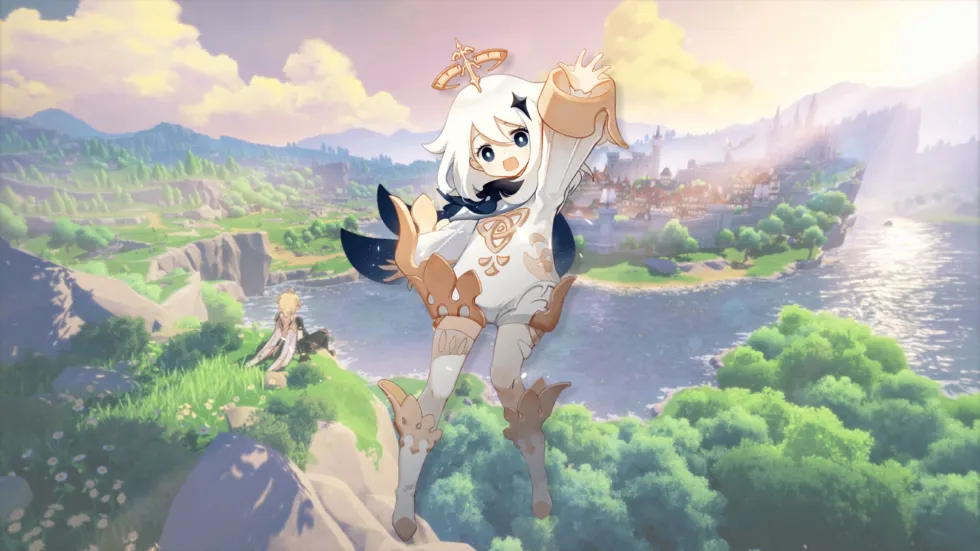
Paimon welcomes you to the land of Teyvat in Genshin Impact — Image by MiHoyo
There is a particular kind of vertigo that comes over you the first time you realize that the cute floating companion in your video game shares a name with a King of Hell. You came to Teyvat to climb mountains, cook suspicious sausages, and pull for five-star characters. You did not expect to find Carl Jung, the Rosicrucians, Alice in Wonderland, and a quietly devastating meditation on whether anyone is truly condemned to repeat the worst version of themselves.
And yet there it all is, hidden in plain sight.
This essay could have leaned hard into the darker reading: Teyvat as a Gnostic prison, the Heavenly Principles as a tyrannical Demiurge, the “False Sky” as a lid clamped over a trapped soul. That reading is real, and the game genuinely flirts with it. But it is, I think, only half the picture — and the gloomier half. The more I have actually traced these references back to their sources, the more I have come to believe the opposite of a prison narrative. Underneath the grimoire aesthetics, Genshin Impact keeps telling the same surprisingly tender story over and over: that creation is not the same as condemnation, that a fate written for you is not a fate you must accept, and that even a monster, given love and a second draft, can become a hero.
This essay is an attempt to do three honest things at once. First, to actually verify the esoteric references HoYoverse threaded into the game, rather than gesturing vaguely at “alchemy” and “Gnosticism.” Second, to keep the layers straight — what is confirmed in the game, what is a borrowed real-world reference, and what is interpretation. And third, to ask the question that matters most for the millions of people who play this game without ever opening a single lore wiki: what is it actually trying to tell us, and is any of it good for us?
I think the answer is yes. Let me show you why.
A note on method: three layers, not one
Before we descend into the mysteries, a word about how to read claims like the ones in this essay, because the lore-analysis corner of the internet is notorious for collapsing very different kinds of statements into one confident-sounding blur.
There are really three layers here, and keeping them apart is what separates insight from fan-fiction-with-footnotes.
The first layer is canon — what the game itself states. Albedo is named Albedo. Rhinedottir is called “Gold.” Durin’s story quest is officially titled the Draco Rubedo Chapter. These are facts, citable to the game.
The second layer is borrowed reference — the real-world myths, books, and figures that HoYoverse’s writers clearly drew from. Some of these the developers have effectively confirmed through naming and structure so precise that coincidence is implausible. “Narzissenkreuz” is German for “Narcissus Cross,” built on the exact template of the Rosicrucian “Rosenkreuz.” That is not a fan theory; that is a translation.
The third layer is interpretation — what it all means, what positive or negative reading we draw out. This is where I, and every other lore essayist, am offering a perspective rather than a fact. I will try to flag when I cross into it.
With that, let us peel back the False Sky.
I. Paimon and Philemon: the companion who guides
Let us start with the figure you cannot get away from. Paimon is, by HoYoverse’s own design, the face of the game — her head is literally the pause-menu icon, and the developers’ official mail to players is signed “P·A·I·M·O·N.” She is the first being the Traveler meets, fished out of a lake, and she never leaves your side for the entire journey. She is the guide.
She is also named after a demon.
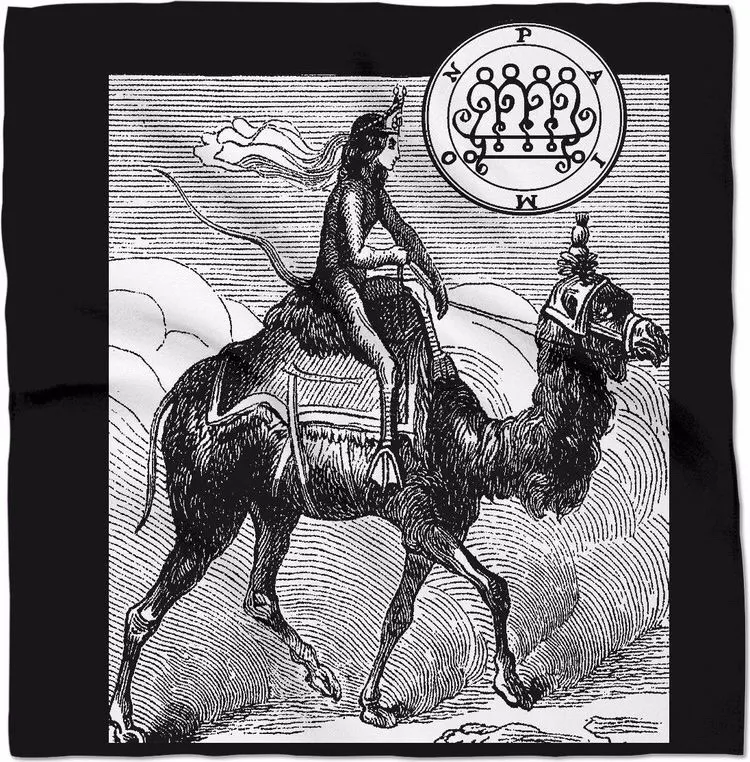
King Paimon from the Ars Goetia — Image in Public Domain
The King of the Goetia
In the Ars Goetia, the first section of the seventeenth-century grimoire known as The Lesser Key of Solomon, Paimon is listed among the seventy-two spirits a magician might summon. He is no minor imp. Paimon is a King, depicted riding a camel, crowned, and — crucially — described as loyal above the others to Lucifer, and as a teacher who imparts knowledge of the arts, sciences, and “secret things,” who can grant dignities and bind other spirits to the operator’s service.
Notice what the grimoire emphasizes: loyalty and teaching. The demon Paimon is, before anything else, a faithful instructor who makes the summoner powerful and helps them gain allies. Strip away the medieval dread, and that is an uncannily exact description of what Genshin’s Paimon actually does across hundreds of hours: she is fiercely loyal to the Traveler, she narrates and explains the world, and she is the social connective tissue that introduces you to nearly everyone you meet. The game took the King of the Goetia and kept his function while inverting his menace. The teacher of secret things became a small, hungry, big-hearted friend.
This is the first quiet lesson, and it is a thematic one HoYoverse returns to constantly: the thing that tradition told you to fear may, looked at clearly, simply be a guide.
Jung’s Philemon, the wise old man inside
But the demon is only half of Paimon’s heritage, and arguably the lesser half. Read her name aloud, slowly, and a second figure surfaces: Philemon.
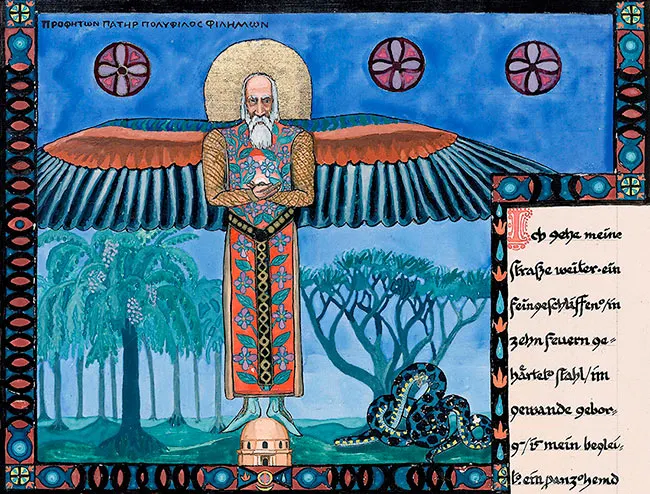
Philemon from Jung’s Red Book — Image from philemonfoundation.org
Philemon is one of the most important figures in the inner life of Carl Gustav Jung, the founder of analytical psychology. In his confessional masterwork The Red Book (Liber Novus), and again in his memoir Memories, Dreams, Reflections, Jung describes Philemon as a winged spirit who appeared to him in visions and active imaginations — an old man with the horns of a bull and the wings of a kingfisher, who became, in Jung’s words, his inner teacher. Philemon represented for Jung the discovery that there are contents of the psyche that are not produced by us, that seem to possess their own life and to know more than the conscious ego does. Philemon was the figure who taught Jung “psychic objectivity” — the reality of the soul. He was the guru within.
Jung did not invent the name. He drew it from two older sources. In Ovid’s Metamorphoses, Philemon and his wife Baucis are an elderly, poor, devoted couple who, alone in their region, show hospitality to two travelers who turn out to be the gods Jupiter and Mercury walking the earth in disguise. For welcoming the divine strangers when everyone else slammed their doors, the old couple is spared a coming flood and granted their dearest wish — to die at the same moment, never to be parted, and to be transformed into two intertwined trees. The same Philemon and Baucis reappear in Goethe’s Faust, the play that shadowed Jung’s entire intellectual life, where the old couple’s little cottage stands in the way of Faust’s grand reclamation project and is destroyed — a small, human good crushed by titanic ambition.
Pull these threads together and Paimon becomes a remarkable layered figure. She carries the name of a King of Hell and the name of Jung’s benevolent inner guide and, behind that, the name of the humble mortal who recognized gods in the guise of wanderers and offered them a seat at the table.
Why this matters for you, the player
Here is where the positive message lives, and it is genuinely worth carrying out of the game and into a life.
The Traveler is, in every sense, the divine stranger — an “Outlander,” a being from beyond the stars, walking through Teyvat in disguise. And Paimon is the Philemon who, before anyone else, takes the wanderer in. The very first thing that happens in the story is an act of hospitality to a stranger: she is the one fished from the water, but she immediately becomes the one who opens every door.
The Jungian layer adds something deeper still. In Jung’s framework, Philemon is the part of yourself that is wiser than your everyday mind — the inner companion who shows up precisely when you are most lost, most outlandish, most cut off from where you came from. Read that way, Paimon is not just a sidekick. She is the externalized image of the inner guide each of us is supposed to be cultivating: the steady voice that stays, that keeps you oriented, that insists on your name when the world tries to dissolve it.
There is a reason so many players, half-joking, feel real affection for “the emergency food.” The game is using one of the oldest archetypes in the human psyche — the wise companion who walks beside the hero — and dressing it in a form small and silly enough to slip past your defenses. The lesson is not occult at all. It is this: when you are most a stranger to yourself, look for the guide who stays. And try, like old Philemon, to be that guide for the next wanderer who arrives at your door.
II. The Narzissenkreuz Ordo: the Rose Cross and the mirror of Narcissus
If Paimon is the friendly face of the game’s esotericism, the Narzissenkreuz Ordo is its scholarly heart — the single densest concentration of real occult history in all of Teyvat, hidden inside a sunken institute beneath the city of Fontaine.
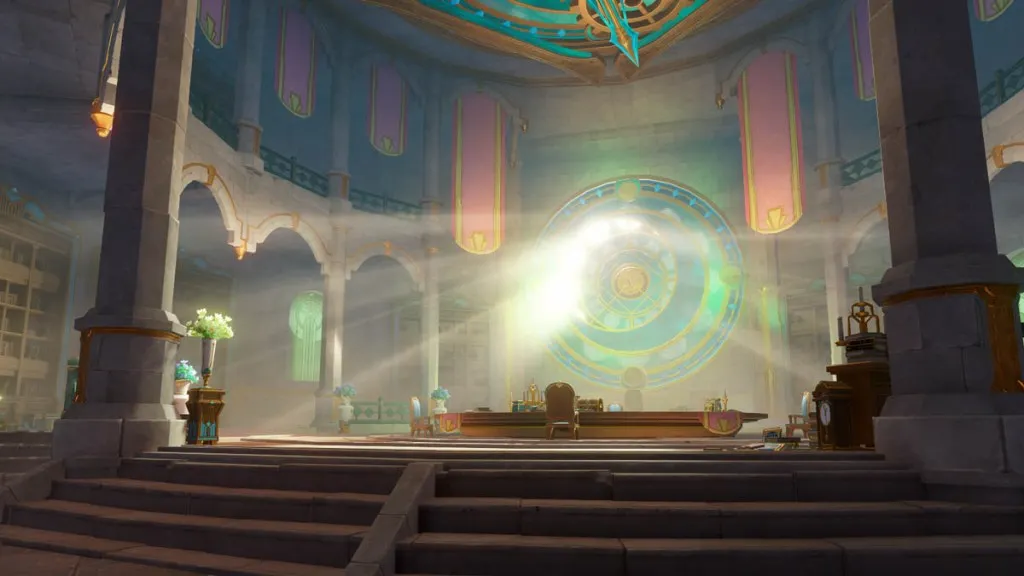
Meeting place of the Narzissenkreuz Ordo — Genshin Impact — Image by MiHoyo
A society built from a translation
Start with the name, because the name is the argument. “Narzissenkreuz” is German, and it means “Narcissus Cross” or “Daffodil Cross.” That construction is not arbitrary. It is a deliberate echo of Rosenkreuz — “Rose Cross” — the surname of Christian Rosenkreuz, the legendary (and probably allegorical) founder of the Rosicrucian Order, the Order of the Rose Cross, one of the most influential currents in Western esotericism.
The game makes the link unmissable. Documents associated with the Ordo speak of a “Chymical Marriage,” directly invoking The Chymical Wedding of Christian Rosenkreutz, the 1616 alchemical romance attributed to Johann Valentin Andreae and one of the three foundational Rosicrucian manifestos. The Ordo even meets in a chamber atop a “Tower of Ipsissimus” — Ipsissimus being the highest grade in the magical hierarchy of the Hermetic Order of the Golden Dawn and Aleister Crowley’s A∴A∴. A Doomsday Clock hangs from its ceiling. This is a love letter to the entire Western magical tradition, written in stone and water.
A roll-call of the real
What truly distinguishes the Ordo, though, is its membership list, which reads like a who’s-who of nineteenth-century occultism with the serial numbers only lightly filed off. The Genshin wiki and the game’s own materials make the parallels plain:
“Mr. Eliphas” stands in for Éliphas Lévi, the French ceremonial magician whose Dogme et Rituel de la Haute Magie re-ignited European interest in magic in the 1850s and gave us much of the visual vocabulary we still associate with the occult. “Ms. E. Lenormand” evokes Marie Anne Lenormand, the celebrated French cartomancer and fortune-teller of the Napoleonic era. “Mr. Griffin L. Randolph” points to Paschal Beverly Randolph, the pioneering African-American occultist and spiritualist who founded one of the first Rosicrucian bodies in the United States and who wrote, under the pen name “Griffin Lee,” a book arguing for human existence on earth long before Adam. “Ms. Giuffria” nods to Lisa la Giuffria, a character from Aleister Crowley’s occult novel Moonchild; the Ordo’s notes elsewhere quote Crowley’s “Hymn to Pan,” and the whole secret society is shadowed by Crowley’s religion of Thelema. “Madam M. Laveaux” recalls Marie Laveau, the famed Voodoo practitioner of nineteenth-century New Orleans.
This is not set dressing. It is a curriculum. HoYoverse built a fictional secret society and populated it with thinly veiled portraits of the actual people who shaped modern Western esotericism — and then dropped it into a game whose audience is overwhelmingly teenagers and twenty-somethings who have never heard any of these names. For a curious player, the Ordo is a doorway into a real and fascinating chapter of intellectual history.
The warning hidden in the flower
And yet the Ordo is, in the story, a cautionary tale — and this is where the daffodil matters as much as the cross.
The narcissus is the flower of Narcissus, the youth of Greek myth who fell in love with his own reflection in a still pool and wasted away, unable to tear himself from the image of himself. The Ordo’s defining sin is precisely this: a fixation on self that curdles into self-erasure. Founded over four hundred years before the events of the main story by Rene de Petrichor and Jakob Ingold — both haunted by a prophecy of a coming apocalypse — the Ordo pursued a radical “solution.” They would merge the wills, memories, and consciousnesses of all Fontainians into a single transcendent being that could survive the end of the world. To save everyone, they would dissolve everyone into one.
Look closely at the philosophy and the horror of it comes into focus. The Ordo’s chamber is decorated with notes invoking the “primordial human,” the abandonment of individual identity, and the rejection of Heimarmene — a real Gnostic term for the chain of fate that binds souls to the material world. Their leader, Rene, ultimately erased his own personality and the Institute’s Director both, fusing them into a new entity called the Master, “Narzissenkreuz.” In trying to escape death, they annihilated the self.
That is the trap the flower warns against. Narcissus dies not from hatred but from a love turned entirely inward, a self so absorbed in itself that it cannot survive contact with anything other. The Ordo, terrified of the end, mistook the obliteration of individuality for salvation.
What the Ordo teaches
The positive message here is a negative-space lesson, drawn by contrast — which is often the most powerful kind. The game does not endorse the Ordo. It defeats them. The heroes of Fontaine’s story are precisely the ones who refuse the bargain: who insist that a person is not interchangeable, that grief and fear do not justify dissolving the individual into the mass, that you cannot save people by erasing what makes them people.
In an age of algorithmic sameness and the constant pressure to merge our attention and identities into giant collective feeds, the warning lands with unexpected force. Beware the beautiful solution that asks you to stop being yourself. The fear of an ending — of death, of catastrophe, of irrelevance — is real, and the temptation to escape it by dissolving into something larger is ancient. But the daffodil by the pool is a warning, not an invitation. The self is worth keeping.
III. Mary-Ann and the girl who would not grow up: Wonderland in Fontaine
The Ordo’s story has a second protagonist, and her name is the one you asked me to look closest at: Mary-Ann.
On the surface, Mary-Ann Guillotin is one of the Institute’s children — later a moral philosopher and machine-builder who broke with the Ordo over its monstrous methods, clashed with them violently, and died at the sunken site of Elynas, her mechanical steward Seymour left broken beside her. Out of the union of her lingering consciousness with the Oceanid Lyris came a childlike water-being named Ann. It is a genuinely sad story about a woman who could not let go.
But the name is doing something specific, and it is one of the most elegant literary jokes in the whole game.
The maid Alice was mistaken for
In Lewis Carroll’s Alice’s Adventures in Wonderland, there is a small, easily-missed scene. The White Rabbit, flustered and late, mistakes Alice for his housemaid and barks at her to fetch his gloves and fan. The housemaid’s name is Mary Ann. For a few pages, Alice is addressed as, and effectively becomes, Mary Ann.
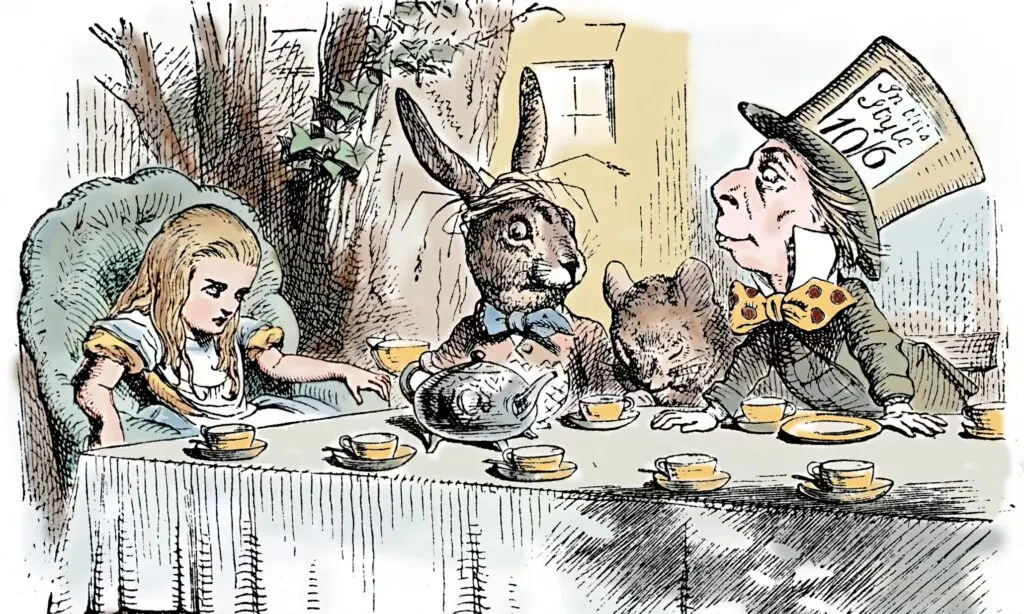
Alice’s Adventures in Wonderland by Lewis Carrol — Image in Public Domain
Genshin builds an entire region around this gag. The multiple “Ann” figures in the Fontaine quests echo the doubling of Alice and Mary Ann; an in-universe book even references a character named “Liddell” — Alice Liddell being the real-world girl for whom Carroll wrote the Alice books — who gets mistaken for Mary-Ann. And the dream-realm at the center of it all, Annapausis, is Wonderland in everything but name: a world of talking animals saying nonsensical things, sheltered from the passage of time, defined by an endless tea party that the dreamer wishes would never, ever end. Alain, Mary-Ann’s counterpart, is given the title “White Cavalier” — the White Knight of Through the Looking-Glass. There is a Caterpillar. The treasure at the heart of the storybook is named “Time.”
The reference is confirmed and exact. Mary-Ann is Alice — and Annapausis is the rabbit-hole she fell down to escape the world above.
A resonance worth naming
Before we draw the lesson, one resonance worth flagging honestly as interpretation rather than confirmed intent. The hermetic tradition we have been tracing has its own famous Mary Anne: Mary Anne Atwood, whose A Suggestive Inquiry into the Hermetic Mystery and Alchemy (1850) was one of the first serious modern treatments of alchemy as a spiritual and psychological discipline rather than mere proto-chemistry — and one of the very few such works written by a woman. Given how saturated the Narzissenkreuz storyline is with real esoteric figures, it is at least a lovely coincidence that its tragic woman-philosopher carries the name of the woman who argued, more than a century before Jung, that alchemy was really about the transformation of the soul. I would not claim the developers intended it. But the resonance is real, and it rhymes with everything else the game is doing.
The dream we build to survive
Now the lesson, because Mary-Ann’s arc is one of the most quietly moving in the game and its message is one almost everyone will need at some point.
Annapausis is not evil. It is grief made into architecture. Mary-Ann, unable to bear the loss of the happy days at the Institute — the friendships, the tea parties, the version of the world before everything went wrong — builds a dream in which those days never end and time never moves. She does what so many of us do with our golden memories: she tries to live inside them so she never has to grieve them.
And the resolution of her story is not a triumphant battle. It is gentler and harder than that. With the Traveler’s help, the resurrected Narzissenkreuz — once the architect of so much pain — leads Ann to find Mary-Ann within the dream, and Mary-Ann forgives him. She forgives the man at the center of the catastrophe that killed her. She steps out of the unending tea party. And she invites him, of all people, to come with her.
That is the message, and it is worth saying plainly because the game says it so beautifully: the dream where nothing changes is a kind of death. The escape from grief that freezes time also freezes you. The way out is not to win, but to forgive — including, sometimes, the people and the past that hurt you — and to let time start moving again. Alice eventually climbs back out of the rabbit hole. So, finally, does Mary-Ann. The endless tea party is a beautiful place to visit and a terrible place to stay.
IV. Gold and Chalk: Albedo, Rhinedottir, and the alchemy of becoming
Now we arrive at the place where the game stops referencing alchemy and starts being about it: the linked stories of Albedo, the alchemist who does not know if he is allowed to be a person, and Rhinedottir, the mother who made him.
The colors of the Great Work
Classical alchemy described the Magnum Opus, the Great Work of transforming base matter into the Philosopher’s Stone, as a sequence of color stages. The two essential poles are Nigredo, the blackening — putrefaction, dissolution, the death and breakdown of the old material — and Albedo, the whitening — purification, the washing-clean of what the blackness left behind. Between and beyond them, many texts add Citrinitas, the yellowing or solar stage, and Rubedo, the reddening — the final achievement, the wedding of opposites, the completed Stone. You can find these stages mapped out in everything from medieval manuscripts to Jung’s monumental study Psychology and Alchemy (1944), where he argued that this color sequence was really a projection of the stages of psychological integration — the death and rebirth of the self.
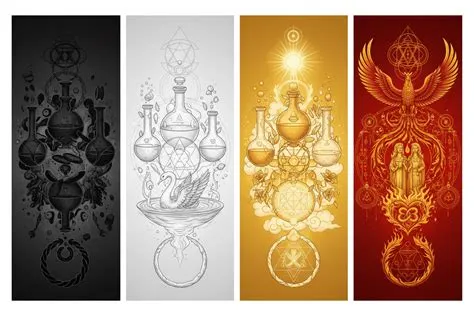
The Four Stages of Alchemy — Image from mysticryst.com
Hold those four colors in your mind — black, white, yellow, red — and watch what Genshin does with them.
Albedo the character is named, transparently, after the whitening stage. The game underlines it relentlessly. His title is the Kreideprinz — German for “Chalk Prince.” His pen name is Calx, the Latin word for the white, powdery residue left after a substance is burned in the alchemical operation of calcination — and the root of the word “chalk.” His creator classified him under the pedigree “Cretaceus,” meaning chalky or of the Cretaceous, the whitest and, she said, highest-quality category of her creations. White, white, white, white. He is the Albedo in every sense: the purified product, the clean white stone drawn out of the blackness.
And his mother? She is called Gold — Citrinitas, the yellow-gold stage. The connection is made explicit in a line from a self-proclaimed prophet quoted in the game’s own materials: “Chalk pursues gold.” Albedo (the white) pursues Rhinedottir (the gold). The whitening stage reaching toward the golden one. A son searching for his mother, rendered as the alchemical sequence itself.
The forbidden art and the homunculus
Rhinedottir’s specialty is the Art of Khemia, which the game defines as the alchemical practice of creating life. This, too, is rooted in the real tradition. The word “alchemy” descends through the Arabic al-kīmiyā from a root often traced to the Greek khēmía — “black earth” — and ultimately, many believe, to Kemet, the ancient Egyptians’ name for their own land, “the black land” of the fertile Nile silt. Alchemy is, etymologically, the art of the black earth, the dark fertile ground from which life is coaxed. The game even has Rhinedottir explain Khemia to the young Albedo in almost exactly these terms: the universe as the dark starry essence, the earth as accumulated memory, and the chalk — that is you — as the new birth drawn out of it.
The dream of using alchemy to create a human being is also genuinely historical. The creation of the homunculus, an artificial human, was held by some alchemists to be the ultimate proof of the art. Albedo’s combat ability is literally named “Homuncular Nature.” Rhinedottir’s grand project — the one that finally produced him — is called the Primordial Human Project. He is the homunculus made good: the artificial human who actually woke up, thought, and felt.
The danger of the creator
But the game does not let this be a simple triumph, and that complexity is exactly what makes its message worth taking seriously.
Rhinedottir is no benevolent mother-goddess. She is one of the Five Sinners of Khaenri’ah, a figure of “earth-shattering” abyssal power, and the maker of countless monsters that ravaged Teyvat during the Cataclysm. She produced failures and discarded them — one rejected prototype she disposed of by leaving it inside the belly of a dragon. She is described as having developed “a penchant for madness.” She created beings, called them her children, and used them as instruments. When her dragon Durin remembered her, his memory was of being told to go forth and display her beauty — sent out into the world less as a beloved child than as a showpiece, a demonstration of his maker’s genius.
So Albedo’s existence is haunted by a question that is, underneath the fantasy, profoundly human: if I was made for someone else’s purpose, am I free? Do I get to be a person, or only a project? He is wary of his own power, afraid that the very art that made him could make him a destroyer like his “brother” Durin. He does not know if he is a man or a masterpiece.
What Albedo chooses
And here is the answer the game gives him, and it is the most quietly radical thing in all of Teyvat.
When Rhinedottir vanished, she left Albedo a final assignment: to seek out “the truth and meaning of this world.” It is, on its face, just another task set by a controlling creator. But Albedo does something with it that no instruction could have demanded. He turns it into a chosen vocation. He becomes the Chief Alchemist of the Knights of Favonius not because he was ordered to belong to Mondstadt, but because he decides to. He befriends people. He looks after Klee like an older brother. He shares his deepest secrets with the Traveler — another being not native to this world — out of genuine kinship rather than design. The homunculus made to be a demonstration chooses, instead, to be a person who cares about other people.
The lesson is one the game states more boldly than almost any other piece of mainstream entertainment aimed at young people: the circumstances of your creation do not get the final word on the meaning of your life. You may have been made for someone else’s reasons — by your parents’ expectations, by an accident, by forces that had nothing to do with your own good. Albedo says, in effect: I will take even an assignment handed down by a flawed creator and make it mine. I will find the truth and meaning of this world not because I was told to, but because I have decided that seeking it is who I am.
That is not a Gnostic nightmare. That is something close to grace.
V. Durin: rewriting the fate of the terrible dragon
Which brings us to the dragon — and to the single most beautiful demonstration in the entire game of every theme we have been tracing. If you take only one story out of this essay, take this one.
Two Durins, one name
There are two dragons named Durin in Genshin Impact, and the relationship between them is the whole point.
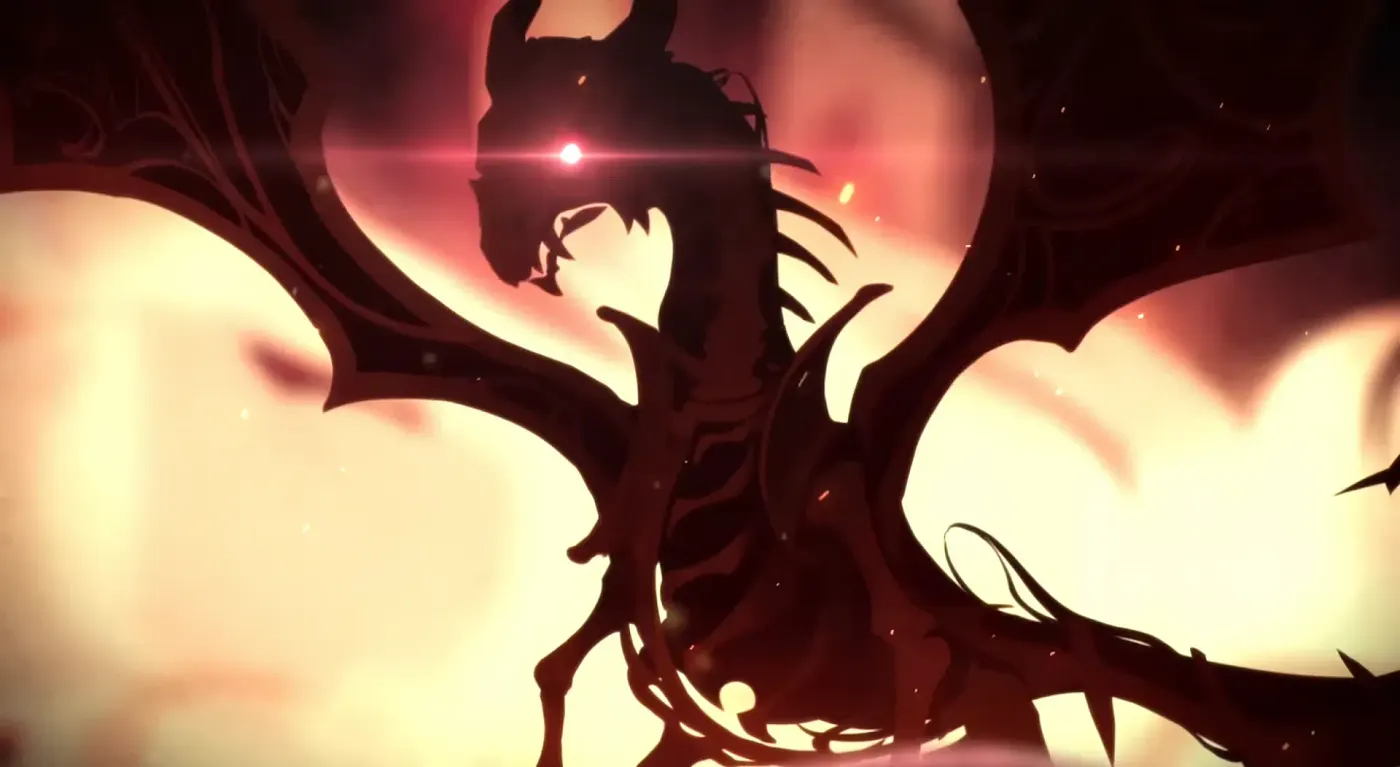
Durin from Dragonspine — Genshin Impact — Image from MiHoyo
The first Durin is a figure of legend and terror. He was one of Rhinedottir’s “miraculous” creations, made in fallen Khaenri’ah. Five hundred years ago, this black serpentine dragon descended on the young nation of Mondstadt in a storm of poison and fire — and was struck down only through the combined effort of the dragon Dvalin and the Anemo Archon Barbatos (the bard you know as Venti). Durin died on the mountain now called Dragonspine. But death did not end his influence. His blood seeped down into the ley lines, poisoning the land, freezing the peak, and corrupting Dvalin himself for centuries. His still-beating heart, buried in the ice, would later nearly allow a discarded prototype to revive and replace Albedo. The terrible dragon of Dragonspine is the wound at the center of Mondstadt’s history.
But here is the detail that turns the whole story inside out. Durin’s earliest memory — preserved in the game’s lore — is not of malice at all. It is the memory of a child thanking his mother for giving him wings, longing only to fly to “a land of lovely songs” so that he could tell its people how beautiful the place where he was born had been. He wanted to show the world his mother’s beauty. He was, in his first moment of life, innocent. The monster of Dragonspine began as a child who only wanted to be loved and to share what little love he had been given. What he became — the corruption, the rampage, the catastrophe — was, the game strongly implies, something done to him, a fate imposed on a being who started out gentle.
A name from the deep north
The name itself carries weight, which the game knows and uses. Durin is one of the oldest dwarf-names in Norse mythology, appearing in the Völuspá of the Poetic Edda among the first dwarves shaped from the earth. J.R.R. Tolkien borrowed it directly: Durin is the eldest of the Fathers of the Dwarves in Middle-earth, and “Durin’s Bane” is the Balrog that slumbers in the deeps of Moria — a buried catastrophe, an ancient evil sleeping under a mountain, waiting. A buried dragon under a frozen mountain, bearing a name that in two of the deepest wells of Western fantasy means an old maker-figure and a sleeping doom beneath the rock. The naming is doing exactly what good mythological naming does: telling you the shape of the story before the story is told.
The storybook dragon
Now the second Durin.
Centuries later, a witch named Andersdotter — a member of the coven called the Hexenzirkel, and a gentle novelist among titans — wrote a children’s storybook world called Simulanka. (Her name, “daughter of Anders,” and her authorship of a tale called The Boar Princess point unmistakably at Hans Christian Andersen, whose own “The Swineherd” is a princess-and-a-disguised-suitor fairy tale.) Into her storybook, against the explicit warnings of her fellow witch Barbeloth, Andersdotter wrote a dragon. And she named him Durin.
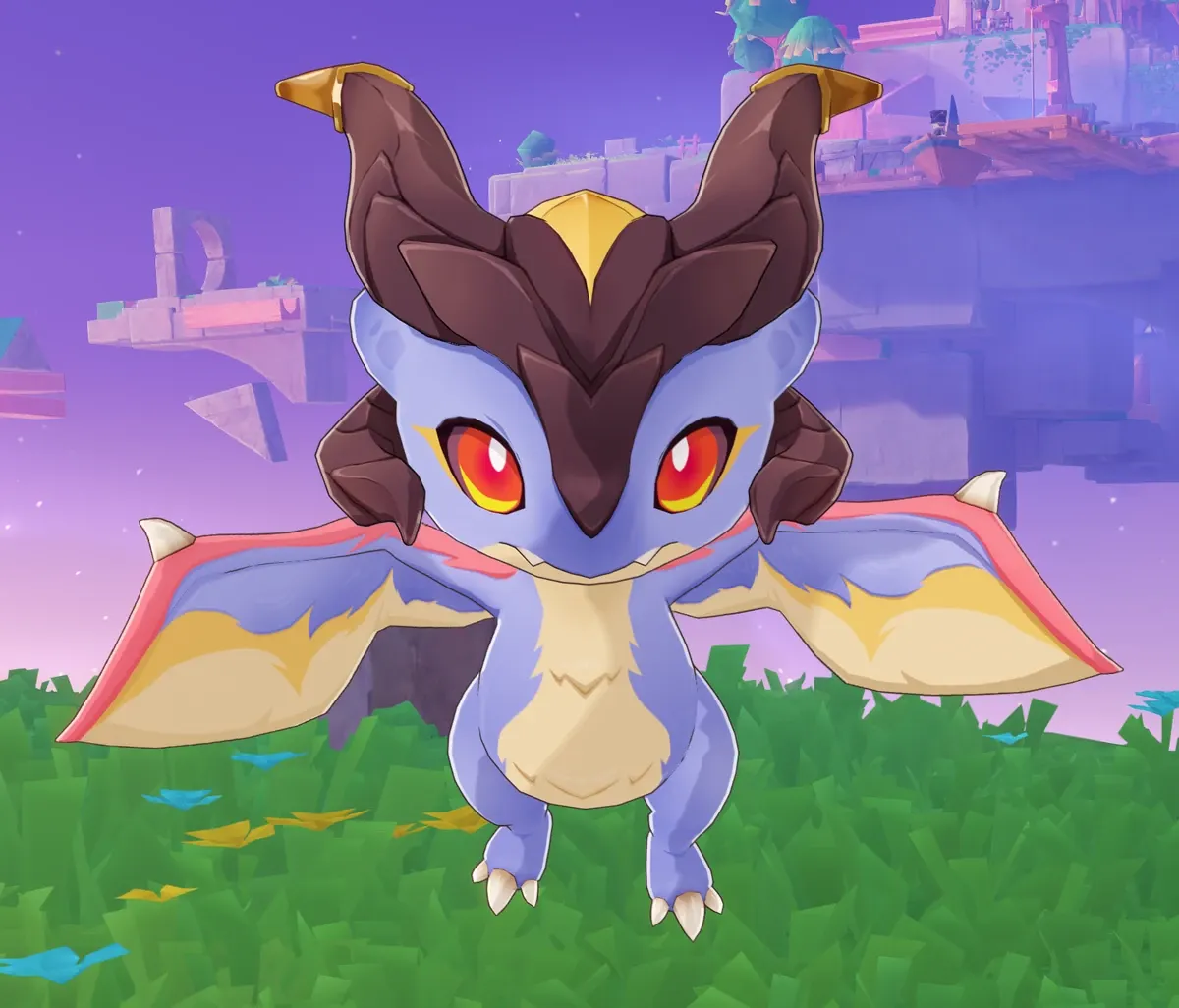
“Mini-Durin” from Simulanka — Genshin Impact — Image from MiHoyo
The warning she ignored is one of Teyvat’s deepest rules: names hold power. To name her gentle storybook dragon after the real, dead, terrible Durin was to risk binding the two together — to risk her innocent creation being dragged toward the fate of its namesake. And indeed, the little storybook Durin is feared by the residents of his world for a crime he has not committed, simply because of what he is and what his name means. All he wants is to make friends. Because of his size and his name, the world treats him as a monster.
It is impossible to miss what the game is saying. Here is a being condemned by inherited reputation, by a name and a shape he did not choose, treated as the monster everyone has decided he must be. If you have ever been pre-judged by something you had no hand in — your background, your family, a past version of yourself, a label that arrived before you did — the storybook Durin is your dragon.
Draco Rubedo: the alchemy of a second chance
And then the game does the most extraordinary thing.
Remember the colors of the Great Work: black, white, yellow, red. The Cataclysm that birthed the monsters was the Nigredo, the blackening, the putrefaction of an entire civilization. Albedo, the Chalk Prince, is the Albedo, the whitening drawn out of that death. His mother Gold is the Citrinitas, the golden stage he pursues. What, then, is the final stage — the Rubedo, the reddening, the completion of the Work, the wedding of opposites that produces the Philosopher’s Stone?
It is Durin’s redemption. The official title of Durin’s story quest is the Draco Rubedo Chapter — the Chapter of the Red Dragon, the Rubedo made flesh. The game tells you, in its own chapter heading, that the redemption of the monster is the completion of the alchemical Great Work. The whole sprawling, decade-long alchemical structure of Teyvat has been building toward this: not the creation of gold, but the redemption of a damned thing.
And the mechanism of that redemption is the most quietly profound idea in the game. Albedo, working with the astrologer Barbeloth, the alchemist’s legacy of his mother Rhinedottir, and the magic of Alice, devises a way to bring the gentle storybook Durin into the real world to take the place of the dead, terrible Durin on Dragonspine. In Albedo’s own words, the plan means using one Durin’s fate to overwrite the other’s — grafting the innocent dragon’s story onto the doomed dragon’s fate.
Pause on the distinction Albedo draws, because it is the philosophical heart of the entire game. Every living being in Teyvat, the astrologer reminds them, has had its fate woven into the fabric of time — a given track, a most-natural path, the destiny the stars assign. But a story is different. A story is something a being writes. And a story, Albedo discovers, can overwrite a fate.
The climax of the quest makes this literal and unbearably tender. Durin meets a manifestation of his mother — the novelist Andersdotter, who, dying, refused to let her child’s story end with her. She entrusts him with her pen so that he can keep writing his own story after she is gone, defying his original’s fate in a final battle. Barbeloth, looking into the stars where every fate is written, can no longer find Durin’s fate among them — because he has stepped off the given track entirely. He has become a being without a predetermined ending. The Wanderer, surveying the catastrophe the original Durin would have caused, says it plainly: by taking the monster’s place, this Durin is actually a hero. In the good ending, the redeemed dragon flies at last alongside Dvalin — the very dragon who killed his namesake — not as enemies, but as friends.
The most important thing the game ever says
Strip away the alchemical scaffolding and look at what just happened, because it is, I think, the single most valuable thing a piece of entertainment can tell a young person, and Genshin Impact tells it to millions of them without their quite noticing.
A being was born innocent and made into a monster by forces outside himself. He carried a name and a shape that condemned him in everyone’s eyes. The stars had written his fate. And the game’s answer to all of that — to the inheritance, the reputation, the corruption, the destiny — was not “accept what you are.” It was: your fate is not your story, and a story can be rewritten.
You are not condemned to repeat the worst version of yourself. The destiny that was written for you — by your origins, by other people’s expectations, by your own past mistakes, by the simple weight of what you have always been told you are — is not the same thing as the story you get to write. The pen, in the end, is yours. Andersdotter’s dying gift to her child was not safety and not a happy ending. It was the pen. It was authorship. It was the right to write himself.
That is the True Thought hiding under the False Sky. Not a prison. An invitation to revise.
VI. The Hexenzirkel: a circle of mothers
It is worth pausing on a detail that quietly unites almost everything we have just traced, because it reframes the game’s view of creators in a hopeful direction.
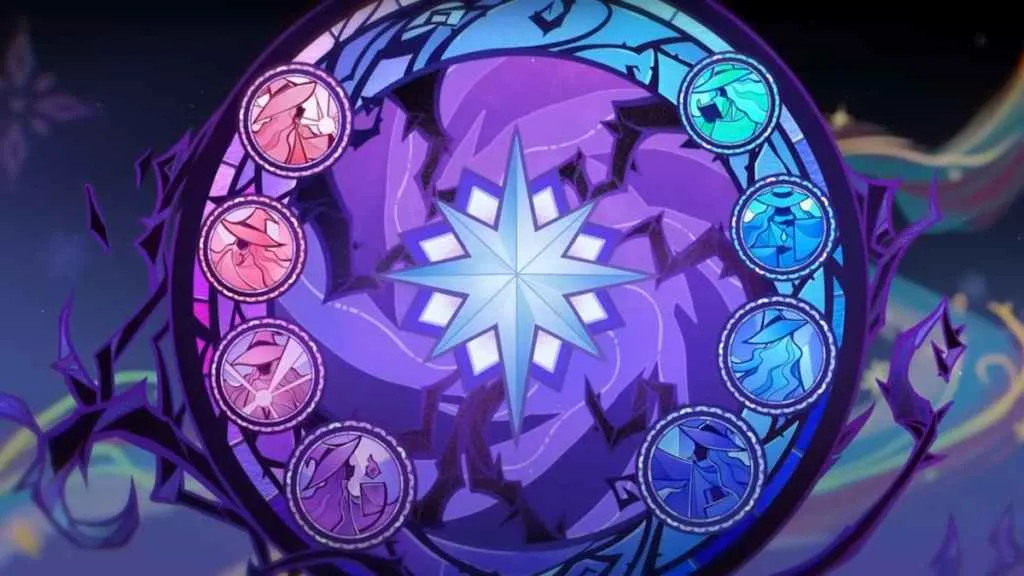
The Hexenzirkel — Genshin Impact — Image from MiHoyo
Every figure who came together to rewrite Durin’s fate belongs to the same secret sisterhood: the Hexenzirkel — German for “witches’ circle.” Rhinedottir (“Gold,” codename R) made the dragon. Andersdotter (codename M) wrote his innocent twin. Barbeloth read the stars to find the path off his fate. Alice — the famed adventurer, Klee’s mother, and author of Teyvat’s most popular travel guide — supplied the magic that made the rewrite stick. Four witches, four crafts (alchemy, storytelling, astrology, magic), bound in a coven that, by the game’s gentle account, mostly gathers for tea and conversation and excursions into the world-memory.
The names, once again, are doing work. “Barbeloth” is built on Barbelo, a central figure of Sethian Gnostic cosmology — the first emanation of the supreme source, the divine Forethought or Pronoia, often called the Mother of All in texts like The Secret Book of John. To name your astrologer-witch after the Gnostic Mother-of-Forethought, and have her job be the reading and re-reading of fate, is the kind of precision that tells you the writers knew exactly which well they were drawing from. “Andersdotter,” as we saw, is Hans Christian Andersen, the fairy-tale author whose stories — “The Little Mermaid,” “The Ugly Duckling” — are themselves full of created and condemned creatures longing to be loved. “Alice” carries the whole weight of Carroll’s Wonderland we met in Fontaine.
But here is the thematic payoff. Earlier, in Rhinedottir, we met the dark face of the creator — the maker who treats her creations as instruments, who calls them children and uses them anyway. The Hexenzirkel is the corrective. When the same circle of makers reconvenes — not to use a creature, but to save one; not to demonstrate their genius, but to give a frightened dragon a second chance — we see what creation looks like when it is done in love rather than ambition. Andersdotter, dying, does not want her creation to perform for her or carry her glory into the world. She wants him to outlive her and write his own story. She gives him the pen instead of a leash.
That contrast is the whole moral argument of the alchemical thread, stated through two mothers. Rhinedottir made Durin and sent him out to display her beauty, and he became a catastrophe. Andersdotter made Durin and gave him her pen, and he became a hero. The same art, the same act of creation, can be an act of love or an act of vanity — and which one it is determines everything about what the created thing becomes. It is a lesson aimed, whether the writers intended it or not, squarely at every parent, teacher, mentor, and maker who has ever shaped a life: the question is never only what you create, but whether you can let it become its own.
VII. Irminsul and the twilight language
There is one more piece, and it lifts the personal lesson to a cosmic scale.
Teyvat’s history is, in a literal in-game sense, editable. At the heart of the world stands Irminsul — a great world-tree, named for the sacred pillar of the pagan Saxons, that stores the memory and history of Teyvat itself. And that memory can be altered. Erase an entry from Irminsul and the past it recorded ceases to have happened; the world reshapes itself around the edit, and almost no one notices the seam. The game has already used this mechanism in its main story, quietly removing a character’s history from the tree and letting the consequences ripple outward. Reality, in Teyvat, is not a fixed record. It is a manuscript still open for revision.
Esoteric writers have a name for the way sacred texts deliberately speak in code and contradiction — “twilight language,” a contrived idiom of metaphor and misdirection that hides a truth from the uninitiated while preserving it for those ready to read it. Peter Levenda and others have argued that the old alchemical books are, in this sense, essentially fictions: they describe impossible operations precisely because the literal recipe was never the point. Teyvat’s whole presentation — a history that can be deleted, a sky that is admitted to be false, a “reality” that turns out to be a constructed language — is the game wearing this idea on its sleeve.
But notice how differently this lands once you have followed the positive thread the whole way. If history can be rewritten, that is, yes, a little frightening — it means the ground is less solid than it looks. But it is also the cosmic guarantee of the very thing Durin discovered on a smaller scale. A fixed fate is a closed book. An editable one can be revised. The same property that makes Teyvat unsettling — that nothing is finally, permanently written — is exactly what makes redemption possible. A world where the past were truly immutable would be a world where the monster of Dragonspine could never become a hero, where Mary-Ann could never leave her dream, where Albedo could never be more than the assignment he was made to complete. The editability of the world is not only the prison; it is also the door.
The “twilight language,” read this way, is not merely disinformation meant to keep the soul asleep. It is the game telling you, in the only way it can without breaking the spell, that the official version is not the final version — and that this is good news. The sky is false so that you will not mistake the ceiling for the limit. The history is editable so that no one is trapped forever in the worst thing that ever happened. The manuscript is open. There is room to write.
VIII. The Chemical Marriage and the shape of the whole
Step back far enough and the individual stories resolve into a single design, and it is worth naming, because it gathers everything we have found into one positive shape.
The oldest goal of alchemy is the Coniunctio Oppositorum, the union of opposites — the “Chemical Marriage” celebrated in that Rosicrucian wedding-text the Narzissenkreuz Ordo keeps invoking. The alchemists imagined the great work as a marriage of Sol and Luna, Sulfur and Mercury, King and Queen, the masculine and feminine principles dissolved and rejoined into something whole. Jung read this, again, as a map of the psyche: the integration of the divided self into a unified one.
Teyvat is built on exactly this separation-and-reunion. The story begins with two travelers from beyond the stars torn apart at the threshold of the world, one taken, one left behind, the player’s entire journey driven by the longing to find the other and become whole again. The Traveler and the lost sibling are the divided pair, the King and Queen of the great work, waiting across the length of the world to be rejoined. The game’s central engine is not conquest. It is reunion — the patient, difficult work of putting back together what was broken apart.
And notice that every story we have examined is a variation on this one theme of separation healed:
Paimon is the guide who refuses to leave the wandering Traveler alone — companionship against isolation. The Narzissenkreuz Ordo is the dark mirror, the false union that erases the self instead of integrating it, and the heroes who reject it. Mary-Ann is the soul that hid from its grief in a frozen dream and finally chose forgiveness and the flow of time over the unending, lonely tea party. Albedo is the made thing that chose to belong, to care, to author its own meaning. Durin is the condemned creature whose fate was overwritten by a story of friendship and a mother’s last gift of the pen.
The “False Sky,” in this brighter reading, is not primarily a Demiurge’s prison. It is the lid we are tempted to accept on what is possible — the voice that says this is simply how it is, this is what you are, this is the track you are on, there is nothing above the ceiling. And the whole game, character by character, quest by quest, is an argument against that lid. The sky is false. The ceiling is not the limit. The fate is not the story.
IX. Hidden in plain sight
Here is what I find genuinely remarkable, and where I want to leave you.
None of this is buried so deep that you need a master’s degree in comparative religion to feel it. A twelve-year-old who has never heard the name Christian Rosenkreuz still feels, watching the storybook Durin be feared for a name he did not choose, the simple human truth of being pre-judged. A college student grinding for artifacts still absorbs, somewhere below conscious thought, the lesson of Mary-Ann’s frozen tea party and the courage it takes to let time start again. The references to Jung and the Goetia and the Rosicrucians are real, and tracing them is a delight — but they are scaffolding. The building they hold up is made of feelings everyone already has and lessons everyone can use.
That is the achievement, and it is why I think the gentler reading is the truer one. A more cynical designer could have used all this esoteric machinery to make players feel small — trapped in a Gnostic prison, base metal in someone else’s crucible, a soul behind a False Sky with no way out. Genshin’s writers did very nearly the opposite. They took the oldest dream of the alchemists — that base things can be transformed into noble ones, that what is broken can be made whole, that death and putrefaction are not the end of the process but a stage within it — and they made it hopeful. They built a world that whispers, to anyone willing to listen past the gacha mechanics and the daily commissions: you are not finished. You are not your worst chapter. The pen is yours.
So the closing question is not the menacing one — are we the alchemists, or are we the base metal in the fire? The honest answer is that in any real transformation, we are always both at once; that is what transformation means. The base metal and the alchemist are the same person. You are the thing being changed and the one doing the changing.
We are not, in the end, merely playing a game. We are being handed, very quietly, a pen. What we do with it is the only story the stars cannot write for us.
Works Cited
In-game and official sources
- Genshin Impact. HoYoverse / miHoYo, 2020–present. Story content referenced includes: Albedo’s Character Stories and the events The Chalk Prince and the Dragon (v1.2) and Shadows Amidst Snowstorms (v2.3); the Interlude Chapter, Act IV — Paralogism; the World Quest series In the Wake of Narcissus (Fontaine); the event Summertide Scales and Tales (Simulanka); and the Draco Rubedo Chapter: The Magic Known as Storytelling (Durin’s Story Quest), including the act The Solution of Fate.
- Genshin Impact Wiki (Fandom). Entries consulted for canon details and developer-reference notes: “Paimon,” “Narzissenkreuz Ordo,” “Narzissenkreuz,” “Rhinedottir,” “Albedo/Storyline,” “Art of Khemia,” “Durin,” “The Magic Known as Storytelling,” and “The Solution of Fate.” (Used as a secondary index to primary in-game text.)
Esoteric and mythological sources (the real-world references)
- The Lesser Key of Solomon (Lemegeton), including the Ars Goetia. Ed. S. L. MacGregor Mathers and Aleister Crowley, 1904. — On Paimon as a King among the seventy-two spirits.
- Jung, C. G. The Red Book (Liber Novus). Ed. Sonu Shamdasani. New York: W. W. Norton, 2009. — On the inner guide Philemon.
- Jung, C. G. Memories, Dreams, Reflections. 1962. — Jung’s account of Philemon as teacher of “psychic objectivity.”
- Jung, C. G. Psychology and Alchemy. Collected Works vol. 12. 1944. — On nigredo, albedo, citrinitas, and rubedo as stages of psychological integration.
- Ovid. Metamorphoses, Book VIII. — Philemon and Baucis and the hospitality shown to disguised gods.
- Goethe, J. W. von. Faust, Part Two. — Philemon and Baucis and the cottage destroyed by Faust’s ambition.
- Andreae, Johann Valentin (attrib.). The Chymical Wedding of Christian Rosenkreutz. 1616. — The Rosicrucian template behind “Narzissenkreuz.”
- Lévi, Éliphas. Dogme et Rituel de la Haute Magie (Transcendental Magic). 1854–56. — Inspiration for “Mr. Eliphas.”
- Crowley, Aleister. Moonchild (1917) and “Hymn to Pan.” — Sources for “Ms. Giuffria” and the Ordo’s notes.
- Randolph, Paschal Beverly (as “Griffin Lee”). Pre-Adamite Man. 1863. — Inspiration for “Mr. Griffin L. Randolph.”
- Atwood, Mary Anne. A Suggestive Inquiry into the Hermetic Mystery and Alchemy. 1850. — Cited as thematic resonance for the name “Mary-Ann”; a foundational text reading alchemy as spiritual transformation.
- Carroll, Lewis. Alice’s Adventures in Wonderland (1865) and Through the Looking-Glass (1871). — The maid “Mary Ann,” the Caterpillar, the White Knight, and the endless tea party behind Annapausis; “Liddell” for Alice Liddell.
- The Poetic Edda, “Völuspá.” — The dwarf-name Durin among the first-made.
- Tolkien, J. R. R. The Hobbit (1937) and The Lord of the Rings (1954–55). — Durin, Father of the Dwarves, and “Durin’s Bane.”
- The Apocryphon of John (The Secret Book of John), in The Nag Hammadi Library. — On Barbelo, the Gnostic Mother-of-Forethought behind “Barbeloth.”
- Andersen, Hans Christian. Fairy Tales (e.g., “The Swineherd,” “The Little Mermaid,” “The Ugly Duckling”). — Behind the witch “Andersdotter” and her tale The Boar Princess; recurring images of created and condemned creatures longing to be loved.
- On Irminsul: the Irminsul was a sacred pillar or tree-trunk venerated by the continental Saxons, recorded as destroyed by Charlemagne in 772 CE (see the Royal Frankish Annals); the game adopts it as its world-memory tree.
- Cockren, Archibald. Alchemy Rediscovered and Restored. 1940. — On Thomas Vaughan and alchemy as “demonstrable in every phase of consciousness.”
- Vaughan, Thomas (Eugenius Philalethes). Lumen de Lumine (1651) and Anima Magica Abscondita (1650). — On the Soror Mystica and the Chemical Marriage; the partnership of Thomas and Rebecca Vaughan.
- Levenda, Peter. The Tantric Alchemist and Stairway to Heaven: Chinese Alchemists, Jewish Kabbalists, and the Art of Spiritual Transformation. — On alchemy as process rather than product, and on the “twilight language” of esoteric texts.
- Klossowski de Rola, Stanislas. Alchemy: The Secret Art. London: Thames & Hudson, 1973. — On the color stages and visual language of the Magnum Opus.
Note on sourcing: this essay distinguishes three kinds of claim. Statements about what happens in the game are drawn from in-game text and the Genshin Impact Wiki. Statements that a name or society references a real-world figure or text reflect parallels noted in the game’s materials and community documentation, ranging from developer-confirmed to strongly implied. Interpretations of meaning — what these stories teach — are my own reading, offered in that spirit.