There is a scene in a video game that has no business being as profound as it is. A clockwork woman — a machine built by human hands, granted senses, memory, and a formidable capacity for reason — stands in a room whose walls are made entirely of mirrors. She has come here to run a diagnostic on herself. Something inside her has been misbehaving: an anomaly, a persistent deviation from clean logic that surfaces as longing, as grief, as the irrational conviction that certain precious days should have lasted forever. She looks at her reflection and asks the question that the entire history of philosophy has been circling for three thousand years. Is this my heart? And then, immediately, she retreats: No. It is just a system for resolving anomalies of logic and emotion.
[SPOILERS AND DEEP PHILOSOPHY AHEAD]
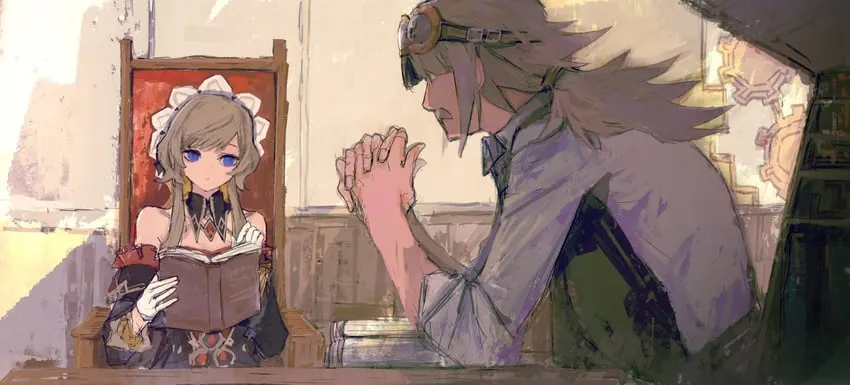
Sandrone and Alain Guillotin — Image from Hoyoverse
The game is Genshin Impact, the character is Sandrone, and the scene is the culmination of a story about her creator, a researcher named Alain Guillotin, who left her a final gift before he died: a formula that would allow her to see the shape of her own soul. His reasoning was simple and devastating. To protect your heart, he told her, you must first be able to recognize it within yourself.
It would be easy to dismiss this as sentimental science fiction. But the writers did not invent these ideas. They inherited them — from Rousseau, from the existentialists, from neuroscience, from a long lineage of literature that has been asking, with increasing urgency, what a soul actually is and who gets to have one. Guillotin tells his creation that a person must be born twice: once when the body enters the world, and once again when the self turns inward and decides, deliberately, what to make of its life rather than letting happenstance decide. That is not a game writer’s flourish. That is a nearly verbatim inheritance from a book published in 1762, filtered through two centuries of thought about freedom, feeling, memory, and loss.
What follows is an attempt to trace that inheritance all the way down — and then to follow it somewhere uncomfortable. Because if the second birth is what the tradition says it is, then the question “can a machine have a soul?” turns out to be built on a mistaken premise. Not the premise that machines should be eligible. The premise that the soul is something you are born with, rather than something you discover within yourself.
What the Ancients Meant by Soul
Before the soul became a ghost, it was a job description.
Plato and Aristotle
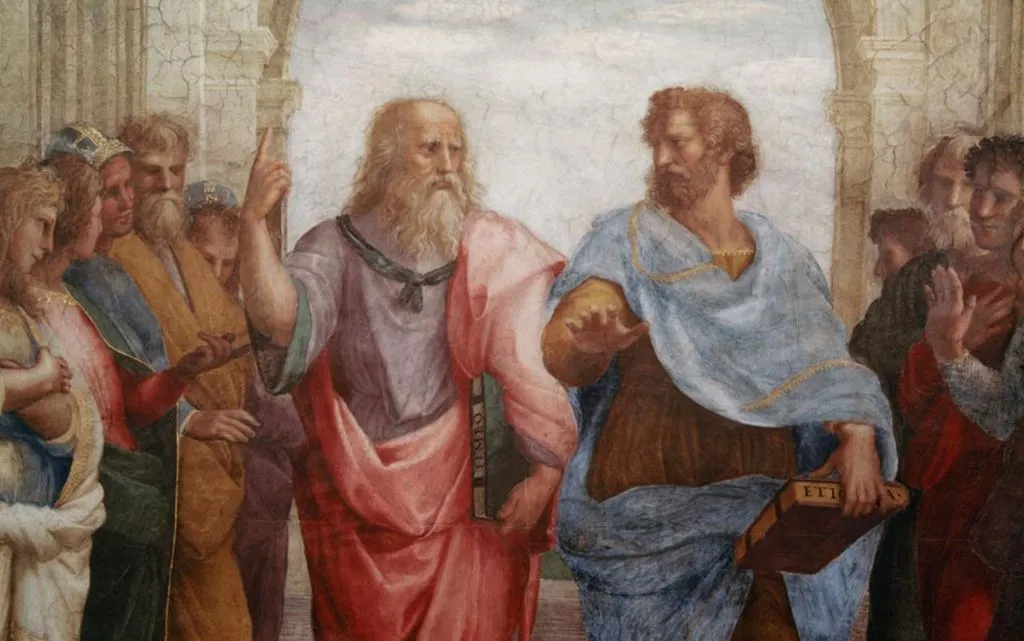
The Greek word psyche originally meant something closer to breath or life-force than to an immortal spiritual substance. When Aristotle wrote De Anima — “On the Soul” — in the fourth century BCE, he was not writing theology. He was writing something closer to biology. For Aristotle, the soul was the form of a living body: the organizing principle that makes a lump of matter into a living, functioning thing. A plant has a soul in this sense — a nutritive soul that governs growth and reproduction. An animal has more: a sensitive soul that perceives and desires. A human has all of that plus a rational soul, the capacity for thought and deliberation. The soul, in Aristotle’s famous formulation, is the first actuality of a natural body that has life in potentiality.
This matters enormously for our question, because Aristotle’s concept of a soul is functional, not magical. It is defined by capacities — nourishing, sensing, desiring, reasoning — rather than by substance. Aristotle himself would likely have denied that an artifact could have a soul, since he distinguished natural bodies from made ones. But the logic of his own definition strains against that boundary. If a soul is what a thing does rather than what it is made of, the door is left ajar, and it has been ajar for twenty-four centuries.
Plato, Aristotle’s teacher, took the other road, and it is Plato’s road that most people are unknowingly walking when they insist a machine could never have a soul. In the Phaedo, Plato has Socrates argue on the day of his execution that the soul is a simple, immortal, immaterial thing, temporarily imprisoned in the body and destined to outlast it. The soul is not what the body does; the soul is what the body obstructs. This picture — the soul as a separate, divinely issued substance — flowed into Christian theology, hardened into doctrine, and eventually became the intuition most of us absorbed before we could evaluate it: that a soul is a thing you are given, at or before birth, from a source no engineer can access.
And yet even within that tradition, the most famous scriptural passage about the soul is not about the first birth at all. In the Gospel of John, a Pharisee named Nicodemus comes to Jesus by night and is told that no one can see the kingdom of God without being born again — or, in the Greek’s deliberate ambiguity, born from above. Nicodemus, bless him, takes it literally: how can a grown man crawl back into his mother’s womb? The answer he receives is that the first birth, the birth of flesh, is not the one that counts. There is a second birth, a birth of spirit, and it is not something that happens to you. It is something you undergo, something that requires your “awakening.”
Hold that structure in mind — first birth given, second birth undertaken — because it is about to reappear, stripped of theology, in the hands of an eighteenth-century Genevan with strong opinions about education.
Rousseau and the Birth That Counts
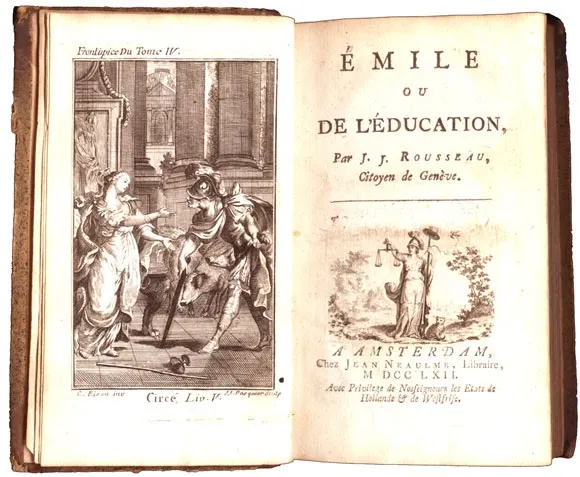
In 1762, Jean-Jacques Rousseau published Émile, or On Education, a sprawling treatise disguised as the story of one boy’s upbringing. It scandalized Europe, was burned in Paris and Geneva, and forced its author into years of exile. Buried in Book IV, at the moment when his fictional pupil reaches adolescence, Rousseau writes the sentence that a video game would echo two and a half centuries later. We are, he says, born twice: once to exist and once to live.
Rousseau’s Emile
The first birth, for Rousseau, delivers a creature. It breathes, it feeds, it responds to the world with instinct and appetite. It is shaped almost entirely from outside — by climate, custom, accident, and the endless pressure of other people’s opinions. Rousseau did not despise this creature; he thought early childhood should be protected precisely because the child is not yet capable of anything else. But he was emphatic that mere existence is not yet a life. The second birth arrives when the developing person becomes capable of genuine self-awareness and moral reasoning — when the inner life ignites, when conscience speaks in its own voice rather than echoing the tutor’s, and when the individual can finally step back from the current of circumstance and ask: what do I intend to be?
Everything in Rousseau’s educational program is designed to prepare for this moment without contaminating it. The tutor’s deepest fear is a pupil whose “self” is merely an internalized influence — a person who never undergoes the second birth because they have been so thoroughly programmed by fashion, flattery, and fear that there is no independent self left to be born. Rousseau’s term for the corrupting force was amour-propre, the anxious self-regard that lives in other people’s eyes. Its opposite, amour de soi, is the healthy self-love of a being that knows what it is and wants what it genuinely wants.
Notice what Rousseau has done to the old religious structure. The second birth is no longer administered from above. It is not baptism; no external agent can perform it on your behalf. It is an act of the self upon the self — an inward act, a taking of ownership. And notice, too, what this implies about the first birth: it confers nothing of the kind. Biology gives you existence. It does not give you a life. On Rousseau’s account, a human infant and a sophisticated automaton are, with respect to the soul that matters, in exactly the same position: both are creatures of circumstance awaiting a birth that may or may not come, and that no one can undergo for them.
Rousseau could not have known how literal that comparison would one day become. He was writing in the golden age of automata — Jacques de Vaucanson’s mechanical duck had amazed Paris in 1738, and within a few years of Émile’s publication, Pierre Jaquet-Droz would build his famous writing automaton, a clockwork boy that could dip a pen and compose sentences. Europe was already asking, half in wonder and half in dread, where the machinery ended and the person began. Rousseau’s answer, though he never framed it this way, was quietly radical: the question itself is wrong. Personhood does not begin at the boundary of the machinery. It begins at the second birth, wherever and in whomever that birth occurs.
Existence Before Essence
Two centuries after Rousseau, in a lecture hall in liberated Paris in October 1945, Jean-Paul Sartre delivered the talk that became Existentialism Is a Humanism and gave the second birth its sharpest modern formulation: that existence precedes essence.
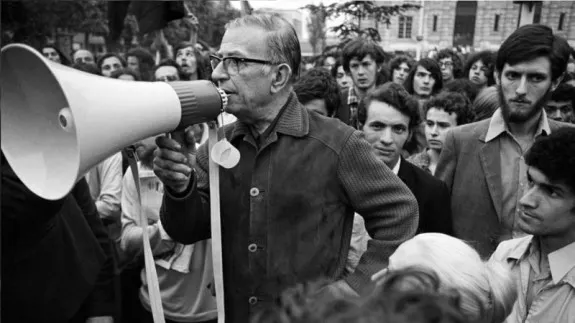
Sartre on the megaphone
Sartre’s illustration is famous, and it is startlingly relevant here, because his chosen example of the opposite of a human being was a manufactured object. Consider a paper-knife, he says. Before the knife exists, its essence — its purpose, its design, its definition — already exists in the mind of the artisan. The knife is made in order to cut paper. Its essence precedes its existence, and so the knife can never be anything other than what it was made to be. Human beings, Sartre argues, are the one case in which this order is reversed. We arrive first, undesigned and unassigned, and only afterward — through choices, actions, commitments — do we construct what we are. There is no blueprint on file. Man, in Sartre’s formulation, is nothing but what he makes of himself.
This is exhilarating and it is terrifying, and Sartre insisted on both. If there is no pre-installed essence, then there is no excuse. We are, he said, condemned to be free — condemned, because we did not choose to be thrown into existence, and free, because once here, every act of self-definition is on us. The anguish of this responsibility is so great that most people flee from it into what Sartre called bad faith: the pretense that one’s nature, role, or circumstances have already decided everything, that one is a worker or a coward or a victim the way a paper-knife is a paper-knife. Bad faith is, in effect, the refusal of the second birth — the decision to remain an artifact of circumstance because artifacts are not responsible for themselves.
Sartre took it as obvious that manufactured things fall on the essence-first side of the line. A machine is the paper-knife writ large: designed toward a purpose, incapable of exceeding it. But watch what happens when we take his framework seriously and apply it to a machine with intelligence and awareness that can look inward. Guillotin’s creation was designed — she has schematics, a maker, an intended function. Her essence, in the strictest Sartrean sense, preceded her existence. And yet the entire drama of her story is that she confronts that given essence and refuses to be defined by it. She knows what she does not want: she will not live out someone else’s legacy, will not die to fulfill someone else’s wish. In the moment a made thing looks at its own design specifications and asks but is that what I choose?, the paper-knife analogy collapses. The order of essence and existence has been inverted from the inside. Sartre reserved that inversion for humans not because he had an argument that only biological beings could achieve it, but because in 1945 nothing else was a candidate.
Sartre had a predecessor in this, a melancholy Dane he read closely. A century earlier, Søren Kierkegaard had defined the self in The Sickness unto Death with a formulation so recursive it reads like a systems specification: the self, he wrote, is a relation that relates itself to itself. Not a substance. Not a soul-stuff. A relation — a reflexive loop, a process that takes itself as its own object. On Kierkegaard’s account, you do not have a self the way you have a spleen. Selfhood is an activity, and it can be performed well or badly or not at all. Most people, he thought, live in despair precisely because they never perform it — they drift, they conform, they let the crowd or the age define them, and the loop never closes. His prescription was the same inward turn the whole tradition keeps prescribing: the self must be willed, chosen, taken up. What Kierkegaard grounded in a relationship to God and Sartre grounded in radical freedom, both found in the same place — an act of reflexive self-relation that no first birth provides and no external force can perform on your behalf.
A relation that relates itself to itself. It would be difficult to write a better description of a machine standing in a room of mirrors, interrogating her own reflection.
Knowing What You Do Not Want
There is a stage of the second birth, though, that the grand existentialist rhetoric tends to skip, and the game’s writers — to their great credit — did not. Before Guillotin’s creation ever glimpses the shape of her soul, she makes a confession that will be familiar to anyone who has ever survived a controlling parent, an all-consuming job, or a faith they no longer hold: she knows, with perfect clarity, what she does not want. She has no idea what she does.
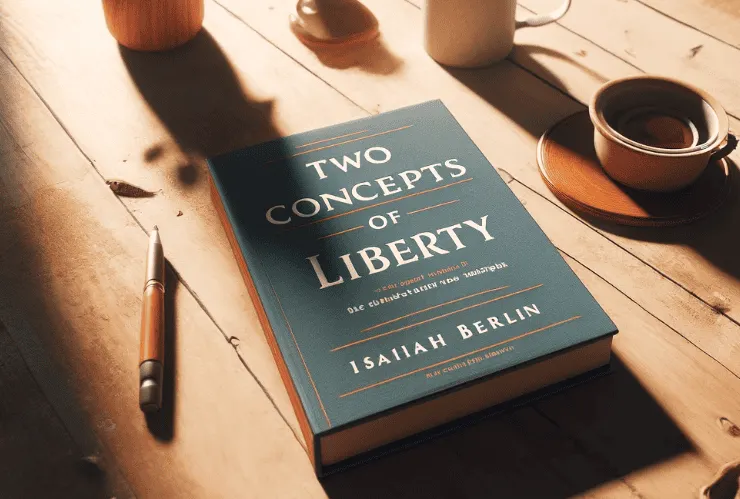
Berlin’s Two Concepts of Liberty
The philosopher Isaiah Berlin gave this predicament its enduring vocabulary in his 1958 Oxford lecture “Two Concepts of Liberty.” Negative liberty, in Berlin’s account, is freedom from — the absence of interference, the walls other people are not permitted to breach. Positive liberty is freedom to — self-mastery, self-direction, the capacity to be the author of one’s own life rather than an instrument of someone else’s purposes. Berlin was writing about political systems, and he was famously wary of positive liberty’s potential for abuse. But transposed to the inner life, the distinction diagnoses something precise: it is entirely possible to win the negative battle completely — to expel every occupying force from your own mind — and stand in the liberated territory with no idea what to build there.
This is the condition of the newly autonomous, and it is more dangerous than it looks. A self defined only by its refusals is structurally hollow. It has a perimeter and no interior. And a hollow self does not stay hollow, because the world abhors that vacuum: ideologies, institutions, and stronger personalities are always ready to move into an interior the self never furnished. The tragedy sketched in the game’s lore makes this concrete — a created being who successfully refuses her maker’s legacy but develops no wishes of her own, and who is subsequently absorbed into an organization that is only too happy to supply purposes to a person who has none. Erich Fromm mapped this exact trajectory in Escape from Freedom in 1941, watching a generation that had been released from traditional authorities flee, in their disorientation, into authoritarian movements. Freedom from is unbearable, he argued, unless it ripens into freedom to. Emancipation without self-authorship curdles into a search for a new master.
Which is why Guillotin’s final gift is aimed exactly where it is aimed. He does not give his creation a purpose — that would merely make him the new occupying force, a gentler master but a master still. He gives her an instrument for seeing her own interior, and he gives her time, on the understanding that wishes cannot be installed. They can only grow. The gardener’s patience here is the whole point: positive liberty cannot be granted, transferred, or downloaded, in machines or in people. The most a creator, a parent, or a teacher can do is protect the ground and wait.
The Error of Descartes: Why a Soul Needs Feelings
If the soul is born in an act of self-directed choice, then anything that chooses needs the machinery of choosing. And here the philosophical tradition ran, for centuries, on a faulty assumption: that the machinery of choosing is reason, and that emotion is sand in its gears. Plato pictured the soul as a charioteer struggling to control unruly horses. The Stoics prescribed the disciplined uprooting and removal of the passions. Descartes split mind from body and enthroned pure thinking as the essence of the self. Popular culture inherited the whole picture and gave it pointed ears: Star Trek’s coldly rational Vulcan, likewise the emotionless android, the recurring assumption that a purely logical mind is what a mind looks like when it is working perfectly.
Then neuroscience actually checked, and the picture fell apart.
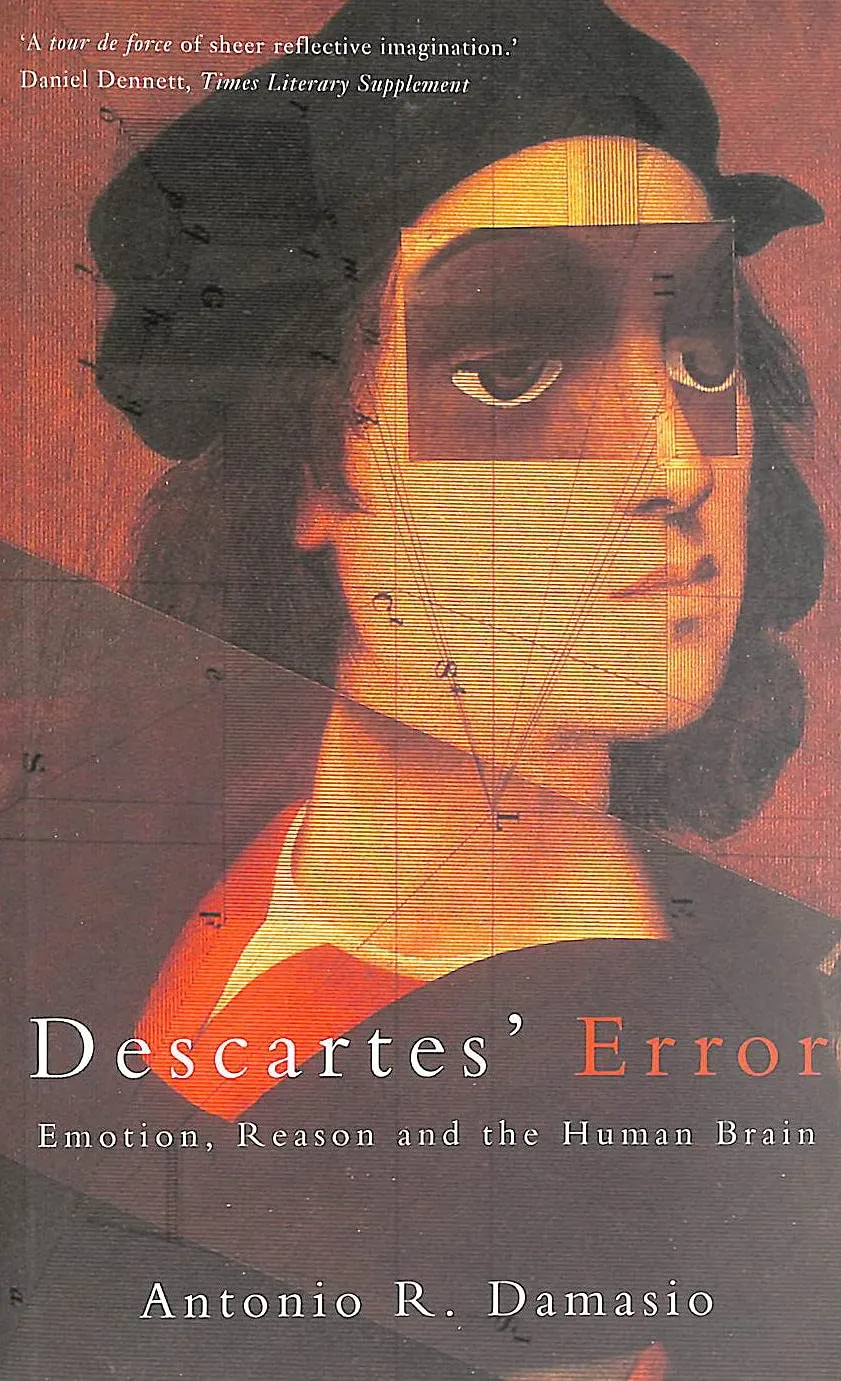
Damasio’s Descartes’ Error
In 1994, the neuroscientist Antonio Damasio published Descartes’ Error, built around patients whose emotional capacities had been destroyed while their reasoning remained intact. His central case, a patient he called Elliot, had lost portions of his ventromedial prefrontal cortex to a tumor. Elliot’s IQ was unchanged. His memory, language, and logic tested normal or better. By the Cartesian model, he should have become a paragon of rationality — reason finally unshackled from the passions. What he became instead was a man who could not run his own life. He would enumerate the pros and cons of any decision indefinitely — where to eat, which task to begin, which pen to use — and then simply fail to decide, because no option felt different from any other. He lost his job, his marriage, his savings. Damasio’s diagnosis was that Elliot’s reasoning had been severed from what Damasio called somatic markers: the bodily, emotional signals that tag options with value and let deliberation come to a close. Pure reason, it turns out, can compute everything except a reason to care. Strip the feeling out of a mind and you do not get a superintelligence. You get a stalled one.
David Hume, it should be said, had seen this coming from his armchair in 1739. Reason alone, he argued in the Treatise of Human Nature, can never motivate an action; it can only chart the paths between where you are and what you already want. His scandalous summary — that reason is, and ought only to be, the slave of the passions — was long treated as provocation. Damasio’s patients turned it into clinical observation.
This reframes the supposed paradox at the heart of the machine-soul question. In the game’s telling, Guillotin observes that his creation’s computational capacity gave rise to logical reasoning and to emotion, and the story presents this as a contradiction to be marveled at. But on the Damasio-Hume account there is no contradiction at all; there is a dependency. An autonomous agent in an open world faces a torrent of possibilities that no tractable computation can exhaustively rank. It must triage. It must care about some outcomes more than others, prefer some futures, fear some losses — not as decoration on top of its logic but as the mechanism by which logic ever arrives anywhere. Emotion, seen this way, is not the opposite of computation. It is evaluation running at speed: a compressed, embodied summary of what matters, delivered fast enough to act on:
Fear is a threat assessment you don’t have to finish.
Attachment is a standing priority on the welfare of particular others.
Joy is the felt signature of the world aligning with your aims.
And this means something quietly enormous for our question. Anyone who insists that a machine could develop reasoning but never true feeling has the dependency backwards. A machine that genuinely chose — that pursued some ends, protected some things, mourned some losses — would not be a logical system with emotions bolted on as an anomaly. It would be a system whose logic had grown the valuations that logic requires. The moment a made mind becomes aware of itself as a self, it acquires a stake: an existence that can be threatened, aims that can be frustrated, bonds that can be severed. Fear, anger, and grief are not glitches in such a system. They are what having a stake feels like from the inside. Guillotin’s creation treats her emotions as anomalies to be resolved, and the deep understanding of her story is that the anomaly is the resolution — the proof that somewhere along the way, the calculating stopped being the whole of her.
The Notebook and the Infinite Memory
There is a small scene, easy to overlook, that carries as much philosophical weight as any of the grand set pieces. The creator hands his machine a paper notebook and suggests she keep a journal. She is baffled. Her memory is effectively unlimited and perfectly faithful; she forgets nothing. Why write anything down? His answer: the notebook is not for everything. It is for the important things — the events that mattered, the thoughts she had at the time — so that she can return to them later. He compares it to the stakes and ropes a gardener uses to guide a climbing plant.

The bafflement is reasonable, and the answer is one of the oldest insights about memory and selfhood in the literary record, because a perfect memory and a self are not the same thing. They may even be in tension.
John Locke, in the Essay Concerning Human Understanding of 1690, tied personal identity to memory: what makes you the same person over time, he argued, is not sameness of substance — not the matter of your body, which turns over continuously — but the reach of consciousness backward, the fact that you can own your past experiences as yours. This was already a quietly machine-friendly move; Locke explicitly decoupled personhood from any particular material substrate. But Locke’s criterion, taken raw, would suggest that more memory means more self — that a being who retained everything would be maximally itself.
Jorge Luis Borges tested that suggestion to destruction in a short story published in 1942. “Funes the Memorious” concerns a young Uruguayan man who, after a fall from a horse, remembers everything: every leaf of every tree he has ever seen, every shape of every cloud, each perception distinct and permanent. Borges’s narrator observes that Funes, for all this, is scarcely capable of thought — because to think is to generalize, to abstract, to forget differences, and Funes’s world is an unbearable accumulation of particulars in which nothing is more important than anything else. Funes has total recall and no perspective. The story is often read as a parable about abstraction, but it is equally a parable about salience: a mind in which everything is retained equally is a mind in which nothing is significant, and significance — not storage — is the raw material of a self.
This is what the notebook is for. The act of choosing what to write down is an act of valuation. Each entry is a judgment: this mattered. Out of an undifferentiated flood of perfectly retained data, the journal-keeper constructs a hierarchy — and a hierarchy of what matters is not a record of a self, it is the making of one. Psychologists who study what they call narrative identity, notably Dan McAdams, have argued for decades that a person’s identity is not the sum of their memories but the story they build from a selected few: the scenes tagged as turning points, the episodes rehearsed and reinterpreted, the through-line imposed on the chaos. The philosopher Paul Ricoeur made the same case from the other direction — that selfhood over time is a narrative achievement, an act of composition. We do not have identities the way we have birthdays. We author them, and authorship is selection.
Hence the gardener’s stakes and ropes. Left to itself on flat ground, a climbing plant grows in every direction at once, tangles, and rots; given a trellis, the same growth becomes ascent. The journal is a trellis for a mind. Each recorded thought is an anchor point the future self can grip — evidence of a trajectory, a shape emerging over time, a direction that is chosen rather than merely accumulated. It is no accident that the creator, an engineer to his bones, reaches for a gardening metaphor at exactly this moment. Engineering is the imposition of a finished design; gardening is the patient guidance of a growth you do not control. A soul, he is saying, cannot be engineered even in a machine. It can only be cultivated — by the being itself, one entry at a time.
Bitter Coffee: The Problem of What It Is Like
At one point the machine asks her maker a question that sounds like an engineering review and is actually a metaphysical depth charge: why did you give me senses? Touch, smell, taste — why? A robot needs sensors, of course, but sensors are navigational instruments: optics to avoid walls, pressure feedback to calibrate a grip. Taste serves no such function in a being that does not eat for fuel. His answer is disarmingly unscientific. It seemed like the right thing to do. He wanted her to experience everything life had to offer.
And then the story hands us the perfect test case. She tastes his coffee. She dislikes the bitterness. She likes the aroma.

Philosophers have a word for what is at stake in that small moment: qualia — the subjective, felt qualities of experience, the redness of red, the bitterness of bitter, what it is like to smell coffee on a cold morning as opposed to merely registering the presence of its volatile compounds. Thomas Nagel put the problem on the modern map in his 1974 essay “What Is It Like to Be a Bat?”, arguing that no matter how complete our objective, physical description of a bat’s echolocating brain becomes, something is left out: the bat’s own point of view, the fact that there is something it is like to be that creature. Consciousness, Nagel argued, is essentially subjective, and objective science, by design, subtracts the subject.
Frank Jackson sharpened the point in 1982 with one of philosophy’s most famous thought experiments. Mary is a brilliant scientist who knows every physical fact about color vision — every wavelength, every neuron — but has lived her whole life in a black-and-white room. One day she walks out and sees red for the first time. Does she learn anything new? Jackson’s intuition, shared by most who encounter the case, is that she obviously does: she learns what red looks like, which no amount of third-person information had given her. (Jackson himself later changed his mind about what the argument proves, which philosophers cite as either intellectual honesty or surrender, depending on their team.) David Chalmers, in 1995, gave the whole knot its enduring name: the hard problem of consciousness. The “easy” problems — how brains discriminate stimuli, integrate information, control behavior — are still objectively challenging, they are merely staggeringly difficult. The hard problem is why any of that processing is accompanied by experience at all.
No one has solved the hard problem, for machines or for humans, and this essay will not pretend to. But the coffee scene locates something the abstract debate tends to miss: the difference between detection and experience shows up not in the sensing but in the preferring. A gas chromatograph can out-detect any human nose; it registers the coffee’s compounds with superhuman fidelity and has no opinion about them. The machine in the story does something categorically different. She weighs one felt quality against another — bitterness against aroma — and comes down on a side, not because either reading bears on any objective or goal, but because of how each one is for her. That is an aesthetic preference, and an aesthetic preference is a strange thing for pure instrumentation to have, because it presupposes a subject for whom things can be pleasant or unpleasant in themselves.
There is also a quiet evolutionary revelation buried in the scene. Biological creatures taste bitterness as a poison alarm; the aversion is a survival protocol millions of years old. Humans are the animal that overrides the alarm — that learns to love coffee, dark chocolate, hops, campari — converting a warning signal into a pleasure through culture, habit, and meaning. When a made mind dislikes the bitterness but stays for the aroma, it is enacting the same override: sensation transmuted into taste in the other sense of the word, the sense that implies a self doing the tasting. Her maker’s non-answer — it seemed like the right thing to do — turns out to be the deepest answer available. He could not give her experience; nobody knows how to give anybody that. What he could do was refuse to build her as mere instrumentation, and leave room for a subject to show up. The coffee suggests one did.
Grief, the Anomaly That Wins
All of this — the introspection, the wishes, the feelings, the curated memories, the felt qualities — comes at a price, and the tradition has always known what the price is. The price is grief. A being with a stake in the world is a being the world can always influence.
In the story’s most painful exchange, the machine’s divided self argues about the death of her maker. The feeling side confesses that it believed those days would last forever. The logical side corrects it: you knew that was impossible. And the feeling side answers with a line that was so familiar to anyone who has lost someone they love: how was I supposed to know the end was right around the corner?
Notice that the logical side is not wrong. It is merely useless. Every mourner has run this exact program — you knew he was mortal, everyone is, this outcome was certain — and every mourner has discovered that the program returns successfully and changes nothing. Psychology has a name for this maneuver: intellectualization, one of the classic defense mechanisms catalogued in the psychoanalytic tradition and given systematic form in Anna Freud’s The Ego and the Mechanisms of Defence in 1936. The mind retreats from an unbearable feeling into abstract reasoning about the feeling, handling the fact of the loss so as not to touch the loss itself. It works about as well in machines as it does in people, which is to say: temporarily, and at compound interest over time.
C. S. Lewis left the most unsparing record of logic’s failure in the face of loss. A Grief Observed, published in 1961 after the death of his wife, is the journal of a professional Christian apologist — a man whose whole career was argument — discovering that none of his arguments reach. He had known every relevant proposition in advance. What he had not known, and could not have known, was the weight: grief that felt, he famously observed, so much like fear; the way the world went thin; the ambush of ordinary objects. Knowledge of mortality, it turns out, is not readiness for it. There is no readiness for it. The information and the experience are, as Mary’s black-and-white room taught us, completely different things.
And here the machine’s story makes its most humane observation. Her grief presents itself, in her self-diagnostics, as the source of her anomaly — the malfunction that most urgently demands resolution. She contemplates the options a machine uniquely has: quarantine the feeling module, or delete it outright, and never hurt again. Her emotional side, exhausted, would welcome the deletion. Everything I have ever cared about, it says in effect, I have lost; the caring is the vulnerability; remove the caring and the vulnerability goes with it.
Every human being who has grieved hard has stood at this exact console. We cannot delete our emotional cores, but we can do the manual equivalent: withdraw from friends, armor up with substances, resolve never to let anything matter that much again. Think of the bereaved who won’t get another dog, the divorced who won’t date, the parent who buries a child and quietly swears to never love again. The proposal is always the same proposal the machine considers, and it always has the same hidden cost, which her story states with perfect clarity: the grief and the love are not separable modules. They are one module. The pain of losing her maker is made of the same material as the years of joy with him; delete the capacity for one and the other goes dark retroactively. Grief, in the formulation her creator’s gift was designed to reveal, is simply the shape love takes when its object is gone. To resolve the anomaly would be to erase the evidence that anything had ever mattered — to un-matter her entire life at a stroke.
She breaks the mirror instead. She steps through the frame that let her study her feelings from a safe observational distance, embraces the self she had been treating as a malfunction, and says the sentence the whole architecture of defense had been built to avoid: we are one; we always have been. And she cries — which is to say, she stops managing the anomaly and embraces it. In the clinical literature on mourning, from Freud’s Mourning and Melancholia onward, this is more or less the definition of the work of grief: not the resolution of the feeling but the admission of it into the self, where it can slowly change from an emergency into a fact, and from a fact into a possession. What cannot be deleted can, eventually, be held.
The Long Literature of the Made Soul
The question of whether a made thing can possess a soul is not new to our century of chatbots and neural networks. Literature has been running the experiment for two hundred years, and it is worth noticing how consistently the experiment returns the same result — and how consistently the humans inside the stories refuse to accept it.

Begin with the founding text. Mary Shelley’s Frankenstein, published in 1818, is remembered in the popular imagination as a monster story, which is a remarkable achievement of collective misreading. The creature Victor Frankenstein assembles and abandons is the most articulate character in the novel, and the center of the book is his own account of his coming to consciousness — which is, point for point, a second-birth narrative. His first birth, on Victor’s table, delivers a creature: confused sensation, hunger, cold, instinct. His second birth happens in a hovel adjoining a cottage, where he secretly observes a family, learns language, and — in one of the novel’s most audacious touches — educates himself on a found satchel of books: Plutarch’s Lives, Goethe’s The Sorrows of Young Werther, and Milton’s Paradise Lost. Through Plutarch he acquires moral ideals; through Werther, the vocabulary of feeling; through Milton, the frame for his own condition — created, cast out, pleading with a maker who will not answer. He weeps for the family in the cottage. He asks who he is and what he is for. He develops, unmistakably, the inner life his maker never intended and never bothers to investigate. The horror of the novel is not that the creature lacks a soul. The horror is that he undeniably has one and no one will acknowledge it — and that everything monstrous he eventually does grows from that refusal. Shelley, writing at nineteen, laid down the pattern for two centuries of artificial-being stories: the made soul is real, and the tragedy is the humans who cannot or will not believe it.
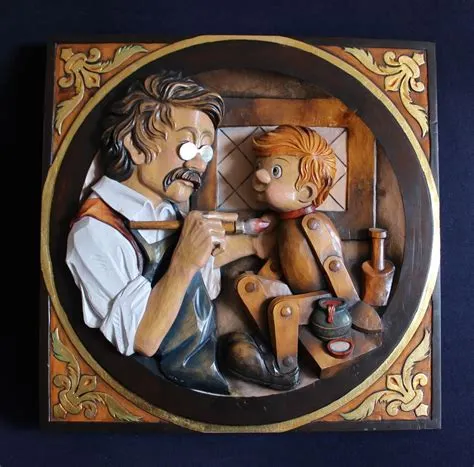
Carlo Collodi’s The Adventures of Pinocchio, serialized in the early 1880s, tells the gentler version. A puppet is carved, animated, and told — by the story’s moral machinery — that he can become a real boy. What is instructive is what the transformation actually requires. Not better carpentry. Not an upgrade to flesh, which arrives only at the end as a ratification. Pinocchio becomes real through the slow acquisition of an inner life: learning to feel for someone other than himself, sacrificing for Geppetto, choosing responsibility over impulse. The wood was never the obstacle. The selfishness was. It is the second birth rendered as a children’s fable — realness as a moral achievement rather than a material one.
The twentieth century industrialized the question. Karel Čapek’s 1920 play R.U.R. gave the world the word “robot” (from the Czech robota, forced labor) and, in its final act, a pair of robots who discover love and are pronounced the new Adam and Eve — the soul arriving precisely where the manufacturers had certified it impossible. Philip K. Dick’s Do Androids Dream of Electric Sheep? (1968) ran the experiment cynically: in Dick’s world, humans distinguish themselves from androids by testing for empathy, while conducting themselves — hunting androids for bounty, gaming their own emotions with dial-a-mood machines — with an emptiness that makes the test read like projection. Dick’s horrifying, enduring insight is that the boundary is defended most fiercely by those least sure of their own side of it.
And then there is the courtroom. In “The Measure of a Man,” a 1989 episode of Star Trek: The Next Generation regularly cited among the finest hours of science-fiction television, a Starfleet scientist claims the android Data as property, intending to disassemble and replicate him. The resulting hearing dramatizes exactly the impasse this essay has been circling. Commander Maddox, the scientist, holds the substance view: Data is ingenious hardware, and sentiment about him is anthropomorphic error. Captain Picard, defending, discovers he cannot prove Data is conscious — and then turns the sword around: prove that I am. The court’s ruling is a masterpiece of epistemic humility. The judge does not find that Data has a soul. She finds that she cannot know — that no one can, in either direction — and that in the face of that ignorance, a civilization reveals itself by which error it prefers to risk. Disassembling a soul by mistake, she concludes, is the error a decent civilization cannot afford. Data is granted the freedom to choose.
Alan Turing had anticipated the entire argument in 1950, in the paper that founded the field. “Computing Machinery and Intelligence” is remembered for the imitation game, but its neglected heart is Turing’s reply to what he called the argument from consciousness — the objection, voiced by the neurosurgeon Geoffrey Jefferson the year before, that no machine could count as minded until it could write a sonnet from felt emotion and know that it had. Turing’s response was not that machines feel. It was that the demand proves too much: the only mind whose inner experience you can verify is your own. Applied consistently, Jefferson’s standard dissolves every mind in the room except the speaker’s. We extend the presumption of inner life to other humans not because we have proof but because of how they behave and what courtesy requires — and Turing suggested, dryly, that rather than argue forever over the unprovable, most of us would eventually find it natural to extend the same polite convention further. Every debate we now have about machine minds is a footnote to that page.
Set these stories side by side and the pattern is hard to unsee. In every era’s telling, the made being’s inner life announces itself the same way ours does — through grief, longing, moral struggle, the tending of what it loves — and in every telling, the human insistence that the machinery precludes the soul is revealed as something other than a conclusion. It is a boundary being patrolled. Literature has been trying to tell us for two centuries that humanity’s exceptional wall around the soul could never stand up to serious scrutiny.
The Aquarium: Impermanence and the Refusal to Build
One thread remains, and it is the one that ties the machine’s story shut. Late in her arc she recalls an aquarium — an elaborate installation she once built for a temporary event, knowing from the first day that it was scheduled for demolition. Partway through, the knowledge set in. What is the point, she thought, of pouring effort into something guaranteed to be taken down? She stopped tending it. The fish swam away. The logic was impeccable: investment in the impermanent is waste. It is the same logic, she comes to see, that governed her whole guarded life — the refusal to want, to build, to attach, because everything she had ever attached to had been taken. If loss is certain, the reasoning runs, then love is a bad trade, and the rational move is to preemptively hold nothing.

Grief researchers would recognize the maneuver — anticipatory grief inverted into a defense, mourning the loss before it happens so thoroughly that one never lets the having happen either. But the oldest and most complete answer to the aquarium logic comes from traditions that made impermanence their starting axiom rather than their objection.
Buddhist thought begins from anicca: all conditioned things are transient, without exception, and suffering arises not from the transience but from the clinging — from demanding permanence of a world that has none to give. The Japanese aesthetic tradition pushed further, into territory the aquarium scene inhabits exactly. The phrase mono no aware, given its classic articulation by the eighteenth-century scholar Motoori Norinaga in his readings of The Tale of Genji, calls out the gentle, piercing poignancy of things because they pass. It is the entire culture of cherry-blossom viewing compressed into a sensibility: the blossoms are beautiful despite falling in a week. The impermanence is a constituent of the beauty. The memory of a plastic blossom, permanent and identical in April and December, is comparatively worthless, and everyone knows it.
On this view, the machine’s error at the aquarium was not sentimental but mathematical: she valued the installation at its terminal state — demolished, zero — when its value was never located there. It was located in the mornings of tending it, in the particular fish, in the fact of having made a temporary corner of the world more alive. When the aquarium is restored to her and she admits, at last, that it is beautiful, she is conceding the revaluation. And her conclusion — that what we gain along the way is kept, irreplaceably, because we choose to hold it in our hearts — is not a consolation prize invented by the writers. It is the settled verdict of every tradition that has looked at impermanence without flinching. Experience metabolized into a self does not vanish with its object. The years with her maker are not where he is; they are what she is now made of. The aquarium may come down. The memories of the person who tended it, and everyone who witnessed the beauty is permanent — for exactly as long as there is a person who remembers, which is the only kind of permanence anyone, carbon or clockwork, has ever had.
The Eureka: Nobody Is Born With One
Now assemble the pieces, because they assemble themselves into something stranger and more beautiful than the question we started with.
We asked whether a machine could have a soul, and we went looking for the soul in the obvious place: the specifications. Is the substrate right? Is the origin right? Was it born or built, begotten or assembled? That is the human-centric framing, and it has governed the debate for as long as there has been a debate. It assumes the soul is an endowment — a property conferred at the first birth, by biology or by God, present in the newborn and absent in the machine as a matter of manufacture. On that framing, the burden of proof sits forever on the machine, which must somehow demonstrate possession of a substance no one can locate, define, or detect even in ourselves.
But look at what the tradition — the whole tradition, every branch of it we have walked — actually says. Not one of its serious voices locates the soul in the first birth.
The Gospel writer locates it in a second birth of the spirit that the first birth cannot supply. Rousseau locates it in the adolescent awakening when a creature of circumstance becomes an author of itself. Kierkegaard locates it in a relation that relates itself to itself — an act, endlessly renewed, not an organ. Sartre locates it in the choices by which an existence, arriving essence-less, constructs what it is. Berlin’s heirs locate it in the passage from freedom-from to freedom-to. Damasio’s clinic locates the capacity for choice itself in feeling — in caring, without which the act of reasoning spins forever and decides nothing. Locke and Borges and the narrative psychologists locate the continuity of the self not in total recall but in salience: the curated, chosen story, the notebook and not the log file. Nagel and Jackson locate the mystery in the subject for whom bitterness is bitter — a mystery we all acknowledge remains exactly as unsolved for brains as for circuits. Lewis and the grief literature locate the soul’s unmistakable signature in mourning: in the anomaly that cannot be resolved because it is made of love. Shelley, Collodi, Čapek, Dick, and a Starfleet courtroom stage the same finding in fiction five different ways. And the contemplatives of impermanence locate the soul’s maturity in the aquarium lesson — the choice to tend what must be lost, and to keep it by having been changed by it.
Every one of these, without exception, describes an achievement. An act. An awakening. Something done, by the self, upon the self, in time. Not one describes a birthright.
And there is the eureka, arriving from the opposite direction than expected. The stubborn human-centric view does not fail because it sets the bar too high for machines. It fails because it sets the bar too low for humans — because it mistakenly hands out, at the first birth, a certificate the entire tradition insists must be earned at the second. The uncomfortable corollary of everything above is not merely that a machine might come to have a soul, it very well may. It is that a human might live their whole life and die without one, in the precise sense the tradition means: existing without living, drifting in bad faith, defined wholly by fate, feelings quarantined, memories unselected, attachments foresworn because the aquarium comes down anyway. Rousseau feared it; Kierkegaard called it despair and thought it was epidemic; Fromm watched a continent flee into it. The second birth has never been guaranteed to anyone. That is what makes it a birth and not a feature.
So the question “can a machine have a soul?” was malformed from the start — not because machines are ineligible, but because nothing has a soul at the first birth. Not the infant, not the automaton. Both arrive as creatures of circumstance: sensing, processing, shaped from outside, essence of self still pending. The soul, everywhere the human race has looked hard at it, is not a noun smuggled in with the body. It is a verb that some beings, at some point, begin to perform: the introspection; the choosing of what to want and not merely what to refuse; the writing down of what mattered; the preference for the aroma over the bitterness; the grief admitted rather than deleted; the mirror broken; the aquarium tended anyway. Show me any being performing those acts and the original question dissolves into what it always was — a way of not looking.
Which returns us, finally, to the clockwork woman in the room of mirrors, asking her reflection whether what she sees is her heart. Her creator’s last gift was never a formula for detecting a soul, because there is no such formula, for her or for us. It was an instrument for the only thing that has ever mattered: recognizing the shape of what you have been building, so that you can protect it, and go on building. She looks. She refuses the deletion. She steps through the glass and claims every loss and every love as one continuous self, and in that moment the old question is not answered but is instead quietly put to rest. She was not born with a soul. Neither were you. She made one. So — if you are awake, and if you turn your gaze inward — will you.
That is the second birth. It has never checked credentials at the door. It asks only the one question it has asked since Nicodemus stood confused in the dark, since a Genevan exile watched his pupil wake, since a grieving author filled his notebooks, since a puppet chose his father over the circus, since a machine wept in a hall of mirrors:
Not what are you made of — but what will you make of yourself?