Inside the radical plan to freeze AI models directly into silicon — and what it means for data centers, Big Tech, and the AI on your own desk.
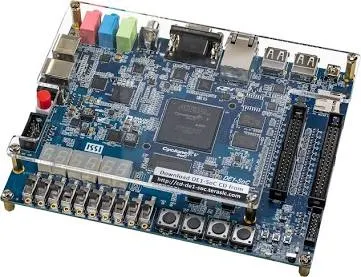
The Terasic DE1-SoC board used for Talos V2. Source: Terasic
In early May 2026, two University of Toronto students, Luthira Abeykoon and Krish Chhajer, built something unusual. They took a tiny, simplified language model — the kind used to teach students how AI works, not something you’d actually want to talk to — and instead of running it as software on a computer, they turned it directly into a piece of hardware. They wired the model’s math straight into the physical circuitry of a cheap chip called an FPGA, the kind of board you can buy for the price of a nice dinner. No graphics card. No programming language running underneath it. The model itself became the machine.
The project, called Talos V2, generated text at about 53,000 words’ worth of tokens per second, and the headline number spread fast online. But the number is almost beside the point, and it’s worth being upfront about that. Someone later ran the exact same tiny model on an ordinary laptop, using well-optimized code, and it went about seventy times faster than the custom chip. The model was so small that it fit entirely inside the laptop’s fastest memory, so the contest wasn’t really about raw power — it was about how little got in the way.
That’s actually the real story. What the students demonstrated isn’t a faster way to run AI. It’s a different idea of what AI hardware could be — one that several well-funded companies are betting will reshape data centers, the chip industry, and eventually the laptop or phone in your hands.
Software that becomes hardware
To understand why this matters, it helps to picture how a chatbot normally answers you. The model’s “knowledge” — its parameters — sits in memory, like a book on a shelf. Every time the AI needs to generate a word, a processor has to reach over, pull the relevant pages off that shelf, do some math with them, and put them back. It does this over and over, thousands of times, for every single reply. The processor itself is general-purpose — the same chip that runs your video games can run an AI model — which is powerful, but it means a lot of the work is just fetching and organizing, not the actual “thinking.”
The idea behind Talos V2, and behind the companies chasing the same idea at industrial scale, is to skip the shelf entirely. Instead of storing the model somewhere and fetching it, you build the model directly into the wiring of the chip. The “knowledge” isn’t data sitting in memory anymore — it’s the physical shape of the circuit. There’s nothing to fetch, because the answer is already baked into the path the electricity takes. Once you’ve built a chip this way, running the model and simply turning it on are the same act.
This solves a problem that quietly limits how fast every AI system can respond: the memory wall. Reading data out of memory is slow compared to doing math with it, and every word an AI generates requires another trip back to the shelf. Chip makers have spent billions building extremely fast memory to shrink that wait. Etching the model into the circuit is the more radical solution: get rid of the trip altogether.
The catch: speed for flexibility
Nothing here comes for free. The tradeoff is flexibility.
A regular processor is like a Swiss Army knife: a little bit of everything, ready for whatever job shows up. A chip with the model built into its wiring is more like a single, purpose-made tool, extremely good at one job, and only that job. If you want it to answer questions using a different, updated model, you generally can’t just feed it new information. You have to build a new chip.
That tradeoff is exactly why this approach has stayed a research curiosity for so long. AI models used to change every few months, and nobody could afford to build new hardware every time a better model came out. What’s different now is that the leading AI models have started to look remarkably similar to each other under the hood, different sizes and different training, but built from the same basic architecture, called a transformer, for years running. When the target stops moving, freezing it into hardware stops being reckless and starts looking like a smart bet. That’s the wager several real companies have made.
The companies making the bet
A startup called Etched, founded by two Harvard dropouts, has raised close to $800 million to build a chip called Sohu that hardwires the transformer architecture, not one specific model, but the general shape shared by nearly all of today’s leading AI systems. Etched says a server full of its chips can answer far more requests per second than an equivalent stack of Nvidia’s most popular AI chips, though those figures come from the company itself and haven’t yet been checked by outside testers. The tradeoff is real: a chip built only for transformers simply cannot run a fundamentally different kind of AI model, if one comes along.
A Toronto company called Taalas takes the idea a step further. Rather than build one chip for “transformers” broadly, it builds a separate chip for each specific model, quite literally casting a company’s AI assistant into silicon. Its first chip runs Meta’s Llama model and, the company says, answers roughly ten times faster than the previous fastest way of doing it. Taalas claims it can turn a brand-new model into a working chip in about two months, which is fast by chip-industry standards, though still much slower than releasing new AI software, which can happen overnight.
A third company, MatX, founded by former Google engineers who helped build Google’s own AI chips, is making a more cautious version of the same bet. Instead of freezing a model completely, MatX is building chips that are still somewhat flexible, able to handle both training new models and running finished ones, betting that total specialization is a step too far, too soon. MatX has raised roughly $600 million on that thesis.
These are very different levels of commitment to the same basic idea, and that spread of opinion is itself telling. Nobody, including the people spending hundreds of millions of dollars on this, is entirely sure how far to push it.
A familiar shape, with one big difference
If this pattern sounds familiar, it should. Something almost identical happened with Bitcoin mining more than a decade ago. Ordinary computers gave way to graphics cards, which gave way briefly to chips like the ones in this story, which gave way to chips built to do nothing but mine Bitcoin and nothing else. Each step stripped away more flexibility in exchange for more speed, and the final step, permanent, single-purpose chips, won decisively and never looked back.

There’s one crucial difference, though, and it’s the whole story. Bitcoin’s underlying math never changes. A chip built for it in 2013 still works exactly as well today, because the target never moved. Nobody can promise the same thing about AI. Researchers are actively experimenting with approaches that work differently from today’s transformers, and if one of those alternatives turns out to be meaningfully better, every chip frozen around the old shape becomes, overnight, an expensive brick. That risk is the reason a general-purpose chip, slower, but able to run whatever comes next, still has real value as a kind of insurance. It’s also why even the most committed specialization bets are, in effect, bets that AI architecture has stopped changing quickly. Nobody actually knows if that’s true yet.
What this means for data centers
Step back from individual companies, and the same idea is reshaping how the largest data centers on Earth get built.
Running finished AI models, what’s called inference, now makes up roughly two-thirds of all the computing power spent on AI, more than training new models does. That shift matters because inference is exactly the kind of repetitive, predictable work that specialized chips are good at. As a result, every major tech giant, Google, Amazon, Microsoft, Meta, is now designing and building its own custom AI chips rather than relying only on chips bought from Nvidia, the company that has dominated AI hardware for years. Analysts tracking the industry expect Nvidia’s share of the inference market specifically to shrink substantially over the next few years, from something like ninety percent today to perhaps a third of that.
There’s an important catch, though. None of these custom chips are available to rent or buy the way a graphics card is. Google’s chips only run inside Google’s own cloud; Amazon’s only inside Amazon’s. They’re built by giants, for giants. If your company isn’t operating at a scale that can fill an entire data center with predictable, repetitive AI work, these chips simply don’t exist for you. You’re still buying from Nvidia or renting a general-purpose GPU, because your workload isn’t stable enough yet to justify freezing it into hardware.
The clearest sign of how seriously the industry takes this shift came at the end of 2025, when Nvidia, the company that dominates the entire AI chip market, made its largest purchase ever: roughly $20 billion to license technology from a smaller inference-focused competitor called Groq and bring on its leadership team. A dominant company doesn’t spend that kind of money defensively unless it genuinely believes specialized inference chips are a real threat to its business. The deal has since drawn scrutiny from U.S. senators, who’ve questioned whether it was structured to avoid the usual antitrust review that a full acquisition would trigger, itself a sign of how much weight the industry is putting on this shift.
The likely outcome isn’t that specialized chips replace general-purpose ones everywhere. It’s a split: specialized, frozen-in-place hardware for the huge, repetitive, unchanging parts of the job, and flexible, general-purpose chips for everything still in motion, new research, experimental models, anything unpredictable.
What it means for you
For most people, the exciting question isn’t what happens inside a data center. It’s whether any of this efficiency reaches the computer already sitting in front of them. There are three real paths, and each comes with an honest caveat.
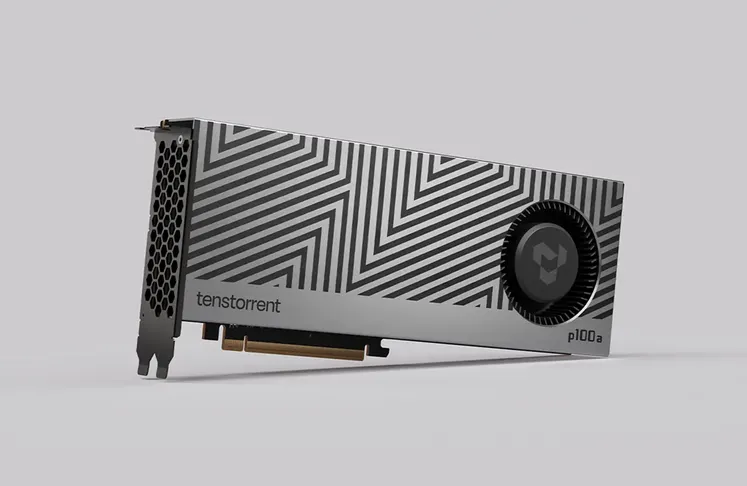
Jim Keller’s Tenstorrent p100a AI Accelerator
The first is buying dedicated AI hardware for your own desktop. A company called Tenstorrent, led by veteran chip designer Jim Keller, sells add-in cards built specifically for running AI models locally, starting around $1,000, a fraction of the price of the highest-end graphics cards, with the added benefit that the company has made its entire software stack open for anyone to inspect and build on, which is unusual in an industry built on closed, proprietary systems.

Microsoft Branding for AI Enhanced PCs
The second path is the “AI chip” that’s probably already inside a laptop bought in the last couple of years. Microsoft’s Copilot+ PCs, along with recent chips from Qualcomm, Intel, and AMD, all advertise a built-in AI processor with an impressive-sounding speed rating. Here’s the honest caveat: that speed rating mostly doesn’t matter for running the kind of chatbot-style AI most people actually want to use at home. What limits a language model’s speed isn’t raw computing power, it’s how quickly the chip can move the model’s data around, similar to the memory-wall problem described earlier. A laptop’s built-in AI chip is genuinely good at small, constant background tasks like live captioning or blurring your webcam background, but running a full local chatbot in practice usually falls to the regular processor or graphics chip instead. The one real exception is a small number of higher-end laptop chips built with unusually wide, fast memory, which can run genuinely large AI models at reasonable speed, and notably, it’s the wide memory doing the work, not the dedicated AI processor.
Opensource Llama.cpp logo
The third path costs nothing but time: free, open software like llama.cpp and tinygrad, both built by independent developers, which strip away the layers of extra software that usually sit between an AI model and the chip running it. They don’t turn a model into a physical circuit the way Talos V2 does, but they follow the same underlying instinct: cut out everything standing between the model and the hardware, and speed shows up in the gap that’s left.
The real question
Underneath the funding rounds, the chip specs, and the headline numbers, there’s really just one question worth holding onto: how much longer will today’s AI models keep their current shape? Every bet described here, from a student’s cheap circuit board to a company spending hundreds of millions of dollars, is really a bet that the answer is “long enough to be worth it.”
If that bet is right, AI could get dramatically cheaper and more efficient to run, opening the door to things that aren’t practical today, from truly instant assistants to AI running on devices with almost no power to spare. If it’s wrong, if some new approach to AI turns out to beat the transformer decisively, a lot of very expensive, very specialized hardware becomes a very expensive lesson. Nobody, not even the people writing the checks, is fully certain which way it goes. That uncertainty is exactly why a couple of students with a $50 board and a few billion-dollar companies are, underneath it all, making the same wager.