Why the instinct to prohibit artificial intelligence in the classroom is failing everyone it claims to protect — and what an honest curriculum would look like instead.
Detection is not Teaching — Updating the Curriculum to Train Ethical Use of AI Tools
Walk into a faculty meeting at almost any college in the country right now and you will hear a version of the same conversation. Someone proposes stricter detection software. Someone else suggests a return to handwritten blue-book exams. A third voice wants the honor code rewritten, again, with sharper language about generative tools. The meeting ends with a policy memo, the policy memo ends up in a syllabus, and the syllabus ends up ignored by the very students it was written to constrain.
This is the ban reflex, and it has become the default posture of higher education toward artificial intelligence. It is understandable. It is well intentioned. And it is a strategic failure on every level that matters — pedagogical, ethical, and economic.
The numbers make the futility plain. The Digital Education Council’s Global AI Student Survey, drawing on thousands of student responses across sixteen countries, found that 86 percent of students already use AI in their studies, with more than half using it weekly and roughly a quarter using it daily. By the Council’s most recent regional research, adoption has climbed past 90 percent. A ban, at this point, is not a policy. It is a decision to stop looking.
The uncomfortable truth is that educators are not really debating whether students will use AI. Students have settled that question. Educators are debating whether the institution will acknowledge reality and teach into it, or retreat into an enforcement crusade that turns professors into forensic investigators and students into suspects.
I want to argue for a different path, and I want to be specific about it. Not a vague call for “AI literacy” bolted onto orientation week, but a structural redesign: a curriculum that treats AI the way we eventually learned to treat the calculator and the internet — as an expected instrument whose presence raises the bar for what we ask of humans — and that redirects the energy currently spent on detection toward the capabilities no model can generate on a student’s behalf. Judgment. Debate. Public speaking. Leadership under pressure. The ability to defend an idea to another human being’s face and revise it when the evidence demands.
That proposal is controversial in some faculty lounges. I think it is also overdue. Here is the case, and this is the blueprint.
Part One: Why the Ban Fails
Detection is an arms race the institution cannot win
Start with the enforcement tools themselves, because the case against them is not philosophical. It is empirical.
In 2023, a team of Stanford researchers led by James Zou tested seven widely used AI-text detectors against essays written by real humans. The detectors performed near-perfectly on essays by native English speakers — and flagged essays written by non-native English speakers as AI-generated 61 percent of the time. On roughly one in five of those human-written essays, every single detector agreed, unanimously and incorrectly, that a machine was the author. The reason is structural, not fixable with a patch: detectors score text on measures of linguistic predictability, and writers working in a second language naturally produce more predictable prose. The same study showed the inverse problem — a simple request to the AI to “elevate the language” was enough to slip machine-generated text past the detectors entirely.
Sit with what that means in practice. The students most likely to be falsely accused are international students, first-generation students, and anyone whose English is careful rather than ornate. The students most likely to evade detection are the ones sophisticated enough to prompt around it. An enforcement regime that punishes honest, vulnerable writers while waving through skilled cheaters is not merely imperfect. It is inverted. It selects for exactly the wrong trait.
And detection reshapes the teacher’s job in a way that should alarm anyone who entered the profession to teach. Every hour spent running submissions through a classifier, adjudicating disputed flags, and defending accusations through grievance processes is an hour not spent on instruction. Faculty did not train for years in their disciplines to become polygraph operators. Yet in classroom after classroom, that is what the ban reflex demands of them.
The ban teaches the wrong lesson about the tool
There is a second failure, quieter and more corrosive. When an institution prohibits a technology that students know they will use every day of their working lives, it forfeits the chance to shape how they use it.
Students are not learning responsible AI practice right now. They are learning covert AI practice. They are learning to launder machine output through paraphrasing tools, to strip the telltale phrasings, to keep their usage secret from the one community — the academy — that is actually equipped to teach them verification, source criticism, and intellectual honesty. Prohibition does not produce abstinence. It produces unsupervised habit formation, at scale, during the exact years when habits calcify.
The students themselves seem to know something is missing. In the Digital Education Council’s survey, even as usage approached universality, 58 percent of students said they lacked sufficient AI knowledge and skills, and 48 percent said they did not feel prepared for an AI-enabled workplace. That is a remarkable admission: nearly nine in ten are using the tools, and roughly half are telling us, unprompted, that nobody has taught them how to use the tools well. The demand for instruction exists. The ban is a refusal to supply it.
The ban is workforce malpractice
The third failure is economic, and it lands on the people paying tuition.
Employers have been unusually clear about what they want from graduates. In the National Association of Colleges and Employers’ Job Outlook 2025 survey, nearly 90 percent of employers said they look for evidence of problem-solving ability on a new graduate’s resume, and roughly 80 percent look for teamwork, with written and verbal communication close behind. The World Economic Forum’s Future of Jobs Report 2025, aggregating responses from more than a thousand global employers representing fourteen million workers, found analytical thinking to be the single most sought-after core skill — named essential by seven in ten companies — followed by resilience, flexibility, leadership, and social influence, with AI and big data skills topping the list of fastest-growing demands.
Now hold that against what higher education is delivering. In the AAC&U and Elon University survey of 337 college presidents, provosts, and senior leaders, 59 percent said their own spring graduates were not prepared for work in companies where AI skills matter, and 56 percent said their institutions were not ready to prepare them. A follow-up survey of more than a thousand faculty published in January 2026 was blunter still: 63 percent said the previous spring’s graduates were not prepared to use generative AI in the world of work, and roughly nine in ten worried the tools were eroding students’ critical thinking.
Read those findings together and the diagnosis writes itself. Employers are asking for judgment, communication, and fluency with AI. Institutions are responding with prohibition — a policy that develops none of the first two and actively suppresses the third. A student can now graduate with honors from a program that spent four years treating the defining workplace technology of their generation as contraband. Their first week on the job, they will be handed an enterprise AI license and expected to use it responsibly, skillfully, and with judgment nobody ever assessed. The degree said they were ready. The ban guaranteed they were not.
Part Two: We Have Solved This Problem Before
None of this is unprecedented, and the precedents are instructive because education eventually got them right.
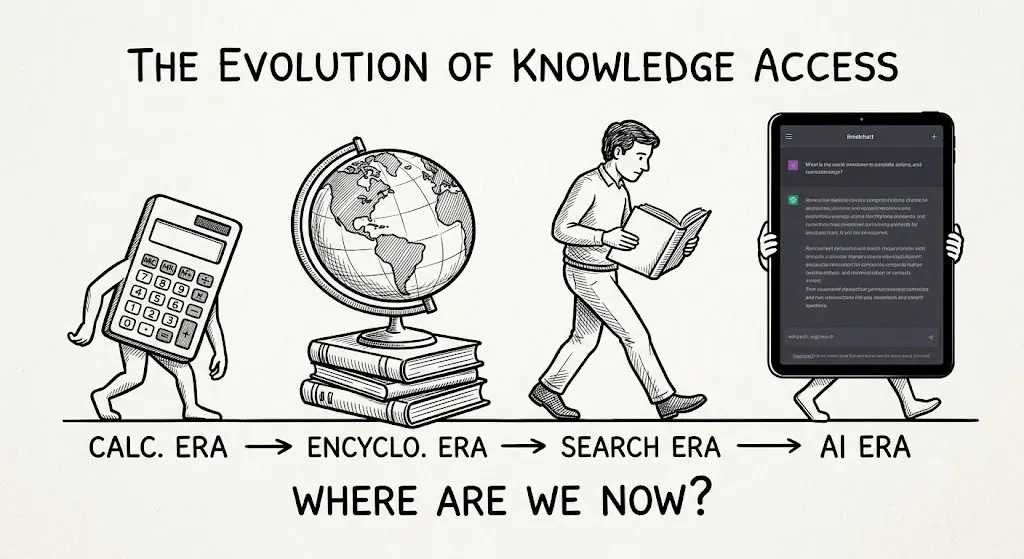
When affordable electronic calculators arrived in the 1970s and 1980s, the panic was nearly identical in structure to today’s: students would stop learning arithmetic, mental discipline would atrophy, the machine would think so the child wouldn’t have to. The College Board experimented, retreated, and experimented again. Then it made a decision that looks quietly radical in hindsight: beginning in 1995, graphing calculators were not merely permitted on the AP Calculus exams — they were required. The exam was redesigned around the tool’s presence. Whole categories of computation questions became worthless, so they were discarded, and the freed space was filled with questions demanding conceptual reasoning: set up the integral, interpret the result, justify the answer with mathematics rather than copying the output of a screen. The College Board’s own exam guidance still encodes the philosophy in a single sentence: a justification must include mathematical reasons, not merely calculator results.
Notice what that policy did not do. It did not surrender rigor. Today’s AP Calculus exam still contains entire sections where no calculator is allowed, because educators concluded — sensibly — that certain foundations must live in the student’s own head before the tool is layered on top. The calculator settlement was neither prohibition nor capitulation. It was a redesign: the tool is assumed, the foundations are protected, and the questions are rewritten to measure what the tool cannot do.
The internet forced the same reckoning a decade later. When the entirety of recorded human knowledge became searchable from a dorm room, take-home essays asking students to summarize known information lost their evidentiary value. The institutions that adapted did so by changing the question: open-book exams that tested application rather than recall, research assignments graded on source evaluation rather than source collection, problem sets built on data too fresh to have canned answers.
In both cases, the pattern held. A technology commoditized a task the academy had been using as a proxy for thinking. The academy panicked, attempted prohibition, discovered prohibition was unenforceable and pedagogically hollow, and finally redesigned assessment around a sharper question: now that the machine can do X, what is the human for?
Generative AI is that pattern again, at larger scale and higher speed. It has commoditized the polished paragraph, the competent summary, the five-paragraph argument, the boilerplate code — the artifacts that for a century served as evidence that a mind had done its work. As the educator Elizabeth Rubino argued in a recent essay that helped crystallize my own thinking, AI did not create a crisis in higher education so much as reveal one: if a language model can complete a large share of the work required to earn a degree, the urgent question is not how to stop students from using the model. It is what those assignments were measuring in the first place. A degree, she observes, was never really a certificate of information possessed. It was a promise of trust — trust that the graduate had done the thinking the credential implies. The artifact was only ever a proxy for that thinking, and the proxy has now been automated.
The ban reflex is an attempt to protect the proxy. The blueprint below is an attempt to protect the thing itself.
Part Three: The Blueprint — A Curriculum Where AI Is Expected and Humans Are Assessed
The proposal rests on one governing principle: treat AI the way we treat the calculator — as a declared, expected instrument — and move the point of assessment from the artifact a student submits to the judgment a student demonstrates. Everything else follows from that shift. What follows are the four structural pillars of such a curriculum, along with the mechanics that make each one workable rather than aspirational.
Pillar One: The Declared Instrument — AI use is mandatory, transparent, and graded
The first move is the most counterintuitive: stop asking whether students used AI and start requiring them to show exactly how they used it.
In this model, major assignments are completed with AI by design, and every submission travels with a disclosure record — call it a cognitive log. The log documents the prompts the student ran, the outputs the model produced, the claims the student checked and how, the errors and hallucinations the student caught, the suggestions the student rejected and the reasoning behind the rejection. The final artifact — the paper, the codebase, the brief — becomes a minor component of the grade. The log becomes a major one.
This inverts the entire integrity problem. Under prohibition, the student’s incentive is concealment and the instructor’s job is detection. Under declaration, the student’s incentive is demonstrated judgment and the instructor’s job is evaluating it — which is to say, teaching. A student who pastes a prompt and submits the output unexamined now has nothing to grade: an empty log is a failing log. A student who catches the model inventing a citation, traces the real literature, and documents why the model’s framing was subtly wrong has produced exactly the evidence of thinking that the old take-home essay only ever gestured at.
It also trains the single most economically valuable AI skill there is: knowing when the machine is wrong. Employers do not need graduates who can generate a first draft; the software does that. They need people who can audit the draft — who treat fluent output with professional suspicion, verify before they forward, and take responsibility for what goes out under their name. That is a teachable discipline, and the cognitive log is its practice field. Verification is not a sidebar to the assignment. It is the assignment.
There is a corollary worth stating plainly, because it answers the most common objection before it arrives: declared use does not mean unlimited use. Just as the AP Calculus exam still contains calculator-free sections, this curriculum preserves protected foundational phases — early courses and early units where the work is done unassisted, because a student cannot audit a tool’s output in a domain where they have no baseline of their own. You cannot catch a hallucinated fact in a field where you know no facts. The sequence matters: foundations first, without the tool; judgment second, with the tool and a log; mastery third, defended out loud. Which brings us to the second pillar.
Pillar Two: The Return of the Spoken Word — assessment moves to live defense
If the essay is no longer reliable evidence of understanding, the oldest assessment technology in the academy is waiting to be rediscovered: the human voice, under questioning.
In this curriculum, the written artifact is not the exam. It is the ticket to the exam. Students may build their paper, their model, their design with whatever assistance they choose — and then they stand in front of an instructor, a panel, or a structured peer cohort and defend it. Explain the argument in their own words. Justify the choices. Respond when an examiner alters a variable, removes an assumption, or presses on the weakest link. A student who genuinely did the thinking finds this conversation demanding but navigable. A student who outsourced the thinking discovers that no amount of polish in the document can answer a follow-up question on their behalf.
This is not romantic nostalgia for the Oxford tutorial. It is a return with modern engineering, and the evidence base is already forming. A National Science Foundation-funded research program at UC San Diego has been studying oral exams in large undergraduate engineering courses since 2020, and its findings run directly against the assumption that live assessment is a boutique luxury: the researchers report that oral exams increased students’ motivation to learn and deepened their understanding of the material, in part because the adaptive, dialogic format lets an examiner follow a student’s actual thought process rather than a bubble sheet’s shadow of it. The same program is explicitly working on the scaling problem — training graduate teaching assistants to administer defenses consistently and equitably — because the researchers understand that scalability, not validity, is the real barrier.
And on scalability, higher education has an existence proof it keeps forgetting it owns. In the 1970s, medical education faced precisely this dilemma: written exams could not certify clinical competence, but traditional bedside oral exams were unstandardized, examiner-dependent, and impossible to run fairly at scale. Ronald Harden’s answer at the University of Dundee — the Objective Structured Clinical Examination, first run in 1972 and published in 1975 — broke live performance assessment into timed, rotating stations with predefined tasks, trained examiners, and checklist-anchored scoring. Fifty years later, the OSCE is the backbone of clinical certification across the world, administered to entire cohorts of medical students every year. Nobody argues that medicine should go back to multiple choice because live assessment is expensive. The profession decided that certifying what a person can actually do was worth building the machinery for. The rest of the university can make the same decision.
The machinery for a general curriculum looks like a funnel. At the base, automated and structured self-testing: students rehearse against question banks and practice defenses, including against an AI interlocutor configured to probe their own submission — a genuinely constructive use of the same technology the ban tries to exile. In the middle, small peer-defense cohorts of four to six students, meeting on a regular cadence, where each member presents and takes questions, scored against tight rubrics focused on comprehension and adaptability rather than charisma. At the top, faculty-led defenses: shorter, targeted oral examinations for every student at key milestones, with deeper panel defenses reserved for capstone work. The instructor’s time is spent where it is irreplaceable — in live contact with a student’s mind — rather than where it is currently being burned, line-editing prose that a model may have written and a detector cannot reliably attribute.
The deeper payoff of this pillar is not integrity at all. It is that live defense is itself the education. Every defense is a rep in public speaking. Every cross-examination is a rep in thinking on one’s feet. Every peer cohort is a rep in giving and absorbing criticism without collapsing or counterattacking. These are the skills that decide careers — the NACE and World Economic Forum data above are essentially a description of them — and the traditional curriculum develops them almost by accident, in whatever presentations happen to survive the syllabus. This curriculum develops them on purpose, dozens of times per degree, because the assessment format and the skill are the same thing.
Pillar Three: High-Friction Human Labs — the curriculum teaches what experience used to teach by accident
Ask accomplished professionals what actually defined their careers and the answers cluster with striking consistency: the hardest conversations, not the hardest coursework. Delivering bad news to a client. Terminating an employee with dignity. Rebuilding a team’s trust after a wrong call. Persuading a skeptical executive without formal authority. Holding an ethical line when every option carries a cost. Rubino’s essay makes this point from twenty years inside the academy: no course taught these things, no exam measured them, and yet they were the substance of the job. They were learned through experience, mentorship, and failure — which is to say, learned late, unevenly, and at other people’s expense.
A curriculum built for the AI era institutionalizes that learning instead of outsourcing it to the first decade of a graduate’s career. The third pillar is a required sequence of high-friction interpersonal labs: structured simulations, run live, in which students navigate the messy human scenarios that no model can experience for them. A negotiation where the counterparty has been briefed to be unreasonable. A project post-mortem where the student must take ownership of a failure in front of the team it affected. A leadership rotation in which the student must delegate, coach a struggling peer, and make a resource call that leaves someone unhappy. A boardroom briefing where the audience interrupts.
Debate belongs here as a formal, graded discipline, not an extracurricular. Structured argumentation — researching both sides, being assigned the side you disagree with, building a case under time pressure, and absorbing rebuttal in real time — is the closest thing the Western educational tradition has to a gymnasium for judgment. It trains steel-manning over straw-manning, evidence over vibes, and the intellectual humility of discovering mid-round that your opponent’s point is better than your prepared answer to it. It is also, not incidentally, unautomatable in exactly the way this curriculum prizes: an AI can draft your case, and should be used to pressure-test it, but no one can stand at the podium for you.
Assessment in these labs targets what the simulations surface: emotional regulation under pressure, clarity when the stakes are personal, ethical consistency when consistency is expensive, and the ability to preserve a relationship while delivering an unwelcome truth. AI has a supporting role — as a sparring partner for rehearsal, as a persona in early-stage simulations, as a source of feedback on recorded performances — but the graded event is always human-to-human, because the thing being certified is the capacity to be trusted with other people.
Pillar Four: Ethics as Practice, Not Policy — responsible use is a trained behavior
The final pillar addresses the word most abused in current AI policy documents: responsibility. Nearly every institution now has a paragraph about responsible AI use. Almost none has a pedagogy for it, because responsibility written as a rule is compliance, and compliance is what students route around. Responsibility has to be trained as a practice, the way labs train safety and journalism programs train sourcing.
Concretely, that means ethical AI use is woven into graded work rather than quarantined in a one-credit seminar. Students learn and are assessed on a professional verification standard: no AI-derived claim advances into their work unchecked, every consequential fact traces to a source they can produce, and attribution norms — what was generated, what was edited, what is theirs — are followed with the same seriousness the academy already applies to quotation. They study the technology’s real failure modes in the disciplines where they will practice: hallucinated case law, plausible-but-wrong code, biased outputs in hiring and lending contexts, the privacy implications of pasting confidential material into a public model. They rehearse the workplace judgment calls prohibition never prepares anyone for — what may be shared with a tool, what must never be, when disclosure to a client or a colleague is owed, and who is accountable when machine-assisted work is wrong. The answer to that last one, drilled until it is reflexive, is the graduate whose name is on the work.
This is also where the honor culture gets rebuilt on honest ground. An integrity code that pretends AI does not exist commands no respect, and students know it. A code that says, in effect, use the instrument openly, verify what it tells you, disclose what it did, and stand behind the result under live questioning is one a serious student can actually honor — because it describes professional ethics rather than performing institutional denial.
Part Four: Answering the Critics
A proposal like this draws three predictable objections, and each deserves a straight answer rather than a hand wave.
“This cannot scale”
The strongest objection is logistical. A written stack can be graded asynchronously on a Sunday night; a live defense cannot. Multiply ten minutes of oral examination by a three-hundred-seat lecture course and the arithmetic looks fatal.
The arithmetic changes when you count what the current system actually costs. Instructors today are spending their hours on activities the new model eliminates outright: running detection software and adjudicating its false accusations, redesigning assignments in a losing arms race, and — the largest sink of all — carefully grading pages of prose whose authorship they cannot establish. Line-editing a paper a model may have written is not instruction. It is unpaid quality assurance for a machine. Reclaim those hours and redirect them into the funnel described above, where automation handles rehearsal, peer cohorts handle formative rounds, and faculty time is concentrated on the assessments only faculty can perform.
And the OSCE precedent should end the “impossible at scale” argument on its own. Medical schools run standardized, multi-station, live performance examinations for every student in every cohort, every year, worldwide, and have for decades — not because medicine has money to burn, but because the profession concluded that a credential must certify performance, and then engineered the logistics to match the conclusion. The technology available to a university in 2026 — scheduling systems, recorded and asynchronously reviewed defenses, AI-assisted rehearsal, structured peer scoring — makes the engineering easier than anything Harden had in Dundee in 1972. Scale is a design problem, and design problems have a known failure mode: declaring them impossible before attempting them.
“Live assessment is biased and punishes the anxious”
The equity objection is serious and must be built into the design rather than answered rhetorically. An oral defense graded on poise will systematically reward extroversion, native fluency, and cultural familiarity with performance — and that would be a genuine regression.
The answer has three parts. First, rubrics are anchored to substance: accuracy under questioning, adaptability when a premise changes, quality of reasoning — never eye contact, accent, or polish. Examiner training on exactly this point is a core piece of the UC San Diego program’s research agenda and of five decades of OSCE refinement; it is a solved problem in the sense that the failure modes are known and the countermeasures are documented. Second, the format is scaffolded for anxiety rather than weaponized by it: core question domains shared in advance, students permitted an anchor document — their own concept map, their annotated code, their cognitive log — during the defense, low-stakes peer rounds accumulating long before any high-stakes panel, and reasonable alternative formats where disability accommodation requires them. The grade attaches to what happens when a variable changes, not to the theater of the delivery. Third — and this point deserves more prominence than it gets — the status quo is not neutral. The current enforcement regime already discriminates, measurably: the Stanford detector findings mean that non-native English writers are being flagged for machine assistance at rates native speakers never face, in a process with no rubric, no training, and no appeal beyond an adversarial hearing. A designed, transparent, substance-anchored live assessment does not have to be perfect to be fairer than an opaque classifier with a documented 61 percent false-positive rate against the most vulnerable students on campus.
It is also worth saying without apology: some discomfort in this curriculum is the point. Defending an idea out loud, being questioned, receiving criticism in front of peers — these are uncomfortable in the exact way a workplace is uncomfortable, and graduating students who have never practiced that discomfort in a supportive setting is not kindness. It is deferral of the bill, with interest, to their first job.
“This abandons the fundamentals”
The rigor objection assumes that welcoming AI means students never learn to write, reason, or compute unassisted. The calculator settlement already showed why the assumption is false. The AP Calculus exam has required a graphing calculator since 1995 and still runs substantial sections where no calculator is permitted, because the exam’s designers understood that tool fluency and foundational mastery are complements to be sequenced, not rivals to be chosen between.
This curriculum applies the same sequencing. Foundational phases are protected and tool-free: early writing courses where the student’s own prose develops, early problem sets solved by hand, core reading engaged directly. The rationale is taught openly to students rather than imposed on them, and it is easy to teach honestly, because it is true: auditing a machine requires a baseline the auditor personally owns. A student with no unassisted writing ability cannot evaluate generated prose; a student who never solved the equations cannot spot the model’s confident nonsense. Far from abandoning fundamentals, the declared-instrument model gives fundamentals a purpose students can finally see — you are building the internal standard against which you will judge the machine for the rest of your career.
Part Five: What the Degree Comes to Mean
Follow the blueprint to its end and consider what an employer would actually know about a graduate of this curriculum.
They would know the graduate has defended their own work, out loud, under adversarial questioning, dozens of times — and that the transcript certifies performance in that setting, not the unverifiable authorship of documents. They would know the graduate has a trained, documented habit of verifying machine output before staking their name on it, because the cognitive logs graded that habit for four years. They would know the graduate has practiced the conversations most professionals dread — delivering bad news, owning a failure, negotiating under pressure, disagreeing with authority — in structured settings with feedback, rather than improvising them for the first time with real careers on the line. And they would know the graduate learned all of it while using the same class of tools sitting on every desk in the modern workplace, openly and ethically, rather than in secret.
Set that credential against the one the ban produces — a transcript full of grades on artifacts that both the institution and the employer quietly suspect a model may have written, earned by a student whose actual AI habits were formed in concealment. There is no comparison. One degree is a strengthening claim of trust; the other is a weakening one. Rubino’s framing is exactly right on this point: universities do not really sell knowledge, which has been abundant for a generation. They sell trust, and trust is the one product a credential cannot fake for long. Every year the connection between the diploma and the capability frays a little further, the market notices — hiring managers already discount, quietly, what a transcript tells them. The institutions that move assessment onto ground AI cannot occupy are not lowering their standards to accommodate a fad. They are the only ones defending the product.
There is one more constituency in this argument, and it is the one paying for everything: the students. They are not villains in this story, whatever the detection-industrial complex implies. They are rational actors responding to an assessment system that kept grading artifacts after the artifacts stopped meaning anything, and most of them — the surveys say so in their own words — know they are not being prepared for the world they can see coming. They are owed better than a four-year game of cat and mouse. They are owed a curriculum that takes their futures as seriously as they do: one that hands them the most powerful cognitive tool of their lifetime, teaches them its failure modes, drills the verification habits that make it safe, and then asks of them — over and over, in front of other human beings — the one thing no machine will ever supply on their behalf. Do you understand this? Can you defend it? Will you stand behind it when it’s questioned?
A degree that certifies a confident yes to those questions will be worth more in 2030 than any degree has been worth in decades. The blueprint exists. The precedents exist. The evidence exists. What the ban reflex protects is not learning, and not integrity — only the comfort of an assessment model whose time has ended. The institutions that understand this first will not merely survive the AI era. They will define what education in it means.
Sources and Further Reading
- Digital Education Council, Global AI Student Survey 2024 — key findings on student AI adoption and readiness: https://www.digitaleducationcouncil.com/post/what-students-want-key-results-from-dec-global-ai-student-survey-2024
- Digital Education Council, AI in Higher Education Latin America Survey 2026 (adoption at 92 percent): https://www.digitaleducationcouncil.com/post/ai-adoption-is-nearly-universal-among-students-but-confidence-is-not
- Liang, W., Yuksekgonul, M., Mao, Y., Wu, E., & Zou, J., “GPT Detectors Are Biased Against Non-Native English Writers,” Patterns (2023): https://pubmed.ncbi.nlm.nih.gov/37521038/
- Stanford HAI summary of the detector-bias study: https://hai.stanford.edu/news/ai-detectors-biased-against-non-native-english-writers
- The Markup, “AI Detection Tools Falsely Accuse International Students of Cheating” (2023): https://themarkup.org/machine-learning/2023/08/14/ai-detection-tools-falsely-accuse-international-students-of-cheating
- National Association of Colleges and Employers, Job Outlook 2025 — attributes employers seek on new-graduate resumes: https://www.naceweb.org/talent-acquisition/candidate-selection/what-are-employers-looking-for-when-reviewing-college-students-resumes
- World Economic Forum, Future of Jobs Report 2025 — skills outlook: https://www.weforum.org/publications/the-future-of-jobs-report-2025/digest/
- AAC&U and Elon University, Leading Through Disruption (2025 survey of higher education leaders): https://www.aacu.org/research/leading-through-disruption
- AAC&U and Elon University, national faculty AI survey (January 2026): https://www.aacu.org/newsroom/national-survey-95-of-college-faculty-fear-student-overreliance-on-ai-and-diminished-critical-thinking-among-learners-who-use-generative-ai-tools
- UC San Diego, “Oral Exams Improve Engineering Student Performance, Motivation” (NSF-funded research): https://today.ucsd.edu/story/oral-exams-improve-engineering-student-performance-motivation
- College Board, AP Calculus graphing calculator policy and philosophy: https://apcentral.collegeboard.org/courses/resources/ap-calculus-use-of-graphing-calculators
- Harden, R. M., & Gleeson, F. A., “Assessment of Clinical Competence Using an Objective Structured Clinical Examination (OSCE),” Medical Education 13 (1979): https://asmepublications.onlinelibrary.wiley.com/doi/10.1111/j.1365-2923.1979.tb00918.x
- Rubino, E., “What Does a Degree Actually Measure?” Medium (2026): https://medium.com/womenintechnology/what-does-a-degree-actually-measure-55e38e647571