The AI buildout and the oldest bargain of the industrial age
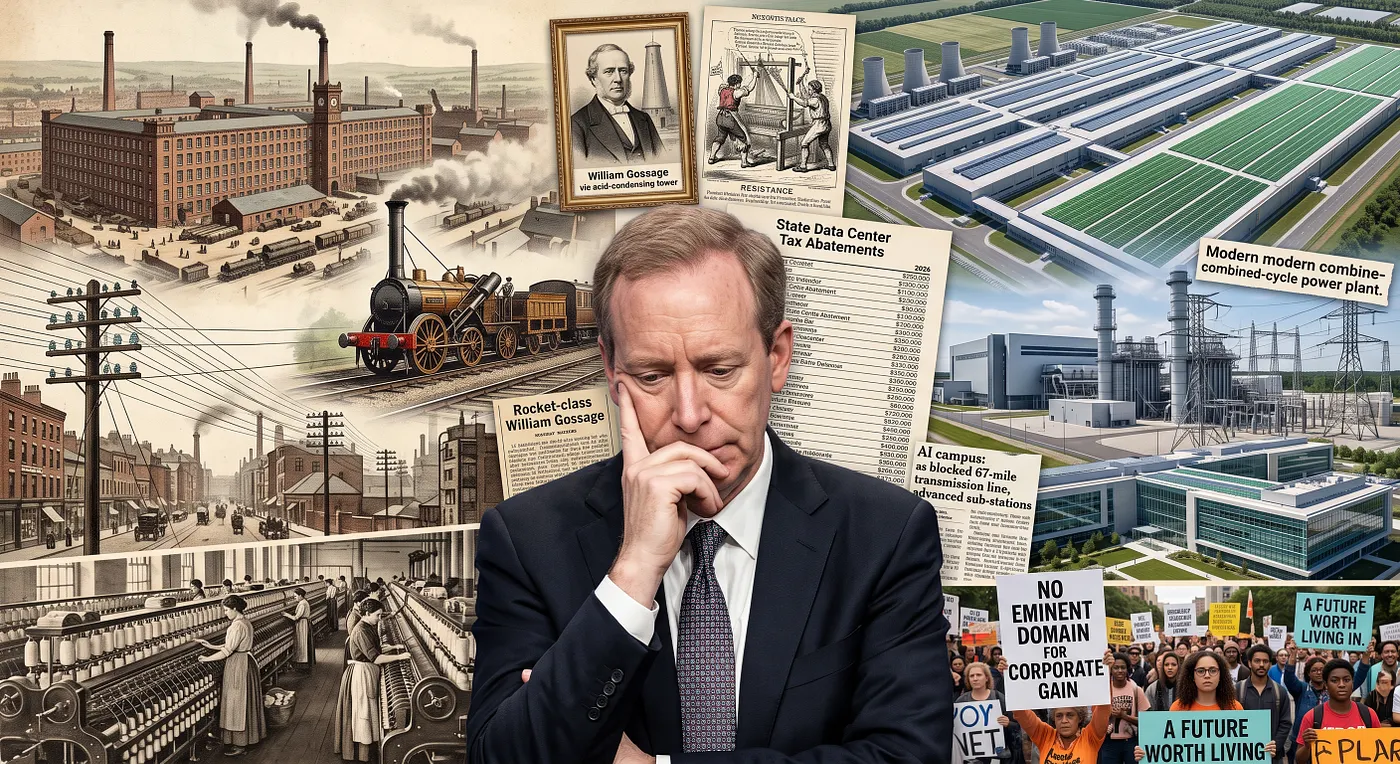
Microsoft’s Brad Smith contemplating the Industrial Revolution and the AI Race — Image by Gemini
In January 2026, Microsoft’s president, Brad Smith, introduced a new set of company pledges on data center construction by reaching back to the 1770s. The United States, he wrote, had advanced through successive eras of enormous infrastructure, from canals and railroads to power plants, the electrical grid, and highways, and artificial intelligence was simply the next chapter in that story. The comparison is flattering, but it cuts deeper than intended. Every one of those eras was also a fight over who would carry the weight of progress and who would collect the reward.
This essay takes that comparison seriously and follows it further back, to the moment when the modern bargain between industry and ordinary people was first struck. In late eighteenth and early nineteenth century Britain, a new productive system rose on four pillars: the enclosure of shared resources, the transfer of physical costs onto nearby communities, a quiet reliance on distant and unseen labor, and a public story that cast every objection as a futile stand against progress. The hyperscale buildout of AI infrastructure replicates these foundational dynamics.
The comparison matters because the first industrial age became livable only when ordinary people forced it to slow down — an insistence that is finally gathering force today.
The commons, fenced
Between 1604 and 1914, Parliament passed 5,265 enclosure acts, and 3,828 of them came in the seventy years between 1750 and 1819. Together, the acts converted roughly 6.8 million acres, just over a fifth of England, from land held under shared customary rights into private property. Villagers who had grazed animals, gathered fuel, and gleaned fields on the commons were sometimes awarded small or poor parcels in compensation, while cottagers and landless families who depended on custom rather than formal title frequently received nothing at all. Many of them ended up in the new mill towns, where their lost independence became the factory’s supply of labor.
The AI economy has carried out a similar conversion in two places at once.
The first is the digital commons. For three decades, people shared writing, art, code, and civic knowledge on the open web with the understanding that other people would read it, link to it, and learn from it. That material became the raw feedstock for commercial models. The courts are still deciding where the legal lines fall, and the early answers are mixed. In June 2025, federal judge William Alsup ruled that training a model on lawfully acquired books was fair use, but that Anthropic could not claim fair use for assembling and keeping a central library of more than seven million pirated books. The case ended in a settlement of 1.5 billion dollars, which received final court approval in July 2026 and pays authors about three thousand dollars for each of more than 482,000 covered works. The law may ultimately permit much of what was taken. It cannot restore the informal understanding under which the material was shared in the first place.
The lawful route had its own cost. Having bought millions of used print books, the company had them cut from their bindings, fed through high-speed scanners, and discarded. The court counted that destruction in the company’s favor, reasoning that one digital copy had simply replaced one paper copy. Google Books had shown years earlier that libraries could be scanned without harming a single volume, but gentler methods were slower and costlier. Under the rule that emerged, a used book that might have passed to another reader, a classroom, or a secondhand shop became safer to shred than to keep. Beyond wholesale digital ingestion, the process actively stripped physical copies from circulation.
The enclosure of physical resources follows an identical playbook. Some of the largest projects have been negotiated behind nondisclosure agreements and code names. In Tucson, Arizona, a proposed 290 acre campus called Project Blue had been under discussion with local officials since at least 2023, and Pima County had been bound by a nondisclosure agreement since at least June 2024. The city and the local electric utility had signed early agreements of their own. The public face of the project was a development firm, and the involvement of Amazon Web Services surfaced through public records. Residents also learned that the site would cool its servers with drinking water for at least its first two years, in a state already coping with a long drought. In August 2025, before a packed chamber, the Tucson City Council voted unanimously to end negotiations.
Public revenue has been fenced off as well. According to the National Conference of State Legislatures, thirty-eight states now offer dedicated tax incentives for data centers. A 2026 report from the watchdog group Good Jobs First found that Georgia, Virginia, and Texas each report losing a billion dollars or more a year to those incentives, and that fourteen states with such exemptions do not disclose their revenue losses at all. Enclosure in the eighteenth century required an act of Parliament and a published award map. Enclosure in the twenty-first can happen inside a confidential agreement and a tax expenditure that no one is required to report.
Smoke over the neighborhood
By the 1850s, British alkali works were decomposing some 250,000 tons of salt each year and releasing about 115,000 tons of hydrochloric acid gas into the air. Neighbors went to court and mostly lost, because it was nearly impossible to prove which chimney had caused which damage. Serious reform began only when wealthy landowners watched their own woodlands wither and their land values fall. In 1863, Parliament passed the Alkali Act, which required works to condense at least 95 percent of the acid gas and created a small inspectorate to enforce the rule.
The manufacturer William Gossage had already invented the acid-condensing tower in 1836, yet the fix sat idle for twenty-seven years before the law required anyone to install it. During those decades, the cost of leaving it unused was paid by the people and the land downwind.
In South Memphis, that lag between deployment and accountability is already visible. Elon Musk’s company xAI began operating its Colossus supercomputer in June 2024 and powered it in part with gas turbines, as many as thirty-five of them according to the Southern Environmental Law Center, without first obtaining air permits. The site sits near Boxtown, a historically Black neighborhood already ringed by industrial polluters, in a metro area that received a failing grade for ozone pollution from the American Lung Association. After the law center sent a notice of intent to sue on behalf of the NAACP, the company removed its unpermitted turbines and obtained permits for fifteen. Local health officials said the permitted units would carry modern emissions controls, and a city-commissioned study found no elevated pollution near the site, though the law center faulted that study for not measuring ozone. For its second facility, just across the state line in Southaven, Mississippi, the company said in January 2026 that it was running twenty-seven turbines and that no permits were required. State records obtained later described fifty-seven off-grid turbines installed there.
Acoustic displacement operates in the same regulatory void. In Prince William County, Virginia, the roughly three hundred homes of the Great Oak neighborhood sit about six hundred feet from an Amazon Web Services campus. In 2022, residents began hearing a constant mechanical whir whenever they stepped outside. One resident recorded 67.4 decibels, above the county’s daytime residential limit of 60. Amazon’s own study disputed that the limit was being exceeded, and the company installed acoustic shrouds. The deeper problem was legal: the county’s noise ordinance, written in 1989, exempted air conditioning equipment, which left residents with no rule to enforce against industrial cooling systems. Three years later, Great Oak residents were still pressing the county board for an ordinance that would actually apply.
Water consumption imposes another unpriced physical externality. The Environmental and Energy Study Institute estimates that the largest data centers can consume up to five million gallons a day, comparable to the use of a town of ten thousand to fifty thousand people. Consumption varies widely with cooling design and climate, and newer approaches such as direct-to-chip and immersion cooling can reduce it. But under current practice, the choice of design largely belongs to the developer, while the aquifer belongs to everyone.
The bill comes due
Nineteenth century factory towns paid for industrial growth with their health and their surroundings. Twenty-first century households are increasingly paying for it through their utility bills.
PJM Interconnection runs the power grid for all or part of thirteen states and the District of Columbia. In 2025, its independent market monitor reported that data center load growth was the primary reason for tight supply and high prices in PJM’s capacity market. By the monitor’s estimate, current and projected data center demand raised capacity costs by 9.3 billion dollars, or 174 percent, for the 2025 to 2026 delivery year, compared with a scenario without that demand. Utilities generally spread such costs across all of their customers. Ari Peskoe, who directs the Electricity Law Initiative at Harvard Law School, has described data centers as driving tens of billions of dollars in wholesale price increases and tens of billions more in utility spending on delivery infrastructure, costs that land on ordinary ratepayers.
Household bills reflect the pressure. Between March 2021 and March 2026, according to federal energy data, average residential electricity prices rose 94 percent in Washington, D.C., and 74 percent in Maryland, both within PJM’s territory. Nationally, residential prices rose about 42 percent over the past five years. Data centers are not the only cause. A 2026 analysis from Lawrence Berkeley National Laboratory also points to equipment costs, an aging grid, and clean energy requirements. But in the places where prices have climbed fastest, data center demand has been a major driver.
Utility bills capture only the part of the cost that can be counted in dollars. Serving gigawatt-scale customers requires new power lines and power plants, and those require land, shifting the burden of urban computation directly onto rural ground. After roughly fifteen years of nearly flat electricity demand, the federal Energy Information Administration expects four straight years of growth for the first time since 2007, driven largely by data centers. In Maryland, a developer called PSEG has proposed a 67-mile transmission line across Baltimore, Carroll, and Frederick counties, part of the regional grid operator’s effort to keep pace with data center growth. The route crosses farmland, forest, and land held in preservation. Local officials in all three counties opposed it, and Governor Wes Moore said he does not believe in eminent domain on the scale the project would demand. PSEG has taken more than three hundred landowners to court to gain access for surveys, and when farmers resisted, the company asked a federal judge to send in United States marshals. The judge refused, but in August 2026 a federal appeals court upheld the company’s right to enter hundreds of properties, even though state regulators have not yet approved the line itself. Signs along the route read, “No eminent domain for corporate gain.”
The country has lived this story before. In the 1970s, farmers in west-central Minnesota fought a high-voltage line built to carry power from a new coal plant in North Dakota. After hearings and lawsuits failed, the protests escalated, and in January 1978 the governor ordered 175 state troopers to Pope County. Opponents later toppled towers and shot out thousands of insulators. The line began operating in 1979 anyway, and the health fears that fueled part of the resistance were not borne out by later research. What the farmers understood correctly was the terms of the transaction. The land was theirs, the power was for someone else, and the decision about who would yield had been made before they ever reached the hearing room.
The hidden hands
The mills of Lancashire ran on cotton, and much of that cotton was grown by enslaved people in the American South. The finished cloth looked like a triumph of machinery. The fiber inside it carried a history of bondage that the buyer never saw.
Modern AI carries its own concealed labor. In 2019, the anthropologist Mary L. Gray and the computer scientist Siddharth Suri gave it a name, ghost work, meaning human labor that customers believe is being done by software. The term fits the data labeling and content moderation that make today’s models usable.
In January 2023, TIME reported that Sama, OpenAI’s outsourcing partner in Kenya, paid data labelers take-home wages of roughly 1.32 to 2 dollars an hour to read and label tens of thousands of text passages, many describing sexual abuse, murder, torture, and self-harm, so that ChatGPT could learn to detect and filter such material. Workers told the magazine the job left them mentally scarred. Sama said its employees had access to licensed mental health therapists, and the company ended its work for OpenAI in February 2022, eight months earlier than planned.
In August 2023, The Washington Post reported that at least ten thousand people in the Philippines labeled data on Remotasks, a platform owned by Scale AI. Of thirty-six current and former workers the paper interviewed, all but two said payments had been delayed, reduced, or canceled after they completed tasks. Workers said they often earned far below the regional minimum wage, which ranges from about six to ten dollars a day, though at times they earned more.
The hardware draws on older supply lines. According to the United States Geological Survey, the Democratic Republic of the Congo produced an estimated 73 percent of the world’s mined cobalt in 2025, and artisanal and small-scale miners play a significant role in that output, while China leads the world in refining it. While cobalt broadly supports consumer electronics and electric vehicles, hyperscale buildouts and dedicated grid-storage arrays are aggressively accelerating this legacy demand. The geography is hard to ignore. The same land was once the Congo Free State, whose forced rubber harvest under King Leopold the Second became a byword for colonial atrocity.
The gospel of inevitability
The Luddite disturbances began in Nottinghamshire in 1811 and spread into Yorkshire and Lancashire the following year. Popular memory recalls the Luddites as people who hated machines. The journalist Brian Merchant, among others, has argued that their grievance was narrower and more political. They objected to machinery used to cut wages, degrade skilled trades, and concentrate wealth in the hands of a few owners.
The state did not answer with debate. In 1812, Parliament made machine breaking itself a capital crime, despite Lord Byron’s defense of the weavers in the House of Lords. Troops were sent into the affected districts. At a special commission in York in January 1813, seventeen men were hanged and others were transported to the colonies. Prosecutors leaned largely on older capital felonies such as burglary, robbery, and arson, but the message was unmistakable: resistance to the new order would be treated as a crime against the nation.
Today’s rhetoric swaps the gallows for the language of national security and geopolitical supremacy. On July 23, 2025, the White House released its AI strategy under the title Winning the Race: America’s AI Action Plan, organized around securing what it called “global AI dominance.” The same day, the President signed an executive order to fast-track federal permitting for data centers and the power infrastructure that serves them. In that framing, a zoning objection, a water permit, or a copyright claim is not a local question to be weighed on its merits. It is friction slowing a national race. The same logic nearly produced a ten-year federal bar on state AI regulation, written into the 2025 budget reconciliation bill, until the Senate stripped it out by a vote of 99 to 1 after opposition from governors, attorneys general, and advocacy groups across the political spectrum.
Alongside the triumphant story runs a frightening one. In May 2025, Anthropic’s chief executive, Dario Amodei, told Axios that AI could eliminate half of all entry-level white-collar jobs and push unemployment to between 10 and 20 percent within one to five years. He presented the warning as a call for government and industry to prepare, and he floated a tax on AI revenue to help cushion the blow. Many economists expected a milder effect, pointing to earlier waves of digital change that did not produce the predicted devastation. Other critics noted that AI leaders have an interest in emphasizing the speed and scale of the coming change, since that urgency helps justify the enormous sums the technology requires.
The economists and the alarmists may both be missing a slower danger. A Stanford study of payroll records found no widespread, economy-wide job displacement, yet by mid-2026 employment for workers aged 22 to 25 in the most AI-exposed occupations stood about 19 percent below where it would have been had it kept pace with their less-exposed peers. The gap came mainly from reduced hiring rather than layoffs, and experienced workers in the same fields saw no comparable decline. The authors describe these as early indicators rather than proof of cause, but a Harvard study of résumé data from some 285,000 firms found a similar pattern: after companies adopted generative AI, junior employment fell sharply while senior employment kept growing. The work being absorbed is the work through which beginners once learned judgment. One economic analysis warns that a technology which replaces entry-level execution while complementing expert judgment can erode the future supply of the very expertise it depends on. Even the chief executive of Amazon Web Services, Matt Garman, has asked how companies expect to function a decade from now if no one has learned anything along the way. The industrial age ran a version of this experiment. In 1814, in the middle of the Luddite years, Parliament repealed the apprenticeship clauses of the Elizabethan Statute of Artificers over bitter objections from trade groups who warned that standards would fall, though the old system had already been fading for decades. Meanwhile, the experienced workers absorbing the additional workload are showing strain. In one large 2026 survey of tech workers, the share reporting significant burnout rose from about 45 percent to nearly 56 percent in a single year, and more than half said they would steer a newcomer away from their own role.
Set the triumphant story beside the frightening one and they share a premise: the pace is fixed, and the only choice left to the public is how quickly to adapt. The Regency government told the weavers the same thing, and backed the message with the gallows. The history that followed suggests the premise was wrong.
The brakes, then and now
Factory owners did not humanize the industrial age out of moral enlightenment; regulations arrived, backed by state inspectors with the power to penalize them. The Factory Act of 1833 barred children under nine from working in textile mills, limited children aged nine to thirteen to eight hours a day, and required them to receive two hours of schooling daily. Most importantly, it created a corps of government inspectors. There were only four at first, and evasion was widespread, but the principle held and the system grew. The Alkali Act of 1863 applied the same approach to air pollution. The regulated industries survived. Once alkali works were forced to capture their acid gas, the captured acid became a raw material for bleach and other products.
Something similar is now happening, and it is starting from the ground up. Data Center Watch, which tracks local opposition, counted at least 75 projects worth about 130 billion dollars blocked or delayed in the first quarter of 2026 alone, roughly matching its total for all of 2025. The number of active opposition groups more than doubled, from 396 at the end of 2025 to 833 by the end of March 2026, spread across 49 states. More than three hundred state data center bills were filed in the first six weeks of the year, and Maine came within a single House vote of becoming the first state to enact a statewide ban.
In July 2026, New York became the first state to impose a statewide pause. Governor Kathy Hochul’s Executive Order 62 holds state environmental permits for new data centers capable of drawing fifty megawatts or more until regulators complete a statewide environmental review, a process the governor has described as lasting about a year. The order states that the cost of grid upgrades for large power users should not fall on everyday New Yorkers. A Siena poll taken the previous month found that 46 percent of New Yorkers thought a one-year pause on large data center permits would be good for the state, compared with 21 percent who thought it would be bad. In June, Arizona Governor Katie Hobbs signed a three-year moratorium on new sales tax breaks for data centers.
Cities are moving too. On August 10, 2026, the Indianapolis City-County Council voted 23 to 1 to bar new data center approvals in Marion County through the end of 2027, and the city’s development commission then approved the measure unanimously. Council President Maggie Lewis was clear that the aim was not a permanent ban. She said the city needed to pause, study the issue in depth, and give residents and experts room for an honest conversation before deciding what comes next. In Congress, Senator Bernie Sanders, Representative Alexandria Ocasio-Cortez, and Representative André Carson have proposed a federal pause on new AI data centers.
Even parts of the industry have shifted. Microsoft’s January 2026 pledges commit the company to pay its own way so that its data centers do not raise local electricity prices, to replenish more water than it uses, and to add to local tax bases. Pledges are not laws, and they bind only the company that makes them. But in a later statement, Microsoft put the underlying principle plainly: communities should share in the benefits of AI infrastructure and should not bear its costs.
The case for speed
None of this makes the case for building empty. Data centers bring construction jobs and, where incentives are limited, meaningful property tax revenue. The systems they run are being put to work in medicine, science, and weather forecasting. Supporters of rapid buildout argue that if the United States slows down, the capacity will be built elsewhere, possibly under weaker environmental and labor standards, and that strategic competitors will gain ground. Moratoriums can also be blunt instruments. In California, a court set aside Imperial County’s pause after finding that its supporting findings did not satisfy state law. And as the Berkeley analysis shows, rising power bills have several causes beyond data centers.
The industrial precedent offers a response. Britain did not ultimately choose between factories and child labor laws, or between soda ash and cleaner air. It chose both, and the economy that emerged grew larger rather than smaller. What the delay cost was measured in the decades when the tools of restraint existed and went unused.
Regulation as Architecture
Had the British government in 1812 answered the weavers with labor inspectors rather than the gallows — forcing mill owners to internalize the disruption before bolting down the frames — the looms still would have arrived. The difference lies entirely in who paid for the transition, and how many lives were wasted learning lessons Parliament eventually codified decades late.
Compute clusters will be built, and much of what they run will prove genuinely useful. The unresolved dispute is whether the surrounding population is treated as a partner or as an open quarry to be drawn down without consent. Local noise ordinances that regulate high-decibel chillers, utility tariffs requiring developers to fund their own substations, courts barring mass piracy, and audits on corporate tax abatements do not halt technological progress. They establish its social license. The first industrial era recognized that necessity only after decades of manufactured misery; this cycle offers the rare opening to establish the baseline before the concrete cures.
Sources for Further Reading
Historical background
- UK Parliament, Living Heritage: Enclosing the Land, Key Dates
- Progress.org: Enclosure
- UK Parliament, Living Heritage: The 1833 Factory Act
- Encyclopaedia Britannica: Factory Act
- Environmental Chemistry Group: 150th Anniversary of the Establishment of the Alkali Inspectorate
- The National Archives (United Kingdom): The Proclamation of Ned Ludd
- JSTOR Daily: Luddites on Trial
- Wikipedia: Destruction of Stocking Frames, etc. Act 1812
- K. D. M. Snell, Annals of the Labouring Poor (Cambridge University Press): Chapter 5, The Decline of Apprenticeship
- UK Legislation: Apprentices Act 1814
- Brian Merchant, Blood in the Machine: The Origins of the Rebellion Against Big Tech (Little, Brown, 2023), available from Hachette Book Group
Land, law, and public money
- Microsoft On the Issues, January 13, 2026: Building Community-First AI Infrastructure
- Microsoft On the Issues, April 7, 2026: Building AI Infrastructure the Community-First Way in Canada
- Associated Press via ABC News, July 21, 2026: Judge Approves a 1.5 Billion Dollar Anthropic Settlement Over Pirated Books
- BetaNews: Anthropic’s 1.5 Billion Dollar Copyright Settlement Receives Final Court Approval
- TechPolicy.Press, June 26, 2025: In Copyright Wins for Anthropic and Meta, Judges Leave Ample Room for Future Defeats
- Card Catalog for Life: Books Have Always Been Destroyed. But Never Like This.
- IBTimes UK, July 29, 2026: Inside Project Panama, Anthropic’s Secret Effort to Scan and Shred the World’s Books
- Eurasia Review, August 6, 2026: Project Panama: Scanning and Book Destruction at Anthropic
- Data Center Dynamics: Residents Cheer as Tucson Rejects Amazon’s Project Blue Data Center Campus
- KJZZ, August 6, 2025: Tucson Leaders Unanimously Vote to Shut Down Project Blue
- Stateline via Pennsylvania Capital-Star, April 15, 2026: Many States Don’t Report Losses From Data Center Tax Breaks, Study Says
Pollution, noise, and water
- Southern Environmental Law Center: xAI Built an Illegal Power Plant to Power Its Data Center
- Southern Environmental Law Center: Resistance Against Elon Musk’s xAI Facility in South Memphis Gets Stronger
- TIME, August 13, 2025: Inside Memphis’ Battle Against Elon Musk’s xAI Data Center
- Technology.org, July 15, 2026: xAI Ran 59 Unpermitted Gas Turbines for Colossus 2 Near Memphis
- Prince William Times: Residents Turn Up the Volume on Data Center Noise Complaints
- WJLA: As Data Centers Proliferate, Prince William County Neighbors Knock the Noise
- Data Center Dynamics: Prince William Residents Complain of Catastrophic Noise From Data Centers
- Potomac Local, June 11, 2025: Data Center Noise Still Shakes Homes in Great Oak
- Environmental and Energy Study Institute: Data Centers and Water Consumption
Electricity costs
- PolitiFact, June 12, 2026: How Much Have Data Centers Increased Electricity Prices?
- Monitoring Analytics, Independent Market Monitor for PJM: Analysis of the 2025/2026 RPM Base Residual Auction, Part G
- Lawrence Berkeley National Laboratory: Retail Electricity Price Trends and Drivers, 2026 Edition
Land, transmission, and eminent domain
- DWS: Data Centers Drive U.S. Electricity Demand
- Valve World Americas: EIA: Data Centers Drive Strongest U.S. Electricity Growth Since 2000
- NBC News, November 3, 2025: Maryland Farmers Fight to Protect Their Land From an Extension Cord for Data Centers
- Maryland Matters, May 5, 2026: Blackout Fears Debated at Fourth Circuit Hearing on Proposed Maryland Power Line
- WYPR, August 20, 2026: Court Upholds Eminent Domain for MPRP in Maryland
- Baltimore Fishbowl: Court Upholds Eminent Domain for MPRP in Maryland
- Wikipedia: Maryland Piedmont Reliability Project
- MNopedia, Minnesota Historical Society: Power Line Controversy
- Pope County Tribune, January 19, 2026: Pope County Protest in Sharp Contrast to What We See in Minneapolis
- History News Network: The Minnesota Powerline Protests
- Echo Press: Museum Remembers Power Line Protests
Labor and supply chains
- Mary L. Gray and Siddharth Suri, Ghost Work: How to Stop Silicon Valley from Building a New Global Underclass (Harper Business, 2019), available from HarperCollins
- TIME, January 18, 2023: Exclusive: OpenAI Used Kenyan Workers on Less Than 2 Dollars Per Hour to Make ChatGPT Less Toxic
- The Washington Post, August 28, 2023: Behind the AI Boom, an Army of Overseas Workers in Digital Sweatshops
- United States Geological Survey: Mineral Commodity Summaries 2026, Cobalt
- United States Geological Survey: The Mineral Industry of the Democratic Republic of the Congo, 2022 Minerals Yearbook
Federal policy and industry statements
- DLA Piper, July 23, 2025: White House Unveils US AI Action Plan
- Sabin Center for Climate Change Law, Columbia Law School: President Trump Orders Expedited Permitting for Data Centers
- United States Senate Committee on Commerce, Science, and Transportation, July 1, 2025: Senate Strikes AI Moratorium From Budget Reconciliation Bill in Overwhelming 99 to 1 Vote
- Axios, May 28, 2025: Behind the Curtain: A White-Collar Bloodbath
- Axios AI+ newsletter: Coverage of Economist and Critic Responses
- SiliconANGLE, May 29, 2025: AI Set to Eliminate Half of Entry-Level White-Collar Jobs Within Five Years, Warns Anthropic CEO
Entry-level work and the talent pipeline
- Stanford Digital Economy Lab, August 2026: No Widespread Displacement, but the AI Employment Gap for Young Workers Has Widened to 19 Percent
- Erik Brynjolfsson, Bharat Chandar, and Ruyu Chen, Stanford Digital Economy Lab: Canaries in the Coal Mine? Six Facts About the Recent Employment Effects of Artificial Intelligence, August 2026 Update
- Seyed M. Hosseini and Guy Lichtinger, Harvard University: Generative AI as Seniority-Biased Technological Change, Stanford Digital Economy Lab Seminar Summary
- arXiv: Automation, AI, and the Intergenerational Transmission of Knowledge
- The Register, August 21, 2025: AWS CEO Says Using AI to Replace Junior Staff Is the Dumbest Thing He Has Ever Heard
- Fortune, December 16, 2025: AWS CEO Says Replacing Young Employees With AI Is One of the Dumbest Ideas
- Lenny’s Newsletter: How Tech Workers Are Feeling in 2026
State and local response
- Data Center Watch: Q1 2026 Report
- Office of the Governor of New York, July 14, 2026: First Statewide Moratorium on New Hyperscale Data Centers Launched
- Office of the Governor of New York: Executive Order №62
- CNBC, July 14, 2026: New York Becomes First U.S. State to Impose AI Data Center Ban
- Axios, July 14, 2026: Hochul Signs Data Center Moratorium Executive Order
- Mirror Indy: Indianapolis City-County Council Approves Data Center Moratorium
- Indianapolis Business Journal: Indianapolis Data Center Moratorium Receives Final Approval
- WRTV: Indianapolis Council President Calls for Pause on Data Center Developments
- FOX59: Metropolitan Development Commission Unanimously Approves Data Center Moratorium
- Imperial County, California: Update on Data Center Moratorium