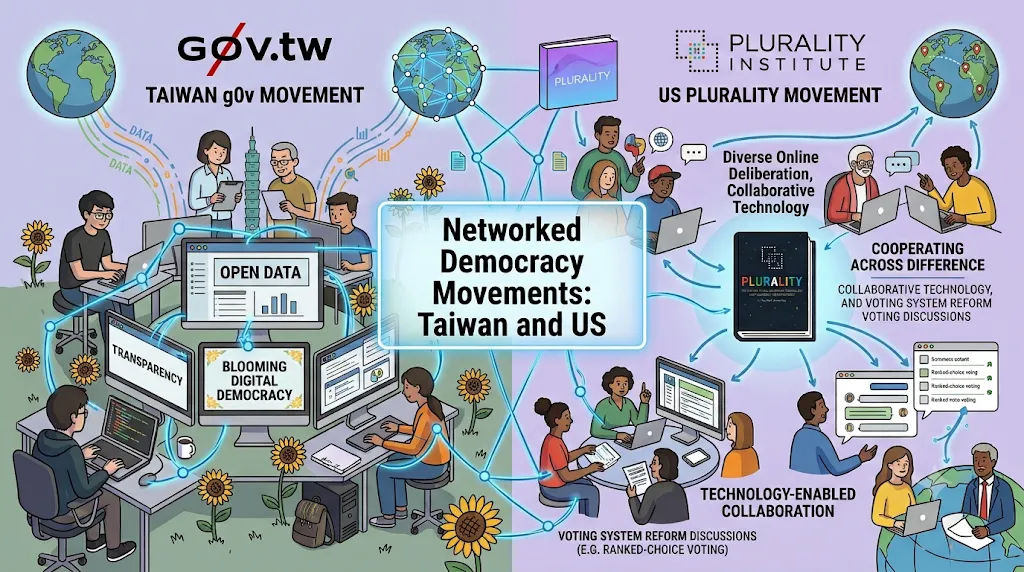
Using the Example of Taiwan g0v to empower the Plurality Movement in the US — Image by Gemini
In late 2012, the government of Taiwan released an advertisement for its Economic Power-Up Plan. The ad’s message, repeated over and over, amounted to this: we have a very complex plan, it is too complicated to explain, so never mind the details — just follow instructions and go along with it.
For a small group of Taiwanese software engineers, that ad was the last straw. It arrived at the same moment as Yahoo!’s Open Hack Day, and a handful of participants channeled their irritation into a last-minute project called Budget Maps, which visualized every government program as a circle that grew or shrank in proportion to the money spent on it. Suddenly anyone could see, at a glance, where the public’s money actually went — including how much had been spent on the ad telling them not to worry about it.
That small act of defiance grew into g0v, pronounced “gov zero,” one of the largest and most consequential civic technology communities in the world. Over the following decade, the movement it seeded would help Taiwan crowdsource national legislation, blunt one of the most intense foreign disinformation campaigns on the planet, and mount one of the most effective early responses to the COVID-19 pandemic — all without seizing a single lever of formal power. The g0v story is not a story about overthrowing a government. It is a story about building a better one alongside the old one, in the open, and letting the old one plug in.
That distinction matters enormously for the United States, where the corrupting force is not a hostile neighbor’s information war but the gravitational pull of concentrated wealth on a political system that claims to serve ordinary people while systematically shutting them out. The tools Taiwan built — and, remarkably, some of the core software Taiwan used was invented in America — are now taking root in US counties, cities, and research labs. Understanding how they work, why they work, and where they are already being deployed is the first step toward joining that work.
A Frustration Becomes a Fork
The founding gesture of g0v was a pun that doubled as a philosophy. In late 2012, programmer Kao Chia-liang and a few collaborators — known in the community by handles like clkao, ipa, and kirby — registered the domain g0v.tw, replacing the letter “o” in “gov” with a zero. The wordplay borrowed from the binary language of computing and signaled an intent to “rethink the role of government from zero.” But the domain did something more clever than symbolize. Because Taiwanese government agencies live at addresses ending in .gov.tw, a citizen could take almost any official URL, swap the “o” for a zero, and land on a “forked” version of that same agency’s website — rebuilt by volunteers to be clearer, more usable, and radically more transparent.
“Forking” is a term from open-source software development. When developers fork a project, they copy its code and take it in a new direction, without asking permission and without destroying the original. Crucially, a fork can later be “merged” back: improvements made in the copy can be incorporated into the source. That is precisely the relationship g0v established with the Taiwanese state. The hackers scraped government PDFs and closed databases, restructured the data, and published interactive tools that made the state legible to its citizens. When those tools proved better than the originals, government agencies began adopting them.
The community organized itself around a rhythm that persists to this day: a large hackathon roughly every two months, open to anyone, where programmers sit alongside designers, teachers, nurses, activists, and civil servants. The very first event, held on December 1, 2012 at Academia Sinica and funded with the prize money from that Yahoo! hackathon, was cheekily named the “0th Hackathon of Martial Mobilization.” Registrations overflowed the original venue. In the years since, g0v’s organizing team, known as Jothon, has run dozens of large-scale hackathons with at least a hundred participants each, drawing thousands of cumulative contributors, and every project released its code and documents under open licenses.
Two features of g0v’s culture deserve emphasis, because they explain much of what followed. First, the community has no bosses, no membership requirements, and no central command; anyone who shows up and contributes is g0v. Its informal motto captures the ethos: ask not why nobody is doing this — you are the “nobody.” Second, the movement’s posture toward the state was neither servile nor insurrectionary. Forking the government was never about overthrowing it. It was about demonstrating, in working code, that a better version was possible, and leaving the door open for the merge.
The Sunflower Moment
The fork met its stress test in the spring of 2014. Taiwan’s ruling party attempted to push the Cross-Strait Service Trade Agreement — a sweeping trade pact with the People’s Republic of China — through the legislature without the promised clause-by-clause review. To many Taiwanese, especially the young, the pact represented both an economic threat and a sovereignty threat: a deepening of dependence on a neighbor that claims Taiwan as its own territory, negotiated behind closed doors.
Students and activists occupied the Legislative Yuan, Taiwan’s parliament, in what became known as the Sunflower Movement. The occupation lasted roughly three weeks and transfixed the country. And g0v was there — not as a political faction, but as infrastructure. Volunteers ran cables and set up connectivity where there was none, and livestreamed the proceedings inside the occupied chamber so that the entire country could watch what was actually happening, unfiltered and in real time. Among those volunteers was a programmer named Audrey Tang, already legendary in open-source circles for contributions to the Perl and Haskell programming languages, who helped broadcast the protesters’ deliberations to the outside world.
The transparency changed the dynamic. With the whole country watching, the government could not easily mischaracterize the occupiers, and the occupiers’ own disciplined, deliberative conduct became visible proof that ordinary citizens could reason together about complex policy. The movement succeeded in halting the trade pact. But its deeper legacy was a demand the government could not ignore: if hundreds of people in an occupied chamber could facilitate serious collective decision-making, why couldn’t the state?
The government’s response was unusual by any international standard: it opened the door. Ministers began treating the civic hackers as partners rather than adversaries. Tang was invited to serve as a “reverse mentor” to a cabinet minister on digital participation, and in October 2016, at age thirty-five, became Taiwan’s youngest-ever minister, holding the digital portfolio. In 2022 Tang became the country’s first Minister of Digital Affairs, serving until May 2024, and was subsequently appointed Taiwan’s Cyber Ambassador-at-large in October 2024. The revolving door in Taiwan, in other words, spun in the opposite direction from the one Americans know: instead of regulators leaving government to cash in with industry, a movement dedicated to radical transparency sent one of its own into the cabinet.
vTaiwan and the Machinery of Consensus
Out of the post-Sunflower opening came vTaiwan, launched in 2015: an open consultation process that brings citizens, experts, industry, and government together, online and face-to-face, to work through contested national issues. At its heart sits a piece of software called Polis, and Polis deserves careful explanation, because it inverts nearly every design choice that makes American social media so corrosive.
In a Polis conversation, participants submit short statements about the issue at hand, and everyone else votes on each statement: agree, disagree, or pass. That is the entire interaction. There is no reply button, no comment thread, no quote-dunking, no way to attack another person directly. A statistical engine then maps participants into opinion clusters based on their voting patterns, and displays the emerging landscape to everyone. The system surfaces the statements that achieve agreement across the divided clusters, not just within one camp. The incentive this creates is subtle and powerful: if you want your idea to rise, you cannot simply rally your own side. You have to craft a statement nuanced enough that people who disagree with you on other things will still click agree. Divisive statements and trolling do not get amplified; they sink. Consensus becomes the thing the system rewards, rather than outrage.
The first major test came in August 2015, over the fight that was then paralyzing cities around the world: how to handle Uber. Taxi drivers reported serious losses; riders worried about the safety of unlicensed drivers; the company insisted it was a technology platform, not a transport operator. The vTaiwan process opened the question to the public through Polis. Initial voting showed exactly the two hostile camps everyone expected. But over four weeks, as participants kept proposing and voting on statements, points of overlapping agreement emerged: that riders’ safety required registration and insurance, that there should be a level playing field between platforms and taxis, that competition could benefit consumers if the ground rules were fair. Tang then carried those consensus points into face-to-face talks with Uber representatives, taxi associations, and government ministries, and in May 2016 the government agreed to ratify the points of consensus into regulation, loosening some legacy restrictions on taxis while requiring app-based operators to play by common rules.
Uber was not a one-off. vTaiwan went on to tackle online alcohol sales, fintech regulation, revenge-porn law, telemedicine, and more. By 2018 the process had been used more than two dozen times, with roughly eighty percent of deliberations leading to decisive government action, and Polis-based consultations in Taiwan have drawn participation from more than two hundred thousand people across dozens of issues. A second platform called Join, run by the government itself and open to petitions from any citizen, extended the participatory model further into everyday governance.
Honesty requires noting the limits. vTaiwan’s mandate has always rested on the government’s willingness to listen rather than a binding legal obligation, and its scope has concentrated on digital-economy questions rather than the hardest distributive conflicts. One legislator and former civic hacker, Jason Hsu, famously called it “a tiger without teeth,” complaining that lawmakers did not take it seriously enough. The criticism is fair, and worth carrying into the American discussion later: deliberative infrastructure produces legitimacy and clarity, but converting those into law still requires institutions that agree to act on the results.
It helps here to name the two shapes this piece will keep returning to. A conventional government is a pyramid: a hierarchy in which authority, information, and legitimacy flow from a narrow top down through layers of officials to a broad base of citizens, whose main way of pushing back is a vote every few years. The system Taiwan’s hackers built is a network: a flat web of many small nodes — individual citizens, volunteer projects, open datasets — where information and initiative can flow in any direction, and where no single point controls or chokes the whole. Pyramids are efficient at command but brittle, because everything depends on the judgment and honesty of the few at the top. Networks are messier but resilient, because any node can act and no node is indispensable. What Taiwan proved is not that the pyramid disappears. It is that a well-designed network running alongside the pyramid can generate better answers than the pyramid produces on its own — and that, over time, the pyramid finds it embarrassing not to use them.
A Distributed Immune System: Resisting Beijing’s Information War
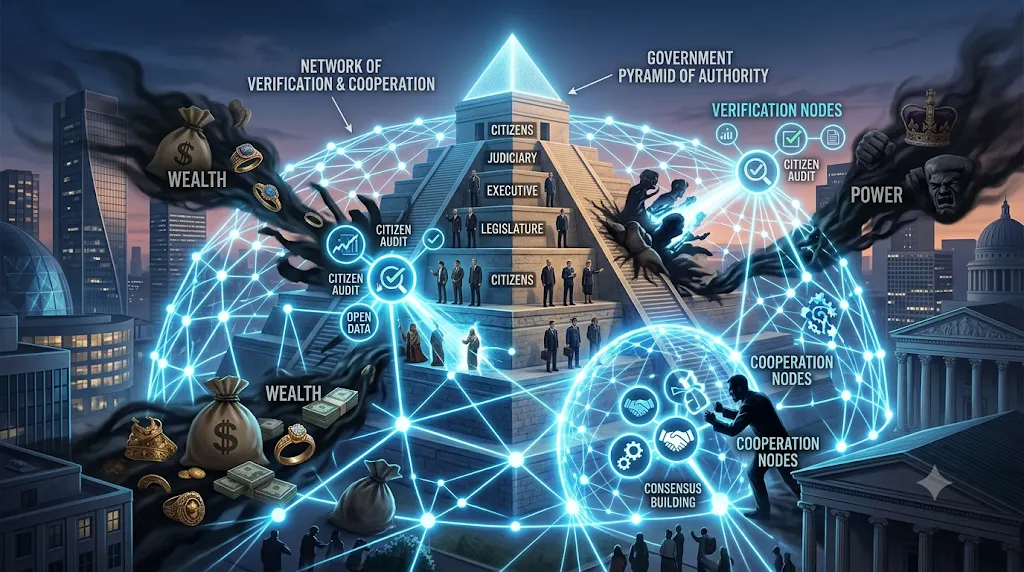
The Network of Verification Immunizes against Corruption of Wealth and Power — Image by Gemini
Taiwan lives under a level of foreign information pressure that most democracies can barely imagine. Researchers have repeatedly ranked it among the societies most targeted in the world by foreign disinformation, the overwhelming share of it originating from the People’s Republic of China. The campaigns are not crude propaganda broadcasts; they are adaptive operations that seed rumors through content farms and messaging apps, amplify domestic grievances, smear candidates, and work to convince Taiwanese citizens that their democracy is chaotic, corrupt, and doomed — that resistance to eventual absorption is pointless. The strategic logic is straightforward: a society that cannot agree on what is true cannot coordinate, and a society that cannot coordinate cannot defend itself.
A centralized government has two bad options against this kind of attack. It can censor, which corrodes the very freedoms it claims to defend and hands the adversary a propaganda victory. Or it can do nothing, and drown. Taiwan built a third option: a distributed civic immune system, in which the capacity to identify and neutralize false information lives in the population itself rather than in a ministry of truth.
The flagship of that system is Cofacts, a project born at a g0v hackathon and launched in 2017 with support from the community’s Civic Tech Prototype Grant. Cofacts attacks the problem where it actually lives: inside LINE, the closed messaging app that dominates Taiwanese family and community life, where rumors circulate in private group chats invisible to journalists and platforms alike. Any user who receives a suspicious message can forward it to the Cofacts chatbot. The bot checks the message against a crowdsourced database of previous fact-checks and replies instantly if a match exists; if not, the message enters a queue where volunteer editors research it, write a response with sources, and add it to the open database. Like Wikipedia, anyone can become an editor, and responses are reviewed and voted on by the community. The entire dataset and codebase are open source.
The design has proven strikingly effective. A 2023 Cornell study comparing tens of thousands of Cofacts responses against professional fact-checking organizations found that the crowdsourced volunteers often responded faster than professional journalists while matching their accuracy, and that they covered ground the professionals missed — hyperlocal rumors, small-time scams, the unglamorous daily sediment of the disinformation economy. Cofacts operates alongside professional organizations like the Taiwan FactCheck Center and the volunteer service MyGoPen, forming overlapping layers of verification, and media-literacy training that includes contributing to these platforms has been woven into Taiwanese school curricula and lifelong-learning programs.
Notice what this architecture does to the economics of influence operations. In a centralized system, an adversary needs to compromise only a few chokepoints — a handful of media owners, officials, or platform algorithms — to shift what a nation believes. In Taiwan’s distributed system, there is no chokepoint. The verification capacity is replicated across thousands of volunteers, an open database, and a population trained to forward before believing. Beijing can flood the zone, and does, but every flood trains the immune system further. The same logic protected the island’s January 2024 presidential and legislative elections, which were conducted under intense cyber and information pressure and proceeded credibly anyway.
The deeper insulation, though, is structural rather than technical. Elite capture works on pyramids: buy or intimidate the top, and the whole structure follows. It works far less well on a society whose policy consensus is formed in the open, across visible clusters of opinion, through processes anyone can audit. When agreement is manufactured in back rooms, citizens cannot distinguish legitimate compromise from a purchased outcome — which is exactly the ambiguity a foreign influence campaign, or a domestic oligarch, needs. When agreement is built in daylight, on platforms whose data and algorithms are public, the purchased outcome has nowhere to hide.
Seventy-Two Hours: The Mask Map and the Pandemic
If the information war shows the network on defense, COVID-19 showed it in emergency response — and produced what may be the single most instructive episode in the entire g0v story.
In early February 2020, with the virus spreading out of Wuhan and global mask supplies collapsing, Taiwan imposed a rationing system: a fixed number of masks per person per week, purchased with one’s National Health Insurance card. The system was fair on paper and chaotic in practice. People queued at pharmacies for hours only to find the stock exhausted; anxious families spent their days messaging each other about which convenience store still had boxes.
In the southern city of Tainan, a software engineer named Howard Wu watched those messages pile up in his family’s LINE groups and did what a g0v-shaped culture had trained a generation of engineers to do: he built the missing tool himself, without asking anyone’s permission. His map let people report and see mask availability at nearby stores in real time. It went viral within hours — so viral that the mapping service fees threatened to bankrupt the project, racking up costs of over six hundred thousand Taiwan dollars almost immediately.
What happened next is the part American readers should study closely. Audrey Tang, then the digital minister, did not commission a government app to compete with Wu’s map, and did not shut it down for using unofficial data. Instead, Tang showed the tool to the premier and made a simple argument: rather than starting a procurement process and waiting weeks for contractors to build something worse, why not just give the civic hackers the real data? On February 6, 2020, the National Health Insurance Administration began publishing the actual mask inventory of thousands of contracted pharmacies across Taiwan — more than thirteen thousand points of sale — as open data, refreshed as often as every thirty seconds. Tang also connected Wu with engineers at Google, which waived the platform costs that had been about to sink the project.
The g0v community took the data feed and ran. Within days, the single map had become an ecosystem of more than a hundred independent tools — maps, mobile apps, chatbots, even voice-assistant integrations — each built by volunteers, each drawing on the same authoritative open data, each serving a different slice of the population. Elderly users who would never install an app could ask a voice assistant. LINE users could query a bot inside the app they already lived in. People standing in a pharmacy queue could watch the store’s counted inventory tick down in real time, which meant they could also hold the system accountable: if the map said forty masks remained and the pharmacist claimed to be sold out, the discrepancy was visible to everyone.
That last point is the one Tang has emphasized repeatedly: the mask map was not merely a convenience tool but a disinformation defense. In a panic, the deadliest rumor is “there are no masks and the government is lying to you.” Radical transparency made that rumor impossible to sustain, because anyone could check the actual numbers at the actual pharmacy on the actual corner. Trust was not demanded; it was made verifiable.
The results spoke for themselves. Through the pandemic’s terrifying first year, while wealthier and larger countries locked down repeatedly, Taiwan — twenty-three million people, a hundred kilometers off the Chinese coast, with massive daily travel links to the mainland when the outbreak began — kept life largely open. By late summer of 2020 the country had recorded fewer than five hundred confirmed cases and seven deaths. Many factors contributed, including early border screening and a public-health system hardened by the SARS experience of 2003. But the civic-tech layer supplied something no health ministry can decree: a population that trusted the information it was given, because it could verify that information itself, through tools its own neighbors had built.
The pattern generalizes far beyond masks. A community that has practiced open, decentralized coordination for a decade does not wait for instructions when a crisis hits, and does not collapse when central systems fail. The coordination capacity is already distributed across the population — in muscle memory, in open codebases anyone can redeploy, in relationships formed at a hundred hackathons. That is what resilience actually looks like at the civilizational scale: not a bunker, but a habit.
The American Disease Is Different

Media-enforced divisions cause gridlock, while consensus-building fosters progress — Image by Gemini
Turn now to the United States, and be precise about what is broken, because the American pathology is not Taiwan’s. No foreign adversary needed to capture the American policymaking process. Domestic money got there first, legally, and built a permanent residence.
The scale is worth stating plainly. The 2024 federal election cycle was the most expensive in history, with total federal spending of roughly sixteen billion dollars, and more than twenty billion once state races and ballot measures are included. Outside groups such as super PACs — vehicles unleashed by the Supreme Court’s 2010 Citizens United decision — spent a record 4.5 billion dollars, and more than half of that outside spending flowed through channels that do not fully disclose where the money came from. Meanwhile, reported federal lobbying reached its own record of 4.4 billion dollars in 2024 alone, a figure that has climbed by more than a billion dollars over the past decade and that understates the true total, since vast influence work falls outside disclosure requirements entirely.
Does the money buy outcomes? The most widely cited attempt to answer that question empirically was published in 2014 by political scientists Martin Gilens and Benjamin Page, who assembled data on 1,779 federal policy questions across more than two decades, matched to public-opinion surveys broken out by income. Their conclusion was blunt: economic elites and organized business interests have substantial independent influence on what the United States government does, while the preferences of the average American have, in their words, a minuscule, near-zero, statistically non-significant impact on public policy. Subsequent scholars have contested aspects of the statistical method, and the debate continues in the journals — but even the critics generally concede that affluent Americans and business groups enjoy large advantages in the policy process. Ordinary citizens feel this without needing a regression: they are asked for their votes every two years, their taxes every year, their labor every day, and their land whenever a pipeline or a stadium wants it, while the decisions that govern all of these are negotiated in rooms they will never enter, on terms they will never see.
This is the American analogue of the closed system Taiwan’s hackers confronted in 2012: a government that says, in effect, the plan is very complex, never mind the details, follow instructions. The difference is that America’s opacity is not a communication failure. It is a business model. Polarization raises campaign money, drives cable ratings, and feeds engagement algorithms; complexity and closed doors are what lobbying purchases. A system like Polis — which mathematically demotes outrage and surfaces the broad, quiet agreements that majorities of Americans actually share — is not merely unfamiliar to that industry. It is a competitive threat to it.
Which is precisely why the work cannot start in Washington, and does not need to. It didn’t start in Taipei’s presidential office either.
Seeds in American Soil
Here is the irony that should give Americans hope: the consensus engine at the heart of Taiwan’s digital democracy is American software. Polis was created by the Computational Democracy Project, a small nonprofit of engineers and researchers based in Seattle, and it is free and open source. Taiwan did not invent the tool; Taiwan supplied the civic culture and the political courage to deploy it at national scale. The tool has been sitting in America’s garage the whole time.
And it is starting to come out. The most ambitious American deployment to date happened in Bowling Green, Kentucky — a mid-sized, politically purple city with a Republican mayor, best known for building Corvettes. Warren County, where Bowling Green sits, is projected to grow dramatically over the next twenty-five years as Nashville’s boom spills north, and county leaders faced a question every growing community knows: grow according to whose vision? As the county’s Judge Executive Doug Gorman put it, that growth can either happen to the community or for it.
In early 2025, a local strategy firm called Innovation Engine, working with the Computational Democracy Project and with Jigsaw — a technology incubator inside Google — and with support from Google.org, launched “What Could BG Be?”, a month-long open online conversation inviting everyone who lives, works, or spends time in Warren County to shape the region’s next quarter century. Residents submitted their own ideas through a Polis conversation and voted on their neighbors’ submissions; large-language-model “sensemaking” tools then helped organize the thousands of contributions into legible themes, with all comments and votes published openly on the project website. The county shared results publicly in April 2025, feeding them into its twenty-five-year comprehensive planning process. The effort had begun as a conventional exercise involving about a hundred community leaders; the network version reached the whole community, and local officials described the response as far beyond what they had imagined. Bowling Green was not even the town’s first experiment — back in 2018, the local Daily News newspaper had partnered with Columbia University’s American Assembly to run a Polis-based virtual town hall on community priorities, one of the earliest such collaborations between a local newsroom and deliberative technology in the country.
A second, complementary current is the American revival of the citizens’ assembly: a deliberative body of ordinary residents selected by civic lottery, the way juries are, to study a hard public question and issue recommendations. In 2022, Petaluma, California convened the state’s first municipal citizens’ assembly, organized by the nonprofit Healthy Democracy: thirty-six lottery-selected residents, demographically representative of the city, spent roughly ninety hours over two months deliberating the future of a contested fifty-five-acre public fairgrounds property that years of politics-as-usual had failed to resolve, and delivered detailed reports to the city council. In 2023, residents of Montrose, Colorado deliberated affordable childcare. In the fall of 2024, a civic assembly in Deschutes County, Oregon took on youth homelessness — thirty delegates, chosen by lottery from thousands of invitations, heard from experts, service providers, and young people with lived experience of homelessness, and produced more than twenty recommendations that each earned the support of at least three quarters of the assembly. These are small bodies, but they attack the same disease vTaiwan attacks: they produce judgments that no donor funded, no consultant scripted, and no party primary distorted, and their legitimacy comes precisely from that independence.
The third current is the research and movement infrastructure knitting these experiments together. In 2024, Audrey Tang and the political economist Glen Weyl — founder of the RadicalxChange movement — published Plurality: The Future of Collaborative Technology and Democracy, a book that distills the Taiwanese experience into a general program for technology that bridges social difference instead of monetizing it. True to its argument, the book was written in the open on GitHub by a global community of contributors, is governed collaboratively, has been translated by volunteers into more than a dozen languages, and is released into the public domain, free to anyone. Around it has grown the Plurality Institute, a research network connecting universities and technologists working on what they call prosocial or plural technology. Among its projects is BridgingBot, an LLM-powered moderation tool designed to intervene in online arguments not by deleting content but by surfacing common ground — developed with partners including researchers at Harvard and UC Berkeley alongside Jigsaw and Google.org, and tested through randomized controlled trials with its code and methods fully open-sourced. Jigsaw, for its part, is working with the Computational Democracy Project to make its sensemaking tools available to Polis users everywhere, which means the full Bowling Green stack is becoming an off-the-shelf kit for any community that wants one.
None of this is a shadow government, and none of it is treason — a worry raised sincerely by people who sense how threatening genuine consensus is to the conflict industry. The Constitution defines treason narrowly, and organizing your neighbors to deliberate in public is about the most protected activity in American law. What these projects actually resemble is what g0v built between 2012 and 2014: working proof, deployed at the edges of the system, that a better process exists. The establishment did not adopt Taiwan’s tools because it was persuaded by essays. It adopted them because the tools were running, visibly outperforming the official process, and refusing them became embarrassing.
How to Take Part
The honest answer to “what can one person do” is not to change the world tomorrow. It is to become a node — and to help stand up the local piece of infrastructure that does not yet exist in your community. The Taiwanese experience suggests the work sorts into four layers, in rising order of commitment.
The first layer is literacy, and it costs nothing. Read Plurality — it is free online at plurality.net, in its entirety, no registration, public domain. Explore the Computational Democracy Project’s case studies at compdemocracy.org to see how Polis conversations have actually run, from Taiwan to Kentucky. Look up your own representatives’ funding on OpenSecrets, which makes the influence economy legible the way Budget Maps once made Taiwan’s spending legible. And if you want to feel what a functioning civic-tech community is like from the inside, join g0v itself: its Slack workspace at join.g0v.tw is open to anyone in the world, its hackathons welcome remote and international participants, and its newcomers’ guides are published in English. Americans are not tourists there; the community’s entire premise is that its methods are meant to be forked.
The second layer is practice at small scale, and this is the step most people skip. You do not need a government’s permission to run a Polis conversation. The software is open source and free. A school board fight, a neighborhood rezoning battle, a church split over a building project, a union contract debate, a company’s return-to-office war — any of these can be run through a consensus-mapping process by one motivated organizer this month. Doing so accomplishes two things: it often genuinely resolves the local fight, and it manufactures the thing American reformers most lack, which is a bench of people who have facilitated networked deliberation and can vouch for it from experience. Every Taiwanese minister who defended vTaiwan had first seen the process work somewhere small.
The third layer is institutional: bringing the tools to your local government, which is far more achievable than it sounds, because the precedents now exist on American soil. A city council member, county executive, or comprehensive-plan committee can be handed the Bowling Green results, the Petaluma reports, and the Deschutes County recommendations — concrete, recent, American, and bipartisan in reception. Organizations exist specifically to help: Healthy Democracy designs and runs lottery-selected assemblies for local governments; groups like Assemble America and Sortition USA advocate for the model and track its spread; the Computational Democracy Project supports public-sector Polis deployments. Local journalism is a natural partner, as Bowling Green’s own newspaper demonstrated back in 2018 — a newsroom that hosts a structured community conversation is doing civic infrastructure work no algorithm will do for it. The pitch to a local official is not ideological, and this matters: the pitch is that the current public-comment process delivers the loudest thirty people, while this process delivers the actual community, with the math shown.
The fourth layer is building and sustaining. Programmers, designers, translators, and researchers can contribute directly to the open-source projects — Polis, Cofacts (whose code and data are open and whose model is explicitly meant to be replicated in other countries and languages), the Plurality book itself, and the projects incubated through RadicalxChange and the Plurality Institute. Those with money rather than time can fund the thin institutional layer that keeps volunteer infrastructure alive; Taiwan’s lesson is that a small amount of stable support — a grants program here, a staffed organizing team there — is what turns hackathon weekends into decade-long institutions. And those with neither can still do the work Cofacts volunteers do every day: adopt the discipline of verifying before forwarding, and make yourself the person in your family group chat who checks.
A warning from the Taiwanese playbook belongs here too. Expect the co-optation attempt. When these methods start working, the existing industry will try to absorb them — consultants will sell “engagement platforms” that harvest input and bury it, and officials will run deliberations whose results they never intended to honor. The defense is the same one g0v built into its DNA: openness as a hard requirement. Real deployments publish the data, the statements, the votes, and the method. Any process that will not show its work is not the network; it is the pyramid wearing the network’s clothes.
What the Network Cannot Do — and What It Can
Clear eyes matter at the end. Consensus software did not repeal the Cross-Strait trade pact; a physical occupation did, and software amplified it. vTaiwan’s recommendations became law because ministers chose to honor them, and its own veterans call it a tiger without teeth when legislators drift. A Polis conversation in Kentucky becomes real only if the comprehensive plan that follows actually reflects it. Citizens’ assemblies advise; councils still vote. None of these tools abolishes power, and anyone selling them as a substitute for organizing, voting, litigation, and journalism is selling something.
What the tools do is change what power has to contend with. A community that has mapped its own consensus in public cannot be told it is hopelessly divided. A recommendation endorsed by three quarters of a lottery-selected assembly cannot be dismissed as the product of a special interest, because it demonstrably is not one. An open dataset cannot be quietly rewritten. A population that has practiced coordinating without permission does not freeze when institutions fail — during a pandemic, after a disaster, or in the face of a propaganda flood. Concentrated wealth thrives on two conditions above all: opacity, which hides what it buys, and manufactured division, which prevents the broad majority from noticing how much it agrees on. Every project described in this piece attacks one or both of those conditions directly.
Taiwan’s civic hackers began with almost comically little: a rude government advertisement, a weekend hackathon, a domain name with a zero in it. They did not ask the pyramid to dismantle itself, and it never did — the ministries, the parties, and the parliament all still stand. What changed is that alongside them there now runs a second system, open and participatory, that the first system must answer to, borrow from, and increasingly depend on. Fourteen years on, that second system has crowdsourced national law, absorbed the full weight of a superpower’s information war, and out-organized a pandemic.
The United States has the software — it wrote much of it. It has the precedents, now, in California and Oregon and Colorado and Kentucky. It has tens of millions of people who correctly sense that the formal channels have been bought, and who have been offered nothing to do about it except rage and a donation link. The Taiwanese answer to that despair was never a manifesto. It was a working alternative, built node by node by people who declined to wait. Ask not why nobody is doing this. You are the nobody.
Sources and Further Reading
Taiwan and g0v
- Taiwan Panorama, “Pioneers of Open Government: g0v’s Civic Hackers” — https://www.taiwan-panorama.com/en/Articles/Details?Guid=736828dd-9df4-48fe-9383-71a5353cf4b7&langId=3&CatId=7
- g0v movement, English-language overview and newcomers’ guide — https://g0v.tw/intl/en/
- g0v Jothon organizing team, community and hackathon documentation — https://jothon.g0v.tw/about/en/
vTaiwan, Polis, and the Uber case
- Computational Democracy Project, vTaiwan case study — https://compdemocracy.org/case-studies/2014-vtaiwan/
- Crowdlaw for Congress, vTaiwan case study — https://congress.crowd.law/case-vtaiwan.html
- MIT Technology Review, “The simple but ingenious system Taiwan uses to crowdsource its laws” (2018) — https://www.technologyreview.com/2018/08/21/240284/the-simple-but-ingenious-system-taiwan-uses-to-crowdsource-its-laws/
- Shareable, “Open-data Hacktivists Help Taipei Craft Regulatory Response to Uber” — https://www.shareable.net/open-data-hactivists-help-taipei-craft-regulatory-response-to-uber/
Cofacts and disinformation defense
- Cornell Chronicle, “Crowdsourced fact-checking fights misinformation in Taiwan” (2023), covering the study by Andy Zhao and Mor Naaman — https://news.cornell.edu/stories/2023/11/crowdsourced-fact-checking-fights-misinformation-taiwan
- Taiwan Insight, “Three Musketeers against Mis/disinformation: Assessing Citizen-led Fact-checking Practices in Taiwan” — https://taiwaninsight.org/2023/03/31/three-musketeers-against-mis-disinformation-assessing-citizen-led-fact-checking-practices-in-taiwan/
- Cofacts, project site and open database — https://en.cofacts.tw/
The mask map and pandemic response
- Carnegie Council, “Taiwan’s Digital Response to COVID-19, with Audrey Tang” (March 2020) — https://www.carnegiecouncil.org/media/podcast/20200331-taiwan-digital-response-covid-19-audrey-tang
- Taiwan Ministry of Health and Welfare, account of the open-data mask inventory release — https://covid19.mohw.gov.tw/en/cp-4868-53923-206.html
- The News Lens, “Audrey Tang Praised for Coronavirus Prevention Tactics” — https://international.thenewslens.com/article/132023
- Ketagalan Media, “Fast, Fair, Fun: Taiwan Digital Minister Audrey Tang On Pandemic Response” — https://ketagalanmedia.com/2021/02/06/fast-fair-fun-taiwan-digital-minister-audrey-tang-on-pandemic-response/
US campaign finance and policy influence
- OpenSecrets, “Total 2024 election spending projected to exceed previous record” — https://www.opensecrets.org/news/2024/10/total-2024-election-spending-projected-to-exceed-previous-record/
- OpenSecrets, “Federal lobbying set new record in 2024” — https://www.opensecrets.org/news/2025/02/federal-lobbying-set-new-record-in-2024/
- OpenSecrets, “Outside spending on 2024 elections shatters records, fueled by billion-dollar ‘dark money’ infusion” — https://www.opensecrets.org/news/2024/11/outside-spending-on-2024-elections-shatters-records-fueled-by-billion-dollar-dark-money-infusion/
- Gilens and Page, “Testing Theories of American Politics: Elites, Interest Groups, and Average Citizens,” Perspectives on Politics (2014) — http://piketty.pse.ens.fr/files/GilensPage2014.pdf
- Bashir, “Testing Inferences about American Politics: A Review of the ‘Oligarchy’ Result,” Research and Politics (2015) — https://journals.sagepub.com/doi/10.1177/2053168015608896
American deployments
- Jigsaw, “What Could BG Be? Enabling a Large-Scale Conversation in Kentucky” — https://medium.com/jigsaw/what-could-bg-be-enabling-a-large-scale-conversation-in-kentucky-70071f4fe268
- Fast Company, “A partnership between Jigsaw and this Kentucky city could be the future of civic engagement” — https://www.fastcompany.com/91278879/jigsaw-bowling-green-kentucky-civic-engagement
- StateScoop, “Kentucky city wraps AI project collecting community planning feedback” — https://statescoop.com/bowling-green-kentucky-ai-community-planning/
- New America, “Building the Future of Democracy in Petaluma, California” — https://www.newamerica.org/political-reform/briefs/citizens-assemblies-petaluma-california-cogovernance/
- Healthy Democracy, 2024 Deschutes Civic Assembly — https://healthydemocracy.org/home/projects/deschutescivicassembly/
Plurality
- E. Glen Weyl, Audrey Tang, and the Plurality Community, Plurality: The Future of Collaborative Technology and Democracy, free and public domain — https://plurality.net/
- Plurality Institute, research and the BridgingBot project — https://www.plurality.institute/