Rorschach Tests in Drop-D Tuning and the Last Secrets of the Analog Afternoon
Nov. 1, 2026 — Madkat Omega
A Note on Format: Soundtracking the Static
This essay is designed to be experienced as a five-track play-along mixtape. Before you read each section below, queue up the accompanying video link, turn the volume up until the midrange pushes against the speaker cones, and let the track play in parallel with the prose. Resist the modern reflex to glance at a lyric sheet. Let the vocal distortion, the buried syllables, and the analog murk wash over you the way they did through a dashboard tape deck in 1994 — when the distance between what the singer recorded and what your mind needed to hear was the only space that truly belonged to you.
Before the internet flattened every mystery into a two-second search query, listening to music was an act of forensic imagination conducted in empty rooms. If you were sixteen in 1994, the official text of your favorite song was rarely available. Liner notes in cassette J-cards and CD booklets were notoriously unhelpful — either omitting the lyrics entirely in favor of cryptic photomontages and illegible handwriting, or printing words that bore almost no resemblance to what the vocalist actually ended up screaming into the studio microphone.
You listened through the blown-out paper cones of a 1984 Civic’s door speakers, or lying flat on the shag carpet of a wood-paneled basement while afternoon dust motes drifted through the gray light of a window well. Around your neck, or tossed onto the laminate kitchen counter beside a box of cereal, was a brass house key. For a generation of kids navigating the quiet gulf between the 3:00 PM school bell and the 6:30 PM crunch of a parent’s tires in the driveway, that silence was vast, unmonitored, and sometimes heavy. When alternative rock flooded into that vacuum, its defining aesthetic was acoustic obstruction: dropped tunings, walls of Big Muff fuzz, and frontmen who treated crisp enunciation like a corporate compromise. Kurt Cobain, Michael Stipe, Chris Cornell, Scott Weiland, and Billy Corgan didn’t sing to you; they slurred, rasped, and swallowed syllables from the bottom of an emotional well.
When what reaches the ear is buried in distortion or slurred past the point of recognition, the human mind stops acting as a passive stenographer and becomes an active author. Starved of clear answers, the brain reaches into its own private inventory of memories, unspoken anxieties, and lived truths to mortar the gaps in the sonic wall. In 1954, the writer Sylvia Wright coined the term mondegreen for these misheard lyrics, framing them as quaint linguistic slips. But for Generation X teenagers coming of age in the twilight of the analog world, mondegreens were never mere parlor trivia. They were Rorschach tests in drop-D tuning — accidental psychodramas through which an unparented generation projected its deepest fears into the static and co-authored a private philosophy of survival.
The Gospel of Latchkey Solipsism
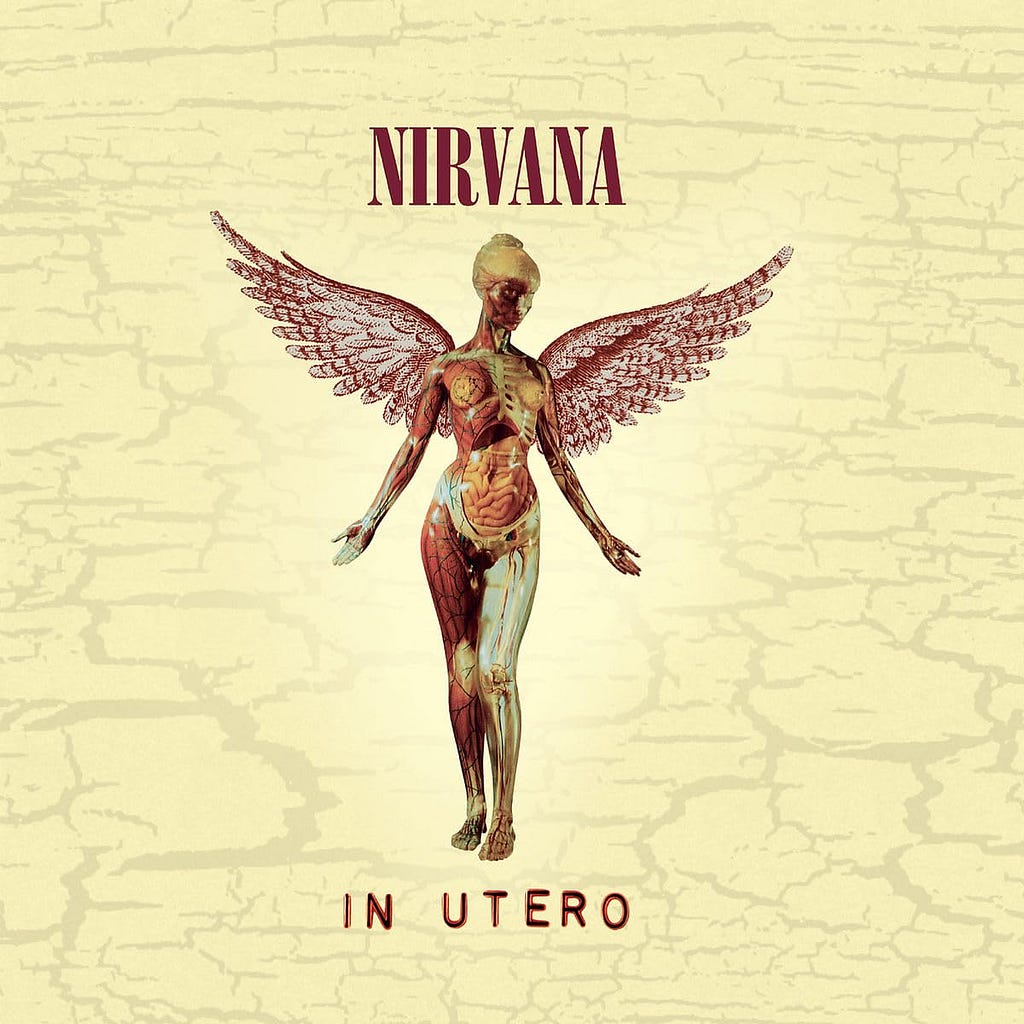
Nirvana: In Utero (DGC Records, September 21, 1993)
When Nirvana released In Utero in the autumn of 1993, producer Steve Albini recorded the band with an abrasive, room-mic intimacy that made Kurt Cobain sound as though he were sitting right beside you. In the closing refrain of “All Apologies,” as the cello and accordion dissolve into a hypnotic, funereal drone, Cobain repeats a single line thirteen times until his voice frays into ash: “All in all is all we are.”
Written on paper, the actual lyric is a flat, exhausted tautology — a quasi-Buddhist shrug at the end of history suggesting that when you strip away human pretension, the sum total of our striving reduces to the bare fact of what we are.
Yet across millions of bedrooms, played on the Alternative radio station or a portable Discman, the line was almost universally decoded as “All alone is all we are.”
It took no clinical textbook to explain why. Cobain didn’t enunciate the phrase so much as he exhaled it through clenched teeth, letting the words blur into an acoustic fog until the listener’s mind simply reached in and pulled out the truth it was already living. To a teenager raised in the wreckage of the 1970s and 80s divorce boom — whose parents were either hollowed out by dual-income survival or chasing the receding mirage of Reagan-era upward mobility — solitude was not a passing mood. It was the foundational architecture of daily life. A detached, collective summary like “All in all” offered some sarcasm and more than a little irony to a kid eating dinner alone in front of a glowing CRT television. By hearing “All alone is all we are,” the Gen X mind performed an act of desperate existential alchemy: it took the private sting of abandonment and forged it into an impenetrable philosophical shield.
If solitary aloneness is the immutable baseline of human existence, then rejection loses its teeth. Consider what that mantra did for an adolescent absorbing the unspoken violence of family fracture. When a household splits apart, or when the people who brought you into the world treat your presence as an inconvenient logistical hurdle, the natural instinct of a child is to internalize the blame — to assume there is something uniquely defective inside them that broke the contract of blood. “All alone is all we are” severed that guilt at the root. It declared that the contract was a polite fiction from the beginning. A cold kitchen and an empty driveway at four in the afternoon were not proof that you had failed as a son or a daughter; they were simply the early removal of a stage curtain. You cannot be banished from a sanctuary that never existed, and you cannot be broken by the loss of a domestic warmth that was only ever a temporary illusion hiding the truth of the world.
That same cold calculus neutralized the sting of religious exile. For teenagers navigating the moral rigidity of 1990s church culture — who sat in fluorescent-lit youth groups feeling the sharp edge of institutional judgment, or who stared at their bedroom ceilings at two in the morning praying to a heaven that returned only dead air — spiritual rejection was a lacerating wound. To be told you are fallen, or to feel nothing at all when everyone around you claims to feel the embrace of grace, is to feel cosmically outcast. Mishearing Cobain’s refrain rewrote that theology overnight. If being alone is the sum total of what we are, then the silence at the other end of a prayer is not a divine indictment of your sins; it is simply the natural acoustics of an empty universe. You no longer needed to beg a hypocritical congregation for belonging or grovel before an absentee God for forgiveness, because nobody was ever inside the fold to begin with. At least you know the truth while others pretend to know theirs.
Most profoundly, this philosophy granted even a self-perceived coward the ability to face death without apology. Traditional models of courage demand that we puff out our chests and pretend we aren’t terrified of the end — because to someone tethered to family, faith, and tribe, death is the ultimate violence: a forced exile that rips you away from the warmth of the herd and hurls you into the dark by yourself. But for the kid who didn’t feel heroic — who felt fragile, cornered, and privately ashamed of their own fear — accepting that the cosmic baseline was, is, and always will be utter solitude stripped the grim reaper of his leverage.
Death cannot threaten you with isolation when isolation is the only room you have ever inhabited. Even a coward can look into the abyss unapologetically, without trembling and without begging for mercy, once he realizes the void isn’t taking anything away that he ever truly possessed. If you enter the world alone and walk through its hallways alone, then stepping into the final dark is neither a tragedy nor a defeat — it is simply returning, intact and unowed, to the sovereign quiet where you began. You have to admit, there is some peace, warmth, and comfort to that perspective.
Suffocating Beneath the Suburban Consensus
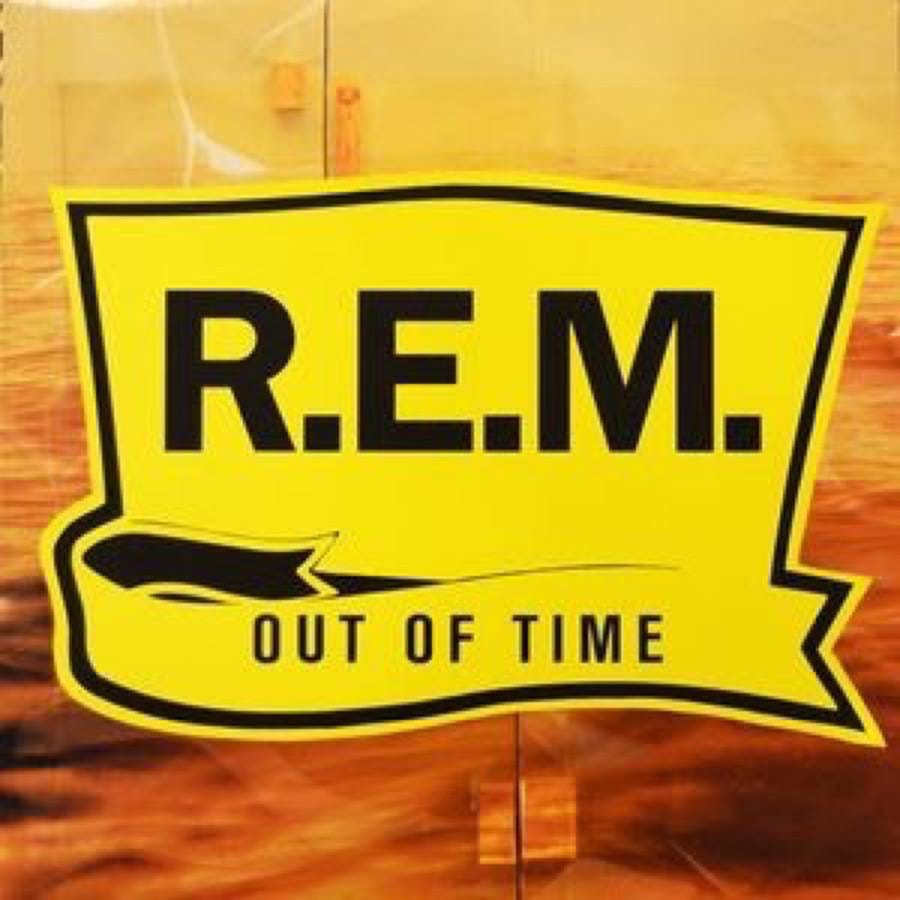
R.E.M.: Out of Time (Warner Bros. Records, March 12, 1991)
Two years before In Utero, R.E.M. had cracked open the glossy, hair-sprayed hangover of the late 1980s with “Losing My Religion,” a minor-key urgency driven by Peter Buck’s relentless mandolin. When Michael Stipe sang “That’s me in the corner / That’s me in the spotlight / Losing my religion,” he was drawing on an old Southern expression for being pushed to the absolute brink of one’s temper and civility, using it to frame a delicate portrait of unrequited, paralyzing infatuation.
Yet for legions of teenage listeners who had never stepped foot in Athens, Georgia, Stipe’s rapid, clipped delivery of spotlight mutated in the ear into something far more brutal. Across suburban basements and high school parking lots, the line became: “That’s me in the corner / That’s me in the dog pile / Losing my religion.”
The mind edits what it hears until the words match the room it is standing in. To an adolescent shuffling through the fluorescent-lit corridors of an overcrowded public school or biking past identical vinyl-sided cul-de-sacs, the theatrical grandeur of suffering beneath a spotlight felt like a lie. A spotlight implies an audience that is paying attention. It implies that your tragedy has weight, that you are a singular protagonist on a stage, and that some higher director — whether God, parents, or society — is watching your struggle with invested eyes. Nobody in 1992 felt watched with that kind of care. They felt buried.
Replacing the spotlight with a dog pile stripped away the romantic dignity of martyrdom and replaced it with the visceral physics of mass conformity. In a dog pile, there is no dramatic villain you can square your shoulders against and fight face-to-face; there is only the blind, compounding gravity of everyone else’s bodies stacked on top of yours, pressing your ribs into the dirt until your lungs can no longer draw breath. Each body added to the heap is just following the momentum of the crowd — the standardized testing rubrics, the pep rallies, the suffocating cheerfulness of the mall, the pre-scripted conveyor belt toward a cubicle and a mortgage.
Once that single misheard noun locked into place, the rest of the verse transformed into a devastating anatomy of uncontrollable loss. It begins “in the corner” — backed against the wall of your own shrinking interior life, clutching the handful of fragile, unmarketable things that actually mattered to you: your strange tastes, your secret loyalties, your refusal to fake an enthusiasm you did not feel. From that corner, “losing my religion” ceased to be a quaint Southern idiom about polite frustration and became the sound of your soul’s private north star being systematically ripped out of your hands. The status quo does not merely ask for outward compliance; it rolls forward like a brutal steamroller of conformity, flattening every conviction and idiosyncrasy that makes you who you are until nothing remains that isn’t paved over and serviceable to the machine.
That is what made the verse’s final, breathless confession — “Trying to keep up with you / And I don’t know if I can do it” — hit with such seismic weight. The true psychological violence of modern conformity is that it forces you to participate in your own erasure. Even as you watched everything sacred to you get torn away by the gears of the status quo, the terror of falling behind kept your feet moving on the treadmill. You destroyed yourself trying to match the pace of the very steamroller that was crushing you, amputating a piece of your identity at every mile marker just to keep pace with a crowd you never wanted to join — until you were finally left trembling in the corner, realizing that admitting I don’t know if I can do it wasn’t a confession of failure, but the last desperate reflex of a human soul refusing to be taken away.
A Prayer to Burn It All Down
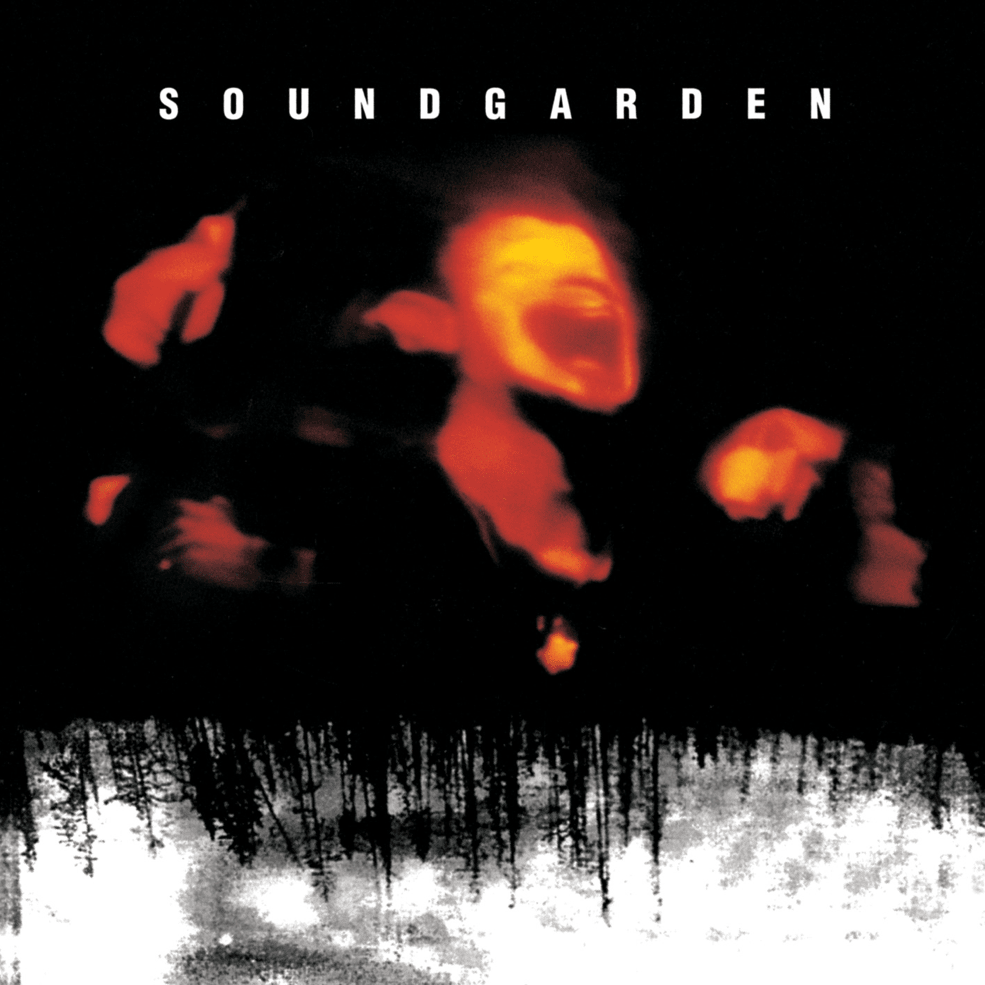
Soundgarden: Superunknown (A&M Records, March 8, 1994)
By the summer of 1994, the alternative explosion had reached its zenith, and no song captured its sun-bleached dread quite like Soundgarden’s “Black Hole Sun.” Its accompanying music video played less like surrealist art and more like an documentary of the suburban soul: manicured lawns, backyard barbecues, women obsessing over makeup, and men doing calisthenics, all stretching their mouths into grotesque, plastic grins while the sky curdled above them. Over a murky, waterlogged guitar arpeggio, Chris Cornell’s four-octave wail climbed toward the heavens: “Black hole sun, won’t you come / And wash away the rain.”
On paper, Cornell had written a detached poetic riddle — asking an inverted star to somehow wash away water. On the recording, the consonant at the start of rain isn’t even obscured. Yet a massive swath of the generation ignored the clear evidence of their own ears and sang the chorus back as a ferocious, collective liturgy: “Black hole sun, won’t you come / And wash away the pain.”
That mishearing had nothing to do with slacker posturing, plaid flannel, or defensive sarcasm. It erupted from a far deeper, more primal terror: the dizzying realization that the entire world you had been raised to inherit was a fraud, and the terrifying premonition that everything you knew was hurtling toward its end.
To look out at the landscape of mid-1990s respectability was to witness an exhausting, joyless pageant of mandatory conformity. It was a kingdom of immaculate white picket fences, chemically green cul-de-sacs, and a pointless, frantic striving for physical and material perfection. Every surface was polished, every body was expected to be sculpted and camera-ready, and every household was locked in a silent competition to project an appearance of happiness that was never true — and could only ever have been a lie. There was no room in that architecture for grief, ugliness, doubt, or human frailty; there was only the compulsory grin, held in place until the muscles in your face cramped.
There is a specific, hollowing pain that comes from waking up inside a counterfeit dream. When you realize as a teenager that the prize waiting at the end of years of obedience is just a mortgage on a stage set and a lifetime of pretending to be fulfilled, the future stops looking like a promise and starts looking like a trap. Yet seeing through the illusion did not make its collapse any less terrifying. Even when a world is built on a lie, it is still the only world you have ever known. To watch the credibility of family, church, and suburban security rot away from the inside out was to feel the ground break away beneath your sneakers, leaving you suspended between the agony of clinging to a fake world and the sheer dread of watching everything familiar disappear.
That is why “Wash away the pain” became an apocalyptic prayer offered up to the sky. Ordinary sunlight only served the lie — it bleached the picket fences whiter, illuminated the glossy magazine covers, and forced everyone to keep squinting and smiling for the neighbors. Gentle rain could never scrub away a deceit that bone-deep. To stop the ache of living inside a mandatory performance, you needed a collapsing star: a black hole in the center of the daytime sky vast enough to devour light itself, rip the manicured lawns out by their roots, and burn the whole fraudulent pageant to the ground.
Singing that misheard chorus was simultaneously a fierce rebuke of a plastic world and a trembling surrender to the inevitable. It was the sound of a youth culture staring straight at the end of everything it knew, concluding that a lie cannot be reformed, and praying for a cosmic reckoning strong enough to incinerate the facade and wash the pain of pretending away forever.
The Panic of Nowhere Left to Run
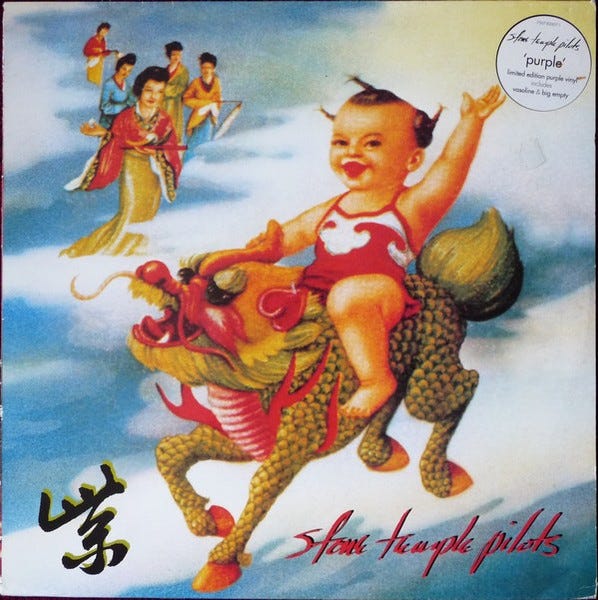
Stone Temple Pilots: Purple (Atlantic Records, June 7, 1994)
That same summer, Stone Temple Pilots dominated the airwaves with “Interstate Love Song,” a track built on a deceptively warm, open-highway guitar slide that masked one of the bleakest lyrics of the decade. As Scott Weiland’s smoky, tar-thick baritone glided over the chorus, he chronicled the quiet cowardice of addiction, relapse, and broken promises: “Leavin’ on a train / Leaving on a train / There’s no time to lose.”
On the record, the narrator is reaching for the oldest escape hatch in the American mythos: slipping out the back door when the wreckage of your choices catches up with you, buying a ticket, and letting geography do the work of absolution. Yet as Weiland’s voice dragged and slurred inside the dense midrange mix of car stereos across the country, the line inverted itself entirely. For countless listeners, the chorus became a suffocating command: “Breathing all the truth / There’s no time to lose.”
Consider the philosophical chasm between those two sentences. Leaving on a train belongs to the frontier fantasy of our parents’ Boomer generation — the belief that you can always abandon a failed marriage, a hollowed-out factory town, or a betrayed promise, and simply reinvent yourself three states over. Breathing all the truth is the exact opposite. It is the claustrophobic realization that the frontier is closed, the tracks have been paved over with identical strip malls, and there is nowhere left on earth to run.
Growing up in the 1990s meant marinating in an atmosphere of polite, institutionalized dishonesty. Families fractured behind closed Venetian blinds while pretending everything was fine for the neighbors; evening news broadcasts turned foreign wars and domestic decay into slick entertainment packages; anti-drug assemblies preached abstinence while the medicine cabinets at home rattled with prescriptions. Lies were the oxygen of polite society.
To hear “Breathing all the truth / There’s no time to lose” was to experience a sudden adolescent awakening. It turned a song about a liar’s retreat into a terrifying confrontation with radical accountability. It taught that the truth is not a gentle philosophical concept you read about in a book; it is a heavy, burning gas that fills the room the moment the illusions collapse. You cannot outrun it on a train, and you cannot hold your breath forever. Surviving the transition into adulthood meant standing completely still in the wreckage you inherited — or the wreckage you made — and forcing your lungs to inhale that unvarnished reality whole, before your breath ran out and you lost your only chance to become an authentic human being.
The Subtle Violence of Those We Love
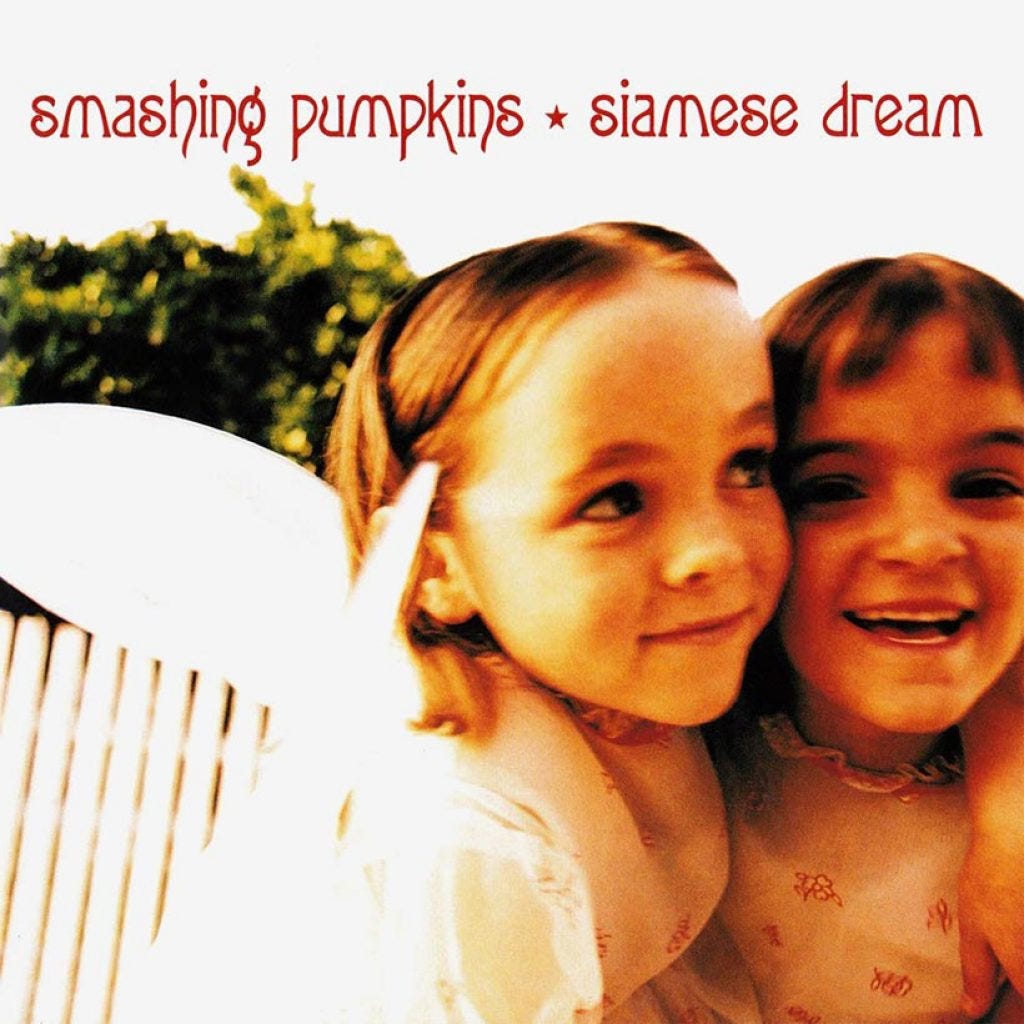
The Smashing Pumpkins: Siamese Dream (Virgin Records, July 27, 1993)
The Smashing Pumpkins articulated the perilous intimacy of our trusted best friends and cherished first loves. On 1993’s Siamese Dream, “Disarm” swells with dramatic strings and funerary bells while Billy Corgan’s nasal, razor-wire snarl cuts across an acoustic strum: “Disarm you with a smile / And cut you like you want me to.”
Corgan was writing a private reckoning with domestic hostility — the tactic of using charm to defuse volatile parents while harboring a volcanic interior rage. Yet when the track poured out of bedroom speakers late at night, the unstressed opening syllable frequently vanished beneath the weight of the acoustic guitars. Instead of the defensive verb disarm, the ear caught a confession of intimate cruelty: “Harm you with a smile / And cut you like you want me to.”
Drop that single syllable, and the song ceases to be about keeping an enemy at bay; it becomes an unflinching meditation on the subtle, devastating violence we inflict upon the people we love the most.
To understand why that paradox — a warm smile paired with a deliberate blade — struck such a raw nerve in the Gen X psyche, you have to understand how we survived our youth: we raised each other. There was a reason movies like The Goonies and E.T. formed the foundational mythology of our childhoods. In those stories, adults are either oblivious buffoons wandering through the background or faceless authorities with walkie-talkies and keys; survival depends entirely on a feral, self-contained pack of best friends pedaling bicycles into the dark, bound by an unspoken oath to never leave anyone behind, and stick together no matter what.
By the time the 1990s arrived and we aged into teenagers, that childhood adventure had hardened into a rough, self-governing tribal law. When the adults abdicated the afternoon — locked in their own volatile relationships, working late, or emotionally checked out — your friends stopped being mere playmates. They became your surrogate parents, your therapists, your sanctuary, and your court of last resort. We had to hold each other up when the bottom fell out of someone’s home life, and just as crucially, we had to police and punish each other when someone screwed up.
Living inside a pack of kids raising other kids meant learning two brutal truths about human closeness. First, a ruthless form of love was sometimes required to keep each other alive. When no father or mother was around to set boundaries, your best friends had to be the ones to administer the correction. When you were spiraling, lying to yourself, or drifting toward self-destruction, a true friend would look you dead in the eye with a crooked, knowing smile and cut your delusions to ribbons. It was a surgical violence — “cut you like you want me to” — because deep down, beneath your pride, you were desperate for someone to care enough to stop you from wrecking your life. Being corrected by your friends was proof that you were still anchored to the earth, that someone was still paying attention.
Second, and far more darkly, that tight-knit dependence meant that the people we loved the most held a monopoly on our survival. An absentee parent had already spent their ammunition, and an indifferent institution like school or church couldn’t touch your core. Only the person who knew every fracture in your armor — the best friend who knew what your house was like with no food, who knew how to take care of the dog and talk to your little brother, your first love who held your deepest shame and still accepted you as the imperfect not-quite adult you were — stood close enough to slip a blade between your ribs without ever dropping their gaze.
Hearing “Harm you with a smile” captured the tragic collateral damage of an unparented generation trying to love each other without a blueprint. Clumsy with our own jagged edges, terrified of abandonment yet starved for loyalty, we inevitably turned our sharpest weapons on the very circle that kept us alive. We hurt the people we loved the worst because they were the only ones who really knew us — and we took the cuts they gave us in return, knowing that even a scar from a friend was infinitely warmer than the cold vacuum of being stuck in your room alone.
The Twilight of the Unmonitored Soul
Looking back across the chasm of thirty years, it is dangerously easy to flatten the 1990s into a harmless nostalgia aesthetic — a Polaroid photo collage of Blockbuster Video aisles, neon windbreakers, and peacetime economic boom. The unambiguous reality on the ground was far sharper, colder, and darker. The misheard lyrics of the era endured as generational scripture precisely because the wounds they accidentally named were real. The domestic neglect was real. The deindustrialization hollowing out Rust Belt towns and timber communities was real. The quiet epidemics of untreated depression, overdose, and suicide that claimed both the heroes on the radio and the kid sitting two rows over in third-period algebra were devastatingly real. We heard “All alone is all we are,” “Wash away the pain,” and “Harm you with a smile” because our minds were wired for survival in a world that offered very little shelter.
Yet bound up inside that abandonment was a fierce, intoxicating sovereignty that no generation since has been permitted to taste. We clung to that cold brass latchkey around our necks — not because we enjoyed coming home to dark kitchens, but because we understood the unspoken terms of the treaty: the price of nobody watching out for you was that nobody was watching you.
When school was out at 3:15 PM, or when you pedaled a rusted mountain bike past the edge of the suburban cul-de-sac into the scrub pines by the railroad tracks, you stepped into an unmapped, unindexed blind spot. Your afternoon belonged entirely to you. When you were upset, you could sit on a concrete culvert in the rain and be miserable without a camera turning your grief into an algorithmic performance. You could make catastrophic mistakes, mend your own scrapes, and outgrow your worst ideas without leaving a permanent, searchable digital log of embarrassment behind you. And you could listen to a muddied cassette tape for five straight years, completely mishearing every word Kurt Cobain or Scott Weiland sang, and build an entire architecture of personal meaning inside that error without a glowing screen leaping in to correct your spelling.
Beneath all the distortion and defensive armor of the late 1990s lay a quiet, nameless premonition that this feral sanctuary was living on borrowed time. You could hear the future clearing its throat in the harsh, robotic screech of the first 28.8k dial-up modems colonizing the family den. You could see it in the magnetic barcodes beginning to appear on plastic student ID badges, and the dome security cameras sprouting like pale mushrooms in the corners of the school cafeteria. We knew, in our marrow, that the acoustic fog was about to be burned away.
The coming wave of ubiquitous connectivity and total digital surveillance would not merely hand us the official lyric sheets in crisp, indisputable text; it would eliminate the shadows where a human mind is allowed to wander, discover, and author its own soul in the dark. We sang our wrong words at the top of our lungs because they were the last secrets we would ever own — shouted into the fading light of the final unmonitored afternoon, right before the whole world turned its cameras on and the static went silent forever.
Works Cited & Further Reading
- Wright, Sylvia. “The Death of Lady Mondegreen.” Harper’s Magazine, November 1954, pp. 48–51. The foundational essay in which Wright coined the term “mondegreen” after recounting how her childhood ear transformed the Scottish ballad “The Bonny Earl of Murray” — specifically the lines “Ye Highlands and ye Lawlands, / Oh, where hae ye been? / They hae slain the Earl Amurray, / And laid him on the green” — into the tragic double murder of the Earl and “Lady Mondegreen.” Crucially, Wright argued that misheard lines are often emotionally richer and more urgent to the listener than the original text.
- Warren, Richard M. “Perceptual Restoration of Missing Speech Sounds.” Science, vol. 167, no. 3917, 1970, pp. 392–393. The landmark psychoacoustic study demonstrating the “phonemic restoration effect”: when syllables or consonants are masked by noise or distortion, the human brain does not register a gap; instead, it actively authors the missing sound using the listener’s internal context and expectations.
- Bregman, Albert S. Auditory Scene Analysis: The Perceptual Organization of Sound. MIT Press, 1990. The definitive cognitive psychology text exploring how the human auditory system applies Gestalt closure and schema-driven processing to extract coherent meaning from dense, overlapping, or degraded sonic environments.
- Rorschach, Hermann. Psychodiagnostics: A Diagnostic Test Based on Perception. 1921. Translated by Paul Lemkau and Bernard Kronenberg, Grune & Stratton, 1942. The classic framework of projective psychology, establishing that when a human subject is confronted with an ambiguous stimulus, the interpretation they construct reveals the underlying architecture of their own subconscious anxieties, defenses, and lived reality.
- Connor, Steven. Beyond Words: Sobs, Hums, Stutters and Other Vocalizations. Reaktion Books, 2014. A philosophical exploration of paralinguistic sound — examining how rasps, slurs, breaths, and vocal distortion bypass literal dictionary definitions to transmit raw emotional truth between singer and listener.