The Accountability Gap in Alex Karp’s AI Nationalization Pitch
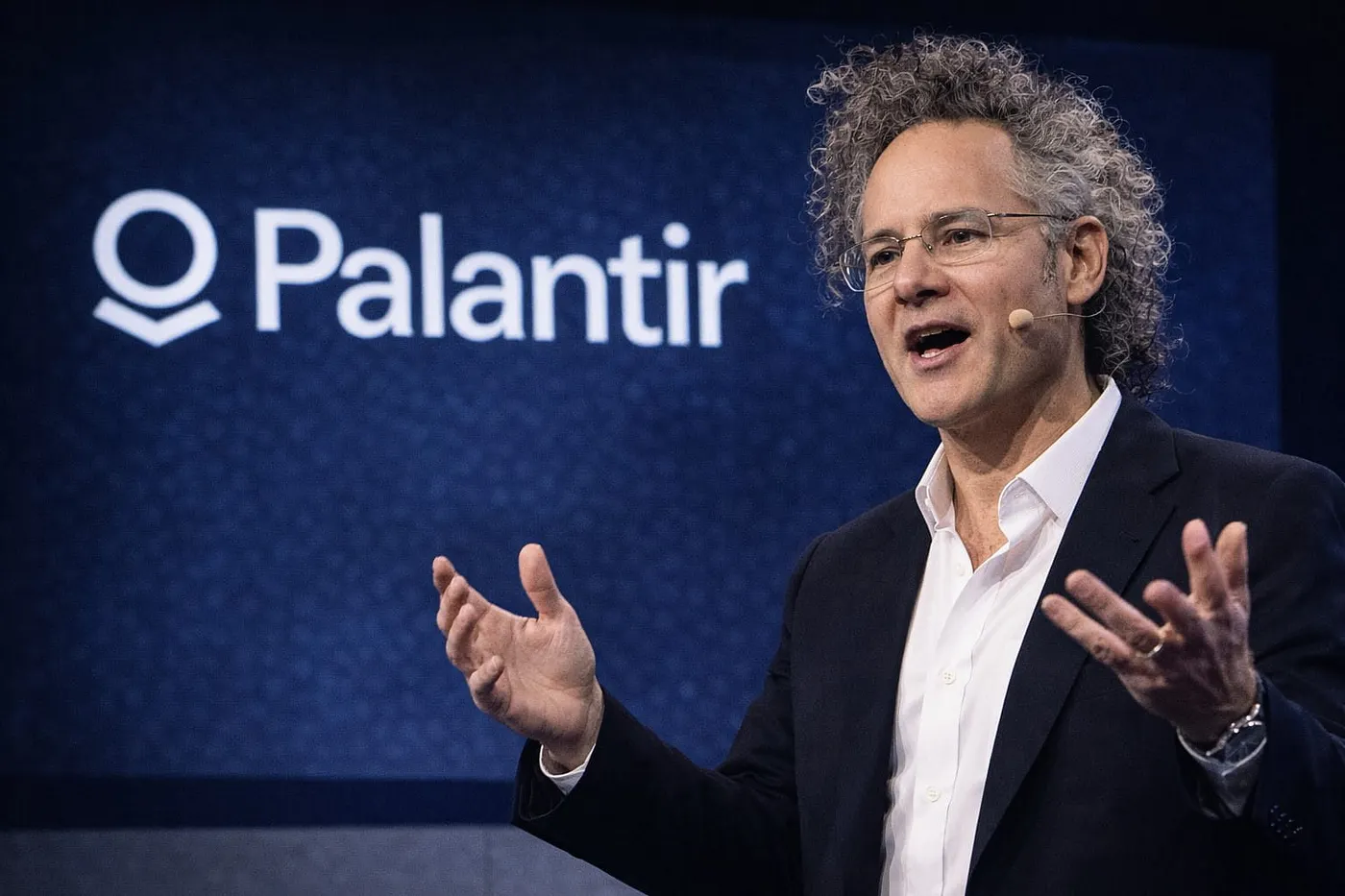
Alex Karp, CEO of Palantir — Image from diariobitcoin.com
Sep 27, 2026 · Madkat Omega
Two Announcements on the Same Thursday
On Thursday, September 17, two statements about responsibility for artificial intelligence went out on the same day. A United Nations fact-finding mission said there were reasonable grounds to believe that the American strike on the Shajareh Tayyebeh Elementary School in Minab, Iran, amounted to a war crime. The strike, on the first day of Operation Epic Fury, killed 156 people, 120 of them children. The target had moved through Maven Smart System, the AI-enabled targeting platform that Palantir built for the Pentagon.
That same day, Palantir’s chief executive, Alex Karp, went on CNBC’s Squawk on the Street to talk about AI liability. His message was that the people who build dangerous AI should answer for it in court, civilly and criminally. It was a striking thing to hear from the head of the company whose platform sat at the center of the deadliest targeting error of the war. It became more striking once it was clear which builders he had in mind.
What Karp Actually Said
Karp’s case rests on liability. Enforceable rules for AI are desirable but, in his telling, unachievable, so the courts have to do the work instead. “The first line of defense is you’re liable for your own actions,” he told CNBC, and developers who act irresponsibly should face both civil and criminal penalties. A company that builds technology capable of destroying a tenth of the world, he argued, should expect that kind of exposure.
Then came the turn that made headlines. Karp said he believes the leading AI labs, the companies that build frontier models such as Anthropic and OpenAI, have concluded that they must be nationalized, because otherwise every single one of his clients is going to sue. Asked how a lab would disclose that liability to investors in a public offering, he suggested the likelier path is a lab going to Washington and asking to be taken over. In his reading, the labs’ loud warnings about AI risk are less about safety than about getting the government, instead of the courts, to absorb the fallout.
What Karp did not offer is as telling as what he did. He named no standard for what conduct would trigger liability, no agency to enforce it, and no plan for how government ownership would work. The proposal is a structural argument, not a policy. And the structure assigns responsibility in a particular direction.
Three Layers, One Target
A modern AI decision system is built in layers, and the question of who is liable depends on which layer you look at. At the bottom sits the data: government intelligence databases, satellite and sensor feeds, and the analysts who label what they show. At the top sits the foundation model, the large language model from a company such as Anthropic or OpenAI that can read, summarize, and converse. Between them sits the integration layer, the software that pulls the data together, runs it through models, ranks the results, and presents a finished recommendation to a human being. In the targeting pipeline used against Iran, that middle layer was Palantir’s Maven.
The integration layer is where the workflow is designed. It decides which data gets fused, which warnings appear on screen, how recommendations are ranked, and how fast they move. Maven was built to produce roughly 1,000 target packages an hour, and the head of the Pentagon’s digital and AI office credited it with enabling the roughly 1,000 targets struck on the war’s first day. That speed is Palantir’s product.
Karp’s liability argument points at the top layer. The “builders” he wants exposed to lawsuits are the frontier labs, whose models he describes as carrying unlimited risk. Some coverage of the interview read him as placing that liability on the developers themselves, not the companies that deploy their models. Palantir, in this framing, is a deployer. When a failure happens, blame can flow down to bad data or up to an unpredictable model, and the layer in the middle, the one that set the pace and shaped the output, is described as neither.
The Minab Test
The fairest way to judge a liability proposal is to run it against a real failure and ask whether it would have changed the outcome. Minab offers the clearest test available.
The school had been separated from a neighboring Revolutionary Guard naval compound for close to a decade. Satellite images showed its own entrances, a playground, and walls painted pink and blue for the girls’ and boys’ yards, and the school kept a website and social media accounts. Yet a Defense Intelligence Agency record still classified the site as military, and it entered Maven with that label uncorrected. According to CNN, intelligence systems warned that the data behind Iranian targets was badly out of date, and senior commanders approved strikes anyway. Central Command’s civilian-harm team, whose job was to catch exactly this kind of error, had been cut from ten people to one, and no one from it reviewed the site. Some personnel, Bloomberg’s sources said, simply expected Maven to flag stale intelligence on its own. At the pace the platform was built for, the writer Kevin T. Baker calculated in The Guardian, a reviewer had about 3.6 seconds per decision. In other words, they were set up to fail.
Now apply Karp’s rule. Suppose every frontier lab faced civil and criminal liability for harms caused by its models. Nothing in the Minab failure chain would have changed. A lawsuit against a model maker would not have refreshed the intelligence agency’s label, restored the civilian-harm team, slowed the targeting cycle, or stopped a commander from overriding a warning. Baker argues that the language models inside it served as a conversational layer over the platform rather than the component that selected targets. The failure lived in the data, in the workflow, and in human command decisions. A rule aimed at the top of the stack misses all three.
None of this makes model makers blameless in general. A company whose model is embedded in a targeting system carries real responsibility for what it permits that model to do, and the public deserves to know what role each model played. But a liability framework that would have left every link in the Minab chain untouched is simply a way of shifting the blame.
The Fix That Came Afterward
Palantir’s public response to Minab was to disclaim the problem. A company spokesperson told Bloomberg that Palantir is not responsible for the underlying data or for identifying deficiencies in the intelligence, and that there is no evidence its software was at fault.
The company’s next move tells a different story. In the days after the strike, according to Bloomberg’s sources, Palantir built new capabilities into Maven: AI agents that re-review the intelligence behind each target, look for factors that should disqualify it, and flag inconsistencies that human reviewers may have missed. Central Command has since added dozens more Maven upgrades, including new ways to sort intelligence so the system can better tell what a building is actually used for.
Those are the checks that could have caught a school still labeled as a military site. They were technically feasible, since Palantir built them within days. They were absent on February 28. Whether an integrator must build such checks is exactly the kind of question a liability regime exists to answer, and the answer Palantir gave in public was that the question did not concern it.
To be fair to the company, it may never have promised that Maven would audit the age of the intelligence it handled, and Bloomberg’s sources could not say why some personnel expected it to. But that is the point. The integrator decides what its product checks and what it passes through untouched, and the product it delivered was built for speed. If “you’re liable for your own actions” is the principle, the design choices of the layer that fused the data, ranked the target, and set the tempo are Palantir’s own actions.
Whose Interests the Argument Serves
Karp’s liability pitch fits neatly with Palantir’s business. The company sells the layer that stands between powerful models and sensitive data, and its value rises every time a client decides a frontier lab cannot be trusted on its own. In mid-September, The Information reported that Palantir would not offer Anthropic’s most capable model through its platform until Anthropic granted an irrevocable guarantee that it would retain none of the data passing through it. Anthropic had begun keeping logs from its top models for 30 days to detect misuse, and says those logs are not used for training. Nvidia and Booz Allen placed their own limits on the same models. A frontier lab portrayed as an unbounded legal hazard is, for Palantir, a sales argument for the intermediary.
The feud with Anthropic is older than this data dispute. Last winter, Anthropic reached an impasse with the Pentagon over whether its usage policies could limit the use of its models in autonomous weapons and government surveillance, and President Trump ordered federal agencies to stop working with the company. Reuters reported that Maven’s workflows had been built partly on Anthropic’s Claude, leaving Palantir to unwind them. Speaking at a defense conference in early March, Karp warned that Silicon Valley companies that turn against the military could bring on the nationalization of the industry’s technology.
Put those two positions side by side and the logic comes apart. In March, a model maker that tried to set limits on military use was cast as a threat. In September, model makers are cast as the parties who should carry civil and criminal liability for what their models do. A lab that is liable for every downstream harm, yet cannot restrict how the military and its contractors deploy its models, holds all of the risk and none of the control. The integrator that wires those models into a kill chain would keep the control and shed the risk. An analysis in TheStreet noted that a regime built on liability and government partnership is one Palantir is already built to serve.
What Karp Gets Right
Karp deserves credit for naming a real gap. Voluntary safety pledges cost a company nothing to break, and no legal framework today clearly assigns responsibility when an AI system causes harm at scale. Liability works because it changes what a company is willing to ship. On that point he is more candid than many of his peers.
He is also right to be skeptical of the labs. Companies that warn loudly about the dangers of their own products while racing to sell them have an incentive to prefer government stewardship over courtroom exposure, and that incentive deserves scrutiny. His argument can be correct and commercially convenient at the same time.
The problem is where his principle stops. A liability rule that stops at the model layer describes a world where the most visible supplier absorbs the blame and the system designer walks away. Minab shows what that world produces: 156 dead, a public finding of possible war crimes, and seven months later, no one who has publicly answered for it.
Liability That Follows the Decision
A serious accountability regime would assign responsibility according to control. Whoever controls a design choice should answer for its consequences, at whatever layer that choice was made.
Under that rule, the agency that keeps a target database answers for classifications it never refreshed. The model maker answers for how its model behaves and for the uses it permits. The integrator answers for the workflow it built: which checks run before a recommendation reaches a human, which warnings appear, how old the data can be, and how fast the queue moves. The commander answers for the approval, and for any warning overridden to give it. Military law already has a tool for that last link. A legal analysis in Just Security pointed to Article 92 of the Uniform Code of Military Justice, which covers dereliction of duty and requires proof that a duty was culpably neglected, with no need to prove intent.
The mechanics are not exotic. Contracts for targeting software can require the vendor to warrant specific safety functions, such as automatic flags on intelligence past a set age, instead of leaving buyers to assume they exist. Systems can log every override with a name and a reason, so that investigators can reconstruct who chose to proceed. Governments can disclose which model performed which function in a lethal decision. And the Pentagon can release the Minab investigation, which officials have described to Bloomberg as all but complete for months, so that the public can see where the chain actually broke.
None of that requires nationalizing anyone. It requires only that the principle Karp stated on CNBC be applied evenly, including to the company he runs.
The Layer in the Middle
Karp is right that the question underneath the AI safety debate is who pays when something goes badly wrong. His answer places the cost on the labs above him and, failing that, on the government. It leaves out the layer where Minab’s failure actually took shape, the one that fused an outdated label into a target package and delivered it to a commander at machine speed.
In Minab, the ruined school has been kept as a memorial, its classrooms left as they were on the morning of the strike. Any liability regime worth the name should be tested against that building. Measured that way, Karp’s proposal does not reach the failure it claims to address, and it leaves Palantir exactly where it stood on September 17, with its principle intact and its own conduct unexamined.
Sources
Karp’s remarks
- CNBC, “Leading AI labs may need to be nationalized because risks are so high, Palantir’s Karp tells CNBC,” September 17, 2026. Link
- Cris Tolomia, “Palantir CEO Alex Karp calls for AI lab nationalization,” Quartz, September 17, 2026. Link
- GuruFocus, “Karp Says AI Labs May Need Nationalizing to Escape Lawsuits,” September 18, 2026. Link
- Moneywise via Yahoo Finance, “Palantir’s Alex Karp says AI’s biggest names may never IPO,” September 2026. Link
- Yahoo Finance, “Palantir CEO Alex Karp Says Anthropic Wants AI Nationalization to Simply Dodge Lawsuits,” September 17, 2026. Link
- Startup Fortune, “Alex Karp Says Leading AI Labs May Need To Be Nationalized,” September 2026. Link
- TheStreet, “Palantir’s CEO just sent a message Silicon Valley won’t ignore,” September 2026. Link
The Minab strike and Maven
- Olivia Le Poidevin and Alexandra Hudson, “UN mission finds grounds to believe US committed war crimes in Iran, and Tehran crimes against humanity,” Reuters, September 17, 2026. Link
- Bloomberg, “Inside US Military ‘Kill Chain’ That Destroyed an Iranian School,” September 2026. Link
- Bloomberg, “US Military Modifies AI, Combat Targeting After Iran Minab School Strike,” September 22, 2026. Link
- Zachary Cohen, “US commanders bypassed warnings about outdated intelligence ahead of strike that hit school in Iran,” CNN, July 7, 2026. Link
- Kevin T. Baker, “AI got the blame for the Iran school bombing. The truth is far more worrying,” The Guardian, March 26, 2026. Link
- Forensic Architecture, “Airstrikes on Minab Primary School,” July 16, 2026. Link
- “When Intelligence Fails: A Legal Targeting Analysis of the Minab School Strike,” Just Security, March 26, 2026. Link
- PBS NewsHour, “The Iranian school struck in the war’s earliest attacks is now a memorial for children,” September 2026. Link
Palantir and Anthropic
- PYMNTS, “Nvidia and Palantir Restrict Anthropic’s Fable Over Data Retention,” September 2026. Link
- AI Weekly, “Nvidia, Palantir, Booz Allen Limit Anthropic Over Data Logs,” September 2026. Link
- Reuters via Yahoo Finance, “Palantir faces challenge to remove Anthropic from Pentagon’s AI software,” March 4, 2026. Link