Between the transhumanists who want to escape the body and a Church that warns against optimizing it away, there is a third path: cure the diseases, and let people be human.
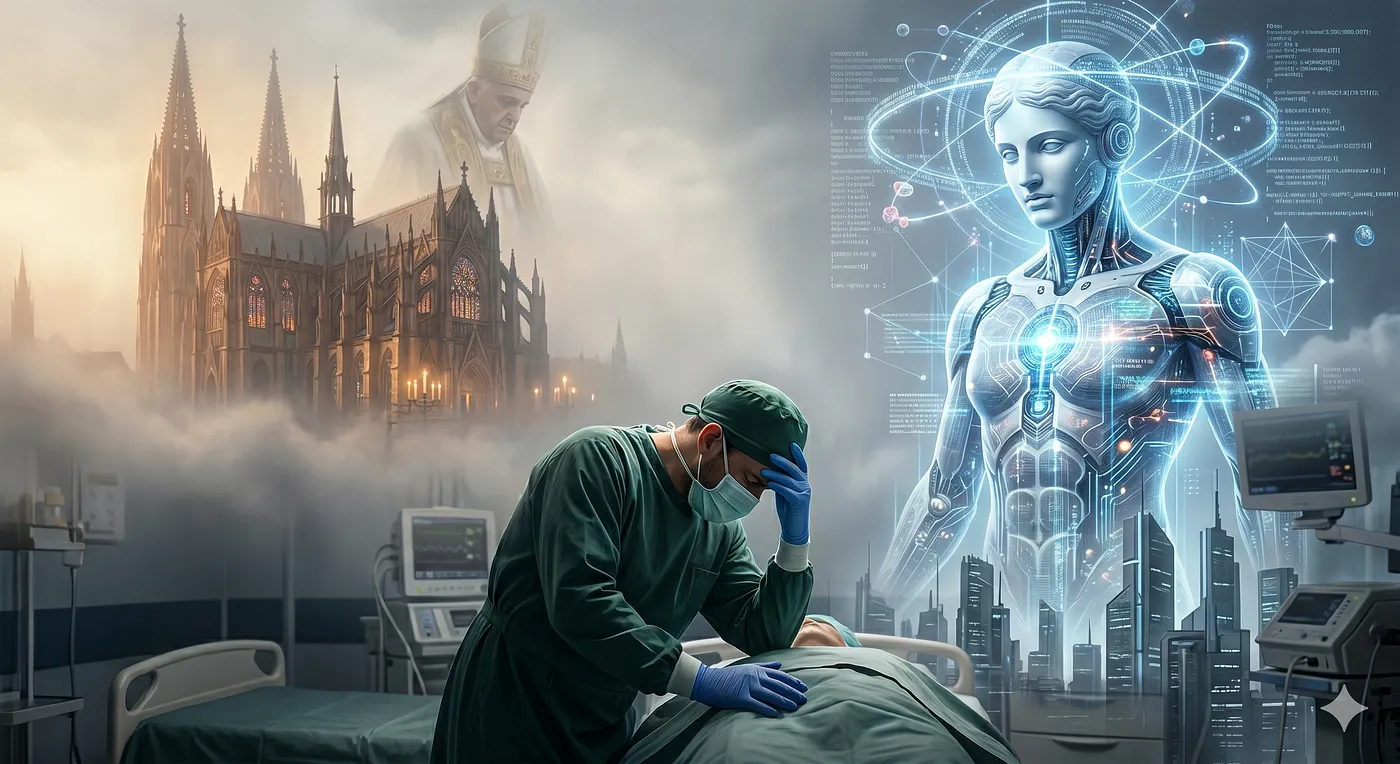
Neither Gods Nor Martyrs — Image by Gemini
There is a child somewhere this morning, in a village outside Kisumu or Kananga or Sokoto, who will be dead by the weekend. A mosquito the size of a grain of rice will have delivered into her bloodstream a parasite that her body cannot fight, and over a few days her fever will climb, her organs will fail, and she will die — at four, at five — of a disease that is, in the most literal and unforgiving sense of the word, solved. We know what malaria is. We know the parasite’s life cycle. We have bed nets, we have new vaccines being rolled out across the continent, we have antimalarial drugs that cost less than a soda, and we have, on the drawing board, gene drives that could collapse the mosquito populations that carry it. Tragically, the child will die anyway, because the solutions did not reach her, and the world did not consider her death an emergency.
I want to begin here, with this child, because almost every grand argument about the future of medicine and technology manages to lose sight of her. The argument has been captured by two camps, both of which are having a more glamorous conversation than the one she needs us to have.
On one side stand the transhumanists, who look at the human body and see, essentially, legacy hardware — a kludge of evolutionary compromises that we should be racing to patch, upgrade, and eventually transcend. Their imaginations run to the spectacular: minds uploaded to silicon, aging “cured” as if it were a bug, death itself reframed as an engineering problem awaiting a sufficiently funded solution. On the other side, newly and eloquently, stands Pope Leo XIV, whose first encyclical, Magnifica Humanitas, released in May of 2026, warns that a civilization drunk on its own technological power risks forgetting what a human being actually is — that in our hunger to optimize ourselves we may quietly decide that some lives, the frail and the slow and the dying, are simply less worth keeping.
Both camps are talking about transcendence. Both are arguing about whether we should become something more than human. And while they argue, the child outside Kisumu dies of a parasite we mapped decades ago.
This essay is an attempt to describe a third position — one that I think most people actually hold, even though almost nobody is articulating it for them. It is not a compromise between the two extremes, splitting the difference and calling it wisdom. It is a distinct moral commitment with its own internal logic, and it begins from a deceptively simple claim: the great work of medicine is not to make us more than human but to let everyone, finally, be fully human. Not gods. Not uploaded angels. Not optimized specimens of a perfected species. Just human — healthy, unhaunted by curable agony, free to live the full arc of a human life with all its irreducible joys and losses intact.
To get there, I am going to have to be fair to both camps in ways that their loudest partisans would find irritating. I am going to argue that the transhumanists are right about something enormous and wrong about something even larger. I am going to argue that the Pope is right about something the transhumanists cannot see and wrong — or at least easy to misread — about something the rest of us cannot afford to get wrong. And I am going to argue that the line between healing and transcendence, between curing a disease and abolishing the human condition, is not a fuzzy gradient where anything goes, but a real and defensible border that we can learn to police.
Let me start with the Pope, because he is the one most often caricatured.
What Leo XIV Actually Said
It is tempting, if you are excited about medical progress, to read Magnifica Humanitas as the latest installment in a tiresome genre: the Church wagging its finger at science, romanticizing suffering, telling the sick that their agony is secretly good for the soul. That reading is wrong, and if you build an argument on it you will deserve the rebuttal you get from anyone who has actually read the document.
The encyclical is not, fundamentally, about medicine at all. It is about artificial intelligence, and behind that, about a single anxiety that runs through all five of its chapters like a spine: the fear that we are building a civilization organized around a logic of optimization, and that this logic, left unchecked, dissolves the very idea of inviolable human worth. Leo’s core philosophical claim — and it is a serious one — is that human dignity is ontological. It belongs to you by virtue of your existence as a person, full stop. In his words, it is something “neither acquired nor earned” and which “does not need to be justified” (§53). You do not have to be useful to be worthy. You do not have to be productive, intelligent, healthy, or contributing to deserve to exist and be cared for.
Against this, he names what he considers the most insidious temptation of the age: the creeping ideology, never stated outright but everywhere implied, that “every person must earn or justify his or her own worth” by their efficiency or their output (§51). This is the worm in the apple of the optimization mindset. Once worth is something you earn through performance, the people who perform less — the disabled, the elderly, the cognitively impaired, the dying — start to look, on the civilizational balance sheet, like liabilities. And a society that thinks that way will, sooner or later, find reasons to stop spending on them.
It is in this context, and only in this context, that the encyclical takes up transhumanism and posthumanism directly, in a tight cluster of paragraphs (§§115–118) building on a 2026 document from the International Theological Commission. Leo distinguishes the two with some precision. Transhumanism, as he describes it, “envisions the enhancement of human beings through technologies” — the upgrade model. Posthumanism goes further, imagining a “hybridization of human beings, machines, and the environment,” a deliberate next step in evolution. His objection is not that these projects are uppity, not that humans are reaching above their station. His objection is that both philosophies smuggle in the optimization logic at the level of the species itself. If the human being becomes something “to be perfected or surpassed,” he warns, then “it becomes easier to accept that some lives are less useful, less desirable or less worthy” (§117). The danger he sees is that, in the name of progress, “necessary sacrifices” will be demanded of the most vulnerable so that the species as a whole can be optimized.
And then comes the line that gets quoted everywhere, the one most likely to be misread by the impatient: “humanity flourishes not despite limitations, but often through them” (§118). Limits — incapacity, illness, old age, suffering, vulnerability — are not, in his telling, defects to be engineered away. They are a “constitutive dimension” of the person, the very ground on which relationship, dependence, love, and openness to God become possible. The authentic way to be “more than human,” he concludes, is not technological self-sufficiency but grace: “we become fully human when we become more than human” precisely by being drawn beyond ourselves into communion, rather than by climbing out of our skin (§128).
Now — here is where the honest reader has to stop and resist a cheap victory. Does this mean Leo XIV opposes curing disease? That he wants the child outside Kisumu to keep her malaria because it is building her soul? No. To read it that way is to flatten a careful argument into a slogan. The Church has built hospitals for two thousand years. The encyclical’s own foundations — the preferential option for the poor, the universal destination of goods, the insistence that true progress is “measured by the dignity of each person and the good of all peoples” (§12) — are a thunderous endorsement of getting medicine to the people who lack it. When Leo warns in that same paragraph against models of well-being “that leave behind entire populations,” he is, if anything, indicting us — the comfortable world that has the malaria vaccine and does not bother to deliver it.
So the encyclical is not the obstacle the technologists imagine. It is something more useful: a precise diagnostic instrument. It tells us exactly which move is dangerous. The dangerous move is not healing. The dangerous move is optimization — the reframing of the human person as a system to be maximized, with the implication that the unmaximized are dispensable. Hold onto that distinction. The entire argument of this essay turns on it.
The Transhumanist Promise, and Its Tell
Now let me be just as fair to the other side, because the transhumanists are not cartoon villains either, and the strongest version of their case is genuinely moving.
Strip away the science-fiction packaging and the transhumanist argument reduces to a moral intuition that is almost impossible to refute: suffering and death are bad, and we should use every tool we have to fight them. When a transhumanist looks at Alzheimer’s — at a beloved grandmother who no longer recognizes her own children, whose self has been erased while her body lingers — they do not see a sacred limit through which the soul matures. They see an obscenity, a slow theft of a person, and they ask, with real moral force, why on earth would we accept this if we have any power to stop it? When they look at the long catalog of human agony — the cancers, the degenerative diseases, the senescence that turns a vigorous person into a frail and frightened one — they refuse to make peace with it. There is something deeply admirable in that refusal. The transhumanist is, at bottom, a person who has declined to call cruelty “nature” and shrug.
They are also right that the boundary of “natural” is morally meaningless on its own. Smallpox was natural. Childbirth killing one mother in twenty was natural. The fact that something has always happened, that it is woven into the biological order, tells us nothing about whether we should accept it. Every vaccine, every antibiotic, every cesarean section is a refusal of the “natural” rate of death, and we are right to refuse it. The transhumanists simply take this universally accepted logic and extend it without flinching: if it is good to push death back from age four to age forty, why is it suddenly bad to push it from forty to ninety, or from ninety to a hundred and forty? Where, exactly, is the line, and who drew it?
This is a serious question and I will try to answer it. But first I want to name the tell — the place where the transhumanist project quietly turns into something other than the noble war on suffering, and becomes the very thing the encyclical fears.
The tell is the word optimization. Listen to how the most ambitious transhumanists talk, and you will notice that the goal stops being health and becomes maximization. The body is not to be healed but upgraded. Intelligence is not to be protected but amplified beyond the human range. Lifespan is not to be extended within a human frame but, ideally, abolished as a constraint altogether. The endpoint of the most radical versions is not a healthy ninety-year-old playing with her great-grandchildren; it is a mind decanted into a substrate that no longer ages, no longer suffers, and — crucially — is no longer recognizably the creature that we are. At that point the project is no longer medicine. It is replacement. And it carries, embedded in its enthusiasm, exactly the hazard Leo named: once “the human” is just a draft to be improved upon, the un-improved start to look like a problem.
Consider three problems the radical version cannot solve.
The first is the meaning problem. Our finitude is not an incidental bug in the human experience; it is, in large part, the source of its weight. The reason a choice matters is that you cannot make all the choices; you have one life and the hours are numbered, so what you do with them is consequential. The reason love between mortals has its particular ache and preciousness is that it exists under the shadow of loss. The reason a life can have a shape — a youth, a middle, an old age, a completion — is that it ends. It is not obvious, to put it mildly, that a being who lives ten thousand years, or who can back itself up and never truly die, would have access to any of this. It might have something. But it would not have the specific thing that we have been calling, for all of recorded history, a human life. The transhumanist who wants to abolish death is not curing a disease. They are proposing to end the only kind of existence we have ever known how to find meaningful, and they have not begun to show that the replacement would be better, or even bearable.
The second is the identity problem. The more thoroughly you optimize a person — rewriting their cognition, their emotional set-points, their drives — the harder it becomes to say that the optimized being is still them, rather than a successor that has displaced them. There is a continuity that matters to us, a thread of self that runs through a human life, and it is not at all clear that it survives radical enhancement. The grandmother cured of Alzheimer’s and restored to herself is unambiguously still her grandmother. A “her” rebuilt with a hundredfold intelligence and re-engineered emotions and a thousand-year clock may be a wonderful thing, but she may also no longer be the person whose continued existence we wanted to protect. Restoration preserves the self. Transcendence risks dissolving it. These are not the same act.
The third is the caste problem, and it is the one that should frighten everyone regardless of their metaphysics. The radical enhancements imagined by transhumanism — if they ever arrive — will not arrive evenly. They will be expensive, and they will reach the rich first, and unlike a vaccine, which the rich have every interest in spreading because contagion ignores borders, a cognitive or longevity enhancement gives its holder a competitive advantage that is diminished by sharing. The structural incentive runs toward hoarding. The plausible endgame of radical transhumanism is therefore not a humanity ascended but a humanity split — a class of the enhanced, living longer and thinking faster and compounding their advantages across generations, and beneath them everyone else, increasingly outcompeted by people who are no longer quite playing the same game. This is the literal biological aristocracy that has haunted dystopian fiction for a century, and the optimization framework gives us no principled reason to avoid it. It only tells us to optimize, and the rich optimize first.
So: the transhumanists are right that we should refuse to accept curable suffering, and they are right that “natural” settles nothing. But the radical wing of their project answers a question nobody sane was asking — how do we stop being human? — and in answering it, walks straight into the abyss the encyclical warned about. They mistake the war on disease for a war on the human condition itself. And those are different wars. One is winnable and worth winning. The other should not be fought at all.
The Category Error Both Sides Make
Here is the strange thing. The radical transhumanist and the most anxious bioconservative, who imagine themselves to be opposites, are in fact making the same error. They both believe that healing and transcendence are points on a single continuous slope — that to start curing diseases is to already be on the road to abolishing death and rebuilding the species, and that the only question is how far down the slope you are willing to slide.
The transhumanist embraces the slope and rides it gleefully to the bottom: of course curing malaria and uploading your mind are the same project, just at different stages; it is all the conquest of biological limitation, so let’s get on with all of it. The frightened traditionalist agrees about the geography of the slope but recoils from it: because curing disease and abolishing humanity are the same project at different stages, we had better be very, very careful about that first step, lest it commit us to the last one.
They are both wrong, because there is no single slope. There are two different mountains.
The distinction is the old one between therapy and enhancement, and though philosophers have rightly pointed out that its border can get blurry in hard cases, the existence of blurry cases does not abolish the distinction any more than the existence of dusk abolishes the difference between day and night. Therapy aims at a baseline: it tries to restore a person to the full, healthy functioning that is proper to a human being. It has a natural stopping point — health — built into its very definition. You cannot “over-cure” malaria. Once the parasite is gone and the child is well, the medicine has done its work and there is nothing further for it to do. The goal is not a maximum; it is a norm, the ordinary human flourishing that disease was preventing.
Enhancement aims at a maximum, and a maximum has no natural ceiling. If the goal is not “healthy” but “more” — more intelligence, more strength, more years, more capacity than a human being has ever had — then there is no point at which you are finished, because there is always a further increment of more. This is precisely why the optimization framework is dangerous: optimization is, by definition, the pursuit of a maximum, and a project with no stopping point will, given enough power, keep going until it has remade everything, including the people it was supposed to be serving.
The therapeutic project is bounded. The enhancement project is unbounded. That is the whole difference, and it is not a matter of degree. The malaria vaccine and mind-uploading are not early and late stages of one journey. They are answers to two different questions. The vaccine answers: how do we let this child have a normal human life? Mind-uploading answers: how do we stop being the kind of creature that has a normal human life? You can be passionately, urgently committed to the first while wanting nothing to do with the second, and there is no inconsistency in this whatsoever. The slope is an illusion produced by squinting until two mountains blur into one.
Once you see this, the encyclical and the war on disease stop being enemies. Leo’s whole objection was to the logic of optimization — the unbounded maximization that treats the human as a draft. Therapy is not optimization. Therapy is restoration toward a norm that honors the human as it is, rather than treating it as raw material for something else. The Pope who warns against “perfecting or surpassing” the human person has no quarrel with the doctor who cures the child’s malaria, because curing the child is not perfecting or surpassing her. It is letting her be her, fully and healthily, which is exactly what the encyclical says we owe her.
Let me now show what that looks like across the actual landscape of human disease, because the abstract distinction earns its keep only when it touches real bodies.
What Healing Actually Looks Like
It helps to sort the great enemies of human health into three rough families, not by biology but by where they come from, because the moral texture of each is slightly different and the temptation to confuse healing with transcendence varies across them.
Diseases of Environment
The first family is the diseases that come at us from the world: the infections, the parasites, the vector-borne plagues. Malaria. Dengue. Tuberculosis. The diarrheal diseases that still kill hundreds of thousands of small children a year. River blindness. Schistosomiasis. These are, morally speaking, the easiest cases imaginable, and it is a scandal that they remain unsolved in practice when they are so nearly solved in principle.
Nobody — not the most ardent bioconservative, not the Pope, not anyone — believes that a child’s soul is enriched by dying of dengue. There is no school of thought in which malaria is a meaningful limit through which the human person matures. It is simply a parasite, an external assailant with no claim on us, and removing it returns the person to nothing more exotic than ordinary health. When new vaccines bring malaria deaths down, when Wolbachia-infected mosquitoes are released to crash dengue transmission, when a gene drive offers the prospect of suppressing the Anopheles populations that have killed more human beings than every war in history combined — these are acts of pure restoration. They take nothing from the human experience. They give a child the chance to have a human experience.
This is the clearest possible illustration of the therapy/enhancement distinction, and it is also where the encyclical’s preferential option for the poor becomes a blade with an edge. Because here the technology already exists, or nearly does. The thing standing between that child and her ordinary human life is not a missing discovery. It is a delivery problem, a financing problem, a problem of attention and will. The world has decided, by inaction, that her death is tolerable. The transhumanists, gazing at the horizon of mind-uploading, are not looking at her. And a Church that takes its own teaching seriously should be screaming about her — because if “true progress is measured by the good of all peoples,” then a world with a malaria vaccine and dying malaria patients is a world failing its own most basic moral test. The diseases of environment are where the grand philosophical debate should feel almost obscene in its detachment. There is no deep question here. There is only a bill, and a queue, and the people we have left at the back of it.
Diseases of Circumstance
The second family is harder, more interesting, and morally subtler: the diseases that emerge from how we live. Type 2 diabetes. Gout. Much of cardiovascular disease. A great deal of obesity-related illness. These conditions sit at the intersection of biology and environment and behavior, and they have exploded in the modern world precisely because we built a world our bodies were not designed for — calorie-dense, sedentary, abundant in exactly the things our hunger evolved to crave.
The reason these are subtler is that they tempt us toward two opposite errors, and both are versions of the mistakes we have been tracing. The first error is to moralize them — to treat diabetes or obesity as a failure of character, a deserved consequence of weak will, and therefore not really a “disease” at all but a punishment. This is cruelty dressed as wisdom, and it has done immense harm. The second error is to medicalize everything — to reach for a drug for every discomfort of being a creature in a difficult environment, until the line between treating illness and engineering away the ordinary friction of life disappears.
The arrival of the GLP-1 drugs — the semaglutides and tirzepatides that have transformed the treatment of diabetes and obesity — throws this into sharp relief. Used to restore metabolic health to someone whose pancreas and weight are killing them, these drugs are therapy in the purest sense: they return a sick person toward the human baseline, and the lives they save and the suffering they prevent are enormous and real. But the same molecules can slide toward enhancement — toward a healthy person seeking a thinner body for reasons that have nothing to do with disease and everything to do with the optimization culture’s relentless message that you are never good enough as you are. Same drug. Different mountain. The therapeutic use restores a person to health; the optimizing use enlists medicine in the project of making the ordinary human body into a defect to be corrected, which is exactly the logic the encyclical warns against.
Gout is a quieter and almost poignant example. For most of history it was an agony with a moralizing legend attached — the disease of gluttons and drunkards, a punishment for excess. In fact it is a disorder of uric acid metabolism, and it is, today, almost entirely controllable with cheap drugs. The story of gout is the story of medicine doing its proper work: dissolving a “moral” suffering into a manageable biochemical fact, and in doing so freeing people from both the pain and the shame. Nobody is a better person for their gout. Curing it takes nothing from the human soul. It just stops their feet from feeling as if they are on fire.
The principle that emerges from this family is one of discernment, and it happens to be the encyclical’s favorite word. The goal is to restore health, not to manufacture an idealized body or to medicalize the entire texture of being alive. Treat the diabetes; do not pathologize ordinary human variation. Cure the disease; resist the optimization culture that would turn every body into a project. The line is not always obvious, but it is real, and the question to ask is always the same: are we restoring this person to themselves, or remaking them into something the market told them to want?
Diseases of Age
The third family is the hardest, and it is where the two great camps go to war: the degenerative diseases that come, mostly, with the passing decades. Parkinson’s. ALS. Alzheimer’s and the other dementias. The cancers, which are, in large part, diseases of accumulated cellular error and therefore rise steeply with age. This is the territory where “curing disease” and “fighting aging” and “extending life” start to bleed into one another, and where the transhumanist sees a clear road and the bioconservative sees a cliff.
Let me take them one at a time, holding fast to the distinction.
Alzheimer’s is, I think, the case that should move anyone. It is not a gentle dimming. It is the progressive erasure of a self — memory, then personality, then recognition, then the basic capacities of personhood — while the body, cruelly, persists. A person with advanced Alzheimer’s has, in a meaningful sense, already been taken from those who love them, and the long goodbye that remains is one of the most harrowing experiences a family can endure. There is no school of soul-building that can find meaning in the disease itself, as opposed to in the love and endurance of those who care for the person it is destroying. To develop treatments that halt or reverse it — and the new antibody therapies that clear amyloid from the brain are, for all their limitations, the first real foothold we have ever had — is not to make a person superhuman. It is to give them back the self the disease was stealing. It is restoration in the most profound sense the word can carry. A grandmother who keeps her memories until she dies at ninety has not been enhanced beyond the human. She has been allowed to remain herself, which is the most human thing of all.
Parkinson’s and ALS tell the same story in the register of the body rather than the mind: the slow imprisonment of a person inside a failing nervous system, the self intact but the body increasingly unable to express it. To loosen those chains — through better therapies, through the genuine prospect of slowing or halting neurodegeneration — is restoration, not transcendence. It returns the person to the ordinary human condition of having a body that obeys them. It does not lift them out of the human condition. It lets them live inside it.
Cancer is the most instructive of all, because it forces us to confront the relationship between curing disease and extending life directly. Cancer is, overwhelmingly, a disease of age: the longer cells divide, the more errors accumulate, and the more likely it becomes that one line of cells slips its leash. The new immunotherapies, the CAR-T cell treatments that re-engineer a patient’s own immune system to hunt their tumors, the cancer vaccines now in trials — these are turning some death sentences into survivable, even curable, conditions. And here is the point I want to make carefully: when you cure cancers, people live longer. Not because you have invented an immortality drug, but because you have removed one of the major causes of death. A population that beats its cancers has a higher average lifespan than one that does not, as a simple arithmetic consequence of fewer people dying at sixty.
This is the “mild lifespan extension as a side effect” that any honest account of medical progress has to include — and it is the place where the bioconservative reflex needs to be answered head-on, because it is here that the fear of transcendence does its most damage. The fear says: if you keep curing the diseases of age, are you not, by the back door, pursuing the transhumanist dream of abolishing death? Is this not the slope after all?
No — and the reason is the difference between healthspan and lifespan, which is the single most clarifying distinction in this entire debate. Lifespan is just the count of years you are alive. Healthspan is the span of years you are alive and well — free of chronic disease and disability, capable of the ordinary activities and relationships of a human life. The therapeutic project is, properly understood, a project of healthspan. Its aim is to compress the period of frailty and disease, so that a person lives the full human arc in good health and then, at the end, dies — later, perhaps, than they would have, but as a mortal being who has had a complete life rather than a truncated or agonized one.
This is categorically different from the transhumanist dream of lifespan without limit, of defeating death as such. The healthspan project accepts mortality. It does not try to make anyone live forever; it tries to make sure that the years they have are not stolen by curable disease, and that the end, when it comes, comes to a person who lived fully rather than to one diminished too soon. If curing the cancers and the dementias means that the average person dies at ninety-five instead of seventy-eight, having spent those extra years well, that is not the abolition of the human condition. It is the human condition, finally delivered in full, to people who were previously cheated of part of it.
There is a real and important boundary here, and I want to mark it precisely, because this is exactly the kind of hard case the honest version of this argument must not dodge. Treating the diseases of aging is therapy. Abolishing aging itself — re-engineering human biology so that senescence no longer occurs and death by old age is, in principle, eliminated — would be enhancement of the unbounded kind, and it would walk us into all three of the problems I raised earlier: the meaning problem, the identity problem, and above all the caste problem. The healing project says: let people be healthy for the whole of a human life. The transcendence project says: let people stop having human lives, which end. These are not the same, and the fact that both involve the word “aging” should not be allowed to blur them. We can — and I think should — pour resources into curing the diseases that cluster at the end of life without committing ourselves to the abolition of the end of life. The mountain of healthspan has a summit, which is a healthy human life of natural length. The mountain of immortality has no summit at all.
The Meaning We Are Trying to Keep
I have been leaning on the claim that finitude gives human life its meaning, and that this is what the radical transcendence project would destroy. I owe the reader a more honest reckoning with that claim, because it is also the place where the bioconservative argument is at its strongest and most seductive, and where, if we are not careful, it can be used to justify the very cruelty we are trying to end.
Here is the strong version of the encyclical’s argument, stated as forcefully as I can make it. A human life is not just a duration; it is a shape. It has a beginning, a maturing, a flourishing, a decline, and an end, and the meaning of the whole depends on the parts being held in tension. Our limits are not external impositions on an otherwise unlimited self; they are part of what constitutes the self. The fact that we are vulnerable is why we need each other; the fact that we age is why wisdom is possible; the fact that we die is why our time is precious and our loves are urgent. A being without limits would be a being without need, and a being without need would be a being incapable of love, because love is, at its root, the gift of one insufficient creature to another. Take away the limits, and you do not get a better human. You get a creature for whom the whole grammar of human meaning has gone silent.
I think this is largely true, and I think the transhumanists who wave it away are not serious. But here is the crucial move, and everything depends on getting it right: this argument applies to mortality and finitude as such. It does not apply to disease.
Malaria is not a meaningful limit. It is a parasite. Alzheimer’s is not the wise decline through which a person matures into the fullness of age; it is the destruction of the person before age can do its work. ALS is not the gift of vulnerability that opens us to one another; it is a thief that takes the body while leaving the mind to watch. The bioconservative argument earns its real power from the genuine goods of finitude — mortality, dependence, the structure of a life that ends — and then, if we are not vigilant, it launders that power onto things that have nothing to do with those goods. It says: limits are meaningful, therefore this particular agony is meaningful, therefore we should hesitate to cure it. That is the move that has to be refused, and refused flatly. Most suffering is not the meaningful kind. Most suffering is just suffering — the gratuitous, soul-flattening, relationship-destroying kind that makes people smaller, not larger, and that the people enduring it would give anything to be free of.
There is a difference, which everyone knows from their own life, between the suffering you grow through and the suffering that just grinds you down. The grief of losing someone you love can deepen you; it is part of the meaning of having loved. The chronic agony of an untreated disease does not deepen you. It exhausts you, isolates you, and steals the capacities — attention, energy, presence — that you would need in order to grow through anything at all. To say that we should preserve the second kind of suffering because the first kind is meaningful is a category error, and a callous one. The whole point of curing the gratuitous suffering is to free people for the meaningful kind — to clear away the curable agony so that what remains is the real human drama of love, work, loss, and mortality, lived by people healthy enough to actually live it.
Because notice what the healing project leaves intact. It does not touch the things that give human life its weight. We will still love, and still lose those we love. We will still age, in the deep sense, even if we age more healthily. We will still die. The structure of a finite life — its arc, its urgency, its preciousness — survives the cure of every disease, because none of those diseases were what gave life its meaning in the first place. A world in which malaria, diabetes, Parkinson’s, Alzheimer’s, and the cancers have been conquered is not a world that has lost the human drama. It is a world in which more people get to complete the human drama, rather than being cut from the stage in the first or second act. The mother still grieves the son who dies at ninety; she simply does not have to grieve the daughter who died at four of a curable fever. We keep the tragedy that means something. We discard the cruelty that means nothing. That is not the abolition of the human condition. It is its mercy.
This, I think, is the deepest answer to the encyclical’s anxiety, and it is an answer that takes the encyclical seriously rather than dismissing it. Leo is right that we must not treat the human person, with all its limits, as an error to be corrected. But curing a child’s malaria does not treat the child as an error. It treats the parasite as an error, which it is. The distinction between healing the person and re-engineering the person is exactly the distinction between fighting the disease and fighting the human condition — and once you hold it firmly, you can be a fierce warrior against disease and a fierce defender of human finitude at the same time, without the slightest contradiction. Indeed, you almost have to be both, because the whole point of defeating the curable cruelties is to let the meaningful finitude shine through.
The Real Dystopia Is Not Immortality. It Is Apartheid.
If you have been waiting for the part where I tell you that the middle path is all sunshine, this is not that part. There is a genuine catastrophe lurking in the future of medicine, and it is worth being precise about what it is, because the two great camps both tend to point at the wrong one.
The transhumanists fear that we will be too timid — that fear and superstition will slow the conquest of disease and death, and that millions will suffer who could have been saved. The bioconservatives fear that we will be too bold — that we will optimize ourselves into something monstrous and lose our souls in the upgrade. Both fears have something to them. But the catastrophe that is most likely, the one that does not require any exotic technology and is in fact already half-built, is neither of these. It is the catastrophe of unequal access. It is the very real prospect of a world in which the breakthroughs are real and the cures exist — and they belong to the rich.
This is where the healing project lives or dies as an ethical proposition, and it is, strikingly, the place where the Pope and the most clear-eyed technologist should be standing shoulder to shoulder. The encyclical’s foundations could not be more relevant: the universal destination of goods (the principle that the goods of the earth are meant for everyone, not just for those who can pay), the preferential option for the poor, the insistence that a technology’s worth is measured by how it serves the most vulnerable rather than how much it enriches the few. These are not pious add-ons to the medical project. In the framework I am describing, equitable access is constitutive of the ethics itself. A cure that reaches only the wealthy is not a partial success. It is, morally, a kind of failure — because it takes the one technology that could have lifted the human baseline for everyone and turns it into another instrument of stratification.
We already know this dystopia is possible because we are living in a mild version of it. The malaria vaccine exists; the children still die. The HIV antiretrovirals that turned a death sentence into a manageable condition took years to reach the global poor after they were saving lives in the rich world, and the gap cost millions of lives that did not have to be lost. The story of medical progress is, again and again, the story of a miracle invented in one place and rationed by price and geography before it reaches the people who need it most. Now imagine the same dynamic applied to the cures for the diseases of age — to the cancer immunotherapies, the neurodegenerative treatments, the metabolic drugs. Imagine a world in which the wealthy reliably live healthy into their nineties while the poor continue to die of the same diseases at sixty, not because the cures do not exist but because they cost too much and no one with power decided that closing the gap was an emergency. That is not science fiction. That is the default trajectory, the thing that happens if we do nothing but let the market distribute the miracles. And it would be, quite literally, the biological caste system — not built by transhumanist enhancement, but by the ordinary, grinding inequality of who can afford to be healed.
So the democratic commitment is not the soft, optional, feel-good appendix to the healing project. It is its spine. To say that the goal of medicine is to let everyone be fully human is to say that a cure which reaches only some is an incomplete act, a job half-done, a moral debt outstanding. This has hard, concrete implications that go well beyond sentiment. It means treating the delivery of existing cures to the global poor as the emergency it actually is, rather than as charity to be doled out when convenient. It means structuring the incentives of medical innovation — the patents, the pricing, the public funding — so that the path from discovery to universal availability is short rather than generational. It means measuring our success not by the most that the most fortunate can now achieve, but by the floor — by what the least among us can count on. A society that develops a cure for a disease of the poor and then prices it out of their reach has not lifted the human baseline at all. It has merely widened the distance between the top and the bottom, and called it progress.
If you want a single sentence that captures the difference between the project I am defending and the one the encyclical fears, it is this: the transhumanist optimization project asks how high the ceiling can go; the healing project asks how high we can raise the floor. Optimization is obsessed with the maximum, with the most that the most enhanced can become. Healing is obsessed with the baseline, with making sure that the ordinary, healthy, complete human life — which the fortunate take for granted and the rest of the species has never reliably been able to count on — becomes, at last, something that belongs to everyone. The encyclical’s word for a society organized around the maximum was “Babel”: the tower that reaches for heaven on the strength of its own pride and tramples the weak in the climbing. The word for a society organized around the floor — around shared responsibility, around the dignity of each person, around rebuilding the walls together so that the whole city is safe — was the rebuilt Jerusalem, where, as the Pope writes, the rejected stones become the cornerstone. You do not have to share his theology to feel the force of the image. The question of our medical century is which city we are building.
Naming the Position
The notes that started me on this essay reached for a name: Democratic Bio-Optimism. I want to gently retire that label, and the reason is not pedantry. The word optimism is too close to optimization, and optimization is precisely the concept that the encyclical, rightly, identifies as the hazard — the unbounded maximization that treats the human as raw material. To name our position with a cousin of that word is to hand every critic a free and devastating line: ah, so you admit it is just optimization with a friendlier face. It is also simply inaccurate, because the whole point of the position is that it is bounded — it aims at a baseline, not a maximum.
Let me propose a sturdier name: therapeutic humanism. Or, if you prefer something with more music in it, the healing mean — the mean in the old Aristotelian sense of the virtue that sits between two vices, between the recklessness that would remake the human and the timidity that would let it suffer.
Whatever we call it, the position can be stated as a small set of commitments, each of which has earned its place in the argument above.
It holds, first, that the proper goal of medicine is restoration, not transcendence — to return every person to the full health proper to a human being, not to engineer a being beyond the human. This is the therapy/enhancement line, and it is the load-bearing wall of the whole structure.
It holds, second, that the war on disease is urgent and unconditional, and that “natural” is no defense of any curable agony. Malaria, dengue, diabetes, gout, Parkinson’s, ALS, Alzheimer’s, the cancers — all of these are enemies to be defeated, and there is no school of soul-building that requires us to leave them standing. On this point the therapeutic humanist stands with the transhumanist against every romanticization of suffering.
It holds, third, that finitude is not a disease, and must be defended even as we cure the diseases that cluster around it. Mortality, vulnerability, the shape of a life that ends — these are not bugs but the very ground of human meaning, and the project of abolishing them is not an extension of medicine but a departure from it. On this point the therapeutic humanist stands with the encyclical against the dream of immortality. We pursue healthspan, not endless lifespan. We want people to live the whole of a human life in good health, and then be allowed to pass on as mortals who have lived fully.
It holds, fourth, that the human person has an ontological dignity that does not depend on capacity, output, or optimization — that the frail and the slow and the dying are not liabilities on a civilizational balance sheet but persons whose worth is, in the encyclical’s phrase, neither earned nor justified. This is the firewall against the optimization logic, the thing that prevents the war on disease from curdling into a war on the people who happen to be different, or diseased.
And it holds, fifth, that access is constitutive, not optional — that a cure which reaches only the wealthy is a moral failure, that raising the floor matters more than raising the ceiling, and that the metric of success for any medical technology is what it does for the most vulnerable. This is the democratic guardrail, and it is the difference between building the metaphorical Jerusalem and building Babel.
Notice what this position is not. It is not anti-technology; it is one of the most technologically ambitious visions imaginable, willing to deploy gene drives and immunotherapies and engineered vaccines without apology. But it is anti-transcendence: it draws a hard line at the point where medicine stops healing the human and starts trying to replace it. And it is not a lukewarm compromise that nobody would care about. It is, I suspect, the thing most human beings actually want when you ask them directly. Almost nobody, when pressed, says they want to live forever or to become a different species. What they say is that they want their children to survive, their parents to keep their minds, their own bodies to carry them healthily through a full life, and the people they love to not be taken from them by curable cruelties. That is the healing mean. It has simply lacked a name and a defense, because the megaphones have all been held by the people arguing about gods.
The Hard Cases, Honestly
I would be doing the reader a disservice if I pretended the line I have drawn is always crisp. It is a real line — day really is different from night — but there is a dusk, and intellectual honesty requires walking into it rather than around it.
Consider vaccines that do not merely restore but exceed natural immunity — that protect against a pathogen better than your unaided immune system ever could. Is that therapy or enhancement? I think it is therapy in spirit, because its aim is protection from disease, which is a baseline good, and because it gives a capacity that serves health rather than competitive advantage. But it shows that the “baseline” is not always a simple natural fact; sometimes restoring health means giving a person a function nature did not. The heuristic that survives the hard case is this: ask what the intervention is for. If it is for health and protection from disease, it sits on the therapy mountain even when it exceeds the natural baseline. If it is for advantage, for “more” as such, it has crossed over.
Consider the treatment of severe depression or chronic anxiety. These are diseases — real, biological, devastating — and treating them is unambiguously therapeutic. But the same pharmacology can shade into the optimization of ordinary mood, the medicating of the normal sorrows and frictions of being alive, until we are no longer healing illness but engineering a frictionless emotional life. Same caution as with the metabolic drugs: treat the disease, resist the pressure to pathologize the human condition itself. The question is always whether we are restoring a person to themselves or remaking them into something more convenient.
Consider embryo selection and the editing of the germline. Here the line genuinely strains, because the same technique that could prevent a child from being born with a horrific genetic disease — an unambiguous good, therapy in the deepest sense — could also be turned toward selecting for traits that have nothing to do with health, which is enhancement, and which raises the caste problem in its most chilling form, since it would let advantage be inherited and compounded across generations. My own view is that the therapy/enhancement line is exactly where morality exists, and that we should be willing to prevent terrible disease while drawing a hard and well-guarded boundary against the engineering of advantage — but I will not pretend this boundary polices itself, or that reasonable people of good will agree on precisely where it falls. This is a place for genuine humility and constant vigilance, not for the false confidence of either camp.
And consider, finally, the hardest case of all: aging itself. I have argued that treating the diseases of age is therapy while abolishing aging is transcendence, and I stand by that. But aging is not cleanly separable from the diseases that ride on it; the same cellular processes that drive senescence drive much of cancer and neurodegeneration, and an intervention that slows the underlying aging process might cure a dozen diseases as a side effect while also, unavoidably, extending life. Where does that sit? I think the honest answer is that it sits right on the border, and that the right posture is neither the transhumanist’s “full speed ahead” nor the bioconservative’s “do not touch,” but a careful, case-by-case discernment that keeps asking the two questions that have organized this whole essay: Are we restoring people to health, or remaking them beyond the human? And are we raising the floor for everyone, or building a higher ceiling for the few? If an intervention restores health and raises the floor, it belongs to the healing project even if it also, modestly, extends life. If it abolishes finitude or builds a biological aristocracy, it does not, no matter how it is marketed.
The point of naming these hard cases is not to dissolve the position in a fog of “it’s complicated.” The position holds. It is to show that holding it requires judgment rather than a slogan — which is, in the end, exactly what the encyclical means by discernment and exactly what the best of the scientific tradition means by responsibility. The two camps offer the comfort of a rule that thinks for you: optimize everything or change nothing. The healing mean offers no such comfort. It asks you to look at each intervention and each body and ask whether you are serving the human person or replacing them, lifting the floor or raising the ceiling. That is harder. It is also the only honest way through.
The Magnificent and the Least
Let me return to the child outside Kisumu, because she is the test of everything I have written, and because the two great camps both, in their different ways, fail her.
The radical transhumanist fails her by looking past her. Her problem is not interesting enough; it is a solved problem, a delivery problem, and the imagination that thrills to mind-uploading and the conquest of death finds little glamour in the unglamorous work of getting a cheap vaccine to a village. She is, to the optimization mindset, already in the past — a problem of the old, unenhanced humanity, soon to be left behind. The frightened traditionalist fails her differently and more rarely, but fails her still, whenever the rhetoric of sacred limits and meaningful suffering is allowed to slide from mortality-as-such onto her entirely curable, entirely meaningless death, and to counsel a hesitation she cannot afford. She has no time for our hesitation. She has until the weekend.
The healing mean does not fail her, because she is its entire point. Its measure of success is not how high the most fortunate can climb but whether she gets to have an ordinary human life — to grow up, to be healthy, to love and work and age and, eventually, as all of us must, to die, but as a person who was given the whole arc rather than cut from it at four. That is not a modest ambition dressed up as a grand one. It is the grandest ambition there is, because it is universal: it is the claim that every single human being, regardless of where they were born or what they can afford, is owed the chance to be fully, healthily, completely human. Not more than human. Not a god, not an upload, not an optimized specimen of an improved species. Just human, in the full and unhindered sense — which, it turns out, almost no one in the history of our species has reliably been able to count on.
The encyclical that began this essay takes its title from a phrase that means magnificent humanity, and it leaves us with a question we cannot dodge: what would make our humanity magnificent? The transhumanist answer is transcendence — we will be magnificent when we have surpassed ourselves and left the old human behind. The encyclical’s answer is grace — we will be magnificent when we let ourselves be drawn beyond ourselves into communion rather than climbing out of our skins. I want to offer a third answer that I think both can recognize. Our humanity will be magnificent not when the most fortunate among us have become something more than human, but when the least fortunate among us are finally, securely, no longer perceived as something less than human — when the floor has risen so high that the ordinary miracle of a healthy human life, lived in full and ended in its proper time, belongs to the child outside Kisumu as surely as it belongs to the child of the wealthiest family on earth.
That is a city worth building. It will not reach the heavens, and it is not supposed to. It is supposed to be a place where everyone, the strong and the frail, the quick and the slow, the dying and the just-born, is protected by the wall and has a place inside it. We do not need to become gods to build it. We do not need to make martyrs of the suffering to keep our souls. We need only to do the patient, unglamorous, deadly serious work of healing — of curing what can be cured, of reaching those who have not been reached, of defending the dignity of the human person against every logic that would price it or optimize it or surpass it. Neither gods nor martyrs. Just healers, raising the floor, one cured disease and one delivered cure at a time, until the magnificent thing we have been arguing about turns out to have been the ordinary human life all along — finally given, at last, to everyone.