Retrofit Autonomy and the Family Farm’s Third Path
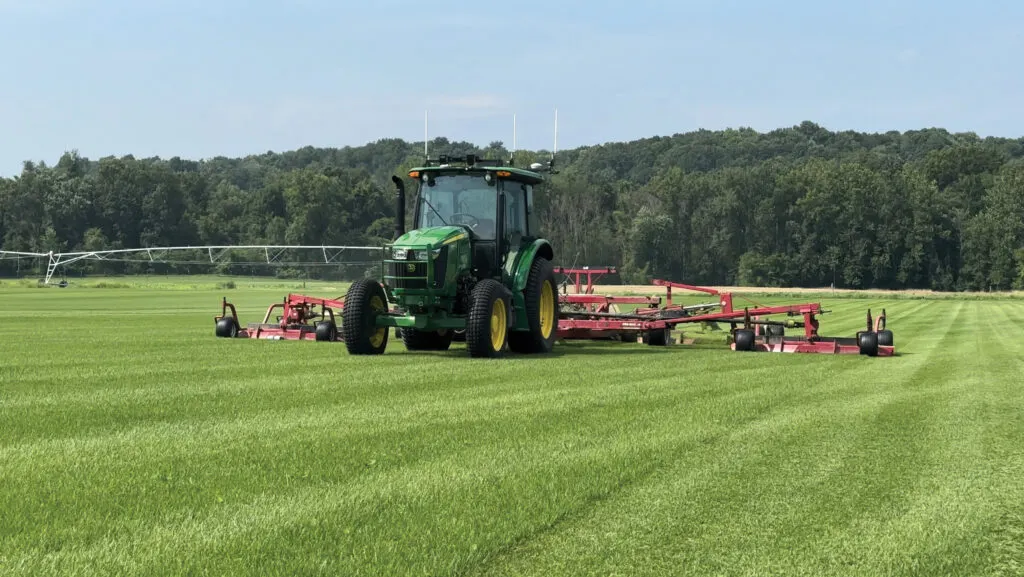
A Sabanto Retrofit for a Driverless Tractor — Image by Sabanto
Oct 14, 2026 · Madkat Omega
Around eleven o’clock on a spring night in New Haven, Kentucky, Quint Pottinger checks on his corn planter one last time before bed. He does it from home, on an iPad. Out on the rolling ground of Affinity Farms, a green John Deere utility tractor with nobody in the seat is pulling an eight-row planter at a little under three miles an hour. If the seed boxes look like they will run dry before sunrise, Pottinger sends a single instruction, and the tractor drives itself to the seed tender, parks, and waits for the morning crew.
Pottinger is the eighth generation of his family to work this land, which has been farmed since 1788. This spring he planted his entire corn crop without a driver. The Kentucky Department of Agriculture counted him as the first farmer in the state to plant a whole crop with a driverless tractor, and one of fewer than 50 farms in the country to have done it.
The robot gets the headlines, but the more useful part of his story is what he sold to make room for it. Pottinger got rid of his biggest tractors, both of his big planters, and a combine. He replaced them with one modest tractor, one small planter, and a box of sensors and software that bolts onto the cab in a day. For family operations caught between crushing equipment debt and an unreliable labor market, that trade points to a third path that did not exist a few years ago.
The Squeeze in the Middle
American agriculture has been sorting itself into very large farms and very small ones for decades, and the middle keeps getting thinner. The 2022 Census of Agriculture, released by the Department of Agriculture in February 2024, counted about 1.9 million farms, down from 2.04 million just five years earlier. Over those five years, the number of farms selling between $250,000 and $999,999 a year slipped from about 158,000 to 153,000, while farms selling between $1 million and $5 million a year jumped from about 68,000 to 89,000. In 2022, farms with more than $1 million in sales made up fewer than 6 percent of all farms, yet they sold more than three quarters of everything American agriculture produces.
Those midsize operations are the classic family farm: big enough to need serious machinery, too small to spread its cost over tens of thousands of acres. They are also the farms most exposed when prices sag and costs climb, which is exactly what has happened since the record year of 2022. In its September 2026 forecast, the Department of Agriculture projected net farm income of $158.4 billion for this year, a drop of 5.5 percent once inflation is counted. Total production expenses are forecast to hit a record $492.8 billion. Direct government payments are forecast to rise nearly 70 percent, to about $47 billion, which American Farm Bureau Federation economists read as a sign of how far market returns have fallen behind the cost of growing a crop.
The strain shows up in the courts. The American Farm Bureau Federation counted 315 Chapter 12 family farm bankruptcies in 2025, a 46 percent jump from the year before, with the Midwest and the Southeast accounting for most of them. Chapter 12 is a last-resort restructuring tool, so those filings understate how many families simply sold out quietly. Meanwhile, the Agriculture Department expects total farm debt to reach a record $605.1 billion in 2026.
Inside all of those numbers sits one line item that family farmers talk about constantly: machinery. Tractors, planters, and combines are expensive to buy, expensive to finance, and they lose value whether or not the year turns a profit. When Pottinger described his own breaking point to No-Till Farmer this June, he said he had already cut costs everywhere he could, but that “the fixed equipment costs were just eating us alive.”
Two Old Answers, Both Wearing Thin
For a long time, a midsize grain farm had two ways to get more done in a short planting window. It could buy bigger, faster machines, or it could hire more people to run the machines it already had. Both routes are getting harder to travel.
Buy bigger
The equipment industry’s answer to tight margins has usually been more horsepower and more width. Pottinger told No-Till Farmer that the message he kept hearing from manufacturers was to trade two planters for one wide planter that could run at ten miles an hour. Autonomy from the major brands has followed the same logic. John Deere introduced its driverless 8R tractor at the Consumer Electronics Show in Las Vegas in 2022. At the same show in January 2025, it unveiled a second-generation autonomy kit with sixteen cameras for its giant 9RX tillage tractor, managed through the company’s own cloud platform. The same lineup included an autonomous orchard tractor, and Deere says its camera system can be retrofitted to certain existing machines, but for row-crop farms the headline product is its biggest tractor.
That is a hard fit for a farm already worried about cash. Paimun Amini, who leads agricultural venture investing at Leaps by Bayer, the investment arm of the seed and chemical company, told AgFunderNews in July that newly built autonomous machinery can cost half a million dollars or more for a single unit. When his team interviewed farmers, he said, the problem they raised most was liquidity, meaning the cash they actually have on hand.
Hire more hands
The other route runs through people, and people are scarce. Pottinger put it plainly to Spectrum News 1 in April: “we can’t really afford to hire new people on the farm.” A grain operation needs skilled operators who will sit in a cab for sixteen hours a day during planting and harvest, and those workers are increasingly hard to find and keep.
For farms that depend on immigrant and seasonal labor, the picture has grown more uncertain still. Congress approved roughly $170 billion in additional funding for Immigration and Customs Enforcement and the Border Patrol through September 2029, and Zachariah Rutledge, an agricultural economist at Michigan State University who tracks the farm workforce, has warned that stepped-up enforcement could deepen an existing labor shortage. A survey of more than 500 California growers by Michigan State University and the California Farm Bureau, conducted in late 2025 and early 2026, found that fewer than 1 percent had lost workers to an enforcement action on their own farm. About 15 percent, however, said they lost workers because of fear surrounding enforcement in their area, and about 14 percent said they reduced production. One Orange County strawberry grower reported that roughly 60 percent of his 160 workers stopped showing up for two to three months.
The legal guest worker route is in flux as well. In October 2025, the Labor Department changed how it calculates the adverse effect wage rate, the minimum hourly pay for workers on H-2A agricultural visas, and lowered the wage floor for many farms. The United Farm Workers union sued to reverse the change, and the department’s own posted wage tables have been revised several times since the summer of 2025, most recently in August 2026. Supporters of the new rule argue it makes legal hiring affordable again, while critics argue it undercuts American farmworkers. For a farmer trying to budget a season, the practical effect is the same either way: the cost and availability of labor have become harder to predict.
The Third Path: Old Iron, New Code
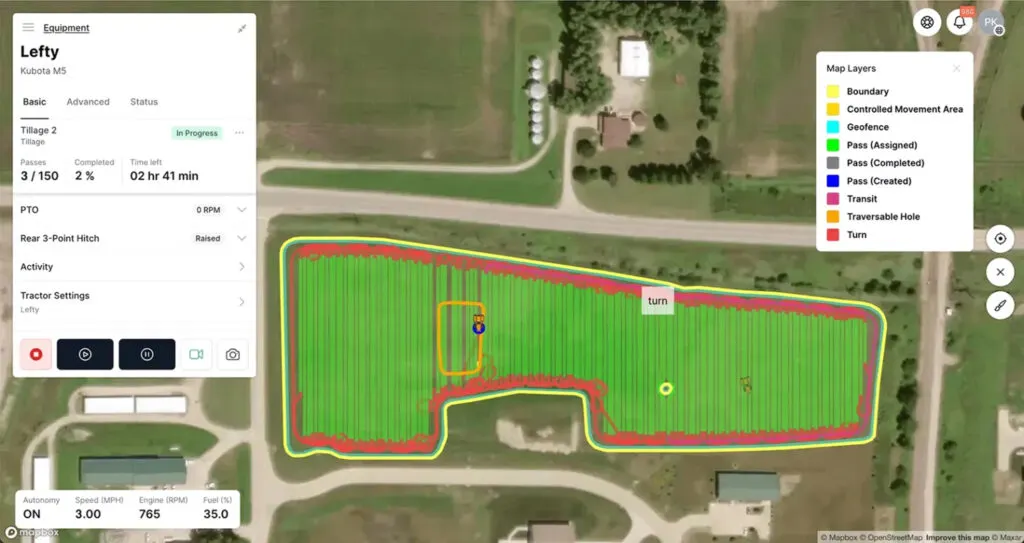
Planning the route to autonomously manage a field — Image by Sabanto
Retrofit autonomy starts from a simple observation. Most farms already own capable midsize tractors, and the hard part of making one drive itself is software. Instead of selling a new robot tractor, a retrofit company sells a kit that teaches the old one to take orders.
The company behind Pottinger’s setup is Sabanto, based in Ames, Iowa. Its founder and chief executive, Craig Rupp, previously worked at John Deere and sold an earlier company to The Climate Corporation in 2014, so he has seen the equipment business from the inside. His pitch runs against the industry’s bigger-is-better habit. “Autonomy should reduce capital investment, not increase it,” he told AgFunderNews this summer.
The kit itself is a bundle of familiar parts. According to Progressive Farmer magazine, it includes antennas, a dual satellite positioning receiver, obstacle detection sensors, infrared object detectors on the cab and front of the tractor, and video cameras. An onboard computer translates the farmer’s instructions into steering, throttle, and hydraulic commands. To make that possible, Sabanto’s engineers decode each tractor model’s internal data network, the wiring system that lets a modern tractor’s engine, transmission, and hydraulics talk to each other. Once the kit can speak that language, a farmer can start the engine, pick a direction, set the engine speed, and run the hydraulics from a phone. The cab is left largely untouched, so the tractor can still be driven the ordinary way.
The price is the part that changes the math. Progressive Farmer reported that the Sabanto tractor package retails for about $70,000, and the company says a kit can be installed in a single day. Farmers Weekly reported in late 2024 that owners also pay a yearly subscription of about $10,000, which covers the satellite guidance service. That is real money, but it sits next to the six-figure price tags of the large autonomous platforms, and it goes onto a tractor the farm may already own outright. Sabanto currently supports John Deere 5E, 5M, and 6E series tractors along with Kubota’s M5 series, and it has built kits for Fendt models as well.
The model has moved past the pilot stage. Progressive Farmer reported that Sabanto supports between 200 and 300 kits across the United States, Canada, and Australia, including more than 20 tractors working at King Ranch in Texas. In July 2026, the company closed a Series B funding round led by Leaps by Bayer, with participation from the venture firm DCVC and the fertilizer company Yara. Rupp describes where he thinks this leads in one phrase: “the future is smaller swarms of equipment.”
Sabanto is not the only company working this angle. Bluewhite, an Israeli American firm, sells retrofit kits aimed at orchards, vineyards, and other specialty crops, where its converted tractors pull sprayers, mowers, and discs. Progressive Farmer reported in 2024 that the kit was sold by subscription for about $35,000 a year. Deere itself says its newest camera system can be added to certain existing Deere machines. The independent retrofit companies are casting a wider net, aiming at the ordinary midsize utility tractor already parked in a typical farm shop.
Inside Affinity Farms
Pottinger’s family has been no-tilling since 1968, and the farm plants roughly 2,000 to 2,200 acres of corn, soybeans, wheat, rye, and barley with a crew of about four people. Before autonomy, the core of the planting operation was two large-frame John Deere 8000 series tractors pulling two 40-foot, sixteen-row planters. By Pottinger’s estimate, keeping that fleet in the field cost about $2,800 an hour.
He sold almost all of it. The two big tractors went, the two big planters went, and so did a combine and two headers. His stated goal, as he described it to Progressive Farmer, was to put nearly half a million dollars back into the operation through equipment sales. In their place, he bought a midsize John Deere 6E series tractor of about 130 horsepower, a 20-foot eight-row planter, and the Sabanto kit. No-Till Farmer reported the total at about $200,000, compared with roughly $750,000 for the setup it replaced, and Pottinger said he paid for it without taking on debt. Running that smaller rig about sixteen hours a day, he now estimates his planting cost at about $828 an hour.
He tested the system before betting the corn crop on it. In the fall of 2025, the driverless tractor seeded about 500 acres of winter wheat, cereal rye, and barley with a 15-foot grain drill. That first season revealed a labor benefit he had not expected. With the tractor planting on its own, the two people who would normally drive it and haul seed were free to help with soybean harvest, and the farm found it could get by with one combine instead of two.
This spring came the real test: corn, much of it planted with no tillage straight into thick standing cereal rye, a demanding job for any planter. Pottinger told No-Till Farmer the tractor struggled to hold seed depth at three and a half miles an hour, so he geared it down to about 2.8 miles an hour. Each field took a little longer, but the machine kept going through the night, at times running up to twenty hours a day. The result, he said, was a good stand of no-till corn across about 850 acres.
A new kind of workday
The farm runs on check-ins now. Whoever arrives from the direction of the planter in the morning tops off fuel and seed. Pottinger checks at noon, someone else checks at the end of the human workday, and he does the final look from home before bed. Software from Precision Planting streams the planter’s monitor to his screen, so he can watch seed depth, spacing, and soil contact and change settings remotely, as if he were sitting in the cab. A Starlink satellite internet dish backs up the cellular connection the system normally relies on for its centimeter-level steering corrections.
The fall season also taught him to plan in blocks. At first the crew refueled and reloaded whenever the tractor ran low, which wasted trips. By the end of fall planting, Pottinger was setting acre limits for each run so that seed, fuel, and routine maintenance all came due at the same stop. His aim was never to run around the clock for its own sake. He wanted the tractor working during the best planting hours on each field, and in central Kentucky those hours shift from day to day.
The savings are already being redeployed. Rupp told AgFunderNews that Pottinger used part of the money to buy cattle, an asset that earns income without depreciating like a planter. AgWeb reported that he is also adding a malt house on the farm, a new outlet for the barley he grows. As for neighbors who would rather keep driving their own tractors, Pottinger told AgWeb he understands the feeling, but he sees it as a business decision. “I’m running a business,” he said.
What the Machine Still Cannot Do
None of this makes the farmer optional. The kit drives the tractor; it does not run the farm, and the early adopters are candid about the gaps.
The first is reverse. The tractor cannot back up on its own, so every mission has to be laid out as forward passes, and Pottinger’s crew still finishes the corners by hand. If someone takes the controls mid-pass to deal with a problem, the tractor has to be returned to the exact spot where it stopped before the autonomous run can pick up again. These are small frictions, but on a farm with irregular fields they add up.
The second gap is the road. Moving a driverless tractor on a public road is illegal, so autonomy only pays off where fields connect. Pottinger reshaped his land base around that rule. He let some farms go and held on to others he might once have dropped, because they sit in three blocks linked by private lanes. Now the rig only has to travel public roads three or four times, with a person at the wheel.
The third gap is what happens behind the drawbar. Self-steering solves the driving, but a planter can plug, a disc opener can break on a buried rock, or a seed meter can fail, and a tractor with nobody aboard will not notice unless the implement tells it. That is why Pottinger’s planter carries the monitoring hardware that sends text alerts to his iPad, row clutches that shut off individual rows to prevent double planting, and air bag downforce on the row units, which he chose because it is more forgiving than hydraulic cylinders over the subsurface rocks on his ground. A retrofit buyer should budget for implement upgrades along with the kit itself.
Connectivity is the fourth. The steering corrections and the remote monitoring both depend on a steady signal, which is why Pottinger added Starlink as a fallback. Rural cellular coverage is uneven, and a farm with dead zones will need its own plan for staying connected.
Finally, there is the matter of trust. Pottinger told No-Till Farmer that he checked on the planter every few minutes when he started, and only gradually learned to rely on the alerts. Sabanto recommends a check roughly every four hours, lined up with a fuel stop, a seed refill, or a maintenance look. The job shifts from driving to supervising, and that takes some getting used to.
Who Controls the Iron
Retrofit autonomy is arriving at the same moment that farmers are winning back some control over the machines they already own. For years, one of the sharpest complaints about modern tractors has been the software lock: the diagnostic and programming tools needed for many repairs were available only to authorized dealers. A broken sensor in the middle of planting could mean waiting for a dealer technician and paying dealer rates.
That arrangement has loosened considerably over the past two years. In January 2025, the Federal Trade Commission sued Deere, alleging that the company restricted farmers and independent mechanics from the fully functional repair software its dealers use. In April 2026, Deere agreed to pay $99 million to settle a separate class action brought by farmers over repair costs, while denying wrongdoing. Then on July 8, 2026, the commission and the attorneys general of Arizona, Illinois, Michigan, Minnesota, and Wisconsin announced a settlement of their own case. For the next ten years, Deere must make repair resources equivalent to what its dealers receive available to farmers and independent repair shops on fair and reasonable terms. According to the Associated Press, the order also bars Deere dealers from retaliating against owners or shops who choose to fix equipment themselves.
The pressure has not stopped there. In October, the commission and the Agriculture Department opened a joint inquiry into how farm equipment makers and dealers do business, asking farmers, independent mechanics, and former industry employees to describe restrictive dealer agreements, high parts prices, and repair barriers. Public comments are open through December 7, 2026.
These cases are about repair, and none of them addresses autonomy kits directly. Still, they push the market in the same direction as the retrofit model, toward a farmer who decides what gets bolted onto a machine and who gets to work on it. A paid-off tractor running a third-party kit gives the farm a choice of vendors rather than tying its autonomy to a single manufacturer. The repair settlements make it easier to keep that tractor running for many more seasons.
Who It Fits, and Who Should Wait
Retrofit autonomy is not a fit for every farm yet, and the best candidates share a few traits. They already own, or can cheaply buy, a supported midsize tractor. Their fields sit in connected blocks that a machine can reach without a public road. And their work is repetitive. Mike Burdick, speaking for Sabanto in a 2024 interview, told Farmers Weekly that autonomy pays best on repetitive jobs that keep tractors running all day for a large share of the year, rather than on one big tillage machine that works hard for a couple of months.
Burdick also made a point that favors running more than one small tractor. A single twenty-dollar sensor can sideline a tractor for a day, he said. That is a nuisance when four others are still working and a real problem when it is your only machine. Rupp’s vision of smaller fleets running longer hours rests partly on that logic, and one Sabanto customer is already running 25 converted tractors at once, according to Leaps by Bayer.
The ideal owner is also comfortable acting as part farmer, part systems manager. Pottinger’s setup ties together a tractor kit, a planter monitoring service, cellular and satellite internet, and mission maps he lays out himself. When something goes wrong overnight, the alert lands on his screen, and he has to decide whether to fix it remotely, let it run, or send the tractor to a meeting spot for a closer look.
There are also open questions a careful buyer should raise before signing. Farmers Weekly noted in its 2024 report that responsibility for an autonomous tractor rests with the farm owner, and that formal safety regulation and certification for these machines remain thin. A conversation with the farm’s insurer belongs early in the process.
The operations that should probably wait are the mirror image of the good fits. Scattered parcels that require frequent road travel erode the labor savings. Complex implements without sensors leave the tractor blind to the problems that matter most. Farms whose biggest labor need is hand harvest, in fruits and vegetables, will find that a self-driving tractor helps with spraying and mowing but does nothing for picking.
The interest, though, is broader than many would expect. Pottinger told AgWeb that the farmers asking him the most questions are those aged 55 and older, who look at the machine as a business decision. Rupp told AgFunderNews that bankers in New Haven have taken notice too, and that local conversation has moved from the technology to the economics. Bayer’s venture team says that when it modeled the numbers for farms with no autonomy at all, a retrofit consistently came out ahead of the alternatives. Those are the views of a company and its investors, but they match what one Kentucky farm has put on paper.
The Same Ground, a Different Machine
Pottinger likes to place his tractor inside a longer family story. His ancestors raised grain and livestock in the late 1700s to feed a young community and help found a town. Later generations farmed through the mechanization that followed the Civil War and through the push after World War II to feed a growing world. Each of those generations changed its tools to keep the land in the family, and he sees driverless planting as the latest change in that line.
The broader lesson for midsize farms is about scale. For decades, staying in business has usually meant getting bigger: more acres, more horsepower, more debt. Retrofit autonomy offers a way to grow productive hours instead of growing the machine, using a tractor the farm can afford to own outright and a few people who spend their time managing rather than driving.
It will not fit every operation, and the technology still leaves real work for human hands. But on a farm outside New Haven, Kentucky, where the same family has worked the ground since 1788, a modest green tractor now plants corn through the night while its owner sleeps nearby, and the money that once went to a fleet of big iron is buying cattle.
Sources
Affinity Farms and Quint Pottinger
- Dan Miller, “Kentucky Farmer Aims to Plant 90% of His Corn, Soybeans Autonomously This Spring,” DTN/Progressive Farmer, April 2, 2026
- Aaron Dickens, “Farm of the future: How driverless tractors ease financial strain,” Spectrum News 1 Kentucky, April 7, 2026
- Eduardo Morales, “Kentucky Farmer Saves Thousands of Dollars Letting a Robot Run the Planter,” AgWeb, May 15, 2026
- Noah Newman, “Autonomy Takes the Wheel: No-Tiller Plants Entire Crop with Driverless Tractor,” No-Till Farmer, June 13, 2026
Retrofit autonomy and equipment makers
- Jennifer Marston, “Leaps By Bayer backs Sabanto to bring ‘practical autonomy to more farms’,” AgFunderNews, July 14, 2026
- Oliver Mark, “Sabanto Steward kit gets Fendt 700s working autonomously,” Farmers Weekly, November 20, 2024
- Joel Reichenberger, “Israeli American Autonomy Company Aims to Take on Your Tractor,” DTN/Progressive Farmer, February 23, 2024
- John Deere, “John Deere Reveals New Autonomous Machines and Technology at CES 2025,” press release published by Farm Equipment, January 6, 2025
The farm economy
- U.S. Department of Agriculture, National Agricultural Statistics Service, “2022 Census of Agriculture Highlights: Farm Economics,” February 2024
- Faith Parum and Daniel Munch, “USDA Revises Farm Income Higher, but Costs Still Bite,” American Farm Bureau Federation, September 3, 2026
- Lauren Cross, “Farm bankruptcies jumped 46% in 2025 as debt loads and costs rise,” Investigate Midwest, February 25, 2026
Farm labor
- Frank Morris, “Deportations are set to explode, a huge worry for farmers already facing a labor shortage,” Harvest Public Media, published by St. Louis Public Radio, December 24, 2025
- FreshPlaza, “California survey links enforcement fears to farm labor losses,” February 25, 2026, reporting on a Michigan State University and California Farm Bureau survey
- U.S. Department of Labor, Office of Foreign Labor Certification, “H-2A Adverse Effect Wage Rates,” updated August 3, 2026
Right to repair
- Sarah Raza, “John Deere owners win right to repair equipment under settlement with FTC, Wisconsin and four other states,” Associated Press, published by PBS Wisconsin, July 9, 2026
- Eduardo Morales, “FTC and USDA Launch Inquiry Into Farm Equipment Dealers and Manufacturers,” AgWeb, October 8, 2026