How automating the mental assembly line liberates us from industrial survivalism to rebuild trust, curiosity, and the latent backlog of meaningful work.

Considering the Job as a Day-One Employee — Image by Gemini (AI)
The Pathology of the Panic Narrative
In 1791, the French engineer Gaspard de Prony received a monumental commission from the revolutionary government in Paris: calculate a brand-new set of logarithmic and trigonometric tables accurate to between fourteen and twenty-nine decimal places. Inspired by Adam Smith’s description of a pin factory, de Prony organized his project into a three-tiered hierarchy. At the very top sat a handful of elite mathematicians who selected the governing algebraic formulas. In the middle sat seven or eight trained calculators who translated those equations into numerical intervals. At the bottom sat eighty formerly unemployed hairdressers, put out of work when the French aristocracy lost their powdered wigs to the guillotine. Every morning, these eighty clerks sat at long wooden trestle tables in a drafty Parisian hall, performing nothing beyond simple addition and subtraction on slips of parchment, passing their sums down the line like cobblers nailing heels onto boots.
Society named those clerks computers.
For the next two hundred and thirty years, the global economy expanded that Parisian hall until it spanned continents, encasing millions of educated professionals inside glass office towers in London, New York, Mumbai, Warsaw, and Kuala Lumpur. Even after silicon microprocessors replaced paper ledgers in the late twentieth century, enterprise software remained rigid and semantically blind. A relational database in 1998 could store ten million customer records with mathematical perfection, yet it remained utterly incapable of reading a slightly crooked PDF invoice, reconciling an ambiguous clause in a shipping manifest, or copying a client’s updated risk profile from an email into a compliance terminal.
To bridge the gaps between incompatible software silos, corporations used human nervous systems as biological middleware. Millions of workers spent their prime cognitive years acting as meat-space application programming interfaces: reading text from Window A, applying a static binder of corporate rules, and typing the resulting output into Window B.
Now that era of biological middleware is collapsing, and the sound of its demolition has triggered a wave of institutional panic.
In his recent essay on the shifting employment landscape, Thomas Oppong catalogs the stark vocabulary and numerical scale of this contraction across the British financial sector. Standard Chartered Bank recently announced plans to eliminate 7,800 roles by 2030, representing roughly fifteen percent of its corporate workforce across back-office operations in India, Malaysia, Poland, and China. During the rollout of this strategy, the bank’s chief executive referred to the targeted administrative tiers as low-value human capital, a phrase that former Singapore President Halimah Yacob publicly condemned as disturbing and demeaning. Across the street in Canary Wharf, Barclays is trimming 5,000 operational and functional positions by the close of 2026, roughly five percent of its global headcount. HSBC has gone even deeper, moving to eliminate up to seventy percent of its United Kingdom financial advisers and roughly half of its wealth management specialists and managers, reversing a massive hiring campaign launched just twenty-four months earlier.
Faced with these figures, both ruthless corporate cost-cutters and alarmed commentators arrive at the same grim conclusion: human careers are dying from the bottom up, and the machine is invading the citadel of professional worth.
This shared conclusion rests on a profound historical category error. Both the executive who views an operations clerk as low-value capital and the pundit who views automated workflow tools as an existential apocalypse are mistaking the historical container of work for the essence of human contribution. Moving inputs from point A to point B, checking a figure against a fixed threshold, summarizing a routine transcript, and filling out a standardized form were never authentic human vocations. Those tasks were mechanical friction that organizations forced onto human minds because nineteenth-century filing cabinets and twentieth-century databases were too brittle to handle unstructured reality on their own.
When an artificial intelligence model quietly absorbs the drudgery of a job, the immediate psychological reaction among workers is a hollow sense of obsolescence. People assume they possess no remaining value because the repetitive rituals that occupied eighty percent of their calendar have evaporated. Yet the evaporation of clerical toil is the beginning of professional recovery. What is dying in the back offices of Canary Wharf and across the global enterprise is the mental assembly line that Gaspard de Prony invented in 1791. When we strip away the mechanical friction that masqueraded as a career for two centuries, we uncover the genuine human architecture that was buried underneath it all along.
The Trap of the Lone-Wolf Survivalist
When a medieval market town faced an approaching plague or a foreign siege, the immediate impulse of every merchant was to nail oak planks across the shopfront, carry the flour sacks down into the root cellar, and bolt the iron door from the inside. Individually, each merchant acted with cold, rational self-preservation. Collectively, their retreat into underground bunkers killed the town long before the invading army reached the gates. Commerce froze, wells went unmaintained, watchtowers stood empty, and neighbors viewed every knock at the door with paranoid hostility.
The contemporary discourse around workplace automation promotes an identical siege mentality. Looking out at the restructuring of white-collar industries, commentators like Oppong offer a bracing, hyper-individualistic survival guide for what he terms the new world order of work. The prevailing advice urges every worker to adopt the posture of a solitary insurgent. Audit your daily tasks with brutal detachment. Disrupt yourself before your director points an algorithm at your desk. Master the machine faster than the colleague sitting in the adjacent cubicle so that you gain temporary leverage when the next round of redundancy notices arrives. Build an external runway of private savings, cultivate a personal audience, launch a side practice, and remember that nobody owes you a career. Quoting Nassim Nicholas Taleb’s concept of antifragility, the survivalist doctrine tells the worker to become the roaring fire that feeds on the wind of chaos while watching the weaker candles around the office get snuffed out.
At first glance, this call to rugged self-reliance feels empowering, especially when paired with John Maynard Keynes’s 1930 warning regarding technological unemployment, which observed that our discovery of means to economize labor frequently outruns the pace at which we invent new uses for human hands. As Karl Marx and Friedrich Engels wrote of the first industrial upheaval, all that is solid melts into air; corporate ladders, predictable promotion tracks, and twenty-year pension guarantees are dissolving before our eyes. In such an environment, telling workers to take ownership of their trajectories makes practical sense.
Yet when thousands of employees inside a complex organization simultaneously adopt a lone-wolf survivalist crouch, the internal ecosystem of the company fractures. Modern technical and operational work is deeply interconnected. Whether a team is maintaining bare-metal cloud infrastructure, managing global supply chain logistics, or structuring institutional credit portfolios, high-level outcomes depend on shared situational awareness. No solitary operator holed up in a defensive bunker can run a resilient enterprise alone.
In her penetrating analysis of organizational culture, Emily Stuart identifies the systemic decay that occurs when companies treat efficiency as their sole North Star and inadvertently train employees to prioritize self-protection over collective truth. Drawing on Gallup’s 2026 State of the Global Workplace report, Stuart points to a sobering baseline across the American workforce: overall employee engagement has fallen to an eleven-year low of thirty-one percent, leaving sixty-nine percent of workers detached from their daily mission. Half of all surveyed American employees report experiencing severe daily stress, and nineteen percent report enduring daily loneliness. The strain is equally acute among leadership, where manager engagement dropped from twenty-seven percent to twenty-two percent over the past year, leaving team leads more exhausted and isolated than the people they supervise.
Consider how a culture of defensive survivalism corrupts the operational telemetry of an enterprise. In commercial aviation, safety engineers learned decades ago that punishing pilots for honest errors destroys air safety; when flight crews fear for their livelihoods, they hide near-misses, falsify maintenance logs, and allow minor mechanical anomalies to compound until an airliner falls out of the sky. Corporate offices obey the exact same physics. As Stuart observes, most organizational performance failures are fundamentally truth failures. When workers view their colleagues as competitors in a game of algorithmic musical chairs, psychological safety vanishes.
The cost of telling the truth spikes through the roof.
Inside a fear-driven enterprise, the warning signs of drift appear everywhere, even while annual engagement surveys continue to return polished, unobjectionable scores. Information flows strictly upward when catastrophic and downward when celebratory, replacing genuine listening with sterile compliance reporting. In planning meetings, new proposals die on the table because staff members have learned that risk aversion is safer than visible experimentation. Engineers and analysts spend forty percent of their metabolic energy curating defensive paper trails, hoarding undocumented institutional knowledge to make themselves harder to fire, and performing theatrical busyness to justify their salaries.
When the effort required to navigate a hostile, uncertain internal environment exceeds the effort required to do the actual craft, your sharpest minds walk out the door. The remaining staff members retreat into quiet resignation, mechanically clearing their assigned task queues while withholding their discretionary intelligence, their candid warnings, and their loyalty. Hoarding prompts in a solitary bunker will never save a professional class that is starving for mutual trust. To survive and thrive in the era of intelligent machines, we require a philosophy that turns automation outward toward the collective commons.
The Operational Dividend: From Friction to Agency
Imagine a distributed computing cluster in a regional data center that has been running at ninety-eight percent processor utilization for five consecutive years. The cooling fans scream at maximum revolutions per minute, power draw is astronomical, and every new application deployment times out because the central processing units are choked with unindexed database queries, orphaned memory processes, and redundant logging loops. One weekend, a principal systems architect deploys an automated indexing and garbage-collection daemon across the bare-metal nodes. By Monday morning, baseline processor load drops from ninety-eight percent down to twenty-two percent. The server room falls quiet.
An executive who understands nothing about systems architecture might walk into that data center, see seventy-six percent idle capacity on the monitoring dashboard, and immediately order the facilities team to unplug three-quarters of the server racks and sell them for scrap metal. Conversely, an architect who understands the true purpose of the platform recognizes that the freed capacity is an operational dividend. For the first time in five years, the cluster finally possesses the compute headroom required to run predictive simulations, execute deep fault-tolerance testing, and support the high-margin analytical workloads the business was founded to deliver.
Human organizations undergoing artificial intelligence adoption stand at this exact architectural fork in the road. We can codify the constructive path forward as Restorative Humanism, or the Architecture of Reclaimed Agency. Its foundational premise is straightforward: mechanical friction was never the source of human professional dignity, only the historical constraint upon it. When automated systems absorb the repetitive syntax, data shuttling, and routine summarization of a role, the resulting surplus of hours and cognitive bandwidth represents an operational dividend.
For the past hundred and fifteen years, corporate management theory operated under the ghost of Frederick Winslow Taylor. When Taylor published his treatise on scientific management in 1911, he insisted on a strict division between the managers who planned the work with stopwatches and the laborers who executed standardized physical motions on the shop floor. As the twentieth century progressed into the information age, white-collar offices imported Taylorism wholesale, substituting digital tickets, keystroke trackers, and billable-hour utilization sheets for the factory stopwatch. Three generations of professionals were socialized to equate exhaustion with virtue and volume with value.
If you ended Friday afternoon with an empty inbox, forty closed Jira tickets, and a throbbing headache behind your eyes, you knew you had earned your keep.
Because our professional identities became fused with that procedural friction, the sudden removal of drudgery triggers acute existential vertigo. When a software tool drafts a routine compliance memo in twelve seconds that previously consumed an entire Tuesday morning, the worker stares at the blinking cursor and feels a cold wave of irrelevance. Operating under Taylorist conditioning, the worker assumes that because the struggle is gone, their utility has vanished with it.
Restorative Humanism breaks this psychological conditioning by decoupling human identity from mechanical exertion. Routine execution was merely the tax we paid to keep legacy organizations running before semantic software arrived. When we automate the drudgery AND consciously remove the fear of punitive downsizing, a profound alchemy takes place inside the professional mind. In the space previously occupied by administrative exhaustion, workers reclaim their time and their authentic voice. They rediscover the intellectual curiosity that drew them to their discipline in the first place, before years of spreadsheet maintenance blunted their edge.
Consider what happens when an organization refuses to squander its operational dividend on short-sighted headcount compression and instead invests those reclaimed hours back into its people. Leadership, trust, nuanced judgment, and cross-functional collaboration emerge naturally when you extract fear and drudgery from the workday. A financial adviser freed from manually compiling quarterly portfolio tables can sit across from a frightened retiree during a market correction, listen to their unstated family anxieties, and exercise the calm human stewardship that keeps a client relationship intact for thirty years. A systems engineer liberated from writing repetitive configuration boilerplate can step back to examine the failure modes of an entire regional supply chain, spotting brittle single points of failure before a winter storm halts food distribution.
What Oppong calls the industrialization of the intellect is actually the industrialization of syntax. Syntax follows fixed rules; judgment navigates conflicting human values where no rulebook exists. By handing syntax over to the machine, we reclaim the bandwidth required to exercise stewardship.
Restoring the Relational Commons
In the late seventeenth century, global maritime insurance and modern financial risk assessment were born inside a cramped, smoke-filled room on Tower Street in London known as Edward Lloyd’s Coffee House. There were no algorithmic risk models, satellite weather feeds, or automated underwriting engines. Instead, ship captains, merchants, dockyardwrights, and underwriters gathered at long mahogany tables over penny cups of coffee. When a merchant sought to insure a three-masted brigantine sailing for the West Indies during hurricane season, the underwriters relied on dense relational intelligence. They knew which captain had a habit of cutting corners on hull caulking, which navigator kept his head during a squall off Barbados, and which cargo inspector could be trusted to report dry rot in the timbers honestly. That high-bandwidth social fabric allowed Lloyd’s to price complex, unprecedented risks that no ledger clerk working in isolation could ever calculate.
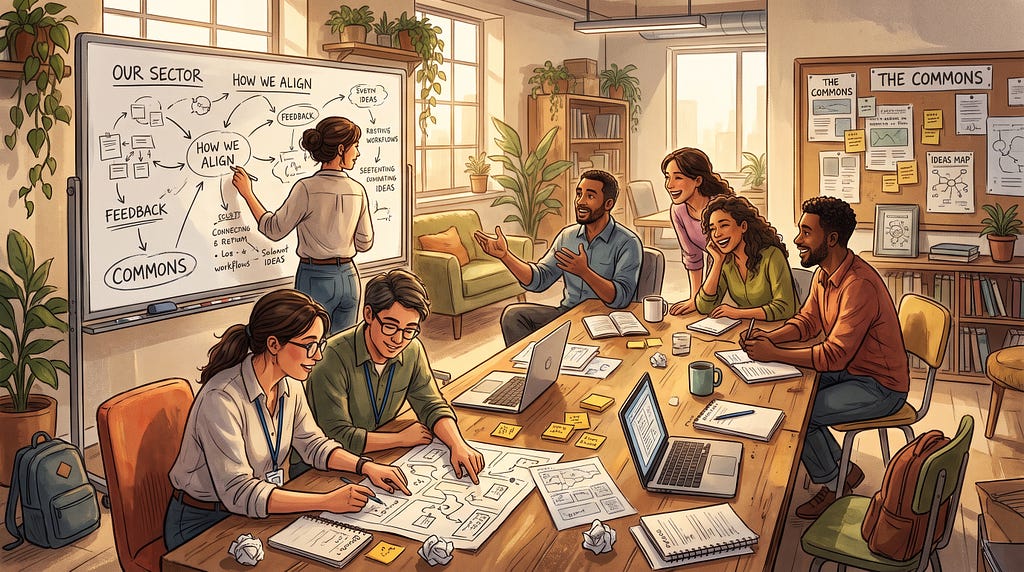
The Relational Commons as the Modern Watercooler — Image by Gemini (AI)
Over the past twenty years, the pursuit of narrow digital efficiency systematically dismantled the modern equivalents of Lloyd’s Coffee House. In the name of productivity, organizations replaced open working sessions with fragmented thirty-minute video calls, substituted automated ticket handoffs for hallway troubleshooting, and reorganized reporting lines every two quarters as if employees were interchangeable modular components in a software library.
Emily Stuart captures the quiet devastation of this trend with surgical precision. Trust between teammates runs on the exact same fuel as trust in a leader: genuinely knowing the human being on the other end of the line. Distributed schedules, relentless calendar compression, and perpetual restructurings starve organizations of the low-stakes, ambient contact where real familiarity takes root. In those unscripted margins of the workday, colleagues learn how a peer reasons through ambiguity, where their true technical strengths lie, and what pressures they are carrying outside the office. When an organization strips away every unscheduled moment as waste, teammates become strangers behind avatars. Every architectural disagreement registers as a personal attack, every cross-team handoff carries an undertone of suspicion, and collaboration grinds down into defensive contract negotiation.
The empirical evidence supporting relational investment is overwhelming. As Stuart documents, comprehensive workplace studies conducted by Gartner demonstrate that employees operating inside human-centric frameworks, defined by intentional collaboration, flexible autonomy, and empathetic leadership, are 3.8 times more likely to achieve high performance than peers in mechanistic environments. Those same workers are 3.2 times more likely to remain with their employer and 3.1 times less likely to suffer clinical burnout. Longitudinal research conducted jointly by Gallup and Workhuman, tracking nearly 3,500 professionals between 2022 and 2024, reveals that employees who receive authentic, high-quality human recognition are forty-five percent less likely to leave their companies within a two-year window.
Here we see the vital intersection between individual philosophy and organizational design. The International Monetary Fund estimates that roughly forty percent of global employment, rising to sixty percent across advanced industrial economies, faces direct transformation from artificial intelligence.
As repeatable technical tasks drop toward zero marginal cost, the primary bottleneck in every enterprise shifts from computation to human alignment.
When artificial intelligence clears ten or fifteen hours of solitary administrative toil from your weekly calendar, the wisest strategic move is to step away from the terminal and walk back into the relational commons. Make new friends across departments that you previously only interacted with through error tickets. Reinforce old alliances that frayed during years of heads-down crunch. Schedule unhurried working sessions where two engineers or analysts sit together in front of a single whiteboard to wrestle with a shared, messy problem rather than dividing it into isolated sub-tasks.
For leaders, Stuart prescribes a concrete set of practices to rebuild this social substrate before a crisis hits. Trust cannot be conjured on command via an executive values deck or an annual corporate offsite; it accumulates slowly through hundreds of unlogged, ordinary interactions. Workers constantly calibrate their commitment by measuring the distance between what leadership claims to value and what leadership actually rewards. Do you follow through on commitments when schedules tighten? Does credit land on the practitioners who actually solved the problem, or does it get siphoned upward by middle management? Do hard, uncomfortable truths get discussed directly with curiosity, or do they get routed around in whispered backchannels?
When a team member raises a concern about a flawed product rollout or a brittle automation pipeline, a leader’s immediate posture determines the intelligence of the entire unit for the next twelve months. If curiosity arrives before defensiveness, the room learns that candor is valued. If a single practitioner is publicly shut down or penalized for flagging a hazard, the entire floor goes silent for a year. Protecting psychological safety has nothing to do with corporate coddling; it is the rigorous engineering practice of protecting your organizational sensors from corrupted data. By reinvesting the time saved by automation into rebuilding friendships, alliances, and candid dialogue, a team constructs a human fault-tolerance layer that can absorb any technological shockwave.
The Perpetual “Day One” Mindset
Think back to the sensory clarity of your very first morning at a new job. You walk through the lobby doors carrying an empty notebook and a temporary security badge, completely unburdened by legacy grudges, territorial turf wars, or habitual blind spots. Because nobody expects you to clear fifty operational tickets on your first Monday, you have explicit institutional permission to observe. You trace how data flows from the customer intake portal down to the settlement engine. You introduce yourself to the database administrator down the hall, the compliance officer on the fourth floor, and the product manager who joined six months ago. When you spot a convoluted manual workaround that takes three hours every Tuesday, you ask the most powerful question in the human vocabulary: why do we do it this way?
Now fast-forward thirty-six months into that same tenure. In a traditional, high-friction workplace, the open-ended curiosity of your first day has been buried beneath three feet of operational sediment. You have inherited forty recurring maintenance workflows, twelve weekly status spreadsheets, and a backlog of routine troubleshooting requests that regenerate faster than you can close them. You no longer ask why the Tuesday script requires four manual spreadsheet exports; you simply drink your coffee, run the exports in silence, and guard your calendar against anyone who asks for five minutes of your time. Institutional familiarity has calcified into operational inertia. You are doing the job, checking the boxes on the task list, while the deeper work of questioning, inventing, and connecting has been crowded out by survivalist routine.
The deployment of intelligent automation offers a rare structural cure for this calcification: it allows experienced practitioners to re-onboard into their own careers.
When you systematically delegate your accumulated procedural maintenance to software agents, you trigger a Perpetual Day One mindset.
This orientation unlocks a combination of capabilities that was historically impossible to achieve in a single employee. Usually, a newcomer possesses fresh eyes and boundary-crossing curiosity but lacks deep institutional context, while a ten-year veteran possesses encyclopedic domain knowledge but is too buried in daily maintenance to step back and reimagine the system. When a veteran practitioner sheds their routine drudgery, they suddenly stand on the shop floor with the unburdened schedule and eager social curiosity of a Day One hire, backed by a decade of battle-tested architectural wisdom.
Imagine approaching your current role tomorrow morning as if you had just been hired to redesign it from scratch, while retaining every hard-won lesson about where the bodies are buried in the legacy stack. You have the breathing room to set up introductory coffees with colleagues in adjacent silos, asking them what hidden friction is slowing down their quarters. You can examine the automated outputs of your new AI tooling with a skeptical, seasoned eye, noticing the subtle edge cases where the statistical model hallucinates or misreads a client’s regulatory reality.
For this Perpetual Day One orientation to flourish across an enterprise, leaders must match individual curiosity with what Emily Stuart calls a design discipline pointed at work itself. In most companies, executive teams lavish hundreds of hours of user-experience research on external customers while dropping massive internal tool rollouts onto their own staff without a single hour of ethnographic observation. An executive committee buys an enterprise AI license based on a vendor pitch deck, mandates its adoption across five hundred engineers or financial analysts via a thirty-minute webinar, and then blames employee stubbornness when the tool sits unused or creates downstream chaos.
A human-centered design approach reverses this sequence entirely. Before restructuring a workflow or deploying an automated platform, leaders study the lived reality of the people doing the work: what their Tuesday afternoon actually looks like, which undocumented workarounds are holding the legacy process together, and where their genuine cognitive friction resides. Gartner’s research confirms the power of this participatory approach, showing that employees who are given direct input into their company’s work design are 2.5 times more likely to achieve high performance than those who have workflows dictated to them from above.
Furthermore, designing for a Perpetual Day One culture requires leaders to abandon the theater of performed certainty. When executives pretend to possess infallible five-year roadmaps during a period of rapid technological upheaval, they trap themselves into defending bad early assumptions that become too politically expensive to reverse. Stuart advocates for prototyping organizational changes in the open, using the exact rigor a product team applies to a software beta. Frame every workflow transition as a bounded experiment: inform the department that two teams are piloting a new AI-assisted triage model for six weeks, specify the exact metrics and human feedback loops being monitored, and commit to sharing the unvarnished findings on a fixed date.
Clear experimental framing steadies an anxious workforce far more effectively than false certainty. When people know the boundaries of a test and see leadership adjusting course based on honest floor-level feedback, transparency becomes a reliable rhythm. Freed from routine drudgery and supported by open experimental guardrails, every veteran employee gets to experience the electric possibilities of their first day on the job all over again.
Activating the Latent Backlog
Walk into the chief engineer’s office at any century-old municipal waterworks or regional rail yard, and pull open the bottom drawer of the steel filing cabinet. Beneath the daily shift rosters and regulatory compliance binders, you will almost always find a weathered, dog-eared notebook filled with hand-drawn schematics. Inside that notebook sits the plant’s latent backlog: a redesigned acoustic baffle that would silence the turbine room, a cross-manifold bypass valve that would prevent winter pipe bursts during sub-zero freezes, and an automated pressure-sensor array that would cut pump wear by forty percent. Every senior technician on the floor knows those projects would transform the reliability of the facility. None of them have ever been built, because the maintenance crew spends one hundred percent of its forty-hour week bolting iron patches onto leaking nineteenth-century mains just to keep water flowing to the city until Friday.
Every modern knowledge organization, from software engineering divisions to investment banks and hospital networks, carries an identical bottom drawer. In the daily life of an individual practitioner, we call these the back-burner tasks: the brilliant, high-leverage improvements that you sketch on the back of a napkin during a moment of inspiration and then reluctantly shove into a folder labeled Someday because five urgent operational fires just landed in your inbox.

The Latent Backlog as a Treasure Finally being Discovered — Image by Gemini (AI)
Inside a typical enterprise, the latent backlog is where the company’s actual future competitive advantage sits gathering dust. For a systems architect, the back burner holds the structural refactoring of a brittle authentication pipeline, the creation of a self-healing chaos-testing harness, or the comprehensive documentation of a complex disaster-recovery runbook that currently exists only inside two senior engineers’ heads. For a financial analyst or wealth advisor, the back burner holds a deep forensic audit of mid-market vendor contracts, the design of an educational tax-planning workshop for generational clients, or the construction of an early-warning liquidity model for volatile bond markets. For an engineering manager, it holds the unhurried mentorship curriculum that would elevate three promising junior developers into autonomous technical leads within a year.
Traditional corporate accounting is structurally blind to the latent backlog because standard productivity metrics measure throughput rather than system health. If an organization evaluates its staff strictly by how many standard tickets they close, how many lines of boilerplate code they commit, or how many client forms they process per hour, then any hour spent fixing the underlying machinery looks like a dip in utilization. Drudgery acts as a suffocating tax on human invention; it forces brilliant problem-solvers to spend their careers patching cracks in the dam rather than doing the long term planning to replace the dam with a better system that won’t break all at once.
Here the philosophy of Restorative Humanism delivers its most tangible economic and personal payoff.
When artificial intelligence quietly takes over the management of the breaking dam we call “operations,” the back burner ceases to be a graveyard for deferred ambition and becomes the primary workshop of the enterprise.
Consider how this shifts the daily posture of the practitioner. In Oppong’s survivalist framework, the worker is urged to get close to the money or the risk and ship visible efficiency fixes primarily out of fear that the employer will otherwise liquidate their seat. Under the Architecture of Reclaimed Agency, the motivation flips from defensive anxiety to creative sovereignty. You pull those long-deferred architectural drawings out of the bottom drawer and begin papering them out across the wall because solving complex, foundational problems is exhilarating human work.
When a practitioner uses their reclaimed ten hours a week to tackle the latent backlog, three transformative things happen simultaneously:
- Systemic Debt Evaporates: The organization finally addresses the root causes of its recurring operational fires. Instead of celebrating the hero who stays up until three in the morning manually restarting a crashed server cluster, the team celebrates the architect who used their reclaimed Tuesday afternoons to eliminate the race condition that caused the crashes in the first place.
- Institutional Intelligence Compounds: As Emily Stuart emphasizes, when leaders ask why they should bother studying current workflows and worker frustrations if AI is going to reshape everything in twelve months, they miss the core asset of the firm. Workflows are temporary; the human judgment that notices a broken edge case and designs a resilient replacement is permanent. Activating the back burner harnesses the tacit intelligence of the people closest to the work, turning front-line employees into an organic, decentralized research and development engine.
- Vocational Joy Returns: Disengagement thrives in the gap between what a capable professional knows they could build and the mind-numbing trivia they are forced to execute all day. When you finally have the calendar space to build the tool, write the strategy, mentor the apprentice, or overhaul the broken process that has annoyed your team for three years, your job transforms from a daily endurance test into a craft worth getting excited about again.
You no longer need to wait for a top-down corporate reorganization or a million-dollar consulting engagement to innovate. By letting the machine handle the routine ticket queue, you fund your own research lab right at your desk.
The New Social Contract of Work
In 1890, the United States Census Bureau faced an existential crisis of data processing. The previous census of 1880 had taken human clerks nearly eight full years to tabulate by hand, and with the nation’s population surging past sixty-two million people, statisticians calculated that the 1890 census wouldn’t be finished before the 1900 count began. Enter Herman Hollerith, a former census employee who invented an electromechanical tabulating machine inspired by railway conductors punching passenger tickets. Using spring-loaded pins that passed through holes punched in stiff paper cards to touch pools of mercury and close electrical circuits, Hollerith’s machines read and tallied a citizen’s demographic record in seconds.
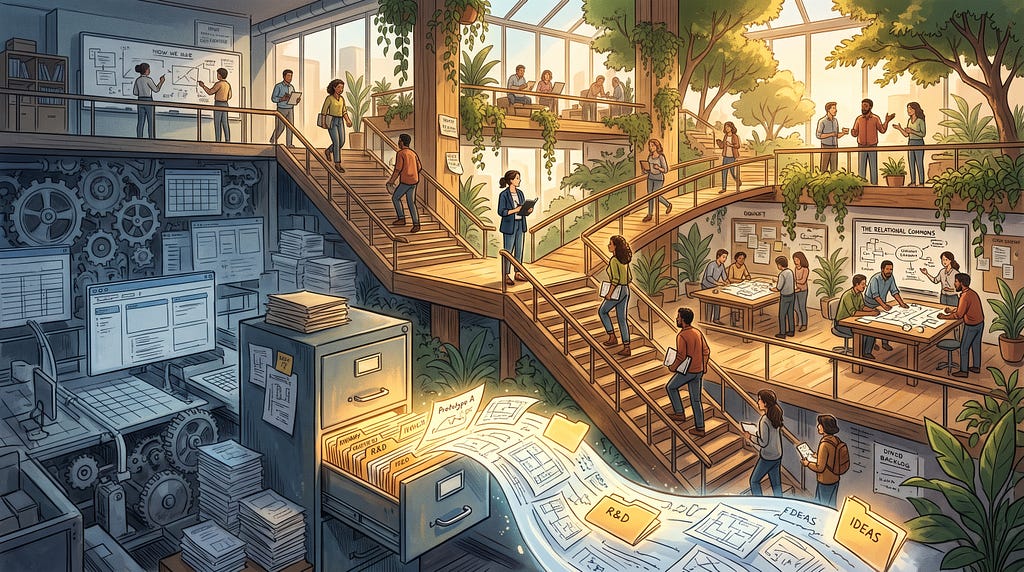
Human workers freed from drudgery can finally get valuable work done — Image by Gemini (AI)
When the electromechanical tabulators were wheeled into the Census Building in Washington, thousands of tally clerks feared that statistical employment had reached its end. Instead, the elimination of manual stroke-counting birthed the modern fields of demographic epidemiology, actuarial science, urban planning, and econometric modeling. Freed from spending eight years making pencil hash marks on ledger sheets, human minds began asking what the numbers actually meant for public health, municipal sanitation, and industrial policy.
Every major leap in computational tooling follows this historical arc: when a machine claims a lower tier of mechanical calculation, humanity is challenged to ascend to a higher tier of conceptual and social stewardship.
We stand inside the turbulent middle of that ascent today. The pessimism radiating from corporate layoff announcements and urgent survivalist essays is an understandable reaction to a period where technological capability has temporarily outpaced organizational wisdom. When banks liquidate thousands of operational roles while dismissing human beings as low-value capital, and when nearly seventy percent of the workforce walks through the office doors feeling detached and stressed, it is easy to conclude that the workplace is becoming a cold, algorithmic wasteland.
Yet fatalism is a choice, and it is a poor one.
The future of work is not a predetermined script written by venture capitalists or cost-cutting committees; it is an open architectural problem waiting to be designed by the people who actually build and run our institutions.
Achieving a humane, high-performing future requires a renewed social contract built on two reciprocal pillars: design-led stewardship from leaders and reclaimed agency from individual practitioners.
For leaders, executives, and managers, Emily Stuart’s research establishes an unyielding operational law: high performance has a non-negotiable human requirement. You cannot squeeze world-class judgment, early risk detection, and bold experimentation out of a workforce that feels surveilled, expendable, and exhausted. Turning a drifting organization around requires applying the same rigorous engineering and design discipline to the human experience of work that you already apply to your flagship products. It demands three unwavering commitments:
- Treat Practitioners as Primary Intelligence: Recognize that the people doing the daily work possess vital, ground-level insight into what is breaking and why, insight that no executive dashboard or enterprise software vendor can replicate.
- Design for How Decisions Land: Evaluate every reorganization, tool rollout, and process shift by measuring its impact on human trust, cognitive load, and team cohesion alongside its projected financial return.
- Engineer Psychological Safety as Infrastructure: Protect the conditions that allow people to surface bad news early, challenge flawed assumptions across lines of authority, and prototype new workflows in the open without fear of retaliation.
For individual contributors, engineers, analysts, creatives, and specialists, the path forward is the daily practice of Restorative Humanism. Refuse to let corporate jargon or sensationalist headlines convince you that your worth was ever tied to the mechanical drudgery that software is now absorbing. And refuse the bleak invitation to retreat into a paranoid, lone-wolf bunker where every colleague is a rival and every workday is a defensive skirmish.
When automation quietly clears the repetitive brush from your calendar, claim that operational dividend with both hands. Reclaim your time and your distinct human voice. Lean deliberately into the irreducible social heart of your vocation, the realm of empathy, presence, shared laughter, ethical discernment, and hard-won mutual trust where no algorithm can ever hold court. Treat tomorrow morning like your very first day on a brand-new job: walk across the floor, make new friends, mend old alliances, and ask the foundational questions that everyone else was too busy to raise. Then pull that yellowing list of back-burner dreams out of your bottom drawer, paper the schematics across the wall, and build something that makes your work worth waking up for again.
The machines can have the drudgery. The frontier belongs to us.
Sources & Further Reading
Inspiration & Core Commentary
- Emily Stuart, “High performance has a human requirement”
- Thomas Oppong, “Welcome to The New World Order. Jobs Are Dying. Careers Are Collapsing”
Workplace Analytics & Empirical Research
- Gallup, “State of the Global Workplace 2026 Report”
- Gallup & Workhuman, “The Human-Centered Workplace: Building Organizational Cultures That Thrive” (2024 Longitudinal Study)
- Gartner, “Human-Centric Work Design and High-Performance Culture Benchmarks” (2022)
- International Monetary Fund (IMF), “Gen-AI: Artificial Intelligence and the Future of Work” (2024)
Historical & Economic Foundations
- John Maynard Keynes, “Economic Possibilities for our Grandchildren” (1930)
- Frederick Winslow Taylor, “The Principles of Scientific Management” (1911)
- United States Census Bureau, “The Hollerith Machine and the 1890 Census”
- Nassim Nicholas Taleb, “Antifragile: Things That Gain from Disorder” (Random House, 2012)