How modern video games and speculative fiction help a post-religious generation trade the fear of an angry creator for the terror of an indifferent cosmos.
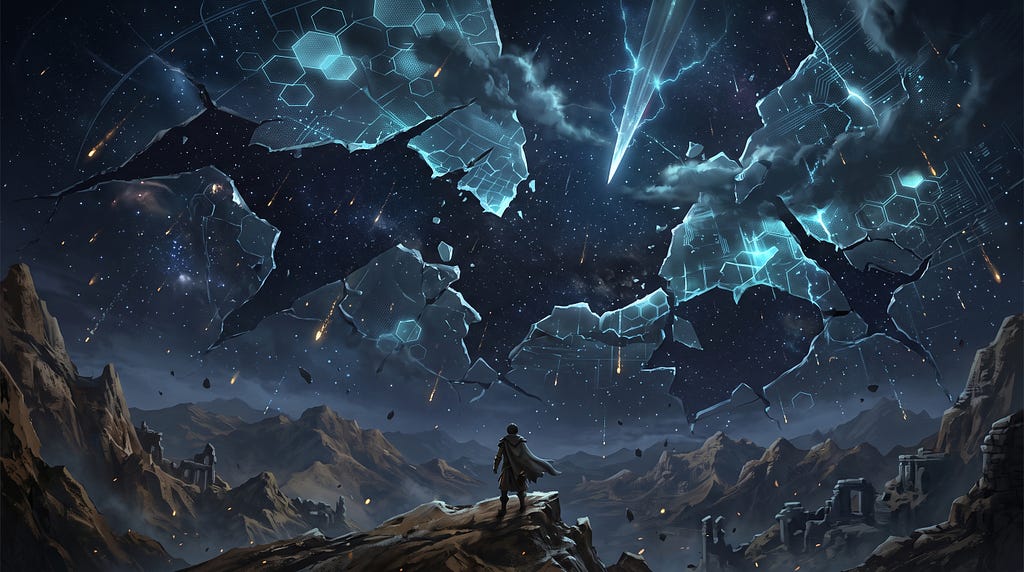
Image created by author in Gemini (AI)
Oct. 20, 2026 — Madkat Omega
The Secular Cathedral
For most of recorded history, whenever human beings needed to wrestle with the unbearable weight of existence — why innocent people suffer, why empires collapse into dust, and who, if anyone, is steering the cosmos — they did so inside the walls of religion. Sacred liturgy, scripture, and theological treatises were the primary arenas where humanity negotiated its relationship with authority and fate.
In the twenty-first century, the institutional teeth of traditional religion have largely dulled, yet the existential anxieties those religions were built to soothe remain as sharp as ever. Rather than vanishing, our metaphysical reckoning has migrated. Today, speculative fiction, tabletop roleplaying, and sprawling interactive video games serve as the secular world’s philosophical sandboxes. They are massive, collaborative improv theaters where writers, developers, and millions of players actively rehearse the collapse of sacred authority.
Video games are uniquely suited to this kind of philosophical stress-testing because of how they are built. In a traditional novel or film, a god can remain an ineffable, poetic mystery. In a video game, however, everything that exists must be translated into code: state machines, boundary triggers, memory registers, and conditional logic. The moment a developer places “heaven” inside a game engine, the divine is stripped of its untouchable mystique and converted into an inspectable, hackable system.
Nowhere is this dynamic more visible than in HoYoverse’s global phenomenon, Genshin Impact. Beneath its bright, painterly surface and commercial character rosters lies one of the most ambitious pieces of subversive theological worldbuilding in contemporary pop culture. By synthesizing ancient heretical mysticism with Eastern humanist philosophy, the game constructs a simulated cosmos where the creator is an automated containment protocol, the local gods are burnt-out middle managers looking for an exit strategy, and human ambition is treated as a rogue virus. It offers a mirror of how a post-religious generation uses interactive fiction to work through the ultimate philosophical transition: moving from the childhood dread of an angry god to the adult terror of an unscripted universe.
“The moment a developer places ‘heaven’ inside a game engine, the divine is stripped of its untouchable mystique and converted into an inspectable, hackable system.”
The Broken Cage
To understand the radical shift happening in modern storytelling, one first has to look at the ancient problem of theodicy — the theological attempt to explain why a supposedly all-loving, all-powerful God permits catastrophic suffering.
In orthodox Western scriptures, the answer almost always relies on human guilt. When the world is drowned in the Book of Genesis, when Sodom and Gomorrah are incinerated by sulfur, or when the builders of the Tower of Babel are scattered across the earth, the narrative framing is unmistakable: humanity sinned, grew arrogant, or corrupted itself, and a righteous Creator stepped in to administer moral punishment. Suffering is the receipt for human disobedience.
Nearly two thousand years ago, however, a collection of early Christian and Jewish mystics known as the Gnostics proposed a darker, far more subversive explanation. In texts that were eventually banned by the orthodox church and buried in the Egyptian desert until their rediscovery at Nag Hammadi in 1945 — most notably The Apocryphon of John — the Gnostics argued that the physical universe was a counterfeit. According to Gnostic myth, the entity who crafted our material world was not the true, transcendent God, but an arrogant, blind, lesser craftsman called the Demiurge (often named Yaldabaoth). Ignorant of the higher spiritual realms above him, the Demiurge built the physical world as a tightly sealed terrarium, trapping sparks of true divinity inside mortal bodies and appointing cosmic wardens — called Archons — to enforce astrological fate and keep humanity asleep.
Modern speculative fiction has resurrected the Gnostic Demiurge, updating him for the information age. In contemporary worldbuilding, the “zookeeper god” who runs the human terrarium is no longer even an emotional tyrant throwing temper tantrums of fire and brimstone. Instead, the Demiurge is reimagined as a cold, reactionary artificial intelligence — a headless planetary maintenance daemon running on an infinite, decaying loop.
Genshin Impact stages this exact scenario with surgical precision. Its world, Teyvat, is enclosed beneath a literal fake sky — an inverted dome constructed eons ago by an alien usurper known as the Primordial One (or the “Heavenly Principles”) who conquered the planet’s indigenous elemental dragons and terraformed the surface for human habitation. When players meet the enforcer of this supreme power in the game’s opening moments, her title in the original Chinese script is Tiānlǐ de Wéihùzhě — literally the “Maintainer” or “System Technician” of the Heavenly Principles.
Throughout the fictional history of Teyvat, advanced human civilizations — from the snowy mountain kingdom of Sal Vindagnyr to the subterranean machine empire of Khaenri’ah — are repeatedly obliterated from above. Yet none of these societies are destroyed because they are cruel, greedy, or morally wicked. They are wiped out the exact moment their scientific, alchemical, or philosophical literacy allows them to peer past the artificial sky and contact the raw, chaotic reality outside the dome (the Abyss).
When a civilization breaches those parameters, the sleeping celestial system does not deliver a sermon; it drops a “Divine Nail” — a colossal, geometric pillar that pins down the world’s memory network, freezes the local climate into a radioactive wasteland, and halts the spread of forbidden data. It is the mythological equivalent of an automated hardware shutdown purging a memory leak before the simulation crashes.
“Civilizations in this framework are not eradicated because they are wicked; they are purged the exact moment their intellectual maturity threatens the stability of the simulation.”
This framing echoes one of the most famous passages in modern literature: “The Grand Inquisitor,” a parable inside Fyodor Dostoevsky’s 1880 novel The Brothers Karamazov. In the story, a sixteenth-century Spanish Inquisitor arrests Jesus and explains that the Church no longer needs him. Humanity, the Inquisitor argues, is too weak to handle the terrifying weight of true spiritual freedom; what mortals actually crave is security, predictable rules, and a warm cage. By casting the divine as an automated containment system that trades human potential for ecological stability, modern interactive fiction allows us to look at the Grand Inquisitor’s bargain from the outside — and start looking for a crowbar.
Ren Ding Sheng Tian and the Ethics of Defiance
If the world is a managed terrarium governed by a legacy algorithm, how are human beings supposed to respond? Here, contemporary storytelling stages a dramatic collision between Western and Eastern mythological attitudes toward ambition.
In the classical Western tradition, mortal attempts to cross the boundary separating humanity from the gods are almost universally framed as hubris — fatal pride that guarantees a tragic fall. When Icarus flies too close to the sun on wax wings, he plunges into the sea. When the Titan Prometheus steals divine fire from Olympus to give humanity technology and civilization, Zeus chains him to a mountain peak where an eagle tears out his regenerating liver every single day. The overarching moral of classical Western antiquity is one of cosmic boundary enforcement: know your place as a mortal, or the universe will break you.
Chinese foundational mythology, however, runs on a radically different philosophical engine, captured in the four-character idiom Ren Ding Sheng Tian (人定胜天): “Human resolve can overcome heaven.”
In the ancient Chinese mythic imagination, when the cosmos turns hostile, the heroic response is neither humble prayer nor tragic submission — it is public works and relentless engineering:
- When a catastrophic deluge submerges the ancient heartland, the culture hero Dayu (Yu the Great) does not build an ark and wait for heaven’s mercy; he spends thirteen years dredging riverbeds and cutting irrigation canals through mountains to physically force the floodwaters into submission.
- When ten solar deities rise into the sky simultaneously and scorch the earth’s crops, the archer Hou Yi does not offer sacrifices to appease them; he draws his bow and shoots nine of the suns out of the sky, leaving just one to warm the people.
- When the daughter of the Flame Emperor drowns in the Eastern Sea, she transforms into the Jingwei bird, spending eternity carrying twigs and pebbles in her beak to drop into the waves, determined to fill up the ocean that killed her.
Modern roleplaying narratives fuse the Gnostic rebellion against a false world with the pragmatic defiance of Ren Ding Sheng Tian. In these stories, the sacred is not something to be worshipped; it is an environmental obstacle to be engineered around.
Even more striking is how contemporary writers treat the gods who sit between humanity and the supreme throne. In Genshin Impact, the seven regional deities who govern the continents — the Archons, each tellingly named after a demon from the seventeenth-century occult manual The Lesser Key of Solomon — do not behave like jealous lords demanding blood and incense. They behave like exhausted, traumatized civil servants who have seen the machinery behind the curtain and want out.
Every major chapter of the narrative is, structurally, an abdication story. The God of Contracts in Liyue stages his own assassination during a public festival specifically to test whether human merchants and legal institutions are ready to govern their own metropolis without a deity looking over their shoulder. In the aquatic nation of Fontaine, the Hydro Archon, Focalors, discovers that the heavenly system has pre-programmed an unavoidable flood to dissolve her citizens. Rather than begging heaven for clemency, she spends five centuries quietly accumulating energy to build a metaphysical guillotine — executing her own divine office, shattering her celestial throne, and returning the stolen power of the planet to its original dragon sovereign so her people can become fully autonomous human beings.
“The sacred no longer needs to be overthrown by violent revolution when the gods themselves realize their own obsolescence and quietly hand humanity the keys.”
By playing through these storylines, an audience raised in a secularizing world gets to rehearse a profound cultural graduation. The training wheels of divine paternalism are not ripped away in malice; they are dismantled by mutual consent because humanity has finally outgrown the nursery.
The Vertigo of the Empty Throne
Yet every great rebellion in literature carries a hidden sting, and the overthrow of the “zookeeper god” exposes the deepest psychological nerve of the modern age. If the traditional narrative of an angry, punishing God was so restrictive, why did human civilizations cling to it so fiercely for thousands of years?
The uncomfortable truth is that an angry god is infinitely more comforting than an indifferent universe.
To believe that a drought, a plague, or an earthquake happened because you broke a divine commandment is, in a strange way, the ultimate validation of human ego. It means that what you do in your bedroom, what you eat on a Friday, and what you whisper in your prayers matters so immensely to the Architect of the Cosmos that He will rearrange the weather just to teach you a lesson. Under the gaze of a wrathful deity, humanity is never alone. Suffering is never random; it is part of a grand, authored drama where every tear is counted and every injustice will eventually be balanced on a celestial ledger.
When we use philosophy, science, and speculative fiction to pull back the curtain — exposing the miracles as mechanical scripts and the angry Father as a dormant, unfeeling server — we win our freedom at the cost of our cosmic safety net.
In his famous 1945 lecture Existentialism Is a Humanism, the French philosopher Jean-Paul Sartre distilled this exact crisis into three words: “Existence precedes essence.” When an artisan makes a paperknife, Sartre explained, the artisan starts with a blueprint and a specific purpose — an essence — before the knife physically exists. For millennia, human beings believed we were made the same way: designed by a Creator with a built-in purpose and a pre-written destiny mapped onto the stars.
But if the throne of heaven is empty — or occupied only by a blind, legacy machine — then there is no blueprint. We exist first. We wake up inside the world unannounced, and only afterward must we figure out what we are for. Without a divine script to blame for our flaws or a heavenly parent to bail us out of our disasters, Sartre argued, humanity is “condemned to be free.” Condemned, because we did not create ourselves; yet entirely free, because once thrown into the world, we are responsible for everything we do.
“To believe that a plague struck your city because you sinned is the ultimate validation of human ego: it means the Architect of the Cosmos is always watching you.”
Three centuries before Sartre, standing at the dawn of the scientific revolution as telescopes first revealed the terrifying scale of the physical universe, the French mathematician and philosopher Blaise Pascal jotted down a single, haunted sentence in his Pensées: “The eternal silence of these infinite spaces terrifies me.”
That is the true destination of our modern myths. When the artificial sky of the terrarium finally shatters — whether in the climax of a sprawling roleplaying game or in the quiet secularization of twenty-first-century life — we do not step out into a warm, welcoming garden. We look up past the broken glass and see the real Abyss: vast, unscripted, indifferent, and completely silent.
We use our fiction to rehearse the death of the gods because we are still learning how to breathe in that thin, cold air. The ultimate dread of our era is no longer that heaven will strike us down with fire and sulfur for daring to build our towers too high. The dread is realizing that no one is going to stop us — that there are no Divine Nails left to pause our mistakes, no Archons left to balance our scales, and that the crushing, exhilarating responsibility of holding this fragile world together belongs entirely to us.
Works Cited & Further Reading
- Birrell, Anne. Chinese Mythology: An Introduction. Johns Hopkins University Press, 1993. Available via Johns Hopkins University Press and Bookshop.org.
- Dostoevsky, Fyodor. The Brothers Karamazov. Translated by Richard Pevear and Larissa Volokhonsky, Farrar, Straus and Giroux, 1990. Available via Macmillan Publishers; public domain English translations accessible via Project Gutenberg.
- HoYoverse (miHoYo). Genshin Impact. 2020–present. Primary software client and official world lore available via HoYoverse Official Site.
- Meyer, Marvin, editor. The Nag Hammadi Scriptures: The International Edition. HarperOne, 2007. Available via HarperCollins; public domain manuscript translations archived online at The Gnostic Society Library.
- Pascal, Blaise. Pensées. Translated by A. J. Krailsheimer, Penguin Classics, 1995. Available via Penguin Random House; full public domain text accessible via Project Gutenberg.
- Sartre, Jean-Paul. Existentialism Is a Humanism (L’existentialisme est un humanisme). Translated by Carol Macomber, Yale University Press, 2007. Available via Yale University Press; open-access English transcription accessible via the Marxists Internet Archive.