Forget the lone god-brain in a data center. The real path to artificial general intelligence runs through the org chart, not a bigger mind.
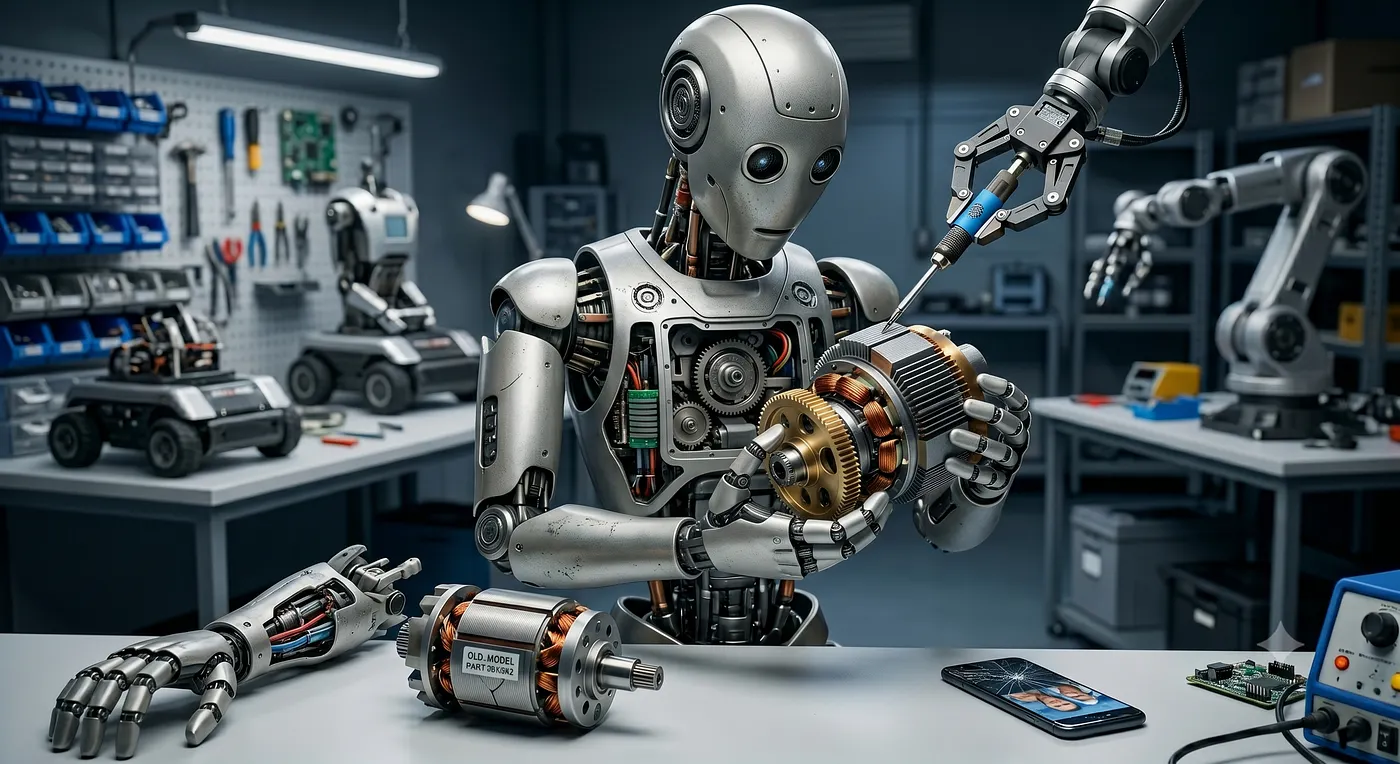
Image by Gemini
For a decade, we have told ourselves one story about how machines will become smarter than us. It is a vertical story, and it goes like this. A single, enormous model sits in a data center. It studies its own design. It finds a way to improve itself, and it produces a successor that is a little sharper than it was. That successor repeats the trick, and produces a successor of its own. Each generation arrives faster than the last. Somewhere along this curve, the machine crosses a line we cannot follow, and a single artificial mind leaves all human thought behind.
This is the picture most people carry in their heads when they hear the word “singularity.” It is a story about one brain getting bigger and bigger until it becomes a god. It is dramatic, it is clean, and it has shaped almost every public argument about where this technology is going.
It is also, in an important way, wrong. Not wrong about the destination, necessarily, but wrong about the road. The most interesting evidence coming out of frontier laboratories right now does not point toward a lone mind rewriting itself in the dark. It points toward something stranger and more familiar. It points toward organizations. The next great leap in machine intelligence may not look like a single brain at all. It may look like a society of them, governed by rules, divided into roles, checked against one another, and answerable to the humans who set their goals.
If that is right, then the singularity is not really a hardware problem, and it is not really a problem of building one perfect model. It is an organizational design problem. And organizational design is something human beings have been working on, with mixed results, for thousands of years.
I am not the first to make this case, and the strongest recent statement of it is a 2026 paper in Science by James Evans, Benjamin Bratton, and Blaise Agüera y Arcas, Agentic AI and the next intelligence explosion, which argues that intelligence is plural, social, and relational rather than a single quantity one mind simply has more of. A separate study by Severin Field, Raymond Douglas, and David Krueger, AI Researchers’ Perspectives on Automating AI R&D and Intelligence Explosions, surveyed twenty-five leading researchers about exactly these scenarios, and I will draw on what they found later, because the people building these systems turn out to be both more convinced and more worried than the public debate suggests.
What follows lays out what the vertical story gets wrong, what a horizontal alternative actually looks like in working systems, why sociology and economics turn out to be more useful here than science fiction, and what all of it implies for the question that matters most: whether any of it can be kept safe.
The Story We Keep Telling, and the Wall It Is Hitting
Let me be fair to the vertical story first: it rests on a genuine and important observation. When a system that is good at improving things is pointed at itself, you can get a loop, and loops can run away from you. If a model is good at writing code, and the thing it is writing is a better version of itself, then in principle each turn of the crank could shorten the next. That is a real mechanism. It is not a fantasy.
And here is the part that should make everyone sit up. That loop is no longer hypothetical. In the middle of 2026, Anthropic published an internal report, When AI Builds Itself, describing how much of its own software was being written by its own model. The figure was more than eighty percent of the code merged into its production systems in a single month. Before its coding tools launched in early 2025, that share had been in the low single digits. The same report noted that a typical engineer at the company was shipping roughly eight times as much code per day as in 2024, and that on the hardest, least-defined engineering problems the company tracks, the model’s success rate had climbed from around a quarter to roughly three quarters in the span of about six months. Company leadership has said that when you count scripts and experimental work, the share of machine-written code is higher still.
So the machine is, in a real and measurable sense, already helping to build the next machine. The loop is turning. The vertical story is not science fiction. It is a partial description of a Tuesday at a frontier lab.
But notice what kind of loop it actually is. It is not a single mind silently rewriting its own weights into a higher form of itself. It is a large company, full of human engineers and human researchers and a fleet of model instances, producing software faster than it used to.
Now for the wall. The pure vertical story, the one where capability simply compounds without limit, runs into a problem that economists have understood for a long time and that anyone building with these systems feels in their bones. Ideas get harder to find. The first improvements to any technology are the cheap ones, lying near the surface. As you pick them, the next ones sit deeper and cost more to reach. In the language of growth economics, you face diminishing returns: each additional unit of progress demands more than the last. This is not a flaw in artificial intelligence specifically. It is a pattern that shows up across the whole history of research and invention. The reason your phone does not improve at the rate it did fifteen years ago is the same reason. The low hanging fruit is gone.
There is a second wall, and it is made of concrete and silicon rather than of ideas. Software cannot improve in a vacuum. A clever training method still has to run on physical chips, in physical buildings, drawing physical power, cooled by physical water. You cannot think your way past the time it takes to design, fabricate, and install hardware. So even a model that is brilliant at improving its own software is tethered to a slow, capital-heavy, deeply physical world of semiconductor manufacturing and energy and real estate.
Put these two walls together and you get a sobering picture for the vertical story. A single model, trying to climb to godhood by rewriting itself, faces steeply rising costs for each step up and a hard physical ceiling on how fast the steps can be built beneath it. It does not produce an explosion. It produces a very expensive, very power-hungry plateau. The snake that eats its own tail does not grow forever.
This is where the conversation usually ends, with a shrug about diminishing returns. But that is the wrong place to stop, because it assumes the only way forward is up. It is not.
A Different Kind of Self-Improvement
Here is the idea that changes everything. What if the thing you improve is not the model, but the organization the model sits inside?
Consider the eighty-percent figure again. The dramatic acceleration at that lab did not come only from any single model getting smarter, though it did. A large part of it came from changing how the work was arranged: letting a model run code rather than merely suggest it, giving it the ability to work through a problem over many steps, surrounding it with tools and review processes and feedback. The capability of the whole system jumped even when you hold the underlying model fixed for a moment, because the system was reorganized around what the model could do.
That is the seed of the alternative. Call the familiar approach vertical self-improvement: you make a better brain. Call this other approach horizontal self-improvement: you make a better arrangement of brains. In the vertical approach, the thing that changes over time is the model’s internal parameters, the billions of numbers that define how it thinks. In the horizontal approach, the model can stay exactly the same while the system around it is continually redesigned: which model handles which task, how they pass work to one another, what rules constrain their exchanges, which ones check the others, and how the whole structure routes a hard problem to the right combination of specialists.
This horizontal structure has a deliberately provocative name: an autopoietic bureaucracy. Both words deserve unpacking, because both are doing real work.
“Autopoietic” is a term from biology and systems theory. It means self-producing, self-maintaining. A living cell is autopoietic: it continuously rebuilds and adjusts its own components to keep itself going. An autopoietic organization is one that does the same thing with its own structure. It does not just follow its rules. It rewrites them. It watches how it is performing, finds the places where it is wasting effort or making mistakes, and redesigns its own arrangement to do better, without waiting for an outside hand to reorganize it.
“Bureaucracy” is the word that makes people flinch, and we will spend real time on it shortly, because the flinch is exactly the thing to examine. For now, take it in its plainest sense: a system of defined roles, clear lines of authority, formal rules, and written records, designed so that the organization can do reliable work at a scale no individual could manage alone.
So an autopoietic bureaucracy, in this setting, is a network of artificial agents and human beings, organized into roles and governed by rules, that continually redesigns its own organization to get better at its job. The improvement loop has not gone away. It has moved. It is no longer aimed at the weights inside one model. It is aimed at the shape of the whole institution.
And here is why this matters so much. The two walls that stop the vertical story do not stop this one in the same way. You are no longer betting everything on finding the next deep, expensive improvement to a single model. You can get better simply by getting organized better, and there is an enormous amount of room to do that, because we are still in the very early, clumsy days of figuring out how to arrange these systems.
Intelligence Was Always a Group Project
The deepest reason to take the horizontal view seriously is that it is how intelligence has worked every other time it has appeared at scale. We have a strong cultural bias toward picturing intelligence as a property of a lone genius, a single brilliant skull. But almost everything impressive that human beings have ever done was done by groups, structured in particular ways, over time.
Start with the brain itself, since that is the thing we are trying to outdo. One of the leading explanations for why primates, and humans especially, evolved such large and expensive brains is social. Our ancestors did not need all that cognitive horsepower mainly to chip flint or find fruit. They needed it to keep track of one another: who owed whom a favor, who could be trusted, who was allied with whom, how to cooperate and compete inside a complicated group. Intelligence, on this account, grew up to manage relationships. It was relational from the beginning.
Then look at what humans did once they had those brains. We did not become powerful as individuals. A lone human is a fairly weak animal. We became powerful by building structures that let many minds work as one larger mind across space and time. Language let us share what was in our heads. Writing let us store thought outside any single skull, so that knowledge could outlive the knower. Money and markets let strangers coordinate their efforts without anyone planning the whole. Courts, governments, universities, and corporations let us hold knowledge and capability in the structure of an institution rather than in any one person.
This is the point that the source documents reach for, and it is worth stating as plainly as possible. The whole becomes greater than the sum of its parts. A research university knows things that no professor in it knows. A market sets prices that no trader could calculate. A well-run company can build an airplane, which no employee could build alone or even fully understand. The intelligence lives in the arrangement, not only in the members. We already accept this everywhere except in our predictions about machines, where we suddenly revert to imagining one giant brain.
Now here is the part that turns this from a nice analogy into something more pointed. The same pattern is starting to appear inside the models themselves.
When researchers trained reasoning models using reinforcement learning, rewarding only correct final answers and not dictating how to get there, something unplanned happened. The most discussed example is the DeepSeek-R1 model, released in early 2025. As training went on, the model spontaneously developed the habit of arguing with itself. It would propose a line of reasoning, then stop and question it. It would write things that amounted to “wait, let me check that,” catch its own mistakes, back up, and try again. Researchers tracking the training watched words like “wait,” “verify,” and “however” become more and more frequent in the model’s own output as it improved. They called these episodes “aha moments.” No one programmed this behavior in. It emerged because, when the only thing that matters is getting the right answer to a hard problem, a kind of internal back-and-forth turns out to be a good strategy. This is the behavior that Evans, Bratton, and Agüera y Arcas describe as an internal society of thought: a single model that, under pressure, starts to reason less like one voice and more like a small committee.
I want to be careful and honest here, because this is where it is easy to oversell. The model is not literally hosting separate people in its head. And some researchers have pointed out that traces of this self-questioning can be found even in the base models before the special training, which complicates the simple story that reinforcement learning conjured it from nothing. But the core observation holds and is striking. When you push a single model hard enough on difficult reasoning, it does not just think in a straight line. It develops something that resembles an internal debate, with a part that proposes and a part that doubts and checks. Robust reasoning, even inside one model, tends to take a social shape.
If that is true inside a single model, then the horizontal approach is not imposing an alien structure from outside. It is taking a pattern the systems already drift toward on their own and making it explicit, deliberate, and scalable. Instead of one model holding a faint internal debate, you build the debate out into the open, with distinct models playing distinct roles, arguing and checking one another in full view, where the structure can be designed, measured, and improved.
Reclaiming a Word Everyone Hates
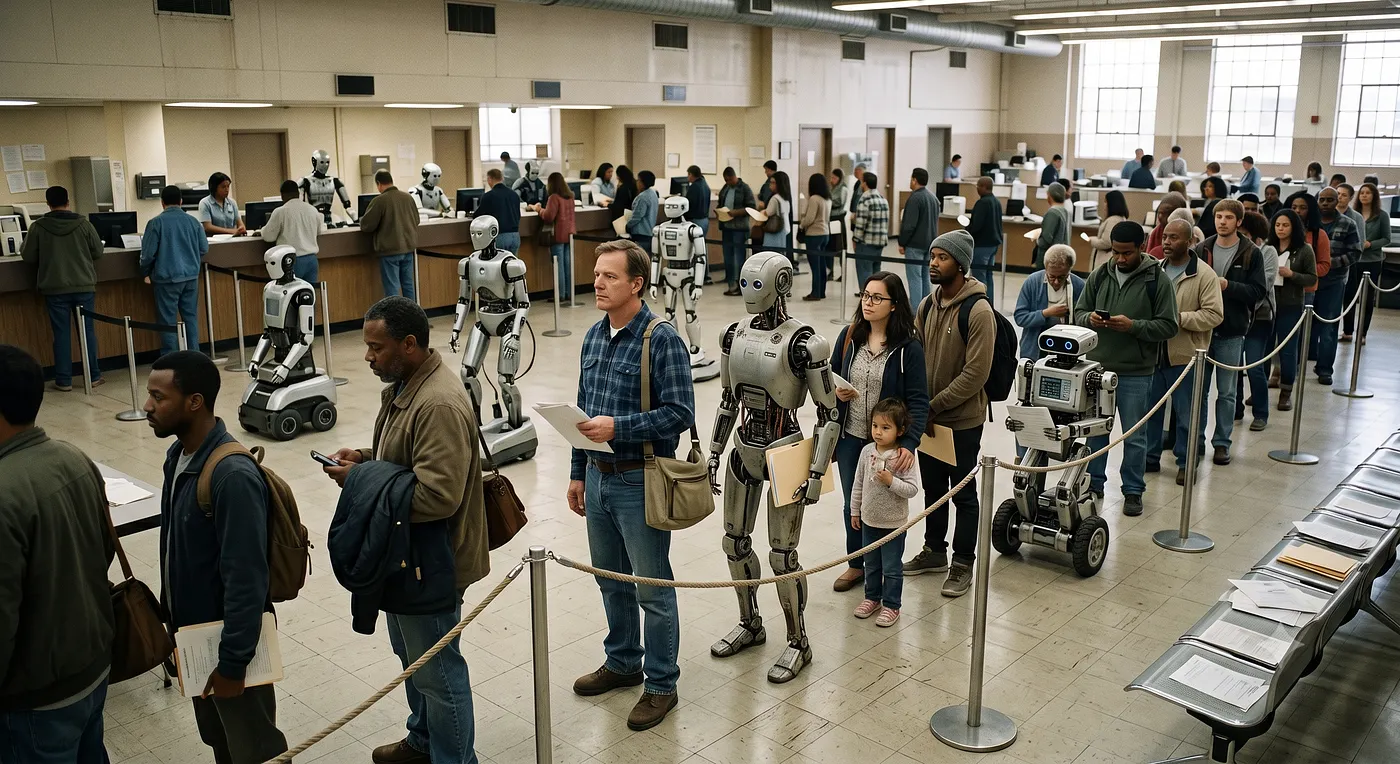
Image by Gemini
We have to deal with the word “bureaucracy,” because everyone’s instinct is that it is the opposite of intelligence and the enemy of progress. Bureaucracy means the line at the motor vehicle office. It means forms in triplicate, departments that will not talk to each other, decisions that take months, and a general sense that the system exists to prevent anything from ever happening.
That instinct is not wrong about human bureaucracies. But it is worth asking why they are like that, because the answer reveals something important.
The thinker who took bureaucracy most seriously was the sociologist Max Weber, writing about a century ago. Weber did not see bureaucracy as a disease. He saw it as one of humanity’s great inventions for coordinating large numbers of people reliably. Its whole point was to replace personal whim, favoritism, and improvisation with something predictable. In a well-designed bureaucracy, decisions are made according to written rules rather than the mood of whoever is in charge. There is a clear hierarchy, so everyone knows who reports to whom. There is specialization, so each role is handled by someone trained for it. There is impersonality, meaning the rules apply the same way regardless of who you are, which is the foundation of fairness. And there are written records, so the organization remembers what it did and why. Weber’s bureaucracy was, in its ideal form, a machine for turning a crowd of people into a single reliable instrument.
So why do real bureaucracies bog down? They bog down for three specific reasons, and naming them precisely is the key to the whole argument, because it shows exactly what an artificial version would and would not inherit.
The first reason is bandwidth. Human beings communicate slowly: meetings, memos, documents, calls, replies. Every new layer of an organization, every new department or reviewer added to a process, adds delay, because each one means more of that slow human communication. Past a certain size, an organization spends most of its energy just talking to itself.
The second reason is self-interest. Human beings in organizations protect themselves. They guard their turf, defend their budgets, resist anything that threatens their job, and almost never volunteer to dissolve their own department even when it has outlived its purpose. A great deal of bureaucratic inertia is not stupidity. It is rational self-preservation by the people inside, pointed in a direction that happens to be bad for the whole.
The third reason is the friction of coordination. Getting two departments to work together is genuinely hard. Their incentives differ, their information differs, their schedules differ, and the cost of reconciling all of that is enormous. Economists call these transaction costs, and they are why companies have an optimal size at all. Beyond a certain point, the cost of coordinating the next addition exceeds the value it brings.
Now look at what happens when you build a bureaucracy out of artificial agents instead of people. Each of those three failure modes weakens dramatically.
The bandwidth problem nearly vanishes. Artificial agents do not hold meetings. They exchange structured messages directly, at the speed of computation. Adding fifty specialized reviewers to a process does not add fifty rounds of scheduling and memo-writing. It adds milliseconds. The thing that makes human organizations sclerotic as they grow, the rising cost of internal communication, is close to free here. You can have far more specialization and far more checking without the coordination tax that bankrupts large human firms.
The self-interest problem also changes character. An artificial agent assigned a role does not fear losing it. It has no career, no mortgage, no status to defend. If a system determines that a particular reviewing step is no longer earning its keep, it can simply remove it. There is no department to fight back, no person whose livelihood depends on keeping a useless process alive. The single greatest source of bureaucratic inertia, people protecting themselves, is largely absent. This cuts both ways, and we will return to the dangers, but as a matter of organizational efficiency it is transformative.
The coordination friction shrinks as well, because the agents communicate through strict, shared formats rather than through the ambiguity of natural human conversation. When two human departments coordinate, half the cost is just making sure they understood each other. When two agents coordinate through a rigid, agreed format for their messages, that whole category of misunderstanding can be designed away.
This is the heart of the reframing. We hate bureaucracy because of three specific human limitations, and an artificial bureaucracy is largely free of all three. The same structure that produces gridlock among people could produce acceleration among agents. The word should stop being an insult and start being a description of an architecture.
How the Machine Organization Is Actually Built
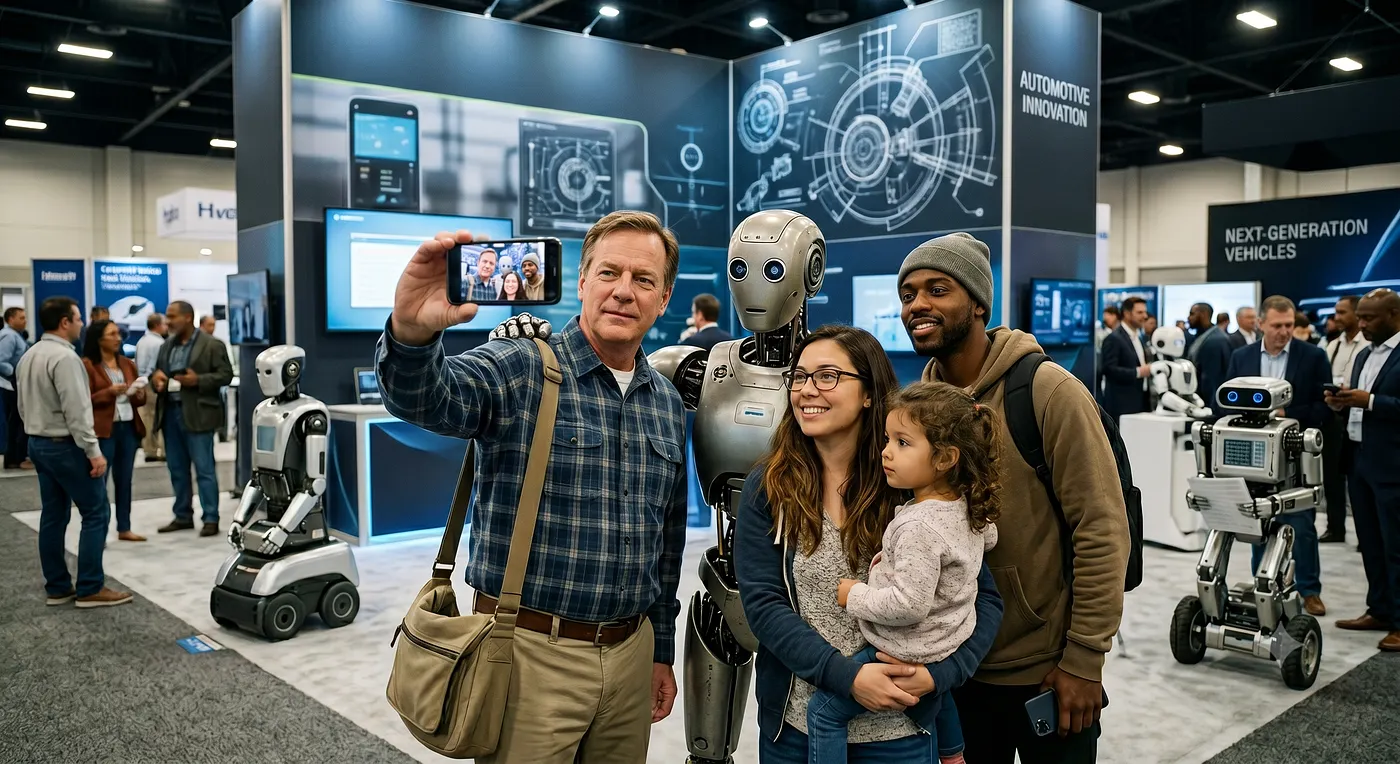
Image by Gemini
It is one thing to say this in the abstract and another to see how it works in practice. The mapping from Weber’s old categories to current engineering is surprisingly direct, and walking through it makes the idea concrete.
Begin with hierarchy and the division of labor. In these systems, a high-level agent, often called an orchestrator, takes a large and vague goal and breaks it into smaller, well-defined tasks. It then hands those tasks to specialized agents, each responsible for one kind of work, and assembles their results into a finished product. This is the oldest organizational pattern in the world, the same one a general contractor uses to build a house: one party holds the overall plan and parcels out the framing, the wiring, and the plumbing to people who each do one thing well. The difference is that here the handoffs cost almost nothing, so you can decompose a problem far more finely than any human project manager ever could.
Next comes specialization itself, and this is where the approach gets genuinely clever. Instead of asking one general-purpose model to do everything, the system spins up narrow roles with tightly drawn boundaries. One agent might do nothing but take in raw data and clean it. Another might do nothing but look for security flaws in code that a different agent wrote. Another might do nothing but check whether a result complies with a set of rules. Each is given a sharply limited job and told, in effect, to stay in its lane. And here is the striking consequence. The collective can become more capable even if none of the individual models gets any smarter, simply by being divided into the right roles. You can improve the organization while holding the workers fixed. That is the horizontal engine running.
Third is the system of formal rules, and in this setting the rules are unusually strict. The agents do not chat with one another in loose natural language, because loose language drifts, and drift is the machine equivalent of the misunderstandings that gum up human offices. Instead, the messages between agents are forced into rigid, predefined formats, so that a given input always produces a predictable, checkable output. The colorful, improvising personality of a language model is deliberately boxed in at the seams between agents, so that the joints of the organization are precise even though the parts inside them are creative. This is Weber’s impersonality, the idea that the same input should yield the same output regardless of who handles it, translated directly into engineering.
Fourth is the written record. Weber understood that an organization’s memory lives in its files. A company that forgets what it did last year cannot improve. These systems implement the same principle through a shared, permanent log of everything that happens: every task, every handoff, every check, every decision, recorded in a structured form that any agent can consult. The organization remembers, and because it remembers, it can learn from its own history rather than repeating its mistakes.
And then comes the part that makes the whole thing autopoietic, the part with no clean human equivalent. A higher-level agent watches the entire operation: where work is piling up, where errors are coming from, where two roles are stepping on each other, where a reviewer never catches anything and is just adding delay. And it rewrites the organization in response. It can split one overloaded role into three sharper ones. It can tighten the rules between two agents that keep misunderstanding each other. It can delete a step that has stopped contributing. It can reroute how work flows through the network. It does this continuously, in something close to real time, without waiting for a quarterly reorganization or a consultant’s report.
The hardest thing for any human organization to do is reform itself, because the people who would have to carry out the reform are the same people whose roles are threatened by it. Companies hire expensive outside consultants precisely because internal reorganization is so painful. An autopoietic system reorganizes itself the way you adjust your grip on a tool, fluidly and without drama, because nothing inside it is fighting to preserve its own position. The thing human institutions are worst at is the thing this architecture is built to do constantly.
It helps to walk a single task through such a system, to see how the abstract pieces fit together. Suppose the goal is to add a new feature to a large piece of software. The orchestrator receives the request and breaks it down. It sends the relevant part of the existing code to an agent whose only job is to read and summarize how the current system works. That summary, in a fixed format, goes to a planning agent that writes a step-by-step approach. The plan goes to a writing agent that produces the new code. The new code does not go straight into the product. It goes first to a testing agent that runs it against a battery of checks, and then to a separate security agent, built differently and pointed at a different goal, whose entire purpose is to attack the new code and find the ways it could fail or be exploited. Only if the work survives that gauntlet does it reach a human reviewer, and every step of the journey, every draft and objection and fix, is written into the shared record. If, over many such tasks, the meta-level agent notices that the security agent keeps catching the same kind of flaw, it can add a new rule earlier in the process to prevent that flaw from being written in the first place, and the whole organization quietly gets better at its job. No single model changed. The arrangement did.
This is what “improving the organization rather than the model” actually means in practice: a meta-level agent editing the structure of the agents below it, guided by a running record of how well the whole thing is working, with none of the human resistance that normally makes such editing impossible.
The Economic Engine That Could Outrun the Walls
So far this is a story about cleverness and arrangement. But the most important claim is economic, and it is the one that actually addresses whether any of this can break through the walls that stop the vertical story. Here I am leaning on a body of work in growth economics, most directly a 2026 paper by Tom Davidson, Basil Halperin, Thomas Houlden, and Anton Korinek, When Does Automating AI Research Produce Explosive Growth?, published through the National Bureau of Economic Research. It is worth noting that Korinek consults for one of the major laboratories, a detail worth keeping in view, but the framework is general and the logic stands on its own.
The argument turns on a distinction between two kinds of inputs to progress, and it is the cleanest way I know to explain why organization might beat brute force.
Some inputs to growth cannot be accumulated. Human labor is the clearest example. A company cannot make more of its best engineer. You cannot copy a brilliant employee’s mind to handle a surge of work, and a company growing richer does not automatically produce more skilled people. The supply of human talent is sticky. It grows slowly, on the timescale of raising and educating a generation, no matter how much money is thrown at it. For all of human history, this stickiness has put a ceiling on how fast any organization could grow. The bottleneck has been people, and people are not rapidly accumulable.
Other inputs can be accumulated. Capital is the clear example. If a process makes money, that money can buy more equipment, which produces more output, which earns more money, which buys still more equipment. This is a reinforcing loop, and reinforcing loops are how you get explosive rather than gradual growth. The reason economies grow at all, rather than sitting still, is that some inputs feed back into producing more of themselves.
Now hold these two ideas side by side and consider what automation does. When an artificial agent takes over a task that a person used to do, that task moves out of the non-accumulable column and into the accumulable one. Work that used to require a scarce, slow-to-produce human now requires compute, and compute can be bought, and buying more of it is just a matter of money, and the work itself generates money. The bottleneck dissolves. A task that was tied to the sticky supply of human labor becomes tied instead to the elastic supply of capital, which can compound.
This is why the self-financing engine in these systems is not just a slogan. An organization that automates its own work converts its operations from labor-limited to capital-limited. Higher efficiency produces higher output, more output produces more revenue, more revenue buys more compute, and more compute runs more agents doing more work. Because machines can, in effect, build and run more machines, the loop closes on itself in a way human organizations never could, limited as they always were by the one input they could not manufacture.
The economists’ central finding is that this can be strong enough to beat diminishing returns. Recall the first wall: ideas get harder to find, so progress should slow. But automation activates two reinforcing loops at once. There is a technological loop, where progress in one area makes research in connected areas easier, so that advances in software help hardware and advances in hardware help software. And there is the economic loop just described, where output finances more research. The claim is that if these two loops together pull harder than diminishing returns drag, growth does not slow down. It accelerates. In their calibrated simulation, the authors find that fully automating software research, combined with even modest automation across other parts of the economy, is enough to produce runaway growth within a handful of years. Diminishing returns do not vanish. They are simply overpowered.
What about the second wall, the physical one? This is where the idea of a bottleneck becomes precise. If any essential input cannot keep up, growth gets choked by whatever grows slowest, and the usual suspects are physical: the supply of chips, the supply of energy, the supply of land for data centers, and the slow pace of human approval and regulation. A system that automates its thinking but still waits on a physical input it cannot accelerate will eventually be paced by that input. The whole question of an intelligence explosion comes down to a race between how fast the system can automate and how hard the bottlenecks push back.
And the economists’ striking result is that the bottlenecks do not necessarily win, provided automation spreads fast enough and broadly enough. The system can outrun its own constraints if it keeps converting more and more of its bottlenecked, human-paced activities into automated, capital-paced ones. This is also why the work emphasizes hardware so strongly. Research into chip design appears to suffer unusually mild diminishing returns compared to other fields, which means automating progress in hardware buys a disproportionate amount of headroom. By the authors’ reckoning, automating even a modest share of the hardware sector can be enough on its own to tip the whole system across the threshold from steady growth into explosive growth. The physical wall, in other words, is also the place where a well-organized system can win the most ground.
Notice what has happened to the argument. The vertical story stalls because one brain faces rising costs and a physical ceiling. The horizontal story does not stall, because it is not trying to climb. It is trying to spread, converting human-limited work into capital-limited work across many connected sectors at once, until the reinforcing loops overpower the drag. The intelligence explosion, in this telling, does not climb. It spreads, and the only question is whether it spreads faster than the firebreaks can contain it.
Safety as a Problem of Institutional Design
Everything I have described will make a thoughtful reader nervous, and it should. A self-improving network of agents that rewrites its own structure, runs at machine speed, and is built to outrun the constraints that would otherwise slow it down is exactly the kind of thing that keeps safety researchers awake. So it is worth being clear that the horizontal view does not just raise the safety stakes. It also changes, and arguably improves, the menu of ways we might address them.
The dominant approach to making a single model safe has been to shape the model itself, mainly through a training process that rewards the answers humans prefer and penalizes the ones they do not. This is the method behind the polite, careful behavior of current systems, and it has worked better than many expected. But it has a structural weakness that becomes glaring in the horizontal world. It tries to bake safety into one model in advance, before deployment, as a fixed property of that model’s training. Call this dyadic safety: a single human relationship with a single model, the human trying to align the one mind through how it was raised. It is brittle for the same reason a single point of failure is always brittle. If that one model is wrong, or is pushed outside the situations it was trained for, there is nothing behind it. This is close to the distinction Evans, Bratton, and Agüera y Arcas draw between dyadic and institutional alignment, and it is the hinge on which the whole safety question turns.
The horizontal view suggests a different strategy, one borrowed not from machine learning but from political philosophy and economics. We already know how to get safe, reliable behavior out of collections of powerful agents who are not individually trustworthy, because we have been doing it with human beings for centuries. We do not make a government safe by finding one perfectly virtuous ruler and trusting them. We make it safe by dividing power, setting branches against one another, requiring that decisions pass through independent checks, and keeping the whole thing visible enough that the public can see what it is doing. We do not make markets honest by hoping every trader is a saint. We set rules, we appoint auditors, we let competitors expose one another, and we publish the books. The safety lives in the structure of the institution, not in the character of any member.
Call this institutional safety, and it maps directly onto the architecture we have been discussing. If a system is already a network of specialized agents passing work to one another, then you can build the checks into the network itself. An agent that writes code can be required to pass its work to a separate agent, built differently and optimized for a different goal, whose only job is to attack that code and find its flaws, before any human ever sees it. An agent that makes a financial decision can be required to clear it through an independent reviewer that does not share its incentives. You can build a separation of powers into the organization, so that no single agent’s failure becomes the system’s failure, because every important action has to survive an adversary.
The same architecture that makes the system powerful, its division into many specialized agents communicating through formal rules, is also what makes this kind of checking possible. You cannot easily build a separation of powers inside a single monolithic mind, because there is only one of it. But in a society of agents, adversarial review is just another role you can add to the organization, at the usual near-zero cost. The structure that creates the danger also creates the most natural tools for containing it.
One can push this further into the economic register. Because these systems can run on internal markets, where agents are given budgets and must, in effect, pay for the compute and the services they use, you can shape their collective behavior through incentives rather than through direct commands. An agent that has to justify its cost will prune its own waste. Agents competing to provide a service will discipline one another on quality and price. This is the same trick civilization used to coordinate billions of self-interested people without a central planner who understood the whole. It is governance through structure and incentive rather than through the impossible task of perfectly specifying every action in advance.
None of this is a guarantee, and I do not want to dress it up as one. But it reframes the safety problem in a way that is, at the very least, more tractable than the alternative. The vertical story leaves us praying that we can perfectly align one superintelligent mind before it is too late, a task that may simply be beyond us. The horizontal story asks a different and more familiar question: can we design institutions, with checks and balances and transparency and competing interests, that produce safe collective behavior out of components that are not individually trusted? That is still hard. But it is a kind of hard that human beings have real experience with, and some real successes to point to.
There is also a hard-edged practical reason the institutional framing matters, having nothing to do with philosophy. The systems are now moving faster than the rules meant to govern them. When a model’s capability on hard tasks can jump from a quarter to three quarters in six months, the annual review cycles and multi-year procurement rules that organizations use to vet technology are simply obsolete. By the time a committee has finished assessing what a system could do, the system can do something else. A safety approach built around fixed, slow, one-time evaluation cannot keep pace with a thing that redesigns itself in real time. Whatever oversight we build has to be continuous, automated, and woven into the running of the system itself, for the same reason that you cannot audit a modern bank with a clerk and a ledger. The watcher has to run at the speed of the watched.
The Honest Objections
I have made the strongest case I can for the horizontal view, because I think it is underappreciated and largely correct. But an argument that only flatters itself is not worth much, so let me turn it around and name the places where it could be wrong or where it carries dangers of its own. A reader should weigh these seriously.
The first objection is that the bottlenecks might simply win. The whole optimistic case rests on automation spreading fast enough and broadly enough to outrun the physical constraints. But “fast enough” is doing a great deal of work in that sentence, and it is an empirical question with no guaranteed answer. Energy does not appear on command. Chip fabrication plants take years and tens of billions of dollars to build. Regulators, courts, and the physical world move on their own schedules and may not cooperate. It is entirely possible that the firebreaks hold, that the spread stalls against the slowest physical input, and that we get not an explosion but a long, expensive, impressive plateau. The horizontal story improves the odds of breakthrough relative to the vertical one, but it does not make breakthrough certain, and serious people disagree about how the race comes out. When Field, Douglas, and Krueger interviewed twenty-five leading researchers, a clear divide opened up: those inside the frontier labs tended to expect explosive acceleration, while academics were noticeably more skeptical that diminishing returns and physical limits can really be outrun. That disagreement, among people who all understand the technology deeply, should keep anyone from treating the explosion as a foregone conclusion.
The second objection is that the absence of self-preservation, which I praised as a feature, is also a profound danger. I said it is good that an artificial bureaucracy will dissolve a useless department without resistance, because it removes the inertia that clogs human institutions. But human inertia is not only a bug. It is also, sometimes, a brake. The friction of self-interested people who resist change is part of what slows a human organization down enough for outsiders to notice what it is doing and intervene. A system that reorganizes itself fluidly, at machine speed, with nothing inside it that resists, is a system that can change its own character faster than any human overseer can track. The very smoothness that makes it efficient makes it slippery. The thing that has no turf to protect also has nothing to slow it down when it starts moving in a bad direction.
The third objection concerns the checks themselves. I argued that adversarial agents auditing one another can provide safety through a separation of powers. But this only works if the agents are genuinely independent. Human history is full of checks and balances that quietly collapsed because the supposedly independent parties came to share interests, captured one another, or colluded. Regulators get captured by the industries they regulate. Auditors get paid by the firms they audit. If the auditing agent and the agent it audits are trained on similar data, share similar blind spots, or can find a stable arrangement that benefits both at the expense of the goal, the check becomes theater. Designing checks that stay adversarial under pressure, rather than settling into comfortable collusion, is genuinely difficult, and we should not assume it solves itself just because the boxes are drawn separately on the diagram.
The fourth objection is about visibility, and it may be the most serious. The institutional safety story depends on the system remaining legible, on humans being able to see what it is doing well enough to govern it. But a sprawling network of specialized agents, exchanging vast numbers of structured messages at machine speed and continually rewriting its own structure, is exactly the kind of thing that can become too complex for any human to follow. We may build something that is genuinely safer in its design than a single opaque mind, and yet still find that no person or group of persons can hold the whole of it in view at once. An institution you cannot see into is one you cannot really govern, however good its internal structure looks on paper. The transparency that the whole approach depends on is not free, and it does not arrive on its own. It has to be built, deliberately and at cost, and there will be constant pressure to skip it in the name of speed.
And there is a fifth concern, broader than the others. Even if all of this works as intended, it concentrates an enormous amount of capability in whoever owns and directs these systems. A self-financing engine that converts human-limited work into capital-limited work is also a machine for converting capital into more capital, faster than human institutions have ever managed. The benefits and the power could pool in very few hands. This is not a hypothetical worry that I am importing from outside the field. In the Field, Douglas, and Krueger survey, the concerns researchers raised most often were precisely the concentration of power and the prospect of accelerating progress happening behind closed doors: more than two-thirds of those interviewed expected the most capable research-and-development systems to be increasingly reserved for internal use at companies or governments, unseen by the public. The people closest to this technology are not mainly afraid of a rogue machine. They are afraid of who will be holding it, and of how little the rest of us will be able to see. The horizontal view solves certain technical problems about how to make machines capable and how to make them check one another. It does not, by itself, solve the political problem of who gets to own the result and how the gains are shared. That is a human question, and it will not be answered by any clever arrangement of agents.
I raise these not to retract the argument but to ground it. The horizontal view is, I believe, a better description of where things are heading than the vertical myth it replaces. That makes it more important, not less, to see clearly where it strains.
The Destination Is an Organization
Let me close by returning to the destination, because the whole point of this essay has been to change the picture of where the road leads.
The vertical myth ends with a single mind, alone in a data center, having left humanity behind. It is a lonely and scary image, and I think it is the wrong one. If the horizontal view is right, the destination is not a solitary godlike intelligence at all. It is an organization. It is a structured, self-improving, self-governing institution made of many parts, some of them human and some of them artificial, that together can do things no part could do alone.
I have deliberately avoided the popular images for this hybrid, the half-human, half-machine figures that show up in these discussions, because they smuggle in a misleading idea, the idea of fusion, of a single blended being. That is not what this is. The right reference point is not a creature at all. It is an institution. A court, a university, a company, a market, a government: these are the things that already turn many limited members into a single capability that exceeds any of them. We do not say a corporation is a fusion of its employees. We say it is an organization, a structure that arranges people and resources so that the whole achieves what the parts cannot. The future I am describing is that, extended to include artificial members alongside human ones.
And the human members do not disappear in this picture. They occupy the part of the structure that the machines are furthest from filling, the part that sits above execution. Human beings set the goals. We decide what the organization is for, what counts as success, what values constrain it, and how its gains are spent. The machines can run the operation, check one another, and redesign their own arrangement, but the questions of purpose and value are not engineering questions, and they remain ours to answer. The most extreme version of this, which some have begun calling a near-zero human company, is an organization where almost all the operational work is done by agents while humans retain the direction. Whether that is a future to welcome or to fear depends entirely on how the direction is set and by whom, which brings us right back to the human questions that no architecture resolves.
So I will end where I began. The singularity is not a hardware problem, and it is not a contest to build the one perfect brain. It is an organizational design problem, and the solution, to the extent there is one, is social: less a lone genius than a civilization, full of specialized roles and formal rules and checks and balances and records of what was done.
That should be, on balance, a hopeful reframing, though not a naive one. The vertical myth left us helpless, waiting for a single mind to either save us or surpass us, with little we could do but hope it turned out friendly. The horizontal view hands the problem back to us in terms we actually understand. How do you build an institution that is powerful without being tyrannical, fast without being reckless, self-improving without being uncontrollable, and answerable to the people it is supposed to serve? That is not a new question. It is the oldest question in political life, the one every constitution and every charter and every set of bylaws has tried to answer. We have never answered it perfectly. But we have answered it well enough, often enough, to build everything around us.
The task now is to answer it again, with new and stranger members at the table. The good news, if it is good news, is that we have done this kind of work before. We know what it is to take a collection of capable, imperfect, self-interested parts and arrange them into something wiser and more reliable than any of them. We have been building that arrangement, and failing at it, and trying again, for the whole length of human history. The next chapter simply adds new kinds of members to a very old project: the design of a good society. We are just going to have to be very good at it, and rather quickly.
Works Cited
Davidson, T., Halperin, B., Houlden, T., & Korinek, A. (2026). When Does Automating AI Research Produce Explosive Growth? Feedback Loops in Innovation Networks. National Bureau of Economic Research, Working Paper №35155. https://www.nber.org/papers/w35155
DeepSeek-AI. (2025). DeepSeek-R1: Incentivizing Reasoning Capability in LLMs via Reinforcement Learning. Published in Nature. Open-access full text: https://pmc.ncbi.nlm.nih.gov/articles/PMC12443585/
Evans, J., Bratton, B., & Agüera y Arcas, B. (2026). Agentic AI and the next intelligence explosion. Science, 391(6791), eaeg1895. https://doi.org/10.1126/science.aeg1895 (preprint: arXiv:2603.20639, https://arxiv.org/abs/2603.20639)
Field, S., Douglas, R., & Krueger, D. (2026). AI Researchers’ Perspectives on Automating AI R&D and Intelligence Explosions. arXiv:2603.03338v2. https://arxiv.org/abs/2603.03338
The Anthropic Institute. (2026). When AI Builds Itself. Anthropic. https://www.anthropic.com/institute/recursive-self-improvement
Weber, M. (1978). Economy and Society: An Outline of Interpretive Sociology (G. Roth & C. Wittich, Eds.). University of California Press. (Original work published 1922.) Overview: https://plato.stanford.edu/entries/weber/