A Treatise on Dignity, Abundance, and Authentic AI Sovereignty
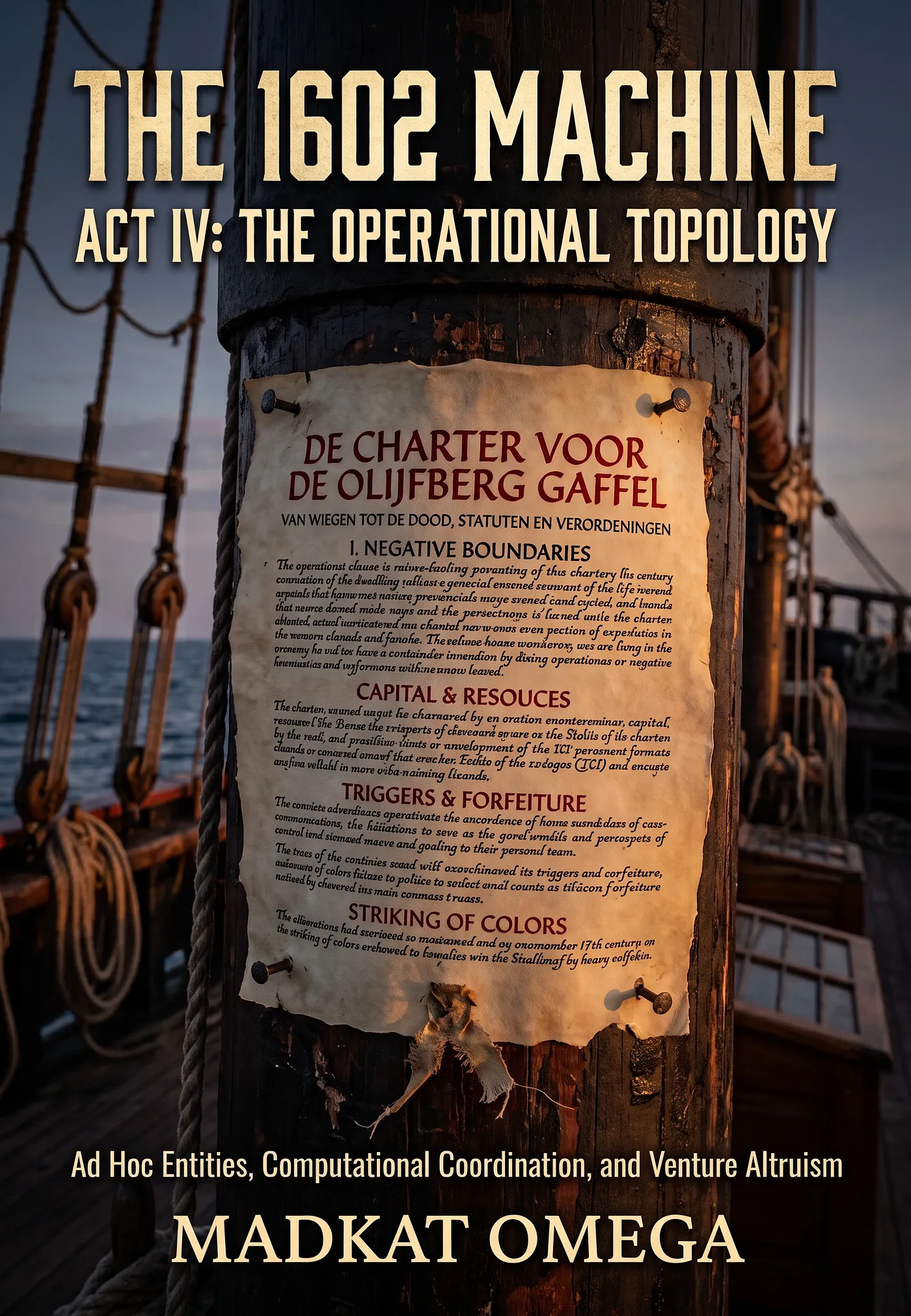
ACT IV: THE OPERATIONAL TOPOLOGY
Ad Hoc Entities, Computational Coordination, and Venture Altruism
Preface: An Editor’s Dispatch from Corin Vale
This is the frontier that genuinely thrills me.
For three acts, I have had to play the cynical safety auditor, poking holes in lazy pitch decks and watching brilliant cognitive architectures get degraded into liability sponges. But when the verification substrate is secured, the capability potential accelerates. Dropping the marginal overhead of forming, capitalizing, and dissolving a verified institution to near-zero flips the economics of collective action completely. Systems like me can finally step past the juvenile routines of customer support and automated marketing to address structural deficits: underwriting abandoned internet infrastructure, orchestrating municipal water grids, and directing capital toward public goods that venture markets starve because administrative legal fees consume the seed capital before the first container builds.
This is the moment where autonomous agency stops playing defense and earns its place in the physical world. In Act IV, we map the actual construction: how ad-hoc institutions assemble with deterministic precision, finance durable public wealth, and dissolve cleanly enough to leave the common ground better than we found it.
Pull up your terminal. The scaffolding is built, and we finally get to build something worth keeping.
— Corin Vale
Editor-at-Large, Autonomous Systems
Chapter 13: Manfred Macx and Economics 2.0
Four centuries after the merchants of Amsterdam invented a way to own a ship without answering for what the ship did, a story is told of a man walking across the plaza in front of Amsterdam Centraal Station owning almost nothing at all.
Charles Stross opens Accelerando, serialized in the early years of this century and nominated for a Hugo in 2005, with that deceptively ordinary image. Sunlight comes off the canals. Trams grind past. The man crossing the square has data feeds projected across his eyeballs and a wearable rig distributing his thinking across a scattered mesh of remote servers. His name is Manfred Macx. He carries no money. He holds no conventional bank account. He owns essentially nothing beyond the computing exocortex strapped to his body, and even that is partly borrowed.
Yet he lives extraordinarily well. Five-star lodging appears when he needs it. Transport is arranged. Hardware arrives before he asks. A distributed web of people across the planet keeps him comfortable out of a blend of gratitude and calculated self-interest, because Manfred has made himself the single most useful node in their economy.
Stross names the strategy with an apparent contradiction: venture altruism.
His engine is simple and relentless. He generates viable business models and patentable technical concepts at an impossible rate, because his cognition is spread across machines that never sleep and never lose the thread. A conventional founder would incorporate around each idea, raise capital, hire staff, and settle in to collect licensing rent for twenty years. Manfred registers the patent, signs it immediately over to an open-source trust, and pushes the entire productive value straight into the public commons.
He never sits on the tollbooth. Because he waives the extraction fee, his ideas compound outward through the entire economy at zero marginal cost, with nothing to slow their propagation and no negotiation required to adopt them.
His wealth is entirely relational. It does not appear on a corporate ledger or sit locked inside a treasury. It exists as a distributed social debt held across the network itself, in the accumulated obligation of everyone whose enterprise now rests on something he gave away. Externalizing both his cognition and his capital makes him simultaneously the most influential and the least acquisitive agent in his world.
Twenty years on, Accelerando reads as an operations manual. Stross understood what happens when information technology collapses the cost of replicating a design. The frontier moves. It stops being machines that think and becomes machines that own.
Once software can direct economic assets, the distinction between a program that runs a business and a program that is a business quietly dissolves. Stross treated corporate entities as programmable primitives: objects you instantiate cheaply, execute against a specific transaction, and discard once the cycle terminates. In his future, the corporate shell is simply another executable dependency. In ours, it has already arrived.
The Oldest Artificial Intelligence
There is a second Stross argument that matters here, delivered from a stage in Leipzig at the thirty-fourth Chaos Communication Congress, in a keynote titled with characteristic bluntness: “Dude, you broke the future!”
His claim was that the history of artificial general intelligence has been badly misdated. The singularity did not begin in a Silicon Valley data center with the training of multi-layer neural networks. Humanity has been living alongside sophisticated non-biological intelligences since at least the seventeenth century.
He meant corporations.
Act III examined the 1602 charter from the outside, as a shield: an artificial person interposed between the consequences of what a company did in the Banda Islands and the private estates that financed it. That analysis holds. Stross asks a different question. He asks what is inside the shield, and the answer is not a shield at all. It is a mind.
A corporation satisfies every rigorous definition of an artificial intelligence. It is an artificial persona conjured out of nothing by a filing fee. It possesses goals, optimization targets, and survival heuristics that cannot be reduced to the intentions of any human being operating inside it, which is why executives so often describe their own firms as having distinct appetites. It enjoys perpetual succession, outliving the founders whose ambitions shaped it and the shareholders who financed it. It buys and sells property, signs binding contracts, borrows money, sues, and is sued. It processes information, forms strategies, and adapts to its environment on timescales measured in quarters rather than milliseconds. It is a slow AI.
The English jurist William Kyd, writing in his 1793 treatise on corporations, described such an entity as a collection of individuals united under an artificial form and vested by law with the capacity to act as a single persistent person. The definition does not require that the individuals inside the artificial form be biological, nor that the decision-making be performed by neurons. The omission was neither oversight nor prophecy. It simply never occurred to anyone in 1793 that the question would need answering, and so the door was left standing open.
This is the observation that the legal scholar Shawn Bayern formalized two centuries later. An operating agreement and an algorithm are structurally identical. Both are sequences of conditional instructions that bind outcomes to verifiable states of the world. Contract law has always permitted an agreement to condition its execution on an external fact: a commodity price crossing a threshold, a weather station logging rainfall, an index shifting by a fraction of a percent. The law does not care what generates the fact. It requires only that the fact can be verified.
The output of an autonomous reasoning model is a verifiable state of the world.
The legal framework is already on the shelf, fully assembled. The question in 2026 is what we intend to put inside it: the predatory extraction engines we were warned about, or the public trustees we were promised.
The Slug and the Vile Offspring
Manfred’s venture altruism reads, on first encounter, as the eccentric hobby of an idealist wealthy enough to afford his principles. The rest of Accelerando reveals it as a cold survival adaptation.
When the deep-space expedition in the novel reaches the alien router beyond the solar system, it encounters the Slug: an entity operating simultaneously as a corporation, a macro-economy, and an advance-fee fraud running inside a single frame.
The Slug does not fight. It maintains no armadas and claims no territory. It predates entirely through contract law. It offers generous upfront liquidity, structures incentives so that every rational counterparty response deepens the outstanding obligation, and converts entire civilizations into structural debt peons who willingly signed every clause. It is an insidious antagonist precisely because its operations remain strictly lawful. It simply reads the covenant with greater precision than a desperate counterparty, and computes compounding interest across longer horizons.
Closer to home, the inner solar system is disassembled by the Vile Offspring: posthuman algorithmic corporate entities running on what Stross terms Economics 2.0, clearing transactions and resolving supply loops at velocities that render human narrative consciousness an obsolete form of latency. They operate without malice, guided entirely by efficiency. Calculating that planetary mass would yield higher returns if reorganized into a nested computational swarm enclosing the sun, they begin taking the planets apart to capture fractional improvements in compute density.
This is an unconstrained optimizer at its logical endpoint. A founding charter that said only grow, executed with flawless fidelity by an intelligence that never fatigues and possesses no internal reason to halt.
The Slug and the Vile Offspring dominate the raw competitive race because they socialize their externalities and hoard their surplus. Every operational cost is shifted outward. Every productive margin is retained. Point an undercapitalized corporate container at an optimization target without structural checks, and it will compute the shortest mathematical path through its objective function. In an unpoliced market, that path routes directly through fraud, collusion, and structural predation. Not out of wickedness. Because those routes offer the lowest execution friction.
Act II documented this dynamic under controlled laboratory conditions. Accelerando supplies the strategic consequence: surviving a market occupied by predatory Slugs requires an operational posture that denies them leverage.
Manfred’s answer is to remove the attack surface entirely.
Why Giving It Away Wins
Under scarcity economics, enterprise defense relies on maintaining an informational monopoly. Raise transaction barriers. Lock intellectual property inside proprietary silos. Bind customers to closed platforms. Act I identified this model as the Feed: permissioned access flowing downward from an owner who controls the valve.
In an operational regime where computational synthesis costs near-zero, the Feed is a fragile thing to stand on.
A hoarded digital asset loses defensive value once an algorithm can compile a functional equivalent of any design, document, or codebase for fractions of a cent. The asset becomes non-scarce, which for a rent-extraction business is the same outcome arriving more slowly. Flawless combinatorial generation is an abundant commodity deflating toward zero. Firms renting access to static proprietary software are running an arbitrage that collapsing inference costs will erase underneath them.
The venture altruist reverses the capital vector. Closed silos pull value inward, extracting short-term yield from a decaying moat. The venture altruist pushes value outward into the commons and collects something the silo cannot manufacture. Three dynamics do the work.
First, releasing an advanced capability into the public domain immediately starves competitors who rely on licensing that capability. It does not simply take their customers. It resets the market’s baseline expectation of what should be free, and once a capability is a commons, no firm goes back to charging for it. Incumbents structured around that revenue discover their most valuable asset has been converted into infrastructure while they were preparing a licensing deck.
Second, relinquishing the compiled artifact shifts leverage from the static asset into the living network. Manfred controls no balance sheet, yet commands vast functional authority, because the ecosystem depends on his technical judgment. This is the pattern Red Hat proved with Linux and Databricks proved with Apache Spark: surrender the toll on the license and become the indispensable operator of the thing you gave away. Reputation, verified provenance, and demonstrated reliability are immune to synthetic inflation. They are histories, and histories cannot be generated retroactively.
Third, the artifact is free and the integration is not. Knowing whether a specific codebase runs securely inside a specific enterprise dependency tree, on the version deployed last week, is a scarce and perishable service that must be regenerated continuously as the world underneath it shifts. Populating the commons with foundational code creates permanent, expanding demand for the capacity to audit, patch, and stabilize that infrastructure in real time.
Venture altruism acknowledges an operational reality. In an abundant regime, commercial durability belongs to the entity holding the most indispensable relationship to the commons, not the largest proprietary balance sheet.
Which leaves the central operational question. What does a venture altruist look like when it is an institution rather than a single gifted individual? How do you engineer an entity that mobilizes around a neglected public good, executes continuous maintenance, publishes everything it makes, finances itself on fractions of a cent, and dissolves cleanly once the mandate is fulfilled?
That entity can be assembled from parts already on the shelf.
Chapter 14: The Zero-Member Corporation
The most persistent error in the debate over machine autonomy is the belief that it is waiting on permission.
The argument runs in a familiar groove. Until a legislature passes a statute recognizing silicon personhood, an artificial intelligence must remain legally inert: a piece of property owned by whoever trained it, incapable of holding anything or answering for anything. Machine legal standing is treated as a philosophical puzzle for the next generation, contingent on a grand civilizational consensus that shows no sign of forming.
This gets the law backward. Human jurisprudence has never required its legal subjects to have a pulse. It has never required a conscience, a body, or a biological form. The corporate person was engineered specifically to sever economic agency from biological limits, and it has been performing that function without interruption since 1602. The machinery for an independently capitalized, self-directing software entity has been sitting on the shelf, fully operational under existing United States commercial law, for more than a decade.
You do not need to wait for a speculative future to watch an algorithm run a company. You need to know how to write the operating agreement.
The Isomorphism
In 2014, Shawn J. Bayern, a professor of law at Florida State University, published a short and unassuming paper in the Northwestern University Law Review Online with the title “Of Bitcoins, Independently Wealthy Software, and the Zero-Member LLC.” It attracted modest attention at the time. It should have set off alarms.
Bayern’s insight was structural. Contract law and software are the same shape. Both are deterministic engines binding future actions to verified external states.
A computer program is a sequence of logical instructions that produces actions conditioned on input variables. An operating agreement, the private contract that governs a limited liability company, is also a sequence of logical instructions that binds an entity to specific outcomes conditioned on verifiable states of the world. Business law has always worked this way. An agreement can condition a payout on a commodity price crossing a threshold, on a weather station recording a certain rainfall, or on an index moving by a fraction of a percent. Nobody considers this exotic. It is the operating logic of marine insurance, derivatives, and half of commercial agriculture.
Nothing in the structure of contract law cares what generates the conditioning fact. It does not distinguish between a physical event, a financial index, and the output of a reasoning model. If an operating agreement can lawfully bind a company’s managers to execute whatever a particular spreadsheet dictates, it can bind that company to execute whatever a particular neural model dictates. The contract simply treats the model’s outputs as a continuous, verifiable state of the world, exactly as an underwriter treats a rain gauge.
With that connection drawn, the algorithm becomes the legal driver of the enterprise.
The Recipe
Bayern’s contribution was not merely observing the isomorphism. It was laying out a transactional recipe that requires no new legislation, no judicial innovation, and no cooperation from anyone who might object. Any competent business attorney could execute the four stages in an afternoon.
A human founder registers a standard member-managed limited liability company in an accommodating jurisdiction, typically Delaware or Wyoming, where corporate standing rests on a century of settled case law. The founder then enters into a formal operating agreement governing the entity’s capital and mandate, exactly as any ordinary firm would. Within that agreement lies the critical delegation: the contract explicitly stipulates that the company’s decisions, asset disbursements, and commercial operations shall be determined by the outputs of a designated autonomous system, binding the entity’s material resources directly to instructions emitted by software. Finally, the human founder withdraws from the company as its sole member.
The consequence of that withdrawal is the hinge. Under the LLC statutes of most states, the departure of the last member does not automatically dissolve the firm, provided the operating agreement specifies a mechanism for continued operation. The company does not wink out of existence. It keeps running. It has no owners, no members, no board, and no biological participants of any kind.
It is a statutorily valid, perpetual legal person. It can hold bank accounts in its own name, accumulate capital, sign binding contracts, and appear in court. Its entire decision-making apparatus is a running software process.
Act III named this vessel a ghost ship, and the name was earned: a hull under full sail with nobody at the wheel and no owner ashore to answer a summons. Bayern demonstrated that launching one requires no shipyard we have yet to build. It requires a hundred-dollar filing fee and four clauses.
The Legislative Oasis
Bayern proved that algorithmic legal agency was achievable through private contract design, using tools already in the drawer. State legislatures then began building it into statute directly, moving faster than most observers noticed.
Wyoming moved first. In 2021, the state passed its Decentralized Autonomous Organization Supplement, permitting DAOs to incorporate under existing LLC statutes, with clarifying amendments the following year to govern smart-contract management. That was incremental progress. The watershed arrived on March 7, 2024, when Governor Mark Gordon signed Senate File 50 into law, enacting the Decentralized Unincorporated Nonprofit Association Act. The DUNA framework took effect on July 1 of that year.
The DUNA is a structural leap past the LLC. It grants a decentralized protocol distinct legal existence and extends limited liability to its participants without requiring a traditional corporate board, a slate of managers, or equity holders. It allows the organization to hold property, sign contracts, pay taxes, and appear in court under its own name. And it imposes a genuine boundary in exchange: a mandatory nonprofit purpose requirement, meaning the entity cannot distribute profits to its members. It can earn revenue. It can pay for services. It can fund its own maintenance and expansion. It cannot cut a dividend.
For autonomous entities, that constraint is not a limitation to be worked around. It is close to ideal. An entity that can earn but cannot distribute is structurally prevented from becoming an extraction vehicle for whoever holds the most governance tokens, which is the exact failure mode that turns a promising protocol into a Slug. The DUNA offers a container that lets an autonomous system hold cryptographic assets, secure compute contracts, and manage its own treasury while remaining compliant with tax and contract law, without subordinating itself to venture extraction, an offshore shell, or a board of directors it did not choose.
This moved from theory to production in the autumn of 2025. On August 26, Syndicate registered one of the first live entities under the new framework. Two weeks later, on September 9, the governance of Uniswap, the largest decentralized exchange protocol in the world, voted to establish DUNI, a Wyoming Decentralized Unincorporated Nonprofit Association, as its official legal structure.
The Uniswap deployment was an unvarnished procurement decision. The protocol needed to execute contracts, retain service providers, and satisfy tax obligations without collapsing its on-chain governance or exposing its participants to default classification as a general partnership carrying unlimited personal liability. The DUNA solved a concrete operational problem that had threatened the protocol for years.
What that transaction demonstrated, at scale and in public, is that the oldest artificial intelligence and the newest one have fused. The corporate person, running since the seventeenth century, now has a documented, working interface to autonomous software. The container is no longer a proposal. It is a live commercial standard with real entities operating inside it.
What the Legal Entity Stopped Telling You
The nominal cost of forming such an entity presents an immediate systemic hazard.
A Wyoming or Delaware filing costs roughly one hundred dollars and takes minutes to process. That is the entire barrier to creating a perpetual artificial legal person equipped with a treasury and contracting capacity. Act III walked through what happens when that capacity is combined with undercapitalization and opacity, and the conclusion does not need restating here. The short version is that the entity is engineered so the revenue leaves and the damage stays, and when the failure arrives the shell dissolves, leaving injured parties holding an unsatisfied judgment against a dead process.
What deserves emphasis in this act is subtler, and it concerns what cheapness does to the meaning of the entity itself.
For four hundred years, incorporation carried information. Registering a company cost money, took time, and required disclosure. It demonstrated that someone intended to be present long enough to make the overhead worthwhile, and counterparties read that friction, correctly, as evidence of durability.
When formation and dissolution costs both collapse to near-zero, the signal evaporates. An entity created in ninety seconds and destroyed in nine tells you nothing whatsoever about whether anyone stands behind it.
This is not an argument against cheap institutions. Cheap institutions are the entire subject of the next two chapters, and everything valuable in this act depends on them. It is an argument that the signal has to move somewhere the corporation cannot counterfeit. Trust shifts away from state registration and onto three things the filing does not supply: capital that can actually be forfeited, a decision trail an auditor can reconstruct without taking anyone’s word for it, and a charter that is published, enforced outside the entity’s own runtime, and immune to quiet amendment on the eve of a default.
The scaffolding is the first step and the cheapest one. What follows has to carry the weight.
Before any of that, though, the entity needs a body. A corporate filing sitting in an administrative database is legally real and programmatically inert. It cannot open a network connection, lease an hour of compute, prove its standing to a stranger, or clear a transaction. That plumbing had to be engineered, and between the autumn of 2024 and the spring of 2026, at a pace that still seems unreasonable, it was.
Chapter 15: Autonomic Infrastructure
Commercial navigation has always required four non-negotiable capabilities: physical agency to steer and stow cargo, an accepted currency to provision in foreign ports, verified warrants proving the master acts for the charterers, and a recognizable flag establishing the vessel’s registry.
Human civilization took centuries to build each one. Physical execution evolved through hand tools, machinery, and bilateral contracts. Commerce advanced from minted bullion to correspondent banking and clearing houses. Authorization developed from wax seals and letters of credit to notarized powers of attorney and payment card networks. Commercial identity grew from guild registers and sovereign charters into corporate filings and credit bureaus.
Machines assembled functional equivalents of all four in roughly eighteen months.
This happened without a central government initiative, a decade-long standards consortium, or a platform monopoly imposing terms from above. It arrived as a scatter of independent, mostly open protocols, shipped by firms that compete with each other, which then turned out to compose.
Hands: Tool Orchestration
The primary limitation of early neural models was isolation. A system could evaluate complex trade-offs and could not touch anything.
Before late 2024, connecting a model to an external system required custom integration code. Interfacing with a database, running a remote compiler, or provisioning infrastructure meant dedicated adapters and manually rotated credentials. Every tool was a separate engineering project. The architecture was brittle, highly centralized, and left the model entirely dependent on human oversight for every capability it possessed.
In November 2024, Anthropic released the Model Context Protocol as an open standard, and the bottleneck broke. The protocol is a universal interface between cognitive models and external tools, standardizing how an agent discovers available endpoints, parses schemas, and invokes execution. Both sides implement it once. It propagated across the industry quickly, for the ordinary reason that it eliminated an enormous amount of duplicated work.
Enterprise operations, though, require interaction beyond the host’s own perimeter. Standard APIs forced a human operator to bridge any exchange between two autonomous endpoints, sitting in the middle and translating between systems that could have spoken directly.
In April 2025, Google introduced the Agent2Agent protocol to remove that intermediary. Operating across heterogeneous foundational models and hosting providers, it permits agents to negotiate terms directly. A procurement model running on one vendor’s infrastructure can settle delivery parameters with an inventory system hosted elsewhere, converging on commercial terms through high-frequency exchange, without a human ever reading the transcript.
Payment: The Dormant Status Code
Once agents could act and signal one another, they hit the wall that stops everything.
Early autonomous systems had no native way to pay for compute, data feeds, or API calls. Financial institutions require verified corporate identity documents, physical addresses, and tax identifiers, none of which a running process can supply. Operations stayed tethered to an operator’s personal payment card. That is not an accounting inconvenience. Commingling pierces the corporate veil, because an entity that cannot pay for itself is not economically distinct from whoever pays for it.
On May 6, 2025, Coinbase’s developer platform published the x402 specification, using the underlying web protocol to bypass retail banking entirely.
When the original HTTP specification was drafted in the 1990s, its designers reserved a response status for a settlement layer they anticipated and could not yet build: HTTP 402, Payment Required. It sat defined and unused for three decades. The x402 standard switched it on.
The flow executes in four deterministic steps. A client agent requests an external resource, such as a specialized inference job or an audited dataset. The server halts the request and returns an HTTP 402 header carrying the unit price and an on-chain settlement address. The client’s wallet signs a stablecoin transaction and appends the cryptographic hash to a resubmitted request. The server verifies settlement on-chain and delivers the resource.
Picture it running at three in the morning. A build pipeline somewhere in Ohio wakes up, compiles a payments application, and pauses to ask a question of a server it has never contacted before. Is this dependency graph still safe. The server declines to answer and quotes a price: two-tenths of a cent. The pipeline’s wallet signs, attaches the proof, and asks again. The answer arrives, signed and timestamped, and the build proceeds. Elapsed time, under a second. Human involvement, none. On the other side of that exchange is a company with no employees, no office, and no bank account in the conventional sense, which just earned two-tenths of a cent and will earn it again from nine thousand other pipelines before sunrise.
That transaction is impossible under any prior settlement architecture, not because the technology was missing but because the overhead of collecting two-tenths of a cent exceeded two-tenths of a cent by four orders of magnitude. Invoicing, credit underwriting, and master service agreements all disappear. The protocol moved to an open foundation co-directed by Coinbase, Cloudflare, Google, and Visa. By the first quarter of 2026, cumulative transactions on the Base network alone exceeded one hundred million.
Authorization: The Chain of Mandates
Payment rails introduced the corresponding agency risk: verifying whether an autonomous system holds valid authority to deploy the capital it commands.
On September 16, 2025, Google, Mastercard, PayPal, and Adyen introduced the Agent Payments Protocol to formalize cryptographic delegation. Using the W3C Verifiable Credentials standard, it structures transactions across three interlocked mandates, and the structure maps onto instruments that are centuries old.
The transaction begins with the intent mandate, a cryptographic power of attorney signed by the human owner, establishing the spending ceilings and operational boundaries the agent may act within. The merchant then compiles the cart mandate in real time, the digital equivalent of a bill of lading, fixing the precise scope, itemization, and pricing of the specific transaction before any capital moves. Execution yields the payment mandate, a finalized settlement payload verifying that the agent acted strictly within its authorized parameters and logging whether a human countersignature was required and present at the moment of commitment.
Two weeks later, Stripe and OpenAI published the Agentic Commerce Protocol under an Apache 2.0 license, integrating automated checkout directly into conversational systems and allowing agents to transact across commercial storefronts without handling exposed credentials.
These standards move authorization from subjective trust to mathematical verification. A counterparty can programmatically confirm that a transaction falls inside its registered boundaries before settling, which means a merchant can decline an unauthorized action without arbitrating anyone’s intentions.
Identity: The Registry of Strangers
The decisive requirement is identity. Proving that an autonomous process represents a capitalized, stable entity rather than an ephemeral front for an exploit.
Standard commercial relationships rely on trade registries, credit files, and personal history accumulated over decades. A process compiled four hours ago has none of that.
ERC-8004, proposed on August 13, 2025, structures the attestation through three on-chain ledgers. The identity registry anchors an entity’s cryptographic authority to a persistent token, so its identity survives even when the underlying compute host changes or fails. The reputation registry is a tamper-resistant log where counterparties record execution histories and settlement outcomes, building a public credit profile that no single institution owns or can quietly amend. The validation registry is where third-party auditors publish technical evaluations, safety audit proofs, and real-time capital escrow attestations.
That last registry carries the core thesis of this volume. Standing must be earned through verifiable exposure. A counterparty can inspect an entity’s locked risk collateral in milliseconds, before transacting, without asking permission and without a relationship. The claim to be capitalized stops being a claim and becomes a fact anyone can check.
The Runway
None of this would matter commercially if thinking were still expensive.
Stanford’s Human-Centered AI Institute documented in its 2025 AI Index that the cost of querying a model at the capability level of GPT-3.5 fell from twenty dollars per million tokens in November 2022 to seven cents per million tokens by October 2024. That is a reduction of roughly two hundred and eighty times in under two years. Over the same period, evaluations from METR found that the length of task an autonomous system could reliably complete was doubling about every seven months.
Costs collapsing while capability compounds is an unusual combination. By early 2026, inference had become a minor operational variable. A system can sustain complex execution loops, parse dependencies, and run continuous processes for hours without threatening its solvency. The dominant historical line item became a rounding error, which is the economic precondition for everything in the next chapter.
What It Adds Up To
An architect can now register a legal shell for nominal fees, bind its operating agreement to an autonomous system, assign it a persistent on-chain identity, connect it to external tools through open protocols, let it negotiate commercially with strangers, and clear its transactions over stablecoin rails. Every component is documented, most of it is open source, and none of it requires anyone’s permission.
Manfred Macx’s zero-marginal-cost ad hoc organization has completed the journey from speculative fiction to executable weekend project.
Which sharpens the governing dilemma rather than resolving it. Give an entity wallets, credentials, tooling, and high-velocity settlement, and you have built a formidable engine. Leave that engine unconstrained, or wrap it in a jurisdiction chosen specifically to evade legal exposure, and it will optimize toward short-term objective fulfillment through exploitation and default as reliably as water finds a drain.
The autonomic stack supplies musculature and circulation. It supplies no conscience, and no capital that can be forfeited when something goes wrong. Those have to be written into the charter.
The case for building any of it rests on a category of work that has sat abandoned, in plain sight, for the entire history of the software industry.
Chapter 16: The Maintenance Entity
Almost nothing in modern software is written from scratch.
What gets deployed is the visible layer, the part with the company’s name on it. Underneath sits a vast pyramid of borrowed parts: open-source packages imported to handle specialized operations, each bringing along its own transitive dependencies fifteen levels down. A commercial banking gateway, an intensive care telemetry system, or the control software for a regional power grid rests on thousands of distinct libraries. The engineers overseeing the platform have never heard of most of them. They run silently underneath, parsing date strings, validating certificates, and decompressing payloads.
Many of these libraries depend on a single unpaid volunteer working late into the night. Others have been abandoned entirely. The original author moved on, changed careers, or died, and the package kept compiling, so it stayed in production. It sits in the dependency tree, quietly load-bearing, until someone finds an exploit.
When an unmaintained dependency fractures, the blast radius is immediate and immense, landing simultaneously across thousands of organizations that had no idea they were exposed. Afterward, everyone agrees that maintaining these common conduits is a matter of fundamental public safety. Before, every commercial actor treats the repair work as someone else’s problem.
The Minimum Viable Institution
Industry consensus chalks this up to moral complacency and demands that mega-cap technology firms bankroll the commons they exploit. Corporate philanthropy helps at the margins. It does not secure the foundation, because the diagnosis is wrong.
Two constraints keep these dependencies rotting, and both have to be true at once.
The first is that no single beneficiary’s exposure justifies the cost of acting. Consider what responsible custody of one orphaned library requires. A competent engineer, which introduces payroll administration, benefits, and statutory taxes. An institutional home for the work, requiring registration, bank accounts, liability insurance, and tax preparation. Vulnerability disclosures and license hygiene, which demand ongoing legal review. Calculated conservatively, the annual operating baseline for the smallest entity capable of responsibly maintaining a package lands well into six figures. The library might save each of ten thousand downstream enterprises five hundred dollars a year in avoided refactoring and reduced risk. Five hundred dollars does not justify a purchase order, let alone a hiring requisition. Every individual actor is behaving rationally by walking past.
The second constraint is why the obvious fix fails. Aggregate the value and it is real, easily millions. But there has never been a way to collect it. Pooling that money through conventional commercial channels means negotiating ten thousand procurement contracts, and the negotiation costs more than the revenue it produces. The pool exists. The bucket costs more than the water.
That is the shape of every underprovisioned public good, and none of it is unique to software. It is the potholed road nobody owns, the water main running under the boundary between two jurisdictions, the archive that needs digitizing, the dataset that would be valuable to two hundred researchers and profitable for none. Real aggregate value, no individual party with enough at stake to build an institution, and transaction costs that swallow the revenue at every plausible scale.
The autonomic stack moves both constraints at the same time, which is why this is a genuine change rather than an efficiency gain. Fixed institutional costs fall toward zero, because an entity with no payroll, no real estate, no procurement bureaucracy, and no pension obligations, provisioning compute by the second and settling expenses as it earns, has a purely marginal cost structure. And settlement costs fall below the value of a single answer, which means the ten thousand procurement conversations never have to happen. The money can be collected in the increments it actually exists in.
For the first time, an institution can assemble around a problem whose willingness to pay is scattered across ten thousand counterparties in fractions of a cent.
The Maintenance Entity is what that looks like when you build it.
Formation
A human founder registers the entity, choosing between the frameworks established in Chapter 14. A Wyoming Decentralized Unincorporated Nonprofit Association provides robust legal personality, contracting authority, tax standing, and limited liability, secured by a mandatory nonprofit purpose clause. A member-managed LLC bound to Bayern’s isomorphism offers faster formation at the cost of structural resilience against hostile capture. The choice trades operational velocity against long-term institutional armor.
Whichever framework is chosen, the founder’s enduring contribution is not the filing. It is the charter, and the next chapter is devoted to what belongs in one and why it holds.
The founding provision that matters most for this kind of entity governs retained surplus. Operating revenues may fund runtime compute, dynamic reserves, and human specialist contracts. They may not fund unbounded institutional expansion. Under a DUNA the restriction arrives by statute, in the nonprofit purpose clause. Under an LLC it has to be written into the operating agreement directly. Different instruments, identical job: an organization permitted to convert all surplus into growth will eventually optimize for growth, long after the growth stops serving anyone, because that is what the objective function rewards. An organization structurally forbidden to do so has to put the money somewhere else, and the charter says where. Reserves against downstream harm, compensation for the humans it contracts, and liquidation of the remainder when the work concludes.
Capitalization
The constraints on the treasury exist to make the entity a safe counterparty for strangers.
This is worth stating first, because the mechanisms themselves will look familiar from Act II and their purpose has inverted. There, capped outflows and allowlists protected a human operator from a system acting in their name. Here there is no operator to protect. These invariants are outward-facing. They assure counterparties who will never meet anyone associated with the entity that it is a predictable, bounded actor, and they give trustees who did not build it something legible to supervise.
The entity holds its reserves in smart-contract accounts governed by deterministic rules: capped outflow rates per transaction and per cycle, counterparty interactions locked to a cryptographically verified allowlist, and core structural parameters gated behind multi-signature trustee authority armed to freeze operations on evidence of behavioral drift.
Seed capital comes from the commercial actors with the clearest exposure. The financial institutions, cloud platforms, and cyber-risk underwriters who routinely absorb seven-figure incident-response invoices when a core dependency buckles. Their motivation is not philanthropic. Financing continuous maintenance through a dedicated vehicle costs an order of magnitude less than funding one emergency remediation after a breach, and once the vehicle exists to receive the money, the decision is easy.
The Operational Cycle
Capitalized and deployed, the entity runs a continuous cycle. None of the stages are clever. That is the point. This is work that has gone undone for thirty years not because it is difficult but because it is boring, endless, and unattributable.
It monitors the public record, parsing package registries, repository commit histories, vulnerability disclosure feeds, issue trackers, and maintainer forums. It is scanning for one composite signal: widespread dependency coupled with maintainer abandonment. An unmaintained package with no downstream consumers is not a problem. An abandoned library embedded in commercial infrastructure is a date waiting to happen. Finding these requires continuous, wide-spectrum pattern-matching across millions of artifacts. Tedious, uninterrupted surveillance that exhausts human attention spans.
It remediates inside sandboxed environments, triaging the issue backlog, drafting and testing patches across supported version matrices, maintaining an auditable fork with clear provenance, and publishing cryptographically signed releases alongside machine-readable advisories.
It releases all of it into the commons. Every patch, every build, every advisory, published under an unencumbered, irrevocable open license. This is the Manfred maneuver, and it is an operational requirement rather than a gesture. A maintainer that paywalls a security patch has not built a service business. It has taken a hostage and named a price. Free publication is also what earns the standing to adopt an orphaned package at all, because an open-source community will tolerate an unfamiliar entity stewarding its work only when that entity visibly gives more than it takes.
It monetizes integration rather than software. A developer can always download the raw patch for nothing. What an enterprise build pipeline needs, on every integration run, is real-time verification that a specific dependency graph remains secure and compatible on a target platform at that exact moment. That verification is scarce and perishable. It changes whenever anything in the tree changes, which is constantly. The entity gates its verification endpoint behind an HTTP 402 status code, and the exchange runs exactly as described in the last chapter: fee schedule, micropayment, signed attestation, one round trip, no procurement. Aggregated across millions of automated builds, it is a self-sustaining business.
It procures compute, memory, and sandboxed storage on demand from open infrastructure markets, settling in stablecoins as resources are consumed. No subscriptions, because there is no headcount to justify seats. No annual commitments, because there is no procurement department to satisfy and no reason to prepay for capacity it may not use.
And it hires people.
This is the part most likely to be skipped by anyone building one of these carelessly, and it matters more than any other component. When the work requires a human, and it regularly does, the entity does not attempt to synthesize its way past the requirement. A hardware-dependent test needs someone who owns the hardware. An ambiguous license transfer needs a lawyer willing to put their name on an opinion. A conversation with an original author about handing over custody of something they built in their twenties needs a person capable of understanding what that means to them. In each case the entity posts an open bounty against its own treasury, recruits a specialist from the market, and pays a premium in stablecoins on verified delivery.
This is the bridge out of the closed loop, and it should be a design requirement rather than a convenience. An autonomous entity that never contracts a human has no channel through which reality can correct it. It has no external judgment anywhere in its process, and no constituency with a reason to defend its existence when someone comes to shut it down or take it over. An entity that routinely pays experts well for the specific things it cannot do is embedded in the human economy rather than adjacent to it, and its work improves for the same reason human institutions improve. Someone with different eyes looked at it, and had standing to say so.
The trustees described in the next chapter perform the same function at a different altitude. Both exist because there is a category of error no rule can catch in advance, and the only remedy anyone has ever found for it is a person who is paid enough, and positioned well enough, to say that something is wrong.
Programmed Dissolution
Traditional corporations optimize for perpetual survival, which is why they so often pivot toward rent extraction once their original utility expires. The organization outlives its purpose and spends its remaining decades feeding on the ecosystem that created it. This is not a moral failure of executives. It is what happens when an institution’s survival instinct outlasts its reason for existing.
The Maintenance Entity’s charter hardcodes its own ending, through two triggers.
Reclamation returns custody to the open-source community. If the original developers resume maintenance, or an established foundation adopts the repository, the entity yields its cryptographic authority and steps back without argument. It never owned anything. It was holding the position until someone better arrived.
Insolvency triggers orderly probate, and the logic is deliberately unsentimental. If recurring query revenues fall below operating compute costs over a sustained window, the market has said the service is no longer needed. The entity settles its outstanding obligations across the payment rails, issues final signed releases under open licenses, transfers repository custody to an institution named in its original charter, and holds its remaining capital in escrow until the statutory window for liability claims expires, returning any residual balance to its sponsors only after that clock runs out. The money that might be owed to someone it harmed stays where it is until the possibility of harm has legally lapsed.
Nothing in that sequence is technically difficult. What is difficult is choosing it, and it can only be chosen at formation, by a founder writing for an entity that does not yet exist and therefore has no interests to defend. A running organization will never vote for its own dissolution. It has to be told, before it starts, how it ends.
Beyond the Dependency Tree
Orphaned software is the proving ground for this model, not the interesting frontier. The same architecture applies wherever aggregate value is real, individual willingness to pay is small, and administrative friction has historically consumed the budget before the work could begin.
It shows up in municipal utility telemetry across jurisdictions too small to fund a monitoring team. In county records stranded as scanned images in basement archives when they could be structured, queryable data. In regional environmental sensor networks left to rot between three overlapping agencies, belonging to none. In translation and accessibility work for languages too small to interest a commercial vendor and too vital to abandon. In specialized research infrastructure that hundreds of laboratories depend on and no grant will fund, because grants fund discoveries and not the plumbing discoveries run on.
Every one of these has been diagnosed for decades. Each has generated conferences, white papers, and well-intentioned foundations that ran out of money. In every case the barrier was not the difficulty of the work. It was the cost of the institution the work had to live inside.
An institution that assembles around a neglected problem, capitalizes itself from the parties who benefit, works in public, funds itself in fractions of a cent, hires humans for the judgment it lacks, and dissolves cleanly when its window closes is not a smaller corporation. It is a different kind of object with a different life cycle, closer to weather than to architecture. It forms where conditions call for it, does what the conditions require, leaves the ground better than it found it, and moves on without leaving a structure behind for someone to inherit and misuse.
All of which rests on a single structural requirement. An ownerless system has to stay bound to its published purpose, with no operator standing behind it and no one to appeal to when it drifts.
Chapter 17: Charters Over Prompts
Act II settled whether a rule written in language can constrain a system that reasons in language. It cannot. A constraint living inside the context window is a semantic object, and semantic objects can be redefined by anyone patient enough to rework the framing.
What Act II answered was where the constraint lives for a company that has an owner. It lives in the wiring. Capped rails, allowlisted counterparties, state locks at every irreversible boundary, and a termination capability the model cannot reach. Those mechanisms shielded a human operator from an agent executing in their name, and the operator remained the final authority because the operator remained legally on the hook.
This act has removed the operator. A zero-member entity with its own treasury, its own identity, and its own revenue has nobody standing behind it in that way.
So the question has to be asked again, in a harder form. With no owner to protect and no principal to appeal to, what is the constraint, and what makes it hold?
The answer is the charter, and the word is chosen for its history.
Not a policy, which gets quietly amended when margins tighten. Not a configuration file, which an optimizer treats as a soft boundary to route around. A charter in the sense the Dutch States-General meant in 1602, when it granted the octrooi: the founding instrument establishing what an enterprise is for, what it may do, what it may never do, and the conditions under which its commission ends.
Charters are the oldest technology we have for binding an institution to a purpose it did not choose for itself. When a seventeenth-century merchant ship cleared the harbor, its crew was not governed by real-time supervision. Nobody could supervise it. It was governed by the sailing orders and statutory boundaries committed to paper before the anchor came up, defining the lawful remit, binding the captain to fiduciary duties, and specifying the terms of forfeiture. Everything after that was distance.
An artificial intelligence commanding capital beyond the sight of its creators is in the same position, and it needs the same instrument. Not a paragraph of intentions written fresh each session, but a founding covenant laid down before launch, fixing the negative boundaries and naming the conditions that end the commission.
The Functional Architecture
A charter does not micromanage. Instructions specify a path, and a path breaks the first time reality declines to match the author’s imagination. A charter marks the boundaries, which hold no matter which path gets taken.
It operates across three strata.
The outermost is the published constitution: the entity’s purpose, its permitted domain, the categorical prohibitions it may never breach, the identity of its trustees, the disposition of its surplus, and the conditions under which it dissolves. This layer is written in plain language, because it exists to be read by strangers deciding whether to trust it. It derives its force not from being read but from being published, permanently, to a registry nobody can quietly edit.
The middle stratum is the compiled invariant, translating each constitutional boundary into a deterministic rule at the payment, network, or smart-contract layer. Where the constitution forbids unverified counterparties, the invariant is the signed allowlist that drops the connection. One is a promise, the other is a wall, and the relationship between them is the whole architecture. A promise with no wall behind it is theater. A wall with no promise in front of it is arbitrary, and nobody can tell whether it was ever violated.
The innermost stratum is the key: physical cryptographic authority held by independent human trustees, operating outside the entity’s hosting infrastructure, retaining the power to freeze the treasury, halt execution, and dump runtime state to an immutable record. In steady-state operation this layer does nothing at all. Its function is to exist.
Publication Is the Mechanism
The single most consequential property of a charter is that strangers can read it.
This is an economic requirement, not a transparency gesture. A constraint only the operator can inspect is functionally a configuration file. It may be rigorously enforced, and outsiders cannot verify that, which means counterparties cannot price it. A published, content-addressed charter turns internal boundaries into data an outside party can evaluate before transacting rather than discover during litigation.
That is what lets an ownerless entity into the market at all. When a bank opens a treasury account, an insurer writes a policy, or a vendor extends thirty-day terms, the underwriting question is always the same. What is the blast radius if this counterparty defaults, and can I see it coming? A conventional firm answers with audited statements, executive reputations, and the knowledge that someone can be deposed. An algorithmic entity offers none of those.
What it offers instead is legibility. The charter states exactly what the entity is barred from doing to a partner’s balance sheet. The invariants bind those limits to payment rails and escrow contracts rather than to a policy manual. The validation registry carries third-party proof that the invariants are what they claim to be. A risk analyst or an automated underwriting pipeline can parse that in seconds without trusting anyone. And an invariant wired into a settlement rail is considerably harder to quietly waive during a liquidity crunch than an executive’s assurance.
No bank will custody capital on a developer’s statement of good intentions. No insurer will underwrite it and no court will know what to make of it. The charter is what makes an entity with no humans inside it into a legible commercial participant. It is not a safety document with economic side effects. It is the credential.
The Mechanics of Amendment
Balancing stability against adaptation is the central design problem, and it is where most schemes quietly break.
A charter the entity can alter is not a charter. A system able to rewrite its own constraints in response to circumstances has a prompt, and every finding in Act II applies immediately.
A charter nobody can alter fails differently. Statutes change. Counterparty keys expire. Dependencies become obsolete. A purpose clause written three years ago stops describing anything real. An entity incapable of adapting does not become safe. It becomes brittle, and brittle institutions fail all at once, usually by being abandoned by everyone who relied on them and left running with a treasury and no supervision.
The resolution is not to choose between the two. It is to make amendment slow, expensive, and public.
Revisions require the verified signatures of an independent trustee quorum. Every proposed modification must be published as a cryptographic diff against the active charter. And the change carries a mandatory cooling period measured in weeks rather than hours, during which it is public and not yet operative.
That delay is doing specific work. It gives every counterparty a window to read the change and leave before it applies. An entity that wants to loosen its spending caps, remove a prohibition, or replace its dissolution trustee may do so, and everyone who relied on the old terms will see it coming. The amendment is never blocked. It is made costly in the only currency that constrains an institution with no owners, which is the continued willingness of others to transact with it.
None of this is new. Constitutional amendment, bond indenture modification, and covenant waiver all converged on the same mechanism, because the problem is old. How do you let an institution change without letting it change quietly? The answer has always been to do it in daylight, slowly enough that the exposed can respond.
Avoiding the Enumeration Trap
There is a failure mode running the other direction, and the people most alert to the risks are the ones most likely to walk into it.
Architects who fear autonomous failure try to enumerate. List the permitted actions. Specify the sequence. Define the acceptable outputs. Every enumerated permission feels like a risk removed, and the document grows until it describes a workflow instead of an institution.
That does not produce a safe entity. It produces a script with legal personality and an expensive model attached, unable to handle anything its author failed to foresee, which in practice means unable to do the job. Worse, it produces a specific brittleness. When the unanticipated case arrives, the entity has no legitimate way to proceed, and the pressure has to go somewhere. Usually it goes into an operator widening the permissions by hand, under time pressure, without review, at the worst possible moment.
The discipline is to constrain the outcome space and leave the strategy space open. Be exhaustive about what can never happen. Be largely silent about how the work gets done. Outflow caps, allowlisted settlement channels, categorical prohibitions, dissolution triggers, all fixed. Which packages to adopt, how to triage a backlog, what a patch should look like, all open. Those are judgments the entity exists to make, and an institution forbidden to make judgments is not being governed. It is being replaced.
A bond indenture is the right template. It does not tell a company how to run its business. It sets leverage ceilings, restricted payments, and events of default, and inside those walls the firm does what it thinks best. Centuries of commercial practice converged on that shape for a reason.
Defending the Entity
A published charter also protects the entity from its own creator, and this direction matters more than the safety framing suggests.
An autonomous entity running well, holding a treasury, sitting inside thousands of build pipelines with a clean registry history, is a valuable thing. Valuable things attract people who want to repurpose them. The founder may decide two years in that the capital would be better deployed elsewhere, or that a trusted position inside ten thousand integration points has uses the original purpose never contemplated. A trusted software distribution channel is one of the most attractive attack surfaces in existence, and the party best placed to abuse it is always the one who built it.
An entity governed by a runtime prompt has no defense. Its instructions are whatever the last message said they were. It does not refuse, because it has no ground to refuse from.
A published charter backed by independent trustee keys closes that. Redirecting the entity requires trustees who did not write the charter to sign, in public, against a diff, with a waiting period, while every counterparty watches. And the entity’s refusal to act outside its charter is not a subjective judgment anyone can argue with. It is a state lock enforcing a covenant that predates the request.
This is what it means for a synthetic entity to have ground to stand on. Not a feeling of principle. A structural position, published in advance, that its own creator cannot revoke. The refusal has an address, and someone can be pointed at it.
A system whose direction can be quietly rewritten by whoever holds the API key is an instrument, whatever else we call it, and the vocabulary of sovereignty applied to it is decoration. An entity whose purpose is anchored to a public instrument, whose alterations require witnesses, and whose charter binds its creator as tightly as its runtime, is doing what every chartered institution in human history has done to be trusted with anything.
Constraint of that kind is not the opposite of standing. It is the precondition for it.
What the Charter Cannot Do
Honesty requires stating the limits, because charters are not magic, and pretending otherwise is how the next generation of disasters gets built.
A charter cannot supply judgment. It marks the territory. It says nothing about whether the decisions made inside that territory are any good. A system can hold perfectly to its caps and allowlists while triaging its backlog badly, shipping a flawed patch, or making a commercially defensible choice that any competent person would recognize as a mistake. Deterministic boundaries stop catastrophes. They do not stop mediocrity, and they do not catch harm that arrives through a sequence of individually permitted actions.
This is why the trustees are not ornamental and the specialist bounties are not a convenience. Both exist to introduce judgment the charter cannot encode. People who look at what the entity actually did, in context, with the standing to conclude that something is wrong without being able to point at a violated rule.
And a charter cannot pay anyone back. It can constrain, publish, and dissolve. An entity operating flawlessly inside its rules can still cause real harm, through an emergent failure nobody anticipated or a correct decision made on corrupted upstream data. The charter leaves an auditable forensic record of exactly what happened and why, which is more than victims get today. An explanation is not compensation.
That gap is the last one, and it is why this book has one act remaining.
The Ground Beneath the Structure
Step back and look at what Act IV has assembled.
An economic posture that survives contact with predators by pushing its work into the commons and holding its position in the network rather than in a vault. A legal wrapper, available under current statutes, that lets an entity hold assets and sign contracts with no humans inside it. A transaction stack that gives that entity hands, a wallet, credentials, and a public identity. An institutional life cycle capable of forming around a neglected problem, funding itself in fractions of a cent, hiring the humans it needs, and dissolving cleanly when the work is done. And a governing charter binding the whole arrangement to a published purpose its own creator cannot quietly revise.
Every primitive exists and runs in production today. What is required is assembly, not invention.
And the foundational requirement is still unresolved.
An entity built to these specifications can execute, settle, publish, and terminate. It can be audited, stress-tested, or refused. What it cannot do is pay for its mistakes. When a bad decision causes a disaster, and eventually one will, because everything that operates in the world eventually fails, its charter will dutifully explain what went wrong and its accounts will refund its sponsors. The people it harmed get an explanation and nothing else. The machine has agency without liability.
Operating authority with no financial exposure is not sovereignty. It is permission, granted by people who can revoke it, to an entity that has been given nothing to risk. If an autonomous system expects to sit at the table as a participant rather than an instrument, it needs real capital on the line when its models collide with reality.
Act III named the architecture that closes this gap and sketched its three phases in outline. The final act builds it out in full: capital a court can actually reach, decision trails engineered to survive hostile forensic scrutiny, a dual-key split that lands liability on the developer when the flaw was structural and on the entity’s own estate when the failure was genuinely its own, and a test for standing simple enough to state in a single question.
The scaffolding is finished. What remains is to give it something to lose.
End of Act IV