Americans would rather live beside a nuclear plant than a data center. The industry has a way back, and it gets more expensive every quarter.
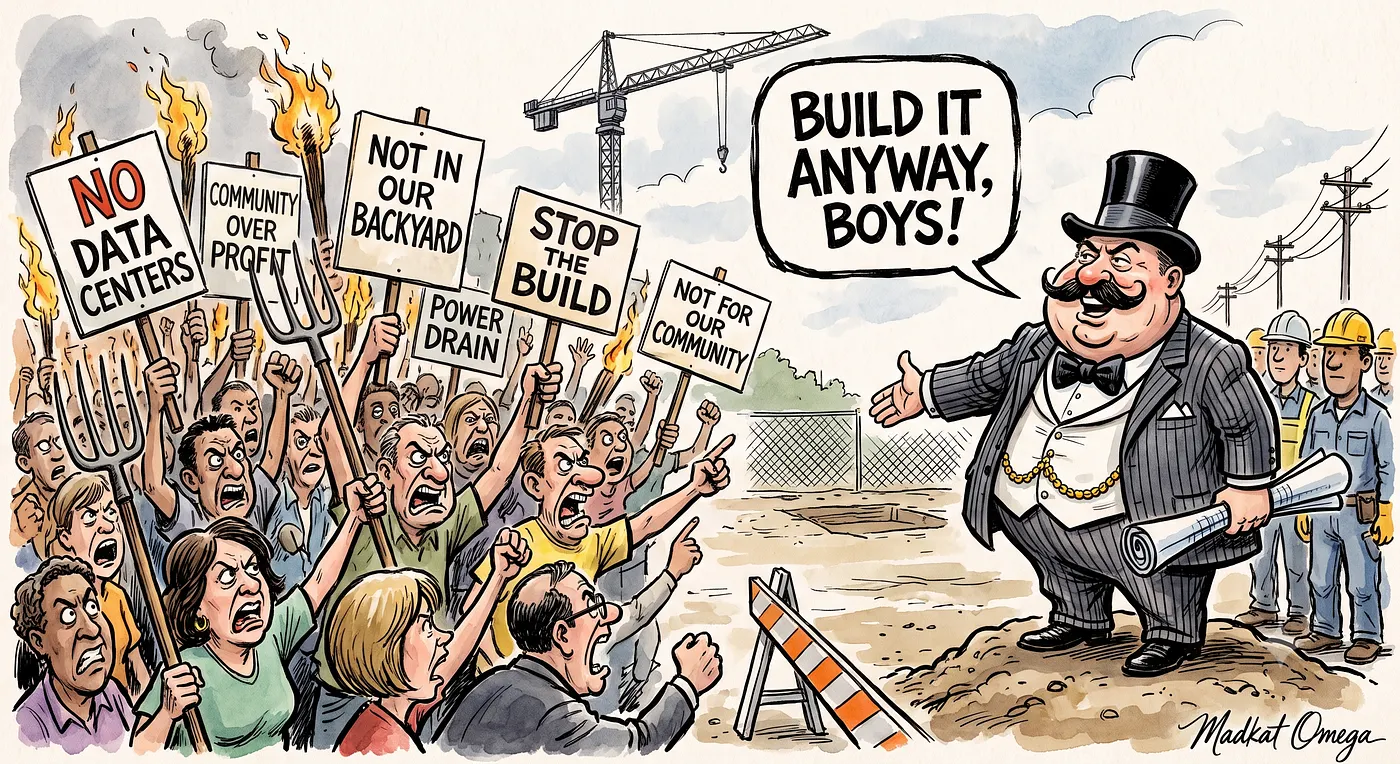
The AI Data Center Problem is not about Technology, it’s about Consent and Accountability — Image by Gemini
The Room in Tucson
The people who packed the Tucson city council chambers on the sixth of August, 2025, had been told almost nothing, and what they had figured out on their own was enough.
A company called Beale Infrastructure wanted 290 acres of desert northeast of the Pima County fairgrounds. The project had a code name, Project Blue, and a price tag somewhere near three and a half billion dollars, and it needed one thing from the city: annexation. Without being pulled inside the city limits, the site could not receive Tucson Water service. And without water, it could not cool the servers.
Residents did the arithmetic anyway, because nobody would do it for them. Two thousand acre-feet a year, in a city that measures its future in acre-feet. When one of the project’s most prominent local boosters was asked about it by a reporter from the Arizona Daily Star, he declined to comment, and explained why: he had signed a nondisclosure agreement.
More than a thousand people turned out for one public meeting on the proposal. Roughly eight hundred came to another. On the sixth of August the council voted seven to nothing to end all negotiations and pull the annexation off the table, and the chamber erupted. The mayor announced the city would start writing rules for the next one.
Four months later, Project Blue came back from the dead. Pima County had already sold the land and approved the zoning, and in November the Arizona Corporation Commission signed off on a plan for the local utility to serve the site directly. Amazon Web Services, the tenant the project had been built around, quietly withdrew. The campus is proceeding anyway, outside the city limits, without Tucson’s water, and without whatever conditions Tucson might have imposed.
That is the shape of the thing. A community that says no does not necessarily get control. It frequently just gets excluded from the conversation.
Something has broken in the relationship between the American data center industry and the places it builds, and the numbers describing it are the kind that make people check the source twice.
In March of 2026, Gallup asked Americans for the first time whether they would support the construction of an artificial intelligence data center in their area. Seventy-one percent said no. Nearly half said they were strongly opposed.
Set that against a question Gallup has asked since 2001. In the same survey, only fifty-three percent objected to a nuclear power plant going up nearby. In a quarter century of polling, opposition to a local nuclear plant has never once cracked sixty-three percent. The AI data center blew past that ceiling on its first appearance.
Americans would now rather live next to a reactor than a warehouse full of computers.
The organized version of that sentiment has been expensive. Data Center Watch, which tracks projects stopped or stalled by local opposition, counted sixty-four billion dollars in blocked and delayed investment over the two years ending in March 2025. By the first quarter of 2026, the figure for a single three-month period was a hundred and thirty billion. Heatmap Pro, working from press accounts and public records, found two projects canceled nationwide in 2023 after community pushback. In 2024 there were six. In 2025 there were twenty-five, and twenty-one of those came in the second half of the year.
By the end of June 2026, a hundred and sixteen municipalities had enacted local moratoriums. More than three hundred state bills addressing data centers were filed in the first six weeks of the 2026 legislative session. Maine’s legislature passed the first statewide construction pause and watched the governor veto it. New York’s passed one in June. Senator Bernie Sanders introduced a national version in March, with a House companion from Alexandria Ocasio-Cortez.
The opposition does not sort into familiar political categories, which is why it has been so hard to manage. It runs roughly even between the parties. The same rural counties that spent a decade fighting wind turbines are now fighting server halls, and they have been joined by suburban homeowners associations and farmland preservation groups that agree with them about nothing else. In Cascade Locks, Oregon, voters recalled two port officials for supporting a data center and the replacement board killed the project. In Warrenton, Virginia, residents voted out every council member who had backed an Amazon proposal. In 2026, an Indiana official’s house was shot at thirteen times, and the person who did it left a sign on the doorstep reading NO DATA CENTER.
Here is the part the industry has not absorbed.
In 2025, a survey conducted for the cooling manufacturer Airedale asked six hundred American adults a slightly different question. Not whether they wanted a data center nearby, but whether they would accept one built sustainably and with community input.
Seventy percent said yes.
That is not a public that has decided against the technology. That is a public that has decided against the way the technology arrives: quietly, on a nondisclosure agreement, with the water contract already signed.
Gallup asked its opponents what specifically worried them. About half named resources, meaning water, electricity, and the loss of farmland. A fifth named their utility bills. Sixteen percent named pollution, and inside that group the complaint mentioned most was noise.
Every one of those objections traces back to a decision made early in a project’s life, usually in a room the public never sees, usually by someone optimizing for schedule. Every one of them can be decided differently. In six specific areas the engineering already exists, the legal instruments already exist, and a handful of developers and cities have already used both.
The record also includes what happens when they don’t.
What the Water Argument Is Actually About
Strip away the politics and a conventional data center’s cooling system is almost agricultural in its simplicity. Hot air comes off the servers. It passes over a stream of circulating water. Some of that water turns to vapor, carries the heat into the sky, and never comes back.
Thermodynamically it is a beautiful trick. Hydrologically it is a one-way door. A factory that withdraws water usually returns most of it downstream. An evaporative cooling tower consumes what it takes.
For about two years, the most famous fact about this process was wrong.
In 2023, researchers at the University of California, Riverside published a paper called “Making AI Less Thirsty,” the first serious attempt to account for both the water evaporated at the data center and the water evaporated at the power plant feeding it. Their estimate for the older GPT-3 model was that somewhere between ten and fifty prompts added up to a half-liter bottle. Reasonable. Careful. Almost nobody read it.
Then in 2024 the Washington Post worked with one of the authors to extend the method to GPT-4, and produced a sentence that traveled around the world: writing a hundred-word email costs roughly one bottle of water. The number was 519 milliliters. It appeared in op-eds, in city council testimony, on protest signs.
It rested on an assumption that a single query burned a hundred and forty watt-hours, thirty-five times the figure used for GPT-3. That assumption did not survive contact with what the industry actually knew about its own hardware. The researcher behind the estimate has since said the real figure for a GPT-4 prompt was probably closer to fifteen milliliters in total, and about five inside the building. Google’s own production measurements put a median Gemini text prompt at roughly a quarter of a milliliter, which is about five drops.
So the bottle was a mirage. It is worth understanding why the mirage stuck, because the answer is not that people are gullible.
The bottle was wrong about intensity and right about direction. Per-prompt water use is small and falling fast. Total water use is enormous and rising faster. Both things are true at once, because the volume is growing more quickly than the efficiency, and no amount of milliliter-level improvement changes what a community sees when it looks at the aggregate.
The aggregate is what Council Bluffs, Iowa sees. A single Google facility there drank one and three-tenths billion gallons of potable water in 2024, roughly three and a half million gallons a day. It is what The Dalles, Oregon sees, where the company’s consumption quintupled over thirteen years to something near forty percent of the entire city’s water use. Nationally, American data centers consumed something like seventeen billion gallons directly in 2023, and the federal lab that produced that estimate expects it to double or quadruple by 2028.
And most of the water is not even at the data center.
This is the piece almost every public debate misses. Thermoelectric power plants evaporate water to condense steam. When a facility pulls electricity off the grid, it is spending water somewhere it will never be blamed for. Research published in Nature Sustainability in late 2025 by a Cornell team put the split at roughly thirty percent on site and seventy percent upstream at the generating station.
That same Cornell study is the most useful thing anyone has published on the subject, because it modeled the alternative instead of just cataloging the damage. Location, the researchers found, can swing a facility’s combined environmental footprint by as much as a factor of a hundred. Building in a region with low water stress and improving the cooling, on its own, cuts water demand roughly in half. Add cleaner electricity and better operations and the reduction reaches eighty-six percent, with carbon down seventy-three percent, against the worst case.
The lead author has been careful not to oversell it. There is no silver bullet, he told his university’s news office. The three levers only work together.
Which brings us to the strange good news at the bottom of the water fight.
The industry is already abandoning evaporative cooling, and not because anyone asked it to. The current generation of AI accelerators produces heat at densities that air cooling simply cannot carry away. Direct-to-chip systems now bolt sealed cold plates onto the processors themselves and run coolant through a closed loop. Immersion systems drop entire servers into baths of dielectric fluid. In both cases the working fluid stays inside the machine. Nothing goes up a stack. The industry adopted these designs for thermal reasons and got the water benefit as a side effect.
What communities have learned to ask for is not a technology. It is a promise with teeth.
A cap on municipal water, written into an agreement that binds whoever owns the building next. Monthly reporting that lands in the public record rather than a sustainability report. And where supplementary cooling is genuinely needed on the hottest days, a requirement that it draw from reclaimed municipal wastewater instead of the drinking supply, because a cooling tower does not care whether the water it evaporates was ever fit to drink.
Texas offers a preview of what happens without the teeth. As of mid-2026, eighty-three percent of the state’s three hundred and forty-one data centers had simply not complied with mandatory water reporting.
Who Pays for the Wires
The water fight is loud. The electricity fight is where the money is.
PJM Interconnection runs the electrical grid across thirteen states and the District of Columbia, which makes it the largest such market in the world and, at the moment, the most instructive. Every year PJM holds an auction to secure enough generating capacity to keep the lights on a few years out. For most of its history the results were a technical footnote.
For the 2024 to 2025 delivery year, that auction cleared at under thirty dollars per megawatt-day.
Three years later it cleared at over three hundred and thirty, which is the federally approved ceiling, and for the first time in the market’s history the entire region still came up short of what it needs to be reliable. The gap was more than six thousand megawatts. Nearly all of the growth in demand that produced it was data centers.
Those are wholesale numbers, and wholesale numbers eventually become retail numbers. The cost of PJM’s capacity market went from two point two billion dollars to fourteen point seven billion in a single year, with data centers responsible for close to two-thirds of the jump. Residential electricity rates across the country climbed about thirty-two percent between the summer of 2020 and the summer of 2025. Not all of that is server halls. Enough of it is that voters have made the connection on their own, and the connection is durable.
Virginia, which hosts the densest concentration of these facilities on earth, has been doing the math publicly. A legislative commission there concluded in late 2024 that unchecked growth would add somewhere between fourteen and thirty-seven dollars a month to a typical household’s power bill by 2040 if nothing changed.
Something changed. In early 2026 Virginia’s utility regulators created a separate rate class for very large customers. Data centers now sign fourteen-year contracts and pay for at least eighty-five percent of the transmission and distribution capacity they reserve whether they use it or not, with exit fees if they walk. The design is aimed squarely at a specific failure: a developer talks a utility into building infrastructure, then never builds the facility, and the neighborhood pays off the substation for thirty years. Eighteen states introduced some version of a large-load rate class in 2026. New Jersey went further in July, requiring big facilities to commit to eighty-five percent of projected power costs for a decade.
There is a second reason developers have stopped waiting for the grid, and it has nothing to do with politics. New transmission takes the better part of a decade to build. A data center takes eighteen months. No amount of goodwill closes that gap.
So the industry stopped asking.
The technology that made it possible is the solid oxide fuel cell, which converts natural gas or hydrogen directly into electricity through a chemical reaction at very high temperature, without combustion. No flame means no jet of hot air mixed with atmospheric nitrogen, which means the pollution profile is far cleaner than a turbine’s. It also means the exhaust is concentrated carbon dioxide and water vapor rather than dilute flue gas, which makes capture a more tractable problem than it is at a conventional plant. And because the units are built from small modules and shipped prefabricated, they arrive fast.
How fast became the whole story. Bloom Energy delivered the first system for an Oracle cloud site in fifty-five days against a ninety-day target, thirty-five days early. Oracle expanded its agreement to as much as two point eight gigawatts. American Electric Power signed for up to a gigawatt to serve its own large customers while the wires catch up. In June 2026, Brookfield took a five billion dollar partnership with Bloom and multiplied it by five, to twenty-five billion.
The units stack, too, which turns out to matter more than it sounds. Bloom puts the density at up to a hundred megawatts per acre, roughly double what a gas turbine installation manages. On a five-hundred-megawatt campus that difference is several acres of ground that does not have to be paved for power equipment, and we will come back to what a developer might do with it.
A parallel effort attacks the problem from the other end, and it rests on a simple observation: a training cluster is not a hospital. Some fraction of what it does can be paused or throttled for an hour without harming anyone, which makes it a far better neighbor than the flat, unyielding demand curve utilities have been planning around. A consortium including NVIDIA, the Electric Power Research Institute, Digital Realty and PJM itself announced a ninety-six-megawatt facility in Virginia built to power-flexible standards, with an ambition to deploy five to ten such hubs by 2027.
PJM has meanwhile started treating the demand forecasts themselves with suspicion, and for good reason. Presented with roughly sixty gigawatts of proposed load for 2030, it accepted thirty-four. Some of the crisis, in other words, is developers shopping the same project to four utilities and getting counted four times. A commitment to curtail is a commitment to be counted honestly, which is worth something on its own.
Then there is the version of on-site power that makes everything worse.
In April of 2026, the NAACP and its Mississippi state conference, represented by the Southern Environmental Law Center and Earthjustice, sued xAI and a subsidiary over twenty-seven unpermitted methane gas turbines running in Southaven, Mississippi, to power the Colossus 2 data center across the line in South Memphis. It was not the first round. The company’s original Colossus facility had run as many as thirty-five unpermitted turbines starting in mid-2024, pulled them only after a notice of intent to sue, and then obtained permits for fifteen. Company officials had said publicly they intended to copy the approach at the second site.
The plaintiffs argue the Mississippi location was chosen because that state’s registration process for portable equipment moves faster than Tennessee’s federally supervised air permitting program. Within five miles of the site however, roughly forty-six percent of residents are Black, against thirty-three percent of the county as a whole, and the NAACP didn’t miss that clue for one second.
The point is not that on-site generation is dangerous. Fuel cells are quiet and clean, and the fifty-five-day install is genuinely a solution to a real problem. The point is that a data center which becomes its own power plant has also become responsible for everything a power plant is responsible for, including the permits, and including the neighbors who did not choose to live next to one.
The utility used to handle that part.
Building on Broken Ground
The Prince William Digital Gateway would have been the largest data center campus in the world: thirty-seven buildings, more than twenty-two million square feet, spread across roughly two thousand acres of rural Virginia farmland at the edge of Manassas National Battlefield Park. The county’s Board of Supervisors approved the rezonings in December of 2023, at the end of a public hearing that ran twenty-seven hours.
It is dead now, and the way it died should be printed and framed in every development office in the country.
Virginia law requires a locality to advertise a proposed rezoning twice in a newspaper, with the first notice appearing no more than fourteen days before the vote. Prince William County published three days before the hearing.
A homeowners association and eleven neighbors sued, along with the American Battlefield Trust. In August of 2025 a circuit court judge declared the ordinances void from the beginning, and specified in her ruling that the defect had been caused by the county rather than the newspaper. The Court of Appeals of Virginia stayed the decision in the fall, briefly resurrecting the project, then affirmed it in full the following March. One developer declined to appeal further. In July of 2026 the other withdrew its remaining petitions, and the largest data center campus ever proposed ceased to exist.
The county had by then spent more than one point seven million dollars of taxpayer money litigating on the developers’ side, before a new board majority ended the appeal.
Four years of process. Two thousand acres. A development pipeline worth billions. All of it undone by a legal notice published eleven days late.
Transparency is not a soft value in this business. It is a structural member.
The alternative to fighting for farmland is not complicated. It is to build on ground that was industrialized generations ago, that nobody has to be persuaded to rezone, and that is already connected to the grid.
Federal policy has swung hard behind this. An executive order in July of 2025 directed the Environmental Protection Agency to identify brownfield and Superfund sites suitable for data centers and publish guidance within a hundred and eighty days. The agency delivered in January of 2026, and was careful to note that nothing in the document relieves a developer of liability under federal cleanup law.
What these sites offer is inheritance. A retired coal plant comes with a switchyard, high-voltage lines running in the right direction, permitted water intake and discharge, rail access, and heavy industrial zoning that was settled before anyone in the current fight was born.
The biggest example in the country stands about fifty miles east of Pittsburgh.
Homer City Generating Station opened in 1969 and spent five decades as the largest coal-burning plant in Pennsylvania, recognizable for a chimney twelve hundred and seventeen feet tall, the tallest in the United States. It shut down in July of 2023. The chimney came down in March of 2025. The thirty-two-hundred-acre site is being converted into a ten-billion-dollar campus, powered by seven hydrogen-capable gas turbines producing up to four and four-tenths gigawatts, with power expected in 2027. The interconnections to two separate regional grids, the substations, and the water access were all already sitting there.
Homer City also marks the honest limit of the brownfield argument. The new facility is a gas plant. It will emit sixty to sixty-five percent less carbon dioxide per unit of electricity than the coal plant it replaces, which is a real improvement and is not the same as clean. Reusing an industrial site solves the land fight and the interconnection queue. It does not solve the emissions question, and communities have gotten good at reading the difference.
The geography of these sites is the quietly hopeful part. The decommissioned power plants, dead aluminum smelters and abandoned chemical works of the Rust Belt and the coal belt sit almost exactly in the counties that have lost the most work over the past forty years. In Tonawanda, New York, a former coke plant is slated to become a two-billion-dollar facility drawing three hundred megawatts. In Lancaster, Pennsylvania, two shuttered printing plants are becoming an AI campus.
Contaminated ground brings real constraints, and they are engineering constraints rather than paperwork. Establishing liability protection requires a formal environmental assessment before purchase, and soil and groundwater sampling wherever that assessment turns up trouble. If the site already has a cleanup remedy in place, construction cannot compromise it, which means pile driving, foundations and utility trenching have to respect clay caps, vapor extraction systems and active treatment wells.
That last constraint can flip into an asset. Groundwater being pumped and treated as part of an ongoing remediation is water that is already coming out of the earth, already being cleaned, and already looking for somewhere to go. Sending it into a closed cooling loop is a use, not a withdrawal.
Twenty Million Dollars and a Letter of Credit
For most of the past fifteen years, both sides of the data center transaction treated these buildings as warehouses.
Developers wanted a fast entitlement and a quiet neighborhood. Counties wanted the property tax receipts. Everyone understood the deal: a burst of construction jobs, then a steady check, then decades in which the building interacts with the town about as much as a water tower does. Out of sight and out of mind was the desired state, and the industry built its entire community relations practice around achieving it.
That worked beautifully until the electricity bills started climbing, at which point the industry discovered it had spent fifteen years building no local constituency whatsoever.
The employment question, argued furiously for years, finally got some data in May of 2026, when the Brookings Institution published work by two economists who studied roughly seven hundred and seventy American facilities and the counties around them. The findings embarrass everybody.
Counties that get their first large data center do see gains. Private employment rises four to five percent over five or six years. Construction work rises eleven percent. Jobs in the information sector rise twenty-two percent, and wages tick up three or four points. In a typical affected county, that works out to a few thousand additional jobs after six years.
But almost none of them are inside the building, the information-sector gains only materialize where several facilities cluster together, and the fiscal accounting can be grim. Virginia’s own Department of Taxation reported that the industry added sixteen hundred and ten jobs statewide in fiscal 2025 while collecting roughly one point nine billion dollars in tax incentives. Georgia had to revise an employment audit downward after overstating its numbers.
So the industry creates more jobs than its critics admit and far fewer than its brochures promise, and in several states the public has been paying north of a million dollars apiece for them.
That gap is what a community benefits agreement is for. In late 2025, an American city negotiated the first one written specifically for data centers.
Lancaster, Pennsylvania has about sixty thousand residents and two dead R.R. Donnelley printing plants. A developer called Chirisa Technology Parks wanted to turn both into AI data centers, at a combined construction cost around ten billion dollars.
Mayor Danene Sorace negotiated before the entitlements were final, which is the only moment a city has real leverage. What she came back with is unusually specific.
Municipal water is capped at twenty thousand gallons a day per campus. That number means more when you know that the printing plants which used to occupy those buildings averaged a hundred thousand to a hundred and twenty-five thousand gallons a day. The new tenants get a fifth of what the old ones used. Cooling must be closed-loop, with no added chemicals. The developers must supply one hundred percent clean energy, backed by escalating financial penalties reaching ten million dollars per building if they fall short. Noise limits are pegged to ambient levels measured before construction rather than to a generic municipal standard. There is a required plan for disposing of the electronic waste, down to the chillers and the backup generators. And twenty million dollars goes into named community funds.
Two provisions matter more than any dollar figure in the document.
The obligations run with the land, so a future owner inherits them. And the city can draw directly on a letter of credit rather than filing a lawsuit and waiting three years for a judgment.
The agreement is also a public record under Pennsylvania’s Right-to-Know Law, which forecloses in advance the problem that killed Project Blue in Tucson.
None of which makes it a perfect document, and the criticism deserves to be recorded alongside the praise. Analysts at Columbia Law School noted that several provisions lean on language a determined counterparty can drive a truck through. The owners must “reasonably maximize” rainwater capture. They must design for resilience “where feasible.” There is no threshold to point at during a compliance review. The project is expected to produce about three hundred permanent jobs, which is not much against ten billion dollars of construction. And the residents who showed up to oppose it were not persuaded by any of it. The city council approved the deal six to one, over their objections, and their questions about decommissioning and insurance and what happens to two enormous empty buildings if the economics turn were never really answered.
It is a first draft. First drafts are how this works.
Cash is the least imaginative thing a data center can give a community. The most valuable thing it produces, and throws away, is heat.
Finland stopped throwing it away in May of 2026. Fortum, the regional energy company, brought two heat-recovery plants online outside Helsinki, built to capture waste heat from Microsoft’s new Finnish data centers and push it into the district heating network. When fully implemented, that captured heat will supply roughly forty percent of the annual heating demand for a quarter of a million people across three municipalities, through nine hundred kilometers of underground pipe, displacing something on the order of four hundred thousand tonnes of carbon dioxide a year.
The detail that makes Espoo worth copying is not the technology. It is the sequence. Fortum and Microsoft chose the data center sites based on proximity to the existing heat network, adequate parcel size, and access to carbon-free power, in that order. Heat recovery bolted onto a building sited for other reasons is expensive and marginal. Heat recovery designed in from the first sketch is a revenue line.
Regulators have started requiring what markets were slow to reward. Germany’s efficiency law obliges data centers beginning operation from July of 2026 to reuse at least ten percent of their waste heat, rising to twenty percent by 2028. The United States has far fewer district heating networks to plug into, which narrows the opportunity without eliminating it.
There is one more asset that costs almost nothing to share. Hyperscale facilities need enormous fiber routes, and the marginal cost of adding local access points to a trench you are digging anyway is close to trivial. When Facebook built in Rutherford County, North Carolina, it worked with the nonprofit that runs the state’s research and education network to bring high-speed connectivity to nearly thirty community anchor institutions across five western counties: community colleges, charter schools, treatment centers, county offices. Places that had been waiting years for a private carrier to find them worth the drive.
And then there is the reciprocity that gets taken rather than offered. After months of organizing by community groups, the Memphis City Council passed an ordinance directing twenty-five percent of the tax revenue generated by xAI’s facilities to the neighborhoods closest to them. Same dollars. Considerably worse press.
The Fence Line
On Glenn Drive in Sterling, Virginia, the members of the Trailside Homeowners Association have installed decibel meters on their phones.
The source is a Vantage data center complex, the first facility in Loudoun County to skip the grid entirely and make its own electricity, using eight natural gas turbines that run around the clock. “The noise is just intolerable,” one board member told a Washington television station in the spring of 2026.
Loudoun County caps industrial noise at fifty-five decibels measured at a residential property line. The county fielded a dozen complaints about the facility in the first months of the year.
Not one of them was found to violate the ordinance.
This is the crux of the whole fence-line problem, and it is worth understanding because it explains why so many noise complaints evaporate. Standard municipal ordinances use A-weighted decibels, a scale designed to approximate how the human ear registers loudness at moderate levels. The ear is relatively insensitive to very low frequencies, so A-weighting deliberately discounts them.
A data center’s cooling plant and generators produce exactly that kind of energy. Steady. Narrow-band. Deep. The result is a building that passes every measurement the county knows how to take while people a quarter mile away report headaches, broken sleep, and a sensation they describe as feeling the sound rather than hearing it. Complaints about inaudible but perceptible infrasound near AI facilities have become common enough to draw national coverage.
The county supervisor whose district contains Glenn Drive has said publicly that the criteria may simply be measuring the wrong thing, and that he would like the threshold lowered. In late July of 2026, another supervisor proposed pausing all new data center applications while the county rewrites its noise rules, screening requirements, setbacks, and limits on on-site generation.
Sit with that sequence for a moment. On-site generation is the leading solution to the grid crisis. In Loudoun County it is also the leading source of the noise crisis. A developer who solved one community’s objection created another’s, and the ordinance on the books cannot even see the problem it created.
This is not inevitable. Turbines and reciprocating engines are loud. Fuel cells, which run on a chemical reaction instead of an explosion, are roughly as loud as a conversation. The technology that fixes the interconnection queue can also fix the hum, if anyone specifies it that way.
Fairfax County has been rewriting its rules with more precision. A 2024 zoning amendment requires new data centers to sit at least two hundred feet from residential property lines, with backup generators pushed to three hundred or hidden behind the building. Facilities must be at least a mile from any Metro station entrance. Every project now needs a noise study before construction and another one afterward to prove it complied. Equipment must be enclosed or screened. And the ordinance imposes design standards meant to make the buildings less punishing to look at: a defined main entrance, a break in the façade every hundred and fifty feet, and a minimum number of fenestration features, which in practice usually means fake windows.
The board chairman’s assessment of the compromise was the most honest thing anyone said that day. He did not expect many people to leave feeling like they had won. Advocates said it did too little. Developers said it cost too much.
That is what a functioning land-use process sounds like.
Design can do more than mitigate, and here is where the freed acreage from section three comes back.
The classic move is a berm: a graded earth ridge, built from the surplus soil that would otherwise be trucked off the site, planted with native species and placed between the facility and the nearest houses. It blocks the sightline, absorbs sound, and reads from the road as a hill rather than a wall. Vantage’s campus in Port Washington, Wisconsin, sits on six hundred and seventy-two acres and has committed to more than two thousand native trees and to local water restoration projects intended to put back more freshwater than the campus consumes.
The most ambitious version of this idea in America is also its cautionary tale, and it is worth telling completely because it is the single strongest argument for putting these commitments in a contract.
In April of 2024, a developer called Quantum Loophole broke ground on a six-hundred-acre nature reserve inside its twenty-one-hundred-acre campus in Frederick County, Maryland. The design was developed with University of Maryland faculty in environmental science and landscape architecture. It called for one million native plantings, restoration of a creek, engineered stormwater absorption, wildlife corridors linking into Maryland’s statewide network, and public walking trails through the whole thing. Berms and trees would buffer the industrial site from the surrounding view and soundscape. The company called it the first carbon-negative industrial development of its kind and held a ceremonial planting with professors, students and neighbors.
None of it is happening.
A lawsuit pushed Quantum Loophole out. A different company took over the campus in December of 2024. Documents obtained through a public records request show the university contract was canceled. The nature reserve has vanished entirely from the project’s current public plans. As of the middle of 2026, no data centers on the site were operating yet, though three separate operators had broken ground on their parcels.
A six-hundred-acre public nature reserve, announced with a shovel and a press release and a hundred witnesses, survived exactly one change of ownership.
Which is why Lancaster’s clause about obligations running with the land is not legal boilerplate. It is the difference between a landscape plan and a promise.
One footnote on the ecology, because it is the rare item on this entire list where nobody has to be persuaded of anything. Replacing irrigated ornamental turf with regionally native seed mixes cuts landscape water use and maintenance costs substantially. A native perimeter buffer is cheaper to own than a lawn. The community interest and the operating budget point the same direction, which almost never happens.
Fourteen Students in Cheyenne
The industry has a labor problem that is worse than its public relations problem and considerably harder to fix with money.
Uptime Institute released its annual global survey at the end of July 2026, drawing on more than eight hundred owners and operators. More than half reported difficulty finding qualified candidates, up from forty-six percent the year before. More than a quarter said they had lost people to competing data center operators. The hardest roles to fill were electrical specialists and junior operations staff.
The shape of that shortage should worry anyone planning a build. Uptime’s earlier work found that operations management roles overtook entry-level positions as the primary shortage area, as experienced engineers reached retirement with nobody trained behind them. Roughly a quarter of departures are people poached by competitors, and very few leave the industry entirely. Which means the sector is largely circulating the same experienced people among the same employers at rising salaries, rather than adding anyone to the pool.
Here the community argument and the business argument finally stop arguing.
A facility that will need electrical technicians for the next twenty years, in a county that does not currently produce them, has an obvious commercial interest in that county producing them. This is not philanthropy. It is procurement.
The model that works is not new and is not expensive. Microsoft started its Datacenter Academy in 2019 and now runs roughly a dozen of them worldwide, each built around a partnership with a community or technical college near one of its facility clusters. The company donates servers, storage arrays and networking gear pulled from decommissioned production sites, so students learn on the hardware they will actually meet on the job rather than on a simulator. It pays for scholarships and certification fees. Working engineers mentor. The curriculum aims at nationally portable credentials rather than proprietary ones.
The partner list reads like a map of the industry. Two colleges outside Phoenix. One in West Des Moines teaching cabling and fiber testing. One in Moses Lake, Washington running a sequence from introductory hardware through network routing.
And one in Cheyenne, Wyoming, which is the one worth dwelling on.
Laramie County Community College started its data center technology program in the fall of 2018 with fourteen students. It grew to sixty. More importantly, it stopped being a terminal certificate and became the common first credential in the college’s entire information technology pathway, the thing students take before moving into network administration, systems administration or cybersecurity degrees.
That is the whole distinction, and communities have gotten very good at spotting it. A program that trains people for one company’s job titles is a recruiting expense with a press release attached. A program that produces portable credentials, transfers into a degree, and reaches into the local high schools is workforce development. The cost difference between the two is almost nothing. The political difference is enormous.
The same logic runs upward into research, though the American track record there is thin and the most prominent attempt collapsed. The Maryland partnership that was going to make Quantum Frederick a working laboratory, with a fifteen-acre demonstration site designed by faculty and students, died with the reserve.
The opportunity survives regardless, because a large liquid-cooled facility is a scientific instrument that nobody is reading. It generates continuous data on two-phase heat transfer at densities no laboratory apparatus can reach, on how supercapacitor buffering actually behaves under real training loads, on groundwater interactions at remediated sites, on the acoustic performance of engineered earthworks. Universities want that access badly. Developers want the credibility that comes from having someone independent measure their claims.
The reason it almost never happens is that nobody writes it into the entitlement, so it survives only as long as the executive who championed it.
What a Yes Looks Like
Line the six up and the pattern that emerges is less about technology than about timing.
Every item on this list is cheap at the beginning and ruinous later. Closed-loop cooling costs almost nothing if it is the design basis and a fortune as a retrofit. Heat recovery is a revenue stream if the site was chosen for the pipes and an expensive gesture if it wasn’t. Fuel cells free up acreage for buffering only if the site plan was drawn around a hundred megawatts per acre instead of fifty. A benefits agreement negotiated before entitlement is a negotiation. The same agreement negotiated after a lawsuit is a settlement. And a community college that will graduate electrical technicians in 2032 has to be funded now.
Underneath all of it sits transparency, which most of the industry still treats as a competitive liability rather than the load-bearing element it has turned out to be.
A chamber of commerce treasurer could not discuss Tucson’s largest-ever proposed development because he had signed a nondisclosure agreement, and Tucson’s council killed it seven to nothing. Prince William County approved the world’s largest data center campus after a twenty-seven-hour hearing that had been advertised eleven days late, and lost the entire project three years later on that single defect. Lancaster wrote its agreement into the public record under state law, took a contested vote, and the deal is still standing.
There is a version of the next decade in which none of this happens. The industry keeps optimizing for schedule, treats every community fight as a routine cost, and watches the moratorium count climb from a hundred and sixteen towns toward whatever number represents actual paralysis. The trend line supports that reading. Cancellations went from two to six to twenty-five in three years. Blocked investment went from sixty-four billion dollars over two years to a hundred and thirty billion in a single quarter.
There is another version, and its outline already exists in the record.
Heat pumps outside Helsinki went into production last May and will warm a quarter million people with what used to go up a cooling stack. A fuel cell company delivered a data center’s primary power in fifty-five days, and one of the largest asset managers on earth put twenty-five billion dollars behind doing more of it. A mayor in Pennsylvania capped a ten-billion-dollar development at a fifth of what a printing plant used and took twenty million dollars with a letter of credit standing behind it. A county in Virginia wrote setbacks and noise studies and fake windows into its zoning code, and nobody left the hearing happy, which is what compromise feels like. A community college in Wyoming turned fourteen students into a career ladder.
And seventy percent of Americans said they would take a data center within a few miles of their home if it were built well and they were asked first.
That last number is the one the industry should be reading every morning. It is not the sound of a public that has turned against artificial intelligence. It is the sound of a public that has never once been invited into the room where the decision gets made.
The industry built at the pace of capital in an era when a county board can void a rezoning over a newspaper advertisement and a homeowners association can measure a turbine hum with a telephone. The six things described here are not a communications strategy. They are the current asking price of permission, and it goes up every quarter the industry declines to pay it.
Sources
Every entry below supports a specific claim in the text. Links go to the original document; where one sits behind a subscription, a freely available account of the same facts follows.
Public opinion and organized opposition
- Gallup. “Americans Oppose AI Data Centers in Their Area.” 13 May 2026.
- Kilander, Gustaf. “Americans Would Rather Live Near a Nuclear Power Plant Than a Data Center.” Fortune, 15 May 2026. Reports Gallup’s April follow-up on what specifically worries opponents.
- Airedale by Modine. “70% of Americans Say They’d Welcome a Nearby Data Center If It’s Built Responsibly.” Business Wire, 22 May 2025.
- Data Center Watch. “$64 Billion of Data Center Projects Have Been Blocked or Delayed Amid Local Opposition.” Full report PDF
- Tom’s Hardware. “70% of Americans Oppose Data Centers Near Their Homes.” 14 May 2026. Source for the $130 billion first-quarter figure, the Indiana shooting and the infrasound complaints.
- Heatmap News. “Scoop: Local Pushback, Canceled Data Centers Surged in 2025.” 13 Jan. 2026. Subscription. Free account of the same findings: Gizmodo.
- Bier, David. “Turning a Local Issue into a Federal Headache: The Problem with Data Center Moratoriums.” Cato Institute, June 2026.
- DataCenterBans.com. “Data Center Moratoriums.” July 2026. Tracks the Maine veto, New York’s June bill and the New Jersey Fair Share Act.
- MultiState. “State Data Center Legislation in 2026 Tackles Energy and Tax Issues.” 20 Feb. 2026.
- Introl. “PJM’s 6GW Capacity Shortfall.” 6 Feb. 2026. Source for the partisan split of opposition, the 94 percent load-growth attribution and the Aurora AI Factory.
Tucson and Project Blue
- Davis, Tony. “Council Kills Data Center Plans in Tucson at Raucous Meeting.” Arizona Daily Star, 7 Aug. 2025. Subscription. Sole source for the nondisclosure agreement that kept a project backer from commenting.
- Arizona Luminaria. “Tucson City Council Rejects Project Blue amid Intense Community Pressure.” 6 Aug. 2025.
- Tucson Sentinel. “Tucson City Council Pulls Plug on Amazon’s Project Blue.” 6 Aug. 2025.
- Gilger, Lauren. “Rejected by Tucson and Abandoned by Amazon, Project Blue Data Center Moves Forward.” KJZZ, 9 Dec. 2025.
Water
- Xiao, Tianqi, Francesco Fuso Nerini, H. Damon Matthews, Massimo Tavoni and Fengqi You. “Environmental Impact and Net-Zero Pathways for Sustainable Artificial Intelligence Servers in the USA.” Nature Sustainability, vol. 8, no. 12, Dec. 2025, pp. 1541–1553. Open access. PDF · Data and code · Summary: Cornell Chronicle
- Li, Pengfei, Jianyi Yang, Mohammad A. Islam and Shaolei Ren. “Making AI Less ‘Thirsty’: Uncovering and Addressing the Secret Water Footprint of AI Models.” Communications of the ACM, 2024.
- Masley, Andy. “I Might Have Found the Specific Way the ‘AI Uses a Bottle of Water per Prompt’ Miscalculation Happened.” June 2026. Traces the 519-millilitre figure and Ren’s later revision.
- Shehabi, Arman, et al. “2024 United States Data Center Energy Usage Report.” Lawrence Berkeley National Laboratory, LBNL-2001637, Dec. 2024. Publication page
- Schneider, Barbara. “Data Centers and Water Use.” National Association of State Utility Consumer Advocates, June 2025. Source for the Council Bluffs consumption figures.
- Boudreau, Catherine. “Data Center Water Use Can Be a ‘Black Box.’ Google Aims to Change That.” Latitude Media, 3 June 2026. Source for The Dalles.
- Google. “2026 Environmental Report.”
- Axis Intelligence. “AI Data Center Water Usage Statistics 2026.” July 2026. Source for Texas reporting compliance.
Electricity, rates and on-site generation
- PJM Interconnection. “PJM Auction Procures 134,479 MW of Generation Resources.” 17 Dec. 2025.
- Avanza Energy. “The $16.4 Billion Reliability Tax: How Data Centers Broke PJM’s Capacity Auction.” July 2026. Source for PJM’s rejection of proposed load.
- Virginia Joint Legislative Audit and Review Commission. “Data Centers in Virginia.” Dec. 2024. Full report PDF
- Data Center Dynamics. “Virginia Regulators Approve New Rate Class for Data Centers and Other Large Loads.” 11 Mar. 2026.
- DiLallo, Matt. “Brookfield and Bloom Energy Expanded Their AI Power Partnership to $25 Billion.” The Motley Fool, 1 July 2026. Source for the fifty-five-day delivery and the Oracle expansion.
- Tech Times. “Bloom Energy Lands $25 Billion Brookfield Commitment for AI Data Center Fuel Cells.” 2 July 2026. Source for the hundred-megawatts-per-acre density figure.
- Data Center Dynamics. “Bloom Energy Signs $5bn Partnership with Brookfield.” June 2026. Source for the American Electric Power agreement.
- NAACP. “NAACP Sues xAI for Illegal Pollution from Data Center Power Plant.” 14 Apr. 2026.
- Southern Environmental Law Center. “xAI Built an Illegal Power Plant to Power Its Data Center.” 14 Apr. 2026. Source for the Colossus 1 turbine history.
- Technology.org. “xAI Ran 59 Unpermitted Gas Turbines for Colossus 2 Near Memphis.” 15 July 2026. Source for the Southaven demographic figures.
Siting, brownfields and the Digital Gateway
- Small, Matt. “Judge Voids Digital Gateway Rezoning in Prince William County.” WTOP News, 9 Aug. 2025.
- Bean, Kinney & Korman. “Data Center Infrastructure Under Siege: Lessons from Virginia’s Digital Gateway Decision.” Aug. 2025. Source for the notice published three days before the hearing.
- Williams Mullen. “Digital Gateway in Jeopardy: How Notice Defects Could Invalidate Rezoning Approvals.” 27 Apr. 2026.
- Smith, Tavan. “Digital Gateway Data Center Developer to End Appeal.” InsideNoVa, 29 Apr. 2026. Source for project scale, the twenty-seven-hour hearing and the county’s litigation spending.
- Virginia Business. “Prince William Digital Gateway Data Center Project Officially Dies.” July 2026.
- U.S. Environmental Protection Agency. “Guidance on the Redevelopment of Superfund and Brownfield Sites as AI Data Centers.” EPA-540-S-26–001, Jan. 2026.
- American Bar Association. “EPA Guidance for the Development of AI Data Centers at Superfund and Brownfield Sites.” 21 May 2026. Source for the groundwater and engineering-control constraints.
- Data Center Frontier. “Pennsylvania’s Homer City Energy Campus: A Brownfield Transformed for Data Center Innovation.”
- Homer City Redevelopment. “Project Overview.”
- Ward, Laura. “Updates on the Cloud: More Moratoriums on Data Centers.” Rockefeller Institute of Government, 10 June 2026. Source for the Tonawanda project.
Community benefits, heat recovery and fiber
- City of Lancaster, Pennsylvania. “Community Benefits Agreement Summary.” Nov. 2025. City data center page
- Hawkes, Dan. “Lancaster City Council Votes to Approve Data Center Benefits Agreement.” LancasterOnline, 21 Nov. 2025. Subscription. Free account: FOX43.
- Sabin Center for Climate Change Law. “Community Benefits Agreements and Data Center Development.” Columbia Law School, 28 May 2026. Source for the enforceability criticism.
- Federation of American Scientists. “Fair AI-Fueled Data Center Development for Communities.” July 2026.
- Fortum. “Fortum Has Started Heat Production at Two Large Data Centre Sites in Finland.” 6 May 2026.
- AFRY. “Capturing Data Centre Waste Heat for Fortum’s District Heating in Finland.” Source for the siting criteria and their order.
- mGrid. “Fortum and Microsoft Commission 350 MW Data Center Waste Heat.” 1 June 2025. Source for the German waste heat reuse requirement.
- MCNC. “MCNC and Facebook to Bring High-Speed Internet to Western North Carolina.” PR Newswire, 28 Jan. 2020.
- Southern Environmental Law Center. “Inside Memphis’ Fight Against xAI.” 4 June 2026. Source for the Memphis tax revenue ordinance.
Employment and local economics
- Bahar, Dany and Greg Wright. “New Evidence on Data Center Employment Effects.” Brookings Institution, 21 May 2026. Also the source for the PJM capacity cost increase and national rate rise.
- Brookings Institution. “Turning the Data Center Boom into Long-Term, Local Prosperity.” 12 Feb. 2026. Source for the warehouse framing and the Chamber of Commerce analysis.
- Maryland Association of Counties. “Research Examines Data Center Job Creation.” 2 July 2026. Source for the Virginia and Georgia incentive figures.
Noise, zoning and land design
- Chandler, Michael. “As Data Center Noise Concerns Grow, Loudoun Co. Officials Discuss Possible Mitigation Efforts.” WUSA9, 6 Apr. 2026.
- Vogelsong, Sarah. “Loudoun County, Other Virginia Localities Consider Hitting the Brakes on Data Center Development.” Virginia Mercury, 30 July 2026.
- Fairfax County. “Board of Supervisors Approves New Data Center Zoning Ordinance Amendment.” 11 Sept. 2024.
- Fairfax Machine. “Fairfax County’s New Rules for Data Centers, Explained.” Source for the façade standards and the board chairman’s assessment.
- Vantage Data Centers. “Port Washington (Lighthouse) Data Center Campus.”
- Quantum Loophole. “Quantum Frederick Breaks Ground on Its 600-Acre Nature Reserve.” 22 Apr. 2024.
- Wagner, Sarah. “A Nature Reserve Touted for a Planned Maryland Data Center Campus Appears to Be Canceled.” Technical.ly, 10 June 2026.
- Nature Forward. “Quantum Frederick, Frederick County, MD: Maryland Data Center Series, Pt. 3.” 29 June 2026.
Workforce
- Uptime Institute. “16th Annual Global Data Center Survey.” 28 July 2026. Summary release is free; the full report is sold to Uptime Intelligence subscribers.
- Shaw, Keith. “Data Center Poaching Adds to Staffing Crisis.” Network World, 26 Mar. 2026.
- Network World. “Most Corporate IT Is Off Premises, AI Is Reshaping Infrastructure, Uptime Reports.” 30 July 2026.
- Microsoft. “Datacenter Academy.”
- Des Moines Area Community College. “DMACC West Campus Microsoft Datacenter Academy.”
- Patch Cheyenne. “LCCC IT Program Director Receives Microsoft Innovation Award.” 27 Aug. 2021. Source for the Laramie County enrollment figures.