A patriot’s case for universal national service, and for making the country feel what it decides
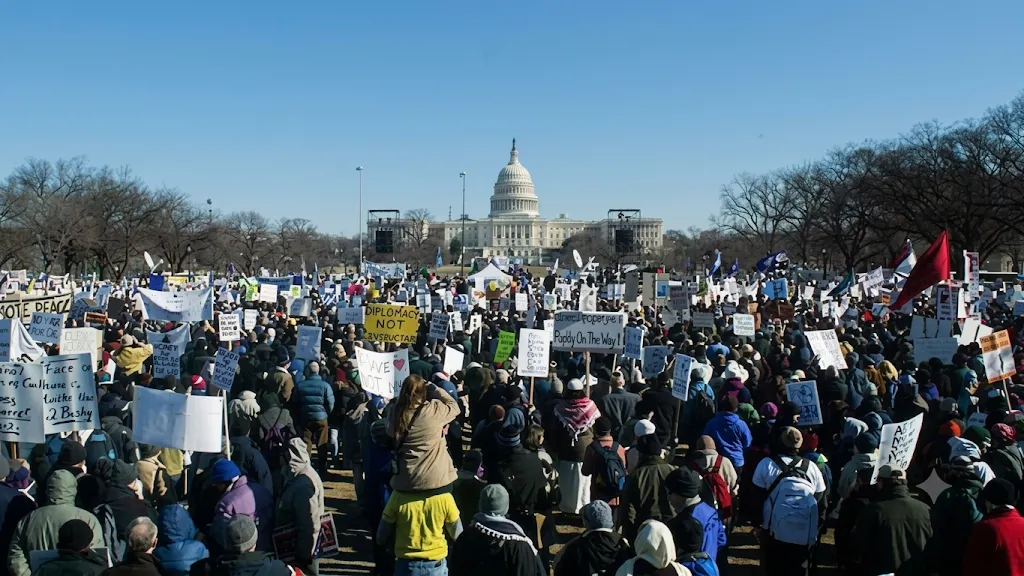
The 2003 Iraq war protests in Washington, DC — Image by Fox News, de-noised by Gemini
On February 15, 2003, people gathered in more than six hundred cities to oppose an invasion that had not yet happened. The BBC estimated that between six and ten million people turned out across as many as sixty countries that weekend. Rome alone drew roughly three million, a figure the Guinness Book of World Records later listed as the largest anti-war rally ever held. Social movement researchers still describe that single day as the largest protest event in human history.
A month later, the invasion began anyway.
It has become fashionable to read that sequence as proof that protest is theater. The more accurate reading is that the country sent a bill, and the bill came due late. Political scientists David Karol and Edward Miguel found that Iraq casualties measurably depressed George W. Bush’s vote share in 2004, and estimated that without the roughly ten thousand American dead and wounded by Election Day, he would have won nearly two percent more of the national popular vote and carried additional states. Christian Grose and Bruce Oppenheimer found that in the 2006 midterms, the swing against Republican incumbents ran hardest in districts that had buried the most soldiers and against members who had voted for the war. The party that ignored the streets lost both chambers of Congress. The war’s chief architects left office discredited, and the doctrine they represented has not recovered its standing in either party.
So the protests were not pointless. They were slow. And slowness is the problem worth solving, because a penalty that arrives three years after the decision is a penalty the decider has already priced in.
The real defect is distance
Consider what the person who orders a war actually risks, and what the public that pays for it actually feels.
Fewer than one in a hundred Americans serves in the active-duty military. In 1973, the last year of the draft, four hundred and one of the five hundred and thirty-five members of Congress had worn a uniform, about three quarters of the institution. In the Congress seated in 2025, one hundred members are veterans, roughly one in six. When the Iraq war resolution came to a vote in October 2002, Senator Tim Johnson of South Dakota appeared to be the only member of Congress with a child headed for the front line. By 2005, the Associated Press could count about half a dozen members whose children had served in Iraq, out of five hundred and thirty-five.
The money was hidden as thoroughly as the risk. Brown University’s Costs of War project estimates the total budgetary cost of the post-9/11 wars at roughly eight trillion dollars, and reports that these wars were financed entirely through borrowing. More than a trillion dollars has already been spent on interest alone, and by 2030 the interest may exceed what was appropriated for the war operations themselves. It was the first time in American history that taxes were cut during a war rather than raised. No war bonds, no war surtax, no ration book, no shared inconvenience of any kind. A generation that had not yet been born was quietly assigned the invoice.
This is the machinery that makes a decade of bad wars survivable for the people who choose them. The costs land on volunteers drawn disproportionately from a handful of communities, on foreign civilians whose names never enter the record, and on the future. Nothing about the choice touches the choosers, their children, their donors, or the median voter’s Tuesday. Under those conditions, an intervention is not a national decision at all. It is a procurement.
You cannot fix that with better arguments. You fix it by changing who has skin in the game.
The proposal: a universal civic year
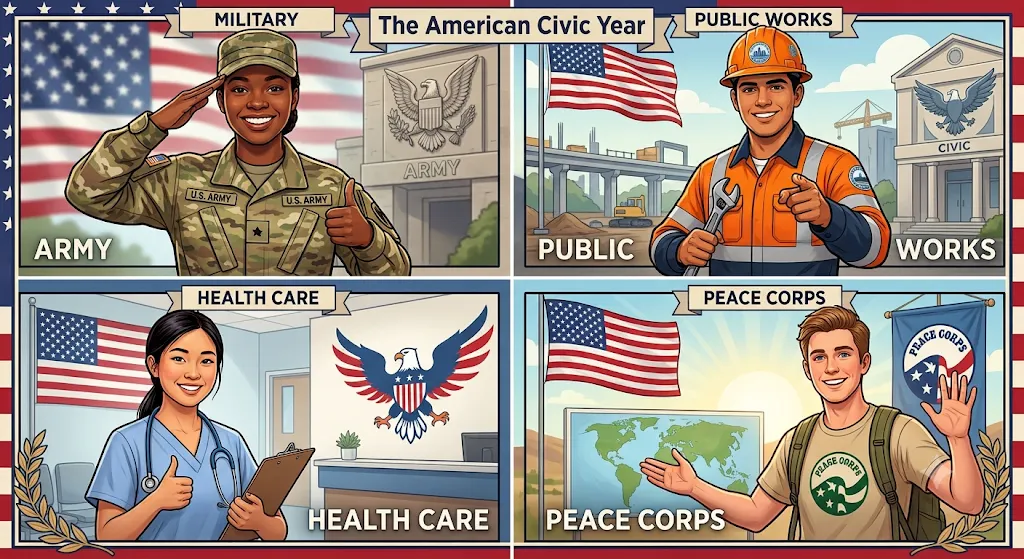
The American Civic Year — Image by Gemini
Every American, on turning eighteen or on finishing secondary school, owes the country one year of paid national service. No exemptions purchased by wealth, no deferments engineered by connections, no quiet path around it for the children of senators, executives, or generals. Service is the price of the franchise the way a jury summons is the price of a court system, and it is treated the way a first vote or a first job is treated, as the door a person walks through into adult citizenship.
Six design commitments make this workable and make it fair.
The first is genuine choice of track. A participant may choose the armed forces, or disaster response and wildfire crews, or public health and elder care, or schools and tutoring, or conservation and infrastructure, or the unglamorous administrative work of local government, courts, and elections. The conscientious objector is not an awkward exception in this design. Civilian service is the default and the military is one honorable option among many, which is precisely what makes universality politically achievable.
The second is real compensation. A living stipend, housing or a housing allowance, full health coverage during the term, and a substantial education or trade benefit on completion. A service year that only the comfortable can afford to take is a class filter wearing a flag pin, and it would deserve every criticism aimed at it.
The third is no exemptions and no substitutions. Physical or cognitive limitations change the assignment, never the obligation. There is always a job that can be done, and the point of the requirement is that it reaches everyone. A universal duty with a wealthy escape hatch is worse than no duty at all, because it launders privilege into the appearance of shared sacrifice. The Vietnam-era deferment system is the cautionary example, and its memory is a large part of why Americans over fifty still flinch at the word conscription.
The fourth is deliberate mixing. Assignments should place participants alongside people from outside their county, their income bracket, and their political tribe. Half the value of the year is the work. The other half is the discovery that the person on the other end of a shovel or a hospital cart is not the caricature you were sold.
The fifth is protection of existing workers. The statute must forbid using service members to displace paid employees, undercut wages, or break bargaining units. Service should fill the gaps that the market and the budget have left open, in rural clinics, wildfire seasons, understaffed schools, and flood zones, and it should never become a subsidy for firing people.
The sixth is local rooting. Wherever possible, some portion of the year happens near home, so participants learn how their own water system, school board, hospital, and county budget actually function. The habit of showing up to civic business is easier to keep once you have seen the inside of it.
One year required, a second year offered
A single year has an unavoidable weakness. Three to four months of it go to training, orientation, and safety certification, which leaves perhaps eight productive months before a participant leaves and has to be replaced by someone who knows nothing. A wildfire crew, a rural clinic, or a school district cannot run on a workforce that is permanently new.
The answer is not to lengthen the requirement. Two-year and four-year mandates buy efficiency at a price the country will not pay, and they turn a rite of passage into a sentence. The answer is to require one year and to make a second year worth choosing.
A participant who extends earns a substantially higher stipend, a doubled education or trade benefit, and the credentials that come with real responsibility, because the second year is not a repetition of the first. Second-year members are the squad leaders, the certified technicians, the crew bosses, the ones who hold the wildland fire qualification or the commercial driver’s license or the emergency medical certification, and who supervise eight to twelve first-year members apiece. They are the layer between the professional staff and the flood of eighteen-year-olds. They arrive already trained, so every month they serve is a productive month.
This is where the arithmetic turns. The first year is expensive per unit of work delivered, because so much of it is instruction. The second year is cheap, because the instruction is already paid for. A program that requires the first and rewards the second gets the universality that makes it a civic institution and the competence that makes it a functioning workforce.
Why this counts as a war remedy
A civic year does not, by itself, prevent a war. Anyone who promises that is selling something. What it does is raise the political price of an unserious one, and it does so before the fact rather than three years after.
Universality means that the population of eighteen-year-olds in any given year is a genuine cross-section of the country, and that every member of Congress has constituents, neighbors, and often family in that cohort. It restores the condition that made the 1970s Congress cautious, which was not superior virtue but personal familiarity with what deployment means. It also builds a civilian corps with actual competence in emergencies, so that the reflexive answer to a crisis is not always a military one.
The service year should not travel alone. Pair it with two companion measures that make cost visible in real time. First, restore Congress’s Article One role in practice by sunsetting open-ended authorizations for the use of military force, so that no president inherits a permanent legal blank check written for a different war. Second, require that any sustained military engagement beyond a short statutory window be funded by an explicit, dedicated levy rather than by silent borrowing, with the amount printed on every taxpayer’s annual statement. If a conflict is worth fighting, it is worth asking the country to pay for it while the country is still watching. That was the American norm through the Second World War, Korea, and Vietnam. Abandoning it was a choice, and it can be unmade.
Together these do something protest alone cannot. They shorten the delay between a decision and its felt consequences, and they distribute the cost across the people who authorize it.
The legal ground is firmer than it looks
The standard objection is that compelling a young American to spend a year tutoring or clearing brush is involuntary servitude, forbidden by the Thirteenth Amendment. It is a serious objection and it will be litigated. It is also weaker than its confidence suggests, because most of the questions it raises have already been answered.
Start with Butler v. Perry, decided by the Supreme Court in 1916. Florida required every able-bodied man in the state to work six ten-hour days each year on the public roads near his home, without pay, with criminal penalties for refusing. The Court upheld it unanimously. The Thirteenth Amendment, it held, was aimed at compulsory labor akin to slavery, and was never intended to interdict the enforcement of duties that individuals owe to the state, naming service in the army, the militia, and on juries as examples. That case has never been overruled. It is worth noting what made Florida’s version easy: a man could send a substitute or pay a small tax instead. A civic year that includes a comparable alternative inherits that comfort.
Two years later the Court decided the Selective Draft Law Cases, rejecting the argument that conscription itself was involuntary servitude, on the ground that the power to compel service is contained in Congress’s authority to raise and support armies.
The harder question is whether that authority reaches purely civilian work. It already has. The Selective Training and Service Act of 1940 required conscientious objectors to perform work of national importance under civilian direction. Between 1941 and 1947, nearly twelve thousand draftees served in roughly a hundred and fifty Civilian Public Service camps, doing soil conservation, forestry, firefighting, and staffing mental hospitals. The Fifth Circuit rejected a Thirteenth Amendment challenge to that requirement in Heflin v. Sanford in 1944, holding that Congress may require an objector to perform work of national importance without violating the amendment. That same year the Supreme Court, in Falbo v. United States, affirmed a criminal conviction for willfully refusing to report for exactly that civilian assignment. Compelled civilian service under a national service statute is not a novelty awaiting its first test. It existed for six years, it was enforced with prison sentences, and it survived.
Modern courts have kept the same line. In Steirer v. Bethlehem Area School District in 1993 and Immediato v. Rye Neck School District in 1996, the Third and Second Circuits upheld mandatory community service as a high school graduation requirement, applying a contextual test drawn from the Supreme Court’s 1988 decision in United States v. Kozminski and confining the Thirteenth Amendment to conditions genuinely akin to slavery. The Second Circuit found no basis in fact or logic for treating a school service program as slavery.
Three design choices follow from that record, and together they turn the constitutional question from a coin flip into a manageable defense.
Anchor the obligation in the war power. Structure the statute the way the 1940 act was structured, as universal registration and induction under Congress’s Article One authority, with a broad and easily elected civilian alternative rather than a narrow tribunal-tested exemption. Everyone is called under the defense framework; almost everyone serves in a civilian corps. That is the configuration courts have already sustained.
Do not lean on the Commerce Clause. In National Federation of Independent Business v. Sebelius in 2012, the Court held that Congress may not use the commerce power to compel individuals to enter into commerce, which is fatal to any statute drafted on that theory. The same decision upheld the individual mandate as an exercise of the taxing power. A service obligation that a person may satisfy by paying a defined levy instead sits on that surviving ground, and it echoes the substitute-or-tax option that made Butler v. Perry straightforward.
Condition federal benefits on individuals, not on states. In Selective Service System v. Minnesota Public Interest Research Group in 1984, the Court upheld a law denying federal student aid to young men who failed to register for the draft, holding that conditioning a benefit on meeting a legal responsibility is not punishment. That is direct authority for tying eligibility for federal financial aid, federal employment, and federal security clearances to completion of the civic year. The limits run the other way, toward the states: South Dakota v. Dole requires that conditions relate to the federal interest and stop short of coercion, and the Medicaid holding in Sebelius showed how a condition on state funding can cross that line. So the states are partners by agreement and grant, never by federal command. The anti-commandeering rule the Court laid down in New York v. United States and Printz v. United States makes cooperative compacts the only durable route anyway.
None of this makes the program litigation-proof. It means the government would walk into court holding a century of precedent, a working historical model, and a statutory design built around the exact features that made the earlier versions survive.
What it costs, and what the country gets back
Roughly four point two million Americans turn eighteen each year. The Census Bureau counted about four point four million eighteen-year-olds in 2023, and that number falls from here, because American births dropped from four point three million in 2007 to about three point six million in 2023. A universal program is at its most expensive the year it starts and gets cheaper every year after.
Take a full cohort of four million and a package that is decent rather than lavish: a living stipend of about twenty-two thousand dollars, which is roughly full-time work at eleven dollars an hour; housing and subsistence of about eight thousand five hundred where the assignment is residential; health coverage of about four thousand five hundred; five thousand for training, equipment, transport, insurance, and supervision; fifteen hundred for administration, audit, and oversight; and an education or trade benefit of twelve thousand paid on completion. That comes to about fifty-three thousand five hundred per participant, or roughly two hundred and fourteen billion dollars a year.
Add the second year at a twenty-five percent take-up rate. A million extension members at a thirty-two thousand dollar stipend, the same housing and health coverage, minimal administration, and a second twelve thousand dollar tranche of education benefit runs about sixty thousand each, or sixty billion dollars. Total gross outlay, about two hundred and seventy-four billion dollars a year.
The second year is what makes that number defensible rather than merely large. A first-year participant costs fifty-three thousand five hundred and delivers about eight productive months, which is roughly sixty-seven hundred dollars per productive month. An extension member costs sixty thousand and delivers twelve, which is five thousand per productive month, about a quarter cheaper, before counting the fact that each one supervises eight to twelve novices who would otherwise need paid staff to lead them. The expensive year buys the civic institution. The cheap year makes it work.
Set that against what the country already spends. Federal outlays in fiscal year 2025 were about seven trillion dollars, so the full program at both tiers is roughly four percent of federal spending. National defense alone came to nine hundred and sixteen billion that year. The post-9/11 wars, at roughly eight trillion dollars, would have funded about thirty years of it. The interest already paid on borrowing for those wars, more than a trillion dollars, would have covered the first four.
Now the harder honesty, because a proposal that hides its costs deserves the same skepticism as a war that does.
The largest real cost is not on that ledger at all. Four million young people spend a year outside the private labor market, and the output they would otherwise have produced is forgone. That loss is smaller than it first appears, since much of the cohort is in school or out of work in any given year, and since the service itself produces genuine output in the form of tutoring delivered, acres treated, homes weatherized, and patients seen. But it is not zero, and any honest score has to include it.
Some frequently cited offsets do not survive contact with the numbers. Folding in the existing national service agencies saves very little: AmeriCorps received about one point two six billion dollars for fiscal year 2025, and the Peace Corps is a fraction of that. Together they are under two billion, a rounding error against two hundred billion, not the ten or twenty billion sometimes claimed. Similarly, the well-known finding that federal hazard mitigation grants return about six dollars for every dollar spent comes from the National Institute of Building Sciences and describes capital projects, not labor programs. It is good evidence that prevention beats recovery. It is not a line item you may subtract.
What can be said, carefully, is that the return channels are real and several of them are measured.
On disaster work, an analysis commissioned by AmeriCorps of one national disaster-recovery organization estimated returns as high as eleven dollars and ninety-six cents per federal dollar, driven by faster and cheaper reconstruction and by better employment outcomes for the members themselves. Across the agency’s portfolio of program-level studies the results range enormously, from under a dollar to more than thirty, which is the most useful finding of all. National service is not automatically a good investment. Well-designed programs in literacy, weatherization, conservation, and disaster response return multiples of their cost, and poorly designed ones do not. The case for the civic year is a case for building the first kind and auditing out the second, which is precisely why independent oversight is a fiscal provision and not a good-government ornament.
On the broader economics, a study by economists at Columbia University estimated that each dollar invested in national service generates close to four dollars in returns to society, counting higher earnings, improved health, and the value of the work performed. Applied to a program of this size that would imply returns in the high hundreds of billions, and no one should treat a per-dollar ratio measured on a program of two hundred thousand people as a safe guide to one of four million. What the estimate supports is the direction and rough order of the effect, not a promise.
Three channels are worth naming because they touch the concerns that decide elections.
Debt. AmeriCorps members have earned more than three point six billion dollars in education awards since 1994, and about a billion of that has gone to paying down student loans. A twelve thousand dollar benefit for a full cohort, doubled for those who extend, substitutes public investment for private borrowing at the exact moment in life when borrowing is most expensive and least informed. That reduces federal loan subsidies and defaults, and it leaves a generation with more disposable income and earlier household formation.
Employment. The participants who gain most are the ones the current system serves worst: the roughly forty percent of young Americans who will never earn a bachelor’s degree. A year that ends with an emergency medical certification, a commercial driver’s license, a wildland fire qualification, or a documented supervisory record is a credentialed entry into the labor market rather than a gap in a resume. Higher lifetime earnings mean higher lifetime tax receipts, which is the slowest and most reliable way any public investment repays itself.
Capacity. The work is work the country needs and is not doing. Wildfire fuel reduction, flood mitigation, rural elder care, school tutoring after a decade of learning loss, and the administration of elections are all chronically under-resourced. Meanwhile the cohort that would staff them is shrinking, which makes the labor scarcer and more valuable every year, not less.
Whether all of that adds to more than two hundred and seventy-four billion dollars a year is not a question anyone can settle in advance, and a proposal this size should be scored by the Congressional Budget Office before it is voted on rather than argued into existence with favorable ratios. What can be said now is narrower and still sufficient. The country has repeatedly found sums of this magnitude for undertakings that produced far less and were never scored at all, and it borrowed every dollar of the last one without asking anybody to vote on a tax.
The honest objections
A serious proposal has to survive its critics rather than avoid them.
It is coercion. Yes. So is jury duty, so is compulsory schooling, so is the tax code, and so was the draft. Surviving in court is not the same as deserving to, and the legitimacy question is separate from the constitutional one. The answer to it is sequencing. Build the capacity first, run it as a universal expectation backed by strong incentives before it is backed by penalties, and let the first cohorts demonstrate that the year is worth having. A duty the country believes in needs very little enforcement. A duty it resents cannot be enforced at any price.
Conscripts do bad work. Often true, and it is the reason the bipartisan National Commission on Military, National, and Public Service declined to recommend mandatory service when it reported in March 2020. That commission preferred voluntary expansion, aiming for five million Americans a year beginning some form of military, national, or public service within a decade, and it advised reserving compulsion as a last resort. That recommendation deserves respect, and it suggests sequencing rather than surrender. Build the capacity first, make the year excellent, oversubscribed, and genuinely desirable, and only then make it universal. Nobody should be conscripted into a program that has not yet proved it is worth a year of a young person’s life.
The government cannot be trusted to run it. The record here is a warning rather than a refutation. In April 2025, roughly four hundred million dollars in AmeriCorps grants were cancelled and about eighty-five percent of the agency’s staff were placed on leave. A federal judge in Maryland issued a preliminary injunction that June restoring terminated programs in the two dozen jurisdictions that had sued and ordering more than seven hundred and fifty members of the National Civilian Community Corps reinstated, and the Office of Management and Budget released roughly one hundred and eighty-five million dollars that September. A program that can be switched off between one spring and the next cannot anchor a rite of passage. Any civic year worth building needs the funding structure of an entitlement and the political protection of universality, which is exactly what makes universal programs harder to kill than targeted ones.
It is too expensive. It is expensive, and the case above should be read as an argument about proportion rather than a promise of thrift. The relevant comparison is that the country spent roughly eight trillion dollars on the wars this is meant to make harder, borrowed all of it, and will pay more in interest than it appropriated for the fighting. Affordability was never the constraint. Attention was.
Nobody wants it. Public opinion here is softer and more movable than the conventional wisdom suggests. Gallup found in November 2017 that forty-nine percent of American adults favored requiring young men and women to give a year of service, though a majority of adults under thirty were opposed. But when people are asked about a concrete design rather than an abstraction, the numbers change. A 2023 survey commissioned by Steve Cohen, a former board member of the United States Naval Institute, found that seventy-five percent of Americans aged eighteen to twenty-four supported an eighteen-month requirement, provided it was compensated, included room and board, and let them choose between civilian and military tracks. Sixty-five percent of respondents said the country was too divided and would benefit from a common experience. The design is the argument.
What kind of country asks this
None of this is exotic. Since 2014, Lithuania, Sweden, Latvia, Croatia, and Serbia have reintroduced compulsory military service. Denmark is extending conscription to women and lengthening the term from four months to eleven. Germany’s new service law took effect on January 1, 2026, requiring every eighteen-year-old man to complete a questionnaire on his fitness and willingness to serve, with medical examinations to follow from July 2027, while service itself remains voluntary for now. Democracies under pressure are rediscovering that a country which asks nothing of its citizens has trouble asking anything of them later.
The American version of this idea is older than any of those. In 1906, William James proposed what he called the moral equivalent of war, a universal conscription of the young into the service of the country’s actual needs rather than its enemies, on the theory that the civic virtues built by war could be built without the killing. He was right about the mechanism and wrong to think it would be easy.
The line drawn in February 2003 was real. Millions of people put their names on the record before the fact, and history did not forget who was right. But a line drawn in the street is only a record. What converts a record into power is a citizenry that is not a stranger to its own government, that has spent a year discovering how a school, a clinic, a fire line, or a county office actually works, and that can no longer be told that a war is happening somewhere far away to someone else’s children.
That is not a radical demand. It is the oldest one a republic makes. If a nation is going to send anyone, it should first have asked everyone.
Sources
The February 2003 demonstrations
- BBC News, “Millions join global anti-war protests,” February 17, 2003, the source of the estimate of six to ten million participants across as many as sixty countries. http://news.bbc.co.uk/2/hi/europe/2765215.stm
- Guinness World Records, “Largest anti-war rally,” on the Rome turnout of approximately three million. https://www.guinnessworldrecords.com/world-records/74335-largest-anti-war-rally
- History.com, “Millions protest the impending invasion of Iraq,” for city-by-city turnout figures. https://www.history.com/this-day-in-history/february-15/millions-protest-iraq-war-february-15
How the war moved votes
- David Karol and Edward Miguel, “The Electoral Cost of War: Iraq Casualties and the 2004 U.S. Presidential Election,” Journal of Politics 69, no. 3 (2007). Published by the University of Chicago Press; the abstract is free and the full article may be purchased or accessed there. https://www.journals.uchicago.edu/doi/10.1111/j.1468-2508.2007.00564.x
- Christian Grose and Bruce Oppenheimer, “The Iraq War, Partisanship, and Candidate Attributes: Variation in Partisan Swing in the 2006 U.S. House Elections,” Legislative Studies Quarterly 32, no. 4 (2007), pages 531 to 557. Published by Wiley; the abstract is free and the full article may be purchased there. https://onlinelibrary.wiley.com/doi/abs/10.3162/036298007782398495
Who carries the cost
- Brown University Watson Institute, Costs of War project, “U.S. Federal Budget,” on the eight trillion dollar total, debt financing, and interest projections. https://costsofwar.watson.brown.edu/costs/economic/us-federal-budget
- Costs of War project, “Economic Costs,” for the underlying budgetary estimates. https://costsofwar.watson.brown.edu/costs/economic
- Military Times, “Breaking down the number of veterans in the 119th Congress,” January 2, 2025. https://www.militarytimes.com/news/pentagon-congress/2025/01/02/breaking-down-the-number-of-veterans-in-the-119th-congress/
- Military Officers Association of America, on the 1973 figure of 401 veterans holding congressional seats and the decline since. https://www.moaa.org/content/publications-and-media/news-articles/2024-news-articles/recommended-reads/how-many-veterans-will-be-serving-in-congress-after-the-2024-election/
- Roll Call, “As Johnson Sends Son to War, Other Members Wait for Call,” March 21, 2003. https://rollcall.com/2003/03/21/as-johnson-sends-son-to-war-other-members-wait-for-call/
- Associated Press, “Half a Dozen Lawmakers Have Kids at War,” March 14, 2005, reprinted by the office of Representative Joe Wilson. https://joewilson.house.gov/media-center/articles/associated-press-half-a-dozen-lawmakers-have-kids-at-war
National service proposals, programs, and polling
- National Commission on Military, National, and Public Service, Inspired to Serve, final report, March 25, 2020, including the recommendation to promote voluntary approaches and reserve compulsion for emergencies. https://inspire2serve.gov/reports
- Full text of the final report as posted by the House of Representatives. https://houlahan.house.gov/uploadedfiles/final_report_-_national_commission.pdf
- Gallup, “Half of Americans Favor Mandatory National Service,” November 2017. https://news.gallup.com/poll/221921/half-americans-favor-mandatory-national-service.aspx
- Steve Cohen, “Americans support mandatory national service,” The Hill, October 2023, reporting the survey he commissioned. https://thehill.com/opinion/campaign/4253664-americans-support-mandatory-national-service/
- Washington State Attorney General, “Court orders halt to AmeriCorps funding cuts after AGs sue,” June 2025, on the preliminary injunction and the reinstatement of National Civilian Community Corps members. https://www.atg.wa.gov/news/news-releases/court-orders-halt-americorps-funding-cuts-after-ags-sue
- Maryland Matters, “Feds agree to release nearly $185 million in AmeriCorps funds within weeks,” August 29, 2025. https://marylandmatters.org/2025/08/29/americorps-funds-restored/
Conscription and civic service abroad
- Library of Congress Global Legal Monitor, “Germany: Act to Modernize Military Service Enters into Force,” January 2026. https://www.loc.gov/item/global-legal-monitor/2026-01-28/germany-act-to-modernize-military-service-enters-into-force/
- German Federal Government, “Military service modernised,” on the questionnaire requirement and the 2027 medical examinations. https://www.bundesregierung.de/breg-en/news/new-draft-military-service-law-2397962
- International Centre for Defence and Security, “Pretence or Preparedness? Germany’s New Military Service,” December 2025, including the list of European states that have reintroduced conscription since 2014. https://icds.ee/en/pretence-or-preparedness-germanys-new-military-service/
- CNN, “Denmark to conscript women for military service,” July 2, 2025, on the lottery and the extension of service from four months to eleven. https://www.cnn.com/2025/07/02/europe/denmark-expands-conscription-women-scli-intl
Budget and economics
- U.S. Census Bureau, national population estimates by single year of age, the source for the size of the eighteen-year-old cohort. https://www.census.gov/data/tables/time-series/demo/popest/2020s-national-detail.html
- Texas A&M University System Data Science, “Projecting the Demographic Cliff,” on the 2023 count of 4.36 million eighteen-year-olds and the decline in births from 4.32 million in 2007 to 3.6 million in 2023. https://www.tamus.edu/data-science/2025/03/01/projecting-the-demographic-cliff-18-year-olds-and-high-school-graduates/
- Peter G. Peterson Foundation, “Budget Basics: National Defense,” on the $916 billion spent on national defense in fiscal year 2025, about 13 percent of federal spending. https://www.pgpf.org/article/budget-explainer-national-defense/
- Senate National Service Caucus letter to the Office of Management and Budget, August 1, 2025, citing the fiscal year 2025 AmeriCorps appropriation of $1,262,806,000. https://www.collins.senate.gov/download/letter_to_omb_on_americorps
- AmeriCorps, “AmeriCorps Reports $12 Return per Dollar Invested in Disaster Relief,” October 2022, on the estimate of up to $11.96 per federal dollar for disaster recovery work. https://americorps.gov/newsroom/press-release/americorps-reports-12-return-dollar-invested-disaster-relief
- AmeriCorps, “National Service Programs Provide a Powerful Return on Investment,” November 2023, showing the wide range of program-level results. https://www.americorps.gov/newsroom/press-release/national-service-programs-provide-powerful-return-investment
- Voices for National Service, “The Economic Value of National Service,” summarizing the Columbia University estimate of nearly $4 in social returns per dollar invested. https://voicesforservice.org/research-and-reports/economic-value-national-service/
- Voices for National Service, on the $3.6 billion in education awards earned by AmeriCorps members since 1994 and the roughly $1 billion applied to student debt. https://voicesforservice.org/news/press-release/new-research-shows-an-unprecedented-return-on-investment-to-the-federal-government-and-communities-from-americorps-and-senior-corps/
- National Institute of Building Sciences, Natural Hazard Mitigation Saves: 2019 Report, the origin of the finding that federal mitigation grants return about $6 per $1 and code adoption about $11 per $1. https://nibs.org/projects/natural-hazard-mitigation-saves-2019-report/
Law and philosophy
- Selective Draft Law Cases (Arver v. United States), 245 U.S. 366 (1918), upholding conscription against constitutional challenge. Full opinion at Justia. https://supreme.justia.com/cases/federal/us/245/366/
- Butler v. Perry, 240 U.S. 328 (1916), upholding compulsory unpaid road work and holding that the Thirteenth Amendment does not reach duties individuals owe to the state. https://supreme.justia.com/cases/federal/us/240/328/
- Falbo v. United States, 320 U.S. 549 (1944), affirming a criminal conviction for refusing to report for civilian work of national importance. https://supreme.justia.com/cases/federal/us/320/549/case.html
- United States v. Niles, 122 F. Supp. 382 (N.D. Cal. 1954), collecting the cases upholding alternative civilian service, including Heflin v. Sanford, 142 F.2d 798 (5th Cir. 1944), on the Thirteenth Amendment. https://law.justia.com/cases/federal/district-courts/FSupp/122/382/1968705/
- Immediato v. Rye Neck School District, 73 F.3d 454 (2d Cir. 1996), upholding mandatory community service as a graduation requirement and adopting the contextual approach set out in Steirer v. Bethlehem Area School District, 987 F.2d 989 (3d Cir. 1993). https://law.justia.com/cases/federal/appellate-courts/F3/73/454/556979/
- Selective Service System v. Minnesota Public Interest Research Group, 468 U.S. 841 (1984), upholding the denial of federal student aid to men who failed to register for the draft. https://www.law.cornell.edu/supremecourt/text/468/841
- National WWII Museum, “Alternative Service: Conscientious Objectors and Civilian Public Service in World War II,” on the roughly 12,000 draftees who served in about 150 camps between 1941 and 1947. https://www.nationalww2museum.org/war/articles/conscientious-objectors-civilian-public-service
- William James, “The Moral Equivalent of War,” delivered at Stanford in 1906 and published in 1910. The text is in the public domain and available in full through the Mead Project at Brock University. https://brocku.ca/MeadProject/James/James_1911_11.html