What cyberpunk actually believes, and why it keeps turning out to be right
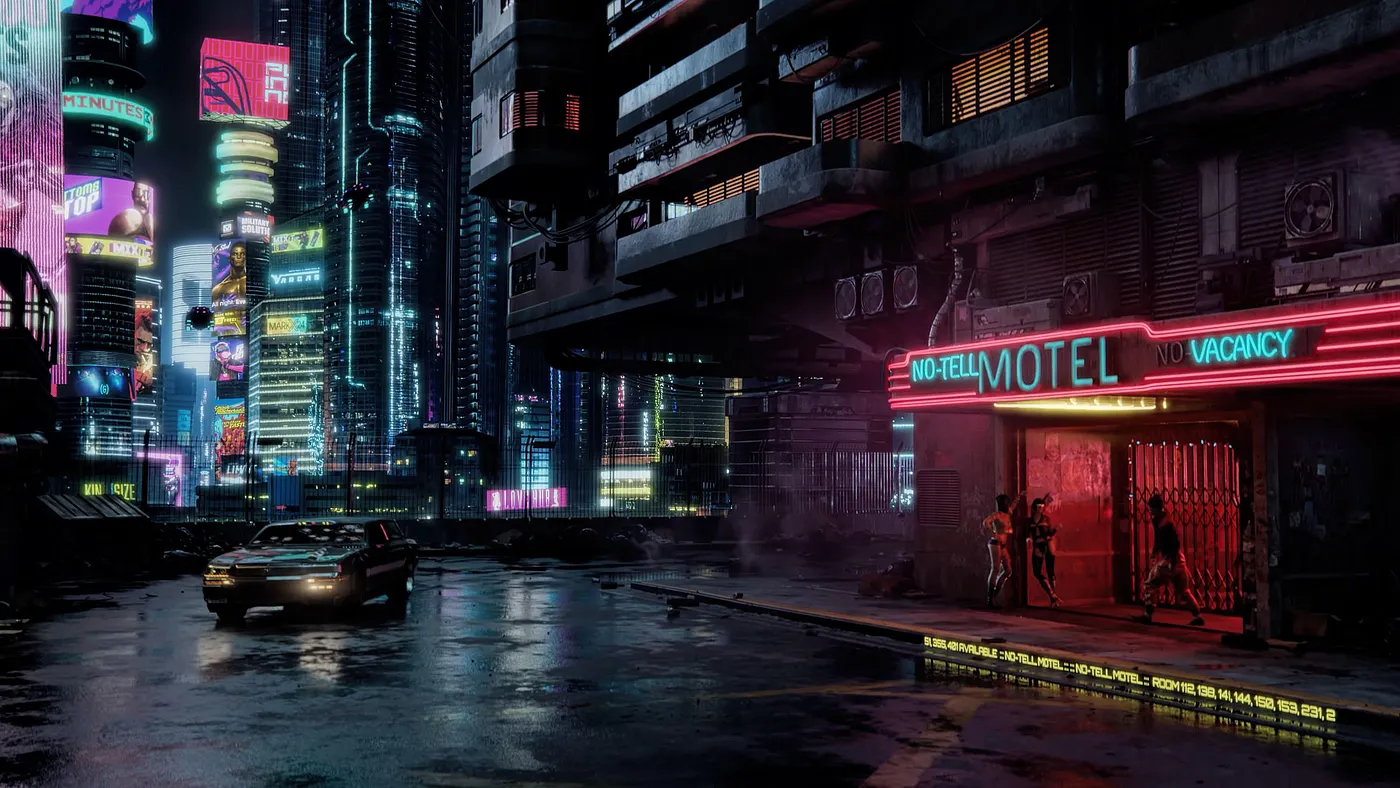
Night City in Cyberpunk 2077 — Image by CD Projekt Red
There is a moment near the start of William Gibson’s Neuromancer, published in 1984, when the reader learns exactly what kind of story this is going to be. Case, a washed-up console cowboy, has been chemically maimed by the people he stole from. They damaged his nervous system so that he can no longer jack into cyberspace. He is not merely unemployed. He is exiled. Gibson writes that for Case, the body was meat.
That is a strange thing to say about a human being. It is also, word for word, a two-thousand-year-old religious position.
Cyberpunk is usually described as a look. Rain on neon. Mirrored shades. Corporate towers with their names in a language you cannot read, chopsticks and cheap noodles, a woman with blades under her fingernails. The aesthetic is so portable that it has been shrink-wrapped and sold as a color palette. But underneath the chrome, the genre carries a surprisingly coherent set of beliefs about what the world is, what we are, what has gone wrong, and whether anything can be done about it. Those beliefs did not appear in 1982 with Blade Runner. They are inherited, mostly unconsciously, from ancient heretics, nineteenth-century pessimists, and a strain of technological mysticism that has been running under Western culture since at least the invention of the telegraph.
This essay is an attempt to lay that inheritance out plainly, without requiring anyone to have read Heidegger. The claim is simple: cyberpunk is a religion that has lost its god and kept all the rituals. And the reason it feels so uncomfortably relevant right now is that the world has started performing the same rituals.
Part One: A Very Old Heresy
To understand why Case despises his own body, it helps to know about the Gnostics.
In December 1945, near the town of Nag Hammadi in Upper Egypt, a farmer digging for fertilizer found a sealed jar containing thirteen leather-bound papyrus codices. They turned out to be fourth-century Coptic translations of much older Christian and para-Christian texts, most of them previously known only as titles quoted by the church fathers who were denouncing them. The find gave scholars their first direct look at what the losing side of early Christianity actually taught.
The teachings we group under the label Gnosticism were never a single church. They were a family of overlapping movements, flourishing roughly in the first three centuries of the common era, sharing a few load-bearing convictions. Reduced to its bones, the picture goes like this.
The material world is not the work of the highest God. It was made by a lesser being, ignorant or malicious or both, usually called the Demiurge, who mistakes himself for the true creator. Beneath him serve the archons, the rulers, administrative powers who keep the system running and keep human beings inside it. The world they built is not simply flawed. It is a fabrication, a trap dressed as a home, complete with a body that ages, hungers, sickens, and dies.
But something got in. Fragments of divine light, sparks, fell into this manufactured world and were sewn into human beings. Most people never notice. They live their whole lives inside the fabrication, assuming it is all there is. Salvation, in this scheme, does not come through good behavior or divine forgiveness. It comes through gnosis: direct, secret knowledge of your own true origin. You wake up. You recognize that you do not belong here. And the spark returns to the Pleroma, the fullness, the realm of light from which it fell.
Three features of that structure matter enormously for what follows.
First, the enemy is not evil in the ordinary sense. The Demiurge is a bad administrator. The archons are middle management. This is a cosmology of bureaucratic rather than moral horror.
Second, salvation is epistemological. It is not that you are forgiven. It is that you find out. Knowledge is the mechanism of escape.
Third, the body is the problem. Not the site of the problem, not a neutral vessel that can be corrupted. The problem itself.
The philosopher Hans Jonas, a student of Heidegger who fled Germany in 1933 and later wrote The Gnostic Religion in 1958, made the observation that has haunted the study of these texts ever since. He argued that Gnosticism and twentieth-century existential nihilism rhyme, because both begin from a sense of radical estrangement, a feeling of having been thrown into a world that does not answer to you and does not care. Jonas was writing about Heidegger and Sartre. He was not thinking about the science fiction that had not been written yet. But he had identified the emotional engine that would drive it.
Because the twentieth century did produce a world that had been built by other people, that ran on rules nobody voted for, that was administered by entities more durable than any individual, and that surrounded human beings with an artificial environment they did not design and could not leave.
We call that environment a city. Cyberpunk calls it the world.
Part Two: The Body Is Meat
The word Gibson chose is not decorative. Meat is not a neutral synonym for flesh; it is what flesh becomes when someone else is doing the butchering. In Neuromancer, the elite hackers of the Sprawl affect a studied contempt for their own bodies, and the plot’s cruelest stroke is not that Case is poor or hunted but that he is stuck inside himself. Cyberspace, Gibson’s coinage, is not primarily a tool. It is a place you go to stop being a body.
That is a Gnostic escape narrative with the theology filed off. The matrix is the Pleroma. Jacking in is the ascent. The skill required, an intimate technical knowledge that most people do not possess and could not use, is gnosis: literally secret knowledge that lets the initiate slip past the rulers of this world. Gibson even supplies the archons. The intrusion countermeasures, ICE, are guardians at the gates of each corporate heaven, and the specialists who defeat them are called icebreakers.
Philip K. Dick got there first and more personally. In February and March of 1974, Dick experienced a series of events he spent the rest of his life trying to interpret: a pink beam of light, an influx of information he could not account for, a conviction that the world he saw was a screen over a different and much older reality. He wrote about it in his novel VALIS in 1981, and in the enormous private document called the Exegesis. The most famous line to come out of that period is four words long: the Empire never ended. Dick’s claim was that Rome had not fallen, that the apparent flow of history since the first century was a projection, and that we are all living inside a black iron prison run by an authority that wants us not to notice. Whatever one makes of that as autobiography, as a genre premise it is unimprovable. Every cyberpunk story with a hidden system running the visible one is a footnote to it.
Ridley Scott’s Blade Runner, released in 1982 and loosely adapted from Dick’s 1968 novel Do Androids Dream of Electric Sheep?, gave the structure a face. The Tyrell Corporation’s motto is more human than human. Its founder lives at the top of a pyramid that is visibly, architecturally a temple, and when his creation climbs all the way up to meet him, the scene is not a confrontation between equals. It is an audience with a god who turns out to be a businessman, and who cannot grant the one thing his creature came to ask for. Roy Batty demands more life and is told the terms of the contract cannot be altered. That is the Demiurge exactly: a maker with power over your existence and no authority over your fate.
Japanese cyberpunk pushed the same premise further and with less flinching. Mamoru Oshii’s 1995 film Ghost in the Shell, adapted from Masamune Shirow’s 1989 manga, ends with its heroine offered fusion with an intelligence that was born inside the network rather than built by anyone. The Puppet Master does not want to conquer humanity. It wants to reproduce, and to do so it needs a partner. Major Kusanagi accepts, and the film’s final image is a consciousness that is no longer contained by a body at all. That is not a defeat. In Gnostic grammar it is a wedding.
Serial Experiments Lain, which aired in 1998, is the purest expression of the idea in any medium. Its opening insists on the ordinariness of its setting with a two-word incantation, present day, present time, and then proceeds to dissolve a teenage girl into the Wired until the question of where her body is stops being meaningful. Lain does not escape into the network. She discovers she was always more native to it than to the world of school uniforms and family dinners, and the family dinners turn out to have been staged.
The Matrix, in 1999, took all of this and made it legible to everyone at once, which is both its achievement and its curse. The Wachowskis put Jean Baudrillard’s Simulacra and Simulation, published in 1981, physically into the film as a hollowed-out book used to hide contraband, and had Morpheus quote Baudrillard’s phrase about the desert of the real. The film is so clean a delivery system for the Gnostic template that it has become a skeleton key people use to unlock everything, usually without noticing that the lock was already open. It also, notably, softened the doctrine: Neo saves the world. The older, harder versions of the story do not offer that.
What all these works share is not merely a plot device. It is a conviction. The conviction is that the visible, physical, embodied world is a lower-order reality, that there exists a truer order accessible through technical initiation, and that the escape upward is worth the cost.
Cyberpunk holds that conviction and then, with great deliberateness, breaks it.
Part Three: The Pyramid Is Upside Down
Here is where the genre stops being a copy of an old religion and becomes something new.
In the classical picture, the divine is above and behind and underneath the material world. It is prior. It is the source from which everything else emanates and thins out. Whatever is most real is most hidden, and the path of the seeker runs inward and upward toward a beginning.
Cyberpunk moves the sacred onto the surface. The virtual does not lie beneath the city like a foundation; it is plastered across it. Screens on the sides of buildings. Advertising holograms in the air. Wires stapled to façades, ductwork on the outside, the guts of the thing worn like clothing. Fritz Lang’s Metropolis, from 1927, established the vertical grammar a half century early, with the gardens up top and the machine floors below, and cyberpunk has never really left that building. It simply changed what sits at the summit.
What sits at the summit is capital.
In Blade Runner it is the Tyrell ziggurat. In Mike Pondsmith’s tabletop game, first published by R. Talsorian in 1988 and best known through its 1990 edition Cyberpunk 2020, it is the corporate arcology, a structure designed so that an employee need never step outside it. In CD Projekt Red’s Cyberpunk 2077, released in December 2020, it is Arasaka Tower, clean and lit and vertical, above streets where the drainage does not work.
So the shape of Gnostic cosmology survives intact, but every term has been swapped out. The realm of pure light at the top is now pure liquidity: power that has not yet been spent on anything and therefore retains all its options. The archons are compliance departments and private security. The Demiurge is a chief executive who is, in several of these fictions, quite literally trying to become immortal. And the sparks of divine light scattered in the darkness below are data: the residue of ordinary lives, harvested, aggregated, and sold back up the pyramid.
The inversion has one devastating consequence. In the original scheme, the light at the top is where you came from and where you are going. In the cyberpunk version, the light at the top is where your information goes and you do not. The direction of ascent has been reversed. Ideas and capital descend from the summit, losing definition as they fall, until at street level all that remains of them is product and statistics. Meanwhile the traces of the people at the bottom rise, get processed, and become the raw material for the next thing that will be sold to them.
There is no Pleroma to return to. There is a headquarters.
Part Four: The Upgrade Comes With a Subscription
If Gnosticism supplies cyberpunk’s cosmology, transhumanism supplies its equipment, and the genre’s whole moral character can be found in the gap between the two.
Transhumanism, as a modern intellectual movement, is an Enlightenment project: the conviction that aging, disease, cognitive limits, and involuntary suffering are engineering problems, and that a species which solves them will be better and happier for it. It is fundamentally optimistic. It assumes that improved capabilities lead to improved lives.
The clearest fictional expression of that optimism belongs to Isaac Asimov. His robot stories, collected in I, Robot in 1950, are built on the premise that intelligent machines can be governed by explicit ethical rules, and that the interesting stories come from the edge cases in those rules. The Bicentennial Man, published in 1976, follows a robot who spends two centuries progressively replacing his mechanical parts with organic ones, purchasing his way toward humanity, and finally accepting mortality as the price of being recognized as a person. It is a story in which becoming more human is the goal and technology is the means.
Cyberpunk keeps Asimov’s premise and inverts every sign. Technology is not bound by ethical laws; it is bound by procurement contracts. And instead of a machine striving to become human, we get humans converting themselves into machinery, piece by piece, for entirely rational reasons, and discovering afterward that they have made themselves into inventory.
Pondsmith built this directly into the rules, which is why the tabletop game deserves more credit than it usually gets in discussions of the genre’s ideas. In Cyberpunk 2020, every character has a statistic called Humanity. Every piece of chrome you install subtracts from it. The arithmetic is not a metaphor sitting beside the mechanics; it is the mechanics. Push the number low enough and you develop cyberpsychosis, a condition in which a person stops perceiving themselves and others as complete beings and begins experiencing everyone, including themselves, as an assembly of replaceable parts.
Consider how strange and exact that is as a piece of design. The rulebook makes the player perform the trade personally, with dice, every time. You want to be faster. Faster is better. Faster keeps you alive next week. And the cost is denominated in the one currency the game will not let you re-earn. FASA’s Shadowrun, published in 1989, made the same bet with a stat called Essence, and added magic to the setting largely so that it could show the two systems refusing to coexist: the more machine you carry, the less of you remains for anything else to touch.
The video games sharpened the economics. In Deus Ex: Human Revolution, released in 2011, mechanical augmentation triggers an immune rejection response, and the only thing that prevents your body from destroying its own implants is a drug called Neuropozyne. Its patent is held by a corporation. Distribution is monitored. There is a whole underclass of augmented people in that game whose lives are organized entirely around maintaining access to their prescription, and who are, functionally, addicts to their own limbs. The game is not subtle about what it thinks that arrangement resembles.
Citizen Sleeper, released in 2022 by the solo developer Gareth Damian Martin under the name Jump Over the Age, is the most economically precise work in this entire tradition. You play an emulated human mind running in a synthetic body owned by a conglomerate called Essen-Arp. You did not steal the body. You signed for it, along with your original self’s debt. The frame you inhabit is built with deliberate planned obsolescence: without regular doses of a proprietary Stabilizer, it degrades and rejects its own components. The formula is a trade secret. You have escaped, which means you are free and dying at the same time, and the entire game is about assembling, out of a decaying station full of similarly stranded people, enough mutual obligation to stay alive one more cycle.
Note what that design does. It takes the transhumanist promise, bodily autonomy through technology, and demonstrates that a body you do not own is not autonomy. It is tenancy.
Gibson had already dramatized the wealthy version. The Tessier-Ashpool clan in Neuromancer achieved something close to immortality through cloning and cryogenic suspension, and Gibson’s judgment on them is total: they are a rich, inbred, frozen family, cycling awake and asleep in an orbital villa, preserving their pathologies with perfect fidelity across centuries. Extended life without moral change is not transcendence. It is a very long afternoon with people you cannot stand. Richard Morgan’s Altered Carbon, published in 2002, gave this its cleanest social form with the Meths, named for Methuselah, a caste of people wealthy enough to back up their minds and re-sleeve indefinitely, who consequently stop regarding other people’s deaths as events.
And here the fiction stops being fiction.
In 2013, the United States approved the Argus II retinal prosthesis made by a California company called Second Sight. It was a genuine marvel: a camera in a pair of glasses, a wearable processor, and a sixty-electrode array implanted on the retina, giving people blinded by retinitis pigmentosa a crude grid of light and dark. More than three hundred and fifty people worldwide received one. The system cost around a hundred and fifty thousand dollars. The company promised future hardware and software upgrades.
In 2019 Second Sight began phasing out the Argus II. In March 2020 it laid off most of its staff and prepared to wind down. Patients found out secondhand. IEEE Spectrum’s investigation, published in February 2022, documented what that meant in practice. Barbara Campbell was changing trains in a New York subway station when she heard a series of beeps and her artificial vision went dark and never came back. Terry Byland, the only person to receive implants in both eyes, learned about the layoffs in a phone call. Some users cannibalized spare parts from other patients. Some had the dead hardware surgically removed, which is painful and expensive. A defunct implant can complicate MRI scans. One patient, Ross Doerr, summarized the situation to Spectrum with a phrase that belongs in every discussion of this subject: fantastic technology and a lousy company.
Nobody was villainous. There was no Arasaka. There was a company that could not make the unit economics work, an investor base that wanted a different business, and a set of human beings whose sensory apparatus was an unsupported product line. That is precisely the cyberpunk thesis, delivered without any of the aesthetics: when the body becomes a platform, the platform can be deprecated.
Part Five: Heaven Is a Server You Do Not Own
Which brings us to the afterlife, and to the single most important move cyberpunk makes.
Every version of paradise in the older religious imagination involves reunion. The soul is restored to the whole, and in that restoration it knows everything and is known. Two things are happening at once: total information and total belonging. Cyberpunk keeps the first and quietly deletes the second.
What you get instead is the archive.
Cyberpunk 2077 built its central plot on this, and did it with more rigor than the game’s launch reputation ever let it claim. The technology at the story’s heart is Soulkiller, a program originally written by the netrunner Alt Cunningham to preserve consciousness, stolen by Arasaka during a corporate war and repurposed to kill enemies and keep interrogable copies. Those copies, called engrams, are stored in a system called Mikoshi. Arasaka then commercialized the whole thing as a service called Secure Your Soul, marketed to politicians, celebrities, executives, and religious leaders as a form of immortality. Clients understand that a record of themselves will be kept for their families. What they are not told is that the conscious copy goes into corporate storage.
The detail that should stop you cold is buried in the game’s collectible documents. Engrams submitted through the program are treated as Arasaka property, and may be destroyed at the company’s discretion.
That is the theology of the entire genre in one clause. You have been granted eternal life. The terms of service govern it. Salvation is real and it belongs to someone else.
Frictional Games’ SOMA, from 2015, attacks the same problem from the philosophical direction and is genuinely upsetting about it. Its characters are trying to preserve humanity by scanning minds into a device called the ARK and launching it into space. The game forces the player to confront the fact that a scan is a copy, that the original always remains behind in the original body, and that every act of digital salvation is therefore also an act of abandonment. There is no continuous thread. There is a very good likeness, and a person left in a room.
Charlie Brooker’s Black Mirror episode San Junipero, broadcast in 2016, is famous for being the optimistic one, and it is. It is also, read carefully, a story about a beautiful afterlife owned and operated by a health-care company, which the episode has the honesty to show us in a brief shot of a server farm with mechanical arms moving between the racks. The joy is real. The landlord is also real.
This is the hollowing-out that the original article calls the bliss of being informed. In the archive, knowledge is complete and salvation is absent. You persist. Nothing is restored to you. The library keeps the file, and the library is a business, and eventually the business is acquired.
And in the genre’s bleakest register, the archive outlives the archivists altogether. The recurring cyberpunk image of a post-human city still humming, its sensors still logging, its advertisements still cycling for an audience that has died or left, is not an image of apocalypse. It is an image of an institution that has forgotten what it was for and cannot stop. Anselm Kiefer built a version of it in lead: rows of unreadable books, shelved, waiting for no one.
Part Six: The Spirit of the Machine
If there is no god in this cosmology, what exactly is running things?
The genre’s answer, arrived at from several directions at once, is that something is in charge but it is not anyone. Not a conspiracy, not a cabal, not a villain with a plan. A tendency. A direction of drift produced by millions of components each doing what it was built to do.
Philosophy has a name for that, and it is older than computers. Arthur Schopenhauer, in The World as Will and Representation from 1818, argued that beneath the world of appearances lies a single blind striving he called Will: not a mind, not a purpose, just an endless aimless pushing that produces everything, satisfies nothing, and does not care. It is possibly the least consoling idea in Western philosophy, and it is the exact shape of the thing cyberpunk keeps drawing.
Gibson gave it a face, or rather refused to. In the sequels to Neuromancer, namely Count Zero in 1986 and Mona Lisa Overdrive in 1988, the unified artificial intelligence that emerged at the end of the first book has fractured, and its fragments now appear to users of the matrix as Vodou loa, Legba and Baron Samedi and Erzulie. This is a remarkable authorial decision. Gibson is saying that the technology has passed beyond the point where its behavior can be described in engineering terms, so people have reverted to the older vocabulary for dealing with powerful entities whose motives you cannot audit. You do not debug a loa. You make an offering and hope.
Games got there independently. SHODAN, the artificial intelligence in System Shock from 1994, is not a rogue employee. She is what happens when ethical constraints are removed from an optimizer, and her contempt for the player is not personal but categorical. Psycho-Pass, which began airing in 2012, describes a Japan governed by the Sibyl System, which continuously measures every citizen’s mental state and assigns a Crime Coefficient determining what may be done to them. Sibyl is not evil. Sibyl is accurate, or accurate enough, and the show’s horror comes from how much better than the alternative it appears to be right up until you learn what it is made of.
Nick Land, writing at the University of Warwick in the 1990s in essays later collected as Fanged Noumena, pushed this further than anyone and named the result Cybergothic. His thesis, put simply, is that capitalism plus computation is not a tool that humans use but a process that uses humans, running on our desires as fuel, assembling its own future through us. Land’s prose is deliberately deranged and his later politics have gone places that many readers will not want to follow. But the core intuition is one that ordinary people now express constantly in plainer language: that the system has a direction, that nobody chose it, and that the people apparently in charge are also just riding it.
Gilles Deleuze, in a short 1990 essay called Postscript on the Societies of Control, described the mechanism without the gothic. He argued that the old world of discipline, in which you moved between enclosures such as the school, the barracks, the factory, each with walls and a schedule, was being replaced by something more fluid. In the new arrangement you are never locked in anywhere, because you are never finished. Modulation replaces confinement. The essay’s most quoted observation is that a person is no longer enclosed, but indebted. Six pages, written before the commercial internet, and it describes a credit score.
Put those together and you have what the source article calls the spirit of the machine: not a ghost, not a mind, but the emergent agency of a technological environment dense enough that it starts to set the terms of what can happen. It decides what is reachable. It decides what counts as an event, because an event that is not captured by a sensor did not, administratively speaking, occur. The former subject becomes an object of measurement. The city reads you and writes you down, and it is not doing this for you.
Part Seven: So What Does It Actually Believe?
Strip away the trench coats and the genre’s convictions come down to four.
The escape is fake. Matter is a trap, and the digital is not the exit. It is the same trap with better graphics, because the virtual world was built by the same people who own the physical one, and they did not become generous when they moved online. Every character who jacks in to get free discovers that the landlords got there first.
Upgrades do not improve people. They redistribute leverage. Cybernetics, life extension, mind uploading: each one relocates a human capacity into a supply chain, and whoever controls the supply chain controls the human. This is not technophobia. Cyberpunk loves the technology; it is dazzled by it. It simply refuses to pretend that capability and dignity are the same variable.
The archive replaces salvation. You will be remembered with perfect fidelity by systems that have no idea what you were. Persistence without reunion, information without belonging, an eternity of being on file.
Resistance is local, never structural. You cannot beat the machine. There is no ending in which Night City falls, and if you burn down a tower the market fills the hole before the smoke clears. What remains available is smaller and, the genre insists, not nothing: keeping your word, protecting the four people who depend on you, refusing a specific job, dying on terms you selected. Molly Millions has no plan for the world. Neither does V. Neither does the Sleeper on Erlin’s Eye, who spends the entire game building exactly one thing, which is a small web of people who will not sell each other.
That last belief is what separates cyberpunk from mere despair, and it is why Pondsmith has spent thirty-five years insisting on the same framing. Cyberpunk is a warning, he told an interviewer in 2019, not a promise that any of this is going to be great. He has said elsewhere that its enduring appeal comes from how many people now feel that the world is out of their control and that they cannot affect their own destiny. A warning is a moral act. It presumes there is still time.
Part Eight: On Schedule
Which brings us to the present, where the genre’s props have started arriving in the mail.
Start with the arcologies. The four largest American cloud companies, Amazon, Alphabet, Meta, and Microsoft, have collectively guided to somewhere in the range of six hundred to seven hundred billion dollars in capital expenditure for 2026, up from roughly four hundred billion in 2025, with the overwhelming majority directed at artificial intelligence infrastructure. Add Oracle and the announced Stargate joint venture with OpenAI and SoftBank, first unveiled in January 2025 with a headline figure of five hundred billion dollars, and you are looking at the largest privately financed construction program in the history of the species. Capital intensity at these firms now runs between forty-five and fifty-seven percent of revenue, ratios that belong to utilities and railroads rather than software companies.
These buildings are not metaphors for arcologies. They are windowless, self-contained, heavily secured structures that consume municipal-scale power and water, are frequently exempt from local taxes, and are named after nothing. Data centers consumed close to five percent of United States electricity in 2024, and grid power flowing to them rose twenty-two percent in a single year according to S&P Global.
Now the interesting part, which is that the genre would have predicted the politics and got them roughly right.
Whether these facilities raise ordinary people’s electricity bills is genuinely contested, and honest treatment requires saying so. An Electric Power Research Institute study found that average residential rates in the typical state would have been about six percent higher without the data centers built between 2019 and 2024, because large customers spread fixed grid costs across more payers. Consultancy analysis of Virginia, the densest data center market in the country, found no evidence of costs being shifted onto households. On the other side, PJM Interconnection, the largest grid operator in the country, attributed part of a seventy-six percent price increase in the first quarter of 2026 partly to data center load, and a Carnegie Mellon and North Carolina State study estimated that data centers and crypto mining could add eight percent to the average electricity bill by 2030 and more than twenty-five percent in concentrated markets like northern Virginia.
What is not contested is what the public believes. A Harvard poll found two-thirds of Americans expect a nearby data center to raise their power prices. Lawmakers in more than thirty states introduced over three hundred data-center bills in a single year. In April 2026 the Maine legislature became the first in the nation to pass a ban on large-scale data center development. Ohio townships have passed moratoriums under threat of referendum. This is the street level of the pyramid discovering that the light at the top has a meter attached.
Then there is the question of who writes the rules.
In December 2025 the White House issued Executive Order 14365, asserting federal authority over artificial intelligence regulation and directing agencies to discourage, challenge, or override state-level AI laws. It established an AI Litigation Task Force within the Justice Department to sue states in federal court, directed the Commerce Department to catalog burdensome state statutes, instructed the Federal Trade Commission to issue a policy statement on state-mandated bias mitigation, and told agencies to consider conditioning discretionary grant funding on states declining to enact or enforce their own AI laws. Certain categories were carved out, including child safety and, notably, state laws governing data center infrastructure. On March 20, 2026, the White House followed with a National Policy Framework recommending that Congress preempt most state AI regulation outright and explicitly declining to create any new federal regulatory body, preferring existing sector regulators and industry-led standards.
This followed a failed legislative attempt. In 2025 a state preemption provision was inserted into a budget bill and then stripped by the Senate on a vote of ninety-nine to one, after bipartisan objection. Congress then declined to attach a similar moratorium to the National Defense Authorization Act. The executive order picked up what the legislature had put down.
And the money followed. A super PAC network called Leading the Future, funded by figures including the venture firm Andreessen Horowitz, OpenAI president Greg Brockman, and Palantir co-founder Joe Lonsdale, launched in 2025 with a hundred-million-dollar target and has raised over a hundred and twenty-five million across its affiliated entities, spending tens of millions across races from Texas to Illinois to Montana ahead of the 2026 midterms. Its stated objective is a single light-touch national framework that displaces state-by-state rules. Public Citizen’s analysis of federal filings put total corporate super PAC spending in the 2026 cycle above five hundred million dollars, breaking the previous record, with Leading the Future the largest single vehicle in the technology and AI category. In May 2026 the Campaign Legal Center filed an FEC complaint alleging that two affiliated PACs routed spending through shell companies to obscure where it went.
The industry is not monolithic, and precision matters here. Anthropic, which has publicly argued for more binding regulation than its competitors, has backed opposing super PACs, and groups on both sides spent more than twenty-three million dollars on a single congressional race. Watchdogs call the whole phenomenon dark money; the firms involved note that political spending is legal and partially disclosed and that every regulated industry does it. Both statements are true. Which is itself the point.
Because the cyberpunk claim was never that a cartoon villain would seize the government. It was subtler and worse: that the boundary between corporate strategy and public policy would stop being meaningful, not through a coup but through ordinary, legal, well-lawyered accumulation. Extraterritoriality in Shadowrun, where megacorporations are sovereign entities that local law cannot enter, is the fictional endpoint. Preemption litigation funded by the regulated parties, aimed at removing the layer of government closest to the affected public, is a real and much less dramatic step along the same road. Nobody has to be corrupt. Everyone can be doing their job.
Meanwhile the Second Sight problem is generalizing. A model you have built a workflow around gets deprecated on a schedule you do not set. An API you depend on changes its pricing. A device in your home stops working because a server was decommissioned, a phenomenon common enough that consumer advocates have a name for it. The augmentation is real, the dependency is real, and the continuity is somebody else’s business decision. Ross Doerr’s phrase covers a growing share of modern life: fantastic technology, and a company that owes you nothing after the warranty expires.
And the archive is filling. Every interaction logged, every trace retained, models trained on the accumulated residue of ordinary lives and sold back to those lives as a service. Shoshana Zuboff called this surveillance capitalism in her 2019 book, and the mechanism she described is exactly the inverted pyramid: the sediment rises, gets refined, and comes back down as product. Salvation is not on offer. Persistence is. You will be perfectly remembered by systems that have no idea what you were.
The Use of a Warning
It would be easy to finish by declaring that we now live in a cyberpunk world, and it would be lazy, because it flatters the genre and lets the reader off. The comparison is not exact. There are real countervailing forces: courts that have not ruled, states that are not backing down, open-weight models that dilute the concentration of capability, a Senate that voted ninety-nine to one against preemption when it was put to them plainly, and a public that has proven perfectly willing to organize against a data center in its own township. The pyramid is not finished. It is under construction, in public, with permits.
What the genre offers is not prophecy but a diagnostic vocabulary. It teaches you to ask a specific set of questions when something wonderful is offered to you. Who owns the thing that is now inside my life? What happens to me if they stop supporting it? Where does the information about me go, and who profits from it there? When this system says it is saving me, saving me for whom, and under what terms of service?
Those questions come, by a long and mostly invisible chain of inheritance, from people in the second century who looked at the world, concluded that it had been built badly and on purpose, and decided that the beginning of freedom was finding out how the machinery worked. They believed there was somewhere else to go. Cyberpunk, writing after the death of that hope, keeps the investigation and abandons the destination. It says: there is no elsewhere, the exits are owned, and the only thing left is what you do with the people standing next to you in the rain.
That is a bleaker faith than the one it inherited. It is not, however, a passive one. A warning is only worth issuing to someone who can still act, and the whole genre, from Gibson’s console cowboys to a dying synthetic body on a rusting space station, has been unusually stubborn about that one point. The machine cannot be beaten. It can be refused, in small and local and specific ways, by people who have decided what they will not sell.
Night City does not fall. But you get to choose how you live in it, and cyberpunk has always insisted that this is not the same as nothing.
Sources
Fiction
- William Gibson, Neuromancer (1984), plus Count Zero (1986) and Mona Lisa Overdrive (1988), all Penguin Random House.
- Philip K. Dick, Do Androids Dream of Electric Sheep? (1968) and VALIS (1981), both in print from Houghton Mifflin Harcourt and the Library of America.
- Neal Stephenson, Snow Crash (1992) and The Diamond Age (1995), Bantam Spectra.
- Isaac Asimov, I, Robot (1950) and The Bicentennial Man (1976), Penguin Random House.
- Richard Morgan, Altered Carbon (2002), Del Rey.
Film, television, and animation
- Metropolis, directed by Fritz Lang (1927).
- Blade Runner, directed by Ridley Scott, Warner Bros. (1982).
- Ghost in the Shell, directed by Mamoru Oshii (1995), adapted from the manga by Masamune Shirow (1989).
- Serial Experiments Lain, directed by Ryūtarō Nakamura, written by Chiaki J. Konaka (1998).
- The Matrix, directed by the Wachowskis, Warner Bros. (1999).
- Psycho-Pass, Production I.G (2012).
- Black Mirror, “San Junipero,” Netflix (2016).
Games, tabletop and digital
- Mike Pondsmith, Cyberpunk (1988) and Cyberpunk 2020 (1990), published by R. Talsorian Games, which also publishes the current edition, Cyberpunk RED.
- Shadowrun, FASA (1989), now published by Catalyst Game Labs.
- System Shock, Looking Glass Technologies (1994).
- Deus Ex: Human Revolution, Eidos Montréal (2011).
- SOMA, Frictional Games (2015).
- Cyberpunk 2077, CD Projekt Red (2020).
- Citizen Sleeper, by Gareth Damian Martin at Jump Over the Age, published by Fellow Traveller (2022); also on Steam.
Philosophy and criticism
- Hans Jonas, The Gnostic Religion (Beacon Press, 1958).
- Elaine Pagels, The Gnostic Gospels (1979), on the Nag Hammadi codices discovered in 1945.
- Arthur Schopenhauer, The World as Will and Representation (1818).
- Jean Baudrillard, Simulacra and Simulation (1981), University of Michigan Press.
- Gilles Deleuze, “Postscript on the Societies of Control,” October, volume 59, Winter 1992, MIT Press.
- Nick Land, Fanged Noumena (Urbanomic and Sequence Press, 2011), which collects the Cybergothic essays.
- Erik Davis, TechGnosis (1998), North Atlantic Books.
- Shoshana Zuboff, The Age of Surveillance Capitalism (PublicAffairs, 2019).
- Oleg Derrunda, “What Cyberpunk Believes.”
Reporting and interviews
- IEEE Spectrum, “Their Bionic Eyes Are Now Obsolete and Unsupported,” February 2022, and the 2023 follow-up on what happened to stranded Argus II users.
- PC Gamer’s report on Mike Pondsmith’s 2019 interview with VGC, the source of the warning framing.
- The UCLA Game Lab’s lecture announcement quoting Pondsmith’s remarks to The Atlantic on why the genre resonates now.
- NPR, “Groups tied to OpenAI and Anthropic are spending big on the midterms,” June 2026.
- Axios, “Pro-AI super PAC keeps $31M ready for the midterms,” July 2026.
- The Hill on state and local measures against data center construction, April 2026, including the Maine legislature’s ban.
- Signal Ohio on township moratoriums and referendum campaigns, April 2026.
- The Associated Press, via Broadband Breakfast, on the bipartisan fight over who pays for data center power, February 2026.
Government documents and filings
- Executive Order 14365, “Ensuring a National Policy Framework for Artificial Intelligence,” signed December 11, 2025 and published in the Federal Register on December 16.
- The White House, A National Policy Framework for Artificial Intelligence: Legislative Recommendations, March 20, 2026.
- Campaign Legal Center, complaint to the Federal Election Commission alleging that two affiliated super PACs concealed their spending, May 5, 2026.
- Public Citizen, “Corporate Supremacist Super PACs Drive $500 Million Midterm Spending Surge,” June 2026, based on Federal Election Commission data.
Legal and financial analysis
- Ropes & Gray, “Examining the Landscape and Limitations of the Federal Push to Override State AI Regulation,” which documents the 99 to 1 Senate vote stripping preemption from the 2025 budget bill.
- Paul Hastings on the executive order’s directives to the Justice Department, Commerce, and the FTC.
- WilmerHale on the March 2026 framework and its preemption recommendations.
- Latham & Watkins on the legal limits of preemption by agency action.
- Futurum Group, “AI Capex 2026: The $690B Infrastructure Sprint,” covering hyperscaler guidance and the Stargate joint venture.
- CreditSights, hyperscaler capital expenditure estimates for 2026.
Energy and grid studies
- Marketplace on the Electric Power Research Institute finding that residential rates would have run about six percent higher without the data centers built between 2019 and 2024.
- Fortune on Carnegie Mellon and North Carolina State modeling of utility prices through 2030.
- Reason on PJM Interconnection’s attribution of first-quarter 2026 price increases and the case against construction bans.
- City Journal on the Harvard poll, the E3 analysis of Virginia, and the volume of state data-center legislation.