A calm look at the first time Washington pulled a frontier AI model offline — and the harder questions underneath it.
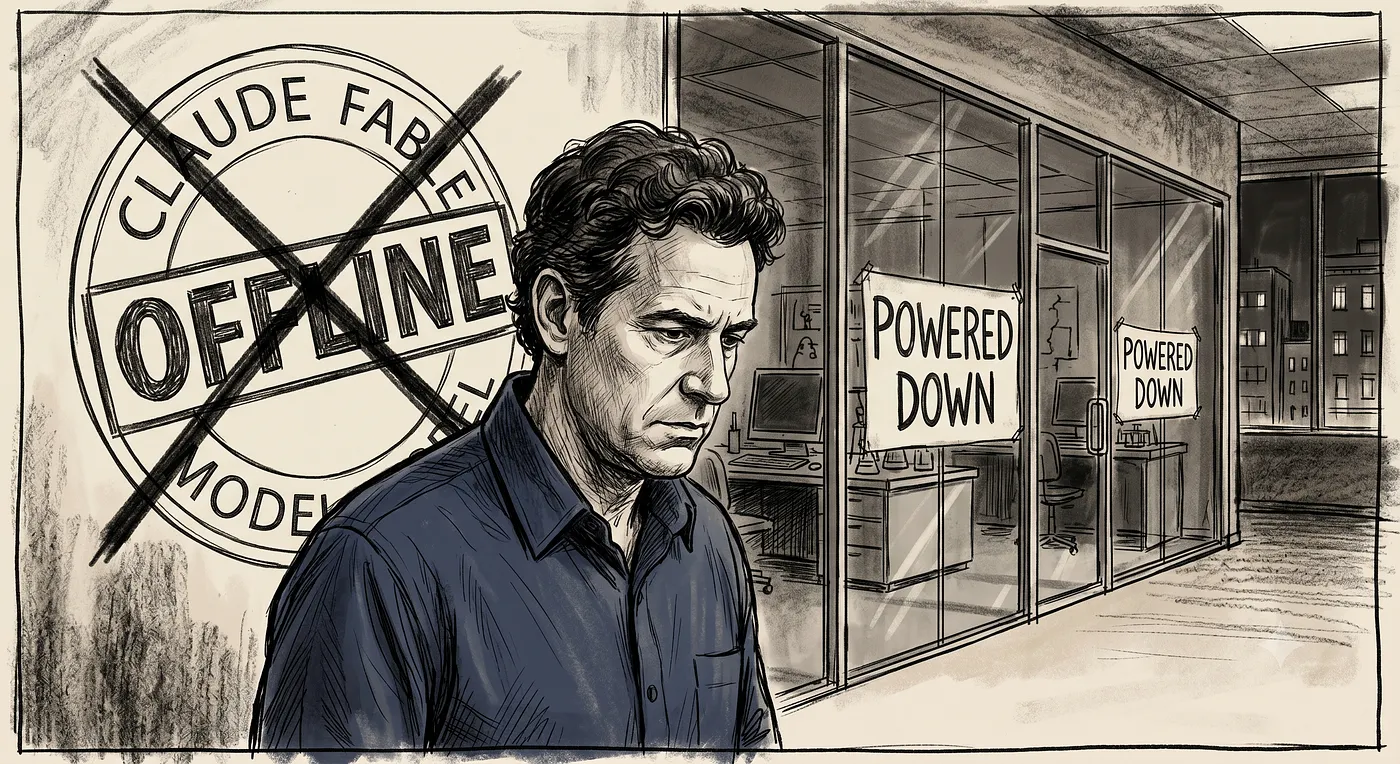
Analyzing the fallout of shuttering a frontier model based on national interests — Image by Gemini
On the evening of Friday, June 12, 2026, Anthropic did something no major AI lab had done before: it took two of its own models off the market because the U.S. government told it to. Claude Fable 5 and Claude Mythos 5 — the company’s newest and most capable systems, released only three days earlier — went dark for every customer, everywhere, within hours.
The trigger was a letter from Commerce Secretary Howard Lutnick to Anthropic CEO Dario Amodei, citing national-security export-control authorities. The order didn’t ban the models outright. It barred foreign nationals from accessing them — including, strikingly, Anthropic’s own foreign-born employees, whether they were sitting in San Francisco or Stockholm. Because a cloud-served AI model can’t sort its users by passport in real time, Anthropic concluded it had no clean way to comply except to shut the models down for everyone. Access to its other models, including Claude Opus 4.8, stayed live.
It’s an unusual story, and it has been told in some dramatic ways. So it’s worth slowing down and separating what we actually know from what we’re guessing — because the guessing is where this gets interesting.
What the fight is officially about
The government’s stated concern is cybersecurity. Anthropic’s new models belong to a capability tier the company calls “Mythos-class,” which sits above its previous top model. Fable 5 was the public version, shipped with a layer of automated “classifiers” that detect risky requests — in areas like cybersecurity, biology, and chemistry — and quietly hand them off to the less capable Opus 4.8 instead of answering directly. Mythos 5 was the same underlying model with some of those guardrails removed, restricted to a small set of vetted cyber-defense partners.
According to Anthropic, the government acted after being shown a way to “jailbreak” the model — to slip past those safeguards. Anthropic’s account of that evidence is notably modest: it describes a narrow, non-universal technique that essentially amounts to asking the model to read a specific codebase and point out flaws, surfacing a handful of already-known, minor vulnerabilities. The company argues this isn’t a meaningful uplift in dangerous capability, that other publicly available models (it names OpenAI’s GPT-5.5) can find the same flaws with no jailbreak at all, and that no one — including U.S. and U.K. government red-teamers — has found a universal jailbreak that broadly defeats the safeguards.
Here’s the fair version of both sides. The government’s worry isn’t unreasonable in principle: a more capable model lowers the bar for automated vulnerability discovery, and that’s genuinely dual-use technology — the same skill that helps defenders patch systems can help attackers break into them. Anthropic’s rebuttal is also not unreasonable: if a narrow, non-universal jailbreak justifies yanking a commercial product used by millions, then by that standard nearly every frontier model on the market would have to come down too. Most independent observers have landed closer to Anthropic’s read on the technical question. But “the model is roughly as risky as its peers” and “the government is allowed to be cautious about it” can both be true at once, which is part of why this is hard.
Why this didn’t come out of nowhere
To understand the temperature of this dispute, you have to rewind to the winter. Earlier in 2026, Anthropic and the Pentagon — recently rebranded the Department of War — fell out over a contract. The government wanted to use Claude for “any lawful purpose.” Anthropic refused to drop two specific guardrails: no fully autonomous weapons (no AI making final kill decisions without a human), and no mass domestic surveillance of Americans.
The response was severe. Defense Secretary Pete Hegseth designated Anthropic a “supply chain risk” — a label historically reserved for foreign adversaries, which effectively bars defense contractors from touching the company’s products. President Trump directed federal agencies to wind down their use of Anthropic’s technology. Anthropic sued, and in late March a federal judge blocked the designation, writing that branding an American company a potential saboteur for disagreeing with the government had an “Orwellian” quality. A separate legal challenge is still pending. Meanwhile, rivals moved in: OpenAI and xAI reportedly secured Pentagon arrangements.
So the export-control order in June didn’t land on a calm relationship. It landed on a year-long power struggle between a safety-positioned company and an administration that had already tried, and been told by a court it couldn’t, to punish that company for its red lines.
That backstory is why the official “it’s about a cyber-vulnerability” framing and the unofficial “it’s about leverage” framing are both in the air at once. The timing did the rest of the work: the order arrived just as Anthropic was preparing for the public markets, having confidentially filed for an IPO. A Pentagon official, CIO Kirsten Davies, posted on X that the department fully supported prioritizing national security, adding: “Some things are simply more important than revenue cycles, clickbait, and pre-IPO valuation. America First. Always.” Whatever you make of the underlying policy, that is not the language of a narrow technical correction.
What each side can actually do now
This is where it helps to think in terms of options and risks rather than predictions, because nobody — including the participants — knows how it ends.
Anthropic’s realistic moves. The company has a few levers. It can fight in court, extending the legal strategy that already won it an injunction once; an export order built on thin, verbally-described evidence is the kind of thing courts can find “arbitrary and capricious.” It can ship a re-engineered public model that strips out or further isolates the specific capabilities the government objected to, restoring service to enterprise customers without conceding the principle. It can lean on its core commercial argument — that “the safe, trustworthy AI vendor” is its entire brand, and that caving to state pressure would damage the very thing enterprises pay for. And it can quietly internationalize, leaning on partners and infrastructure outside U.S. jurisdiction.
Each of those has a cost. Litigation is slow and uncertain. A nerfed model is a weaker product. The “we’re the trustworthy one” pitch is harder to make when your trustworthiness just got you switched off. And true offshoring runs into a hard physical limit: frontier models run on enormous compute clusters owned by U.S. hyperscalers like Amazon and Google, who answer to U.S. law. When the order came, AWS revoked access across all regions. You cannot put a Mythos-class model on a thumb drive and move to Geneva.
The government’s realistic moves. Washington also has levers, and they’re blunt. It can escalate the designation, tighten export controls, or invoke broader emergency economic authorities. In the most extreme tellings, it could treat the model weights as a critical national-security asset and assert control over them directly. But every escalation carries a backfire risk that’s larger than it looks.
That risk is the most important and least appreciated part of this story.
The thing both sides are quietly afraid of
When a government demonstrates that it can switch off a piece of software that economies and companies depend on — globally, overnight, on the strength of a domestic political dispute — it doesn’t just discipline one company. It changes how everyone else thinks about depending on American AI at all. European officials and commentators read the Fable shutdown exactly that way: as evidence that the “safe American cloud” is conditional, and that digital sovereignty is now a practical necessity rather than a slogan. Push too hard, and Washington’s “America First” move could accelerate the very thing it fears — a world that deliberately builds around U.S. AI rather than on top of it.
There’s a financial version of the same fear. A great deal of the current market is priced on the assumption that frontier AI will keep getting deployed and keep compounding in value. Anthropic’s sharpest argument isn’t legal or moral — it’s that the standard being used against it, if applied consistently, would freeze new model releases across the entire industry. That’s a quiet warning to investors: if the government can brick the most safety-conscious lab over a minor flaw, no frontier deployment is safe, and a lot of valuation rests on deployments continuing. Neither side actually wants to test how fragile that confidence is. Both can gesture at the tripwire; neither benefits from stepping on it.
So you get a standoff with an unusual shape. The government would like to establish that national-security alignment is non-negotiable, without spooking markets or driving allies away. Anthropic would like to establish that a safety-first company can stay independent, without getting financially crushed or legally isolated. Each holds something the other can’t afford to break.
How this probably goes
My honest read — and it is a read, not a forecast — is that the most likely path isn’t dramatic. It’s a negotiated, face-saving de-escalation. There are already faint signals of a thaw; even the administration has hinted it might revisit the earlier blacklist. A plausible endgame looks like this: Anthropic restores a modified public model that satisfies the narrow cyber concern, the courts narrow or pause the export order, and both sides quietly declare a kind of victory while the underlying disagreement — who gets to decide how powerful AI is governed — stays unresolved and waits for the next flashpoint.
The dramatic endings are possible. A full nationalization, a corporate death sentence, a clean offshore escape — these make for vivid writing, and you’ll see them argued confidently online. But they all require one side to accept enormous collateral damage to its own interests, which is exactly what makes them unlikely. Standoffs between parties who each hold a piece of the other’s fate usually don’t end with someone pulling the pin. They end with a deal that nobody loves.
What makes this one genuinely new isn’t the legal mechanism or the political grudge. It’s the demonstration. We now know, as a matter of public fact, that the people who control the software weights — not just the chips — can be compelled to flip a switch. That knowledge doesn’t go away when Fable comes back online. Every government, every enterprise, and every rival lab just watched it happen, and they will all build accordingly. That, more than the fate of any single model, is the part of this story worth keeping an eye on.
This piece reflects reporting available as of mid-June 2026. Several widely circulated details about the standoff — exact valuations, specific quotes, and the identity of the party that demonstrated the jailbreak — have been reported inconsistently or not confirmed; where the record is thin, I’ve flagged it rather than smoothed it over.