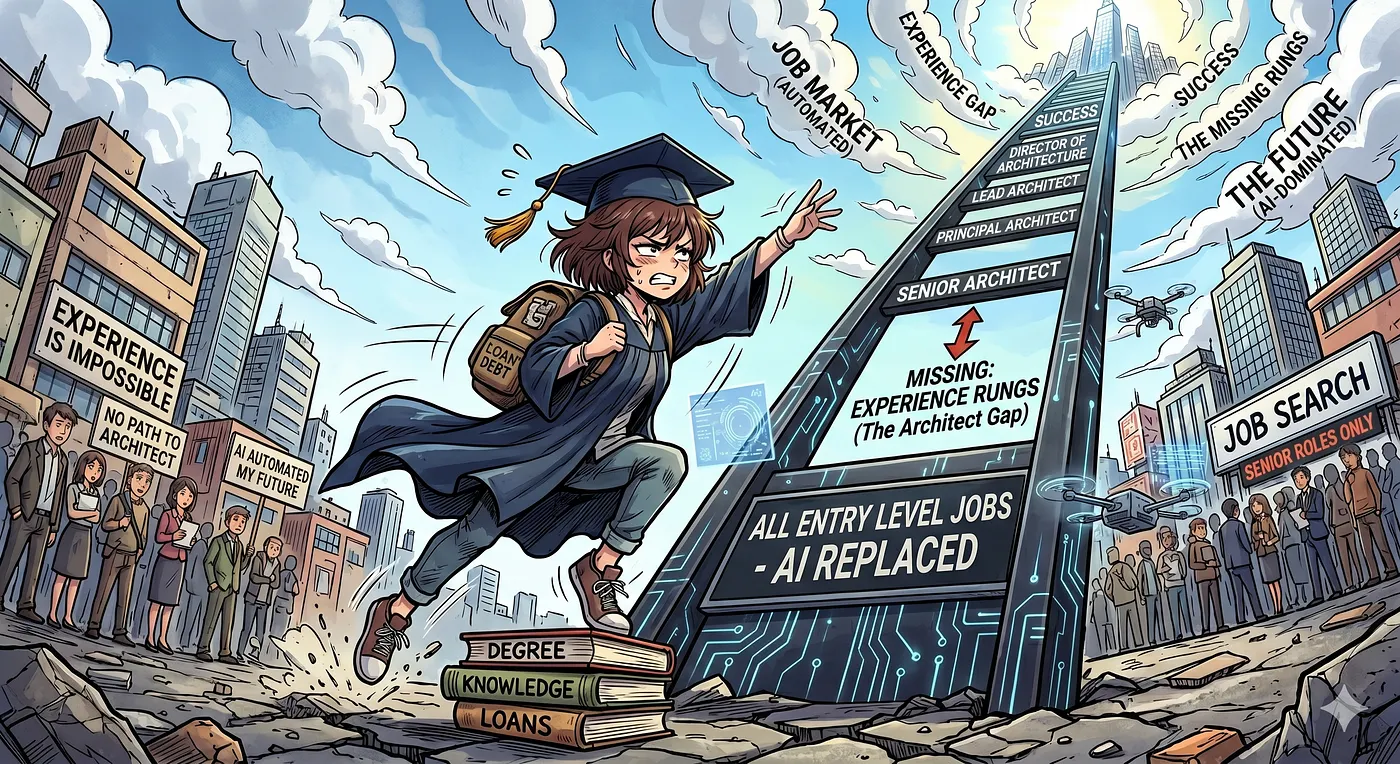
The Architect’s Inversion: Success is just out of reach — Generated by Google Gemini
There is a particular kind of professional pride that has defined the modern era of knowledge work. It is the pride of the builder, the coder, the analyst, the operator. It lives in the fluency of execution. It expresses itself through the person who can write the cleanest code, close the most tickets, build the most polished spreadsheet model, or synthesize a two-hundred-page briefing document into a crisp executive summary before lunch. For decades, this was the coin of the realm. You proved your worth by doing things, and doing them faster and more accurately than the person seated next to you.
That era is ending. Not because the work was unimportant. Not because the people who did it were not genuinely skilled. It is ending because the machine has arrived, and the machine is extraordinarily good at doing those things too. In some cases, the machine is better. In nearly all cases, it is faster. And in every case, it does not need sleep, a salary, or a sense of purpose to keep going.
What follows from that reality is not simply a story about job displacement, though displacement is undeniably part of it. What follows is something more fundamental and more interesting: a total reordering of which human qualities are economically and organizationally valuable. The skills that once placed you at the top of a professional hierarchy are being commoditized. And the skills that once seemed soft, vague, and difficult to measure are becoming the most critical inputs in any knowledge enterprise. This reordering has a name. Call it the Architect’s Inversion.
The Foundation: What We Built, and Why It Made Sense
To understand the inversion, you have to understand what it is inverting.
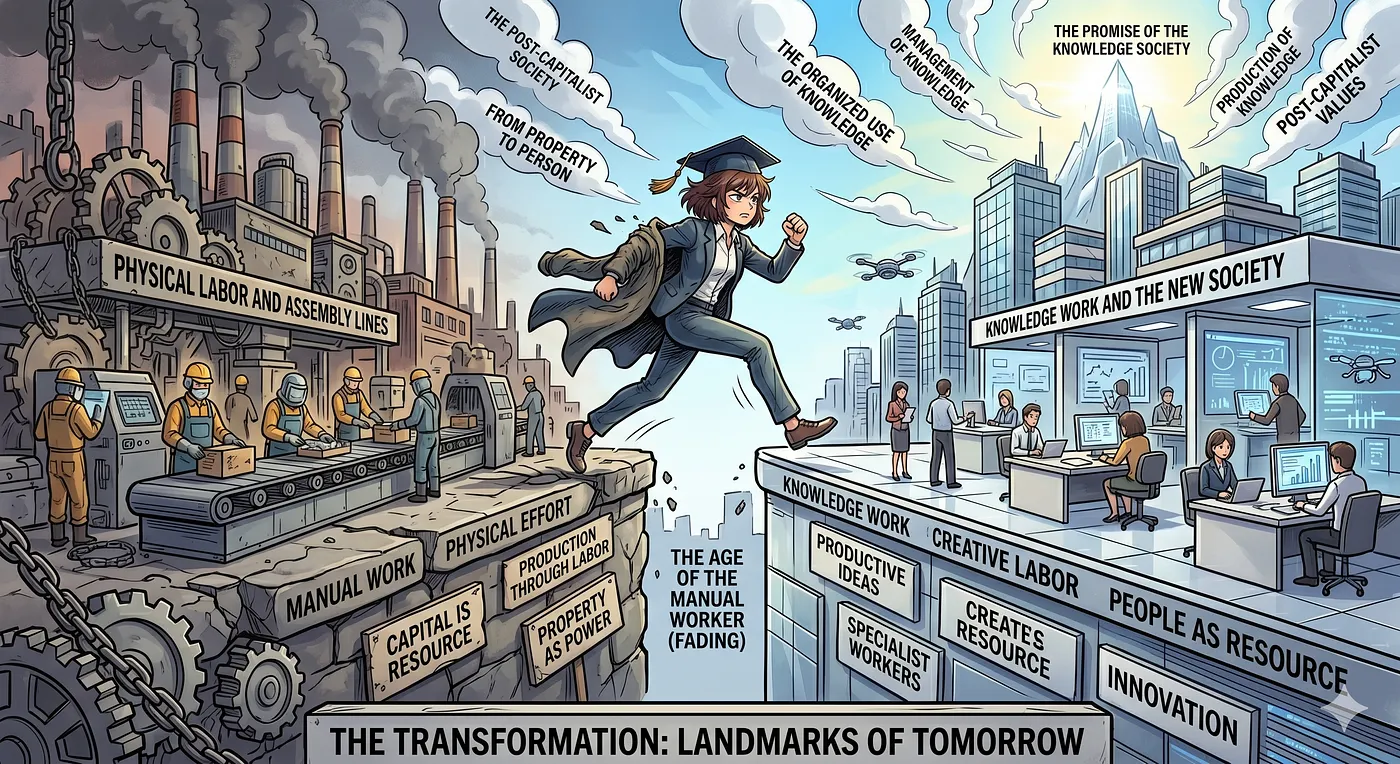
Peter Drucker’s Vision in Landmarks of Tomorrow — Generated by Google Gemini
The industrial economy rewarded people for what they could produce with their hands. The knowledge economy, which followed, rewarded people for what they could produce with their minds. This was the contribution that management theorist Peter Drucker saw coming decades before the rest of the world caught up. In 1959, Drucker introduced the term knowledge worker in his book Landmarks of Tomorrow, and he spent the next half-century elaborating on what the ascendancy of this new class of professional would mean. He argued that wealth and power, which had previously been organized around land and capital, would increasingly be organized around knowledge itself. The worker who produces ideas, information, and analysis would eventually become the most valuable unit in any economy. In his 1966 book The Effective Executive, Drucker drew a sharp distinction between the manual worker, who labors with their hands to produce goods or services, and the knowledge worker, who labors with their head to produce ideas, information, and judgment.
Drucker was right. Over the course of the twentieth century, the knowledge worker did ascend. And as knowledge work matured, it developed its own internal hierarchy of value. At the top sat those who could execute the most technically demanding tasks: write the most sophisticated code, build the most accurate financial models, draft the most legally airtight contracts, interpret the most complex data, and produce the highest-quality deliverables with the greatest consistency. Execution was the proof of expertise. Mastery was demonstrated through doing.
This internal logic made complete sense in a world where doing was the bottleneck. When the constraint on any organization was the speed and accuracy of human execution, then the human who could execute the fastest and most accurately was the most valuable. Entire educational and professional development systems were built around this logic. Universities trained students to perform specific analytical and technical tasks. Law schools put students through thousands of hours of case reading so that legal reasoning would eventually become fluent and automatic. Medical schools ran aspiring physicians through grueling years of procedural training so that clinical judgment would be built on a bedrock of pattern recognition developed through direct experience. Engineering programs built problem sets around the mastery of computational methods. Business schools created case competitions that rewarded the speed and precision with which students could diagnose organizational problems and propose technically grounded solutions.
Firms recruited for demonstrated execution skills. Career ladders rewarded people who could do more, faster, in the same domain. Promotions went to those who had proven they could handle the most complex versions of their craft. The assumption underneath all of it was that what separated the excellent professional from the average one was the quality of their hands-on execution, even when those hands were working a keyboard rather than a lathe.
That assumption is no longer true. And the speed at which it has become untrue is genuinely startling.
The Numbers That Change Everything
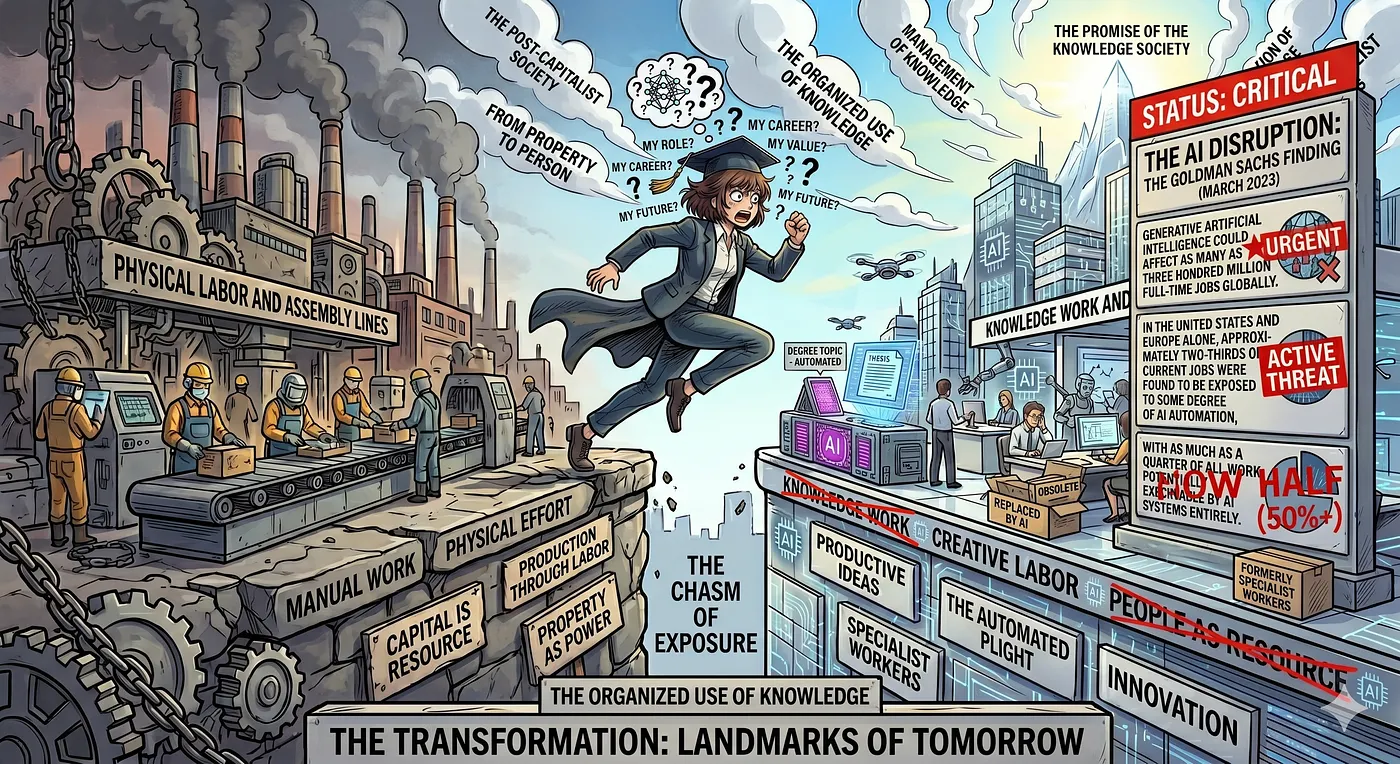
The Uncertain Future of Knowledge Work — Generated by Google Gemini
In March of 2023, economists at Goldman Sachs published a report that sent a tremor through every professional sector on the planet. Their analysis found that generative artificial intelligence could affect as many as three hundred million full-time jobs globally. In the United States and Europe alone, approximately two-thirds of current jobs were found to be exposed to some degree of AI automation, with as much as a quarter of all work potentially executable by AI systems entirely. The sectors most affected were not the ones that had historically faced automation pressure. This was not factory work or logistics. The Goldman Sachs report found that forty-six percent of tasks in office and administrative support could be automated, forty-four percent in legal professions, thirty-seven percent in architecture and engineering, and thirty-five percent in business and financial operations. The knowledge workers, the very professionals whose ascendancy Drucker had predicted, were now looking directly at the machine.
Two years later, the McKinsey Global Institute took the analysis further. Their 2025 report, titled Agents, Robots, and Us: Skill Partnerships in the Age of AI, found that more than half of all work hours in the United States could technically be automated by current technology, primarily by AI agents operating autonomously on complex cognitive tasks. Just two years prior, their 2023 estimates had placed that figure at thirty percent by 2030. The jump was not incremental. It was a near doubling of the projected scale, and a compression of the timeline from a future possibility to a present reality. As McKinsey noted, demand for AI fluency, meaning the practical ability to use and direct AI tools effectively, had grown nearly sevenfold in just two years, rising from job postings affecting roughly one million US workers in 2023 to approximately seven million by 2025. Critically, this surge was not confined to technical roles. The demand was appearing in job postings for management, finance, marketing, and education, signaling that AI literacy had become an expectation across the professional landscape.
The World Economic Forum, drawing on survey data from over one thousand leading global employers collectively representing more than fourteen million workers across fifty-five economies, released its Future of Jobs Report 2025 in January of that year. The report found that twenty-two percent of all jobs would be disrupted by 2030, with one hundred and seventy million new roles expected to be created even as ninety-two million were displaced. The net gain of seventy-eight million jobs sounds reassuring until you examine what kind of work those new roles will require. The Forum found that employers across industries are now identifying analytical thinking, creative problem-solving, leadership, and resilience as the skills they most urgently need, while the skills that are declining in demand are precisely those associated with procedural execution. Nearly forty percent of the skills required on the job were expected to change by 2030, and sixty-three percent of employers were already citing the resulting skills gap as the primary barrier to their business transformation.
What Goldman Sachs began to sketch and McKinsey and the World Economic Forum have since filled in is a portrait of a structural shift, not a cyclical correction. The machine has not merely taken some jobs. It has changed the underlying logic of what makes a human being professionally valuable.
What the Inversion Actually Means
The Architect’s Inversion is the name for what happens when a technology automates the lower layers of a professional hierarchy so thoroughly that it reverses the relationship between execution and strategy. In a pre-AI knowledge economy, strategy sat at the top but was served by execution. The strategist needed the executor. The vision needed the builder. The architect needed the craftsperson. Value flowed from the bottom of the hierarchy up, accumulating at each stage of skilled transformation.
After the inversion, execution becomes the commodity. Strategy, judgment, and the capacity to define what should be built and why it matters become the scarce resources. The architect no longer needs the craftsperson in the same way, because the machine has largely taken that role. What the architect needs now is the ability to frame the right problem, assign it the right objective, evaluate whether the machine’s output actually serves the intended purpose, and course-correct when it does not. The scarcity, and therefore the value, has moved up the hierarchy entirely.
This shift manifests in several specific and observable ways.
The first is what we might call the obsolescence of procedural muscle memory. For generations of professionals, procedural fluency, the ability to execute a technical task from memory, was the foundation of expertise. Junior engineers learned to write code by writing code, building up a repertoire of patterns and solutions that they could deploy automatically. Junior lawyers learned to draft agreements by drafting agreements, internalizing the conventions of legal language through repetition. Junior analysts learned to model businesses by modeling businesses, until the logic of discounted cash flows and comparable company analyses became second nature. Junior consultants spent years formatting slide decks, synthesizing secondary research, and building frameworks, because the accumulation of those micro-skills was how you eventually developed the judgment to advise a client on a genuinely complex problem. That fluency was not just a skill. It was the proof that you had earned your expertise through effort and experience. It was also, more importantly, the training ground for the judgment that came later.
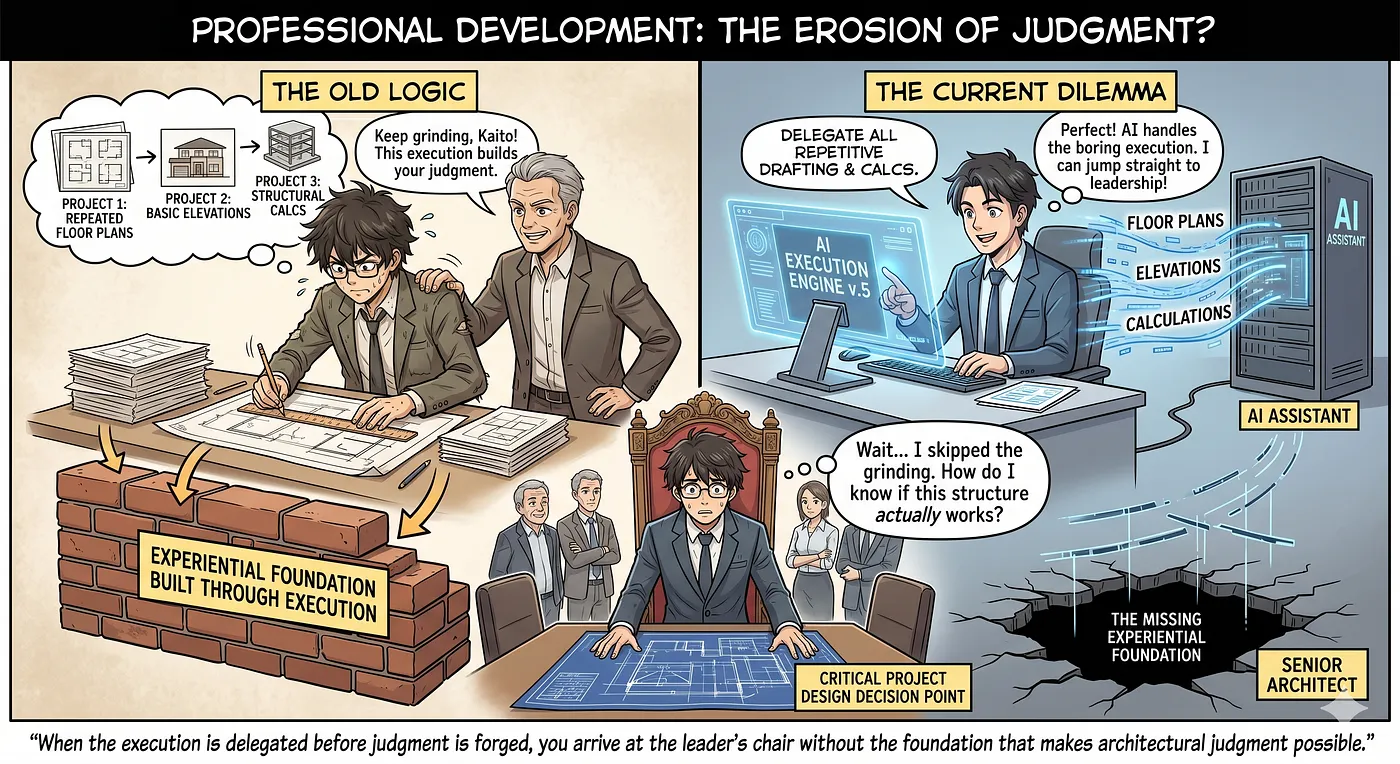
The Erosion of Judgement — Generated by Google Gemini
AI does not care about the proof. It can replicate the output of that procedural fluency almost instantaneously. This creates a complicated situation for professional development, because the old logic was that you developed judgment by grinding through execution. If the execution is delegated to a machine before you have ground through enough of it to build genuine judgment, you may arrive at the architect’s chair without the experiential foundation that makes architectural judgment possible. This is one of the deepest and least discussed risks of the inversion, and it is one that organizations need to take seriously when they design AI integration strategies that apply to people at the early stages of their careers.
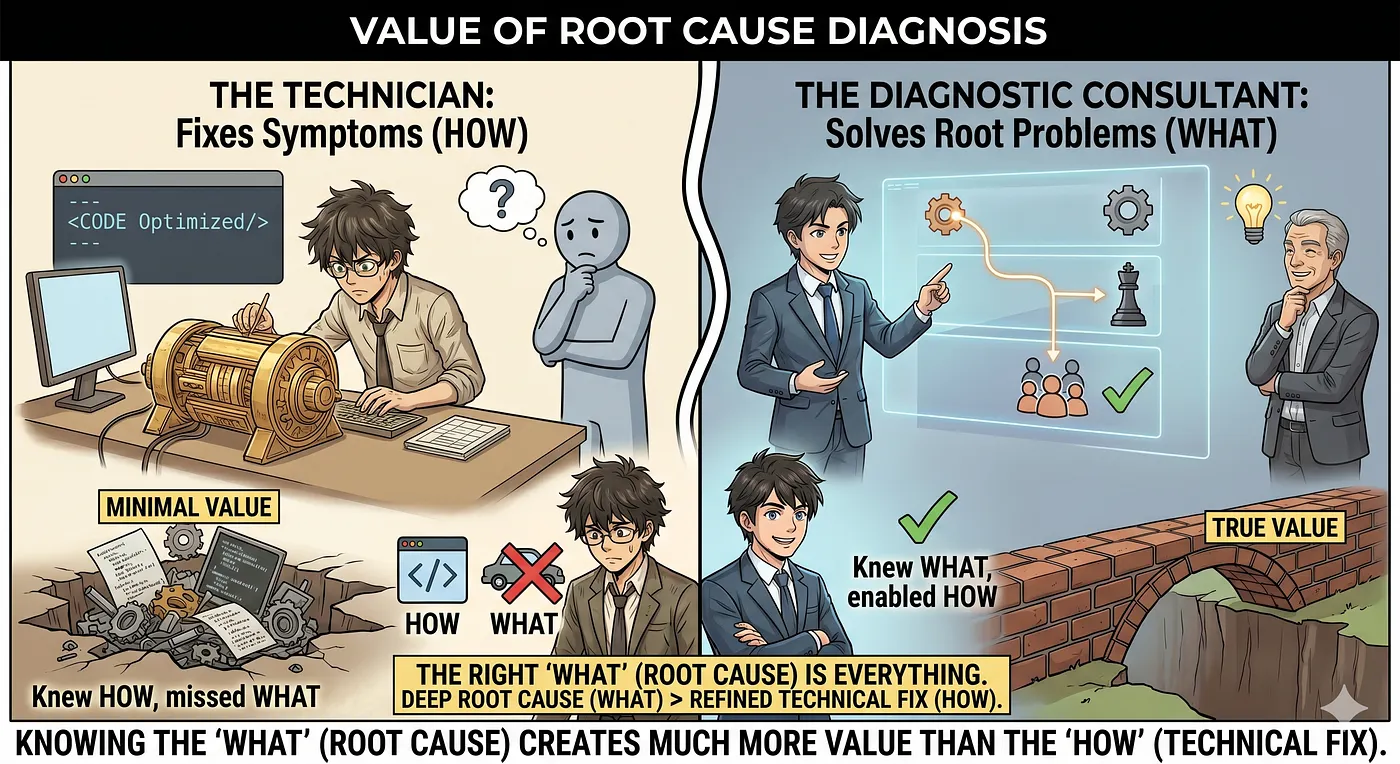
The second manifestation of the inversion is what the research literature calls the shift from depth-first to breadth-first mastery. In the old hierarchy, depth was the measure of expertise. The person who knew one domain more thoroughly than anyone else was the most valuable person in that domain. Deep specialization was the career path, and it was reinforced by every professional incentive structure. The inversion does not eliminate the need for deep knowledge. But it changes what that knowledge must be applied to. The new measure of expertise is what might be called systems orchestration: the capacity to understand how different domains interact, to see where a business problem crosses disciplinary lines, and to select the right combination of tools and perspectives for the job. Knowing when a specific technical solution is the wrong answer to a business problem has become more valuable than knowing how to implement that solution. The consultant who can recognize that a client’s operational problem is actually a strategy problem, or that a strategy problem is actually a culture problem, creates more value than the one who can produce the most technically refined analysis of the presenting symptom.

The Perfect Solution, Solving the Wrong Problem — Generated by Gemini
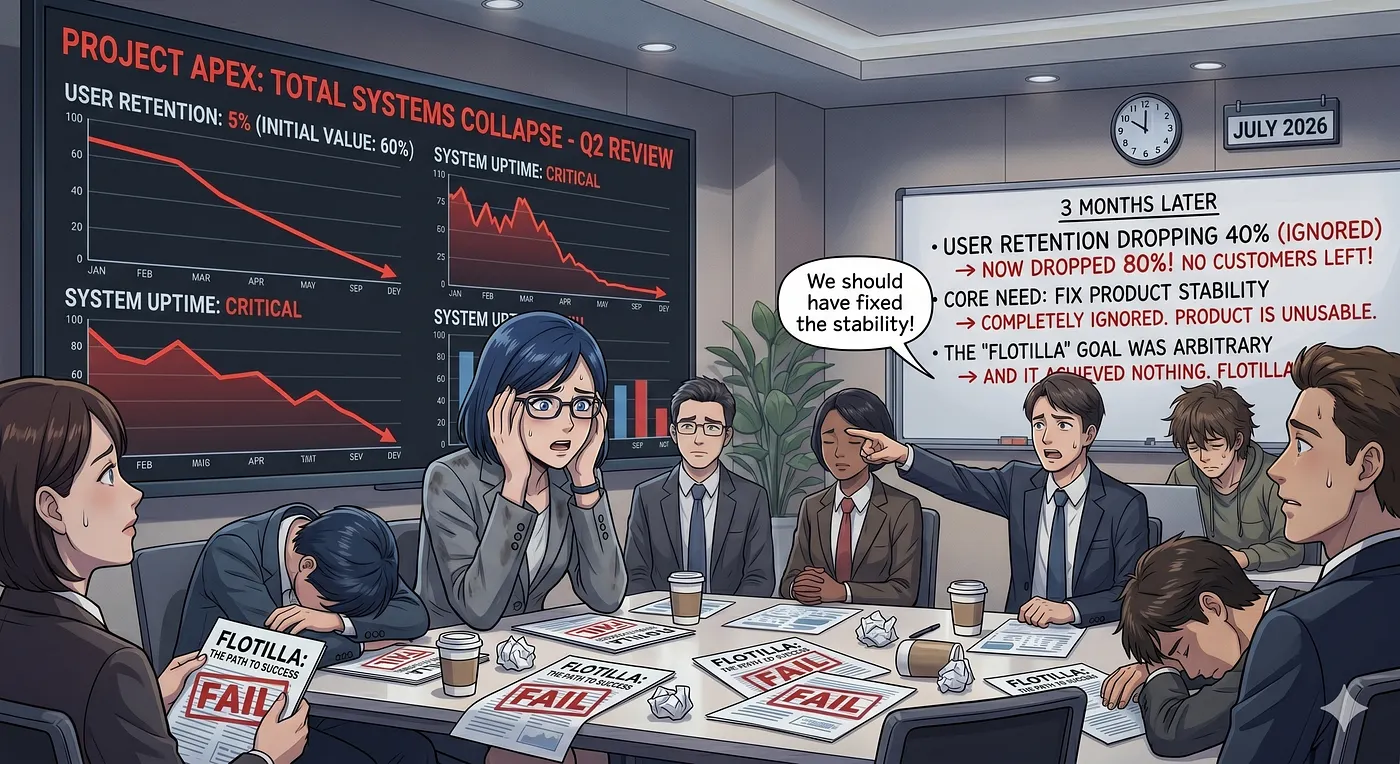
The third, and most consequential, manifestation is the reframing of failure. When execution was the primary constraint, most professional failures were execution failures. The code had a bug. The model had an error. The contract had a gap. The analysis missed a variable. These were correctable, often without catastrophic downstream consequences, because the failure was visible and specific. It could be traced, diagnosed, and fixed. Under the inversion, execution failures become rare, because the machine executes reliably. The new primary failure mode is goal misalignment: building the right thing to the wrong specification, or building the wrong thing entirely, because the human who framed the objective misjudged it. This failure mode is more dangerous precisely because it is harder to detect and more expensive to correct. A flawlessly executed strategy that pursues the wrong goal does not fail in small, correctable ways. It fails at scale, often for months before anyone realizes that the beautifully produced output was never actually solving the right problem.
The Aftermath, Solving the Wrong Problem — Generated by Gemini
Judgment as the New Technical Debt
In software development, technical debt is the accumulated cost of shortcuts taken in the past. Every time a team chooses the quick implementation over the correct one, they create a liability that must eventually be paid down. Technical debt is invisible until it is not, and when it finally becomes visible, the cost of addressing it can be catastrophic.
The inversion creates an analogous concept in the domain of human cognition. When the machine executes flawlessly and the human’s primary contribution is the framing of objectives and the evaluation of outputs, then poor judgment accumulates the way poor code used to. Every instance of vague goal-setting, every uncritical acceptance of an AI-generated output, every failure to interrogate whether the system is solving the right problem, adds to a growing liability of misaligned work. Unlike bugs in code, this liability does not sit in a repository where it can eventually be audited. It sits in the decisions and assumptions of the organization itself, often invisible until the consequences arrive at scale.
Martin Reeves, Mihnea Moldoveanu, and Adam Job argued this point directly in a December 2024 piece in the Harvard Business Review, making the case for the irreplaceable value of human decision-making in the AI age. Their argument was that many crucial aspects of decision-making lie beyond the reach of data and algorithms, including the framing of problems, the selection and validation of data sources, the application of values, and the imagination of possibilities that do not yet exist in any dataset. Two organizations may have access to the same AI tools and the same analytical outputs, they noted, but the outcomes will diverge based entirely on the quality of human judgment brought to bear on those outputs. The spread of more powerful tools and larger datasets, they suggested, would make the human elements of decision-making more differentiating over time, not less.
Research published through Harvard Business School reinforced this perspective, finding through a study conducted in collaboration with academics at the University of California at Berkeley that AI tools alone cannot substitute for human judgment or experience, and that access to AI tools does not automatically produce better business outcomes if the underlying judgment of the person using them is weak. As Rembrand Koning, an associate professor at Harvard Business School, put it directly: for anybody using AI in their work, you need to think carefully about whether the person using the tool has enough judgment for the tasks required.
Research from the Harvard Business School AI Institute, published in January 2025, found that while aggregating multiple AI evaluations could produce results that aligned meaningfully with human expert judgment, individual AI evaluations were frequently unreliable in ways that required expert human oversight to detect. In strategic decision-making contexts specifically, the research noted that AI could augment and accelerate human strategic processes, but that the quality of the final judgment remained dependent on the quality of the human evaluating the AI’s output. The machine elevates the floor. It does not set the ceiling.
This is the uncomfortable truth that the efficiency narrative around AI tends to obscure. The technology is remarkable at what it does. But what it does is execute. What it cannot do, at least not reliably, is want the right things, ask the right questions, recognize when the answer it has produced does not actually fit the problem as it exists in the real world, or exercise the kind of ethical and contextual discernment that makes an organization trustworthy. Those remain irreducibly human capacities, and they are the capacities that the inversion is pushing to the center of professional value.
System Zero and the Symbiotic Architecture of Human-AI Collaboration
The Classical Cognitive Duality — Generated by Gemini
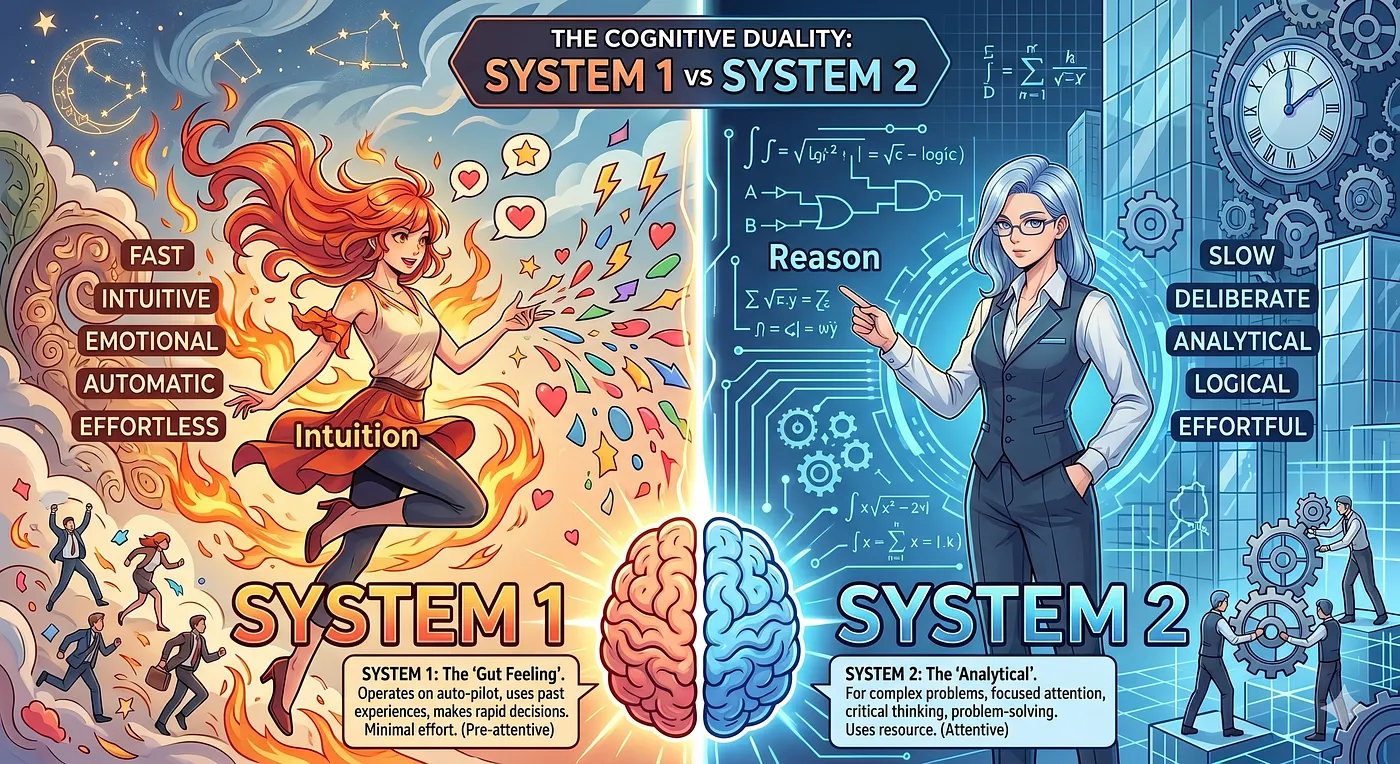
There is a useful way to think about the cognitive relationship between humans and AI that goes beyond the familiar framing of AI as a tool. In cognitive science, the division of thinking into fast, intuitive processes and slower, deliberative ones has been widely discussed through the framework of System 1 and System 2 thinking. System 1 operates automatically and quickly, producing pattern-matched responses without effort. System 2 operates slowly and deliberately, engaging analytical reasoning when situations require it.
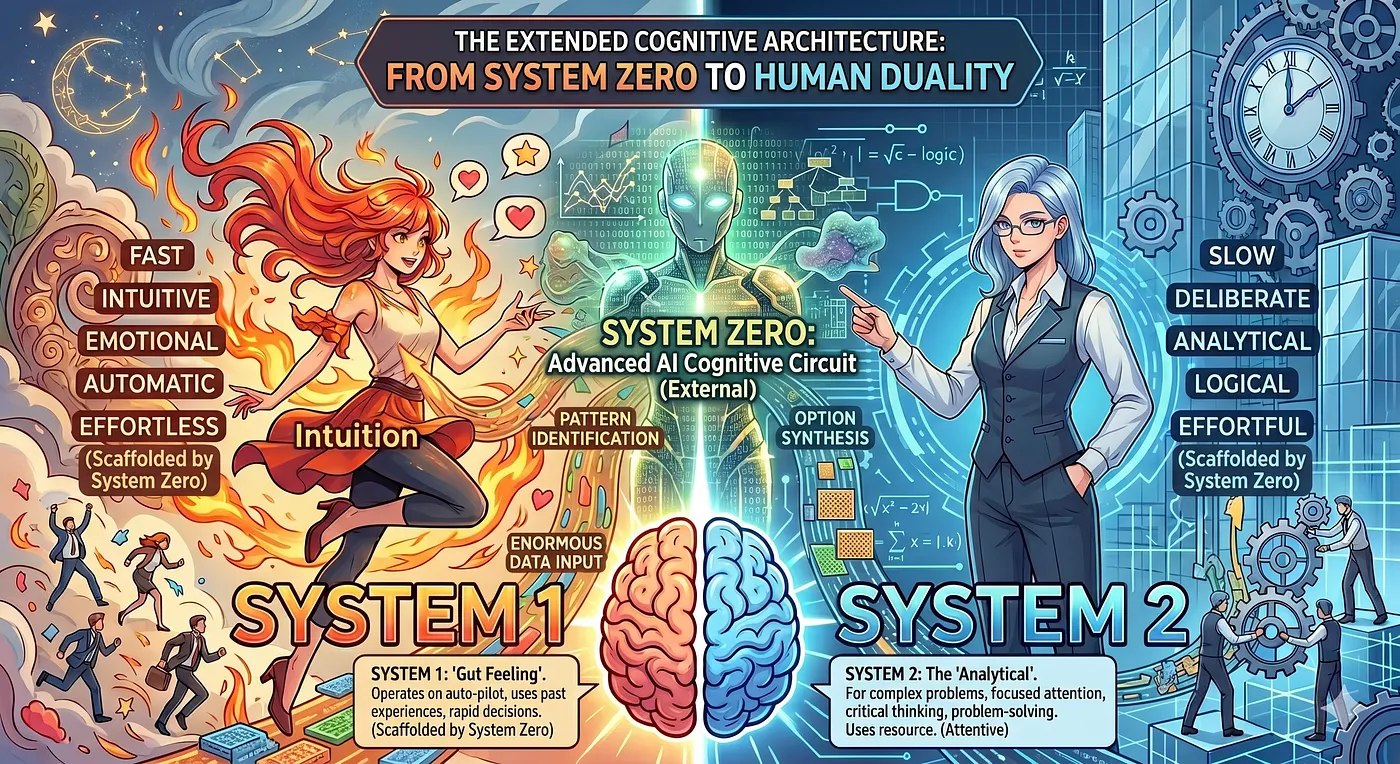
Advanced AI represents something new in this architecture. It functions as what might be called System Zero: an external cognitive circuit that processes enormous quantities of data, identifies patterns, generates options, and scaffolds decisions before conscious human deliberation is even engaged. The most sophisticated organizations are beginning to operate within a genuine human-AI symbiosis, where System Zero handles the computationally expensive work of data processing and pattern recognition, while human cognition handles the things that System Zero cannot: the contextualization of data within specific organizational realities, the assignment of meaning to patterns, the application of ethical judgment, and the kind of imaginative reasoning required when you need to see a possibility that does not yet appear in any dataset.
The Extended Cognitive Architecture — System 0 — Generated by Gemini
This symbiotic architecture is not a distant aspiration. It is already present in organizations that have moved beyond simply deploying AI as a productivity tool and begun redesigning their workflows around the distinct capabilities of each type of intelligence. In these organizations, AI drafts and proposes and analyzes, while humans judge, contextualize, and decide. AI tracks and monitors, while humans coach, influence, and lead. McKinsey’s 2025 research describes this as the future workforce triad: people, AI agents, and robots working together, with human value concentrated in the irreducibly human nodes of that triad.
The research is increasingly specific about what the human nodes in that triad must supply. A study by Czaszar, Ketkar, and Kim published in Strategy Science in November 2024, titled Artificial Intelligence and Strategic Decision-Making: Evidence from Entrepreneurs and Investors, analyzed the cognitive processes involved in AI-assisted strategy development, including search, representation, aggregation, generation, and evaluation. The researchers concluded that as AI continues to advance, the augmentation of human strategists by AI holds genuine promise for boosting the quality, efficiency, and availability of strategic decision-making. The key word is augmentation. The architecture only works when the human brings genuine strategic capacity to the partnership. AI in the absence of human strategic judgment is a very fast machine going in the wrong direction.
The question is not whether this architecture is coming. The question is whether the humans within it will understand their role clearly enough to perform it well.
The Cognitive Atrophy Crisis
Here is where the picture becomes genuinely alarming, and where the optimistic narrative about human-AI collaboration must be interrupted by a harder conversation.
The same technology that is making certain human capabilities more valuable is also actively threatening those capabilities in many of the people who need to develop them. The risk is not merely philosophical. It is physiological, behavioral, and organizational, and it is supported by a growing body of research that should worry anyone who leads an organization, manages a team, or is developing professionally in an AI-saturated environment.
Researchers at MIT’s Media Lab conducted a study in which participants were divided into groups and asked to write essays using ChatGPT, Google search, or no external aid at all. Using EEG equipment to measure brain activity across thirty-two regions, the researchers found that participants who used ChatGPT showed the lowest levels of brain engagement and, critically, the lowest activation in the prefrontal cortex, the region most heavily associated with decision-making and critical thinking. Over the course of the study, the ChatGPT users grew progressively less cognitively active, with many resorting to copy-and-paste behavior by the end. The lead researchers noted that their parallel work on AI use in software engineering was producing results that were, in their words, even worse, with implications for the many organizations that have begun to replace entry-level coding roles with AI-generated output.
A separate study surveying three hundred and nineteen knowledge workers, published and widely reviewed in 2025, found that while generative AI improved efficiency for many tasks, it simultaneously inhibited critical engagement with work and created risks of long-term overreliance and diminished capacity for independent problem-solving. The research found a particularly concerning pattern: when workers had higher confidence in AI responses, their perceived effort required for critical thinking tasks declined correspondingly. The more you trust the machine, the less you exercise the judgment you will need when the machine is wrong or when the stakes require something the machine cannot provide. A further finding deserves particular attention: the AI users in the study produced a less diverse set of outcomes for the same task compared to people relying on their own cognitive abilities, suggesting that heavy AI delegation does not merely reduce critical thinking but may also narrow the creative range of organizations and teams over time.
This phenomenon has a name in the research literature. It is called automation bias, defined as the tendency to over-rely on automated systems and to reduce independent judgment in their presence. A comprehensive review published in 2025, examining multiple empirical studies of automation bias in human-AI collaboration, found that the bias was not confined to naive users. It appeared across professional categories. Research from a clinical context, published in the journal Studies in Health Technology and Informatics in 2024, found that non-specialists in particular were both the most likely to benefit from AI decision support systems and the most vulnerable to automation bias-driven errors, a combination that creates a dangerous dependency on systems whose limitations they may not have the expertise to recognize.
Research published in 2024 in an analysis drawing on multiple prior studies noted that over-reliance on AI solutions reduces the intuitive judgment that experienced professionals develop through sustained engagement with their domain, and that the pattern of cognitive atrophy in heavy AI users was being documented consistently across professional settings. Heavy AI users were found to experience instant gratification through automated feedback in ways that limited their tendency to explore varied perspectives and to engage in the effortful thinking that builds genuine understanding over time.
What makes this doubly dangerous is what researchers call the cognitive miser hypothesis, the well-established tendency of human beings to choose the path of least cognitive effort when alternatives are available. When AI provides a highly plausible, pre-written answer, it eliminates the cognitive work of evaluating alternatives, spotting anomalies, and constructing independent analysis. The result is not just that you have done less thinking in that moment. The result, accumulated over time, is that your capacity to do that thinking, the very capacity that the inversion makes most valuable, may be diminishing precisely as its value is increasing.
A systematic review published through Springer Nature’s Smart Learning Environments in 2024, examining the effects of over-reliance on AI dialogue systems, found that critical cognitive skills, including critical thinking, decision-making, and analytical thinking, were all vulnerable to impairment through excessive AI reliance. These were not fringe findings. They were consistent with a broader pattern of research suggesting that the efficiency gains of AI delegation come with hidden cognitive costs that do not appear in productivity metrics until they already represent significant damage.
A 2025 research paper introducing what the authors called the cognitive sustainability index went further, proposing a unified framework for understanding the dual dynamic of cognitive growth and cognitive atrophy created by human-AI interaction. The authors described the relationship between AI delegation and cognitive development as nonlinear: reflective engagement with AI enhances metacognitive skills, while over-delegation to automation reduces analytical autonomy. The balance between the two determines whether AI integration produces a more capable professional or a more dependent one.
The paradox this creates for the professional workforce is brutal. The inversion is making judgment and strategic thinking more valuable. Automation bias and cognitive atrophy are making those capacities harder to develop and maintain. The technology that elevates the prize is simultaneously threatening the capacity of the people competing for it.
The Organizational Response: Designing for Friction, Not Flow
If automation bias is the disease, passive AI integration is the vector. Organizations that deploy AI tools primarily as efficiency accelerators, measuring success by how much human time is eliminated and how much output is generated, are inadvertently designing environments that will degrade the most valuable human capacities over time. They are optimizing for the short-term productivity gains of execution while systematically undermining the long-term organizational capacity for judgment.
The corrective is not to use less AI. The corrective is to design AI workflows that preserve and strengthen the human cognitive capacities that make AI valuable in the first place. This requires a deliberate architectural shift in how AI is integrated into organizational practice, one that research on automation bias has begun to describe in practical terms.
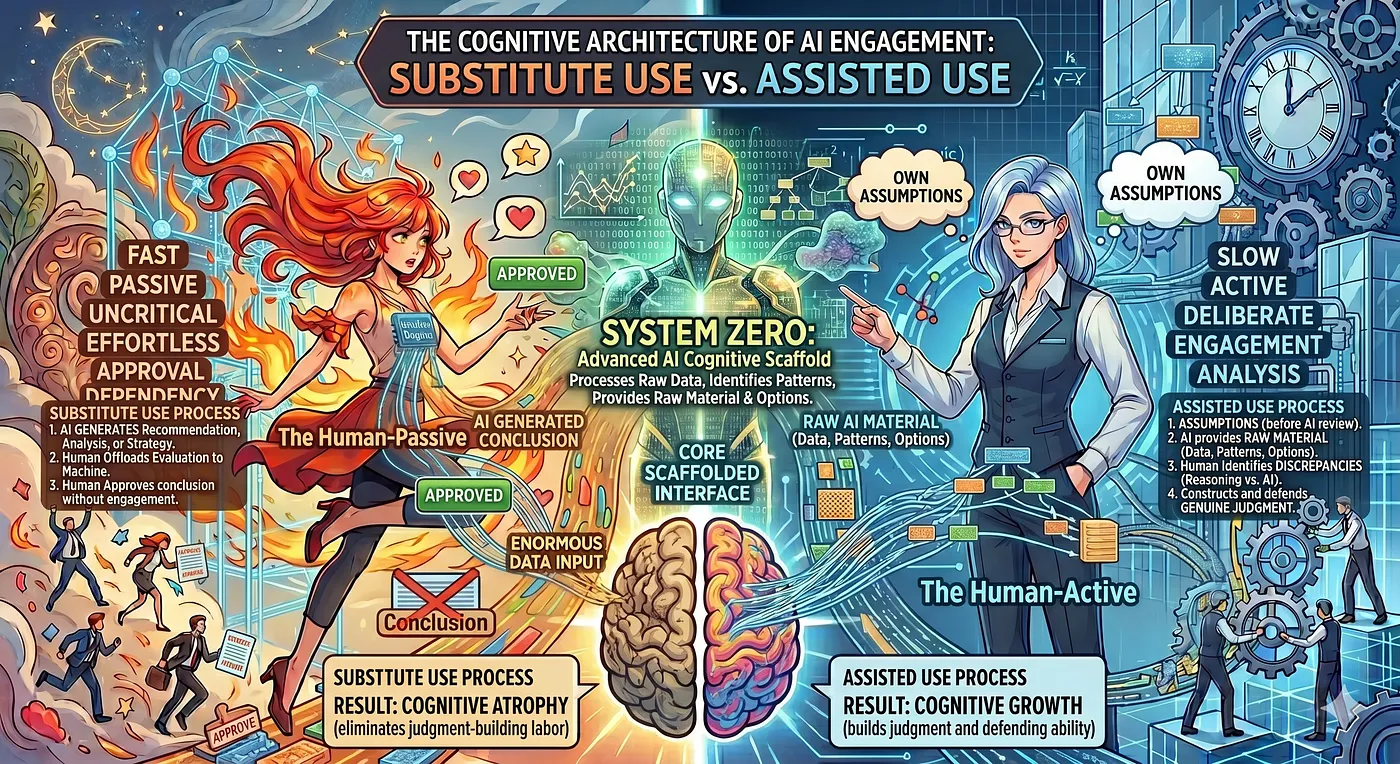
Substitute Use Vs. Assisted Use of AI — Generated by Gemini
The key distinction is between what researchers call substitute use and assisted use of AI. In substitute use, the human accepts the AI’s output as the conclusion, offloading the cognitive work of evaluation entirely to the machine. The AI generates the recommendation, the analysis, or the strategy, and the human approves it. This is the workflow that produces cognitive atrophy, because it eliminates the cognitive labor that builds judgment. In assisted use, the AI provides raw material, and the human is required to engage with that material actively, articulating their own assumptions before reviewing the AI’s output, identifying discrepancies between their reasoning and the machine’s, and constructing a final judgment that they can genuinely defend. The AI is a scaffold, not a replacement for thought.
Research on automation bias suggests that even relatively simple interventions can make a measurable difference. A study published in ScienceDirect in late 2025 found that interface design nudges, prompts that encouraged users to pause and reflect critically before accepting AI outputs, significantly reduced overreliance on incorrect AI recommendations compared to interfaces that offered no such friction. The implication is that how AI tools are deployed within an organization matters enormously, not just which tools are chosen. The design of the human-AI interface is, in effect, a design choice about what kind of cognitive habits the organization will cultivate in its people.
For early-career professionals, this has particular significance. The traditional career path built judgment through the accumulation of procedural experience. The analyst who spent three years building models did not just learn to build models. They internalized the logic of valuation, developed pattern recognition about which assumptions were most consequential, built the instinct to sense when a number did not look right before they had fully worked out why. That intuition, developed through thousands of hours of hands-on work, was the foundation of the senior judgment that came later. If AI eliminates the procedural work too early in a career, organizations may find that they have senior roles that require architectural judgment populated by people who never had the opportunity to develop the experiential foundation for it. This is the hidden talent development risk of AI acceleration, and it is one that will not show up in any current productivity metric.
The response is not to withhold AI from junior professionals. It is to design their work so that AI assists rather than substitutes, requiring them to engage actively with the output, to articulate their own reasoning before reviewing the machine’s, and to develop the habit of critical evaluation that will eventually become the basis of genuine architectural judgment. The goal is to use AI as a training partner, not a replacement for the training itself.
Organizations that get this right will design their workflows to force that engagement. They will require professionals to articulate their analysis of a problem before reviewing AI-generated outputs. They will structure review processes around the quality of human reasoning rather than the speed of throughput. They will build cultures that treat critical questioning of AI outputs as a professional virtue rather than a source of friction to be minimized.
Across Industries: The Inversion Is Everywhere
It would be a mistake to read the Architect’s Inversion as a technology industry story. It is not. It is an economy-wide restructuring that is playing out differently in different sectors but following the same fundamental logic across all of them.
In law, where the Goldman Sachs analysis found forty-four percent of tasks automatable, the profession is undergoing a redistribution of value away from the drafting and research functions that have historically occupied junior associates toward the judgment-intensive work of strategy, client counsel, and the interpretation of legal questions in contexts that have not yet been resolved by precedent. As one legal industry analyst noted when discussing the MIT cognitive research, when young lawyers rely on AI to generate arguments or summarize case law without first developing their own reasoning, they risk bypassing the deep, foundational learning that comes from doing the work manually, which can dull the human judgment and strategic thinking that defines an excellent senior practitioner. The technical legal knowledge that a first-year associate spent years acquiring is now substantially replicable by AI. What remains irreplaceable is the capacity to understand what a client actually needs, often in ways the client cannot fully articulate, and to apply legal expertise toward that need in ways that require contextual and relational intelligence.
In finance, the modeling and analysis functions that defined the early careers of generations of analysts are being automated at pace. What is not being automated is the judgment to know which models apply to which situations, the ability to read the qualitative signals that do not appear in any spreadsheet, and the relational capacity to communicate complex risk assessments to clients in ways that build trust and enable decision-making. The financial professional of the post-inversion era is less calculator and more interpreter, less technician and more counselor.
In medicine, research on automation bias in clinical settings has established clearly that AI diagnostic decision support systems improve performance on average while simultaneously creating new risks of automation bias-driven errors, particularly among non-specialists who may lack the clinical depth to recognize when an AI recommendation is wrong. Research published in the journal Studies in Health Technology and Informatics in 2024 found that professional experience and self-efficacy were associated with lower dependence on AI, while those with less experience were more susceptible to accepting incorrect AI recommendations. The inversion in medicine is elevating the capacity for clinical judgment, patient-centered reasoning, and the kind of integrative thinking that connects data to the specific human being sitting across from a clinician, while delegating the pattern-recognition work that historically consumed enormous physician time and cognitive bandwidth.
In marketing and communications, the drafting and production functions that once defined the work of a copywriter, content strategist, or creative director are being automated rapidly. What is rising in value is the capacity to understand audiences in the kind of nuanced, culturally grounded, empathy-driven way that enables genuinely resonant communication, to evaluate AI-generated content against that understanding, and to direct iterative refinement toward something that actually connects with a specific human being in a specific context. The brand strategist who can define what a voice should feel like, and why, and for whom, and then evaluate whether any given execution achieves it, is doing work that AI cannot do alone.
In management itself, a Harvard Business Review analysis identified five critical skills that leaders need in the AI age: cultivating AI fluency through diverse networks and cross-industry conversations, redesigning organizational structures to unlock AI’s value, orchestrating collaborative decision-making between people and machines, applying the moral judgment that algorithms cannot supply, and using imagination and intuition to perceive possibilities that data alone cannot reveal. The common thread across all five is that they require the leader to operate at a level of abstraction above execution, understanding what the machine can and cannot do, designing systems in which human and artificial intelligence complement each other, and maintaining the ethical and strategic compass that gives direction to the whole enterprise.
The New Hierarchy of Human Value
All of this points toward a clear and specific set of human capacities that are being elevated by the inversion, and that both McKinsey and the World Economic Forum have identified as the defining skills of the coming decade.
Analytical thinking tops the list in the World Economic Forum’s Future of Jobs Report 2025, where it has held the top position for three consecutive reports. Seven out of ten companies surveyed identified it as essential, and the report projected that its importance would continue to grow through 2030. What the report means by analytical thinking is not the ability to run an analysis, which AI can do, but the ability to break down complex, ambiguous problems, interrogate assumptions, evaluate evidence critically, and arrive at defensible conclusions in the face of uncertainty. This is the capacity to frame the problem correctly before delegating its solution.
Leadership and social influence rank closely behind, along with resilience and adaptability. These are capacities that cannot be automated because they are fundamentally relational. The ability to align a team around a shared objective, to navigate the political and emotional dynamics of an organization, to maintain directional clarity under conditions of uncertainty, to inspire people to work toward goals they cannot yet see fully, these are irreducibly human activities. They require the kind of contextual intelligence and interpersonal sensitivity that no model trained on historical data can fully replicate.
Creative thinking, specifically the capacity to generate genuinely novel possibilities rather than interpolate within existing patterns, is the third major cluster. AI is extraordinarily good at recombination. It can take elements from everything it has seen and produce outputs that seem original. But it cannot imagine what it has never encountered, and it cannot perceive what is missing from the world in the way that a human being, embedded in a specific context with specific needs and frustrations, can. The research surveying knowledge workers found that AI tool usage produced a less diverse set of outcomes for the same task compared to people relying on their own cognitive abilities, suggesting that heavy AI delegation may also constrain the creative range of organizations over time.
McKinsey’s 2025 report identified eight transferable skills that consistently appear in the roles facing the least automation pressure and generating the most value in the new economy: communication, management, operations, problem-solving, leadership, detail orientation, customer relations, and writing. What these skills share is that they are all, at their core, about human judgment applied in relational and contextual settings. They are the skills of the architect, not the craftsperson. They are the skills that cannot be bottled, trained into a model, or produced on demand at scale without the messy, effortful, time-consuming process of human development.
The World Economic Forum’s report also identified systems thinking as an increasingly critical capacity: the ability to understand how components of a complex system interact, to model second and third-order consequences of decisions, and to perceive emergent properties that cannot be predicted from examining parts in isolation. This is the capacity that makes architectural judgment possible, the ability to see not just whether a solution works in isolation, but whether it serves the larger system well, creates unintended dependencies, or solves the visible problem while creating a less visible one downstream.
The Education Gap No One Is Talking About
If organizations face an urgent imperative to redesign work around the capacities the inversion demands, educational institutions face an even more fundamental challenge: their entire model was built for the old hierarchy. Universities, professional schools, and graduate programs were designed to produce excellent executors. They were built on the premise that technical fluency, the kind that comes from structured repetition and supervised practice, was the primary output that made their graduates valuable. The problem sets, the case competitions, the legal briefs, the financial models, the laboratory protocols, the code reviews: all of it was scaffolded around the development of execution skills, with the expectation that judgment and strategic capacity would emerge organically over time, as graduates accumulated enough professional experience to see patterns at a higher level.
That model depended on the existence of a career ladder that ran from execution to strategy, a ladder on which you spent years at the lower rungs before ascending to the higher ones. The inversion is removing those lower rungs. AI is automating the work that used to occupy junior professionals, which means the period of hands-on, procedural engagement that traditionally served as the foundation for strategic judgment development is either compressing dramatically or disappearing from many career paths. The education system has not caught up with this reality.
The World Economic Forum’s Future of Jobs Report 2025 found that nearly forty percent of current skills would change by 2030, and that the skills gap was already the most significant barrier to business transformation, cited by sixty-three percent of employers surveyed. That gap is partly a training and upskilling gap in the existing workforce. But it is also, increasingly, a gap between what educational institutions are producing and what organizations actually need. You cannot close that gap by teaching people to use AI tools more fluently. You close it by redesigning how the development of judgment, analytical rigor, ethical reasoning, and strategic thinking is structured into educational experiences.
This means that the most valuable curriculum innovations of the next decade will not be courses on how to use specific AI platforms. They will be structural redesigns of how students are taught to think: how they learn to sit with ambiguity, how they develop the habit of questioning their own assumptions before reaching for external validation, how they practice the articulation of intent and the evaluation of whether a given output actually serves that intent. These are not new skills. They are old skills that education used to develop indirectly, through the effort of execution, and that now need to be developed directly, because the indirect route is being bypassed.
The Long Shadow of Drucker
It is worth pausing to appreciate the arc of this story, because it is, in one sense, a completion of what Peter Drucker began describing in 1959.
Drucker argued that knowledge would become the twenty-first century’s dominant form of capital, just as labor and machinery had dominated previous eras. He was right. But he was describing the first phase of a transition. In the first phase, which has been unfolding for the past sixty years, knowledge workers rose to prominence by mastering the application of knowledge to specific, technically demanding tasks. The knowledge was what mattered, and the people who could accumulate and apply it most skillfully were the most valuable.
The Architect’s Inversion represents the second phase, one that Drucker glimpsed but could not fully anticipate. In the second phase, the application of knowledge to specific tasks becomes automated. What cannot be automated is the meta-knowledge: knowing which tasks to pursue, why they matter, what a good outcome looks like, and how to evaluate whether you are getting there. The value of the knowledge worker does not disappear. It concentrates at the layer of judgment about knowledge, rather than the application of it.
Drucker’s distinction between the manual worker who produces goods or services with their hands and the knowledge worker who produces ideas and information with their head now requires a further refinement. Among knowledge workers, there is an emerging divide between those whose work is primarily executory, applying known methods to defined problems, and those whose work is primarily architectural, defining which problems to solve, specifying what a solution must accomplish, and evaluating whether an executed solution actually serves the intended purpose. The first category is what AI is automating. The second category is what AI is making more valuable. The tragedy of the present moment is that many organizations, career paths, and educational systems are still built around the first category and have not yet fully reckoned with the second.
Toward a New Professional Identity
The professionals who will thrive in the post-inversion economy are not those who resist the technology or attempt to compete with it on its own terms. They are also not those who surrender to it uncritically, allowing its outputs to substitute for their own judgment and eroding the cognitive capacities that give them their irreplaceable value. They are the ones who have genuinely internalized what the inversion demands of them.
This means developing what might be called strategic intuition, not in the mystical sense, but in the practical sense of having accumulated enough domain knowledge and pattern recognition that you can quickly assess the quality of AI-generated outputs, identify the gaps and misalignments that a less experienced reviewer would miss, and translate your judgment into actionable direction. Strategic intuition is the product of genuine expertise, but it is expertise at a different level than procedural mastery. It is expertise in knowing what good looks like, which is something that can only be developed through sustained, effortful engagement with the domain.
It means cultivating the habit of assisted use: engaging with AI outputs actively rather than passively, articulating your own analysis before reviewing the machine’s, and treating discrepancies between the two as productive cognitive friction rather than inconvenience. The discomfort of not immediately accepting a compelling AI recommendation is not a problem to be engineered away. It is a feature of a healthy cognitive practice, the mental equivalent of resistance training. The professional who never experiences that discomfort is building neither muscle nor judgment.
It means embracing a breadth of knowledge that may feel uncomfortable to specialists who built their careers on depth. Understanding how your domain connects to adjacent ones, knowing enough about strategy to evaluate whether a technically correct solution actually serves an organizational purpose, having enough financial literacy to assess whether a recommendation is viable, enough ethical sensitivity to recognize when an efficient solution creates risks that do not appear in any efficiency metric: these are the qualities that architects need and that the inversion is placing at a premium.
And it means accepting accountability for judgment in a way that the execution economy did not require. When execution was the primary contribution, failure was visible and attributable. The code crashed. The model was wrong. The contract had a gap. In the architect economy, the failures are subtler and the accountability is different. When the machine executes flawlessly toward the wrong objective, the person who specified the objective must own that failure. This is a more demanding form of accountability, because it cannot hide behind the complexity of execution. The judgment was yours. The consequences are yours.
The Organizational Imperative
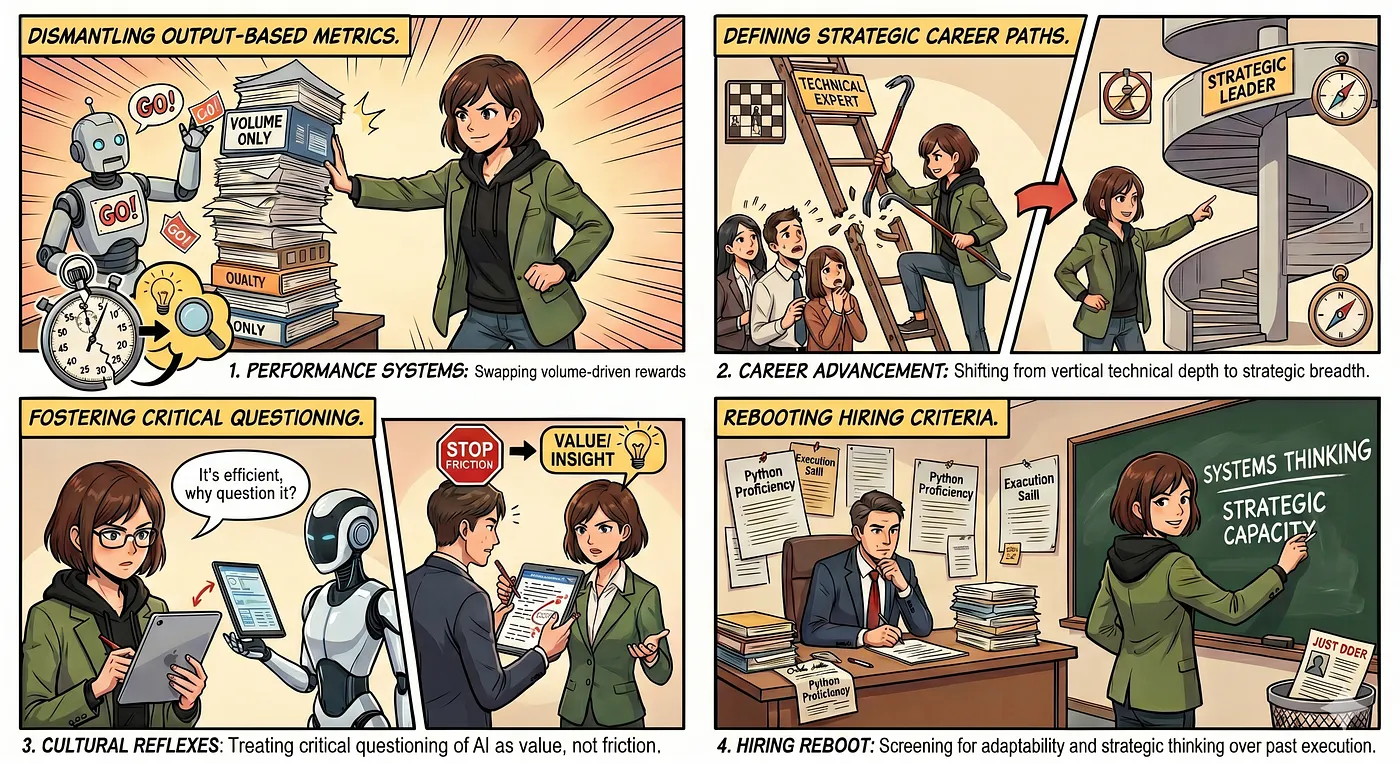
Dismantling Old Success Structures in the Age of AI — Generated by Gemini
For organizations, the Architect’s Inversion creates an imperative that is both urgent and uncomfortable. Uncomfortable because it requires dismantling some of the very structures that have produced success: the performance systems that reward output volume over judgment quality, the career paths that define advancement through technical depth rather than strategic breadth, the cultural reflexes that treat critical questioning of AI-generated work as friction rather than value, and the hiring criteria that have historically screened for demonstrated execution skill rather than capacity for strategic thinking.
The World Economic Forum found that seventy-seven percent of employers were planning to upskill their workforces in response to AI-driven change. But the nature of that upskilling matters enormously. Teaching people to use AI tools more efficiently is not the same as developing the judgment, analytical rigor, and strategic capacity that the inversion is making valuable. The former is a tactical response. The latter is an organizational transformation that requires rethinking not just what people learn, but how work itself is structured to develop the human capacities that matter most.
Performance management systems will need to evolve to measure the quality of human judgment, not just the volume of human output. This is difficult because judgment quality is harder to quantify than task completion rates, and because the consequences of poor judgment often appear months after the judgment was made. But the organizations that develop credible ways of assessing and rewarding the quality of thinking, the precision of problem framing, the rigor of output evaluation, and the courage to redirect AI-generated work that does not serve the intended purpose will have a genuine competitive advantage over those that continue to measure only what is easy to count.
Career development frameworks will need to create pathways for building judgment that do not rely entirely on the accumulation of procedural experience. This is perhaps the most genuinely novel challenge of the inversion, because the entire traditional logic of professional development assumed that judgment grew out of execution. Organizations will need to find new ways to build the experiential foundations of strategic thinking, ways that use AI as a training partner rather than a substitute for training, that create the cognitive challenges and pattern-recognition opportunities that execution used to provide, and that give early-career professionals the exposure to complexity and consequence that is the raw material of good judgment.
Conclusion: The New Proof of Expertise
There has always been a test for expertise. In the execution economy, the test was demonstrable mastery of a technical domain. You could write the code. You could build the model. You could draft the contract. The proof was in the artifact.
In the architect economy, the test is different. The proof of expertise is no longer the artifact. The machine produces the artifact. The proof of expertise is the quality of the judgment that directs, evaluates, and improves the artifacts the machine produces. It is the ability to define the right objective, to interrogate whether the output serves it, to identify what is missing or misaligned, and to specify clearly what must change. It is the ability to ask the right question, which has always been harder than answering any question correctly.
This is a more demanding standard, not because it requires more knowledge in a narrow sense, but because it requires a more integrated kind of understanding: breadth combined with depth, technical fluency combined with strategic vision, domain expertise combined with the ability to recognize when domain expertise is the wrong lens for the problem at hand. It requires the kind of professional identity that is grounded not in what you can produce but in what you can perceive, evaluate, and direct. It requires, in short, the identity of an architect rather than a craftsperson.
Peter Drucker saw knowledge as the defining capital of the twenty-first century. He was right, but the knowledge that is now most valuable is not the knowledge of how to perform a specific technical operation. It is the knowledge of what is worth doing, and why, and for whom, and at what cost. It is the knowledge that lives not in procedures but in principles, not in execution but in understanding, not in the hands but in the deepest reaches of professional judgment.
The World Economic Forum’s data points clearly to the direction of travel. McKinsey’s research confirms the scale and speed of the shift. The cognitive science research adds the urgent warning that the shift can only be navigated successfully by people who have deliberately maintained and developed their capacity for independent thinking, critical evaluation, and strategic reasoning in a world that increasingly makes it easy to outsource those things to a machine.
The inversion is not coming. It is here. The organizations and professionals who recognize it clearly, and who design their work and their development accordingly, will be the ones who look back on this period and understand it for what it was: not a threat to human value, but a redefinition of what human value means at its highest and most irreplaceable expression.
The time of the architect has arrived. The question is who will rise to meet that role.
Sources and Further Reading
Goldman Sachs Economics Research. The Potentially Large Effects of Artificial Intelligence on Economic Growth. March 2023.
McKinsey Global Institute. Generative AI and the Future of Work in America. July 2023.
McKinsey Global Institute. Agents, Robots, and Us: Skill Partnerships in the Age of AI. November 2025.
World Economic Forum. The Future of Jobs Report 2025. January 2025.
Martin Reeves, Mihnea Moldoveanu, and Adam Job. The Irreplaceable Value of Human Decision-Making in the Age of AI. Harvard Business Review. December 2024.
Harvard Business School Institute for Business in Global Society. AI Won’t Make the Call: Why Human Judgment Still Drives Innovation. September 2025.
Harvard Business School AI Institute. The Promise and Pitfalls of AI in Strategic Decision-Making. January 2025.
Czaszar, Ketkar, and Kim. Artificial Intelligence and Strategic Decision-Making: Evidence from Entrepreneurs and Investors. Strategy Science. November 2024.
Kücking, Florian, et al. Automation Bias in AI-Decision Support: Results from an Empirical Study. Studies in Health Technology and Informatics. August 2024.
Springer Nature Smart Learning Environments. The Effects of Over-Reliance on AI Dialogue Systems on Students’ Cognitive Abilities: A Systematic Review. June 2024.
Mitigating Automation Bias in Generative AI Through Nudges: A Cognitive Reflection Test Study. ScienceDirect. November 2025.
ResearchGate. Cognitive Atrophy Paradox of AI-Human Interaction: From Cognitive Growth and Atrophy to Balance. November 2025.
MIT Media Lab. Study on Brain Engagement and AI-Assisted Writing. Published and reviewed June 2025.
Peter Drucker. Landmarks of Tomorrow. 1959.
Peter Drucker. The Effective Executive. 1966.
Peter Drucker. The Age of Discontinuity. 1969.