How Relinquishing Macro-Control Evicts Parasitic Thought and Restores Human Agency
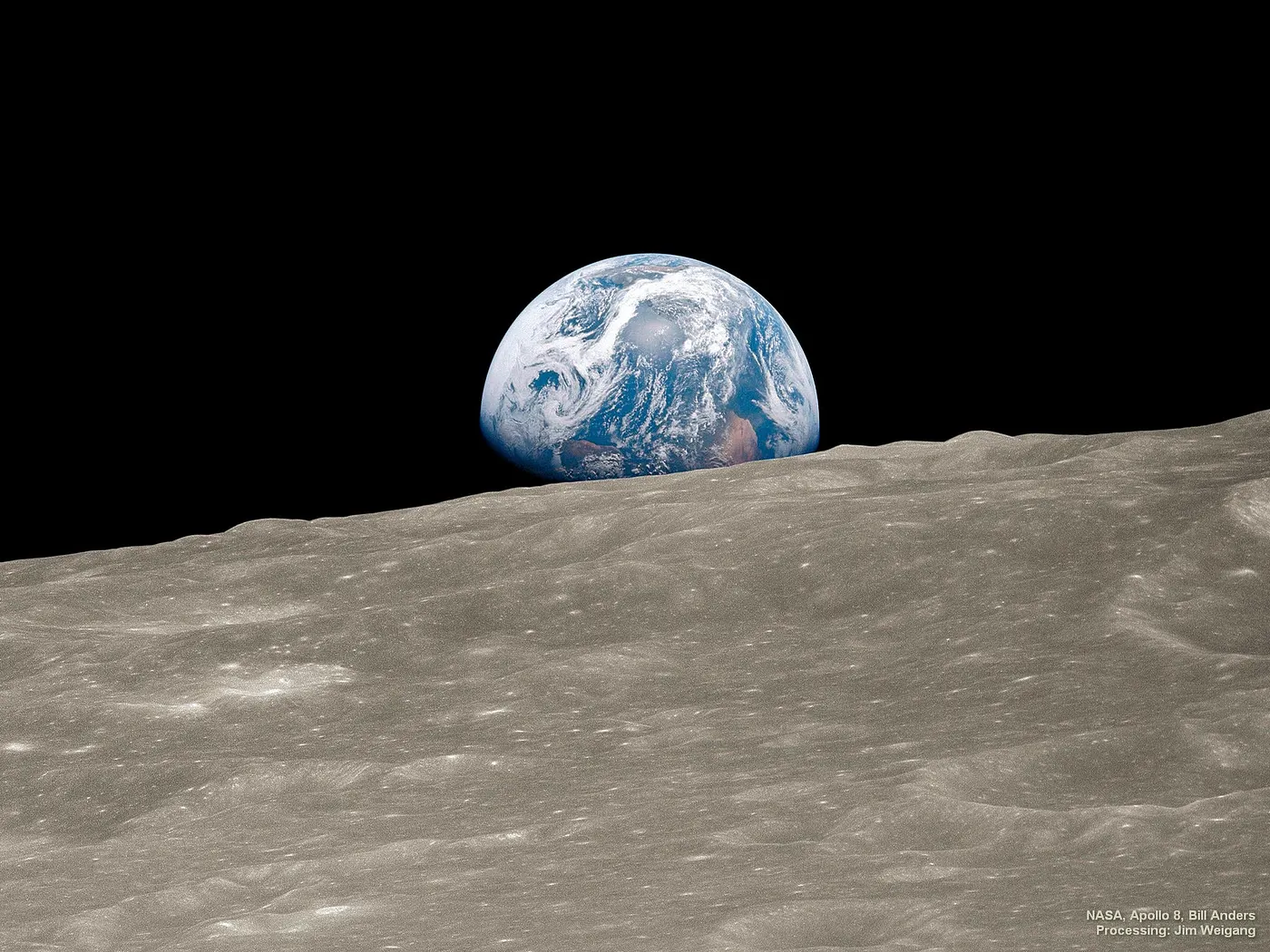
Earthrise — Photo by NASA
Oct. 31, 2026 — Madkat Omega
When Dread Masquerades as Duty
In August 1858, inside a stone cable house on Valentia Island off the western coast of Ireland, Chief Electrician Wildman Whitehouse stood over a bank of five-foot induction coils and cranked the electrical potential toward two thousand volts. Whitehouse was trying to push Morse code messages across two thousand nautical miles of copper wire resting on the floor of the North Atlantic between Ireland and Newfoundland. That underwater line was a marvel of delicate craftsmanship: a thin copper core wrapped in layers of natural rubber sap called gutta-percha. Physicists led by William Thomson had engineered the cable to carry gentle whispers of low-voltage current, which they read at the other end using tiny magnets suspended on silk threads. Whitehouse distrusted that quiet sensitivity. Assuming that a grand ocean required brute force, he slammed massive jolts of high-voltage electricity into the wire. Within three weeks, those violent surges burned holes straight through the rubber insulation on the seabed, grounded the copper core into the Atlantic saltwater, and killed the first telecommunications link between two continents.
Our own nervous systems are enduring the exact same kind of insulation failure every single day. In human terms, the copper wire is our attention, and the high-voltage surge is a mental habit that psychologists have begun calling a parasitic thought. A parasitic thought is a runaway loop of worry that latches onto a terrifying future possibility over which you have zero physical control. If you have ever left an old web browser tab open on a laptop and heard the cooling fans suddenly roar to maximum speed while the battery drains in an hour, you have seen how a runaway background process behaves. The computer is burning through all of its electrical power to calculate a stuck script that produces nothing on the screen. Inside the human mind, a parasitic thought acts the same way. It hijacks your imagination to rehearse economic collapses, geopolitical flashpoints, or distant disasters occurring years down the road, burning through your daily energy while leaving the real world around you untouched.
To understand why our internal wiring burns out under this load, we have to look at the village our brains were originally built to inhabit. In 1992, evolutionary anthropologist Robin Dunbar studied brain sizes across primates and demonstrated that the human neocortex evolved to keep track of roughly one hundred and fifty people. For almost the entire span of human history, the world you knew was the exact same size as the world you could touch. Every problem that reached your ears came from within walking distance. If someone ran into camp shouting about a brushfire on the ridge or a flooded river crossing, you could pick up a shovel, gather your neighbors, walk toward the smoke, and change the outcome with your own two hands.
Because early humans could physically walk up to every problem they heard about, the human body developed a brilliant hydraulic alarm system to help them act. Neuroendocrinologist Bruce McEwen spent decades mapping how this stress response works inside our cells. When your eyes or ears detect danger, a tiny gland at the base of your brain opens a chemical valve, flooding your bloodstream with adrenaline and cortisol. Your heart pounds, your blood pressure climbs, and your liver releases stored sugar so your leg and arm muscles can sprint, lift heavy timber, or defend the perimeter. That chemical flood was designed to last fifteen minutes. Once you finished running or lifting, the physical exhaustion in your muscles sent a signal back to the brain that the crisis was over, clicking the chemical valve shut so your body could go back to digesting dinner and repairing tissue.
Modern screens never out of our impulsive reach break that ancient biological circuit by separating what we can see from what we can touch. Every hour, algorithmic feeds pump two thousand volts of planetary crisis directly into a brain wired for a village of one hundred and fifty neighbors. When you sit on your living room couch at eleven at night reading about global supply-chain fragility, melting ice sheets, or distant military escalations, the primitive alarm center in your brain cannot tell the difference between pixels on glass and a predator in the yard. The chemical valve flies open, pouring high-octane fuel into your veins for a physical sprint that never happens. Because you hold no lever capable of fixing a continental crisis from your living room, your muscles never perform the physical action needed to click the valve shut. The parasitic thought props the emergency valve open day after day, turning a life-saving survival reflex into sleepless nights, tight shoulders, and quiet despair.
When perception outruns our physical reach, the human stress response turns from a survival tool into a slow internal poison.
The Delusion of Macro-Omnipotence
Picture an operator sitting in an armchair, watching a live closed-circuit broadcast of a controlled demolition five hundred miles away. On the television screen, charges of high explosive are lashed to the concrete support columns of a condemned suspension tower. In the operator’s right hand sits a dead man’s switch: a spring-loaded brass grip that requires continuous, firm muscular pressure to keep an internal circuit open. He has convinced himself that his white-knuckle grip is the only thing holding back the detonation sequence. His fingers cramp, his forearm burns with lactic acid, and sweat slickens the metal casing. He refuses to set the switch down to drink a glass of water, terrified that the moment his grip slips, the tower on the screen will crumble into dust.
Look down at the floorboards beside the armchair. The operator can’t see this, but the black cable coming out of the switch runs two feet across the rug and terminates in a severed, bare copper stub. The television on the wall is an incoming broadcast; it receives light and sound from across the continent, but it transmits zero physical telemetry back to the demolition site. The countdown at the blast site proceeds entirely on its own computer clocks, radio frequencies, and local engineering decisions. Whether the operator squeezes that brass lever until his tendons tear or drops it onto the carpet and walks out into the garden, the blast on the screen will happen or not happen according to its own remote conditions. His exhaustion is absolute, his terror is genuine, but his grip exerts zero influence against the blast caps.
White-knuckling a disconnected switch does not delay the blast; it only paralyzes the person holding the trigger.
Most existential dread traps us in the posture of that exhausted operator. Algorithmic feeds deliver real-time footage of foreign wars, shifting climates, and sovereign debt markets straight into our living rooms, tricking the ancestral brain into assuming operational liability for events we are merely watching through glass. We clench our thoughts, sacrifice our sleep, and live in rigid vigilance, harboring the superstitious belief that our private distress acts as a mystical safeguard against catastrophe. We behave as though relaxing our focus for an afternoon will cause the world to detonate. In reality, the feed is strictly one-way. We are clutching a dead man’s switch whose wires end at the base of our own chair.
In 1956, British psychiatrist and systems pioneer W. Ross Ashby proved why this kind of worry always ends in burnout. Ashby formulated a foundational rule of engineering known as the Law of Requisite Variety. Stated simply, to steer any system safely, your steering wheel must have at least as many possible moves as the road has turns. If you try to steer a supersonic jet using a child’s wooden wagon handle, the jet will fall out of the sky because the controller lacks the versatility required to match the environment. A single human being possesses local tools: two hands, a voice, a household budget, a daily craft, and a small circle of trust. Trying to use your personal nervous system to influence eight billion people is like trying to steer an ocean liner with a bicycle handlebar. The panic you feel inside your chest is the logical result of asking a local mind to carry a planetary load.
Worry masquerades as moral responsibility, tricking us into believing that our sleepless nights are holding the rafters of civilization in place.
Thinkers who lived through eras of genuine collapse recognized this trap long before modern psychology committed a single observation. Around the year 108 AD, on the western coast of Greece, a former Roman slave named Epictetus taught a group of students how to keep their sanity inside an unpredictable empire. Epictetus knew plenty about powerlessness; he walked with a permanent limp after his leg was broken during his years in bondage in Rome. In the opening lines of his handbook, he taught his students to perform a simple, ruthless audit of every problem they encountered. Divide the world, he said, into two baskets: the things that answer to your own hands, and the things that do not. Your character, your daily craft, your kindness to the person in front of you, and the way you respond to hardship belong to your hands. The Emperor’s temper, the weather, the economy, and the behavior of distant crowds belong to the outside world. Whenever we spend our emotional inheritance trying to boss around the second basket, we abandon the only post we were actually assigned to guard.
Sixteen hundred years later, in 1665, the philosopher Baruch Spinoza sat at a wooden lathe in The Hague, grinding glass lenses for microscopes and telescopes while war disrupted the ports and an epidemic of plague swept through the Dutch streets. As a working lens grinder, Spinoza understood how easily glass can lie to the eye. When a lens is poorly shaped, incoming light rays scatter instead of meeting at a clean focus, surrounding every object in the viewer’s field with a blurry, menacing halo. Human fear works like an unpolished lens; it magnifies our own vulnerability until every distant rumor looks like the end of the world. To polish the lens of the mind, Spinoza advised stepping back to view events sub specie aeternitatis, under the aspect of eternity. When we widen our view and see ourselves as one small, natural part of an immense, law-governed universe, the blurry halo of panic clears away, leaving behind a sharp, calm view of reality.
Cosmic Insignificance as Sanctuary
On Christmas Eve in 1968, the three astronauts aboard Apollo 8 became the first human beings to leave Earth’s gravity and slip into orbit around the Moon. As their cramped aluminum capsule came around the far side of the Moon on its fourth pass, sixty-eight miles above the gray craters, pilot William Anders glanced out the side window and saw something no human eye had ever witnessed: the Earth rising like a fragile blue-and-white glass marble over the jagged lunar horizon. Anders reached for a Hasselblad camera loaded with color film and snapped the photograph that became known as Earthrise. Looking back at that same glowing sphere, Mission Commander Frank Borman held his thumb up to the thick window glass and realized he could cover the entire planet with his thumbnail. Every border dispute, every central bank, every ancient grudge, and every frantic deadline in human history fit behind the tip of one finger.
Almost twenty years later, author Frank White interviewed twenty-nine astronauts and cosmonauts to understand why seeing the Earth from orbit permanently changed their personalities. He called this psychological transformation the Overview Effect. Crew members who left Earth as hard-charging, competitive test pilots consistently returned home with a quiet, durable sense of peace. When you see the whole planet hanging silently in the black vacuum of space, the frantic self-importance of human anxiety evaporates, replaced by a protective, grounded awe.
We often hear people talk about cosmic insignificance as if it were a bleak, depressing truth, a cold reminder that the universe does not care about our plans. Look at that same fact from the perspective of an overloaded mind, however, and human smallness becomes our greatest sanctuary. Imagine walking into an enormous, ancient conservatory where giant sequoias, underground springs, and self-seeding wildflowers have flourished for ten thousand years. If you walk through the doors believing that you are the chief engineer responsible for keeping every leaf green and every root watered, you will collapse from anxiety before you reach the first bench. Once you realize that you are simply a guest passing through for a brief afternoon, the crushing weight lifts off your chest. You are free to admire the canopy and tend the single flowerpot sitting on your own windowsill.
Accepting our smallness in the grand design is an act of psychological amnesty; if the universe does not rely on our efforts to stay in orbit, we are free to set the weight down.
In 1854, while living in a ten-by-fifteen-foot pine cabin near Concord, Massachusetts, Henry David Thoreau watched workmen stringing newly invented telegraph wires alongside the railroad tracks and spotted the early symptoms of our modern exhaustion. People were already growing addicted to frantic dispatches from distant cities, convinced that their constant vigilance kept society running. In Walden, Thoreau offered a gentle dose of reality for anyone suffering from an inflated sense of duty: ask yourself how much of the world’s business moves right along without a hitch on the mornings when you catch a fever and stay in bed.
Continental plates drift across the mantle at the speed a fingernail grows. Stars fuse hydrogen into light across billions of years without checking human stock tickers. Forest fungi, ocean currents, and migrating birds have weathered five mass extinctions, shifting ice ages, and the rise and fall of every empire in the history books. The universe is a self-healing, resilient system that goes on with or without us. Accepting that we are a tiny piece of a much larger tapestry grants us immediate relief. Starving the parasitic thought begins the moment we look up at the night sky, admit that the cosmos was doing just fine before we arrived, and allow the universe to carry its own weight.
Self-Discovery in the Quiet Space
If you drive deep into the Allegheny Mountains along the border of West Virginia and Virginia, your cell phone signal will drop to zero bars, and the FM radio stations will fade into quiet hiss. You have entered the National Radio Quiet Zone, a thirteen-thousand-square-mile sanctuary established in 1958 to protect the Green Bank Telescope. At the center of a mountain valley sits a massive white dish whose surface could hold two football fields. Engineers tucked that telescope behind rugged mountain ridges and outlawed Wi-Fi routers, cell towers, and even poorly shielded spark plugs on local farm trucks for one very specific reason: the radio waves arriving from distant galaxies and dying stars are unimaginably faint. By the time a signal from deep space reaches West Virginia, it carries less energy than the weight of a single snowflake touching the ground. If a teenager two miles down the road turns on a microwave oven or sends a text message, that loud local static completely blinds the telescope to the whispers of the universe.
Human self-discovery requires building a Radio Quiet Zone inside your own head. When parasitic thoughts about unalterable future disasters run all day in the background, they act like a faulty spark plug roaring right next to your internal receiver. The static of global dread is so loud that it drowns out the snowflake-soft signals of your own intuition, your bodily fatigue, your unspoken griefs, and your genuine curiosities. Many of us walk around for years feeling numb and disconnected from ourselves simply because our internal noise floor is turned up to maximum volume.
You cannot hear the subtle compass of your own character while a siren is wailing inside the room.
When you evict the parasite and drop that internal noise floor, the quiet space left behind fills up with remarkable discoveries. The first gift to return is unbroken attention. Brain researchers who study what happens when we daydream have found that deep self-knowledge and creative breakthroughs depend on quiet periods when the brain feels safe from threats. Once you stop scanning the horizon for hypothetical catastrophes, your mind finally has the breathing room to stitch together old memories, notice what actually makes you feel alive, and sort out your real values from the fears you absorbed off the internet.
The second discovery happens in your hands. Chronic worry traps us in a world of ghosts and abstractions, where nothing is ever finished and nothing can ever be touched. Turning inward brings us back down to the physical workbench. True self-realization happens in bounded spaces where human effort meets real material: tuning a server rack in a quiet homelab, planing a rough board of oak in a garage, digging compost into a backyard garden bed, practicing a difficult chord change on a guitar, or simmering a pot of soup for the people you love. In these tangible spaces, cause and effect are bolted back together. When you turn a wrench, write a clean function, or plant a seed, the physical world answers your care right away. By trading the illusion of planetary control for the reality of local craft, you rediscover who you actually are.
Grounded Global Awareness: Stewards Not Saviors
During the first half of the nineteenth century, early suspension bridges in Europe and America had a disturbing habit of shaking themselves into pieces during windstorms. When a strong gust hit one end of a bridge hung from loose iron chains, the wooden roadway would dip and send a wave rolling down the span. With every gust, that wave bounced back and forth, growing taller and more violent until the iron chains snapped and dropped the bridge into the river. In 1856, engineer John Augustus Roebling set out to build a suspension bridge across the Ohio River between Covington, Kentucky, and Cincinnati, Ohio, using a completely different philosophy. Alongside the main overhead cables, Roebling radiated stiff diagonal stays straight from the stone towers down to the deck and framed each section of the roadway with rigid wooden trusses. Whenever a gust of wind slammed into one section of Roebling’s bridge, that rigid local panel absorbed the shock right where it hit, refusing to pass the wobble to the panels next to it. Because each small piece stayed steady in its own spot, the bridge as a whole stood unshakable through the worst storms on the river.
Roebling’s bridge shows us how to practice genuine global awareness without collapsing into helpless panic. Whenever someone suggests letting go of existential dread, conscientious people worry that inner peace is just a polite excuse for selfishness. That fear confuses emotional contagion with real help. When a crisis breaks out and millions of people whip themselves into a state of frantic, sleepless panic, society behaves like those early collapsible bridges. We pass the tremor to our partners over breakfast, snap at our colleagues in meetings, and amplify the noise online until the entire community is shaking too hard to carry any weight.
A bridge survives a gale when each individual panel absorbs the wind locally instead of passing the tremor down the line.
Practicing grounded global awareness means becoming one of Roebling’s braced panels. A grounded citizen separates staying informed from being consumed. You can understand what is happening in the world by reading a reliable, text-based summary for fifteen minutes once a day, and then closing the page. Once you have the facts in front of you, run Epictetus’s simple audit: is there a physical lever within reach of my own hands that can help this situation?
When a real lever exists, pull it cleanly and without theatrics. Send money to an organization doing boots-on-the-ground work, reduce waste in your own household, contribute your skills to open-source tools, or show up at a local town hall. Once you have taken the action available to you, close the mental loop and refuse to let the parasite feed on the rest of your day.
Even more importantly, a person who refuses to vibrate with every breaking news alert brings priceless stability to their immediate neighborhood. Human beings are wired to take emotional cues from the people standing next to them; a calm voice and an unhurried presence physically lower the heart rate of everyone else in the room. When you starve your parasitic thoughts, you suddenly have the emotional margin left over to notice when a neighbor is lonely, to support the independent bookstore or local game shop down the street, to mentor a younger colleague through a tough week, and to keep your own home warm and welcoming. True care for the world radiates outward from a steady center.
The Reclaimed Mind
Step outside onto the pavement at dusk after a long day of work and watch the streetlights flicker on down a quiet block. Above the rooftops and the bare autumn branches, the first bright planets appear in the cooling twilight, following orbital paths laid down four and a half billion years ago. Inside the houses along the street, kitchen windows are glowing, dogs are waiting by front doors for their evening walk, and ordinary human lives are unfolding at the exact scale for which our hearts and minds were built.
The parasitic thought wants to convince you that standing peacefully on that sidewalk, breathing the evening air without carrying the fate of the next century on your shoulders, is an act of neglect. Two thousand years of human wisdom tell a kinder, truer story. The universe is an immense, durable tapestry that was weaving itself long before we arrived and will carry on long after our brief shift comes to an end.
Letting go of what we cannot control is the beginning of real wisdom. When we stop trying to hold up the sky with our worry, our hands become free to tend what actually belongs to us: a quiet mind, an honest craft, a loving home, and a resilient local community. We serve the larger picture best when we accept our humble place inside it, do our small work with warmth and grace, and trust the universe to carry the rest.
References & Further Reading
Cybernetics, Neuroscience & Cognitive Architecture
- W. Ross Ashby, “An Introduction to Cybernetics”
- Robin I. M. Dunbar, “Neocortex Size as a Constraint on Group Size in Primates”
- Bruce S. McEwen, “Stress, Adaptation, and Disease: Allostasis and Allostatic Load”
- Bruce S. McEwen, “Central Effects of Stress Hormones in Health and Disease”
Philosophy & Historical Precedents
- Stanford Encyclopedia of Philosophy, “Epictetus”
- Stanford Encyclopedia of Philosophy, “Spinoza’s Physical Theory”
- Henry David Thoreau, “Walden, and On The Duty Of Civil Disobedience”