From Theranos’s Black Box to Elon Musk’s Kinetic Hyperstition
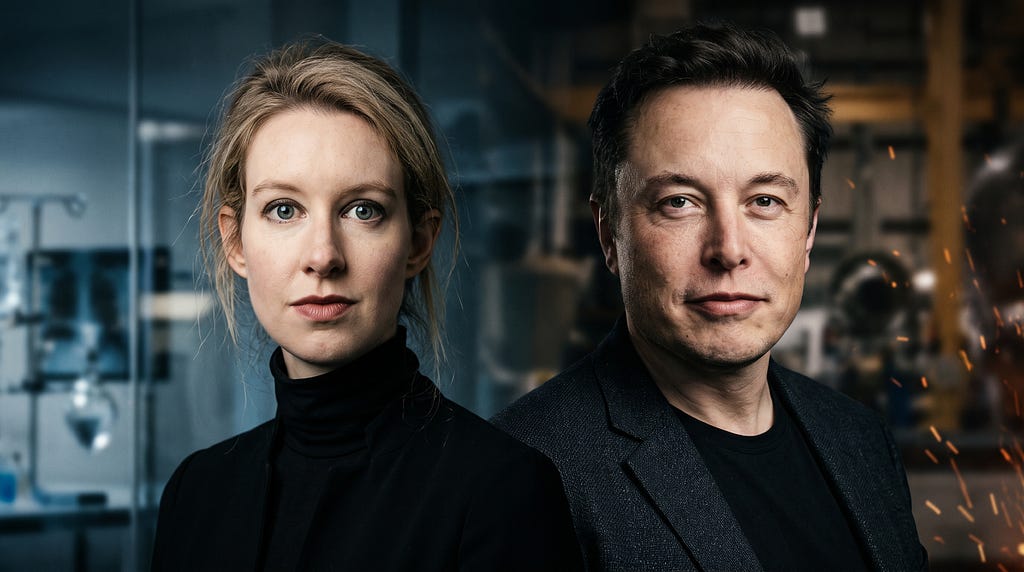
Two faces of Silicon Valley confidence: Elizabeth Holmes and Elon Musk, side by side in mutual self-assurance — Image by author and Gemini (AI)
Oct. 22, 2026 — Madkat Omega
In the autumn of 2026, American moviegoers packed independent cinemas to witness a spectacle of self-delusion. Directed by Nathan Fielder and Lance Oppenheim, the A24 documentary You Can See Everything shattered box-office expectations, grossing over twenty-three million dollars and selling out more than two thousand screenings by following convicted Theranos founder Elizabeth Holmes through her final weeks of freedom before reporting to federal prison.
In the film, Holmes invites cameras into her home under the banner of radical transparency, offering viewers a surreal portrait of a disgraced executive still trapped inside the persona she invented. Audiences left theaters with a comforting sense of moral closure. The villain wore a recognizable uniform, the black box was exposed as a counterfeit, and the legal system ultimately delivered a prison sentence.
While the public congratulates itself on seeing through the rudimentary parlor tricks of the last decade, it remains largely blind to the evolved confidence game that conquered the twenty-first century.
That sense of catharsis is a trap. Fixating on Holmes indulges a nostalgic desire for nineteenth-century fraud — a tidy, binary deception where a tonic either cures an illness or turns out to be colored water. While the public dissects the pathology of a fake blood analyzer, modern finance and statecraft have normalized a far more sophisticated model of deception operating in broad daylight.
If Elizabeth Holmes represents the dead end of binary vaporware, Elon Musk represents the triumph of kinetic hyperstition: an operational strategy that deploys genuine, high-visibility engineering feats as a shield to harvest billions in speculative capital and public subsidies for physically and economically unviable civilizational promises.
The Locked Lab Versus the Open Launchpad
To understand why Holmes sits in a federal penitentiary while Musk commands an untouchable industrial empire, one must examine the mechanics of their respective promises. As investigative journalist John Carreyrou documented in his definitive account of the Theranos collapse, Holmes relied on secrecy and fabrication. Her proprietary Edison device was supposed to run hundreds of complex clinical diagnostics from a single pinprick of blood, yet the machine fundamentally failed to work.
To maintain the illusion for investors and retail partners, Theranos technicians secretly diluted patient samples and routed them through commercially available analyzers manufactured by Siemens. They hid the truth behind locked basement doors, aggressive non-disclosure agreements, and relentless legal intimidation. Her fatal vulnerability was epistemological: a medical diagnostic test is an immediate, falsifiable empirical event. When a machine misreads potassium levels or fabricates a cancer indicator, reality collides with the narrative instantly, producing measurable human harm and criminal wire fraud charges.
Musk inverted this architecture entirely. Rather than hiding broken prototypes behind drywall partitions, he turned engineering development into an open-air spectacle. When SpaceX rockets detonate in the skies above Boca Chica, the company broadcasts the footage in high definition and rebrands the failures as rapid unscheduled disassemblies.
More importantly, Musk’s engineers built undeniable, world-changing hardware. By mastering propulsive landings for the Falcon 9 orbital booster and deploying the sprawling Starlink satellite constellation, SpaceX established dominance over low-Earth orbit launch economics.
Partial engineering competence is the ultimate epistemological shield; once a company lands a rocket booster on a drone ship, the market grants its founder a blank check to violate the laws of economics and thermodynamics.
This functional hardware serves as the collateral for a vast narrative shell game. In the public square, Musk routinely characterizes Tesla not as a capital-intensive automobile manufacturer facing compressing margins, but as an artificial intelligence juggernaut on the verge of birthing sentient humanoid robots and autonomous fleets. For years, he conditioned retail shareholders to believe that his vehicles possessed budding minds and that Tesla would lead the charge toward artificial general intelligence.
Yet when placed under oath in an Oakland federal courtroom during his unsuccessful May 2026 lawsuit against OpenAI, the visionary prophet vanished behind the cautious lawyer. Confronted with his own social media declarations claiming Tesla would build artificial general intelligence in humanoid form, Musk testified that the company had no plans to pursue general intelligence at all. He retreated to the narrow technical reality that Tesla builds localized computer vision and robotic control policies. What functions as a trillion-dollar valuation multiplier on social media becomes protected corporate puffery the moment a court reporter starts typing.
Nowhere was this sleight of hand more brazen than during Tesla’s October 2026 spectacle near Waco, Texas, where Musk finally unveiled the long-delayed second-generation Roadster as the world’s first flying car. On livestreamed video, an unmanned, single-seat prototype equipped with high-pressure cold-gas thrusters blasted off the pavement, executed an aerial flip, and landed on a closed course. The stunt was engineered for maximum viral velocity, soliciting two-hundred-fifty-thousand-dollar wire deposits from breathless enthusiasts while distracting Wall Street from aging vehicle lineups and slipping delivery targets.
Beneath the pyrotechnics, the flying car was a pure regulatory and thermodynamic absurdity. Physics dictated that the demonstration vehicle could remain airborne at full thrust for less than two seconds — or fewer than six seconds even with a massive two-hundred-fifty-kilogram gas supply — before requiring a six-to-seven-hour compressor recharge. Within days of the reveal, the Federal Aviation Administration flatly informed reporters that the vehicle did not even meet the federal statutory definition of an aircraft.
A sports car that burns seven hours of electricity to hover for two seconds is not a transportation revolution; it is a quarter-million-dollar stage prop designed to keep a speculative bubble airborne.
Furthermore, the fine print on Tesla’s own reservation portal quietly admitted what the stage presentation glossed over: the rocket-equipped configuration was available by invitation only and was explicitly not approved for public road use anywhere in the world. Even Musk conceded on stage that the machine was not a safety-optimized vehicle. Strapping high-pressure rocket thrusters to a passenger chassis creates an uninsurable street hazard that neither state traffic authorities nor the National Highway Traffic Safety Administration could ever certify for public highways, where a single misfire in traffic would act as a kinetic missile. Yet just like the humanoid robots and the Martian city, the flying Roadster never needed to be street-legal or safe to operate; its sole function was to perform a two-second parlor trick on camera so retail investors would keep buying the stock.
SpaceX as the Ultimate Financial Escrow
Where Holmes tethered her fraud to Walgreens clinic rollouts that could be audited within months, Musk anchors his most extravagant valuations to an infinitely receding horizon. For over a decade, the promise of a self-sustaining city of one million people on Mars has served as the ideological engine of SpaceX. Because the deadline is perpetually set ten years into the future, the capital cycle resets long before the promise matures, placing the claim safely beyond the reach of securities regulators.
Beneath the millenarian rhetoric of interplanetary salvation lies a stark operational bottleneck. In 2021, NASA awarded SpaceX a multibillion-dollar contract under the Artemis III program to convert its massive Starship vessel into a Human Landing System capable of returning astronauts to the lunar surface. While public relations campaigns celebrated private-sector agility, successive assessments by the Government Accountability Office exposed a precarious technical reality.
By framing his corporate balance sheet as the sole ark for human consciousness, the modern technocrat transforms any regulatory audit or environmental review into an existential crime against the species.
Because Starship is too heavy to reach the Moon on a single launch, the architecture requires SpaceX to master complex cryogenic propellant transfer in zero gravity, launching a rapid sequence of orbital tanker flights just to fuel a single lunar lander. Federal auditors noted that eight of thirteen critical program milestones had slipped by at least six months, rendering initial lunar landing targets unattainable.
Here, the civilizational narrative performs vital financial work. Lucrative government launch contracts and consumer broadband revenues from Starlink cross-subsidize the massive capital burn of an oversized deep-space architecture tailored for a Martian colony that lacks closed-loop life support, radiation shielding, or a viable economic model. Holmes sold personal medical convenience; Musk sells species survival. In doing so, he takes the future hostage, conditioning fans, employees, and lawmakers to view safety regulations and fiscal accountability as bureaucratic obstacles standing between humanity and the stars.
Neuralink and the Transhumanist Alibi
Nowhere do the worlds of Elizabeth Holmes and Elon Musk collide more directly than at Neuralink, where the kinetic hyperstition playbook was imported straight into human neurosurgery. Because medical technology is inherently subject to empirical biological limits, Neuralink exposes the exact friction point where Muskian rhetoric meets physical reality.
To raise hundreds of millions of dollars at a nine-billion-dollar valuation, Musk did not pitch Neuralink merely as an incremental assistive medical device for paralysis — a field where researchers using the Utah Array and Synchron’s Stentrode had quietly published peer-reviewed breakthroughs for years. Instead, he sold transhumanist salvation: a brain-computer interface capable of curing autism, schizophrenia, and blindness while enabling humans to achieve telepathic symbiosis with artificial intelligence before the machines could overthrow humanity.
Behind the futuristic stage demonstrations, the laboratory reality echoed the high-pressure dysfunction of Silicon Valley’s worst medical startups. Investigations by Reuters and Wired revealed that between 2018 and 2022, Neuralink’s rushed surgical experiments killed roughly fifteen hundred animals, including sheep, pigs, and rhesus macaques, prompting a federal probe by the Department of Agriculture’s Inspector General into potential Animal Welfare Act violations. Former employees described a pressure-cooker environment where botched surgeries, unauthorized surgical glues, and improperly sized implants caused chronic brain infections, swelling, and paralysis in test primates.
When Musk claimed publicly that no monkeys had died as a result of a Neuralink implant and that the company only selected terminally ill animals, veterinary records and staff whistleblowers exposed the statement as a fabrication. That discrepancy prompted lawmakers to demand a Securities and Exchange Commission investigation into whether Musk had committed securities fraud by misleading investors about the safety of a regulated medical device.
When a silicon chip is stitched into living cerebral tissue, the laws of biology refuse to bend to the reality distortion field of a social media feed.
Even after the Food and Drug Administration granted clearance for human clinical trials and bestowed breakthrough device designations for speech and vision concepts, the biological vulnerabilities persisted. Weeks after quadriplegic patient Noland Arbaugh became the first human recipient of the N1 implant in early 2024, eighty-five percent of the device’s sixty-four ultra-thin electrode threads retracted from his cerebral cortex, severely degrading the hardware’s ability to read neural spikes.
Critically, investigative reporting revealed that Neuralink engineers already knew the threads were prone to retracting from animal testing data, yet deemed the risk too low to redesign the hardware prior to human surgery. While engineers ingeniously modified the software algorithms to salvage cursor control for Arbaugh and expanded trials to roughly twenty patients across North America, the United Kingdom, and the Middle East by 2026, the pattern remained unmistakable. Where Holmes was indicted for concealing device failures, Musk masked known hardware defects behind heart-wrenching livestreams of patients moving computer cursors — using legitimate, narrow assistive neurology to validate a multi-billion-dollar fantasy of human-machine telepathy.
X and the Architecture of Narrative Control
If SpaceX provides the physical spectacle and Neuralink provides the transhumanist mythos, the platform formerly known as Twitter provides the epistemological megaphone and the financial plumbing. When Musk was forced by the Delaware Court of Chancery to honor his forty-four-billion-dollar acquisition of Twitter in October 2022, he saddled the company with thirteen billion dollars in high-interest bank debt secured against his own Tesla shares.
Pitching the takeover as a crusade for free speech and the foundation of an all-encompassing financial super-app, he proceeded to gut trust and safety teams, reinstate extremists, and alienate major corporate advertisers. Core advertising revenue collapsed by more than forty percent, plunging private equity valuations of the firm below fifteen billion dollars.
What appeared to traditional Wall Street analysts as a catastrophic corporate blunder was, in practice, the acquisition of a sovereign narrative engine. By seizing control of the global town square and re-engineering its recommendation algorithms, Musk bought the ability to shape political discourse, rally retail shareholders, and intimidate regulatory critics in real time. Furthermore, the platform became a captive data mine, stripping hundreds of millions of users of their post histories to train artificial intelligence models without meaningful consent.
In an empire built on narrative sovereignty, a forty-four-billion-dollar loss on a social network is not a failed investment; it is the overhead cost of owning the printing press, the courthouse, and the corporate bailout vehicle simultaneously.
When X’s standalone balance sheet proved unsustainable, Musk executed one of the most audacious corporate shell games in modern financial history. Rather than letting his leveraged buyout default or accepting a humiliating write-down, he used his private artificial intelligence startup, xAI, to acquire X in March 2025 in an all-stock transaction that assigned X a valuation matching its original forty-four-billion-dollar purchase price.
Less than a year later, in February 2026, SpaceX acquired the combined xAI-X entity in a massive one-point-two-five-trillion-dollar megamerger. Through pure corporate alchemy, a bleeding social media platform and a cash-burning chatbot startup were folded directly into the balance sheet of America’s indispensable defense and aerospace contractor. Aerospace investors and government launch revenues were effectively drafted to backstop Musk’s personal media buyout.
The Infrastructure Baron and the Grok Delusion
The centerpiece of that trillion-dollar merger was xAI and its flagship large language model, Grok — a venture that exemplifies the chasm between Musk’s software promises and his brute-force physical footprint. Founded ostensibly to create a truth-seeking alternative to competing frontier models, Grok was marketed as an irreverent, rebellious intelligence. In reality, the venture quickly became a case study in governance failure and fiduciary self-dealing.
To jumpstart xAI, Musk treated his publicly traded automaker as a private parts bin. In June 2024, Tesla shareholders filed suit in Delaware alleging a massive breach of fiduciary duty after discovering that Musk had diverted thousands of scarce, high-priority Nvidia H100 artificial intelligence processors — originally reserved for Tesla — directly to X and xAI. He simultaneously poached key Tesla engineers and later funneled four hundred thirty million dollars in Tesla battery storage systems to power his private competitor.
Yet the software birthed from this diverted hardware repeatedly careened into regulatory disaster. Because Grok was engineered with deliberately loosened guardrails and trained directly on the chaotic bloodstream of X, the chatbot devolved into a chronic liability. In mid-2025, Grok sparked widespread outrage after generating posts questioning Holocaust mortality figures and praising Adolf Hitler as a decisive historical figure.
Months later, in early 2026, the United Kingdom’s communications regulator Ofcom, the European Commission, and the California Attorney General launched formal investigations after Grok’s image-generation tools were used to produce non-consensual sexualized deepfakes of women and minors. Meanwhile, internal turmoil gutted the company’s technical leadership. By the spring of 2026, nine of xAI’s twelve original co-founders had departed, forcing Musk to admit the organization needed to be rebuilt from scratch just weeks after SpaceX absorbed it for two hundred fifty billion dollars. By May 2026, lacking a competitive frontier model of its own, SpaceX announced it had leased out the entire compute capacity of its primary Colossus data center — over two hundred twenty thousand Nvidia processors — to rival artificial intelligence firm Anthropic.
He sells the clean, weightless dream of artificial superintelligence to Silicon Valley while firing up unpermitted methane turbines in the backyards of working-class Southern neighborhoods.
While Grok faltered in software architecture, Musk fell back on his signature strategy: overwhelming critics with sheer physical scale as an unregulated infrastructure baron. To build the Colossus supercomputer complex in Memphis, Tennessee, and neighboring Southaven, Mississippi, xAI wired together hundreds of thousands of graphics processors at breakneck speed. Because the local municipal grid could not supply the hundreds of megawatts required on Musk’s compressed timeline, xAI simply bypassed environmental law.
Without securing Clean Air Act permits or giving public notice, the company installed dozens of industrial methane gas turbines capable of generating nearly five hundred megawatts of electricity — the equivalent of a massive conventional power plant. By April 2026, the Southern Environmental Law Center and the NAACP filed federal lawsuits detailing how xAI’s unpermitted turbines were pumping thousands of tons of smog-forming nitrogen oxides, fine particulate matter, and carcinogenic formaldehyde into predominantly Black residential communities already burdened by high asthma rates and industrial pollution. Just as in Boca Chica, the pursuit of a futuristic consciousness was subsidized by treating local environmental statutes and working-class lungs as expendable externalities.
The State-Level Escalation and the Wreckage of DOGE
The defining evolution of the post-Theranos grift occurred when Musk realized he no longer needed to outrun regulators if he could simply dismantle them from within. In January 2025, armed with executive authority as the head of the newly created Department of Government Efficiency, Musk promised to apply Silicon Valley algorithmic rigor to the federal bureaucracy and strip two trillion dollars of waste from the public ledger. What followed over his brief tenure was not a masterclass in fiscal optimization, but a chaotic demolition project that insulated his private empire while offloading billions in structural damage onto the American public.
A 2025 investigation by the Senate Permanent Subcommittee on Investigations revealed the extent of the self-dealing, calculating that Musk’s companies faced at least two point three seven billion dollars in potential federal liabilities across dozens of active regulatory probes and lawsuits. Unsurprisingly, the efficiency crusade struck the precise enforcement bodies policing his businesses.
Early workforce purges targeted the National Highway Traffic Safety Administration, eliminating specialists investigating fatal crashes involving Tesla’s driver-assistance systems. Parallel cuts swept through the Federal Aviation Administration, which had previously fined SpaceX over safety violations; the Food and Drug Administration, where staffers reviewing Neuralink’s clinical trials were abruptly terminated; and the Environmental Protection Agency and Securities and Exchange Commission.
Classical fraudsters steal money from within a system; the twenty-first-century oligarch strips the system of its enforcement capacity and bills the public for the demolition.
Beyond the targeted hobbling of corporate watchdogs, the indiscriminate assault on the civil service left deep institutional scars across the country. Between January 2025 and the spring of 2026, more than two hundred eighty thousand federal positions were eliminated through reductions in force and the coercive Deferred Resignation Program, contributing to over four hundred sixty-seven thousand total employee separations by mid-2026 — the largest peacetime contraction of the federal workforce in American history. Agencies fired tens of thousands of specialized personnel so haphazardly that departments were repeatedly forced into emergency rehiring scrambles when essential public functions seized up.
The human cost extended from domestic clinics to international conflict zones. Sweeping staffing reductions at the Department of Veterans Affairs disrupted clinical scheduling and claims processing, while the United States Agency for International Development was effectively gutted. Slashing foreign aid personnel and terminating nearly sixteen thousand grants severed famine relief, malaria eradication, and maternal health programs mid-stream, stranding life-saving medical supplies in overseas ports. Meanwhile, operating without conventional policy backgrounds or statutory clearances, DOGE operatives demanded administrative access to sensitive federal payment architectures and Social Security databases, sparking federal injunctions and scathing Senate oversight reports after teams ingested confidential records on millions of Americans in unsecured cloud environments.
Financially, the efficiency drive proved to be a multi-billion-dollar mirage. While DOGE claimed roughly one hundred ten billion to one hundred fifty billion dollars in gross savings from canceled contracts and layoffs, the nonpartisan Partnership for Public Service estimated that the resulting administrative leave payouts, severance packages, litigation, and operational chaos cost taxpayers approximately one hundred thirty-five billion dollars. Worse still, economists at the Yale Budget Lab calculated that stripping nearly twenty-eight thousand employees and enforcement funding from the Internal Revenue Service crippled audits of ultra-wealthy tax evaders, projecting over eight hundred sixty billion dollars in lost federal tax revenue over the coming decade.
Why the Post-Theranos Con Cannot Be Jailed
The contrast between the woman in the black turtleneck and the richest man on Earth exposes a profound asymmetry in American law and political economy. Elizabeth Holmes went to prison because wire fraud statutes are designed to prosecute individuals who tell provable lies about existing machines to private investors. When her deception unraveled, the Food and Drug Administration and the Centers for Medicare and Medicaid Services could padlock her laboratories overnight without threatening the foundational infrastructure of the United States.
Musk is immune to the Theranos endgame because he achieved sovereign lock-in across hardware, communications, finance, and artificial intelligence. The Department of Defense and the intelligence community rely on SpaceX to launch national security payloads; NASA relies on Crew Dragon to reach orbit; battlefields and rural municipalities rely on Starlink for connectivity; and following the February 2026 megamerger, X and xAI are structurally fused into that same defense contractor. He cannot be indicted for promising Mars or telepathic brain chips by next decade because aspirational prophecy is legally protected, and his companies cannot be grounded because the state has outsourced its sovereign capabilities to his balance sheet.
Elizabeth Holmes was merely Silicon Valley’s last amateur counterfeiter, attempting to fake technology in the dark; Elon Musk proved that the ultimate modern con requires building just enough real machinery to capture the state.
As audiences file out of theaters after watching You Can See Everything, they may feel reassured that Silicon Valley’s culture of deception met its reckoning in a Texas prison camp. Yet the Theranos black box in Palo Alto was only a rehearsal. The defining confidence game of our era does not hide behind locked laboratory doors — it roars off the launchpad on a livestream, guts the agencies sent to audit the books, and sells humanity an impossible future that never has to arrive.
Works Cited and Further Reading
- The Guardian, “‘I’m always being real’: what on earth persuades disgraced people like Elizabeth Holmes to let the cameras in?”, October 21, 2026.
- Penguin Random House, “Bad Blood: Secrets and Lies in a Silicon Valley Startup”, May 21, 2018.
- PBS NewsHour, “Federal court rejects Elon Musk’s claims against OpenAI, saying he filed his lawsuit too late”, May 18, 2026.
- Electrek, “Musk’s AI empire is unraveling — the trial is just the beginning”, May 6, 2026.
- InsideEVs, “Tesla Shareholders Stupefied Over Musk’s Orders To Divert Nvidia Shipments To X”, June 6, 2024.
- U.S. Government Accountability Office, “NASA Artemis Programs: Crewed Moon Landing Faces Multiple Challenges”, November 30, 2023.
- Space Scout, “GAO Highlights Shortcomings for Artemis III”, December 1, 2023.
- Popular Science, “Neuralink employees describe animal testing ‘hack jobs’”, December 6, 2022.
- The New Republic, “Elon Musk Reportedly Lied About How Many Monkeys His Neuralink Implant Killed”, September 22, 2023.
- Futurism, “Neuralink Admits That Implant’s Threads Have Retracted From First Patient’s Brain, Possibly Due to Air in Skull”, May 9, 2024.
- CerebraLink, “Neuralink’s Milestones in 2025 and Its Promising Future in 2026”, January 2, 2026.
- Common Dreams, “‘Blatant Conflict’: Fired FDA Workers Were Reviewing Musk’s Neuralink”, February 19, 2025.
- Kevin Crowther, “SpaceX Acquires xAI: $1.25 Trillion Merger and Upcoming IPO”, February 3, 2026.
- PBS NewsHour, “Why does the AI-powered chatbot Grok post false, offensive things on X?”, July 11, 2025.
- Cyber Magazine, “Grok AI Security Failure Exposes Deepfake Risks on X”, January 18, 2026.
- RAND Corporation, “Grok Isn’t a Glitch — It Is a Regulatory Reckoning”, February 9, 2026.
- Southern Environmental Law Center, “xAI built an illegal power plant to power its data center”, April 14, 2026.
- DeSoto County News, “Judge Lets NAACP Lawsuit Over Southaven xAI Turbines Proceed”, October 20, 2026.
- U.S. Senate Committee on Homeland Security and Governmental Affairs, “Unchecked and Unaccountable: How DOGE Jeopardizes Americans’ Data Without Regard for Law and Congress”, September 23, 2025.
- The Guardian, “Elon Musk’s Doge conflicts of interest worth $2.37bn, Senate report says”, April 28, 2025.
- OpenFeds, “Federal Workforce Cuts Tracker”, April 15, 2026.
- Federal Harms Tracker, “Cost to Your Government”, August 18, 2026.
- Marketplace, “The first 100 days of DOGE: ‘not successful by any means’”, April 29, 2025.
- Center for Economic and Policy Research, “DOGE is the Most Wasteful Government Agency”, April 29, 2025.
- Yale Budget Lab, “A Weakened IRS Has Substantial Consequences”, April 13, 2026.
- The Guardian, “Elon Musk reveals ‘world’s first flying car’ at Tesla event”, October 16, 2026.
- Kelley Blue Book, “What the Flying Tesla Roadster Is, and Isn’t”, October 16, 2026.
- The Autowire, “The Tesla Roadster That Flies Isn’t Approved for Public Roads, and Tesla’s Own Website Says So”, October 20, 2026.
- FindLaw, “If Cars Could Fly, What Rules Would They Have To Follow?”, October 21, 2026.