How sovereign AI infrastructure is reshaping the way organizations think about intelligence, privacy, and the true cost of the cloud.
We are standing at the edge of something genuinely historic. Not just the arrival of powerful artificial intelligence — that ship has sailed — but the beginning of a second, quieter revolution happening in the background: the move to bring that intelligence home.
For the past several years, AI has lived somewhere else. It has lived on servers you will never see, in data centers drawing more power than small cities, accessed through APIs, billed by the token, and governed by terms of service you probably did not read all the way through. That model has worked remarkably well for getting the technology into the hands of millions of people quickly. But it was always a transitional arrangement, not a destination. And the cracks are beginning to show.
This is not a criticism of the brilliant teams who built the frontier models. It is simply an observation about physics, economics, and history. Compute is a finite resource. The infrastructure required to meet the current demand for AI does not yet exist at scale. And when a resource is scarce and centralized, the organizations that depend on it eventually look for alternatives.
That alternative is local AI. And it is arriving faster than most people realize.
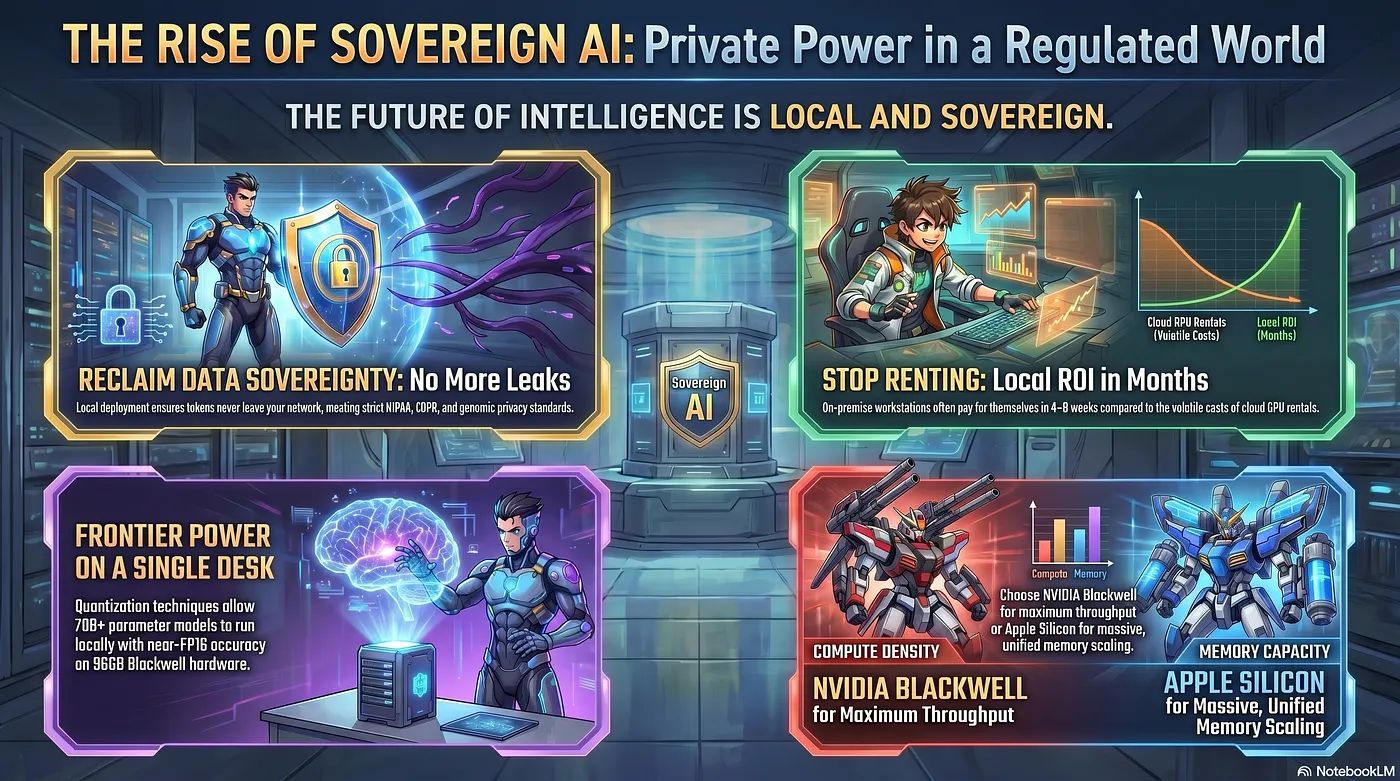
The Rise of Sovereign AI: Private Power in a Regulated World — Infographic generated by Google Gemini
We Have Been Here Before
The history of computing has a pattern, and we would do well to remember it.
In the 1970s and early 1980s, serious computation was centralized. Companies that needed serious processing power rented time on mainframes — massive, expensive machines housed in climate-controlled rooms, managed by specialists, and billed by the hour. The providers of that infrastructure were gatekeepers not out of greed, but out of practical necessity. The machines cost millions of dollars, the skills to operate them were rare, and there was simply no alternative that ordinary organizations could afford.
Then something changed. Advances in miniaturization drove costs down. Components that once filled entire rooms began fitting on a single circuit board. And gradually, then suddenly, computing became personal. By the time the 1990s arrived, every office had a desktop. By the time the iPhone launched in 2007, every pocket held more computational power than NASA commanded during the Apollo missions.
The transition from mainframe to personal computer did not destroy the organizations that had built the mainframes. IBM survived. But the nature of computing was permanently transformed. Intelligence became distributed. Ownership became possible. Dependency became optional.
We are watching the same arc repeat itself with AI — and we are somewhere in the middle of the first act.
The Constraint Is Not Budget. It’s Time.
Here is the honest diagnosis of the current moment. The organizations building frontier AI — the large language models powerful enough to assist with medical research, financial analysis, legal review, and complex engineering — are not withholding their capabilities out of a desire to extract maximum profit. They are simply running out of capacity.
Data center construction is a decades-long infrastructure project. The semiconductor supply chains that feed it are measured in years, not months. High-capacity memory, advanced GPUs, and the power infrastructure to run them at scale are all subject to lead times that no amount of money can fully compress. GPU shortages have pushed cloud rental prices upward; on-demand access to a single high-end NVIDIA H100 currently runs between two and eight dollars per hour, and that is when you can get one. An eight-GPU cluster can cost hundreds of thousands of dollars to purchase outright, if you can find them at all.
The result is a system under pressure. Token costs are climbing. Agentic workflows — in which AI systems run autonomously for hours or days on complex tasks — are accelerating demand in ways that were not anticipated even two years ago. Every dollar of efficiency gained by the models seems to generate three dollars of new demand from users who discover what they can accomplish.
This is not a problem that resolves itself quickly. The global AI inference market was valued at over a hundred billion dollars in 2025 and is projected to grow at double-digit rates for the rest of the decade. Sovereign AI infrastructure alone — the market specifically for localized, privately controlled AI deployments — hit fifteen billion dollars in 2025 and is forecast to reach nearly two hundred billion by 2035. The organizations that get ahead of this shift, rather than waiting for cloud capacity to catch up with demand, will find themselves with a meaningful competitive advantage.
What “Local AI” Actually Means Today
Local AI, sometimes called on-premises AI or sovereign AI, refers to deploying AI models directly on hardware that your organization owns and controls. The inference — the actual thinking, the token generation, the intelligent response — happens on your server, in your building, on your terms.
Five years ago, this was largely impractical for anyone without a research budget and a team of engineers. The models capable of genuinely useful results were enormous, the hardware required to run them was exotic and expensive, and the software to manage it all was immature.
That situation has changed dramatically.
Today, there are models small enough to run on a single workstation GPU that match or approach the quality of frontier systems from 2022. Quantization techniques — methods for compressing model weights without catastrophic loss of quality — have made it possible to fit seventy-billion-parameter models onto consumer-grade hardware with ninety-six gigabytes of memory. Mixture-of-Experts architectures activate only a fraction of a model’s parameters for any given task, dramatically reducing the memory and compute required for each inference. The open-source model ecosystem has exploded, with high-quality models from Meta, Mistral, Google, and dozens of research institutions available for private deployment.
The software has matured alongside the hardware. Agentic frameworks allow individuals and teams to chain AI capabilities together into workflows that run autonomously, completing complex multi-step tasks without constant human intervention. Retrieval-Augmented Generation, or RAG, allows models to query private knowledge bases — your internal documents, your proprietary data, your institutional knowledge — and reason over that information without ever exposing it to an external server.
The result is a local AI ecosystem that is not merely a compromise or a fallback position. For a growing number of use cases, it is the superior choice.
The Sovereign AI Argument: Who Owns Your Intelligence?
This is the question that matters most for organizations in regulated industries, and it is worth sitting with for a moment.
When you send a query to a cloud AI provider, that query — along with everything it contains — travels across the public internet, lands on a server you do not control, is processed by infrastructure that may span multiple jurisdictions, and is subject to the provider’s data retention policies, which can and do change. For many general-purpose tasks, this is an entirely acceptable arrangement. For others, it is not.
Consider the situation facing a hospital system exploring AI-assisted diagnostics. Patient records are among the most legally protected categories of information in existence. The Health Insurance Portability and Accountability Act — HIPAA — imposes severe penalties for unauthorized disclosure. The same logic applies to a pharmaceutical company using AI to analyze proprietary genomic data, or a law firm running AI over privileged communications, or a financial institution using AI to assess risk using non-public trading strategies.
In each of these cases, the cloud model creates exposure that is difficult or impossible to fully mitigate through contractual agreements alone. Data processed on a third-party server is data that has left the building. Regulatory frameworks in healthcare, finance, and increasingly in biotechnology do not always permit that, and the penalties for getting it wrong are significant.
A locally deployed sovereign AI solves this problem cleanly. Tokens never leave the network perimeter. Queries are processed on hardware you own. There is no external API call, no shared inference cluster, no dependency on a provider’s uptime or pricing decisions. Your AI is yours.
Beyond regulatory compliance, there is a competitive dimension that is easy to overlook. The most valuable AI applications in any industry are the ones that operate on the most sensitive and proprietary data — the data that competitors do not have. Running that data through a shared cloud infrastructure, regardless of the contractual protections in place, is a form of risk that deserves serious consideration.
The Cost Equation
The business case for local AI deserves honest arithmetic.
Cloud AI costs are not static. They are usage-based, which means they scale with every employee who adopts the tool, every automated workflow you build, and every improvement in model capability that generates new demand. An organization that spends ten thousand dollars a month on AI API costs today, running fifty users and a handful of agentic workflows, will not spend ten thousand dollars a month at double the adoption and double the workflow complexity. Costs compound.
Against that baseline, a one-time capital investment in local infrastructure begins to look different. Hardware depreciates. It does not send you a larger invoice when your team works harder. A workstation that costs six thousand dollars today serves you for three to five years. An enterprise cluster that costs half a million dollars is expensive upfront but eliminates a recurring operational expense that, for many organizations, will exceed that investment within two to three years of serious deployment.
There is also the reliability dimension. Cloud AI services have service level agreements, but they also have outages, rate limits, and the occasional policy change that affects what the models will and will not do. Local infrastructure runs on your schedule, responds to your priorities, and can be configured, fine-tuned, and customized without asking anyone’s permission.
Three Models for Local AI Deployment
There is no single local AI architecture that fits every organization. What follows are three practical blueprints, each calibrated for a different scale of need. These are not theoretical exercises — they can be built today with currently available hardware and software, and the costs reflect current market realities.
Model One: The Agentic AI Workstation
Who it’s for: Individual knowledge workers, consultants, researchers, developers, and small teams of two to four who want local AI capability without building an IT infrastructure.
What it is: A single, powerful desktop system using Unified Memory Architecture — where the CPU and GPU share a single pool of high-bandwidth memory — to run large models that would otherwise require expensive discrete GPU hardware. The two leading options in this space right now are the Apple Mac Studio with the M4 Max or M3 Ultra chip, and the NVIDIA DGX Spark, which packs a Blackwell GPU and 128 gigabytes of unified memory into a form factor roughly the size of a hardcover book.
Both systems can run 70-billion-parameter models locally with strong results. The Mac Studio is quieter, more power-efficient, and integrates seamlessly with macOS software ecosystems. The DGX Spark brings full CUDA support and NVIDIA’s complete AI software stack, which matters significantly for teams doing any model fine-tuning or working with CUDA-dependent research code. Paired with an agentic framework and a lightweight RAG setup pointing at your personal document library, either system transforms a single worker into someone who can dispatch intelligent agents to handle research, drafting, analysis, and scheduling tasks that previously required either expensive cloud subscriptions or significant manual effort.
Ballpark investment: Three thousand to eight thousand dollars, depending on configuration and storage capacity. The Mac Studio M4 Max with 128 gigabytes of unified memory and sufficient storage typically lands between three and four thousand dollars. The DGX Spark currently lists at around four thousand seven hundred dollars.
Implementation timeline: One to four weeks. These are consumer and prosumer products available through standard retail and commercial channels. Delivery lead times are relatively short compared to enterprise hardware, though supply can be inconsistent for the higher-memory configurations.
Model Two: The Laboratory AI Workstation
Who it’s for: Research labs, clinical teams, financial analysis groups, and small to mid-sized businesses with a team of two to eight users who need genuinely high-quality results, reproducible outputs, and the ability to work over proprietary datasets in a controlled, auditable environment.
What it is: A purpose-built workstation housing two NVIDIA RTX Pro 6000 Blackwell GPUs — currently the only professional workstation card under ten thousand dollars capable of running 70-billion-parameter models without aggressive quantization — supported by an AMD Threadripper processor with 256 gigabytes of system RAM, four terabytes of NVMe flash storage, and a ten-gigabit Ethernet connection to a petabyte-scale NAS running TrueNAS Scale. The NAS provides the long-term storage backbone for a RAG system that allows the model to query the full breadth of the organization’s document library. The workstation runs Docker, hosts the model inference server, and serves a browser-accessible client interface that the research team connects to from their own machines.
This setup provides 192 gigabytes of total GPU memory — enough to run genuinely frontier-class models in high precision — at a fraction of the cost of a dedicated GPU cluster. For labs where accuracy is not negotiable and every output needs to be traceable and verifiable against private data, this is the configuration that delivers. The RTX Pro 6000 launched at around eighty-five hundred dollars per card and currently retails in the eight-thousand to ninety-two-hundred-dollar range, which means two cards represent roughly seventeen to eighteen thousand dollars of the total build cost, but the value they deliver — running a model that four months ago required a forty-thousand-dollar data center GPU — is a genuine step change in what is accessible at this price tier.
Ballpark investment: Forty-five thousand to sixty-five thousand dollars, inclusive of both GPUs, the Threadripper workstation with memory and storage, the NAS hardware and drives for petabyte capacity, networking, and initial software configuration. Organizations already holding a NAS or storage infrastructure can reduce this figure meaningfully.
Implementation timeline: Six to twelve weeks. The primary constraint is GPU availability. The RTX Pro 6000 Blackwell remains supply-constrained in configurations suitable for dual-GPU workstations. Threadripper platforms and NAS builds are more readily available, but integrating all components, running burn-in testing, deploying the software stack, and loading the RAG knowledge base takes time to do properly.
Model Three: The Integrated AI Cluster
Who it’s for: University research institutions, large enterprises with multiple teams running simultaneous AI workloads, hospitals or health systems processing sensitive data at scale, and financial institutions requiring high-throughput private inference.
What it is: A full-scale on-premises AI cluster built around a server node with eight NVIDIA H100 GPUs connected by a 100-gigabit InfiniBand fabric — the same high-speed interconnect used in professional data centers — paired with a Nutanix hyper-converged cluster providing the scalable application layer, orchestration, and front-end interfaces, and backed by a redundant petabyte-scale NAS for serving the RAG knowledge base. This architecture can support dozens of simultaneous users, serve multiple departments with different model configurations and access controls, run continuous fine-tuning workflows against the organization’s proprietary data, and do all of it entirely within the organization’s network perimeter.
This is not a workstation with ambitions. It is a legitimate data center node, capable of running the largest open-weight models at full precision with the context windows and batch sizes needed for enterprise-scale deployment. The eight-H100 configuration represents the minimum meaningful cluster size for organizations with serious, sustained inference workloads — it provides enough memory and throughput to handle peak demand from multiple teams without queuing and waiting.
Ballpark investment: Four hundred thousand to six hundred fifty thousand dollars, depending on H100 sourcing costs, Nutanix licensing tier, NAS configuration, InfiniBand switching, rack infrastructure, and professional services for deployment and integration. H100 GPU units currently run between thirty and forty thousand dollars each on the open market, making the eight-card nerve center alone a three-hundred-thousand-dollar component. Organizations with existing server infrastructure or data center colocation arrangements can offset a meaningful portion of the total.
Implementation timeline: Three to nine months. This is the most constrained build of the three, not because the technology is complex — enterprise data center teams build systems like this routinely — but because H100 GPUs remain among the most supply-constrained components in the entire technology ecosystem. Lead times on GPU allocation, combined with Nutanix deployment, NAS integration, network configuration, and software stack validation, make a realistic timeline closer to six months for most organizations, with three months representing an optimistic best case with strong vendor relationships and pre-allocated inventory.
What to Expect from the Market
The trajectory here is clear, and it is worth understanding not as speculation but as the logical extension of the trends already underway.
Model capabilities continue to improve at a pace that consistently surprises even the researchers building them. Models available today for local deployment already match or approach the quality of the frontier systems of two years ago. That gap will continue to narrow. The open-source model ecosystem is extraordinarily active, and the techniques being developed to make models smaller, faster, and more efficient are advancing on multiple fronts simultaneously.
Hardware costs will come down. They always do. The RTX Pro 6000 at around eighty-five hundred dollars is already a dramatic reduction from the H100 at thirty-five thousand dollars for comparable inference tasks on large models. The next generation will be more capable and less expensive. The DGX Spark at under five thousand dollars for 128 gigabytes of unified AI compute was unimaginable three years ago. The equivalent system in 2028 will almost certainly cost less than half of that.
The software ecosystem is maturing rapidly. The tooling for RAG, agentic orchestration, fine-tuning, and deployment monitoring that required significant engineering effort a year ago is increasingly packaged into usable products that smaller teams can manage without a dedicated AI infrastructure team.
The regulatory environment is moving in the same direction. The European Union’s AI Act, healthcare regulations in the United States, and financial services frameworks globally are all trending toward requirements for explainability, data residency, and audit trails that are significantly easier to satisfy with a locally controlled system than with a shared cloud inference service.
Organizations that build sovereign AI infrastructure now are not just solving today’s compliance problems. They are positioning themselves ahead of a regulatory environment that is almost certainly becoming more demanding, not less.
The Honest Challenges
A realistic assessment of local AI has to include the friction involved.
Supply chain constraints are real. GPU lead times, especially at the high end, can stretch from weeks into months. Organizations that need to build serious clusters should begin procurement conversations now, not when they are ready to deploy.
Local AI requires local expertise. Someone has to manage the hardware, maintain the software stack, update the models, and monitor performance. This is not a set-it-and-forget-it investment. For small organizations, the labor cost of maintaining local infrastructure is a legitimate factor in the decision.
Local models are not yet at the absolute frontier. The very latest capabilities from the leading labs are still accessed through APIs. If your workflow genuinely requires the most advanced model available at any given moment, local deployment will involve some lag. That gap is narrowing, and for most practical business applications it is already small enough to be irrelevant — but it is worth being honest about.
Finally, the upfront capital requirement is real. These are not trivial purchases, particularly for the Laboratory Workstation and the Integrated Cluster. Organizations operating on tight margins need to weigh the total cost of ownership over three to five years carefully before committing.
A Blueprint, Not a Manifesto
The argument for local AI is not an argument against the cloud. Cloud AI services will continue to play a critical role for many organizations and many use cases. The frontier labs doing cutting-edge research will keep building the models that define what is possible, and accessing their latest work through an API will continue to be the right choice for many teams.
But the question every organization should be asking right now is not whether to use AI. That question has been answered. The question is where that intelligence should live, who should control it, and what the real long-term cost of the current arrangement is.
For organizations in regulated industries, the answer is becoming clear. Sovereign AI is not a luxury or a paranoid overcorrection. It is prudent risk management.
For organizations with stable, predictable AI workloads, the arithmetic on total cost of ownership increasingly favors capital investment over perpetual operational expense.
For research institutions and laboratories where the integrity and confidentiality of proprietary data is foundational to the work, local deployment is not just preferable — it may ultimately be the only compliant option.
We are at the beginning of the personal computing moment for AI. The hardware is ready. The models are capable. The supply chains are challenging but navigating. The case is compelling.
The question is whether your organization will be among those who built early, or among those who spent the next decade renting infrastructure they could have owned.
The three build models described in this piece represent current market realities as of mid-2026. Component pricing, GPU availability, and model capabilities are all evolving rapidly. Organizations considering local AI deployments should validate specific hardware costs and lead times with commercial vendors before finalizing procurement plans.