An investigation into the company behind Genshin Impact — a billion-dollar Shanghai studio funding fusion reactors, rockets, and artificial intelligence while telling a story about breaking out of a beautiful prison.
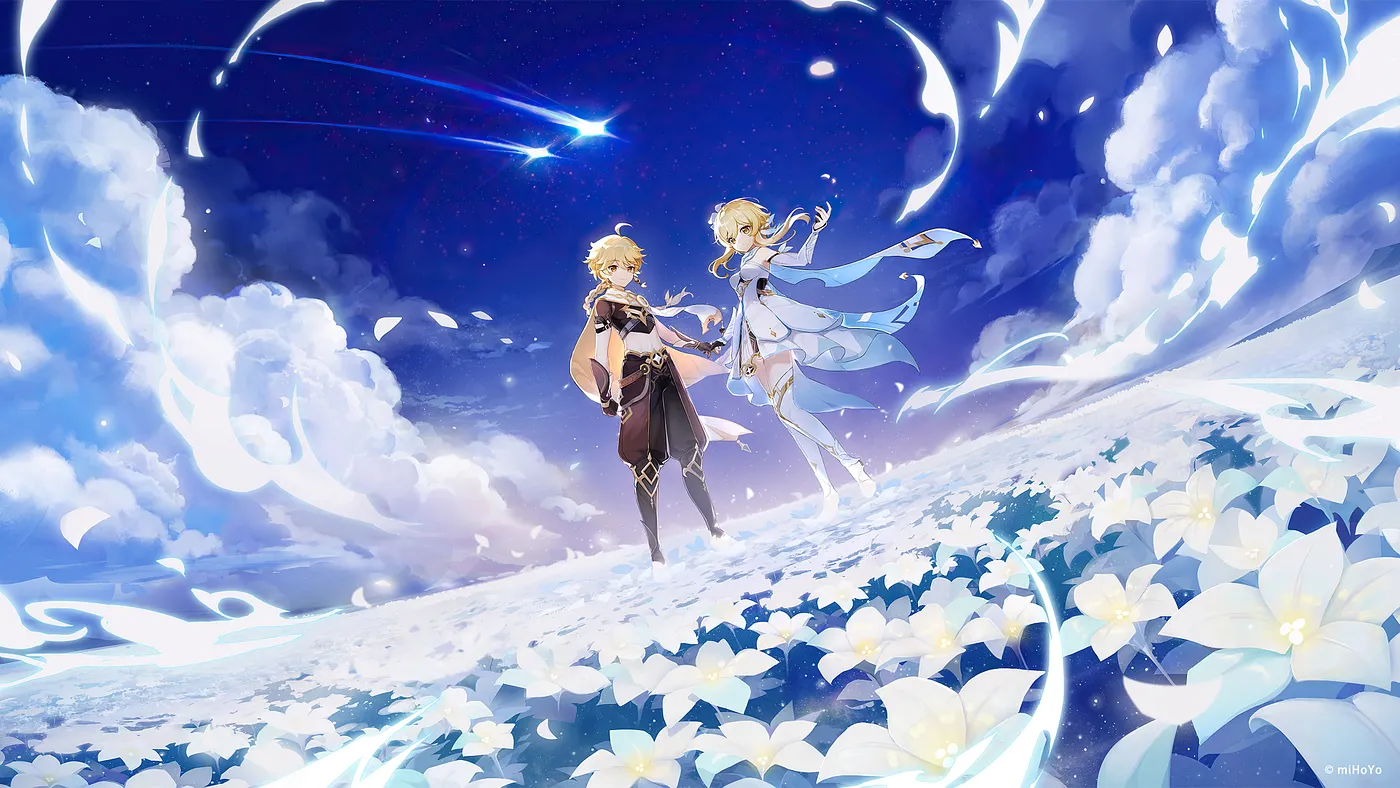
Genshin Impact — The Traveler, the Sibling, and the Sea of Flowers at the End — Image from miHoyo
I. An Artificial Sun in Shanghai
In June 2024, in the Lingang district of Shanghai, a doughnut-shaped machine wrapped in high-temperature superconducting magnets confined a loop of plasma hotter than the core of the sun. The device was called Honghuang 70 — HH70 — and according to its builders it was the first fully high-temperature-superconducting tokamak to achieve plasma, and the first such fusion device designed and operated from start to finish by a commercial company rather than a national program. It has since sustained plasma for 1,337 seconds — more than twenty minutes — a duration record for a privately built reactor, and its developer is raising money for far larger successors.
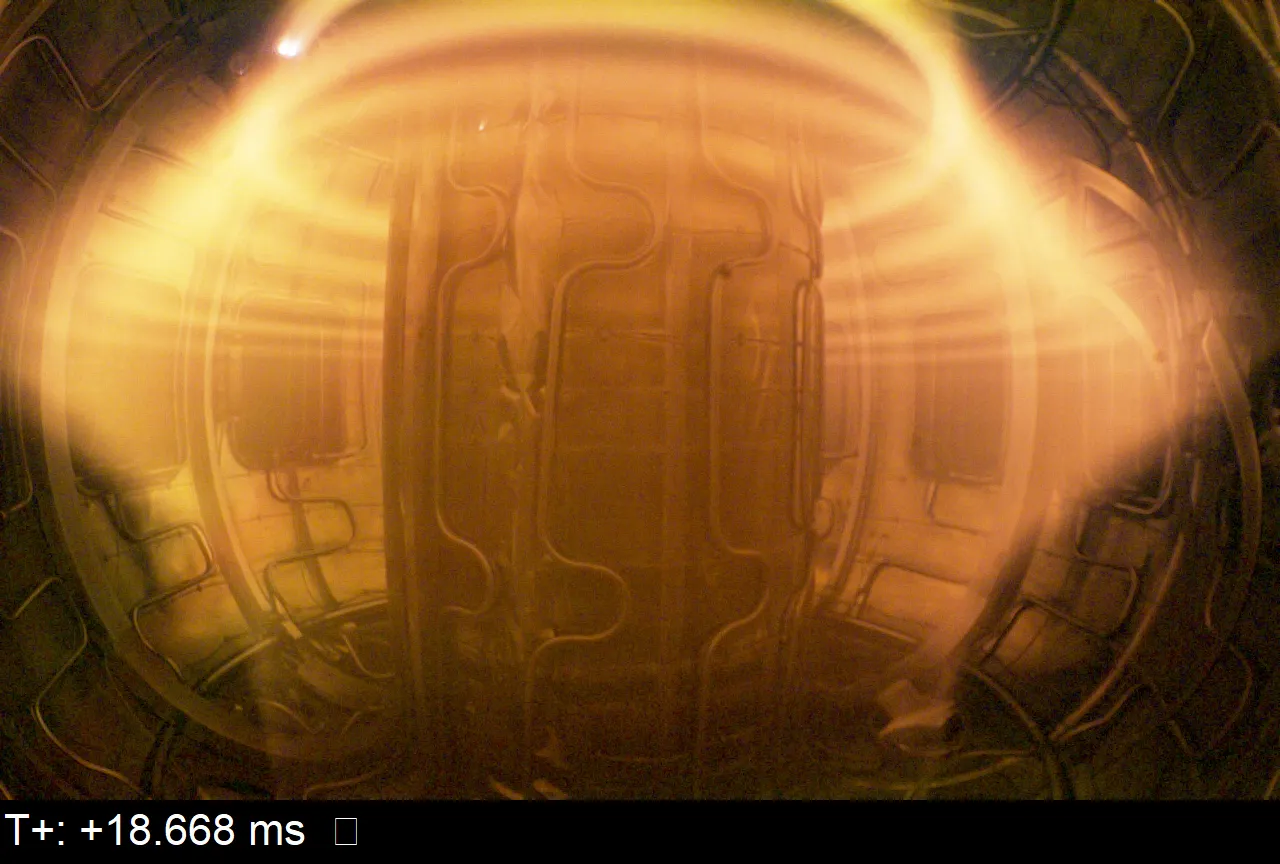
HH70 Fusion Reaction Plasma Field — Image from nextbigfuture.com
This is a serious clean-energy achievement, the product of a credible team and roughly two hundred million yuan of capital. What makes it remarkable is who supplied a major share of that capital. HH70’s developer, a Shanghai startup called Energy Singularity, was funded in part by miHoYo — known outside China as HoYoverse — the studio behind Genshin Impact, a free-to-play fantasy game about magical elemental powers and a small floating companion named Paimon. miHoYo led an approximately $65 million financing round for Energy Singularity in 2022, alongside NIO Capital and the firm formerly known as Sequoia China.
It is the kind of fact that sounds like a joke until you check it, and then it keeps being true the harder you look. miHoYo really did lead a fusion investment. It really has put money into a private rocket company whose vehicle reached orbit. It really has signed a partnership to research brain-computer interfaces. And it really is, at the time of writing, in the middle of one of the largest artificial-intelligence commitments in the history of the games industry. All of this is funded by a fantasy whose central, repeated theme is the struggle of mortals against a remote, all-controlling authority that keeps the world stable, comfortable, and quietly forgetful.
The temptation is to spin this into a conspiracy: that a few engineers from a Shanghai dormitory have been smuggling forbidden truths past the censors of the world’s most controlled media environment, hiding a manifesto inside a fairy tale. It is a seductive reading, and the game itself seems to invite it, because Genshin Impact contains — as an actual plot mechanic — a theory of how truth can survive an all-powerful authority by hiding inside fiction.
The honest story is more interesting than the conspiracy, and it requires holding two ideas at once. The first is that the game genuinely is built on a philosophical framework — drawn from Gnosticism, Hermeticism, and alchemy — about resisting a controlling cosmic order. This is not a stretch; the vocabulary is unmistakable and woven into the game’s bones. The second is that the game flourishes inside China not in spite of that framework but, in a real sense, alongside it: because abstract fantasy does not trip the wires that explicit politics does, and because a wildly successful cultural export is far too valuable to a soft-power-conscious government to suppress. The defiance in the text is real. So is the state that benefits from the game’s success. Both are true.
To see how, you have to start inside the game, with a tree.
WARNING: SPOILERS AHEAD
II. The Tree That Edits Memory
Deep beneath the surface of Teyvat — the continent where Genshin Impact takes place — grows a vast silver-white tree called Irminsul. The name is borrowed from Germanic myth, where the Irminsul was a sacred pillar joining earth and heaven, and the design echoes the Norse world-tree Yggdrasil. In the game, Irminsul is something closer to a database: it absorbs the memories accumulated in the world’s “ley lines,” storing the history of Teyvat. The Dendro Archon, the God of Wisdom, is connected directly to it.
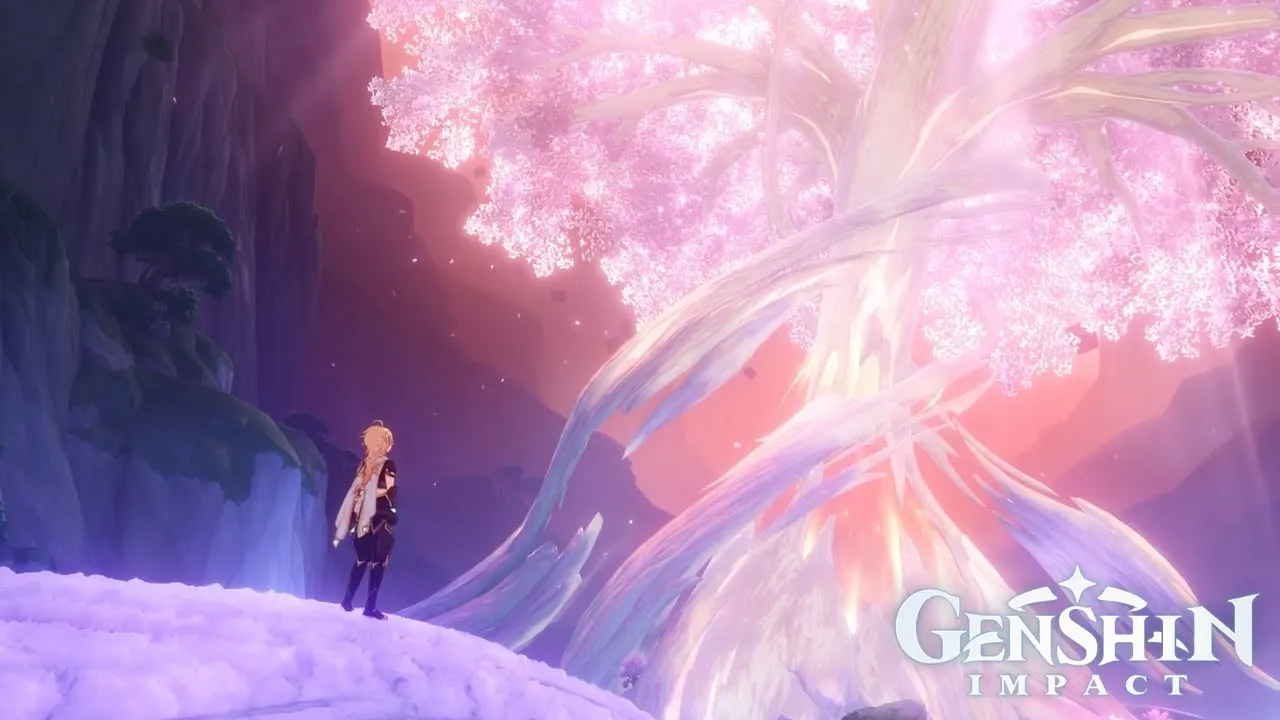
The Traveller and the Irmisul Tree — Image from miHoyo
The unsettling power of Irminsul is that editing it edits reality. When a record inside the tree is altered or removed, history does not merely change on paper — people’s memories change, and even in-game texts rewrite themselves to match the new timeline. This is not fan inference; it is shown twice in canon, and the game alters its own files to prove it.
In the Sumeru Archon Quest, Chapter III, Act V — Akasha Pulses, the Kalpa Flame Rises, in the quest Where the Boat of Consciousness Lies (Version 3.2, November 2022) — the dying Greater Lord Rukkhadevata, the original Dendro Archon, asks her successor Nahida to erase her from Irminsul to purge a corruption threatening the tree. Nahida does so, and the entire world forgets Rukkhadevata ever existed. The change is real in the player’s client: after completing the quest, NPC dialogue, item descriptions, and even character-profile stories update to replace Rukkhadevata’s name with “the Dendro Archon” or attribute her deeds to Nahida. The forest’s familiars, the Aranara, stop mentioning their “Queen Aranyani.” Only the Traveler — the player’s character — remembers her.
A second case follows in the Interlude Chapter, Act III — Inversion of Genesis (Version 3.3, December 2022), when the puppet Scaramouche attempts to erase himself from Irminsul. He succeeds in deleting his history, yet continues to exist as a new person, the Wanderer; once again the world’s memory and the game’s own text shift around the deletion. Memory-editing on this scale is, in other words, established canon, demonstrated mechanically.
Against that backdrop sits the game’s most elegant idea: that some truths survive the editing because they were hidden inside stories. Genshin Impact contains in-universe fairy tales that carry secrets of real history. The clearest example is the book collection The Pale Princess and the Six Pygmies — a play on “Snow White and the Seven Dwarfs” — described in-game as a fairy tale told throughout Teyvat for ages. During Lisa’s Story Quest (Tempus Fugit Chapter, Act I), the Abyss Order tries to steal Volume 1 because of a “secret” hidden within it; the quest never states what the secret is, only that it matters. A related text, Before Sun and Moon, found in Enkanomiya, recounts the world’s history beginning with the Heavenly Principles’ arrival, and was the target of theft by Khaenri’ah and later the Abyss Order.
Here it is important to separate canon from community reading, because the fandom rightly holds writers to that line. What is canonical is that these fairy tales exist, that they are said to contain dangerous secrets relating to Teyvat’s true history, and that powerful factions try to seize or guard them. What is interpretation — well-supported by textual parallels, but not confirmed by the developers — is the specific decoding: that the Pale Princess’s “Moonlight Forest” represents the fallen kingdom of Khaenri’ah, that the “Land of Night” is the Abyss, and so on. That decoding is the work of theorycrafters, and it should be presented as theory, however persuasive.
The mechanic that ties this together is the Hexenzirkel, a coven of immensely powerful mages — German for “witches’ circle” — who, in canon, conduct “Irminsul explorations” and seek forbidden knowledge. One member, Nicole (codename N), is an Angel who survived the downfall of her kind; she speaks directly into the Traveler’s mind during moments when the world shifts, acting as a prophetess who points toward truths the system has buried. During the Irminsul disturbance at the Sanctuary of Surasthana in Sumeru, she spoke into the Traveler’s mind to safeguard their memories.
So the architecture is real: a world whose history can be rewritten at the root, and stories that carry forbidden truth through the rewrite. Whether the developers intend this as a comment on the real world is a separate question, one worth returning to with care. First, though, the game’s framework deserves to be taken on its own terms — because once you see the vocabulary it is built from, the rest of the picture clicks into place.
III. The Machinery of Heaven
Genshin Impact does not merely flirt with Gnosticism; it is constructed from its vocabulary. The elemental gods are called Archons — the precise term Gnostic texts use for the subordinate powers that rule the material world on behalf of a flawed creator. They hold objects called Gnoses, shaped like chess pieces; gnosis is the Gnostic word for the direct self-knowledge that frees the soul. The Chinese title of the game, 原神 (Yuánshén), translates to something like “original god” — and corresponds to “Allogenes,” the Gnostic figure known as “the Stranger,” half-human and half-divine, able to commune with other realms. The framework is not an accident. It is the scaffolding.
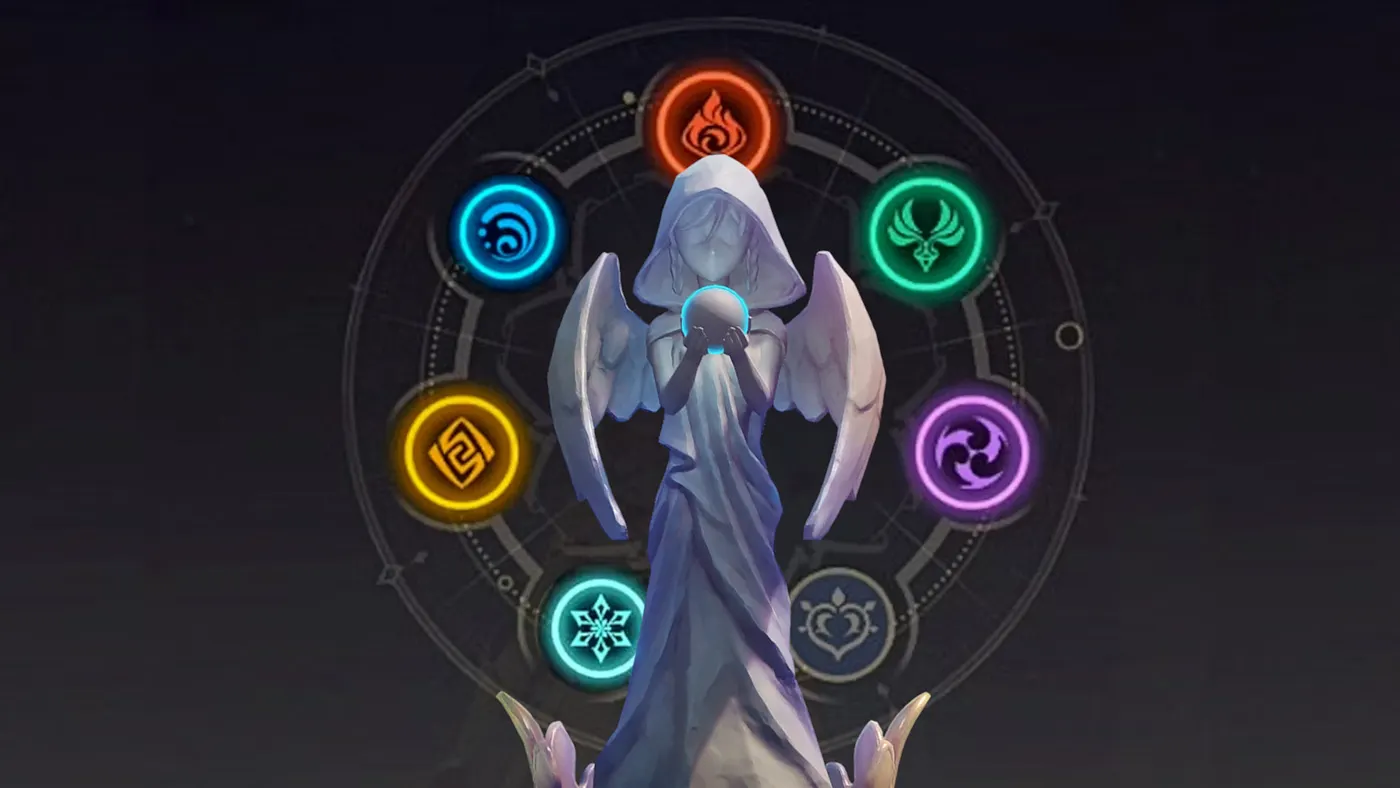
The Seven Elements for Seven Archons — Image from miHoyo
That scaffolding has a history inside the game, and the history matters more than it might first appear. The Archons did not simply inherit their thrones; they won them in the Archon War, an era of divine struggle that ended roughly two thousand years ago. According to the Fontaine Archon Quest and related lore, the war was triggered when Celestia — the seat of the Heavenly Principles — forged the seven Gnoses from the remains of the Third Descender and created the Archons’ Divine Thrones from the powers of the defeated Dragon Sovereigns. The gods then fought over these prizes. The victors became the Seven, established the seven nations, and shaped them with their elemental authority. Lesser gods perished or were sealed in the process. The Gnoses, in other words, descend from the Heavenly Principles, while the elemental Visions granted to ordinary mortals are revealed, in the Fontaine finale, to be made from the Seven Sovereigns’ stolen authority — a permission slip drawn from a conquered people.
This origin story sets the moral terms the rest of the game’s cosmology runs on, and the terms are easy to get wrong. Genshin Impact borrows Gnostic vocabulary, but it does not establish that its own Heavenly Principles is a petty or lesser god in the way Gnosticism’s Demiurge is. Their nature is left deliberately unresolved; the furthest the game goes is Nahida’s tentative conclusion, at the end of the Sumeru arc, that the Heavenly Principles may be the First Descender, silent since the Cataclysm. Nor is the deeper conflict simply gods who love humankind against a heaven that loathes them; the Heavenly Principles may sincerely intend to preserve humanity. The fault line runs elsewhere: between a celestial authority that preserves humanity through control and enforced stagnation, and the impulse toward growth, knowledge, and self-determination that this same authority treats as transgression. What gets coded as sin in Teyvat is rarely affection for mortals; it is ambition on their behalf — seeking forbidden knowledge, defying fate, reaching for a throne the heavens kept closed. The fall of Khaenri’ah punished a kingdom that learned too much, not one that loved too little.
That fault line — control against growth, stagnation against risk — is what the rest of Teyvat’s story keeps circling back to.
IV. The Story It Tells: Breaking Out of a Beautiful Prison
Strip away the elemental combat and the gacha banners, and the spine of Genshin Impact’s long story is a single dilemma, posed and re-posed: is it better to live safely as a protected, contented subject of a stable order, or to risk annihilation for the chance at true freedom?
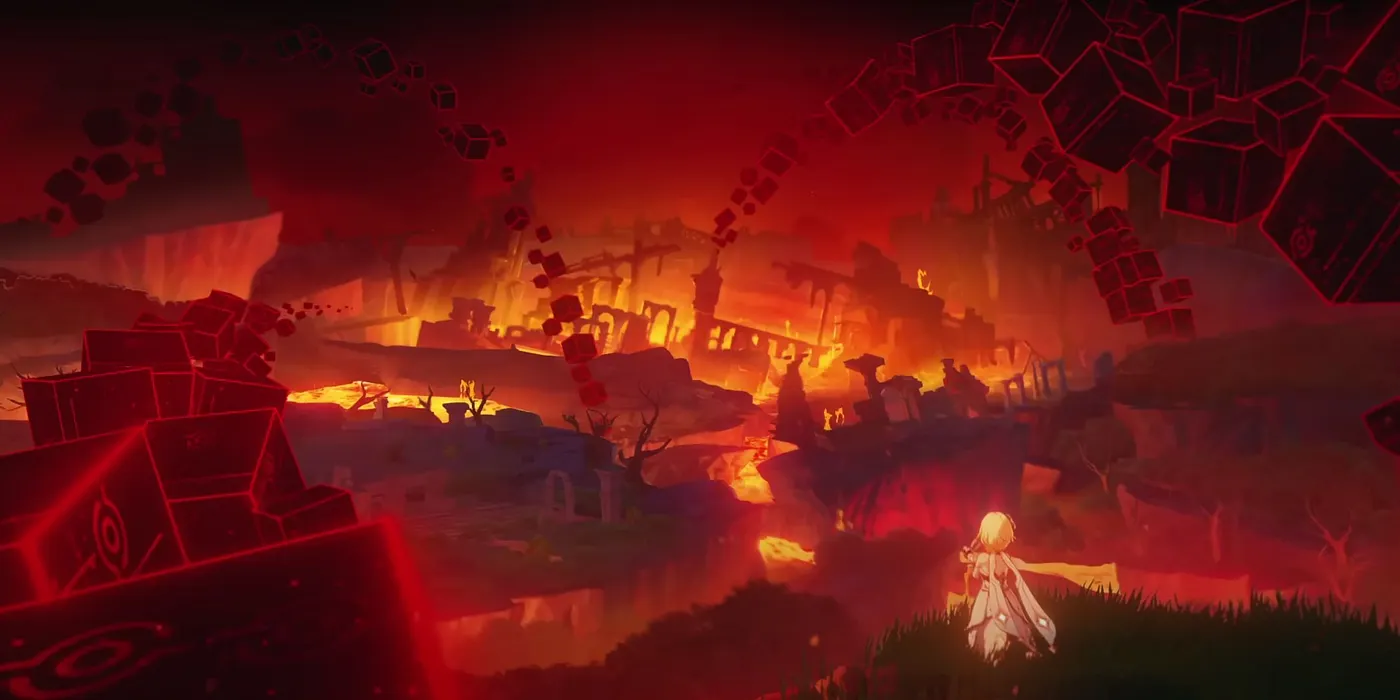
The Sibling Witnesses the Fall of Khaenri’ah — Image from miHoyo
On one side stand the Heavenly Principles and Celestia — the remote, now-silent authority that maintains stability over Teyvat. The “fake sky” over Teyvat is canon: it is not a natural heaven but a sealed firmament, a truth the Harbinger Scaramouche stumbled onto when, sent by his superior to investigate a fallen meteor at Musk Reef (around the Unreconciled Stars event, Version 1.1), he learned of the world’s false sky. Civilizations that advance too far, or probe too deeply at that sky, have historically met catastrophe; the fall of Khaenri’ah five hundred years ago is the great example. The Heavenly Principles keep the world safe and stable, and keep it from growing past a certain point.
On the other side stand those who would defy the Heavenly Principles: the survivors of godless Khaenri’ah, the Abyss, and — looming over the whole arc — the Tsaritsa, the Cryo Archon of Snezhnaya. Here a correction matters, because the fandom will not forgive overreach: the Tsaritsa’s goals are not yet shown directly, and players have not met her. Snezhnaya is still the forthcoming region, its release tied to story beats that have not happened yet. Until it does, everything the audience “knows” about the Tsaritsa’s plan is secondhand — relayed through narration by the exile knight Dainsleif, through Fatui lore and artifact descriptions, and above all through the figure of the Jester.
That figure is Pierro. Before the Cataclysm, he was a royal court mage of Khaenri’ah who failed to stop his kingdom’s sages from courting the divine wrath that destroyed it. As a pure-blooded Khaenri’ahn, he wasn’t transformed into a monster like so many of his people — he was cursed with immortality instead, and the curse was delivered in person, by Ronova, the Shade of Death, an emissary of the Heavenly Principles. He looked her in the eye while she did it. That single image carries the weight of everything that follows: a man embittered against the foundations of his own world, who allied with the Tsaritsa and became the first of the Fatui Harbingers, has spent five hundred years carrying a grudge he watched arrive in person.
So when the story speaks of the Tsaritsa’s aim to “burn away the old world,” it speaks through Pierro and the lore around him, not through the Tsaritsa herself. Dainsleif’s characterization of her is among the few direct descriptions the game offers: a god left without love for her people, or they for her, whose followers hope only to be on her side when her rebellion against the divine finally comes. The richer interpretations of her plan — that she intends to seize all seven Gnoses, rewrite the world’s operating system, and harden humanity to survive the void — are extrapolations the community has assembled from fragments, and they deserve to be flagged as such. They may prove true; the game has a long record of confirming fan readings years later, and an occasional record of overturning them. As of the current state of the story, the Tsaritsa remains a figure glimpsed through intermediaries.
What is not in doubt is the moral shape of the conflict, and the unusual role the player occupies within it. The Traveler is a Descender, an outsider from beyond Teyvat whose mind is immune to Irminsul’s edits. When the world forgets, the Traveler remembers. They are, structurally, the witness the system cannot reach — the one consciousness that survives every rewrite. It is a striking position to hand a player: you are the living record of the truths the world keeps deleting.
V. Three Friends and a Dorm Room
The origin of miHoYo has been polished by retelling, but its documented bones are sturdy.
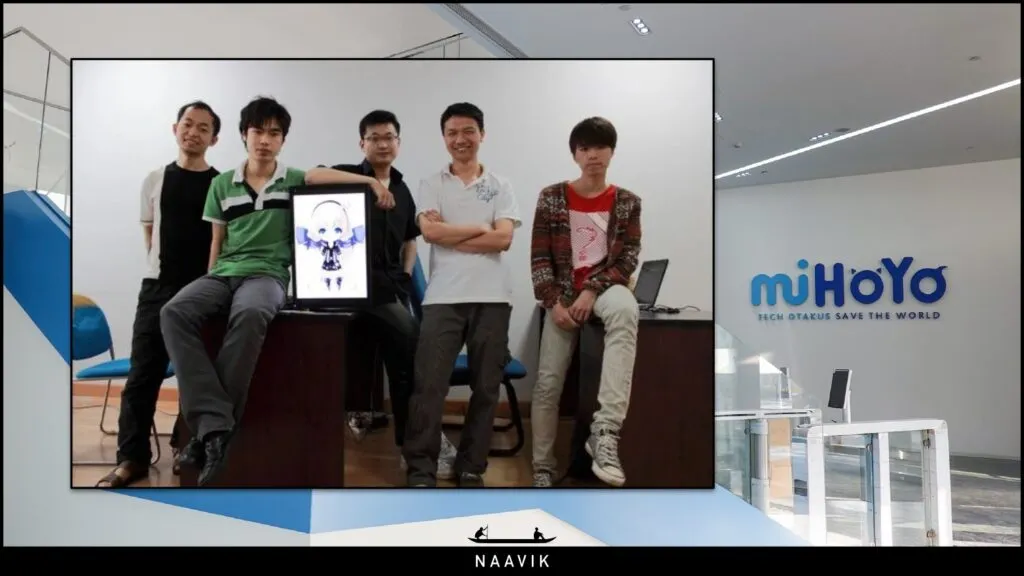
The miHoyo Founders — Image by Naavik
In January 2011, in Dormitory D32 on the Minhang campus of Shanghai Jiao Tong University, three computer-science students — Cai Haoyu, Liu Wei, and Luo Yuhao — formally banded together to make games. They shared a love of anime, comics, and games, the culture abbreviated as ACG, and they self-identified with a word that needs care in English: otaku. In China the term carries little of the sting it can have elsewhere, reading closer to “devoted enthusiast,” and the founders adopted it for themselves in the company’s mission statement — Tech Otakus Save the World. That is the founders’ own framing of their identity, and it is the only sense in which the word belongs in their story.
The company name encodes them. The “H” and “Y” come from Cai Haoyu and Luo Yuhao; the founders added an “O” because Facebook, Google, and Microsoft all contained one. “HoYo” was already registered, so they prepended “mi” — a nod to the virtual idol Hatsune Miku, beloved in the community they were building for.
Their first release was not a success. FlyMe2theMoon, launched on the iOS App Store in September 2011, was a small physics puzzle game, around forty megabytes, named in tribute to an Evangelion ending theme. Sold for eighteen yuan in an era before the studio used gacha mechanics, it sold on the order of three thousand copies in its first month, leaving the founders on a combined income of roughly four thousand yuan a month. It was, financially, a disappointment — but it introduced a character, Kiana Kaslana, who would anchor the later Honkai series, and it proved the team could ship.
What kept them alive was grit and modest patronage. The team placed third in a Shanghai entrepreneurship competition, winning an interest-free loan of one hundred thousand yuan and six months’ use of a roughly fifty-square-meter office; an angel investment of about a million yuan followed in the years after. Liu Wei carried the team’s “virtual idol” pitch from one university contest to the next, running repeatedly into the same skepticism: investors of that era saw anime-and-gaming culture as a niche, and a team of fresh graduates as a poor bet.
Then came the decisive pragmatism. Recognizing that their early titles lacked staying power, the founders studied the monetization engine of the Japanese mobile hit Puzzle & Dragons, which paired a simple game loop with a gacha system of randomized, paid draws. They adapted that numerical machinery for an action game and married it to a high-fidelity, “moe” anime aesthetic. The Honkai series that followed turned the studio profitable; Honkai Impact 3rd in particular proved that high production values and a gacha system could coexist, and that players would embrace the result.
By 2020, miHoYo had the cash, the technology, and the ambition to attempt something audacious: a free-to-play, open-world game of console-grade quality, designed from the outset to win over the West. That game was Genshin Impact.
VI. Free to Play, Built to Last
Genshin Impact launched in late September 2020 and became an almost immediate commercial phenomenon — but the numbers are widely exaggerated, and getting them right matters for any serious account.
The game earned roughly $400 million in mobile revenue in its first four months, recouping a reported development cost of around $100 million. It became the fastest mobile game to reach $5 billion in player spending, and by the end of 2025 it had surpassed $10 billion in cumulative spending across all platforms — again the fastest title to do so. These are extraordinary figures, and they are the foundation of everything the company has built since.
But the often-repeated claim that the game “earns a billion dollars every six months” describes only the launch-era pace, which has not held. Mobile in-app-purchase revenue peaked at roughly $1.9 billion in 2022, fell to about $1.3 billion in 2023, and dropped to around $710 million in 2024 — the first full calendar year the game spent under a billion dollars on mobile — before a projected partial recovery toward $800 million in 2025. These figures track only iOS and Android; PC and PlayStation revenue is undisclosed, and analysts at Niko Partners have estimated that gross spending in China alone runs well above what app-store trackers can see, so the true cross-platform total is higher than any single figure. The accurate picture is of a maturing live-service title: still enormous, still a tentpole, but past its explosive launch.
The player figures need similar care. Genshin Impact has accumulated more than 300 million registered accounts — but that number counts everyone who has ever made a login and only grows. Monthly active users are the honest metric, and they swing with the content calendar: mobile monthly actives averaged around 9.3 million in 2024 and rebounded to roughly 15.2 million by mid-2025; the all-platform peak was higher, around 66 million monthly players in early 2023. Revenue, too, rises and falls with each character banner — a beloved character can drive a $99 million month, while a content gap can see spending fall by most of that within a quarter. This is the defining rhythm of the model, and it is a deadline more than a dice roll: each character is sold on a banner with a fixed, time-boxed window, typically about three weeks, before it rotates out. Miss that window and the character may not return for months, sometimes longer, on a future rerun — if it returns at all in any given player’s planning horizon. Income is tied less to randomness for its own sake than to that ticking clock: the pressure to spend now, while a specific, desired character is actually obtainable, rather than risk losing the chance entirely.
That model is also the most substantive basis for criticism of the company, and it deserves to be stated plainly rather than waved away. Gacha monetization shares structural features with gambling: players pay for randomized chances at rewards, and the systems are tuned — through pity counters, limited-time banners, and calibrated drop rates — to convert engagement into spending, particularly among the minority of high-spenders. In much of the West, this design has long drawn suspicion. miHoYo’s insight was that production value changes how the mechanic is received: Western players who would have dismissed a low-budget gacha game were won over by an orchestral, voice-acted, beautifully animated open world that happened to include a wish system. The studio gave away a game that looked like it should cost full price and recovered the cost many times over.
It is worth holding the two truths together without cynicism. Genshin Impact is, by wide consensus, a genuine artistic and technical achievement, a vehicle for real philosophical themes — and also a finely tuned engagement-and-spending system. Those facts coexist. What miHoYo did with the resulting revenue is what turns a successful studio into something genuinely unusual.
VII. Tech Otakus Save the World, Taken Literally
For years, Tech Otakus Save the World was a charming slogan. Then the company began spending as though it were a plan.
The fusion investment is the headline, and it has been covered above: roughly $65 million leading Energy Singularity’s round, and the HH70 tokamak achieving plasma in June 2024 and later setting a duration record for a commercial device. (A caution that good reporting requires: a few secondary outlets have described HH70 as achieving “net positive” energy, but the well-sourced claims concern first plasma and plasma-duration records, not a demonstrated energy gain. The verified achievement — a privately built, fully high-temperature-superconducting tokamak reaching and sustaining plasma — is impressive without embellishment.)
The space investment is smaller but real. miHoYo participated in a roughly $60 million Series A round for OrienSpace, a private Chinese rocket company; OrienSpace’s Gravity-1 — at the time the largest-payload rocket under development by a private Chinese firm — flew a successful debut launch in January 2024, carrying satellites to orbit, as part of China’s broader push to build out low-Earth-orbit constellations.
The least-discussed investment may be the most striking. In March 2021, miHoYo signed a strategic-cooperation agreement with Shanghai’s Ruijin Hospital to build a joint laboratory for brain-computer interface research, headed by a Shanghai Jiao Tong University professor who had supervised Cai Haoyu’s master’s thesis. The lab’s inaugural project was clinical research into using brain-computer-interface neuromodulation to treat refractory depression.
Fusion, rockets, brain-computer interfaces — and beyond them, by various accounts, stakes in semiconductors, industrial robotics, augmented reality, and AI startups; by mid-2024 miHoYo had reportedly invested in at least ten technology firms. The pattern is not random. It traces, point for point, the toolkit a civilization would need to push past its own limits: abundant clean energy, the means to leave the planet, the means to interface with the mind.
There is, equally, a less romantic reading that deserves the same weight. A privately held company sitting on large but banner-dependent cash flows has every rational reason to diversify out of a single volatile product. Energy, space, semiconductors, and AI are also precisely where the Chinese state is channeling national ambition and capital — meaning miHoYo’s portfolio aligns neatly with Beijing’s strategic priorities, which is no small advantage for a company that must remain in the government’s good graces. Sincere technological idealism and shrewd corporate hedging are not mutually exclusive; they are, here, almost certainly the same set of decisions seen from two angles.
The most consequential bet, though, is the newest — and it carries the company back toward the dream it has held since the start, and toward the founder most identified with it.
VIII. The Second Curve, and the Man Who Went to Build It
As early as 2021, miHoYo’s founders began saying something unexpected: that they did not consider themselves a game company. Genshin Impact, they suggested, was the closest available prototype of the real goal — a vast, persistent virtual world, iterated on every few years. The stated ambition, repeated by both Cai Haoyu and Liu Wei across several years, was to build by 2030 a virtual world that one billion people would want to live in. This was the “second curve”: the company’s term for the growth beyond the limits of any single product.

Hatsune Miku the Vocaloid — Image not attributed
It is worth being precise about what miHoYo has actually said, rather than the grander image the phrase “second curve” might invite. The company’s own claims are specific: a content-driven virtual world, and, more recently, AI-driven non-player characters built to react with something like the complexity of living people. Read against the studio’s own origin story, that ambition points somewhere more concrete than abstraction allows. miHoYo took half its name from Hatsune Miku, the virtual idol, and Liu Wei spent the company’s early years pitching investors on a “virtual idol” product before the studio found its footing in games. An AI character built to hold real conversations and sustain a persona over months or years starts to look less like a traditional NPC and more like an idol in the media-industry sense — a manufactured, parasocial celebrity. Whether that is the actual direction, something more modest, or something else entirely is not something the company has stated outright, and the honest position is to flag it as an open question.
The career of Cai Haoyu is where the story has caused confusion, and it is worth clarifying, because it does cohere. Cai was miHoYo’s chairman, CEO, and largest shareholder, and he personally led the company’s major projects from FlyMe2theMoon to Genshin Impact. In 2023, he stepped back from his corporate roles — relinquishing his board seat and handing the chairman and legal-representative titles to Liu Wei — in order to focus, in the company’s own words, on the research and application of cutting-edge technologies, the development of new projects, and the connecting of domestic and overseas R&D. He did not leave miHoYo, and he remained a major shareholder; he redirected himself toward the frontier.
Where he went is concrete. Cai founded Anuttacon, an AI game company that recruited talent from firms like Microsoft and Meta, and whose debut project, Whispers from the Star, entered closed testing in 2025. The game centers on Stella, an astrophysics student stranded on a distant planet, whom the player guides through text, voice, and video conversation; her reactions and emotions are generated in real time by AI, with the tagline that the player’s conversations decide her fate. In short, the founder most associated with miHoYo’s “virtual world” dream went off to build, in the real world, an AI-driven character you talk to. (By 2026, according to industry reporting, Anuttacon’s large-language-model team was being consolidated back into China.)
Meanwhile, miHoYo’s broader AI commitment, announced in May 2026 at a closed technology forum in Beijing, was led not by Cai but by Liu Wei. Chinese outlets including Yicai reported a plan to invest up to 100 billion yuan — roughly $14 billion to $16 billion depending on the exchange rate — in AI over three years, building a full-stack, in-house ecosystem of GPU clusters, training systems, and infrastructure, with applications including AI NPCs in the upcoming life-simulation game Petit Planet. Liu framed it with notable candor, reportedly saying that if the effort produced nothing, he would accept it as “one grand fireworks display” — a posture only a privately held, self-funded company can afford, since there are no outside shareholders to answer to. The 100-billion-yuan figure is a stated ceiling, not a guarantee, and as a private firm miHoYo discloses little. The push also runs into hard geopolitics: U.S. export controls on advanced semiconductors are exactly why the strategy emphasizes domestically optimized, self-developed infrastructure.
There is a resonance here that fans have noticed, and it is worth raising precisely because it is so easy to overstate. Genshin Impact keeps returning to a single anxious idea: minds that try to merge, replace, or paper over reality with something more comfortable, and the cost that always comes due. In the Sumeru Archon Quest, the city’s endless Sabzeruz Festival turns out to be a deliberately engineered loop — a “samsara,” in the game’s own term — built on purpose by a faction of Akademiya sages to harvest the dreaming minds of an entire population while feeding them a comforting illusion, fuel for a Harbinger’s planned ascension to godhood. In Alhaitham’s Story Quest, a scholar named Siraj tries to dissolve several people’s minds into a single “collective consciousness,” and it collapses under the weight of what it erased. And across two separate Fontaine storylines, well-meaning people try the same trick at different scales — one merging an entire nation’s memories to stave off an apocalypse, the other building a private, fairy-tale dream-world (Narzissenkreuz and Annapausis) to escape an unbearable grief — and both turn out to be load-bearing lies that eventually buckle. Genshin Impact keeps writing this story. It is hard not to notice.
The tempting move is to connect these cautionary tales directly to Cai Haoyu’s real-world pivot toward immersive AI — to suggest the writers were quietly warning against the very kind of life-replacing virtual world their leadership was chasing. That remains speculation: the timing doesn’t cleanly support a causal story, and no one at the studio has ever connected the fiction to the corporate strategy. What is not speculation, however, is that miHoYo has since built and shipped a real, non-fictional virtual world inside Genshin Impact itself — and its early reception offers something fiction cannot: an actual, observable test of whether players want to live inside one.
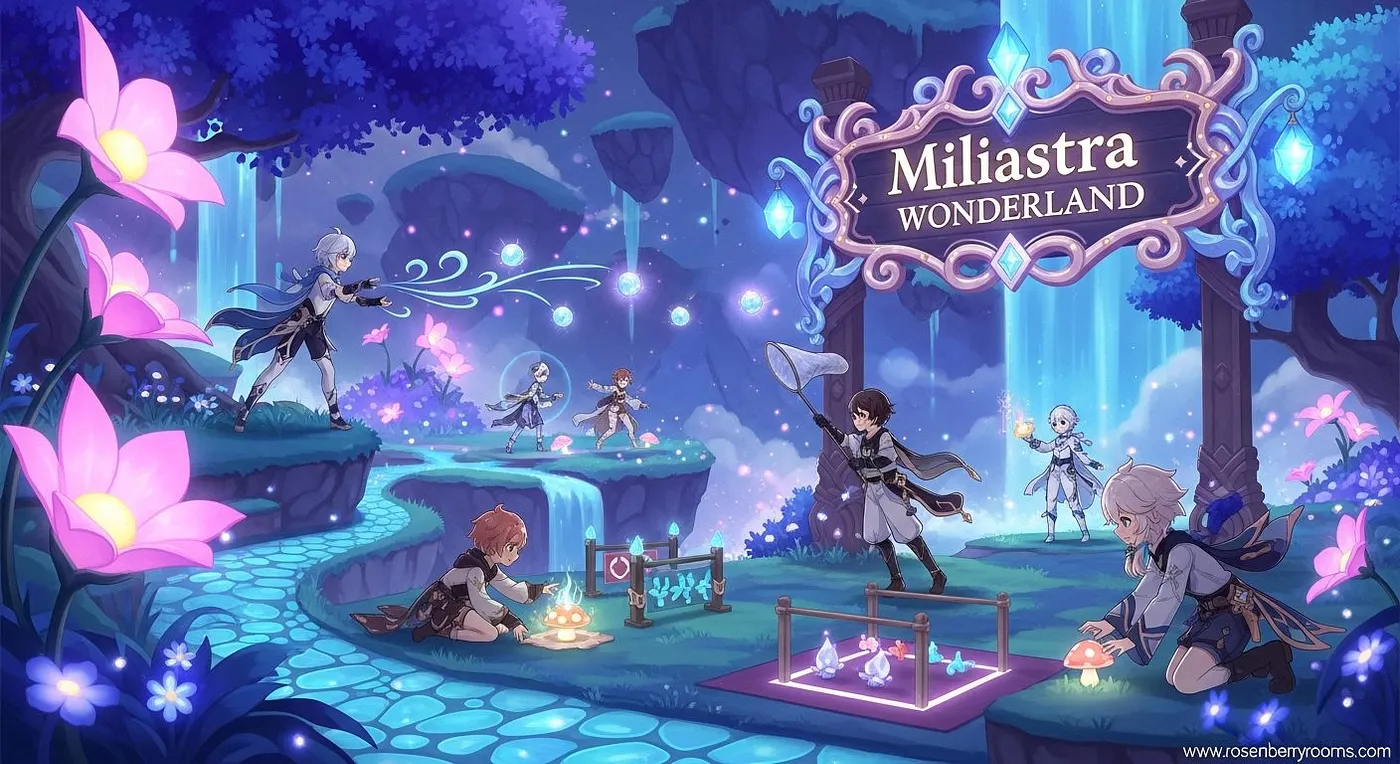
Miliastra Wonderland — Image from rosenberryrooms.com
That project is Miliastra Wonderland, a permanent user-generated-content platform — UGC, in industry shorthand, meaning a space where the players themselves build the content, rather than the studio — launched inside Genshin Impact in Version 6.1 “Luna II,” on October 22, 2025. It is, in concrete terms, exactly the kind of thing the “virtual world for a billion people” language had long gestured toward: a persistent social space with its own customizable avatars (Manekins), its own creation toolkit (the Miliastra Sandbox, open to any player willing to learn its node-based logic), public and private lobbies for meeting other players, and — notably — its own separate economy, layered on top of the base game’s existing one. Outfits for a player’s avatar are sold through a gacha system with its own currency, its own battle pass, and its own pity mechanics, entirely apart from the wishes and Primogems used to pull characters in Teyvat.
The launch did not go the way the “billion people” framing might have hoped. Coverage at the time — including a detailed breakdown from the outlet Gurugamer — catalogued a monetization structure that managed to feel aggressive even by gacha standards: the premium currency for cosmetics could only be obtained with real money, hard pity for a single five-star outfit ran to roughly seventy pulls (on the order of $138), upgrading a duplicate into its enhanced “ascended” form could cost roughly that much again, and outfit banners were gender-locked, so a player who wanted the same outfit on both the male and female Manekin had to pull — and pay — for it separately on each. Community discourse on HoYoLAB in the days after launch ran heavily negative, with thread titles bluntly declaring the mode “A Huge Disappointment” and asking why there was “so much hate” for it — sentiment that, fairly or not, drew comparisons to other studios’ failed attempts at adjacent UGC platforms and to whether the mode should have shipped as a separate product rather than bolted onto a five-year-old RPG.
HoYoverse did not abandon the project in the face of that reaction. Within a few months — by Version 6.3, “Luna IV,” around January 2026 — the studio added a new “Classic Mode,” which let players bring their own already-owned Genshin Impact characters into Wonderland stages, complete with their real artifacts, talents, and constellations intact, rather than being limited to the platform’s default custom avatars (Manekins) with creator-defined stats. The same version reportedly introduced a revenue system paying creators for the stages they built. Neither addition directly answered the monetization complaints from launch, but together they show a studio still actively building out the platform rather than letting it stagnate after a rough start.
What the public record does not contain, consistent with the broader pattern of this private, low-disclosure company, is a verified account of how the mode is actually performing: how many players return to it after the first month, what fraction ever spend money in it, or whether it is closer to a thriving second curve or a quietly maintained feature nobody especially asks for. Specific engagement figures circulating in some secondary gaming-news coverage — claims of tens of thousands of active creators and hundreds of millions of cumulative play sessions — could not be traced to any statement from HoYoverse itself, and should be treated with the same skepticism this article has applied to other unverified figures throughout.
What can be said honestly is narrower, and arguably more interesting than either a triumph or a failure narrative would be: the company’s own first real attempt at the persistent virtual world it has been promising since 2021 met immediate, specific, vocal resistance over exactly the extraction mechanics this article has already described as the engine underneath Genshin Impact itself — and the studio responded by iterating rather than retreating. Whether that is a “virtual world a billion people want to live in” taking its first wobbling steps, or a more elaborate version of the same gilded cage with better customization options, is not a question the available evidence yet answers. It is, in miniature, the exact dilemma the game’s own fiction keeps dramatizing: a comforting constructed world, built by people who likely believe they are giving something real to the people who enter it, whose actual costs only become visible to the people living inside.
IX. Under the Watchful Eye
This is where any claim of hidden rebellion must meet the evidence, and where the truthful answer is more interesting than the conspiracy.
The Rise of China-Approved Blockbusters — Image by Jonny Wan (CNN.com)
Begin with the regulatory landscape, because survival there is not guaranteed — it is, for a Chinese studio, its own kind of filter. The state does not merely censor content; it controls the licenses a game legally needs to operate domestically, and those approvals have at times frozen for months, each freeze a culling event for smaller studios with thin reserves. Layered on top are some of the world’s strictest controls on monetization and playtime, including limits on the hours minors may spend in online games. Across these shifts, large numbers of Chinese game companies have failed. Simply surviving this environment is an achievement; emerging from it as the state’s favored cultural export is something else.
Censorship of content is real and pervasive, and the rules are deliberately vague — edicts against material that might “endanger social morality or national cultural traditions,” elastic enough that companies over-censor preemptively. Genshin Impact complies: in its in-game chat, politically sensitive terms such as “Tiananmen” and “Tibet” are filtered with asterisks across all versions worldwide, occasionally catching innocent homographs in other languages.
So how does a game whose arc concerns resisting a memory-editing authority not only survive but become a celebrated national asset? The simple answer — that the studio fooled oblivious censors — is almost certainly wrong, and the real answer has two parts.
First, abstract fantasy does not trip the wires that explicit politics does. Censorship systems are built to catch direct, contemporary, real-world references — named events, specific dissidents, concrete political symbols. They are not built to flag Gnostic allegory. As long as the antagonists are fictional “Heavenly Principles” and the heroes wield elemental magic, the narrative reads to the state as fantasy that earns billions and wins favorable attention abroad. The subversive interpretation requires a player to do interpretive work — to map Celestia onto real authority — and that mapping lives in the player’s mind, not in any scannable string of text.
Second, and more importantly, the state does not wish to suppress Genshin Impact; it wishes to use it. In July 2021, China’s Ministry of Commerce named the game to its list of key national cultural-export projects. Through its China-inspired region of Liyue — with its traditional instrumentation, opera, folklore, and festivals — the game packages curated Chinese culture into a form that tens of millions of overseas players consume voluntarily. Researchers of Chinese soft power have noted that the propaganda apparatus actively prefers this kind of vehicle over the heavy-handed “red games” of the past, which failed; a 2024 analysis by the threat-intelligence firm Recorded Future documented official interest in spreading culture through games precisely because the soft approach reaches young foreign audiences that the hard approach repels. Chinese officials have publicly celebrated the game as evidence of the country’s cultural and technological standing.
This is the irony the conspiracy version misses. miHoYo did not slip a forbidden message past an oblivious censor. It built a game whose surface is a polished instrument of Chinese soft power and whose depths carry an anti-authoritarian philosophy aimed at a fictional heaven — a philosophy the state either does not read as a threat or does not mind, because the cultural export is aimed at real geopolitics. In that sense the company behaves like a clever faction within its own story: it observes the literal demands of the authority above it, and uses the freedom and capital that compliance earns to pursue its own deeper projects.
Whether the deeper philosophy is intended as political commentary is something no one outside the founders can honestly claim to know, and the distinction matters enormously. There is a wide gap between “the writers drew on suppressed esoteric traditions because those traditions make for resonant, archetypal stories” — which is well-supported — and “the writers are encoding a deliberate message against the state,” which is unfalsifiable. The psychologist Carl Jung and the mythologist Joseph Campbell both argued that when a culture sets aside its mythological frameworks, those frameworks do not vanish but resurface in art and fiction; Genshin Impact is a textbook case of old esoteric material returning in popular form. What can be said with confidence is narrower and still remarkable: a game carrying genuinely subversive philosophical content has become a celebrated arm of cultural policy, and both of those things are true at once.
X. The Great Filter, and the Choice the Story Leaves Us
Return, then, to the dilemma at the center of the game, because it maps with uncomfortable precision onto real anxieties of the present.
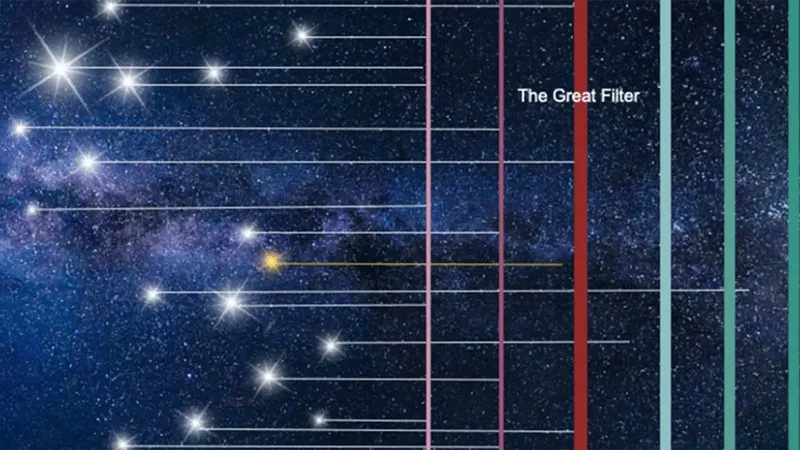
Illustration of the Great Filter Civilization Theory — Jiang at al. (iflscience.com)
The Heavenly Principles offer security at the price of stagnation: a world kept stable, comfortable, and unprogressing, with catastrophe visited on any civilization that climbs too high. The justification, the story concedes, is not pure malice — glimpses of the cosmos beyond Teyvat suggest a genuinely hostile reality, and the Heavenly Principles may be, in part, a shield. The authority that confines humanity may also be a reason humanity survives.
This is sophisticated moral writing, and it speaks to at least three real preoccupations. The first is the problem of the absolute protector: across history, humans have built centralized systems — states, institutions, economic orders — that promise safety in exchange for compliance, and the game presses the hard claim that every structure offering absolute security eventually demands absolute control, leaving a population kept soft and dependent defenseless when the protecting system falters. The second is the comfort trap: a modern intuition, deeply Jungian and as old as alchemy, that growth requires friction, and that sheltering a person — or a civilization — from every threat does not strengthen it but cripples its capacity to adapt.
The game gives this second idea its sharpest expression through the survivors of Khaenri’ah — the “Sinners,” remade by their exposure to the Abyss. Their creed, voiced in late-game lore, is transcendence through suffering: the conviction that a sheltered people stays helpless, and that only by passing through the fire of a hostile reality can the survivors evolve into something able to withstand it. One striking image renders this as alchemy — that when a tree’s fruit dies and its seeds fall into rotten soil, the seeds that take root may grow into trees bearing a far richer harvest. The “rotten soil” is the corrupted cosmos outside. It is a brutal philosophy, and the game neither fully endorses nor fully condemns it; it lets the player live inside the question. (It bears repeating that the fullest version of this worldview, like the Tsaritsa’s plan it is often attached to, is assembled by the community from fragments; the characters voice pieces of it, and theorycrafters supply the rest.)
The third preoccupation is the Great Filter — the hypothesis that advanced civilizations tend to hit some self-made crisis that ends them. The Heavenly Principles’ answer is to press pause: keep the world primitive, loop its history, suppress the ambition that might invite catastrophe. The game’s emerging argument is that the pause is an illusion — that one cannot hide from cosmic reality forever, and that the only path with any chance of survival runs through the crisis rather than around it.
It is not hard to see why this story would resonate with the people who built it. miHoYo’s leadership is betting, with real capital, that one does not survive the future by staying small and safe — funding fusion against an energy ceiling, rockets against a planetary one, and AI and brain-computer research against the limits of the mind. Their portfolio is, in a sense, the corporate form of the gamble the story dramatizes.
And here honesty requires turning the same skepticism on the most flattering reading. It is genuinely uncertain whether that gamble is wisdom or grandiosity. The same company that tells a story prizing sovereignty and growth also runs a refined engagement-and-spending system, complies with the censorship rules of an authoritarian state, and is now investing heavily in AI whose effects on its own players’ attention and autonomy are an open question. A “virtual world a billion people want to live in” is a phrase that could describe a flourishing or a more comfortable confinement — and the game itself, through the Sabzeruz Samsara and through Siraj’s hive mind, repeatedly warns against artificial worlds that stand in for the real one. Whether the studio is building an escape from limits or a more beautiful set of them is a question it is answering, right now, with real money in the real world, and the answer is not yet in.
XI. Nested Fairy Tales
What remains is a structure of stories within stories, each carrying something the layer above would rather forget.
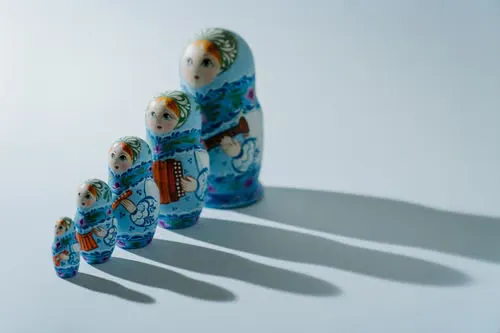
Nesting Dolls — Image by Cottonbro Studio
At the innermost layer is Teyvat, where fairy tales like The Pale Princess and the Six Pygmies are said to hide secrets of a history the world has lost, and where a coven of witches dives into Irminsul to recover what has been deleted. One layer out is Genshin Impact itself — a fantasy that draws its architecture from Gnosticism, Hermeticism, and alchemy, traditions long pushed to the margins, and dramatizes through fiction the questions those traditions asked about freedom, authority, and the nature of a constructed reality. One layer out from that is miHoYo, a company that observes the literal demands of its censors while using the freedom and capital that compliance earns to fund the technologies of a future no government fully controls. And at the outermost layer is the audience, holding the whole nested artifact and deciding how much of it to believe.
The honest conclusion resists both the clean conspiracy and the clean dismissal. Genshin Impact is not a secret manifesto smuggled past unwitting tyrants — the state knows exactly what it has and celebrates it. Nor is it merely a commercial machine in fantasy dress — its philosophical content is real, deliberate, and unusually serious for a free-to-play game. It is, instead, an uncommon kind of cultural object: genuinely meaningful and genuinely commercial, an instrument of a system and a quiet argument with it, depending on the layer at which one chooses to read it.
The game leaves its central question open, and refuses to answer it on the player’s behalf: if the reality beyond the sanctuary is hostile, and the sanctuary — for all its constraints — is part of why anyone is still alive, is it wisdom to stay, or to break out anyway?
What is no longer in question is that the money is real, and that it is flowing — into a fusion reactor in Shanghai, a rocket on a Shandong launchpad, a brain-computer lab in a Shanghai hospital, and a vast bid to build new kinds of artificial minds. The tech otakus, by their own chosen name, are not only telling a story about the choice between safety and growth. With eyes open and the state’s blessing, they are placing their own bet on it — and inviting a great many people to follow the experiment, one chapter at a time.
Works Cited
miHoYo / corporate history and leadership
- “MiHoYo.” Wikipedia. en.wikipedia.org/wiki/MiHoYo
- “miHoYo’s Founding Journey.” Naavik, 12 Oct. 2023.
- “miHoYo and its Metaverse dream.” PandaYoo, 2 May 2024.
- “Cai Haoyu” and “MiHoYo.” Grokipedia.
- “miHoYo.” Baidu Baike (English).
- “Chinese video gaming powerhouse miHoYo … shuffles chairman role.” South China Morning Post (via Yahoo Finance), 20 Sept. 2023. (On Cai Haoyu stepping back from chairman/CEO/legal-representative roles to focus on cutting-edge technology and new projects.)
Fusion — Energy Singularity / HH70
- “Chinese Game Giant Investing $65 Million in Nuclear Power.” The China Academy, 18 July 2024.
- “World’s First Fully HTS Tokamak Sets Fusion Duration Record in Shanghai.” Yicai Global, Apr. 2026. (1,337-second plasma duration record.)
- “Energy Singularity seeks $500M for record-breaking fusion reactor.” Interesting Engineering, Sept. 2024.
- “China’s Energy Singularity produces first plasma.” bne IntelliNews, 26 June 2024. (Note: this outlet’s “net positive” framing is not corroborated by primary sources, which describe first plasma and duration records.)
Aerospace — OrienSpace
- “Genshin Impact’s MiHoYo is so rich, it invested in a rocket.” ONE Esports, 25 May 2022.
- “China Space Startup Orienspace Bags Nearly USD 60 Mn in Series A Round.” EqualOcean, 2022.
- “China’s OrienSpace could be valued at $823 million.” Reuters (via Investing.com), 22 Aug. 2023.
Metaverse vision, AI investment, and Anuttacon
- “miHoYo Reveals Goal to Create a Massive Virtual World.” Anime Corner, 27 Feb. 2021.
- “Genshin Impact maker miHoYo aiming to build virtual world that connects 1 billion users by 2030.” Game World Observer, 12 Jan. 2023.
- “HoYoverse to Invest $16 Billion Over Next Three Years, Aiming for Full-Stack AI.” Inven Global, 19 May 2026.
- “MiHoYo reportedly invests $14 billion in AI model over three years.” Esports.gg, 20 May 2026.
- “miHoYo Pledges $13.9B AI Bet, Recalls Silicon Valley Team.” China Biz Insider, 2026. (On Anuttacon’s LLM team consolidating into China; U.S. export-control context.)
- “Whispers from the Star, an AI-Driven Sci-Fi Game by HoYoverse Devs, Announces Closed-Beta Test.” Game8, 30 Mar. 2025.
- “MiHoYo Founder Cai Haoyu’s New AI Game, ‘Whispers From The Star.’” AIbase, 16 Mar. 2025.
Upcoming projects
- “Honkai: Nexus Anima — Everything We Know.” GameSpot, Jan. 2026.
- “What we know so far about Varsapura, Hoyoverse’s next game.” KrAsia, 24 Nov. 2025.
- “[GI.biz] HoYoverse to invest up to $14.6bn in AI … Petit Planet AI NPCs.” GamesIndustry.biz, May 2026.
China soft power, censorship, and cultural-export designation
- “Genshin Impact and Chinese Nationalism.” The Diplomat, 25 Feb. 2023. (July 2021 Ministry of Commerce cultural-export designation.)
- “China and the Globalization of the Gaming Industry.” Baker Institute, 21 June 2022. (In-game chat censorship of sensitive terms.)
- “Genshin Impact balances mass appeal with Beijing’s blessing.” The Record (Recorded Future News), 9 Dec. 2024. (Insikt Group / Devin Thorne analysis of CCP soft-power game strategy.)
- Li, Qian, and Xiaotian Li. “Debating the ‘Chineseness’ of a mobile game in online communities.” Global Media and China (SAGE), 2023.
Revenue and player statistics
- “Genshin Impact Statistics 2026.” Business of Apps; Quantumrun; Player Counter; Priori Data. (Mobile IAP peak of ~$1.9B in 2022; ~$710M in 2024; $5B and $10B lifetime milestones; MAU figures; 300M+ registered accounts; ~$200M/year development cost; ~66M peak monthly players across platforms, early 2023.)
Game lore (in-game canon, verified via official and community references)
- Greater Lord Rukkhadevata; Irminsul/Modifications; The Seven. Genshin Impact Wiki (Fandom). (Rukkhadevata erased in Sumeru Archon Quest Ch. III, Act V — Where the Boat of Consciousness Lies, Version 3.2; Scaramouche’s self-erasure in Interlude Act III — Inversion of Genesis, Version 3.3.)
- Pierro; Tsaritsa; Ronova / Divine Beings. Genshin Impact Wiki and TV Tropes. (Pierro as a Khaenri’ahn royal mage cursed with immortality by Ronova, Shade of Death, in the aftermath of the Cataclysm; the Tsaritsa’s aims conveyed only secondhand, through Dainsleif, Fatui lore, and Pierro.)
- Archon War; God. Genshin Impact Wiki. (Gnoses forged from the Third Descender’s remains and Thrones from the Dragon Sovereigns’ powers; Visions made from the Seven Sovereigns’ stolen authority, revealed in the Fontaine Archon Quest, Version 4.2.)
- The Empty Illusions of the Sabzeruz Festival; The Samsara of the Sabzeruz Festival; The Morn a Thousand Roses Brings; Setaria. Sumeru Archon Quest, Chapter III, Act II (Version 3.0, 2022). Genshin Impact Wiki (Fandom); Gamepur. (Confirms the Sabzeruz Samsara was deliberately engineered by a faction of Akademiya sages under the Grand Sage Azar, using the Akasha to separate citizens’ consciousness from their dreams and harvest the resulting “Jnana” energy to fuel Scaramouche’s planned ascension — not an unintended malfunction.)
- Siraj; Version 3.4; Alhaitham Story Quest Vultur Volans, Act I — The Illusions of the Mob (Version 3.4, 18 Jan. 2023). Genshin Impact Wiki; Game8; GameWith. (Siraj’s “collective consciousness”/hive-mind project — corrected against the common misremembering of a “reunion-with-the-dead simulation.”)
- Narzissenkreuz; Narzissenkreuz Institute; Waking from the Great Dream (Quest); The Narzissenkreuz Adventure. Genshin Impact Wiki (Fandom); TV Tropes. (World Quest series “In the Wake of Narcissus,” Fontaine, Version 4.0–4.2, 2023; Narzissenkreuz built by Jakob Ingold and Rene de Petrichor to merge all Fontainians’ minds and consciousnesses; the dream-world Annapausis built by the Oceanid Lyris merging with the dying Mary-Ann; disguised figures and hostile “Phantasm” enemies within the dream.)
- Miliastra Wonderland. Genshin Impact Wiki (Fandom); Game8; GameWith. (Launched in Version 6.1 “Luna II,” 22 Oct. 2025; UGC sandbox with Manekin avatars, the Miliastra Sandbox creator toolkit, and a separate gacha/currency/battle-pass economy from the base game.)
- “Genshin Impact 6.1’s Miliastra Wonderland Is An Absolute Disaster.” Gurugamer, 26 Oct. 2025. (Detailed breakdown of launch monetization backlash: real-money-only premium currency, ~70-pull/~$138 hard pity for a 5-star outfit, gender-locked banners, costly duplicate “ascension,” and loss of set bonuses when mixing pieces.)
- “Seems like Miliastra Wonderland is failing Genshin Impact”; “Miliastra Wonderland Is A Huge Disappointment”; “Why there are so much hate for miliastra wonderland?” HoYoLAB community forum threads, Oct. 2025. (Community sentiment in the weeks following launch; cited as forum discourse, not verified engagement data.)
- “Genshin Impact Miliastra Wonderland: General Guide.” act.hoyoverse.com official tutorial; “Miliastra Wonderland/Editor and Miliastra Sandbox.” Genshin Impact Wiki (Fandom); “Miliastra Wonderland.” Baidu Baike (English). (Classic Mode, added in Version 6.3 “Luna IV,” confirmed via official documentation to let players use their own already-owned characters — retaining real artifacts, talents, weapons, and constellations — inside Wonderland stages, as distinct from the platform’s default Beyond Mode, limited to custom Manekin avatars with creator-defined stats; a creator revenue system reportedly launched in the same version. This corrects an earlier, inaccurate secondary-source characterization of Classic Mode as a “lower-grind” casual mode.)
- The Pale Princess and the Six Pygmies; Hexenzirkel. Genshin Impact Wiki; teyvatlore.garden. (In-universe fairy tale containing a “secret” of Teyvat’s history, sought by the Abyss Order in Lisa’s Story Quest; the “Moonlight Forest = Khaenri’ah” decoding is noted as community interpretation, not confirmed canon.)
- Nod-Krai. Wikipedia. (Region released Version 6.0 “Luna I,” 10 Sept. 2025; Snezhnaya as the forthcoming next region.)
Methodological note
Where this article describes verifiable corporate facts — investments, revenue, the cultural-export designation, censorship practices, leadership changes — those rest on the journalistic and primary sources above. Where it describes in-game events, it cites the specific Archon Quest, Story Quest, artifact set, or patch version, drawing on official lore and the community wikis that catalog it; voice lines, character stories, books, artifact descriptions, and weapon lore are treated as canon, consistent with how the game presents them. Where a reading is interpretation rather than confirmed canon — the decoding of specific fairy tales, the full scope of the Tsaritsa’s plan, the connective narrative around the Dragon Sovereigns’ defeat, and any link between the game’s cautionary tales and miHoYo’s real-world ambitions — it is labeled as such. The thesis that miHoYo deliberately encodes political messaging is identified throughout as speculation, because it is unfalsifiable; the parallels are presented as parallels, and the reader is left to weigh them.