The global infrastructure landscape is undergoing a massive, irreversible shift. Driven by the exponential demands of artificial intelligence, cloud computing, and next-generation workloads, hyperscale data centers are expanding at a rate never seen before. Yet, as these massive monolithic structures reshape rural horizons and urban industrial parks, they face a critical inflection point. The era of transaction-based, tax-only local relationships is over.
To secure their social license to operate and guarantee long-term viability, data center project planners must look beyond power usage effectiveness and water scarcity metrics. They must embrace the fourth pillar of responsible digital infrastructure: Economic Reciprocity. For data center development to accelerate sustainably, planners must systematically engineer tangible, structural benefits directly into the social contracts of the communities hosting them.
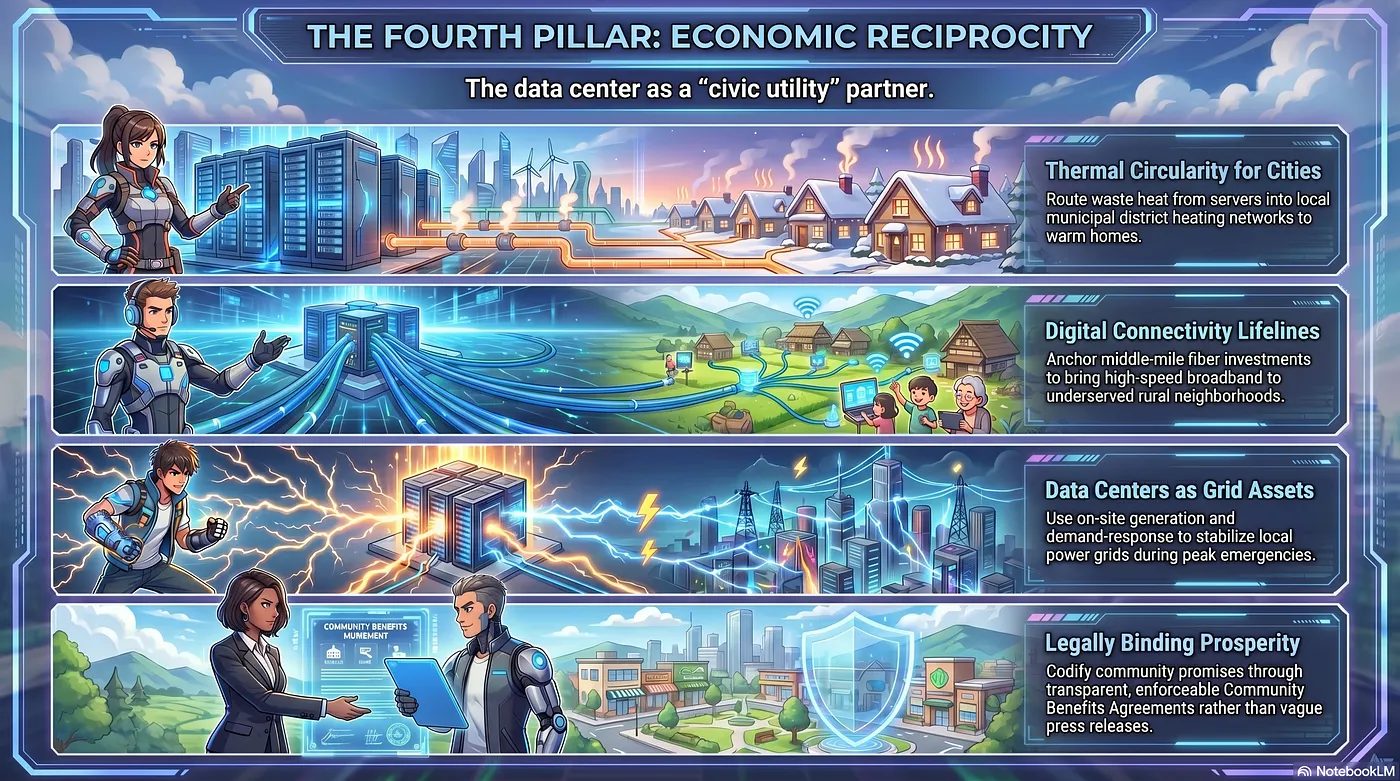
The Fourth Pillar: Economic Reciprocity — Infographic generated by Google Gemini
The Post-Industrial Dilemma: The Operational Employment Gap
Historically, when a massive industrial project broke ground in a town, the local population understood the trade-off. A twentieth-century paper mill, textile factory, or automotive manufacturing plant took up vast acreage and consumed immense local resources, but it paid a recognizable dividend: hundreds or thousands of stable, lifelong blue-collar jobs that anchored local economies for generations.
Data centers present an entirely different economic paradox, and it is one the industry has been slow to acknowledge publicly.
During the construction phase, a hyperscale campus is an undeniable economic engine, employing hundreds of local tradespeople, electricians, pipefitters, and engineers. A study from the Hamm Institute’s November 2025 workforce analysis found that construction requirements for data centers range from 0.7 to 2.0 workers per megawatt of capacity during the build phase — meaning a 500-megawatt campus can generate between 350 and 1,000 construction jobs over an 18-month to 36-month build period. A 100-megawatt hyperscale campus, according to the Uptime Institute’s 2024 Global Data Center Survey, typically employs roughly 850 construction workers during its build phase. These are real, well-paying jobs. The problem is what comes after.
Once the concrete cures and the servers are racked, the operational reality sets in. The most automated hyperscale campuses — those exceeding 100 megawatts and built by the cloud and AI hyperscalers — can operate with as few as 20 to 30 permanent staff per 100 megawatts of capacity, according to the Hamm Institute analysis. An average retail data center using 2 to 5 megawatts employs about 30 permanent workers, according to Built In’s 2026 industry survey. Hyperscale facilities operate at the lowest staffing ratios in the industry, because they are engineered from the ground up for automation. A Vantage Data Centers facility outside Reno disclosed just 73 permanent positions for a 1.1-million-square-foot site in 2024 business records. Meta’s 10-billion-dollar Lebanon, Indiana campus will employ roughly 300 people once complete. Amazon’s $35-billion Virginia investment promised 1,000 permanent positions phased across seventeen years.
The Brookings Institution’s January 2026 research paper, “Why Community Benefit Agreements Are Necessary for Data Centers,” authored by Brookings Center for Technology Innovation Senior Fellows Nicol Turner Lee and Darrell West, framed the employment gap with unusual directness: “Large data center projects often promise only dozens to a few hundred permanent workers while the associated construction jobs are temporary.” A separate Brookings paper released in May 2026, “New Evidence on Data Center Employment Effects,” authored by a team that assembled a dataset of approximately 770 U.S. facilities, provided the quantitative confirmation: the information-sector employment effects of hyperscale facilities are modest, driven primarily by indirect supply-chain activity rather than direct hiring. For colocation facilities, the agglomeration effects were stronger, but for hyperscale campuses built by Amazon, Google, Microsoft, and Meta to run their own workloads, the direct employment creation is structurally constrained by automation.
For a community experiencing the immediate pressure of an expanded physical footprint, potential noise emissions, and increased strain on the local energy grid, a handful of permanent operational jobs can feel like a deeply unequal trade. If the long-term impact is restricted solely to baseline municipal tax revenue — which, while substantial, is passive and invisible in a community’s daily life — local enthusiasm quickly sours into resentment. The political arithmetic has already turned. A January 2026 poll commissioned by CCAN Action Fund found that 73 percent of Virginia likely voters blame data centers for rising electricity costs. A Washington Post–Schar School poll conducted in April 2026 found that voter comfort with a new data center in their community had fallen to 35 percent, down from 69 percent in 2023. To bridge this post-industrial gap, responsible developers must ask a fundamental question: what structural value can our facility return to this community if we cannot offer thousands of factory floor jobs?
Redefining the Social Contract Through Infrastructure Symbiosis
The answer lies not in passive co-existence but in active infrastructure symbiosis. Because data centers operate as localized intensive utilities — concentrating energy, cooling, fiber, and computing in one place — they possess unique and underused opportunities to share the operational fruits of that concentration with the communities that surround them. The most powerful of these opportunities fall into two categories: thermal circularity and digital connectivity lifelines.
Thermal Circularity and District Heating
Every kilowatt-hour of electricity fed into an AI cluster ultimately transforms into thermal waste. The servers produce heat as an inevitable by-product of computation, and the conventional response has been to expend still more energy to reject that heat into the atmosphere through cooling towers, dry coolers, or refrigeration cycles — converting a recoverable resource into an environmental liability. Rather than expending further energy to push waste heat skyward, vanguard data center operators are routing it back into local municipal utilities, converting a liability into a civic asset.
The canonical example — and by Fortum’s own description, the world’s largest data center heat recovery project — is the collaboration between Microsoft and the Finnish state-owned energy company Fortum in the Helsinki metropolitan area. Announced in March 2022, the project involves Microsoft constructing a new data center region in Espoo, the second-largest city in Finland, specifically chosen because Fortum had designed the data center location with waste heat recycling as a primary criterion. Fortum operates a 900-kilometer underground district heating network serving the cities of Espoo, Kauniainen, and Kirkkonummi — the second-largest district heating network in Finland. According to Fortum’s official project page and the project’s AFRY engineering partner, once Microsoft’s data centers reach full operational capacity, the waste heat from the server halls will cover approximately 40 percent of the total annual district heating demand across those three municipalities — roughly 40 percent of a two-terawatt-hour annual demand supplying approximately 250,000 heat users. Fortum switched on two large-scale heat pump plants at Kolabacken in Kirkkonummi and Hepokorpi in Espoo in May 2026, with heat integration from Microsoft’s facilities scheduled to begin step by step as new construction phases complete. The company also discontinued coal-fired district heating entirely in 2024, a year ahead of its original schedule, in part because the Microsoft waste heat partnership made the coal assets redundant.
The project is the world’s largest data center heat recovery initiative, and Finland’s largest single information-and-communications-technology investment. It was described by Fortum’s Executive Vice President for Renewables and Decarbonisation, Peter Strannegård, as “a story of decarbonization and heat-use efficiency at an unprecedented scale.” The use of the waste heat is projected to reduce approximately 400,000 tonnes of carbon dioxide emissions per year, advancing Espoo’s goal of becoming carbon-neutral by 2030.
This model did not begin with Microsoft. The Helsinki-based energy company Helen and the data center operator Equinix pioneered the first data center district heating project anywhere in the world in 2010, connecting Equinix’s Kanavaranta facility to Helen’s 1,409-kilometer district heating network. In June 2022, the two companies extended their cooperation to include additional waste heat from Equinix’s Suvilahti (HE3) and Viikinmäki (HE5) facilities in Helsinki. Noah Nkonge, Heat Export Lead at Equinix, confirmed in the October 2024 announcement of the HE5 expansion that the Viikinmäki project provides heat equivalent to more than 1,000 Helsinki homes. Helen separately operates a heat recovery service with Telia’s Helsinki Data Center, from which up to 90 percent of the facility’s waste heat is recovered and routed to the district heating network — supplying heat consumed by 14,000 two-room apartments in Helsinki, with plans to extend to 28,000 apartments.
This model is breaking ground in North America. In downtown Toronto, Telehouse Canada — a KDDI subsidiary that acquired three data centers from Allied Properties REIT in 2024 — completed a major infrastructure upgrade in May 2026, deploying direct liquid-to-chip cooling systems at its 151 and 250 Front Street West data centers. The excess heat from the liquid-cooled equipment is transferred to Enwave Energy’s closed-loop district energy system, where it is captured and repurposed through a fully isolated process to help heat Toronto’s municipal drinking water. As Telehouse Canada’s published business wire announcement describes, the heat from the server cooling loops is passed through Enwave’s deep-lake-water-cooling infrastructure — Enwave draws cold water from approximately 83 meters below Lake Ontario’s surface, uses it to cool downtown buildings across a broad network of commercial and residential customers, and routes the resulting warm water through a heat exchange that raises Toronto’s drinking water to acceptable distribution temperatures before it enters the city’s supply system. Every unit of heat generated by the servers is therefore re-used rather than vented. The system removes reliance on chillers during normal operation, reduces evaporative cooling water demand, and improves Telehouse Canada’s power usage effectiveness simultaneously.
Through thermal recycling of this kind, the data center evolves from an energy consumer — a node that takes and takes — into an essential public utility partner that contributes to the thermal economy of the city it inhabits. This is not a theoretical future. It is operational in Helsinki, active in Espoo, and now live in Toronto. For any developer designing a new hyperscale facility with direct liquid-to-chip cooling — which, as the first and second pillars of this series argued, is the standard the industry is adopting — the thermal output that was previously a problem to be managed is now a resource to be redirected.
Digital Infrastructure and Connectivity Lifelines
The second major opportunity for infrastructure symbiosis involves the fiber-optic networks that data centers require, and the communities they could serve. When developers construct a hyperscale data center, they pull massive, redundant fiber-optic pipes into the region. These fiber routes are not incidental — they are load-bearing infrastructure that makes the data center economically viable. The bandwidth-to-data-center relationship is so fundamental that the Fiber Broadband Association’s 2025 white paper, “Middle Mile Networks: The Backbone and Highway to Affordable Broadband Innovation,” identified data center growth as the defining driver of middle-mile fiber demand, projecting that U.S. data center bandwidth purchases increased 330 percent between 2020 and 2024, and that fiber route miles may need to nearly double from roughly 95,000 miles today to 187,000 by 2029 to meet projected demand.
Economic reciprocity means ensuring that this digital highway has a local off-ramp. By partnering with regional internet service providers and municipal leaders, data center planners can anchor middle-mile fiber investments that bring high-speed broadband to previously underserved rural or low-income neighborhoods surrounding the campus. The Fiber Broadband Association’s Broadband Breakfast analysis published in February 2026 documented data centers as an “economic development opportunity for rural providers and electric cooperatives,” framing the fiber investment that hyperscalers must make as a shared resource rather than a purely private asset.
Meta’s Forest City campus in Rutherford County, North Carolina — introduced in the third pillar of this series as the canonical brownfield data center case study — is also the most developed American example of fiber connectivity as a social contract. When Meta built a high-capacity fiber route in 2020 connecting its Forest City data center to its Georgia campus, the company partnered with MCNC, the non-profit operator of the North Carolina Research and Education Network, to build approximately 100 miles of fiber making high-speed broadband available to nearly 30 Community Anchor Institutions in the western North Carolina counties of Rutherford, Burke, Caldwell, Wilkes, and Surry. These institutions included community colleges, charter schools, treatment facilities, and government offices. Meta also partnered with PANGAEA Internet, the towns of Forest City, Rutherfordton, and Spindale, and Rutherford County Schools to construct a free Wi-Fi network enabling thousands of local students and families to access the internet who previously could not. U.S. Senator Thom Tillis described the investment as “on a par with bridges and roads” in terms of vital infrastructure. The Forest City model demonstrates that fiber connectivity — infrastructure the data center requires and would build regardless — can be structurally extended to serve the surrounding community at marginal additional cost, converting a private necessity into a public benefit.
The Power of Legally Binding Community Benefits Agreements
True economic reciprocity cannot rely on loose corporate social responsibility press releases or vague promises of community goodwill. It must be codified through transparent, legally binding Community Benefits Agreements. The Brookings Institution’s January 2026 paper on CBAs, which anchors this section’s analysis, is explicit on this point: “Transparency and cooperation between firms, local institutions, and residents are essential to facilitate community input into CBAs, and for proposals to support residents’ digital access, well-being, employment, and more.”
The NDA problem is fundamental to understanding why the CBA conversation is happening now. Brookings CTI’s Nicol Turner Lee told the Brookings Podcast in December 2025: “Data centers, by contrast [to other infrastructure], are very opaque. A huge global real estate market is poised to make a huge profit. Boston Consulting Group estimates that hyperscale data centers will need about $1.8 trillion between 2024 and 2030 to meet AI and cloud infrastructure demand. Most of those deals happen quietly, and most real estate transactions are done through NDAs, and little public understanding of the actual investment.” The Virginia Conservation Network’s 2025 transparency policy report corroborated this finding, documenting that “limited transparency and the widespread use of non-disclosure agreements hinder public access to crucial information on data center proposals” and that localities often lack the technical capacity to evaluate grid, air quality, and water impacts independently.
The NAACP has published both a resolution and a practical accountability framework in response to this opacity. The NAACP’s 2025 resolution on data centers, “Data Centers’ Impact on Energy Demand,” resolved that “state and local governments create additional benchmarks for data centers for meaningful disclosure and accountability regarding environmental threats” and called on Congress to “demand transparency and standardized methodology regarding data and usage of water, energy, and emissions.” The NAACP’s Center for Environmental and Climate Justice Director, Abre’ Conner, summarized the organization’s position at the NAACP’s “Stop Dirty Data” summit in December 2025: “Jobs without transparency are not justice, tax revenue without public benefit is not development, and innovation that requires secrecy, displacement, and environmental harm is not innovation.” The NAACP’s practical accountability guide, “Our Power and Data Center Decisions: A Roadmap to Holding Data Centers Accountable,” further called on communities to use city councils, public utility commissions, and air permit boards to demand disclosure and enforceable limits as conditions of development approval.
The Brookings paper also identified the work of the Sabin Center for Climate Change Law at Columbia University, which published a best practices guide for community benefit agreements for clean energy infrastructure projects. The Sabin Center’s Columbia University Community Benefits Agreements Database, assembled concurrently, documents publicly available CBAs across the United States, finding that the most effective agreements include direct payments or community funds, tax revenue projections, infrastructure improvements, job creation commitments with local hiring preferences, and environmental hazard monitoring.
The most current and instructive real-world example in the United States is the City of Lancaster, Pennsylvania. The city of Lancaster — a county seat with approximately 60,000 residents, located in the heart of Pennsylvania Dutch country — approved the development of data centers at two former LSC Communications printing plant sites: 216 Greenfield Road and 1375 Harrisburg Pike. The developers — a joint venture including Blue Owl Capital, Chirisa Technology Parks, and Machine Investment Group, with CoreWeave as the named technology tenant — are building facilities with a total budget of up to $10 billion, the largest capital investment in Lancaster city history. The total construction permit fees alone totaled $7.8 million.
What distinguishes Lancaster is what the city negotiated in return. In fall 2025, after significant public opposition organized through groups including Lancaster Stands Up, the city and developers executed a formal Community Benefits Agreement, the text of which was published on the City of Lancaster’s official website. Its provisions are concrete and legally enforceable.
On water, the CBA codified a hard cap: “The Owners covenant and agree that their use of municipal water shall not exceed twenty thousand (20,000) gallons per day at either of the Campuses.” This figure — achieved through a closed-loop cooling design — represents a dramatically lower water burden than any comparable manufacturing or industrial use that previously occupied the sites.
On financial contributions, the agreement mandated phased multi-million-dollar payments, totaling $20 million across both campuses, split equally between a city Economic Development Fund and a Sustainable Development and Clean Energy Fund. Lancaster online reported that half of the $20 million will be distributed to nonprofits for economic development by a committee including city council representatives, the Lancaster County Community Foundation, the Lancaster County Economic Development Corporation, and the developers. These are not voluntary charitable contributions — they are contractual obligations with payment milestones tied to construction financing dates and commencement of operations.
On clean energy, the agreement required the developers to use 100 percent clean energy at the data centers, with a contractual floor prohibiting the energy mix from dropping below 60 percent clean energy at any time, and a Contingent Clean Energy Fund of no less than five million dollars that activates if the facilities fall below the full clean-energy commitment. On accountability, the city retained the right to pursue injunctions — up to and including the complete discontinuance of facility operations — if non-financial environmental and community commitments are breached.
Then-Mayor Danene Sorace, whose administration negotiated the agreement, characterized it at adoption as offering “benefits like $20 million in payments toward local causes and a commitment to use 100% renewable energy that are atypical for data centers in Pennsylvania and far beyond what zoning can accomplish.” Lancaster city officials have explicitly stated they hope the Lancaster CBA can serve as a model for other Pennsylvania municipalities and, by extension, for the nation.
The Lancaster example demonstrates what effective CBAs look like in practice: specific resource caps with engineering solutions to back them, phased financial transfers into named community funds with oversight committees, minimum clean energy percentages, and enforcement mechanisms with teeth. These are not aspirational values statements. They are the terms of a business operating license.
Federal Incentives and the Revitalization Movement
Embracing economic reciprocity is not merely an ethical imperative — it is increasingly a competitive regulatory advantage that directly affects a developer’s ability to access federal financing, qualify for tax credits, accelerate environmental review, and secure grid interconnection.
The Inflation Reduction Act’s Energy Communities framework, as detailed in the third pillar of this series, explicitly defined brownfield sites, coal-closure communities, and fossil-fuel-dependent statistical areas as qualifying for a 10-percentage-point Investment Tax Credit bonus. While the One Big Beautiful Bill Act signed in July 2025 terminated this adder, the underlying incentive structure signals what Congress has been willing to reward: investment in communities that hosted legacy energy infrastructure, paired with development that contributes to local economic revitalization. The Community Benefit Plan requirement embedded in many IRA program implementations — including the DOE Loan Guarantee Program’s Title XVII guidelines and the Advanced Energy Project Tax Credit under Section 48C — makes community-centric development models a prerequisite for federal financial support.
EPRI’s DCFlex initiative, which as of late 2025 partners with more than 40 organizations including Google, Meta, Microsoft, Duke Energy, and PJM, is testing demand-response, workload shifting, and use of uninterruptible power supplies as grid resources. The DOE’s 2024 “Powering AI and Data Center Infrastructure Recommendations” explicitly identifies “codifying utility-operator flexibility contracts” as one of three priority strategies for managing data center load growth. A data center that participates in demand-response programs — agreeing to curtail or shift its computational workloads during grid emergencies in exchange for rate incentives or capacity payments — is not merely acting as a good citizen. It is acting as a dispatchable grid asset, providing high-value frequency regulation and emergency load relief to the surrounding community.
By designing facilities that act as microgrid anchors — equipped with behind-the-meter SOFC generation, battery storage, and demand-response capability — data centers align themselves with the DOE’s stated grid-resilience objectives and with the Deloitte Power and Utilities Industry Outlook’s 2025 finding that utilities are actively seeking large, controllable loads as partners in distributed energy resource programs. A data center that can shed 50 megawatts of inference load during a summer peak event, or that can island itself and provide emergency power to surrounding critical facilities — hospitals, water treatment plants, emergency services — during a winter storm, has transformed from a grid burden into a grid asset. This transformation is not theoretical. It is the operational philosophy that underpins the architecture described in the second pillar of this series.
Conclusion: The Cost of Ignoring the Neighborhood
The political and regulatory math is now unambiguous. As of March 2026, according to Senator Bernie Sanders’s press release announcing the AI Data Center Moratorium Act — introduced alongside Representative Alexandria Ocasio-Cortez on March 25, 2026 — more than 100 local communities across the United States have enacted moratoriums on new data center development, and 12 states have introduced related legislation. The bill, which would impose an immediate federal moratorium on AI data centers exceeding 20 megawatts of peak power demand until Congress enacts comprehensive AI safeguards, represents the most aggressive legislative challenge to date, though Roll Call correctly notes it is “unlikely to advance under Republican control of Congress.” What it represents politically is more significant than its legislative probability: it is the formal entry of federal-level anti-datacenter politics into the mainstream, backed by two of the Senate and House’s most prominent progressive voices, and given numerical context by a movement that blocked or delayed $156 billion in data center investment in 2025 alone, according to the Wikipedia compilation of opposition cases.
In Ohio, approximately 18 municipalities were considering or had already enacted moratoriums on new data center construction as of February 2026, according to WOSU Public Media. Communities including Twinsburg, Ravenna, Avon, Painesville Township, and South Bloomfield enacted short-term prohibitions. Lordstown became entangled in litigation with a developer after blocking a data center bid. The state of Ohio, which had offered $2.5 billion in data center sales-tax incentives between 2017 and 2024, was actively reconsidering those programs in the face of public pushback over electricity rate increases and land-use conflicts. In Virginia, Prince William County’s Digital Gateway — which as detailed in the third pillar was one of the most ambitious greenfield data center proposals in American history — was voided by a state appellate court, then abandoned by Compass Datacenters, following years of organized civic opposition.
Data Center Watch’s Q2 2025 update identified $98 billion across 20 projects in 11 states stalled during a single quarter. At least 188 local opposition groups now operate in 40 states, up from 142 groups just months earlier. Project cancellations accelerated from six in 2024 to 25 in 2025, compared with two in all of 2023. These numbers are not a temporary headwind. They are the outcome of a decade of what Milldam Public Relations’ December 2025 analysis called “the black box narrative” — a development model characterized by NDAs, closed-door tax abatement negotiations, and facilities that consume community resources while returning only a nominal property tax line on a municipal budget and a chain-link fence.
The math is simple: digital infrastructure must scale rapidly to keep pace with human innovation, but it cannot scale without local consent. Data center projects should be aggressively embraced, funded, and accelerated — provided their planners approach the host community with a transparent strategy for tangible, mutual prosperity.
When developers act as true economic neighbors — routing thermal output back into district heating networks as Microsoft and Fortum are doing in Espoo, extending fiber connectivity to rural community anchor institutions as Meta did across western North Carolina, negotiating enforceable community benefit agreements as Lancaster city required of CoreWeave and its partners, and designing facilities as grid assets that can serve community needs during emergencies — data centers become a profound force for community revitalization rather than extraction.
Let this serve as a warning to operators who attempt to build behind a wall of NDAs, extracting local power and water while returning nothing but a nominal tax break and a chain-link fence: the cost of local resentment is devastating. Project cancellations that once numbered two per year now number twenty-five. Communities in Ohio, Virginia, Arizona, Indiana, and across forty states have learned to organize, to litigate, and to legislate. A federal moratorium bill, however unlikely to pass in the current Congress, is now a real document with a bill number, two prominent sponsors, and 100 communities’ moratoriums behind it. The political conditions for a more restrictive federal framework are being assembled, piece by piece, by an industry that has too often treated economic reciprocity as optional.
Economic reciprocity is no longer optional. It is the literal foundation upon which the future of global computing will be built — and for developers who understand that foundation, it is also the most reliable competitive advantage available in a market where social license to operate has become the scarcest resource of all.