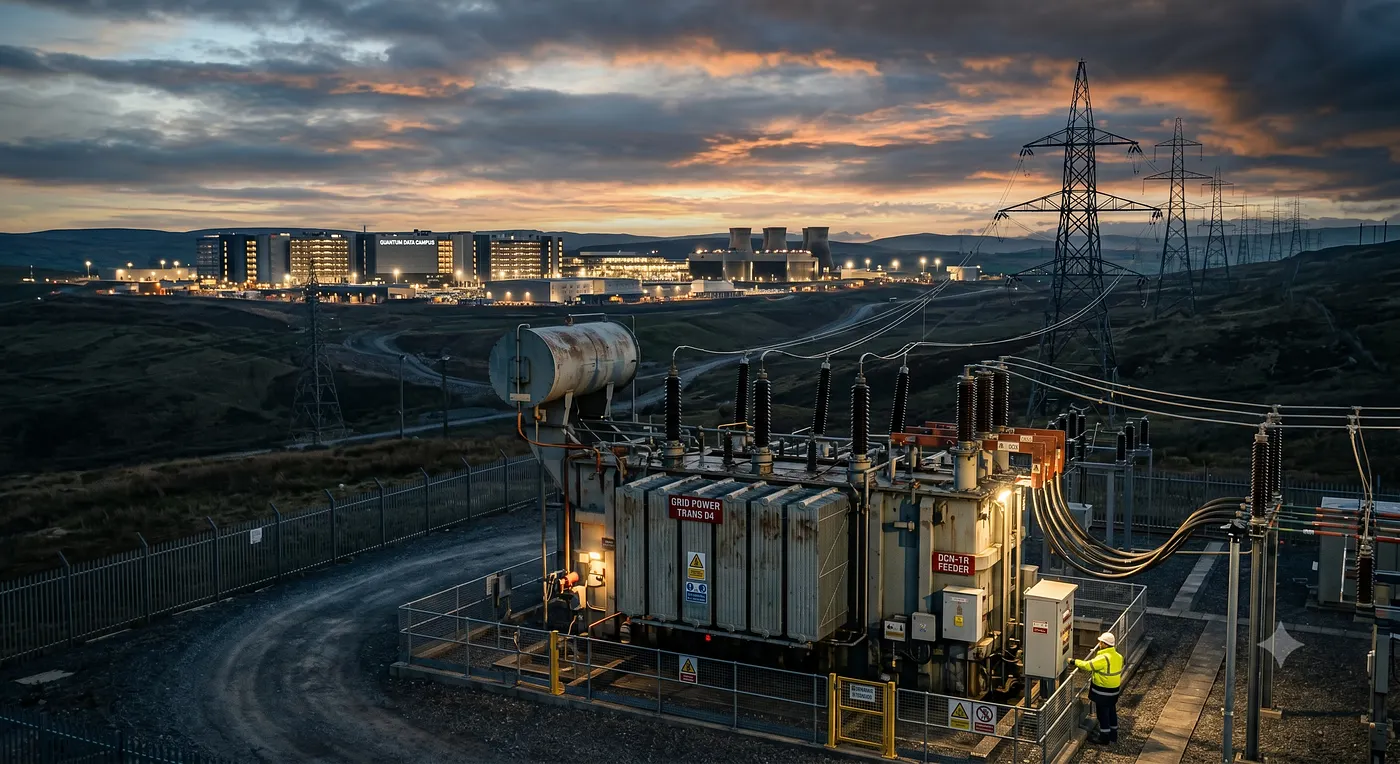
A power transformer powering a city — Image by Gemini
A short note before we begin
A couple of years ago, the whole technology world was worried about one thing: chips. If you couldn’t get your hands on the right graphics processors, you were out of the race. Silicon was the prize, and everyone treated it like the last hard problem standing between us and a future full of thinking machines.
That worry has quietly been replaced by a bigger one, and it is far less glamorous. The new bottleneck is not the chip. It is the power that runs the chip, the steel that carries that power, and the slow, stubborn, deeply physical work of building all of it. We spent years obsessing over software that feels like magic, and we are now waking up to the fact that the magic runs on a foundation made of copper, steel, concrete, and a nineteenth century invention most people have never thought about for a single second of their lives.
This piece is about that foundation. It is about why the money is suddenly easy but the hardware is not. It is about a financial time bomb hiding inside the accounting, a creaky American power grid that takes the better part of a decade to upgrade, and a competitor on the other side of the world that treats building enormous amounts of electricity infrastructure as a totally normal Tuesday. And it is about the thing almost nobody is talking about clearly, which is what the United States is actually doing to fix this, and whether any of it will move fast enough to matter.
Let’s get into it.
Part one: the new currency is electricity
Start with the scale of the money, because the size of the spending is the thing that makes everything else feel almost unreal.
Goldman Sachs published a detailed forecast in 2026 estimating that the world will spend roughly seven and a half trillion dollars building out artificial intelligence infrastructure between now and 2031. That is not a typo. Seven and a half trillion dollars over six years. To put that in perspective, the combined yearly spending of just four companies, Meta, Microsoft, Amazon, and Alphabet, is on track to pass five trillion dollars by the end of the decade, which is larger than the entire annual economic output of Japan, or the United Kingdom, or India, or France. We are talking about a handful of private companies deploying capital at the scale of nations.
Here is the part that should grab you. In that same forecast, the spending breaks into three buckets. The biggest bucket by far is the compute itself, the chips and the servers, somewhere around five trillion dollars. The next bucket is the data center buildings and all the gear inside them, a little over two trillion. And then there is the third bucket, power, which is the smallest of the three at around three hundred and fifty billion dollars.
You would think the smallest bucket would be the least of anyone’s worries. It is the opposite. Power is only about five percent of the total spend, but it is the part that decides whether the other ninety five percent ever gets switched on. You can buy all the chips you want. You can pour all the concrete you want. If you cannot get electricity to the building, and get it inside the building in a usable form, you own a very expensive warehouse full of idle machines.
So the way to think about this whole era is simple. Intelligence is scaling fast, faster than almost anyone predicted. But intelligence does not float free of the physical world. It runs on electricity. And electricity is governed by the laws of physics, the limits of manufacturing, and the pace of construction, none of which care how clever your software is. In this new world, electricity has become the real currency, and the power grid has become the single most fragile point in the entire system.
Think of it like building the fastest race car ever made and then realizing the roads are gravel and the gas stations are three states away. The car is a marvel. It does not matter how good the car is if you cannot fuel it or drive it anywhere. For years, the technology industry poured its genius into the car and assumed the roads and the fuel would simply be there. They are not, at least not in the quantities and on the timelines the industry now needs. The rest of this piece is the story of those roads and that fuel, and of two countries taking very different approaches to building them.
Part two: the boring piece of steel that runs everything
Let me introduce you to the real villain of this story, or maybe the real hero, depending on how you look at it. It is the transformer.
Not the kind from the movies, and not the kind inside the artificial intelligence models, which confusingly is also called a transformer. I mean the heavy, humming, oil filled metal box that sits on the grid and changes electricity from one voltage to another. Power leaves a generating plant at very high voltage, because that is how you push it efficiently across long distances. But your devices, and the chips in a data center, need it stepped way down. That stepping down, over and over, from hundreds of thousands of volts at the transmission line all the way down to the handful of volts a processor actually uses, is the job of transformers. They are everywhere on the grid, and the biggest ones are custom built monsters that weigh as much as a small house.
Here is the problem. These big transformers have become incredibly hard to get.
Before the year 2022, if a utility ordered a large power transformer, they might wait around fifty weeks for it to be delivered. Now, according to surveys from the energy research firm Wood Mackenzie, the average wait for a standard large power transformer has stretched to about a hundred and twenty eight weeks. That is two and a half years. The very largest and most specialized units, the ones that connect big power plants to the grid, can run even longer, and some orders are now taking a full four years to fill. For the custom built units that the biggest data center campuses need, the wait can stretch to three, four, even five years.
Sit with that. A company can have the land, the permits, the chips on order, and billions of dollars in the bank, and still be stuck waiting years for a metal box. The transformer has quietly become the thing that sets the schedule for the entire project. Builders in the industry now talk about ordering transformers and switchgear before they have even finished designing the building, just to hold their place in line, the same way you might order a custom couch before you have picked out the rest of the living room.
And it is not just the wait. It is the price. The cost of these large transformers has jumped by roughly three quarters since 2019, and some of the smaller distribution units have nearly doubled in price. Demand has simply exploded. The need for the big generator transformers that connect new power plants to the grid grew by almost two hundred and seventy five percent between 2019 and 2025. Everyone wants them at once: the data centers, sure, but also the solar farms, the wind projects, the electric vehicle chargers, and the utilities just trying to replace aging equipment that is decades old.
Why can’t manufacturers just make more? That brings us to an even deeper bottleneck, and it is one of the most overlooked facts in this entire story.
Part three: the special steel almost nobody makes
Inside every one of these transformers is a special kind of steel. It is called grain oriented electrical steel, and it is not your everyday metal. The crystal structure inside it is deliberately aligned so that magnetic fields pass through it efficiently, which is exactly what you need to move electricity from one coil to another without wasting it as heat. Without this steel, you do not have a transformer. It is that fundamental.
And here is the kicker. In the entire United States, there is only one company that actually makes this steel. One. That company is Cleveland-Cliffs, which absorbed the old AK Steel operation a few years back, and it is the sole domestic producer of grain oriented electrical steel in the country. Everyone else has to import it.
The result is that the United States relies on foreign suppliers for the vast majority of its large transformer needs. Domestic factories only cover something like a fifth of the country’s demand for big power transformers. The other four fifths comes from abroad. The price of this special steel has roughly doubled since 2020, and that single material is a big reason transformer prices have shot up the way they have.
So when you trace the AI boom all the way down, past the software, past the chips, past the buildings, past the electricity, you arrive at a single rare type of steel made by a single company on American soil, and a supply chain that leans heavily on imports for the rest. That is the actual physical foundation of the so called intelligence economy. It is humbling, and it is more than a little alarming.
Elon Musk put his finger on this a while back, and his framing has stuck with a lot of people. He pointed out that a year or two ago the shortage was chips, and that it was easy to predict the next shortage would be the voltage step down transformers, because you have to feed power into all these machines somehow. After that, he said, the shortage becomes electricity itself, because at some point you simply cannot find enough power to run all the chips you have built. He even joked about the irony of needing transformers, the metal kind, to run transformers, the software kind. The joke landed because it is true. The bottleneck keeps moving down the stack, from the clever part to the physical part, and the physical part is the part that takes years.
And here is something worth understanding. The transformer is the headline shortage, but it is not the only piece of equipment that has become a nightmare to source. A data center needs a whole chain of heavy electrical gear to take the power coming in and distribute it safely to the racks of chips. There is switchgear, the heavy duty equipment that controls and protects the electrical flow, and it sits in the same tight, concentrated supply as transformers, made by a small handful of global producers. There are the backup systems, the giant batteries and the diesel generators that keep everything running when the grid hiccups, and the binding constraint there is often something as mundane as engine availability at a couple of major manufacturers, which can blow a schedule by months. And then there is cooling. The newest chips run so hot and so densely packed that ordinary air conditioning is no longer enough, so the industry has shifted to liquid cooling, piping coolant right up to the processors, and the specialized units that manage that liquid have themselves become a scarce, critical part that can hold up an entire project. So when people say the bottleneck is the transformer, that is true but incomplete. The real bottleneck is the entire ecosystem of heavy industrial equipment that nobody thought much about during the asset light decades, all of it suddenly in desperately short supply, all at the same time.
Part four: when the asset light giants became heavy industry
For most of the last twenty years, the defining trait of a big technology company was that it owned almost nothing. That was the whole magic trick. A software company could serve hundreds of millions of customers without factories, without heavy machinery, without much in the way of physical stuff at all. Investors loved this because it meant huge profits with relatively little capital tied up. They called it being asset light, and it was treated as the natural, permanent state of the industry.
That era is over. Quietly, and then all at once, the biggest technology companies have transformed themselves into something that looks a lot more like old fashioned heavy industry. They are pouring money into land, steel, power plants, and physical infrastructure at a scale the sector has never seen. The share of their cash that now goes into building physical things has climbed to levels that would have been unthinkable for a software business a decade ago. When you strip out what they return to shareholders, an enormous portion of the cash these companies generate is now going straight back into the ground, into concrete and copper and cooling systems.
To pay for it, they have started borrowing money like utilities and governments, not like nimble software firms. And the bond market has been more than happy to lend.
The clearest single example came in early 2026, when Alphabet, the parent company of Google, went to the debt markets to help fund a capital spending plan of around a hundred and eighty five billion dollars for the year, roughly double what it spent the year before. As part of a roughly twenty billion dollar bond sale spread across several currencies, Alphabet did something almost no technology company has ever done. It issued a one hundred year bond. A century bond. A piece of debt that will not come due until the 2120s, sold by a company that has not even existed for thirty years. That single hundred year tranche, a sterling denominated bond worth about one billion pounds, drew so much demand that it was oversubscribed roughly ten times over. Pension funds and insurers, the most conservative money in the world, lined up to lend to a tech company for a century, treating it the way they would treat a government or a piece of permanent national infrastructure.
This is the metamorphosis in a single image. The asset light darling of the software era is now borrowing money on hundred year time horizons to build physical things. And the financial strain underneath that glamour is real. To fund all this spending, Alphabet’s free cash flow, the money left over after the bills are paid, is projected to fall by close to ninety percent in a single year, from over seventy billion dollars to something in the neighborhood of eight billion. The capital is flowing out the door faster than it is coming back in, on a bet that all of this infrastructure will eventually pay off.
And Alphabet is in good shape compared to some. Across the industry, analysts expect technology giants to issue something like three trillion dollars in debt over the next five years to fund this buildout. Some of the most aggressive spenders are now running negative free cash flow, meaning they are spending more cash than they take in, and a few have already seen their stock prices punished hard when investors started doing the math.
Which brings us to the math problem hiding at the center of all this. And it is a strange one.
Part five: the depreciation time bomb
This is the part of the story that gets the least attention from the general public and the most attention from a small group of nervous accountants and short sellers. Stay with me, because it matters, and I promise to keep it in plain English.
When a company buys an expensive piece of equipment, it does not record the whole cost as an expense the day it buys it. Instead it spreads that cost out over the years it expects to use the thing. That spreading out is called depreciation. If you buy a machine for six hundred dollars and expect it to last six years, you record a hundred dollars of expense each year. Simple enough.
Now here is where it gets interesting, and a little scary. The big technology companies are buying staggering quantities of advanced chips, and they have to decide how many years to spread the cost over. Most of them have chosen to assume these chips will last five, even six years. That assumption makes their reported profits look healthier, because it means less expense recorded each year.
But there is a serious argument that these chips do not actually last that long in any meaningful economic sense. The company that makes most of them, Nvidia, releases a dramatically better chip roughly every single year. Each new generation is so much faster and more energy efficient than the last that the older chips become uneconomic for cutting edge work surprisingly fast. The famous investor Michael Burry, the one portrayed in the movie about the 2008 crash, made waves in late 2025 by arguing exactly this. He claimed the real useful life of these chips is closer to two or three years, not five or six, and that by stretching the assumption, the industry was understating its true expenses by roughly a hundred and seventy six billion dollars between 2026 and 2028. If he is right, reported profits across the sector are inflated by something like twenty percent, and a painful reckoning waits down the road when the accounting finally catches up to reality.
The companies push back, and they have a real case. They argue that even when a chip is no longer good enough for the most demanding training work, it still has years of useful life left doing lighter tasks, a process people describe as a waterfall, where chips cascade down from frontier training, to everyday inference, to general purpose computing as newer generations take over the top job. By that logic, the five or six year assumption is defensible, because the chip really does keep earning its keep, just not at the cutting edge. Even one technology chief executive admitted the discomfort out loud, saying he did not want to get stuck holding four or five years of depreciation on a single generation of hardware. The honest answer is that nobody knows for sure, because we have never run this experiment before at this scale.
Why does this matter to the grid story? Because it tightens the financial squeeze at exactly the moment these companies are taking on enormous physical risk. If the chips really do wear out their economic value faster than the books assume, then the cushion these companies are relying on is thinner than it looks. And that thin cushion meets another accounting trap that comes straight from the physical delays we have been talking about.
It is worth pausing on just how big this gap could be, because the numbers are not small. If the true useful life of these chips is three years rather than six, then across the whole industry’s combined hardware spending, the amount of expense being understated each year runs into the tens of billions of dollars. Over a few years it compounds toward that hundred and seventy six billion dollar figure. And the danger is not just that profits look better than they are today. The danger is what happens later. If a company eventually has to admit that its chips are worth far less than its books claim, it has to take what is called a write down, a sudden large charge that crashes through its earnings all at once. That is the cliff people worry about. Years of slightly inflated profits, followed by a painful day of reckoning when reality catches up. Nobody knows if that day comes, or how hard it lands. But the possibility hangs over the entire boom like weather you can feel but not yet see.
Part six: the placed in service trap
Here is the trap, and it is a nasty one.
When can a company start taking the tax benefits and accounting deductions for a brand new data center? The answer depends on a phrase: placed in service. And there are two different definitions of that phrase that do not agree with each other.
The accounting world has a looser standard. Under generally accepted accounting principles, depreciation can begin once an asset is ready and available for use, which for a data center might be the moment the building gets its certificate of occupancy. But the tax authorities use a stricter standard. To them, the property is not really placed in service until it is actually up and running, actually generating income, and has passed all its essential tests.
Recent legislation has made this even more consequential. A major law passed in 2025, often nicknamed the One Big Beautiful Bill Act, brought back the ability to write off the full cost of qualifying equipment right away instead of stretching it out, a generous tax benefit known as full expensing. That sounds great for a company building data centers, and it is, but only if the project actually comes online.
Now connect the dots. If your transformer is stuck in a three year manufacturing queue, or your connection to the grid is stuck in a years long waiting line, then your shiny new data center is not actually in service. It cannot generate income. It cannot pass its tests. Which means you may be forced to wait to claim those big tax deductions you were counting on. You have spent the billions, but the financial benefit gets pushed out into the future, creating a mismatch between cash going out and benefits coming in. For a company that already borrowed heavily and is already running thin on free cash flow, that mismatch is exactly the kind of thing that quietly eats away at its financial cushion. The physical delay becomes a financial wound.
So the picture so far is this. Enormous spending, funded by enormous debt, resting on chips whose true lifespan is genuinely uncertain, with the whole thing gated by physical hardware that takes years to arrive, and tax benefits that may not show up on schedule. It is a lot of risk stacked on top of a foundation that moves at the speed of heavy manufacturing. Which leads to the obvious question. How fast can America actually fix its physical foundation? And the answer is not encouraging.
Part seven: the real timeline of fixing the American grid
Americans tend to assume that when there is enough money and enough urgency, the country can build things quickly. In the world of electricity, this assumption is simply wrong, and the numbers are sobering.
Consider transmission lines, the big high voltage power lines that move electricity across long distances. In the entire year of 2023, the United States built about fifty five miles of new high voltage transmission. Fifty five miles. For a country this size, that is essentially nothing. Building new long distance transmission in America can take a decade or more, once you account for the planning, the permitting, the negotiating with every landowner along the route, the environmental reviews, and the tangle of overlapping authorities who all have to sign off. There is no single national plan and no single decision maker. The grid is a patchwork, stitched together across dozens of states and regions, each with its own rules.
Then there is the waiting line to connect to the grid in the first place. When a new power plant or a big new customer like a data center wants to plug in, they have to get in a queue and wait for studies, approvals, and upgrades. In the most important region for data centers, an area covering much of the mid Atlantic and Midwest, those waiting lines have stretched out for years, with some connections not expected until 2030 or beyond. And the demand piling into those queues has gotten so large that, in that key region, the requests from big new electricity users now add up to roughly three times the amount of confirmed new power capacity available to serve them. Three times. There is simply not enough confirmed supply to go around.
It gets more delicate. Even the routine parts of the process drag. Developers often assume that getting a local permit reviewed will take a week or two. In many places, the actual review now takes a month or two. That sounds minor, but a six week surprise at the front of a project can flip a planned on time delivery into a late one before a single piece of equipment is even built. Multiply these small delays across thousands of projects all competing for the same scarce people, parts, and approvals, and the whole system grinds.
Why is it like this? Partly because for the past twenty years, American electricity demand was basically flat. The country did not need much new power, so it stopped building the muscles required to add a lot of it quickly. The factories that make grid equipment shrank. The workforce that builds transmission lines thinned out. The permitting processes calcified, because there was no pressure to streamline them. And now, suddenly, after two decades of flat demand, artificial intelligence has shown up asking for gigawatts of new power in just a few years. The system that atrophied during the quiet decades is being asked to sprint, and it is not built to sprint.
The result is a kind of slow motion collision. On one side, you have software that scales in months and capital that moves in days. On the other side, you have a power grid that upgrades in years and sometimes decades. The two sides are simply operating on different clocks, and the slower clock wins, because you cannot run a data center on a promise. You can only run it on electrons.
Now, to really understand how risky this is for the United States, you have to look at the country that is running on a completely different clock. You have to look at China.
Part eight: China, where building the grid is just table stakes
In the United States, building a massive amount of new electricity infrastructure is treated as an extraordinary effort, a heavy lift requiring years of fighting through queues and permits and politics. In China, it is treated as routine. It is just what the state does. This difference is not a small detail. It may be the single most important factor shaping the next decade of the artificial intelligence race, and it deserves a careful look.
Start with raw scale. In a single recent year, China added more than four hundred gigawatts of new power generation capacity. To give that a sense of scale, that one year of additions is in the neighborhood of a third of the entire generating capacity of the United States, added in twelve months. China did not agonize over it. It simply built. And looking ahead, analysts project that by 2030, China could be sitting on something like four hundred gigawatts of spare power capacity, more than enough cushion to cover roughly triple the expected electricity needs of every data center on the planet combined. While America worries about whether it can find enough power, China is on track to have a giant surplus.
Then there is the matter of moving that power around. China has gone all in on something called ultra high voltage transmission, which is exactly what it sounds like, extremely high voltage power lines designed to carry enormous amounts of electricity across very long distances with minimal loss. This lets China generate power cheaply in its sunny, windy, resource rich western regions and ship it efficiently to where the demand is. China now has roughly four times the ultra high voltage transmission capacity of all of North America. Remember that the United States built about fifty five miles of high voltage line in a recent year. China has been building tens of thousands of miles of these advanced lines and has constructed dozens of ultra high voltage projects. The gap is not a little gap. It is a chasm.
China has even built a national strategy around this advantage, a program with the memorable name Eastern Data, Western Computing. The idea is to deliberately place the power hungry data centers in the western regions, where land is cheap and clean energy is abundant, and use those long distance transmission lines to connect them to the users in the east. It is exactly the kind of coordinated, top down, build the whole system at once approach that the fragmented American grid struggles to pull off. One recent example had a five hundred megawatt wind and solar project in a northwestern region being built specifically to feed a cloud data center through a dedicated transmission line. In China, you can plan power and computing together as one integrated system. In America, they are split across different companies, different regulators, and different states that often do not coordinate.
The cost difference flows directly from all of this. Data centers in China can pay less than half what American data centers pay for electricity. And the build speed is on another planet entirely. A project in China can move from planning to actually operating in a matter of months, because permitting is faster and the regulatory hurdles are fewer, while a comparable project in the United States can take years. When you can build the power, build the lines, and build the data center as one coordinated state backed effort, you simply move faster.
There is a striking way Elon Musk described this contrast. He said China’s power generation looks like a rocket headed for orbit, while American power generation stays flat. That image captures it well. One country’s electricity supply is climbing steeply upward. The other’s has been a flat line for two decades and is only now, painfully, beginning to bend.
To really feel the gap, consider the cushion each country keeps. Every grid needs spare capacity, a buffer of extra power above what is normally being used, so that demand spikes and equipment failures do not cause blackouts. The American grid runs on a fairly thin buffer, something in the range of fifteen percent. China’s buffer is enormous by comparison, in some descriptions running anywhere from eighty percent all the way up to double its normal demand. Put plainly, China could lose a huge chunk of its grid and still keep the lights on, while America operates much closer to the edge. When you are trying to add gigawatts of brand new data center demand, the size of that cushion is everything. One country has room to absorb the shock. The other is already stretched.
Now, in the interest of being fair, China’s position is not a flawless utopia, and it would be a mistake to paint it that way. The country built so aggressively and so far ahead of demand that many of its data centers actually sit idle or underused, victims of overbuilding and of being placed far from where the computing is actually needed. Beijing is working on systems to sell that surplus computing capacity, but it faces real challenges with delays, with connecting distant regions, and with stitching together different technical ecosystems. And the American lead in the things that matter most, the cutting edge chips, the most advanced models, the sheer number of operating data centers, is genuine and large. So this is not a simple story of one country winning and the other losing. It is a story of two very different bets. America bet on moving fast in software and silicon and assumed the physical foundation would keep up. China bet on overbuilding the physical foundation first and figuring out the rest later. The next several years will reveal which bet was wiser.
Now, here is the part that should make any American strategist deeply uncomfortable, and it ties the whole story together. Remember how the United States imports the vast majority of its large transformers, because domestic factories only cover a fraction of demand? Guess who controls a huge slice of the world’s transformer manufacturing. China does, roughly sixty percent of global capacity. And in 2025, the United States imported thousands of high power transformers from China, a dramatic jump from just a few years earlier. Chinese manufacturers can deliver these transformers cheaper, twenty to forty percent cheaper by some accounts, and faster, with waits closer to a year compared to the three plus year waits from American suppliers.
So step back and see the whole shape of it. The American artificial intelligence buildout, the thing we are told is central to national security and economic dominance, depends on physical equipment that the country largely cannot make for itself, much of which comes from the very competitor it is racing against. That is not a comfortable position. It is the strategic vulnerability hiding underneath all the talk of model benchmarks and chip designs.
Part nine: the strategic risk to the American plan
Let me make the stakes plain, because it is easy to get lost in the numbers.
The United States currently leads the artificial intelligence race in the ways that grab headlines. It has the most advanced chips, the most data centers by a wide margin, and the leading models. By the count in one major index, America had over five thousand data centers in a recent year, compared to a few hundred in China. On paper, America is far ahead.
But leads built on software and chips can be undone by a foundation that cannot keep up. If the most advanced model in the world is sitting in a data center that cannot get connected to the grid for three years, the model might as well not exist. If a company has the best chips money can buy but no transformer to feed them power, the chips sit in their boxes. The race is not won by whoever designs the cleverest algorithm. In an era where intelligence is abundant but electricity is scarce, the race may be won by whoever can actually deliver the electrons, on time, at scale.
This is the heart of the risk. America’s advantage is concentrated in the layers that move fast, the software and the silicon. China’s advantage is concentrated in the layer that moves slow and decides everything, the physical power and grid. And the slow layer has a way of asserting itself. You cannot wish a transformer into existence. You cannot software your way out of a multi year manufacturing queue. The country that has spent the last twenty years quietly building an absurd surplus of power and an advanced grid to move it has an advantage that compounds over time, precisely because that kind of advantage takes so long to build that latecomers cannot easily catch up.
There is also a national security dimension that goes beyond economics. Depending on a strategic rival for the physical equipment that powers your most important industry is a vulnerability in the literal sense. It is the kind of dependency that looks fine until the moment it suddenly does not, during a trade fight, a geopolitical crisis, or a supply disruption. American officials have started to name this problem out loud, with some framing it bluntly as the country’s artificial intelligence buildout hinging on foreign electrical parts. Naming it is the first step. The real question is what gets done about it.
And here, finally, is the part of the story that almost nobody covers, because it is less dramatic than the warnings and the eye popping numbers. The United States is not actually sitting still. There is a real, sprawling, somewhat chaotic effort underway to fix this. Whether it is enough is an open question, but it is happening, and it deserves to be understood.
Part ten: what America is actually doing about it
Let me walk through the response, because it is spread across several fronts and no single piece of it tends to make the news on its own.
The first front is permitting and grid access, the slow bureaucratic machinery we talked about earlier. The federal government has moved to attack this directly. There is now a national strategy framework, often referred to as America’s AI Action Plan, that explicitly treats data centers and the power infrastructure behind them, including high voltage transmission lines and the equipment that runs them, as a national priority worth cutting red tape for. It directs agencies to speed up environmental reviews and streamline the approvals that have historically taken years. There is also a serious push to fix the connection queue problem. In late 2025, the Department of Energy formally instructed the federal energy regulator to start a new rulemaking aimed at dramatically speeding up how large new electricity users get connected to the grid, with the goal of cutting study times and letting big projects combine their power generation and their connection requests into a single faster process. Several major energy market operators have proposed their own fast track processes for large new loads.
In Congress, there is a cluster of bills with names like the SPEED Act, the ePermit Act, and the PERMIT Act, all aimed at shortening the timelines for permitting energy infrastructure of all kinds, from power plants to transmission lines to pipelines. Permitting reform is notoriously hard to pass, and previous attempts have died, but the political pressure behind it is now intense and bipartisan in a way it has not been before, precisely because everyone can see the data center demand barreling toward a grid that cannot absorb it.
The second front is generating new power, and here the most dramatic story is the return of nuclear energy. After decades of being treated as a dead end, nuclear power is having a genuine revival, driven almost entirely by the desperate hunger of data centers for steady, around the clock electricity. The most symbolic example is Three Mile Island, the Pennsylvania plant whose name became shorthand for nuclear disaster after an accident in 1979. One of its reactors, the one that was never involved in that accident, was shut down years ago for economic reasons, and it is now being brought back to life, rebranded as the Crane Clean Energy Center. Microsoft signed a twenty year agreement to buy its entire output, around eight hundred and thirty five megawatts of carbon free power, and the federal government backed the revival with a billion dollar loan. As of early 2026 the plant is most of the way staffed up and aiming to come back online around 2027. It is the first time a retired American nuclear reactor has been resurrected to serve essentially a single corporate customer, and people in the industry see it as a template that could be repeated at other shuttered plants across the old industrial heartland.
And it is not just one plant. Every one of the biggest technology companies has now signed nuclear deals. Amazon locked up nearly two gigawatts of nuclear power from another Pennsylvania plant and invested heavily in a new generation of small modular reactors, which are compact factory built nuclear units meant to be quicker and cheaper to deploy than the giant traditional plants. Google committed to a fleet of these small reactors through a company called Kairos Power, aiming for its first unit around 2030. Meta announced an enormous nuclear procurement strategy spanning several gigawatts to feed its largest data center projects. Add it all up, and the major technology companies have collectively committed to something approaching ten gigawatts of nuclear capacity across more than a dozen deals, with the first nuclear electrons flowing to an artificial intelligence data center expected around 2027. After fifty years of nuclear stagnation in America, that is a remarkable turn, and the artificial intelligence boom is the reason it is happening.
The third front is the move that data center operators are making on their own, which is to stop waiting for the public grid entirely and build their own power on site. The industry calls this going behind the meter. Rather than join a years long connection queue, some companies are simply generating their own electricity right at the data center, whether through natural gas turbines, dedicated power plants, or those nuclear deals. It is a profound shift. The biggest technology companies are effectively becoming their own utilities, building private power infrastructure because they cannot count on the public system to deliver in time. This is partly why you see the federal government negotiating voluntary commitments, sometimes called a ratepayer protection pledge, where these companies agree to build or buy enough new power to cover their own demand and to pay the full cost of the grid upgrades they require, so that ordinary households do not end up footing the bill for the data center boom through higher electricity rates. As of early 2026, the Department of Energy had signed cooperative agreements with dozens of organizations along these lines, including major chip makers and cloud providers. It is worth noting that these pledges are voluntary and not enforceable at the federal level, so critics fairly point out that they identify the problem more than they solve it.
The fourth front, and maybe the most important for the long run, is rebuilding the ability to manufacture this physical equipment on American soil. This is where the special steel comes back into the picture. Cleveland-Cliffs, that sole domestic producer of grain oriented electrical steel, is not just making the steel. It has moved to build its own transformer manufacturing plant, ordering the equipment to begin production and creating new domestic demand for the very steel it makes. The federal government has also directed funding toward improving and expanding transformer manufacturing, and there has been a broader push, partly through tariffs and trade policy, to make it more attractive to produce this equipment in the United States rather than importing it. Other manufacturers have announced expansions of their American factories as well. None of this happens overnight, because building a factory and training a workforce is itself a multi year project, but the direction has clearly shifted from offshoring this capacity to rebuilding it at home.
The fifth front is squeezing more out of the grid and the chips we already have, which is the quiet, unglamorous, and genuinely promising part. On the grid side, there are technologies that can add real capacity to existing power lines in a year or two, far faster than building new lines from scratch, by using advanced conductors and smart equipment that lets the existing wires carry more power safely. On the chip and software side, the industry is racing to get more intelligence out of every watt of electricity. New model designs route work more efficiently, activating only the parts of the system needed for a given task rather than firing up everything at once, which means more useful computing per unit of power. The phrase you hear is intelligence per watt, and it has become a real engineering obsession, because in a world where power is the binding constraint, efficiency is not a nice to have. It is survival.
So that is the response. Faster permitting and grid connection. A nuclear revival. Data centers building their own power. Rebuilding domestic manufacturing of the critical steel and equipment. And wringing more capability out of every watt. It is a serious, multi pronged effort. The honest assessment is that it is also a race against a clock that has a big head start working against it.
Part eleven: the honest reckoning
Let me try to pull the threads together, because the picture that emerges is more nuanced than either the hype or the doom.
The optimistic read goes like this. America has the capital, which is clearly abundant. It has the chips, which are the best in the world. It has now recognized the power problem and is throwing serious effort at it, from nuclear plants to permitting reform to domestic manufacturing. American companies are nothing if not resourceful, and the behind the meter movement shows they will route around obstacles rather than wait politely. Give it a few years, the optimists say, and the bottlenecks will ease as factories ramp up, reactors come online, and the grid catches its breath. The shortage is real but temporary, the growing pains of an industry scaling faster than anyone planned for.
The pessimistic read is harder to dismiss. Physical infrastructure runs on physical timelines, and those timelines do not bend to urgency the way software does. A transformer takes years to build no matter how badly you want it. A transmission line takes a decade to permit no matter how much capital is behind it. A nuclear plant restart, even an expedited one, is measured in years. Meanwhile, the competitor across the ocean is not waiting, is not stuck in queues, is not dependent on imports, and is sitting on a power surplus that the United States can only dream about. And underneath it all sits that financial fragility, the enormous debt, the thin cash cushions, the genuine uncertainty about how long these chips really hold their value. If the bet on artificial intelligence returns disappoints even a little, the whole tower of borrowed money built on rapidly depreciating hardware and slow physical infrastructure could wobble in ways that would be painful to watch.
The truth, as usual, is probably somewhere in between, and it depends enormously on execution and on time. This is fundamentally a story about two different clocks running at two different speeds. The clock of intelligence runs in months. The clock of the physical world, the steel and the copper and the concrete and the high voltage lines, runs in years and sometimes decades. For most of the last few years, everyone watched the fast clock and assumed the slow one would somehow keep up. It will not, at least not automatically. The defining contest of this era is whether America can speed up its slow clock fast enough to keep its fast clock from running off a cliff.
So I will leave you with the question that I think actually matters, the one that has quietly replaced all the chatter about model benchmarks and chip designs. For years we asked who has the best algorithms. That was the wrong question, or at least an incomplete one. The real question, the one that will decide who leads the next decade, is this. In a world where intelligence has become cheap and abundant, but electricity has become precious and scarce, will the winners be the ones with the cleverest code, or the ones who can actually pour the concrete, forge the steel, string the wires, and deliver the power?
The magic, it turns out, was never just in the software. It was always, quietly, in the grid. And the grid is the one thing money alone cannot rush.