The Sixth Pillar of the Responsible AI Datacenter Blueprint
When we think of artificial intelligence datacenters, our minds typically conjure images of hyperscale server racks, humming cooling systems, and massive power grids. They are often viewed as sterile, closed-off monoliths of modern technology — detached from the physical communities that surround them. Yet, as the infrastructure powering the AI revolution continues to expand at a pace unprecedented in the history of industrial development, a critical and increasingly urgent realization is taking shape: a datacenter cannot truly be sustainable, responsible, or politically viable if it operates in isolation from its neighbors.
The first five pillars of this series have established a framework for responsible datacenter development: eliminating water extraction, achieving energy independence, revitalizing brownfield land, building genuine economic reciprocity, and designing facilities as civic assets rather than industrial intrusions. Each of those pillars addresses what the datacenter takes — water, power, land — and demands that the developer give something back. The sixth pillar operates on a different register entirely. It addresses not resources but people, and it asks a question that no amount of engineering can answer: what does this facility do for the minds of the community that surrounds it?
This is the core philosophy behind the sixth pillar of the Responsible AI Datacenter Blueprint: Education and Research Opportunities. The long-term success of high-tech infrastructure is fundamentally enhanced by cultivating local scientific and technical talent. Rather than relying entirely on importing external labor while leaving the surrounding community with no pathway into the industry it is hosting, responsible developers must partner with local educational institutions to create training and research pathways for area residents. By transforming datacenters into centers of learning — at both the vocational and advanced research levels — we can unlock a unique ecosystem for high school students, community college participants, undergraduate researchers, and early-career scientists, fostering community goodwill and empowering the next generation of innovators from exactly the towns and counties that have agreed to host this infrastructure.
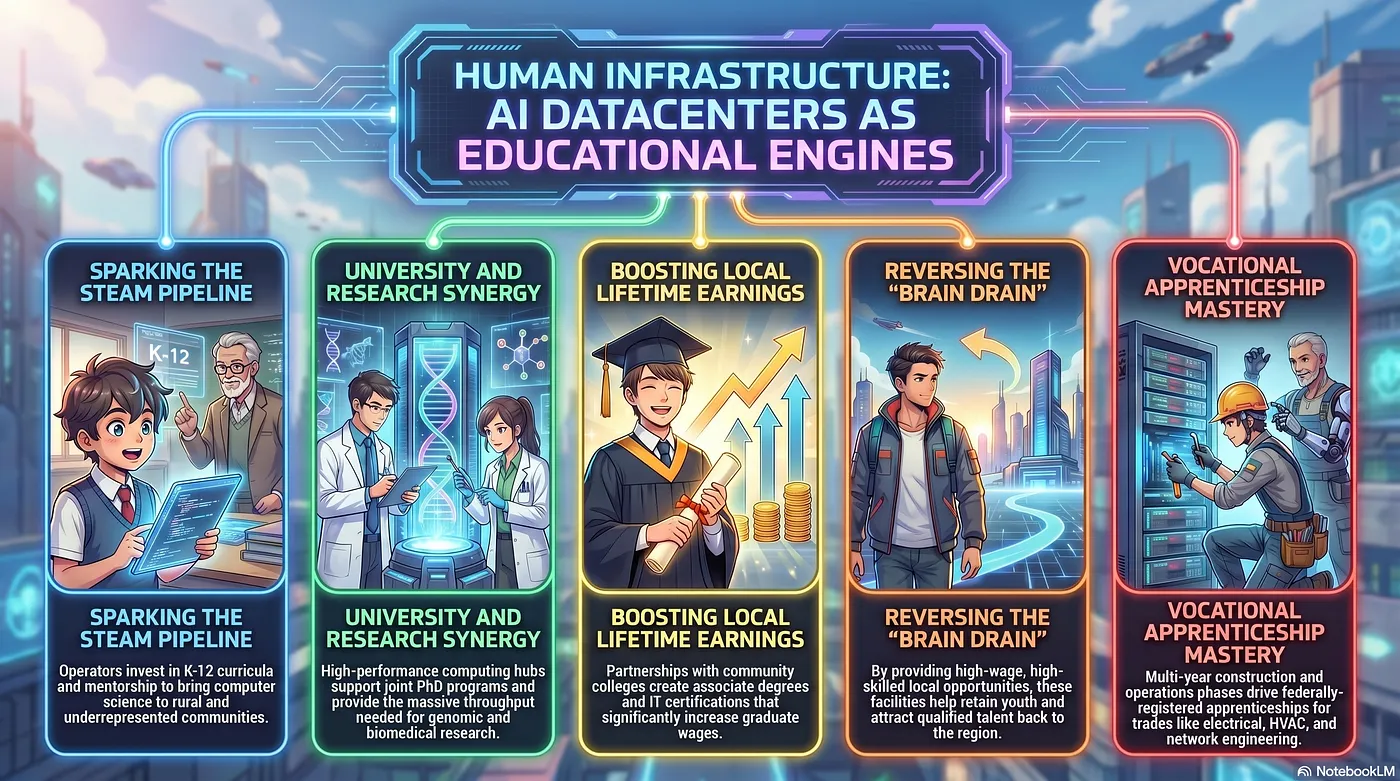
Human Infrastructure: AI Datacenters as Educational Engines — Infographic generated by Google Gemini
Part One: The Problem the Sixth Pillar Addresses
The Education Gap in the Employment Bargain
As the fourth pillar of this series documented, the employment bargain between data center developers and host communities is structurally asymmetric in a way that produces predictable political backlash. A Brookings Institution research paper published in May 2026, “New Evidence on Data Center Employment Effects,” assembled a dataset of approximately 770 U.S. data center facilities linked to county-level employment and wage data from the Bureau of Labor Statistics covering 2003 through 2024. Its headline conclusion was measured but pointed: workers in host counties see wage gains of three to four percent for both existing workers and new hires, but “large data center projects often promise only dozens to a few hundred permanent workers while the associated construction jobs are temporary.” A companion Brookings analysis, “Turning the Data Center Boom into Long-Term Local Prosperity,” published in February 2026 by Joseph Kane, found that economic benefits to local communities “decline substantially after the construction phase,” citing a U.S. Chamber of Commerce Technology Engagement Center dataset from 2017 that documented this consistent pattern across the industry.
The Ohio River Valley Institute’s February 2026 analysis was blunter still: the PwC industry-backed study found 603,900 total U.S. data center workers across 5,426 facilities in 2024 — an average of approximately 111 per facility. The Institute observed that even if data center employment tripled due to the AI boom, it would still represent less than one percent of jobs in a state like Pennsylvania. “Data centers occupy comparable or even larger footprints [to Amazon fulfillment warehouses], consume vastly more public resources, and employ a fraction of the people,” the Institute noted.
This is the gap the sixth pillar is designed to close — not by manufacturing jobs that automation has eliminated, but by building educational infrastructure that creates pathways for local residents into the industry regardless of the number of permanent positions at any single facility. The facility itself may employ 50 to 150 operations staff. The educational programs it anchors may prepare hundreds or thousands of residents annually for careers across the regional technology economy.
The Workforce Shortage That Makes This Urgent for Developers, Not Just Communities
The sixth pillar is not charitable altruism. It is a business necessity that the data center industry has been slow to fully reckon with. According to the Uptime Institute’s 2024 Global Data Center Survey, 53 percent of operators worldwide report difficulty finding qualified candidates for open positions, up from 38 percent in 2018. CBRE’s 2025 North America Data Center Trends report identified labor as one of the top three risks on every major hyperscale build. JLL reports that 90 percent of operators cite staffing shortages as a significant challenge to expansion. Introl’s data center intelligence platform, analyzing construction data through early 2026, found a 439,000-worker construction shortfall affecting the industry across the United States.
The shortage is not abstract. In regions where multiple hyperscale projects compete simultaneously for the same limited labor pool — Northern Virginia, Phoenix, Dallas–Fort Worth, Atlanta — journeyman electricians, mechanical pipefitters, controls and instrumentation technicians, and commissioning engineers receive multiple simultaneous job offers and can command salary increases of 15 to 25 percent in competitive cycles, according to the Uptime Institute’s 2024 staffing analysis. Data Center Geeks’ April 2026 workforce analysis found that data center construction workers earn an average of $81,800 per year — a 32 percent premium over non-data-center construction roles — and that workers switching into data center projects typically see 25 to 30 percent pay increases. Yet 40 percent of construction firms increased base pay by more in 2025 than in 2024, indicating that money alone cannot close a gap rooted in training, not compensation.
The structural fix requires building local training pipelines that feed workers into the data center industry from the community level upward. This is precisely what the vocational and credentialing programs of the sixth pillar are designed to accomplish. When a developer partners with local community colleges to establish data center operations degrees and certifications, it is not performing community service — it is building its own future workforce from the population most likely to stay in the region and fill the roles the facility needs over its operational lifetime.
Part Two: Up-Skilling the Community — Vocational Excellence at the Local Level
A responsible datacenter doesn’t just offer jobs; it builds careers. At the vocational level, the most impactful developers are partnering with community colleges to establish specialized associate degrees, certificate programs, and credentialing pathways in datacenter management, digital infrastructure, and cloud operations. The programs that have achieved the most traction share three design principles: they provide hands-on access to real datacenter equipment rather than simulation; they align curricula with nationally recognized industry certifications that make graduates immediately employable; and they include financial support that removes socioeconomic barriers to participation.
Amazon and Blue Mountain Community College: The Hermiston Model
The most mature and geographically instructive example of this model operating at community scale is the partnership between Amazon Web Services and Blue Mountain Community College in eastern Oregon. AWS operates multiple datacenters in the Boardman and Hermiston corridor of the Columbia River Basin, a region of approximately 18,000 residents in Morrow and Umatilla Counties whose economic history combines agriculture, food processing, and a handful of industrial employers. The AWS presence has made eastern Oregon a Pacific Northwest economic leader in digital infrastructure investment, but the company’s most sustained community contribution is arguably its workforce investment at BMCC.
Amazon’s investment in Blue Mountain Community College’s data center programs has included $150,000 in lab and training equipment for students enrolled in data center and industrial systems technology programs, and $100,000 annually in scholarships for local students in those programs, according to Amazon’s published community investment disclosure. The partnership also operates a four-week AWS Pre-Apprenticeship program that covers 120 hours of instruction in workplace skills and foundational knowledge across electrical, mechanical, fiber-optic, and operational domains, resulting in an industry-recognized credential for completers. BMCC Workforce Training Center Director Anne Morter, quoted in Amazon’s published AWS community page, described the alignment: “Providing industry-aligned training opportunities is core to our mission of developing a skilled workforce for the Morrow and Umatilla County areas.”
On February 10, 2026, BMCC, the Hermiston School District, and Amazon collaborated on an immersive career exploration event at BMCC’s training center in Boardman that brought nearly three dozen Hermiston High School students through three rotating lab sessions: mock interviews with AWS professionals, electrical systems training with circuit-building exercises, and server hardware operations hands-on work. A March 2026 equivalent event served Morrow County School District students. Benjamin Harvey, AWS Community Engagement Manager, described the pipeline philosophy: “These educational partnerships help create real career pathways and opportunities for students right here in their own communities.” Several AWS team members who participated were themselves Hermiston High School alumni — the living demonstration that the pipeline works.
Anne Morter’s framing of BMCC’s mission is the precise articulation of what the sixth pillar demands: educational institutions should serve as the bridge between large infrastructure investment and local human capital development. When AWS invests in lab equipment, scholarships, and curriculum alignment at BMCC, it is not augmenting the college’s general educational mission — it is fusing that mission directly to the economic infrastructure of the region.
Amazon’s Work-Based Learning Program: National-Scale Vocational Pipeline
Beyond the Hermiston partnership, Amazon’s Work-Based Learning Program (WBLP) represents the national-scale expression of the same philosophy. The WBLP, described on Amazon’s official careers page, is a twelve-month paid training program covering data center operations through a combination of self-directed web-based instruction, instructor-led sessions, and on-the-job training. Participants who complete the program requirements and assessments are promoted into their chosen roles at an AWS data center. The program explicitly targets candidates “without previous technical experience,” making it accessible to career changers, recent high school graduates, and workers transitioning out of industries disrupted by automation or economic restructuring.
The AWS Technical Apprenticeship program, now in its ninth year, began as a pilot designed for military veterans and their spouses in 2017 and has expanded to include broader community pathways. The program provides paid training of ten to eighteen weeks depending on pathway, followed by up to twelve months of on-the-job training at an AWS data center. When AWS hired its one-thousandth apprentice, profiled in Amazon’s February 2022 community blog, the milestone was marked by Brittany Wilkins — a former police officer and Air Force Reserve member who had no prior technical experience and was trained entirely through the apprenticeship program. “I came to AWS with no experience, right out of high school,” said one WBLP graduate cited in the program’s testimonial archive. “I applied through the WBLP and started as an intern, which gave me three months to learn the basic functions of the role. I quickly moved into a full-time position, was promoted within six months, and continued to advance — eventually becoming a chief engineer.”
The WBLP model also extends to community colleges through formal partnerships. Hinds Community College in Jackson, Mississippi, launched a four-week paid training program in coordination with AWS’s data center investment in Madison County, Mississippi — a ten-billion-dollar development projected to create at least 1,000 jobs. The I2PA AWS Information Infrastructure Pre-Apprenticeship program at Hinds pays participants for 30 hours of work per week during the four weeks of training. Hinds Vice President of Workforce Development and Governmental Affairs Dr. Ginger Robbins told WJTV: “Since data centers are new to our area, people may not understand the opportunities for high-wage, high-demand jobs the data centers bring with them.”
The Microsoft Datacenter Academy: Equipment, Certification, and Career Pathways
Microsoft has approached the vocational education challenge through its Datacenter Academy program — a structured partnership model with community colleges that donates physical server equipment from decommissioned datacenters to build on-site labs, aligns curricula with nationally recognized CompTIA certifications, and provides financial support for students who would not otherwise have access to industry-standard hardware.
The Datacenter Academy at Estrella Mountain Community College and Glendale Community College in Arizona, formally announced in September 2020 and opened to students in May 2022, is the program’s flagship implementation. Each Datacenter Academy lab, as described in EMCC’s published program documentation, contains three rack cabinets with a mix of servers, storage devices, and networking equipment donated directly from Microsoft datacenters — the same hyperscale hardware that is generating AI workloads at commercial scale. Students can earn a Certificate of Completion or an Associate of Applied Science Degree while pursuing CompTIA certifications in A+, Security+, Network+, Cloud+, and Server+, alongside CCNA and MCSE credentials. EMCC’s program page confirms that students have opportunities to interview for work experience programs within a Microsoft datacenter and receive custom tours of local Microsoft facilities, in-class lectures by Microsoft Datacenter staff, and Q&A panels with practitioners.
Dr. Teresa Leyba Ruiz, GCC President, articulated the partnership’s community value in the September 2020 announcement: “This partnership with Estrella Mountain Community College and Glendale Community College fills a void in the IT job market and provides students with streamlined pathways to high-paying IT jobs.” The partnership provides curriculum guidance, equipment donations, scholarship funding for underrepresented groups, and mentor access — a comprehensive model that goes beyond financial contribution to restructure the educational experience around real industry practice.
In Wyoming, Microsoft’s Datacenter Academy partnership with Laramie County Community College (LCCC) in Cheyenne has taken a particularly financially supportive form. Microsoft’s Local blog documents that the company’s financial support “alleviates the financial burdens of schooling, covering everything from books to tuition to fees for 12 students in the program’s first year.” Students complete the program with a credit diploma certificate from LCCC and preparation for CompTIA A+, Server+, and Network+ certifications. LCCC’s Datacenter Academy program director described the goal: giving local residents the precise tools they need to run the physical infrastructure in their own backyards, converting the datacenter from an opaque tenant into a visible engine of local career development.
Microsoft’s Wisconsin Commitment: The Blueprint at Scale
The most architecturally ambitious vocational education commitment announced by any hyperscaler in conjunction with a datacenter investment is Microsoft’s May 2024 Wisconsin package, which combined a $3.3 billion infrastructure investment with a comprehensive human capital investment designed in parallel. As announced by Microsoft President Brad Smith on May 8, 2024, in the presence of President Joe Biden at Gateway Technical College in Sturtevant, the package has four interlocking components.
The first is a Datacenter Academy in partnership with Gateway Technical College, designed to “train and certify more than 1,000 students in five years to work in the new data center and IT sector jobs created in the area.” This is the classic Datacenter Academy model applied at its largest single-facility scale in the United States — not a regional pilot, but a committed enrollment target with a named institutional partner.
The second is the establishment of the first U.S. manufacturing-focused AI Co-Innovation Lab on the campus of the University of Wisconsin–Milwaukee, staffed in part by Microsoft AI experts and venture experts from TitletownTech, the Green Bay Packers’ technology venture partnership. The lab is designed to serve 270 Wisconsin companies by 2030, helping manufacturers and other businesses design and prototype AI-powered tools and services.
The third is a population-level AI skills initiative: Microsoft will partner with United Way Wisconsin, United Way Racine, and other community partners to upskill more than 100,000 people across Wisconsin by 2030 on generative AI. This is not a datacenter operations program — it is a broad digital literacy initiative designed to ensure that a rural and manufacturing-heavy state can participate in the AI economy as informed users, not passive observers.
The fourth is a 250-megawatt solar project with National Grid Renewables that addresses the energy sustainability obligations discussed in the second pillar. Together, the four components represent what Brad Smith described as making Mount Pleasant “not just a hub for AI — but a blueprint for how innovation can serve everyone.” The project has since expanded: in September 2025, Smith announced an additional four billion dollar investment to build a second facility of similar scale, bringing the total Wisconsin commitment to more than seven billion dollars, with the first facility expected to be operational in early 2026 and supporting approximately 500 full-time jobs growing to 800 after the second is built.
The DOE PACT Initiative: Federal Architecture for Workforce Training
The federal regulatory environment for this kind of partnership received a significant institutional boost on May 4, 2026, when the U.S. Department of Energy’s Hydrocarbons and Geothermal Energy Office and Office of Indian Energy formally launched the Partnerships for Academic-Industry Career Training (PACT) initiative. PACT, managed by TechWerx through a Partnership Intermediary Agreement and administered by RTI International, is offering up to $11.3 million in federal funding for institutions of higher education — including trade and vocational schools, community colleges, and universities — to establish regional academic-industry consortia. Up to $2.3 million is reserved exclusively for Tribal Colleges and Universities.
As documented in the TechWerx funding notice, eligible training areas explicitly include “power generation for data centers” alongside hydrocarbon and geothermal technologies, artificial intelligence and machine learning applications, and construction trades. The structural requirement — that consortia must include at least one two-year institution as the primary training host — directly mirrors the model that Amazon and Microsoft have been implementing voluntarily, and places federal financial backing behind what had previously been an industry-led investment.
The PACT initiative’s inclusion of AI and data center operations in its eligible training categories marks a significant policy shift: the federal government is now formally treating data center workforce development as a component of national energy and technology infrastructure investment, not as a corporate philanthropic add-on. For communities hosting or considering data center development, PACT creates a mechanism for the community college to access federal co-investment that de-risks the institutional commitment to building a new program and reduces the developer’s unilateral financial burden.
Part Three: The Ten-Week Sandbox — Intensive Research Residencies
Beyond vocational credentialing, AI datacenters present an unprecedented platform for advanced scientific discovery. For high school, undergraduate, and graduate students, a modern hyperscale datacenter is not merely a building — it is a live, megascale laboratory running the most sophisticated computational workloads in existence, housing the same GPU clusters that are training the language models shaping global commerce, the same cooling and electrical infrastructure that is at the frontier of applied engineering, and the same operational data that is the empirical foundation for a generation of systems research.
To capture this potential, responsible developers should sponsor competitive research fellowships featuring intensive, ten-week summer research residencies. The design principles that make these programs successful are well-established in the research fellowship literature: mentored independence rather than assigned tasks; stipend and housing support that removes socioeconomic barriers to participation; professional development structures that build career foundations rather than simply adding resume lines; and culminating symposia that integrate student researchers into the professional community.
The University of Chicago XLab: The Academic Model for Independent Research
The most rigorously documented model of what a ten-week research residency can accomplish in the AI safety and security domain is the Summer Research Fellowship of the Existential Risk Laboratory (XLab) at the University of Chicago. XLab was founded in 2022 as an interdisciplinary research organization focused on reducing risks to human civilization’s long-term survival, with primary domains in AI safety and security, nuclear security, and extreme biosecurity.
XLab’s Summer Research Fellowship, now entering its fourth year with the 2026 cohort, is a ten-week, in-person program on the University of Chicago campus. In 2024, the cohort comprised 20 fellows selected from more than 250 applicants, covering experience levels from second-year undergraduates to incoming graduate students. Fellows undertook independent research projects spanning nuclear security, technical AI governance and safety, biosecurity, and climate change — each with mentorship from a domain expert and one-on-one support from program staff to identify, develop, and refine their project. Participants receive a $7,500 stipend, with optional free on-campus housing and dining plans.
The XLab model embodies the design principle that distinguishes genuinely formative research residencies from glorified internships: fellows work on independent, high-impact projects rather than pre-packaged curricula, and the program is explicitly designed to help early-career researchers identify “consequential but overlooked questions” in fields that have not yet established research consensus. The 2024 XLab cohort description notes that fellows whose work proved strongest during the summer had the opportunity to continue as affiliate researchers — a career-continuity mechanism that transforms the ten-week residency from a discrete event into a durable professional relationship.
A datacenter-funded summer fellowship modeled on the XLab structure could channel the unique computational and engineering resources of a hyperscale campus into independent student research in machine learning, environmental engineering, liquid cooling innovation, computational biology, energy systems optimization, and AI governance — disciplines that are simultaneously central to the datacenter operator’s business and to the broader scientific community’s most pressing questions.
The Google Data Center Community AI Fellowship: The Civic Innovation Model
At the community leadership level, the Google Data Center Community AI Fellowship — powered in partnership with the Watson Institute and running as a fully funded 16-week immersive program — demonstrates a different but equally valuable approach to education and research as civic investment. The fellowship, as described on Google’s Data Centers workforce development page, empowers impact-driven local leaders and entrepreneurs who are using AI and technology to address pressing challenges in their communities. Fellows receive award-winning training, dedicated mentorship from industry professionals and Google’s Economic and Community Development team, financial resources, and access to a global network of innovators.
The geographic specificity of the fellowship is among its most important features. The 2025 cohort was open to entrepreneurs and community leaders specifically located in data center host communities: in the United States, the eligible communities were Austell, Georgia; Council Bluffs, Iowa; Omaha, Nebraska; Berkeley County, South Carolina; and Loudoun County, Virginia — with parallel cohorts in Hamina, Finland and two U.K. data center communities. This geography is not coincidental. It reflects Google’s explicit philosophy, articulated on its data center workforce development page: “Whether it’s energy innovations, economic growth, or access to education and technology, each fellow will build solutions in their hometowns, with projects designed to reflect the specific needs, strengths, and opportunities within a fellow’s community.”
The fellowship’s culminating Summit event allows fellows to present their ventures to investors, corporate partners, and Google’s senior leadership team — creating a professional development and funding introduction pathway that is unavailable to most community-level entrepreneurs working in isolation. The program’s Basecamp stipend supports fellows in hosting a one-day community workshop in their home community, multiplying the fellowship’s local impact beyond the selected cohort.
The Google Data Center Community AI Fellowship represents the sixth pillar’s most compelling expression at the civic engagement level: the company uses its presence in a community not just to build servers, but to identify and accelerate the local leaders who are using technology to solve the problems that server infrastructure has, in some cases, helped create. Council Bluffs, Iowa — a historically working-class city on the Missouri River that hosts one of Google’s oldest data center campuses — is precisely the kind of community where a fellowship program that surfaces technology entrepreneurs capable of addressing food insecurity, educational access, or small business growth can change the trajectory of economic development more durably than any property tax receipt.
Part Four: Equity at the Core — Breaking Socioeconomic Barriers
True community outreach requires radical accessibility, and the most important design decision in any educational fellowship or credentialing program is not the curriculum or the certification pathway — it is the financial architecture that determines who can participate.
Data center operations roles pay well by any regional standard. Data Center Geeks’ workforce analysis documents that data center construction workers earn $81,800 annually on average, a 32 percent premium over non-datacenter construction. The Uptime Institute’s 2024 survey documented retention challenges driven by competitors offering 15 to 25 percent salary increases for experienced staff. These wages are transformative for residents of rural Morrow County, Oregon, or post-industrial Racine County, Wisconsin — but only for residents who can access the credentialing pathways that lead to them.
Amazon’s explicit financial commitment at Blue Mountain Community College — $100,000 annually in scholarships and $150,000 in lab equipment — is the right model, directed at the right barrier. LCCC’s Datacenter Academy in Wyoming, where Microsoft covers books, tuition, and fees for participating students, removes the financial friction that stops a first-generation college student from pursuing a credential that would change the trajectory of their family’s economic life. The XLab Summer Research Fellowship’s $7,500 stipend with optional free housing exists because the program’s designers understood that a fellowship with no financial support effectively selects for students whose families can absorb a summer’s foregone income — which means it selects against exactly the students who most need the research experience.
For a datacenter-funded ten-week summer fellowship to fulfill its equity mandate, the financial architecture must cover, at minimum: a competitive stipend sufficient to replace forgone summer employment income (the $7,500 XLab model is a reasonable benchmark for a 2026 cost environment); all travel costs to and from the program site; on-site housing so that students without regional connections are not disadvantaged; and all research supply costs including computational resource access, laboratory materials, and professional development fees. As the draft of this blueprint states plainly: “Whether a student comes from an affluent background or an underrepresented, low-income household, the opportunity to innovate should be equal.”
The programmatic architecture around the financial core should include the professional development structures that convert a ten-week experience into a career foundation. This means weekly journal clubs led by practicing engineers and scientists, not just seminars. It means professional development sessions that address the practical realities of applying for graduate programs, interviewing at technology companies, and networking in an industry that is socially inaccessible to many first-generation participants. It means a formal culminating symposium — not an internal review, but a public event where student researchers present findings to an audience of academic and industry professionals — that creates the documented record and the professional introduction that serve as the fellowship’s career legacy. And it means, where program design permits, continued connection to the host organization as affiliate researchers, consultants, or recruits, so that the investment compounds rather than evaporating at the ten-week mark.
Part Five: The Regulatory Horizon and the Case for Acting Now
The Political Logic of Educational Investment
The sixth pillar operates with a different political logic than the first five. Water sustainability and energy independence address community fears about resource extraction. Brownfield remediation and economic reciprocity address the distributive justice argument. Aesthetic and ecological design addresses the immediate lived experience of proximity. Education and research address something deeper: the question of whether the community is a passive host or an active participant in the economy the datacenter creates.
The Brookings Institution’s February 2026 “Turning the Data Center Boom into Long-Term Local Prosperity” analysis captured this distinction precisely. The analysis observed that the long-term economic footprint of a data center “has more in common with a bridge or a highway than a factory or a long-standing employer” — infrastructure that is essential and valuable but generates most of its employment during construction rather than operation. The solution the Brookings framework proposes is exactly the sixth pillar: “Instead of promising illusory jobs, developers would do better to lean into what they can realistically provide: tax revenue, reliable infrastructure, and sustained investment in community education and training ecosystems.”
A community that has seen its residents trained and certified in data center operations, whose community college has a state-of-the-art equipment lab funded by the facility across town, whose high school students have done hands-on electrical and server work at age 17 through a partnership event, and whose local entrepreneurs have competed for and won a fellowship that put them on stage in front of Google’s senior leadership team — that community has a relationship with its data center that is qualitatively different from one that has simply received a property tax payment and a perimeter fence. The former is a community that elects officials who protect the facility. The latter is a community that elects officials who impose moratoriums.
The data on public opposition is unambiguous by this point in the series. More than 188 organized opposition groups operate in 40 states. Project cancellations accelerated from two in 2023 to 25 in 2025. The AI Data Center Moratorium Act, introduced March 25, 2026 by Senator Bernie Sanders and Representative Alexandria Ocasio-Cortez, cites 100 local moratoriums as its political foundation. The March 2026 Brookings “New Evidence on Data Center Employment Effects” research study found that in the PJM grid region, power supply costs jumped from $2.2 billion to $14.7 billion in a single year, with data centers accounting for nearly two-thirds of the increase — generating a political backlash against facilities that had offered no educational investment to counterbalance the electricity rate increase.
Educational investment does not eliminate the political challenge. But it changes the composition of the community’s response. In Hermiston, Oregon — one of the most data-center-dense rural communities in the United States in proportion to its population — community opposition has been notably absent compared to eastern Ohio, rural Indiana, and western Virginia. The AWS presence in Hermiston is integrated into the community’s economic identity in a way that produces civic pride rather than resentment. The partnership with Blue Mountain Community College, the workforce training events at the Boardman training center, the alumni who graduated from Hermiston High School and now work in the facilities — these are the social fabric of a community that has experienced the data center as a participant rather than a tenant.
What the Regulatory Environment Requires and What It Will Require
No federal law currently requires data center developers to invest in vocational training or research partnerships. The DOE PACT initiative, launched May 2026, creates federal co-investment mechanisms but does not mandate industry participation. Virginia’s HB 338 site assessment bill, the most advanced state-level regulatory framework for data center environmental and community impact as of mid-2026, addresses water, energy, and land use but does not address educational investment.
This regulatory gap will not last indefinitely. The political dynamic that has produced more than 300 state data center bills in the first six weeks of 2026 alone — documented in the second pillar of this series — is not a static condition. As the industry’s resource extraction profile becomes more legible to state legislators, the additions most likely to follow the existing water disclosure, grid cost-allocation, and ratepayer-protection bills are precisely the community benefit requirements: local hiring targets, workforce training contribution mandates, and educational investment minimums tied to facilities above defined power thresholds.
Operators who have already built vocational training partnerships and research fellowship programs will satisfy those requirements without retrofitting. They will have demonstrated models, institutional relationships, and community goodwill that distinguish their projects from competitors in regulatory proceedings. Operators who have not will face the same compliance-driven retrofit dynamic that the first pillar predicted for water management: expensive, disruptive, and arriving at exactly the moment when the gains from being first to market are most exposed to litigation and delay.
Conclusion: The Beacon, Not the Box
When a datacenter opens its doors — genuinely, structurally, institutionally — to local high schools, community colleges, undergraduate programs, and early-career researchers, it ceases to be an opaque warehouse of silicon. It becomes what the sixth pillar envisions: a beacon of opportunity. It signals to the community that they are not simply hosting the future of artificial intelligence. They are actively writing it.
The 35 Hermiston High School students who spent a day building circuits, doing mock interviews with AWS engineers, and handling server hardware at Blue Mountain Community College’s Boardman training center in February 2026 are not abstractions. They are the children of farmers, electricians, and food-processing workers in a county of 12,000 people, and they left that day with a concrete understanding that the massive data center complexes defining their skyline are not closed systems but accessible careers. Some of them will complete BMCC’s data center program. Some will pursue CompTIA certifications and join the AWS workforce without leaving home. Some will go further — to universities, to graduate programs, to research fellowships — carrying the foundational technical exposure they received at age 17.
The 20 fellows who spent ten weeks on the University of Chicago campus in 2024, selected from 250 applicants and working on independent AI safety and nuclear security research with domain experts as mentors, represent what the most ambitious expression of the sixth pillar can achieve: early-career researchers identifying consequential but overlooked questions in fields that will define the safety and governance of the AI systems the datacenter is building. The stipend paid, the housing provided, and the research freedom granted are the direct investment that makes this possible.
The entrepreneurs in Loudoun County, Virginia, and Council Bluffs, Iowa, who competed for and won Google’s Data Center Community AI Fellowship are building ventures designed for their own communities — using the AI tools that Google’s data centers power, with the mentorship of Google’s engineers and the visibility of Google’s networks, to solve problems that their neighbors feel and that no outside developer would have identified.
These are not marketing programs. They are not corporate social responsibility initiatives designed to improve press coverage. They are the structural expression of a social contract: the recognition that the community’s consent to host billions of dollars of infrastructure carries an obligation to return something more than a tax receipt and a perimeter fence. The return, when it is done well, flows in both directions — the developer receives a workforce pipeline, a community that protects rather than opposes its investment, and a political environment that facilitates rather than obstructs its growth. The community receives career access, research opportunity, and the lived experience of having been treated as a participant in the AI economy rather than a resource to be extracted.
Let this serve as the final warning in this series to operators who believe they can sustain a strategy of extraction without investment: the communities that have experienced the data center as an opaque industrial tenant have organized, litigated, voted, and legislated. The communities that have experienced it as an educational partner have not. The choice between those two outcomes is made in the design phase, not in the permitting battle. Developers who choose educational investment before they are required to do so will find themselves operating in communities that are proud to host them, supported by institutions that train their workforce, and positioned with the regulatory goodwill that makes every future expansion faster and less expensive. Developers who defer that investment until regulations force it will find that the forced version costs more, produces less trust, and arrives too late to change the political dynamics that are already moving against them.
The AI revolution is, ultimately, a revolution of human potential. It should be built by the communities it will transform, not merely in spite of them.