A Gen X post-mortem on high-production grunge, Boomer domestic negligence, the algorithmic confessional, and the lost luxury of an unmonitored mind.
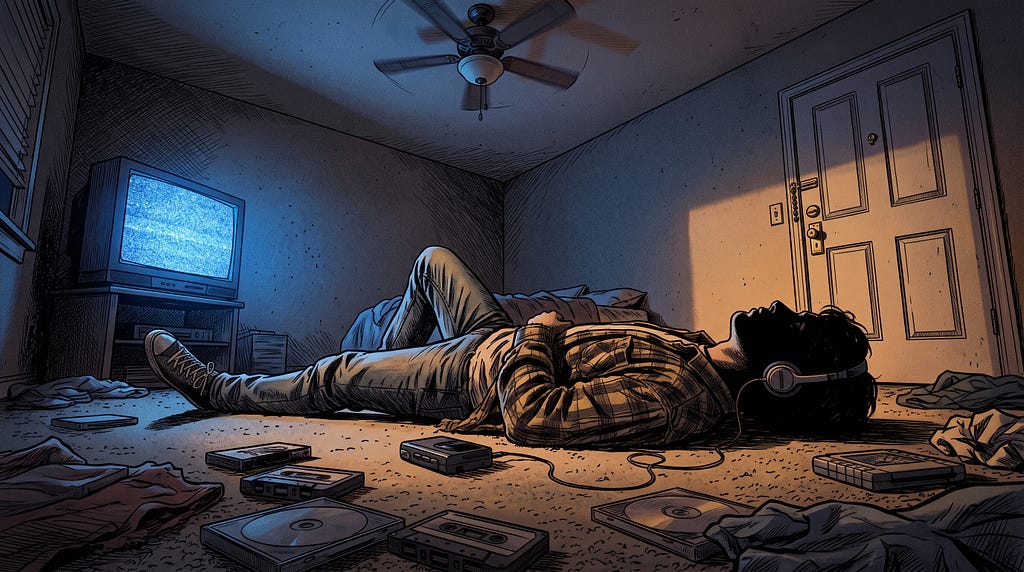
Image by Gemini
Oct. 19, 2026 — Madkat Omega
The Architecture of the Empty House
If you want to understand the psychological baseline of Generation X, you have to start after school with the sound of a deadbolt sliding home at 3:30 in the afternoon.
There is a specific acoustic signature to an empty suburban house in 1990. Once the heavy front door clicks shut, locking you inside until six or seven at night, the silence doesn’t feel peaceful; it feels pressurized. You stand in the entryway with a brass house key still warm from your pocket — or hanging from a braided shoelace around your neck — and listen to the mechanical respiration of a home running on autopilot. There is the low, sixty-hertz hum of the kitchen refrigerator, the occasional metallic tick of cooling ductwork, and, seconds later, the high-pitched electrostatic whine of a cathode-ray tube television warming up in the den.
We were the latchkey generation, the unintended byproduct of a massive socio-economic pivot. For three hours every afternoon, millions of us existed in an unsupervised purgatory populated by dust motes dancing in slanted afternoon sunlight, scorched microwave Totino’s that blistered the roofs of our mouths, and the hypnotic, babysitting glow of basic cable.
Our parents — the Baby Boomers — had spent their youth tearing down institutional walls in the name of liberation, only to spend their thirties and forties discovering that liberation required two full-time salaries, a divorce attorney, or a relentless climb up the corporate ladder. They were the protagonists of American history; we were the set dressing left behind in the split-level ranch.
“Our parents were the protagonists of American history; we were the set dressing left behind in the split-level ranch.”
This produced the central domestic paradox of the late 1980s: maximal expectation paired with minimal presence.
At the dinner table — on the occasional nights when everyone actually occupied the same room — we were fed a steady diet of Boomer institutional optimism. We were told we could be anything, that the Cold War was ending, that the free market had solved history, and that failure was merely a lack of ambition. Yet the daily reality on the kitchen fridge was a hastily scribbled note held down by a magnet and a twenty-dollar bill with instructions to preheat the oven to 400 degrees. Through the explosion of no-fault divorces and the transition from single-earner households to corporate careerism, our parents prioritized their own self-actualization while outsourcing our upbringing to television networks and consumer goods. We weren’t raised so much as we were remotely managed.
When a teenager spends thousands of hours alone in a quiet house, with no cell phone, and no internet, watching commercial television sell a version of the American family that looks nothing like their own, they develop two things very quickly: radical self-reliance and a lethal allergy to bullshit.
We learned to fix our own meals, bandages, and bikes. More importantly, we learned to contain our own emergencies. When nobody is home to hear you cry, crying loses its evolutionary utility. You learn to swallow the panic of a bad grade, a brutal afternoon in the school hallway, or the terrifying realization that your parents’ marriage is disintegrating in the next room. You build an internal blast door.
“When nobody is home to hear you cry, crying loses its evolutionary utility. You learn to build an internal blast door.”
Out of that containment came our generational armor: Whatever.
Historians and older critics mistook “whatever” for laziness or intellectual vacuity. It was neither. It was a psychological firewall. In a culture saturated with slick Reagan-era “Good Morning America” propaganda and corporate motivational posters, we realized early on that caring openly about anything gave the adult world leverage over you. If you wanted something too badly, it could be taken away, divorced, downsized, or turned into a lecture. Preemptive apathy was the only way to maintain sovereign control over your own interior life. If you don’t expect too much from me, as Doug Hopkins would soon write for the Gin Blossoms, you might not be let down.
Static on the Frequency
Until the autumn of 1991, the music blasting out of terrestrial radio and MTV was complicit in the Boomer lie.
Late-eighties pop and hair metal were the sonic equivalents of a suburban shopping mall: bright, synthetic, hyper-sexualized, and aggressively manic. Bands in spandex and Aqua Net screamed about cherry pie, Sunset Strip limousines, and nonstop late night partying. To a fourteen-year-old sitting alone on a floral-print sofa eating cereal out of a mixing bowl, watching Poison or Warrant on MTV felt like receiving transmissions from an alien planet. It was music engineered for people who didn’t have a care in the world, sold to kids who were quietly carrying the weight of fractured households. It was corporate slop — anesthetic disguised as rebellion.
We knew we were being lied to, even if we didn’t yet have the vocabulary to articulate it. We retreated into the fringes where we could find them: passed-around dubs of Metallica’s …And Justice for All, college radio static at the far left end of the FM dial, or skate-punk tapes traded behind the bleachers. We were waiting for someone to admit that the building was on fire.
Then came the four chords.
I still remember the exact texture of the foam pads on my cheap Sony Walkman headphones when the opening riff of “Smells Like Teen Spirit” first cut through the airwaves. It started clean, thin, and deceptively polite — four strummed chords that sounded like a garage band warming up in a basement down the street. And then, Kurt Cobain stepped on the Boss DS-1 distortion pedal, Dave Grohl’s snare hit like a gunshot inside a concrete stairwell, and the entire sonic architecture of the 1980s collapsed in four seconds flat.
It wasn’t just the volume; metal had volume. It was the shape of the sound. The verse dropped back into that eerie, underwater chorus-pedal hum — a two-note guitar figure floating over a stalking bassline — before detonating back into the chorus.
Quiet. Loud. Quiet. Loud.
Numbness. Panic. Containment. Rage.
For the first time in my life, a piece of popular music was replicating the exact neurological rhythm of a latchkey afternoon. That quiet-to-loud dynamic was the sound of sitting in an empty house holding everything together until your ribs ached, and then suddenly wanting to put your fist through the drywall.
For roughly eighteen glorious, naive months between late 1991 and the spring of 1993, that single breach in the perimeter became an all-out flood. We believed the underground had seized the broadcast towers and forced the culture to look at the bruise underneath the American Dream. We didn’t yet realize that the executives in the glass towers in Los Angeles and New York weren’t panicking at the sound of our alienation — they were taking notes.
Five Anthems in the Dark
To understand why the songs that poured through that breach hit us with the force of scripture, you have to remember how we consumed music in 1992. There were no algorithmic feeds nudging us toward “similar artists,” no lyric explanations crowdsourced in real time. There was only the physical artifact: a polycarbonate compact disc pried out of a wasteful acrylic jewel case, a fold-out booklet that smelled of fresh industrial ink, and the private sanctuary of a bedroom with a chair wedged under the doorknob.
We didn’t just listen to the major anthems of that era; we used them to triangulate our own coordinates in a country that felt like it was gaslighting us, before we even comprehended the meaning of that term. Each track operated on a distinct frequency of the latchkey psyche, and ironically, it was the immaculate, high-dollar production behind them that allowed their bleakest truths to bypass our defenses.
It started with the sonic Trojan horse that Butch Vig and Andy Wallace built on “Smells Like Teen Spirit.” Nirvana wanted to be a punk band, and Kurt Cobain spent the rest of his tragically short life apologizing for how slick Nevermind sounded. He wasn’t wrong about the gloss: after Vig tracked layers of overdubbed Fender Mustangs and bass guitars through the custom Neve console at Sound City, Wallace mixed the record using the exact same high-compression, radio-punch tricks he had used on Slayer and mainstream hard rock records.
But Cobain missed the point of why that polish mattered to a kid sitting in a suburban bedroom. A murky, lo-fi punk seven-inch could be dismissed as a novelty from another zip code; Nevermind sounded bigger, heavier, and more authoritative than the corporate rock it was replacing. When Cobain sneered, “Here we are now, entertain us,” he was satirizing the exact couch-locked, TV-numbed stupor we had been marinating in since elementary school. He thought he was mocking the audience, while the title itself — lifted from a brand of teenage girl’s deodorant scrawled on his wall by Kathleen Hanna — was an accidental joke.
“Kurt smells like Teen Spirit”
Yet to us, the irony was the whole point. We knew we were a captive demographic. Hearing someone scream that realization through a wall of phase-shifted distortion felt like watching a hostage kick out the studio lights on live television.
If Nirvana gave us the architecture of our rage, Pearl Jam’s “Alive” gave us the emotional vocabulary for the wreckage left behind.
Recorded at London Bridge Studios with Rick Parashar and mixed by Tim Palmer with a cavernous, 1970s arena warmth, “Alive” didn’t hide behind punk irony. It was built on Eddie Vedder’s real-life teenage trauma: the day his mother sat him down and confessed that the volatile man he thought was his father was actually his stepfather, and that his biological father had died years earlier of multiple sclerosis.
“Son, she said, have I got a little story for you…”
In 1991, nearly half of the kids in my school hallway were shuttling between two apartments with a duffel bag every other weekend, navigating step-parents, custody agreements, and the quiet disappearance of fathers who had started second families across state lines. Vedder wrote the chorus — “I’m still alive” — as a horrified admission of survivor’s guilt, a curse he couldn’t scrub off his skin. Yet when Mike McCready’s two-minute, Hendrix-channeled guitar solo took flight at the end of the track, climbing higher and more desperately with every bar, millions of teenagers did something Vedder never anticipated: we turned his private curse into a communal roar of endurance. We didn’t have therapy vocabulary back then. We didn’t talk about “generational trauma” or “attachment wounds.” We just turned the volume knob past seven and let McCready’s Marshall stacks do the screaming for us.
“We didn’t have therapy vocabulary back then. We didn’t talk about ‘generational trauma’ or ‘attachment wounds.’ We just turned the volume knob past seven and let Mike McCready’s Marshall stacks do the screaming for us.”
Then came the rot beneath the cul-de-sac. When Stone Temple Pilots dropped “Plush” in 1992, the critical establishment in New York and Seattle immediately tried to arrest them for impersonating grunge officers. Critics hated that four guys from San Diego had arrived with Brendan O’Brien’s lush, radio-ready production and Scott Weiland’s theatrical, chameleonic baritone.
What the rock snobs missed — and what every teenager immediately heard — was the unsettling sophistication of the dread inside that song. Bassist Robert DeLeo didn’t write “Plush” out of three-chord punk primitives; he built that tumbling, hypnotic main riff out of ragtime and jazz chord voicings, sliding major-sevenths and dominant chords underneath a heavy drop-D crunch. It sounded slightly off-kilter, slightly seasick. Weiland had written the lyrics after reading a San Diego newspaper account of a young woman who had been kidnapped and found murdered in the hills.
“Where ya going for tomorrow? Where ya going with the mask I found?”
To a generation raised on milk-carton missing children, Unsolved Mysteries broadcasts, and six o’clock local news anchors calmly detailing homicides while we ate dinner alone, “Plush” was the true soundtrack of the suburbs. It stripped away the picket-fence nostalgia of the Boomer imagination and admitted in a matter-of-fact tone that the world outside our front door was predatory, unaccountable, and indifferent.
The Corporate Harvest
If the story had ended there — with three bands turning suburban panic, broken homes, and media saturation into high art — grunge might have remained a pure countercultural triumph.
Instead, here is the part of the story that still stings thirty years later: the machine didn’t fight our rebellion. It bought the publishing rights, vertically integrated the distribution, and turned our self-destruction into a lifestyle vertical.
By late 1992, the major record labels — Geffen, Epic, Atlantic, A&M — had realized that Gen X’s allergy to traditional marketing was itself a goldmine. You couldn’t sell these kids shiny aspirational fantasies, because they didn’t believe in the future. Look at what they did believe in: pain, depression, cynicism, and the righteous nobility of quitting before anyone could fire you.
So the executives pivoted. If authenticity was what the latchkey demographic craved, then trauma would become the new platinum standard.
Nothing captures the sheer brutality of that transaction more clearly than the story of the Gin Blossoms and “Hey Jealousy.”
On the surface, the track was the brightest outlier of the early nineties alternative boom. Recorded at Ardent Studios in Memphis with producer John Hampton, it bypassed Seattle sludge entirely in favor of shimmering Rickenbacker twelve-string guitars and a propulsive, midwestern jangle-pop heartbeat. You could play it at a high school homecoming dance; your parents wouldn’t even tell you to turn it down.
But hiding inside that sunlit melody was the most devastating slacker manifesto of the decade, written by the band’s founding guitarist, Doug Hopkins.
“If you don’t expect too much from me, you might not be let down.”
We sang that line like a carefree anthem with the car windows rolled down, never stopping to examine the pathology underneath it. That wasn’t carefree youth; that was preemptive self-erasure. It was the psychological crouch of a person so terrified of failing to meet the world’s demands that they offer to lie down on the pavement in advance.
For Hopkins, it wasn’t a pose. Suffering from crippling depression and terminal alcoholism, he had become so incapacitated during the recording of New Miserable Experience that A&M Records and the band forced him out, withholding the money he was owed until he signed away half of his publishing royalties and mechanical rights just to survive. In late 1993, as “Hey Jealousy” became an inescapable multi-format smash and handed the label a massive windfall, Hopkins received a gold record for a band he was no longer in, checked himself out of a psychiatric hospital detox unit in Phoenix, bought a .38-caliber revolver, and ended his life. The radio stations didn’t even pause the rotation. His suicide note had already been pressed onto millions of discs and shipped through Columbia House for a penny.
“His suicide note had already been pressed onto millions of discs and shipped through Columbia House for a penny.”
By the time Candlebox released “Far Behind” in July 1993, the commodification of our misery had reached industrial perfection.
Candlebox were the kids who watched the explosion happen and arrived with a textbook on how to replicate it. Signed to Maverick Records — the boutique Warner Bros. imprint founded by Madonna, the ultimate architect of corporate pop reinvention — “Far Behind” took the foundational, bleeding wound of the Pacific Northwest underground and smoothed every jagged edge until it gleamed for terrestrial radio.
Frontman Kevin Martin wrote the lyrics as an elegy for Andrew Wood, the beloved Mother Love Bone singer whose 1990 heroin overdose had shattered the original Seattle community and led directly to the formation of Pearl Jam and Temple of the Dog. Yet where early grunge treated addiction as a claustrophobic, dirty secret, “Far Behind” elevated the overdose into a grand, cinematic power ballad. Co-produced by Kelly Gray at London Bridge Studios, the song followed a pristine commercial formula: a weeping, blues-inflected clean guitar intro, a slow-burning verse, and a triumphant, high-gain Marshall chorus where Martin belted “Now maybe I didn’t mean to treat you oh so bad” to the cheap seats.
It sold four million copies. The Seattle purists despised Candlebox for it, accusing them of carpetbagging on a corpse, while we bought the CD at Sam Goody anyway. Why wouldn’t we? By 1993, we had been thoroughly conditioned to believe that watching our heroes — and our friends — rot away from substance abuse, untreated depression, and fatalism wasn’t a public health crisis. It was just the expectation. It was an aesthetic choice, no different from Doc Martens, wallet chains, or a thermal shirt worn under a ripped thrift-store flannel that Macy’s was suddenly selling on a mannequin at the mall.
This is why Generation X became so pathologically obsessed with the concept of “selling out.”
To younger generations, our nineties purity tests look absurd — an exhausting, gatekeeping paranoia over whether a band had signed to an indie or a major, whether they had licensed a B-side to a sneaker commercial, or whether Eddie Vedder was being pretentious by refusing to make music videos and picking a war with Ticketmaster.
But our obsession with selling out wasn’t about hipster snobbery. It was a desperate, losing battle for psychological sovereignty.
We had grown up in empty houses where our attention was auctioned off to cable networks before we hit puberty. When we finally found a rough, bruised artistic language that spoke the truth about our neglect, we watched in real time as media conglomerates annexed that language, stripped it of its danger, and used it to sell us soft drinks, fast fashion, and self-destruction. When Kurt Cobain walked onto the stage in 1992 wearing a handmade t-shirt that read Corporate Magazines Still Suck for a cover shoot with Rolling Stone, we understood the trapped animal in his eyes. He knew — and deep down, we knew — that the cage was total. Even your refusal to participate could be photographed, glossy-printed, and sold on a newsstand.
So we doubled down on our only remaining defense. We welded the containment hatches shut. We decided that if the corporate world could buy our music, our clothes, and our slang, the one thing they could never monetize was an interior life we refused to show them. We made a pact to keep our wounds private, our faces deadpan, and our vulnerabilities locked behind multiple layers of sarcasm.
We had no way of knowing that thirty years later, a new generation would inherit the exact same corporate machine — and respond by tearing the blast doors off their hinges and livestreaming the wreckage inside.
From Irony’s Shell to the Algorithmic Confessional
If you want to experience true generational vertigo as a Gen Xer today, all you have to do is unlock your phone at two in the morning and scroll through five minutes of short-form video.
You will inevitably land on a nineteen-year-old sitting on the edge of an unmade bed, bathed in the clinical, shadowless halo of an LED ring light, weeping openly into a front-facing camera. While tears track down their cheeks, they will calmly, articulately narrate their own psychological unravelling using the precise clinical vocabulary of a licensed psychiatrist. They will explain how an avoidant attachment style triggered a somatic trauma response, cite their specific neurodivergent diagnosis, set a boundary with an unseen ex-partner, and — without missing a beat — remind you to check the link in their bio for twenty percent off a tele-therapy subscription.
To a latchkey kid who was trained by the merciless Darwinism of a 1989 junior high hallway to swallow blood rather than let anyone see you flinch, watching Gen Z operate in the wild feels like watching an astronaut step out of an airlock without a spacesuit. Every instinct inside our calcified, nineties-forged nervous system screams at them to hide. Put the mask back on. Make a dark joke. Turn up the fuzz pedal and mumble the chorus so the bastards in charge can’t use your weak spots against you.
Yet they don’t hide. Across thirty years of cultural evolution, the defense mechanism of youth didn’t just shift; it flipped completely. Where Generation X met a predatory corporate world with emotional hermeticism — locking our wounds behind deadpan sarcasm, baggy flannel, and cryptic lyrics — Generation Z meets the modern digital panopticon with radical, twenty-four-hour public exposure.
You can hear the exact coordinates of this upside-down in the music that defines their coming-of-age.
In 1992, when Kurt Cobain was dying inside from stomach pain, heroin withdrawal, and the terror of his own fame, he buried his agony beneath Dadaist non-sequiturs about mosquito bites and albino routines. Even when Eddie Vedder or Scott Weiland sang about real-world horror, they wrapped it in third-person narrative masks and towering walls of Marshall amplification. Direct, unmediated confession felt too naked, too easily co-opted by the daytime talk-show industrial complex of Oprah and Phil Donahue.
Compare that to the sonic landscape of the last decade. From the late Lil Peep’s Xanax-soaked emo-rap confessionals to Billie Eilish’s claustrophobic, whispered bedroom pop and Olivia Rodrigo’s hyper-specific relationship autopsies, the metaphor has been stripped down to the studs. The distortion pedal is gone, replaced by dry, close-miked vocals tracked inches from the listener’s ear canal, sounding less like a stadium broadcast and more like a voice memo sent during a panic attack. They don’t write cryptic poetry about broken homes; they name the exact dosage of their SSRIs, detail their body dysmorphia on the bridge, and drop the track alongside a four-part TikTok breakdown of the breakup that inspired it.
We didn’t have the words dysregulation, gaslighting, trauma-bonding, or limerence in 1993. We had four chords, a cheap dime-bag of weed, and a basement couch. Today’s youth have strip-mined the DSM-5 and turned clinical pathology into the foundational grammar of pop culture.
Why did that containment field collapse so completely? Because the machine changed its business model.
In the early nineties, media conglomerates operated on a broadcast economy of scale. Geffen and Sony didn’t care what was happening inside your specific head; they needed to package a uniform countercultural aesthetic that could move five million identical polycarbonate discs through suburban shopping malls. Under that regime, privacy was still possible, and hiding your interior life behind irony actually worked as a localized defense.
Gen Z never had that luxury. They were born into an algorithmic surveillance apparatus that doesn’t want mass uniformity — it wants hyper-granular behavioral extraction. The modern feed is an ingestion engine that starves when you give it silence and rewards you with dopamine, community, and relevance the moment you bleed on camera. In an attention economy, a private wound has zero market value, while a publicly cataloged trauma is a high-performing asset class. Vulnerability is no longer a liability that gives the adult world leverage over you; it is the primary social currency required to prove you exist at all.
“In an attention economy, a private wound has zero market value, while a publicly cataloged trauma is a high-performing asset class.”
This is why the nineties obsession with “selling out” has completely vanished from the cultural lexicon.
Try explaining to a twenty-two-year-old in 2026 why Pearl Jam went to war with Ticketmaster at the peak of their commercial powers, or why we used to stop listening to a band the second their song appeared in a car commercial. They will look at you with the gentle, pitying confusion usually reserved for people who still print out MapQuest directions.
To Gen Z, our purity tests look like the privilege of a generation that could still afford a one-bedroom apartment on a record-store clerk’s wages. They grew up watching the remnants of the social contract get fed into a woodchipper — inheriting a world of institutional housing monopolies, gig-economy precarity, ecological dread, and platforms that extract a thirty-percent toll on human connection. When you are born inside the company store, refusing to participate isn’t a noble stance of artistic sovereignty; it’s financial suicide.
For a digital native, there is no boundary between the self and the brand. Monetizing your breakdown, licensing your bedroom-pop anthem to a fast-fashion conglomerate, and “getting the bag” isn’t viewed as a betrayal of the underground. There is no underground — only different tiers of algorithmic visibility. Where Doug Hopkins drank himself to death in the dark because he couldn’t bear the machinery that bought his misery, the modern artist looks dead into the lens, tags the corporate sponsor on their depressive episode, and invoices the machine before the algorithm shifts its weights and forgets their name.
Epilogue: The Sovereignty Post-Mortem
It would be comforting to end this story on our aging Gen X porch, nursing a lower-back injury and a heavy, 180-gram vinyl reissue of Dirt, feeling quietly superior to the kids crying into their ring lights. It would be easy to tell ourselves that we were the last rugged individualists — the tough, self-reliant latchkey survivors who saw through the corporate illusion, kept our dignity intact, and refused to sell our souls to the feed.
It would be easy, and it would be a lie.
If we are going to apply our famous, unsparing nineties cynicism to anything, we finally have to apply it to ourselves. We have to look at the smoking crater where individual sovereignty used to be and admit our own complicity in how it was lost.
Our generational armor — that cool, detached, impenetrable whatever — worked exactly as designed. It kept us from looking foolish. It stopped us from getting fooled by morning-in-America slogans, corporate motivational speakers, and political messiahs. By retreating into irony and treating every institution as a rigged carnival game, we protected the small, dark room inside our skulls where nobody could touch us.
But there was a fatal flaw in the slacker fortress: while we were busy refusing to play the game, somebody else got to change the rules.
By treating earnest ambition as embarrassing and institutional power as a dirty joke meant for sellouts, Generation X largely abdicated the field. We stood on the sidelines in our distressed flannel, making razor-sharp observations about the hypocrisy of the system, while aging Boomers refused to relinquish the levers of political power and a handful of sociopathic tech architects quietly wired the basement of civilization for total behavioral capture. Our defensive detachment saved our personal pride, yet it left the public square undefended. We were so terrified of being co-opted that we mistook withdrawal for victory.
And yet, when the house gets quiet late at night, I still find myself aching for the specific solitude of 1992.
When I look back at that teenager after school sitting on the floor of an empty suburban house at 4:20 in the afternoon, wedging a wooden chair under the bedroom doorknob and pressing play on a beaten-up Sony Walkman, I realize we possessed a form of sovereignty so absolute we didn’t even know to guard it.
Yes, the major labels packaged our neglect. Yes, they took Kurt Cobain’s rage, Eddie Vedder’s family wreckage, Scott Weiland’s suburban dread, Kevin Martin’s grief, and Doug Hopkins’ fatal despair, stamped it into CDs, and sold them back to us individually shrink-wrapped at the mall. Our rebellion was harvested before the music finished playing, Cobain howling “a denial” still ringing in our ears.
But once you walked out of Sam Goody, rode your bike home, and locked that front deadbolt behind you, the transaction was over.
When you lay on your bedroom carpet staring up at the spinning blades of a ceiling fan while “Plush” or “Hey Jealousy” unspooled in your ears, you were genuinely off the grid. No telemetry packet was firing back to a server farm in Northern Virginia to log the exact second you paused the track. No sentiment-analysis model was measuring your late-night replay loop to infer a depressive spiral and auction your psychological vulnerability to advertisers in real time. No algorithm was studying your loneliness to build a better cage.
“Your alienation had been bought at the cash register, but inside that quiet house, your mind still belonged entirely to you.”
Your alienation had been bought at the cash register, but inside that quiet house, your mind still belonged entirely to you.
That was the final, unrepeatable luxury of the latchkey generation. High-production nineties grunge didn’t save us from the corporate machine; instead, it served as our inoculation. By showing us how effortlessly the system could absorb our loudest, ugliest truths and turn them into quarterly revenue, those songs hardened us for the world to come. They taught us early on that individual sovereignty wouldn’t end with jackboots kicking down the front door — it would end with a marketing department offering to validate our pain in exchange for another piece of our interior lives, and another, and another…
We lost that war thirty years ago, somewhere between the first four chords of “Smells Like Teen Spirit” and the final echo of a shotgun in Seattle. Rest in Peace, brother. The difference is that we still remember what the silence sounded like before the machine learned how to listen back.