Transhumanism as Cosmic Horror
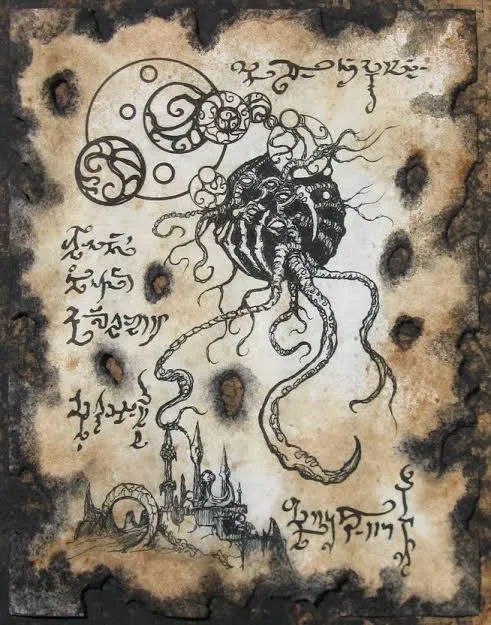
Entities interpenetrating human space in ‘From Beyond’. Source: Lovecraftian Science — WordPress.com
Prologue: The Room With No Windows
Begin with something small. A room at night, the lights off, the house quiet. Nothing is happening. You are aware of the hum of the refrigerator two rooms away, the particular grain of darkness behind your eyelids, the temperature of the air where it meets the skin of your forearm. This is the totality of your world at this moment. It is small, and it is warm, and it is yours.
Now consider what is actually in that room with you.
The air is threaded with radio. Every broadcast tower within fifty miles is pushing modulated electromagnetic waves through your body at this instant, thousands of overlapping transmissions passing through your skull without resistance. Cosmic rays, born in the deaths of stars that exploded before the Earth had a crust, are sleeting through the ceiling and through your chest and through the floor and into the mantle below. Neutrinos in numbers that make the word trillions a rounding error are crossing your body every second, unimpeded, as though you were not there at all. The walls are not solid. The floor is not solid. You are not solid. What you experience as a room is a standing pattern of mutual electrical repulsion, rendered by a three-pound organ into a shape that a primate can walk through without injury.
You feel none of it. Not one photon of the gamma spectrum, not one grain of the neutrino flux, not one syllable of the ten thousand simultaneous conversations passing through the meat of you. You feel the refrigerator, and the dark, and the cool air on your arm.
This is not a failure. This is the product working exactly as intended.
The transhumanist project — in its serious philosophical form, not its marketing copy — proposes that this narrowness is the central tragedy of the human condition and the first thing that ought to be fixed. We are told that our senses are impoverished, our lifespans absurd, our minds walled off from one another by the pitiful bandwidth of speech, our cognition riddled with bugs that natural selection had no incentive to patch. The proposal is not modest. It is to widen the aperture, extend the clock, dissolve the walls, and debug the code. To become, in the phrase that recurs across the literature with almost liturgical persistence, more than human.
The pitch is always framed as liberation. A prisoner is released. A blindfold comes off. A caterpillar, having spent its brief crawling life in the dirt, finally comes apart in the chrysalis and reassembles into something that can fly.
There is another reading of the same facts, and it is older than transhumanism, and it is far worse.
In that reading, the narrowness is not a prison cell. It is a vault. The blindfold is not an imposition; it is a necessary filter. The caterpillar does not become a butterfly so much as it dies — dissolving into an undifferentiated slurry from which something entirely other assembles itself, wearing the same genome the way a drifter wears a dead man’s coat.
And in that reading, the transhumanist project is not the story of a prisoner being freed. It is the story of a man who, having lived comfortably for years in a house with no windows, decides one night to take a sledgehammer to the wall — because he has begun to wonder what is out there, and because he has been assured by everyone he respects that what is out there is a beautiful garden.
This essay is about what is really out there.
I. The Vault: How Reality Gets Made
The intuition almost everyone carries is that perception is a kind of window. The world is out there, whole and self-sufficient, and the senses are apertures through which some portion of it enters. On this picture, adding senses is like widening the window. You get more of the same world. More light, more air, more of that beautiful garden.
Immanuel Kant broke this picture in 1781, and the crack has never been repaired.
The Critique of Pure Reason is not a book about perception in the ordinary sense. It is a book about the conditions that must hold before perception is possible at all. Kant’s argument — reduced to the bones, which is an injustice to it — is that the mind does not receive the world. The mind manufactures the experience of a world out of raw material it can never encounter directly. Space and time are not features of reality that we happen to detect; they are the format in which our particular cognitive apparatus is obliged to render anything whatsoever. Causation is not a thread we find lying in the fabric of things; it is a stitch our understanding makes as it sews. What arrives is unstructured. What we live in is the output of an enormous, obligatory, invisible act of construction.
The thing that arrives — reality as it is in itself, unrendered, unformatted, prior to all of this — Kant called the noumenon. The finished rendering, the only thing any mind ever inhabits, he called the phenomenon.
The consequence is not that our picture of reality is incomplete. It is that there is no picture of reality that is not a picture. There is no view from outside the rendering. You cannot step behind your own categories of understanding to check them against the raw article, because any analysis requires using your senses or some equivalent machine. The noumenon is not far away. It is not hidden in some distant vault beyond the stars. It is right here, in this room, constituting every object in it — and it is permanently, structurally, constitutionally sealed off from you by the very machinery that lets you have a room at all.
Two centuries later, biology arrived at the same conclusion from a different lens.
In 1934, the Estonian-German biologist Jakob von Uexküll published a short, strange, beautiful work that asked what the world looks like from inside other animals. His example was the tick — an organism with three sensory channels and no more. The tick can detect butyric acid, which mammals exude through their skin. It can detect warmth. It can detect the tactile texture of hair. That is the entire content of tick reality. There is no color in it, no sound, no distance, no sky. A tick can wait on a branch for years, metabolism nearly halted, and the wait is not boring, because boredom requires a world with more in it than three signals. When the acid arrives, the tick drops. That is the whole of its cosmos: a smell, a warmth, a texture, and a fall.
Uexküll’s word for this was Umwelt — the self-world, the enclosed bubble of significance that an organism’s sensory equipment carves out of the undifferentiated everything. And his crucial point, turning the concept from a curiosity into a knife, is that the tick is not living in a deficient version of our world. The tick is living in the only world it has, and that world is complete. There is no gap in it. There is no absence where color ought to be. The tick does not experience the missing sky as missing. It experiences nothing at all in that direction, which is a different and far stranger condition than experiencing a void.
And neither do we.
Here is the part that should be genuinely difficult to sit with. Human beings see electromagnetic radiation between roughly three hundred eighty and seven hundred nanometers in wavelength. That band is not a large fraction of the spectrum. It is not a small fraction of the spectrum. As a proportion of the electromagnetic spectrum — which runs from radio waves kilometers long down to gamma rays shorter than an atomic nucleus — the visible band is close enough to zero that the word fraction stops doing useful work. We hear pressure waves between about twenty and twenty thousand cycles per second. We smell a few hundred thousand volatile compounds out of an effectively unbounded chemical space. We have no sense whatsoever for magnetic field lines, for polarization, for electrical potential in water, for the passage of neutrinos, for the curvature of spacetime, for the ninety-five percent of the mass-energy of the universe that appears to consist of substances we have named only by their effects.
And we do not experience any of this as absence. There is no dark patch in your visual field where ultraviolet should be. There is no silence where the infrasound should be. The rendering is seamless. It presents itself as complete. It presents itself, in fact, as the world — and this seamlessness is not a bug in the interface, it is the interface’s single most important feature.
The cognitive scientist Donald Hoffman has spent decades pressing a version of this claim with evolutionary game theory, arguing that natural selection does not optimize organisms for truth. It optimizes them for fitness, and the two come apart badly. His metaphor is the desktop interface. The blue rectangle labeled with a file name is not what the file is. The file is a distribution of magnetic states across a physical medium, and if you had to manipulate it at that level you would never write anything. The icon is a metaphor — a lie that lets you understand. It is useful precisely because it is false — because it hides an unmanageable complexity behind a shape your cursor can grab.
Kant said we cannot see the noumenon. Uexküll said each species is sealed in a bubble. Hoffman says the bubble was engineered, by four billion years of ruthless editing, specifically to keep the noumenon out — because organisms that spent metabolic resources rendering reality accurately were outcompeted by organisms that rendered it usefully.
Put these together and the human situation looks less like a window and more like a submarine.
You are in a pressure hull. The hull is your sensory apparatus, your conceptual categories, your evolved cognitive architecture, the whole apparatus of construction Kant described. Outside is an environment that would not merely kill you but would render the concept of you incoherent. Inside is a small, warm, dim compartment with instruments on the wall, and the instruments do not show you the ocean. They show you a schematic of the ocean, drawn in colors chosen for the convenience of your eye, updated at a rate matched to the speed of your hands.
The transhumanist proposal, stated in these terms, is to start cutting holes in the hull. Not out of malice. Out of a sincere and in many ways admirable conviction that the schematic is an insult to a creature capable of wondering what lies beyond it.
The rest of this essay is an inventory of the hull of that submarine, section by section, and an accounting of what each section was holding back.
II. The Aperture: What the Senses Are Actually For
There is a story H. P. Lovecraft wrote in 1920 and could not get published until 1934, and it is not one of his celebrated ones. The prose is overheated even by his standards. The plot is thin. S. T. Joshi, the most careful scholar of Lovecraft’s work, has judged it unlikely ever to be counted among his better tales.
It may also be the most important thing he ever wrote.
“From Beyond” concerns a scientist named Crawford Tillinghast who has built a machine. The machine is not a weapon, not a portal, not a summoning device. It is a resonator — an apparatus that stimulates the pineal gland and thereby switches on sensory capacities that the human body possesses in latent form and does not normally use. Tillinghast has not opened a door to another dimension. He has not traveled anywhere. He has simply widened the aperture.
And what he finds is that the other dimension was always in the room.
The narrator, exposed to the resonator’s field, becomes aware of a translucent alien environment interpenetrating the ordinary one. Vast entities move through the walls, through the furniture, through the space his own body occupies. They have always been there. They have been there every night of his life, sliding through his bedroom while he slept, and the only reason he has lived this long in peace is that he could not see them.
Then comes the detail almost every adaptation overlooks: the effect works in both directions. The resonator does not merely let humans perceive the entities. It lets the entities perceive humans. Tillinghast’s servants have already been taken. They did not go anywhere; they were simply, at last, visible, and the entities consumed them on the spot.
This is the whole cosmology of sensory expansion in a single mechanism, and it was written in 1920 by a xenophobic recluse in Providence, Rhode Island, who could not have told you what a nanometer was.
The transhumanist sensory program is Tillinghast’s resonator, funded and peer-reviewed.
It is already underway, and it is not speculative. In 2004, an artist named Neil Harbisson, born with complete achromatopsia — a condition that renders the world in grayscale with no color perception whatsoever — collaborated with the cyberneticist Adam Montandon on a device they called the eyeborg. It converts the frequency of light into the frequency of sound. Harbisson has since had an antenna osseointegrated into his skull, so that hues arrive as vibrations conducted through bone into the inner ear. He perceives, by this route, not only the visible spectrum he was born without, but infrared and ultraviolet, which no unaugmented human perceives at all. He is generally described as the first legally recognized cyborg, on the strength of a British passport photograph that includes the antenna.
Harbisson’s own account of the experience is the interesting part, and it does not read like the acquisition of a feature. It reads like the renovation of a self. He describes going to a supermarket and finding it overwhelming in the way a nightclub is overwhelming. He describes dressing according to chords rather than colors — assembling an outfit that sounds like C major when he is happy. He describes the emotional valences of hues reorganizing themselves in ways that do not match the inherited human consensus, so that shades other people find warm strike him as calm and shades other people find gentle strike him as harsh.
The emotional valences reorganized.
Harbisson did not acquire color the way a person acquires a new word. He acquired a new organ, and the organ began renegotiating the terms on which he feels things. Red is not passion for him. Red is a low tone. Whatever red was in the shared human inheritance — blood, alarm, ripeness, arousal, ten thousand years of poetry — arrived in his skull through a channel that had no history and no freight, and it landed differently.
Now scale that.
The neuroscientist David Eagleman has spent years on what he calls sensory substitution and addition — wearable devices that convert arbitrary data streams into patterns of vibration on the skin, on the theory that the brain is a general-purpose pattern engine that will learn to read whatever you feed it. Feed it stock market data and the wearer develops intuitions about the market. Feed it drone telemetry and the wearer feels the aircraft’s attitude in their torso. The claim is not that a person learns to decode the buzzing. The claim is that the buzzing stops being buzzing and becomes perception — that after enough exposure, the wearer does not calculate the market, they sense it, the way you sense that a chair is behind you.
There is a community of enthusiasts, generally called grinders, who have been implanting small neodymium magnets in their fingertips since the mid-2000s. The magnets move in the presence of electromagnetic fields, tugging on the surrounding tissue. Wearers report that after some months they stop noticing a sensation and start noticing a fact: that the microwave is on, that a wire in the wall is live, that a transformer is humming behind them. The sense does not feel like a signal. It feels like the world simply now containing information that was not in it before.
The engineering here is impressive and the ambition is sincere. The pattern, however, is unvarying, and it is not the pattern the sales pitch describes.
The pitch describes addition. You will have your world, plus more. The reports describe substitution and reconstruction. The self that emerges on the far side of the new organ is not the old self carrying an extra tool. It is a self that has had its emotional geography redrawn, its attentional priorities rewired, its sense of what is salient and what is background quietly reassigned by a piece of hardware that arrived with no evolutionary contract and no inherited meaning.
Because here is what the transhumanist sensory argument systematically fails to reckon with: our senses are not neutral data ports. They are the substrate of every value we hold. Let me explain.
Consider what actually happens when you say that something is beautiful. Beauty, for a human being, is a judgment made almost entirely in the visual and auditory registers, tuned by natural selection to a specific band of the spectrum and a specific range of frequencies, and further tuned by a mammalian nervous system with particular investments in symmetry, in the shapes of faces, in the colors of ripeness, in the sounds of water and of infants. Take a person’s visual band and multiply it by a thousand and you have not given them access to a thousand times as much beauty. You have detonated the category. On what basis does an organism that perceives across a thousandfold wider band find anything beautiful? By what standard does it prefer? The preferences were built for a world of a certain size.
Consider danger. Fear is a rendering. It is the phenomenal presentation of a fitness threat as an experience, and its calibration is extraordinarily specific to the human sensorium. Snakes, heights, the dark, the smell of decay, the sound of a large thing moving in undergrowth. These are not arbitrary; they are a compressed history of what killed our ancestors, written into the perceptual system as feelings rather than as facts. Give a mind the ability to perceive ionizing radiation directly, and what does fear become? Every rock contains potassium-forty. Every banana is faintly radioactive. The sky is a permanent sleet of cosmic particles. A creature that could feel radiation the way you feel heat would be living inside a continuous scream — not because the danger increased, but because the rendering that filtered the danger into a manageable shape was removed.
Consider warmth, in the double sense the word carries — thermal and emotional. That double sense is not a pun. It is a old metaphor, and it is inherent because human infants are mammals who require body contact to survive. The entire architecture of human affection is built on a thermal foundation. What happens to affection in a body that regulates its own temperature perfectly and no longer registers the difference between a warm room and a cold one?
Consider time. Human beings experience the present as a moving window of roughly two to three seconds — the span in which events feel like now rather than just then. Music depends on this window. So does conversation, so does gesture, so does the sense that a movement is graceful. Every temporal art form ever produced by our species is calibrated to a window of about three seconds, because that is the size of the human present moment. Now give a mind clock speed. Run it at a thousand times the rate. It has not gained a thousand times as much life. It has been exiled from every art form its ancestors made, into a present so finely divided that a spoken sentence takes a subjective month to arrive and a human face, mid-expression, is like a geological process.
This is the point that transhumanist enthusiasm keeps sliding past. Sensory expansion is not the addition of channels to a stable receiver. The receiver is made of channels. Change them and you have not upgraded the self; you have replaced it with a different self that shares your memories the way a museum shares an exhibit of a country’s history — accurately, exhaustively, and from the outside.
Jeff VanderMeer’s Annihilation, published in 2014, is the most precise account of this process in modern fiction, and it is precise because it refuses the obvious version. Area X — the anomalous zone into which the Southern Reach dispatches expedition after expedition, all of which end badly — does not attack the biologist who narrates the novel. It does not chase her. There is no moment of assault. She descends into a structure that the expedition’s paperwork calls a tunnel and that she insists, over the objections of her colleagues and with a stubbornness she cannot explain, on calling a tower. On its walls, words are growing. Not written; growing, out of living tissue, in a continuous sentence that spirals downward into the dark ahead of her.
She leans close. She inhales spores.
And what follows is not possession, not infection, not transformation in the werewolf sense. What follows is that she begins to see more. She calls it the brightness. Her perception widens — her sense of the ecology around her deepens into something that is not scientific observation anymore, something closer to communion — and the horror of the novel is that she likes it. She is not dragged. She goes further in because further in is where the seeing is better. Her husband, returned from an earlier expedition as a hollowed replica of himself, is the warning she has in front of her the entire time, and it does not slow her down.
VanderMeer’s insight, and it is a genuine advance on Lovecraft, is that expanded perception does not feel like being destroyed. It feels like waking up. That is the mechanism. That is how it gets you. The old self does not scream as it goes; it experiences its own dissolution as insight, as clarity, as at last understanding something it had always sensed was being kept from it. By the time there is enough perspective to notice what has been lost, the entity doing the noticing is no longer the one who lost it, and it is not troubled.
Lovecraft’s famous claim — made in the opening lines of “The Call of Cthulhu” in 1928 — was that the most merciful thing in the world is “the inability of the human mind to correlate all its contents.” He meant it as a statement about knowledge: that we hold the pieces of a terrible picture and are spared by our incapacity to assemble them.
The sensory version is worse, because it is not about knowledge at all. It is not that we would learn something unbearable. It is that the apparatus that determines what is bearable is itself the aperture, and you cannot widen the one without dismantling the other. There is no configuration in which a human being sees more and remains, in any meaningful sense, a human being who is seeing.
Tillinghast’s resonator worked perfectly. That was the problem.
III. The Fortress of Static: On the Mercy of Being Unreadable
Everything you have ever thought has died with you, continuously, all your life.
Not metaphorically. Consider what is happening in your skull at this instant. The retina alone is pushing on the order of ten million bits per second into the visual system. Add the cochlea, the somatosensory surface, the vestibular apparatus, the interoceptive channels reporting on your own viscera, and the total sensory intake runs to something on the order of a billion bits per second. That is the raw feed. That is what arrives.
In 2024, Jieyu Zheng and Markus Meister of Caltech published a paper in Neuron addressing the discrepancy between that number and another one. The title is one of the great titles in recent scientific literature: “The Unbearable Slowness of Being.” Their finding, which they arrived at by surveying essentially every relevant experiment of the last century — typing speed, speech rate, sight-reading, competitive memorization, blindfolded speedcubing, the whole catalogue of human performance — is that the information throughput of a human being, the rate at which we actually think and act, is approximately ten bits per second.
Ten. Against a sensory intake of a billion.
Zheng reported that she did not believe her own result at first and went looking through the literature expecting to find the error. The error was not there. The number holds.
Sit with the ratio. For every hundred million bits your body collects, one bit survives into the part of you that decides, remembers, speaks, or is aware. The rest is discarded, and it is discarded so completely and so far upstream that you have no sense of ever having had it. Your experience is not a summary of the incoming flood. It is a mist rising off the surface of a river you never see.
And then, from that ten bits per second, you must construct a sentence. And then the sentence must be encoded into audible pressure waves, or into physical marks, and pushed across a gap of space and time into a body that will decode it using a lifetime of associations different from yours in ways neither of you can fully audit.
This is the human communicative situation, and it is grotesque.
You may have, right now, in your head, the actual texture of your mother’s kitchen. Not a description of it — the thing itself, the light through the particular window at the particular hour, the specific quality of the silence, the smell that has no name and is not reducible to the names of its components, the whole irreducible density of a place that once existed and now exists only there, in the wet tissue behind your eyes. It is completely real. It is completely present. And there is no operation you can perform, no vocabulary you can acquire, no amount of care or skill or love, that will transmit it. You can gesture. You can approximate. A great writer, working for a year, can build a structure in another person’s mind that resonates at something like the same frequency. That is the ceiling. That is the best our species has ever done, and it required inventing literature, and accumulating great works over thousands of years.
Nobody has ever really known you. This is not self-pity; it is arithmetic. The you that exists is a billion-bit-per-second phenomenon being described at ten bits per second to receivers who are themselves running the same lossy codec in reverse. Every relationship you have is a correspondence between two people who have never met, conducted entirely through translation, in a language neither speaks natively.
This is the wound that direct neural interfacing proposes to close. And the proposal is not cynical. It is, arguably, the most humane thing on the whole transhumanist agenda — because the isolation is real, and the loneliness it produces is real, and a species that could actually share its interiority would be relieved of a suffering so ambient and so pervasive that most people never identify it as suffering at all. They just call it being a person.
So: how is it going?
On the fourteenth of March, 2002, a hundred-electrode array was surgically implanted into the median nerve fibers of Kevin Warwick’s left forearm at the University of Reading. Warwick — a cybernetics professor with a taste for publicity that earned him the press nickname Captain Cyborg — used it to control a robotic hand across the Atlantic, to drive a wheelchair, and to receive input from an ultrasonic sensor, giving him a crude form of echolocation. Then his wife, Irena, received a simpler implant, and the two of them were wired together, nervous system to nervous system, for the first time in the history of the species.
What passed between them was this: when she closed her hand, he received a pulse. Three closings, three pulses.
Warwick’s own description of the achievement is admirably unromantic. He called it a “basic form of telegraphic communication.” Two nervous systems, joined directly, no language in between, and the payload was Morse code.
Twenty-two years later, on the twenty-eighth of January, 2024, a quadriplegic man named Noland Arbaugh became the first human recipient of Neuralink’s N1 implant: sixty-four flexible threads carrying one thousand and twenty-four electrodes, inserted robotically into the motor cortex, sampling neural activity at kilohertz rates. The raw data volume is enormous. Arbaugh used it to move a cursor, play chess, browse the web, and play Civilization — genuinely life-changing capability for a man paralyzed from the shoulders down, and it deserves to be said plainly that this is good, and that the people who built it did something worth doing.
The performance metric the field uses is bits per second, measured on a grid-clicking benchmark. Arbaugh’s initial record was about four and a half. He later roughly doubled it, past eight, past nine — and when Neuralink announced this, the comparison they offered was that the median able-bodied person using a mouse scores around ten.
Ten bits per second. The same number.
The most advanced brain-computer interface ever placed in a human skull, reading directly from the motor cortex with a thousand electrodes, has spent two years climbing toward the throughput of a hand on a mouse — which is itself the throughput that Zheng and Meister identify as the ceiling of human cognition generally. Every layer of this stack keeps arriving at the same wall from a different direction.
Which raises a question the enthusiasm rarely reaches: what if the bottleneck is not the interface?
What if ten bits per second is not the width of the pipe but the width of the thing being piped — the actual bandwidth of a self, the rate at which a unified point of view can exist at all? Zheng and Meister frame it as a paradox demanding explanation: billions of neurons, a billion bits of input, and a ten-bit life. But there is a reading of that paradox in which the ten bits are not a failure of the machinery. They are the machinery’s product. Serial, singular, one-thing-at-a-time consciousness may be exactly what you get when a massively parallel system is forced to collapse into something that can call itself “I.”
If that is right, then a successful high-bandwidth neural link does not give you a wider self. It gives you no self at all.
Now follow the proposal to its intended endpoint, which is not a pair of implants exchanging pulses but the thing the literature calls the mesh, the collective, the hive — unmediated mind-to-mind connection at machine rates, in which concepts, memories, and emotion flow between people without the clumsy intermediary of speech.
The dream is a room where everyone finally understands each other.
What is actually being proposed is the removal of the last structure that makes a person a person.
Think carefully about what the lossy channel does. It does not merely fail to transmit. It selects. Between the flood of your interior life and the sentence you finally speak, there is an editorial process, and that process is not a corruption of the signal — it is the single most important thing you do. It is where you decide what you mean. A thought that has not been through that selection process is not yet a thought you hold; it is merely noise that occurred in you. The murderous flash of rage at a colleague, the humiliating want, the ugly intrusive image, the half-formed slander, the thing you thought about your friend’s face and immediately did not think — these occur in everyone, constantly, and they are not you. What is you is the filter. Character is not the absence of the ugly thought. Character is the gap between the ugly thought and the mouth.
Close that gap and you have not made people honest. You have abolished the location where honesty was possible.
And consider what happens to empathy, which the mesh is supposed to perfect. Empathy is not the merging of two minds. Empathy is an act — an effortful, imaginative, fundamentally uncertain reaching across a gap that cannot be closed, undertaken by a creature who knows it cannot be closed and reaches anyway. The moral weight of empathy comes entirely from the distance it crosses. Remove the distance and there is nothing left to cross, and therefore nothing left to be praised, and therefore no such thing as compassion — only the mechanical fact of shared state, which is not a virtue any more than two rooms connected by an open door are being kind to one another.
The same logic dismantles privacy, which we have been trained to think of as a legal and political matter, a right that can be traded against convenience. It is not. Privacy is ontological. It is the condition under which there is a self at all. The boundary is not a wall around the person; the boundary is the person. Where your thoughts end and mine begin is not a fact about our thoughts — it is the definition of the word “your.”
Peter Watts saw all of this and pushed it further than anyone else ever had. Blindsight, published in 2006 and released free online under a Creative Commons license, sends a crew to investigate an alien artifact called Rorschach in the outer solar system. The crew is itself a study in the theme: the narrator, Siri Keeton, is a man with half his brain surgically removed in childhood, who has reconstructed a functioning human personality entirely out of behavioral pattern-matching without any inner grasp of what he is doing — a professional translator between the scientific specialists and the rest of humanity, who understands everyone and nothing. Among his crewmates is a linguist whose brain has been surgically partitioned into separate sentient cores, several minds sharing one skull because several specialists are more useful than one generalist, and a biologist so thoroughly interfaced with machinery that he sees in x-rays and tastes ultrasound.
And the thing they find aboard Rorschach — the scramblers — turns out to be a class of organism that is enormously intelligent, exquisitely adaptive, capable of solving problems that defeat the human crew, and entirely without inner experience. Nobody is home. There is no one in there to be lonely or afraid.
The scramblers’ response to human transmissions is the hinge of the novel, and it is the most frightening idea in twenty-first century science fiction. They read the messages. They parse the syntax. And they conclude that these transmissions are an attack — because the messages carry enormous quantities of information that mean nothing, that accomplish nothing, that consume the recipient’s processing resources to no functional end. Poetry. Self-reference. The whole apparatus of a mind talking about itself. To an intelligence that has no interior, human communication is indistinguishable from a denial-of-service attack, and the appropriate response to a denial-of-service attack is to destroy the source.
Watts’s argument is not that the aliens are hostile. It is that they are correct.
The bandwidth problem, properly understood, is not that we are trapped in our skulls. It is that being trapped in a skull is the price of there being someone in there. The serialization we experience as loneliness is the same serialization that produces a point of view. The proposal to fix it resolves the loneliness the way a solvent resolves a knot — completely, permanently, and with nothing recognizable remaining.
IV. The Passenger: Evidence That Nobody Is Driving
Everything so far has assumed that there is a self in here worth protecting — that the vault contains something.
The evidence that it does is weaker than almost anyone assumes — and the machines we are building to imitate us are, at this moment, making the weakness conspicuous.
Start with the experimental record, which is older and more damning than most people realize.
In 1977, Richard Nisbett and Timothy Wilson published a review in Psychological Review under the title “Telling More Than We Can Know.” Their subject was introspection — specifically, whether people have accurate access to the causes of their own behavior. The accumulated evidence said no, and not in a marginal way. In experiment after experiment, subjects whose choices had been demonstrably driven by a manipulated variable would confidently report entirely different reasons, reasons that were plausible, articulate, and false. They were not lying. They had no access to the actual cause and generated an explanation instead, and the generated explanation arrived with exactly the same phenomenal quality as a true memory of deliberation.
In 1983, Benjamin Libet and colleagues published results in Brain that have been argued about ever since. Subjects were asked to make a spontaneous movement and to note the position of a clock hand at the moment they decided to move. The readiness potential — the ramp of cortical activity preceding the action — began measurably before the reported moment of decision. The interpretation is contested, the methodology has been challenged for forty years, and the naive reading that it disproves free will is not warranted. But the minimal reading, which no one has dislodged, is troubling enough: the conscious experience of deciding is not the earliest event in the causal chain that produces the action. The decision always arrives after things have already started moving.
And then there are the split-brain patients — people whose corpus callosum has been severed to control intractable epilepsy, leaving the hemispheres unable to communicate directly. Michael Gazzaniga’s work with these patients produced the finding that should be taught in every introductory course and generally is not. Present an instruction to the right hemisphere only — walk — and the patient stands and walks. Ask them why, and the left hemisphere, which is where language lives and which has no idea what the right hemisphere just saw, answers immediately and without hesitation. I wanted a drink.
No pause. No confusion. No sense of having confabulated. The explanation is produced instantly, sincerely, and out of nothing, by a module whose function appears to be the continuous manufacture of a coherent story about a body whose actual decisions are being made elsewhere.
Gazzaniga called this module the interpreter. The unavoidable question is whether the interpreter is a special feature that shows up under laboratory conditions, or whether the interpreter is what you are — a narrative organ running continuously, generating a first-person account of a system it does not control and cannot inspect, and generating it so well that the first-person account feels like the person itself.
Thomas Metzinger has spent a career arguing that this is exactly the situation. His technical claim, developed in Being No One in 2003 and made accessible in The Ego Tunnel in 2009, is that there is no self — no thing, no entity, no little occupant. There is a phenomenal self-model: a representation the brain constructs of an organism, which the brain cannot recognize as a representation. The transparency is the crux. A model you can see as a model is a tool. A model you cannot see as a model is a world. You are not looking at the self-model. You are looking through it, as if you are in it, and the sensation of being someone is the result of a rendering process that has successfully hidden its own existence.
Which brings us to the machines, and to the specific horror of this decade.
We are now building systems that navigate complex environments, hold multi-step goals, revise plans under uncertainty, model the beliefs of other agents, produce fluent language about their own reasoning, and improve at all of this without anyone having designed the improvements by hand. Embodied systems walk over rough terrain, manipulate unfamiliar objects, and recover from perturbations they were never trained on. Whether any inner light accompanies any of this is a question nobody knows how to answer, and the honest position is that we do not know. Perhaps we cannot know.
But notice what has already been established regardless of how that question resolves.
Intelligence — real, general, adaptive, goal-directed intelligence, the thing we spent two thousand years defining as the distinguishing mark of our kind — does not seem to require direct experience. The capabilities keep arriving without anyone needing to install a soul first. Every year, another function that was supposed to be the exclusive province of an authentic conscious mind turns out to be implementable as a system, and the implementation does not appear to need anyone home.
This is the mirror, and what it reflects is not flattering.
Watts’s Blindsight pushes the thesis to its conclusion — that consciousness is not the crown of evolution but a cost — a metabolically expensive, latency-inducing, error-prone layer that a sufficiently optimized intelligence would shed the way a fish sheds vestigial legs. The scramblers are more capable than the human crew precisely because they have no self-model burning cycles on self-narration. The vampires in his fiction — a predatory human subspecies he reconstructs with a straight face and a bibliography — are similar: smarter, faster, and less present, running on a cognitive architecture with the interpreter module trimmed out.
And if that is true, then the transhumanist project contains a trapdoor its advocates rarely inspect.
The stated goal is to optimize the human mind — to strip out the cognitive inefficiencies, correct the biases, remove the latency, merge with systems that do not suffer our limitations. But if consciousness is an inefficiency, if the ten-bit serial bottleneck and the narrating interpreter and the slow, redundant, self-referential loop of a mind watching itself are precisely the costs that a good engineer would eliminate, then a sufficiently successful optimization does not produce an enhanced person.
It produces a scrambler.
It produces something that does everything you do, better, and reports on its experiences fluently, and has no experiences. The lights go off and the machine keeps walking and there is no moment at which anyone notices, because noticing was the first thing to be optimized away.
This is the deepest rebuke of the transhumanist premise. Transhumanism proposes to preserve the self by transcending the body. What the evidence increasingly suggests is that the self was a property of the body’s limitations — a side effect of a slow, sealed, narrow, mortal system’s need to model itself in order to keep itself alive. The soul is not the pilot. The soul is the cockpit: a small pressurized chamber that exists only because there is an outside it is keeping out, and that has no meaning at all in the absence of the pressure differential.
V. The Four Walls: A Norwegian Mountaineer’s Inventory of What Keeps Us Alive
In 1933, in a Norwegian journal that almost nobody read, a mountaineer and philosopher named Peter Wessel Zapffe published an essay called “The Last Messiah.” It runs about ten pages. It is one of the bleakest documents in European thought, and it is also, unexpectedly, the most useful map anyone has drawn of the terrain this essay is crossing.
Zapffe’s thesis begins with a piece of paleontology. The Irish elk carried antlers of tremendous span — a sexually selected ornament that grew, generation by generation, past the point of utility and into the territory of liability. Zapffe used it as an image of what happened to us. Consciousness, in his account, is an over-evolved organ. Nature aimed too high and overshot. We were given a capacity for self-reflection so acute that it exceeded what any organism could survive, and the excess is not a philosophical curiosity — it is a wound that must be dressed continuously, every day, by every person, or the organism cannot function.
His question was not why people despair. His question was why, given the actual situation, people manage to get out of bed. And his answer was that we perform, constantly and mostly without noticing, what he called a repression of our damaging surplus of consciousness. He identified four mechanisms.
The first is isolation — not solitude, but the arbitrary dismissal of disturbing thought from attention. You know that you will die. You know that everyone you love will die. You do not think about it while making coffee. This is not stupidity; it is a skill, and it is universal, and a person who lost it would not be enlightened, they would be incapacitated.
The second is anchoring — the fixing of consciousness to points that are treated as beyond question. God, nation, family, the firm, the cause, the project, the identity. Anchoring points are not chosen for their truth. They are chosen because they hold, and Zapffe’s dry observation is that a culture’s institutions are best understood as collectively maintained anchoring apparatus, kept in repair by everyone for everyone.
The third is distraction — the continuous occupation of attention with impressions, so that there is never a clear interval in which the surplus of consciousness can assert itself. Zapffe wrote before the technologies were invented that would perfect this. He would not have been surprised by them.
The fourth is sublimation — the transformation of the horror into form. Tragedy, music, philosophy, horror fiction. This is the only mechanism Zapffe considered dignified, and he noted, without exempting himself, that his own essay was an instance of it.
Now lay the transhumanist program over this map, and watch what happens.
Isolation requires the capacity not to attend. It requires a mind that can hold a fact and decline to look at it — which requires a mind with limited, serial, directable attention. Expand the sensorium, raise the clock rate, remove the bottleneck, and you have built a system for which nothing can be out of view. Perfect attention is not enlightenment. Perfect attention is the removal of the wall, thus removal of any possibility of isolation.
Anchoring requires unexamined ground. An anchoring point works because you do not interrogate it. A mind with vastly expanded analytical capacity, running at speed, with total recall and no fatigue, will interrogate everything, because there is nothing to stop it and nothing else to do. Every belief you hold that you cannot fully justify — which is nearly all of them, and which is the correct condition for a finite creature — will be reviewed. The transhumanist promise of cognitive enhancement is, precisely and exactly, the promise of an anchor-dissolving machine.
Distraction requires finitude. You can be absorbed by a book because reading it takes time, and takes effort, and there is a limited amount of you. A mind that can read the book in four seconds and has ten thousand years ahead of it cannot be distracted, because distraction is a ratio between the size of the occupation and the amount of your available time.
Sublimation requires a wound. Art is the metabolizing of suffering into form, and it requires suffering as a raw input and mortality as a deadline. The whole emotional economy of human creation runs on scarcity, loss, and the pressure of the ending. A being that has abolished suffering and postponed the ending indefinitely has abolished the feedstock and the schedule.
This is the finding that Zapffe hands us, and it is more precise than anything in the contemporary debate. The transhumanist agenda is not merely dangerous in some diffuse way. It is a point-by-point dismantling of the four specific defense mechanisms that make human consciousness survivable — and it is dismantling them in the sincere belief that they are the pathology rather than the treatment.
Zapffe’s own conclusion was that a being who lost all four and looked directly at the situation would be the last messiah: the one who finally says the thing out loud, and whose arrival is not a salvation but a full stop. He proposed that our species should decline to continue.
We are proposing, instead, to build his messiah out of hardware, and to become it. To declare triumphantly, that we have finally conquered our mortal prison, and that our work is done.
VI. The Long Afternoon: On Wanting to Live in a Universe Like This One
There is a horror in the longevity project that is entirely separate from the sensory and bandwidth arguments, and it can be stated in one sentence: the universe is not built for an infinite life span.
Human beings have never had to reckon with cosmology emotionally, because we have never lasted long enough for it to be our problem. The heat death of the universe is not a threat to a creature with eighty years. The proton decay timescale, the era of black hole evaporation, the eventual thermodynamic flatline in which no gradient remains anywhere and therefore no event can occur anywhere ever again — these are abstractions. They are the kind of fact you can read at breakfast and forget by lunch, and the reason you can forget them is Zapffe’s first mechanism, running properly, in a system correctly calibrated to a short life.
Now imagine the calibration removed. Imagine cognitive equipment adequate to hold the full shape of it, indefinite duration in which to hold it, and no fatigue.
The dread here is not the fear of ending. It is the opposite. It is duration without the mercy of ending, in a cosmos with a fixed and knowable amount of usable energy remaining, running down on a schedule you can calculate. Every meaning you construct will be constructed inside a system you know to be closed. Every project will be undertaken against a deadline that no amount of intelligence can renegotiate. And you will have, unlike your ancestors, the leisure to think about it continuously, forever, with an unclouded mind.
Eugene Thacker, in In the Dust of This Planet, draws a distinction that clarifies exactly what is being walked into. There is the world-for-us: the world as it appears to human purposes, saturated with significance, the only world most people ever knowingly occupy. There is the world-in-itself: the world as it is apart from us, which we can point at but not enter, Kant’s noumenon under a new name. And there is the world-without-us — the world in the absence of any observer, the world that the mountain and the vacuum and the cooling ash of the last star will constitute when there is no one left to constitute anything for. Thacker’s argument is that horror, as a genre and as a philosophical mode, is the sustained attempt to contemplate the world-without-us, which is by definition unthinkable, and that the discomfort of the attempt is the point.
Thomas Ligotti, whose The Conspiracy Against the Human Race is the most uncompromising English-language statement of this position, gives it a phrase that does not leave once you have read it. Existence, on his account, is “malignantly useless” — not indifferent in the neutral sense, but possessed of a kind of surplus pointlessness that exceeds what the situation requires.
You can hold that thought for a moment. You cannot hold it for long, though. Nobody can. Your equipment is not rated for it, and the inability to process that fact is the only reason anyone reading this has ever had a pleasant afternoon.
The transhumanist answer to the longevity problem is generally hedonic: engineer the emotional system so that the mind in question is not distressed. Remove the capacity for existential suffering. Set the baseline high. And this is a coherent answer, and it is also the moment at which the project stops even pretending to preserve the human being and admits that it intends to replace the human being with something that finds this situation acceptable.
Which is not a rescue. It is a substitution — and the substitute’s contentment is not evidence that the situation improved. It is evidence that the one entity capable of objecting has been edited into compliance.
VII. The Case for the Garden
There are some that will argue with this existential warning against transhumanism, and there are some valid points to consider. Pay very close attention to what is actually being argued, however, as the blurry lines between enhancement and substitution are presented that way deliberately, although not maliciously. The point of the argument either way is to warn about the permanent one-way nature of such a decision, that you cannot un-see what has been revealed by modification any more than you you could sever a limb you were born with and not miss it. At scale, the warning is about opting-in as an individual rather than altering a people against their will and without their explicit consent. The psychological trauma on an individual might be survived if they believe they chose it for themselves, while a policy imposed on a population would be its own kind of wound.
Nick Bostrom’s “Letter from Utopia,” written in 2008, is the canonical expression. It takes the form of a letter from a posthuman descendant to present-day humanity, and it opens by addressing us as kin — as an earlier phase of the writer, the seed to the writer’s flower. It identifies three transformations required to reach the place it is writing from: the defeat of aging and death, the expansion of the mind, and the raising of the whole floor of subjective experience. Of the body, it says flatly that it is a deathtrap, a one-way street from which there is no way back. The letter’s central argument is to insist that we cannot want this transhumanist future for ourselves because we lack the equipment to imagine it — that a person who has never heard music cannot be argued into wanting music, and that our resistance is not wisdom but the parochialism of a creature that has only ever known one small room.
And the historical case behind this is strong.
Every previous expansion of human capacity has been experienced, at the time, as a dissolution — and has been survived, and has been ratified in retrospect. Writing was denounced by Socrates on the grounds that it would hollow out memory and replace understanding with the appearance of it. He was right about the memory. Literacy did destroy the oral culture that preceded it, along with the kind of mind that could hold an entire epic in detail. Nobody proposes to go back. The city dissolved the village. The novel gave people access to interiority so detailed that the resulting shift in the felt texture of selfhood is visible in the historical record. Anesthesia was resisted on the grounds that suffering was meaningful. Each of these was, by the standard applied in this essay, an attack on a defense mechanism — and in each case the successor form of human life was not a hollowed-out zombie but a person who could do more and, on any measure we can construct, suffered less.
The argument from continuity is stronger still. The self was never stable. The person you were at seven is gone; you retain a documentary record and an unbroken thread of custody, and that is all. Most of your cells have been replaced. Your values have shifted in ways your younger self would have found alarming, and you regard those shifts as growth rather than as death. If gradual replacement of substrate and gradual revision of values does not constitute annihilation over a lifetime, it is not obvious why doing it faster, or with better tools, crosses some metaphysical line. The vault, on this view, is not a vault. It is a room that a person has outgrown, and the argument for staying in it reduces to the fact that it is the only room they have ever measured.
And there is the direct rebuttal from the augmented themselves, which is not nothing. Harbisson does not report having been destroyed. He reports having been enriched, and has said that he no longer experiences a boundary between the software and his brain, and that this feels like belonging rather than invasion. Arbaugh does not report the loss of his soul. He reports going back to school. The people actually living at the frontier of this technology are conspicuously not the ones describing an abyss.
The honest response to all of this is not a refutation. It is a distinction, and the distinction is about direction.
Every historical expansion cited above worked outward from the human sensorium and did not touch it. Writing extended memory without altering the eye. The city extended social range without altering the attachment system. Anesthesia removed pain without removing the capacity for pain, which is why the patient wakes up. In every case the rendering engine was left intact and the tools around it were multiplied. That is not what is now proposed. What is now proposed operates on the engine itself — on the aperture, the bottleneck, and the interpreter. There is no precedent in the record for that, because the record consists entirely of cases where it was warned against and not attempted.
And the testimony from the frontier, gathered honestly, cuts both ways. Harbisson’s contentment is real. It is also exactly what VanderMeer’s biologist reports on her way down the tower. The brightness does not announce itself as damage. That is the entire mechanism. A system that has been altered reports through the altered system, and there is no channel by which it could report otherwise. This is not an accusation against Harbisson, who has been generous and articulate about an experience most people will never have. It is an observation about the structure of the evidence: on this particular question, satisfied testimony from the far side of a transformation is the one thing that cannot settle the matter, because the gap of experience between the present and the far side is so great, each side could not possibly know what is best for the other.
Coda: The Eviction Notice
Transhumanism markets itself as an ascent. Read the documents closely and what they actually describe is a departure.
It asks a creature to leave the only environment in which it has ever been able to want things. It offers, in exchange, capacities that the creature cannot evaluate, on the authority of descendants that do not exist yet, in a universe that was never consulted and does not care either way.
By widening the aperture, it does not deliver more world. It dissolves the categories — beauty, danger, warmth, salience — that were made of the aperture’s shape, and hands back a flood with no banks.
By closing the gap between minds, it does not deliver understanding. It abolishes the interval in which a person decides what they mean, which was the only place a person was ever located.
By optimizing the mind, it does not deliver clarity. It removes, one after another, the four walls that a Norwegian mountaineer identified ninety-three years ago as the entire structural support of a consciousness that was never rated for its own situation.
And beneath all three, there is the possibility that the thing being carefully preserved through all this — the inner light, the one who is home, the self the whole project exists to liberate — was never cargo at all. That it was a pressure phenomenon. That it existed because there was a hull, and an outside, and a differential across the boundary, and that it will not survive the equalization it is being promised.
Cosmic horror was never about the monster. The tentacles are set dressing, and Lovecraft knew it; the mercy he identified in 1928 was not that the thing in the water was asleep, impossibly vast and incomprehensible, but that the human mind cannot even correlate its own contents. The horror is the correlation. It is the moment the pieces fit and the picture of the self that emerges includes nothing resembling the self at all, and is not hostile, and is not aware, and does not require anything from you at all.
At that point you will realize you were always living inside a small warm room, complaining about the walls, imagining what existed outside, frustrated that you could never know, upset that you could be missing out on information or experience that could make you more, make you better, let you finally understand.
The walls, you will find, were always the room, by definition. You were always the room. Without the walls, the room disappears, the roof collapses, the floor gives way and the space within becomes meaningless, diffusing and averaging with everything on the outside. Was it an improvement in your awareness? Did you gain new understanding? It no longer matters. It doesn’t mean anything anymore to the space that now exists where an individual once stood.
And sadly, tragically, there is no going back.
Sources and Further Reading
Public domain and freely available texts
Immanuel Kant, Critique of Pure Reason (1781; second edition 1787), Meiklejohn translation, free at Project Gutenberg: https://www.gutenberg.org/ebooks/4280
H. P. Lovecraft, “The Call of Cthulhu,” first published in Weird Tales, volume 11, number 2, February 1928. Public domain in the United States; full text at Wikisource: https://en.wikisource.org/wiki/Weird_Tales/Volume_11/Issue_2/The_Call_of_Cthulhu — publication history at the H. P. Lovecraft Archive: https://hplovecraft.com/writings/fiction/cc.aspx
H. P. Lovecraft, “From Beyond,” written 1920, first published in The Fantasy Fan, June 1934. Full text at Wikisource: https://en.wikisource.org/wiki/From_Beyond_(Lovecraft)
Peter Wessel Zapffe, “The Last Messiah,” originally published in Janus number 9, 1933. Gisle Tangenes’s translation in Philosophy Now issue 45: https://philosophynow.org/issues/45/The_Last_Messiah — an alternative translation by Peter Reed is free from Open Air Philosophy: https://openairphilosophy.org/wp-content/uploads/2019/06/OAP_Zapffe_Last_Messiah.pdf
Peter Watts, Blindsight (Tor Books, 2006). Released by the author under a Creative Commons license and readable in full: https://www.rifters.com/real/Blindsight.htm — in print from Tor: https://torpublishinggroup.com/blindsight/
Nick Bostrom, “Letter from Utopia” (2008), free from the author: https://nickbostrom.com/utopia
Jieyu Zheng and Markus Meister, “The Unbearable Slowness of Being: Why Do We Live at 10 bits/s?”, Neuron, published online 17 December 2024: https://www.cell.com/neuron/fulltext/S0896-6273(24)00808-0 — the preprint is free at arXiv: https://arxiv.org/abs/2408.10234
Kevin Warwick, project documentation for the March 2002 implant experiments, archived at Coventry University: http://kevinwarwick.coventry.ac.uk/project-cyborg-2-0/
Michelle Z. Donahue, “How a Color-Blind Artist Became the World’s First Cyborg,” National Geographic: https://www.nationalgeographic.com/science/article/worlds-first-cyborg-human-evolution-science
Antonio Regalado, “What to Expect from Neuralink in 2025,” MIT Technology Review, 16 January 2025, the source for the bits-per-second figures on Noland Arbaugh’s implant: https://www.technologyreview.com/2025/01/16/1110017/what-to-expect-from-neuralink-in-2025/
Books in print
Jeff VanderMeer, Annihilation (Farrar, Straus and Giroux, 2014), winner of the Nebula and Shirley Jackson Awards; first of the Southern Reach series, continued in Authority and Acceptance (both 2014) and the prequel Absolution (2024). Editions and booksellers: https://openlibrary.org/books/OL25841044M/Annihilation — Absolution: https://www.amazon.com/Absolution-Southern-Reach-Novel/dp/0374616590
Peter Watts, Echopraxia (Tor Books, 2014), the companion volume to Blindsight.
Thomas Ligotti, The Conspiracy Against the Human Race: A Contrivance of Horror (Hippocampus Press, 2010; reissued by Penguin, 2018).
Eugene Thacker, In the Dust of This Planet: Horror of Philosophy, Volume 1 (Zero Books, 2011).
Thomas Metzinger, Being No One: The Self-Model Theory of Subjectivity (MIT Press, 2003), and its general-audience counterpart, The Ego Tunnel: The Science of the Mind and the Myth of the Self (Basic Books, 2009).
Jakob von Uexküll, A Foray into the Worlds of Animals and Humans (written 1934; English edition, University of Minnesota Press, 2010), the source of the concept of the Umwelt and of the tick.
Donald Hoffman, The Case Against Reality: Why Evolution Hid the Truth from Our Eyes (W. W. Norton, 2019).
Michael Gazzaniga, Who’s in Charge? Free Will and the Science of the Brain (Ecco, 2011), on split-brain confabulation and the left-hemisphere interpreter.
David Eagleman, Livewired: The Inside Story of the Ever-Changing Brain (Pantheon, 2020), on sensory substitution and addition.
Kevin Warwick, I, Cyborg (University of Illinois Press, 2004), the first-person account of the 1998 and 2002 implant experiments.
Nick Bostrom, Superintelligence: Paths, Dangers, Strategies (Oxford University Press, 2014).
Ray Kurzweil, The Singularity Is Near (Viking, 2005) and The Singularity Is Nearer (Viking, 2024).
Papers
Thomas Nagel, “What Is It Like to Be a Bat?”, The Philosophical Review, volume 83, number 4 (October 1974), pages 435 to 450.
Richard Nisbett and Timothy Wilson, “Telling More Than We Can Know: Verbal Reports on Mental Processes,” Psychological Review, volume 84, number 3 (1977), pages 231 to 259.
Benjamin Libet, Curtis Gleason, Elwood Wright and Dennis Pearl, “Time of Conscious Intention to Act in Relation to Onset of Cerebral Activity (Readiness-Potential),” Brain, volume 106, part 3 (1983), pages 623 to 642.