Nobody is going to ascend in a flash of light, instead the world we live in keeps getting better.
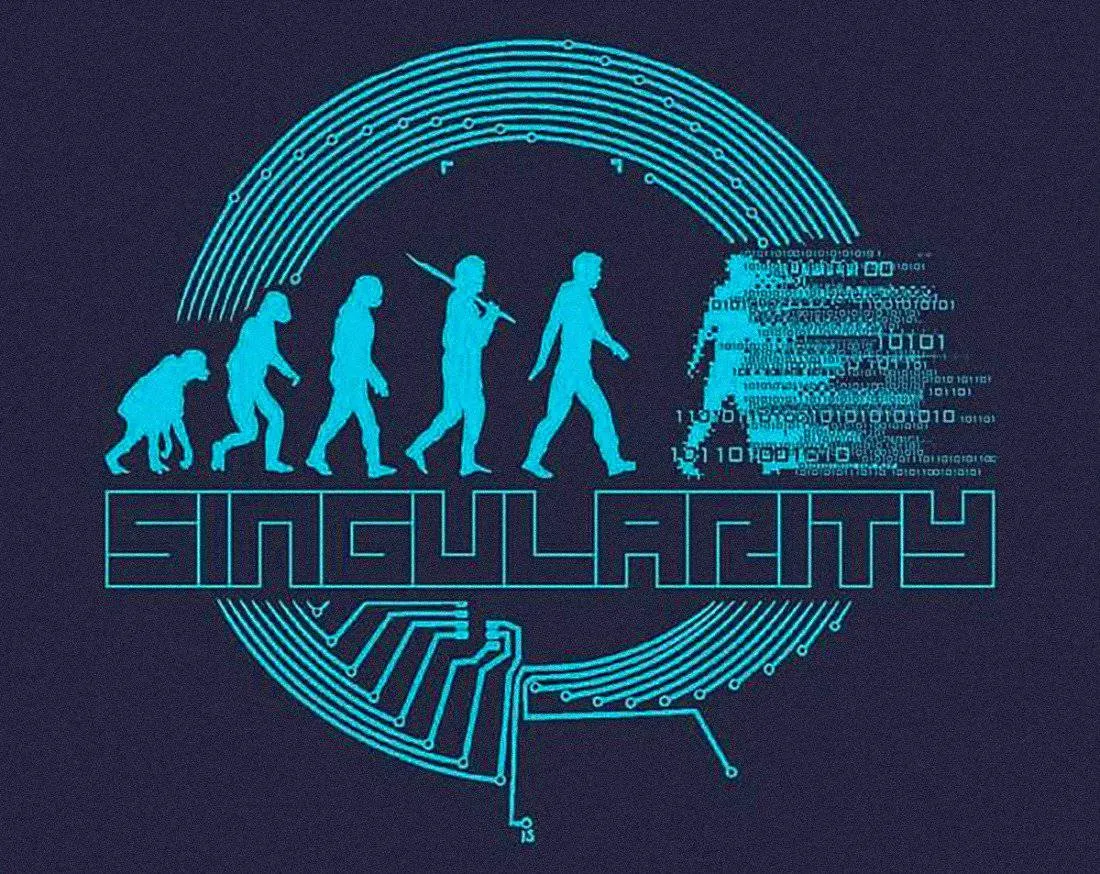
Image: “Singularity March of Progress” parody graphic. Artist unknown (widespread web source / open print-on-demand asset). Parody based on Rudolph Zallinger’s 1965 illustration ‘The March of Progress’.
In the summer of 2026, a seventy-one-person clinical trial in China quietly closed the distance between “incurable” and “treatable” for a disease that has no cure.
Idiopathic pulmonary fibrosis stiffens the lungs slowly and, until recently, without appeal. In a Phase 2a trial published in Nature Medicine in June 2025, patients on the highest dose of a drug called rentosertib gained an average of 98.4 milliliters of lung function over twelve weeks, while the placebo group lost 20.3. The target the drug hits — a kinase called TNIK — was found by a generative AI model. The molecule that hits it was designed by one too. It is now in Phase III trials, the last stop before approval. If it clears that bar, it will be the first drug in history whose discovery and design were both done by a machine, and the first new hope in decades for a disease that currently kills most of the people who get it within five years.
That is not a metaphor for the future. It is a fact about the summer we are living in, and it is one of dozens like it.
This is the story that gets lost every time the word “singularity” comes up, because the word invites us to look for an event — a morning when everything changes at once — and there isn’t going to be one. What there is instead is stranger and, if you actually look at it, better: a long unglamorous accumulation of specific, checkable, dated wins, compounding in the background while the discourse argues about robots and rapture. The lung patient in China. The Swedish woman whose mammogram caught something a year early. The ninth grader in Benin City, Nigeria, who picked up a year of English fluency in six weeks. None of them experienced a singularity. All of them experienced a life that got measurably better because of the same underlying trend the doomers are so sure is going to eat us.
I want to make the case that the singularity — properly understood, not as a rapture but as the thing its own founding thinkers actually described — is the best piece of news ordinary people have gotten in a generation, and that the fights we should be having are about how fast we distribute the winnings, not about whether the winnings are real.
What the thinkers who coined it actually believed
It’s worth remembering that every architect of this idea was, at bottom, an optimist. That gets lost.
I. J. Good, the Bletchley Park cryptanalyst who first described the “intelligence explosion” in 1965, wrote that the first ultraintelligent machine would be “the last invention that man need ever make” — meaning that from that point forward, our hardest problems would have a research partner smarter than any human who ever lived, working around the clock, for the rest of history. He attached a condition, that the machine stay steerable, and that condition is exactly the research agenda the field is racing to satisfy right now. But the reason to build the machine in the first place, in Good’s own words, was survival — he thought humanity’s problems had outgrown human-scale thinking, and needed help.
Hans Moravec, imagining artificial descendants in Mind Children in 1988, was not describing a hostile takeover. He was describing an inheritance — minds that would carry forward everything we’ve learned, into environments and timescales biology can’t reach.
Even Vernor Vinge, whose 1993 essay supplied the word’s darkest connotations, was explicit that the “end of the human era” did not mean the end of humans. It meant the end of the period in which unaided human cognition sets history’s pace — and Vinge spent real energy imagining the upside of that transition: minds augmented rather than replaced, biology extended rather than discarded, participation rather than obsolescence. His actual prediction window — greater-than-human intelligence arriving between 2005 and 2030 — was framed as an opportunity to prepare for, not a doom to await.
And Ray Kurzweil, the most confident of the five, has never described anything close to a rapture. His whole model — the law of accelerating returns — is a story about compounding gifts: computing lets us map the genome faster, which lets us understand disease better, which lets us design medicine faster, which extends the healthy years in which people get to enjoy all of it. He reaffirmed that timeline on a stage at MIT in the spring of 2026: human-level AI by 2029, and — this is the part that gets cut from the headlines — a future in which the boundary between our biological minds and our tools dissolves not because we are being replaced, but because we are being extended.
Read the founding texts and the through-line is not extinction. It’s leverage. Five different thinkers, five different mechanisms, one shared bet: that a mind smarter than any of us, working on our behalf, is a strictly better position to be in than the one we’re in now.
The part that’s already arrived: medicine got a research partner that doesn’t sleep
Start with the place the evidence is least ambiguous, because it happens to be the place that matters most.
The MASAI trial in Sweden is the best randomized evidence anywhere on what AI actually does when it’s handed a real diagnostic task at real population scale. More than 105,000 women were randomized between standard double-reading mammography and AI-supported screening. The results, published across three papers in The Lancet family of journals between 2023 and 2026, are about as good as clinical trials get: a 44 percent reduction in radiologist workload, a 29 percent increase in cancer detection with no rise in false positives, and — in the full results published in January 2026 — a 12 percent reduction in interval cancers, the ones that show up months after a clean screening and carry worse outcomes because they were caught late. Some number of women in that trial had a tumor found at a routine appointment that the old protocol would have missed until it was harder to treat. They will never know which ones they are. That is what success looks like when it’s working exactly as intended: invisible, and permanent.
That is not an isolated case. It’s the leading edge of a genuinely fast-moving field. Since Demis Hassabis and John Jumper won the 2024 Nobel Prize in Chemistry for AlphaFold — the model that solved a fifty-year-old problem in structural biology by predicting how proteins fold — the tools built on top of it have kept compounding. AlphaFold 3, open-sourced in late 2024, turned what used to be a multi-year experimental bottleneck for understanding how a drug candidate binds to its target into a computation that takes minutes. Newer open models like Boltz-2 from MIT and Recursion are pushing binding-affinity predictions toward near-physics accuracy at up to a thousand times the speed of the older pipeline. None of this guarantees any particular drug will work — clinical trials still take years, biology is still hard, most candidates still fail — but it means the search for candidates, the part that used to eat a decade and a billion dollars before a single patient enrolled, is being compressed. Rentosertib is the proof of concept. It will not be the last one.
And medicine’s other frontier — extending the healthy years, not just treating disease after it arrives — is moving on the same curve. This is the part of Kurzweil’s argument that sounds most like science fiction and is in fact the most mundane: AI-accelerated drug discovery doesn’t need to reverse aging to matter. It needs to keep doing what it’s already doing — catching cancer a year earlier, finding a target for a disease with no treatment, cutting the time from hypothesis to human trial — and the compounding effect on how many healthy years an ordinary life contains will be enormous, one unglamorous trial at a time.
The part that’s already arrived: the smartest tutor in the world is now free or nearly free
If you want to see the singularity’s most direct gift to a struggling kid, skip the AI conference and look at the education literature, which has quietly become one of the most encouraging bodies of evidence in the entire field.
In Benin City, Nigeria, researchers ran a randomized six-week after-school program in nine public schools, giving first-year secondary students access to Microsoft Copilot for guided English practice, twelve ninety-minute sessions total. The treatment group gained 0.31 standard deviations on combined outcomes and 0.23 in English specifically — described by the researchers as roughly a year of conventional learning compressed into six weeks. In a Harvard study published in Scientific Reports in June 2025, a custom AI tutor built on the same pedagogical best practices as an in-person active-learning class outperformed the human-led version, with students learning significantly more in less time while reporting higher engagement and motivation — a moderate effect size (d = 0.41) that held up under randomized, controlled conditions. And in a study run with FEV Tutor across a Southern U.S. school district — more than 700 tutors, a thousand K-12 students, all from schools serving low-income families — giving human tutors real-time AI assistance raised student mastery by four percentage points overall, with the biggest gains going to students paired with the least experienced tutors. The tool did the most good exactly where the system was weakest.
That pattern — AI closing gaps rather than widening them — is not a coincidence, and it is not what the automation-anxiety narrative predicts. A struggling tutor with an AI assistant performs like a good one. A kid in a public school in Nigeria gets access to a patient, always-available English coach that would have been unaffordable a decade ago. The single most consistent finding across this fast-growing literature is that the gains concentrate among the students and the instructors who had the least to begin with. That is the opposite of an elite technology. It is one of the more powerful equalizers education research has ever measured, and it is happening in classrooms right now, not in a white paper about 2045.
The part that’s already arrived: expertise got radically cheaper
Zoom out from any one profession and a bigger pattern is visible in Anthropic’s own usage data. As of the most recent Economic Index reports, a majority of conversations with Claude — consistently in the mid-to-high fifties percent, and as high as 78 percent by some independent counts — are augmentation rather than automation: people iterating with the model, validating their own work, learning something they didn’t know how to do before, rather than simply handing a task off wholesale. And the report’s usage data shows something that should matter to anyone worried about who benefits: adoption has been broadening steadily out from the highest-wage, most specialized tasks toward lower-wage, more everyday ones, and the top ten most common uses now make up a shrinking share of all activity, meaning the tool is spreading into more corners of more people’s working lives rather than concentrating in a narrow elite lane.
That is the mechanism behind Good’s intelligence explosion translated into something you can feel: legal guidance, a second opinion on a medical question, a business plan reviewed line by line, a tutor for a subject you never quite learned — all of it available now to someone without the budget for a lawyer, a specialist, or a private tutor. The economist’s word for this is a fall in the marginal cost of expertise. The human word for it is that the kind of help that used to be a luxury good is becoming a utility.
The part that’s already arrived: the cost of power is starting to fall, in the face of increased load
The energy story usually gets told as one-sided bad news — data centers straining the grid, rate cases, capacity auctions running hot. That’s real, and it deserves the scrutiny it’s getting from state regulators. But it’s half the story, and the other half is arguably the more important one for the next twenty years.
Battery storage costs fell 27 percent in a single year to a record low of $78 per megawatt-hour in 2025, according to BloombergNEF, the steepest drop the firm has tracked since it began measuring in 2009. Solar-plus-storage projects are now being built at an average of $57 per megawatt-hour. Tandem perovskite-silicon solar cells have pushed past 34 percent efficiency in the lab, well above the ceiling that trapped conventional panels for two decades, and the first commercial versions are reaching the market this year. Global battery deployment grew 46 percent in 2025 alone. None of this is happening despite the AI boom — a meaningful share of it is happening because AI is now doing the materials-science and grid-optimization work that used to take human researchers years of trial and error, screening candidate battery chemistries and forecasting solar output at a pace and a budget no laboratory could match on its own.
Put the two halves of the energy story together and the honest picture is a race, not a verdict: rising demand from data centers on one side, falling generation and storage costs on the other, with regulators in the middle deciding how the gap gets divided. That is a fight worth having, loudly, in front of public utility commissions. It is not evidence that the technology is a net drain — it’s evidence that the same wave pushing costs up in one column is pushing them down in the next one over, and the second column is currently winning the cost curve even if it isn’t winning the headlines.
What the labor market actually shows, read all the way through
The labor data gets cited constantly as the singularity’s dark underside, so it’s worth reading it in full rather than in the one sentence that goes viral.
Yes: Stanford’s Digital Economy Lab found a sixteen percent relative decline in employment among twenty-two-to-twenty-five-year-olds in the most AI-exposed occupations. That’s real and worth taking seriously. But the same researchers found something that almost never makes the headline: in occupations where AI augments rather than automates, employment grew for workers of every age. The damage is not diffuse. It’s concentrated specifically in the automate-first roles, and even the researchers who found the sixteen percent decline caution that with their most complete controls, the effect only becomes statistically distinguishable from noise starting in 2024 — meaning the story is younger, narrower, and more contestable than the headline version suggests.
Meanwhile, the Economic Policy Institute’s read of the same underlying period found that nearly all of the rise in young-graduate unemployment came from more people entering the labor force to look for work, not from a falling probability that a given young person has a job — and unemployment rose just as much for young workers without college degrees, which is not the signature you’d expect if a language model were specifically eating white-collar entry jobs.
And set against both of those is the biggest, most stubborn labor fact in the American economy: home health and personal care aides are already the single largest occupation in the country, with 4.3 million workers, and the Bureau of Labor Statistics projects 765,800 job openings every single year through 2034 — the largest growth of any occupational category, in work that no model can currently do, because it involves a person caring for another physical person. The technology that is good at drafting a memo is nowhere close to good at bathing an elderly patient, and the economy needs millions more people doing exactly that. This is not a story about a labor market with no jobs left. It’s a story about a labor market whose center of gravity is shifting toward work machines can’t touch, faster than the retraining pipelines that would move people into it — which is a solvable infrastructure problem, and a far less frightening one than “the jobs are gone.”
The honest, complete picture: a real and specific disruption at the automation-heavy entry rung, a much larger and faster-growing set of openings in work AI cannot do, and an augmentation category — the majority of real-world AI use — where employment is growing rather than shrinking. That is a transition to manage, with a real population who deserves real support. It is not a verdict on the technology itself.
The part everyone forgets: we’ve read this chart before
Every generation that lives through a fast technological shift produces a chorus certain that this is the one that finally ends the human role in civilization, and every previous chorus turned out to be describing a transition, not a ending.
Automated teller machines were supposed to empty out the bank teller profession starting in the 1970s. The number of bank tellers in the United States kept rising for decades afterward, because the machines took over cash handling and freed tellers to do higher-value relationship and sales work — banks opened more branches, not fewer, because each branch got cheaper to run while generating more profit. Spreadsheet software was supposed to end accounting as a career; the profession grew, because the software eliminated the drudgery and let accountants spend their time on the analysis clients actually needed. Container shipping was supposed to gut the entire logistics workforce; global trade — and the number of people employed moving it — expanded by orders of magnitude.
None of this means the current transition will be painless, or that history simply repeats. The speed is different this time, and the disruption is landing on cognitive work that previous automation waves mostly left alone, which is exactly why the entry-level labor data above deserves real attention rather than reassurance. But it is a reason for humility on both sides of the argument: the base argument for “this technology will hollow out the workforce” is incomplete, and the counter-argument for “this technology will eventually create more valuable work than it destroys, if the transition is managed” is more honest, if less catchy. Betting against the incomplete viral pattern requires a specific argument about why this time is different, not just a restatement that the change feels large. And the strongest available argument for why this time is different — a shrinking need for entry-level cognitive labor — is precisely the problem a training pipeline and a wage floor can solve, not a problem that requires believing the whole technology is a mistake.
Where the real work is — and it isn’t waiting for a machine to do it
None of this is an argument for passivity. The honest optimist’s case is not “it’ll sort itself out.” It’s “the upside is large enough, and arriving fast enough, that the argument worth having is about distribution, not existence.”
The unconditional cash evidence, from OpenResearch’s three-year randomized trial in Illinois and Texas, is a genuinely useful data point here: $1,000 a month measurably improved parenting quality, especially in the lowest-income and single-parent households, and gave people more room to make employment choices that fit their actual lives rather than pushing them out of work altogether. That’s not proof a universal program would work at national scale — the fiscal mechanism remains an open, serious argument — but it’s proof the underlying intuition, that a floor lets people make better decisions, holds up under the most rigorous test American social science has thrown at it.
The prior-authorization fight in healthcare is a genuinely winnable one: twenty-five states have already issued AI-specific insurance guidance, and the same technology automating claims review can just as easily be pointed at speeding up legitimate approvals as slowing them down — the industry’s own numbers show prior-authorization request volume already falling 11 percent since regulators started paying attention. The PJM rate fight is winnable too: Pennsylvania’s governor sued and won a price cap; Oregon built a dedicated rate class for data centers; Virginia is doing the same. These are not hypothetical remedies. They are already working, in public, in the record.
That’s the case for optimism that actually holds up: not that nothing will go wrong, but that everything going right is currently outpacing everything going wrong, and the mechanisms that keep it that way — courts, utility commissions, insurance regulators, wage floors, retraining pipelines — are the same boring civic machinery that has always been the actual answer to a fast technological shift. Nobody needs to wait for superintelligence to fix any of this. In each case, somebody already did.
What it actually means
The singularity is not a wall you hit. It’s a compounding curve you’re already riding, and the honest report so far is good.
A woman in Sweden got a diagnosis a year earlier than the old system would have caught it. A patient with an incurable lung disease has a real shot at a first treatment, discovered and designed by a model, now in its final trial. An entire class of children in Nigeria picked up a year of English in six weeks. A struggling tutor got noticeably better at their job overnight, for free, and the students who needed the most help got the biggest gains. Battery costs fell by more in one year than most of us expected across a decade. None of it required anyone to merge with a machine or hand over the keys to civilization. It required a research team, a regulator, a teacher, an engineer — the same people who always do the actual work of making a new tool useful — pointing the tool at a real problem and reporting what happened.
That is Good’s intelligence explosion, Vinge’s acceleration, Moravec’s inheritance, Bostrom’s alignment question and Kurzweil’s compounding curve, all doing exactly what their authors hoped they might: producing, quietly and specifically and one dated result at a time, a world with less disease, cheaper expertise, better-taught kids, and — if the regulators keep doing their unglamorous jobs — a fairer share of the bill. The people who are already living inside better outcomes because of this technology are not going to write op-eds about it, because a tumor caught early or a year of education gained in six weeks doesn’t feel like history. It just feels like a good year.
2026 has been a good year. There is real reason to expect the next one to be better, and the honest work in front of us is not deciding whether to believe that — it’s making sure everyone gets a share of it.
References
Founding texts
- I. J. Good, “Speculations Concerning the First Ultraintelligent Machine,” Advances in Computers, Vol. 6, 1965. Publisher page
- Vernor Vinge, “The Coming Technological Singularity: How to Survive in the Post-Human Era,” VISION-21 Symposium, NASA Lewis Research Center, March 1993. Full text
- Hans Moravec, Mind Children: The Future of Robot and Human Intelligence, Harvard University Press, 1988. Publisher page
- Nick Bostrom, Superintelligence: Paths, Dangers, Strategies, Oxford University Press, 2014. Publisher page
- Ray Kurzweil, The Singularity Is Nearer: When We Merge with AI, Viking, 2024. Publisher page
- Ray Kurzweil’s reaffirmation of the 2029/2045 timeline, spring 2026. The Deep View
Medicine
- Zuojun Xu, Feng Ren, Pengcheng Wang et al., “A generative AI-discovered TNIK inhibitor for idiopathic pulmonary fibrosis: a randomized phase 2a trial,” Nature Medicine, June 3, 2025. Paper
- Insilico Medicine, “Insilico Initiates Phase III Clinical Trial for Rentosertib,” 2026. Announcement
- Kristina Lång et al., MASAI clinical safety analysis, The Lancet Oncology, August 2023. Abstract
- Viktoria Hernström et al., MASAI screening performance analysis, The Lancet Digital Health, 2025. Abstract
- MASAI interval cancer, sensitivity and specificity results, The Lancet, January 2026. Abstract
- AlphaFold 3 and open-source structural biology tools, drug discovery pipeline overview. Drug Discovery Online, 2025 highlights
Education
- Gregory Kestin, Kelly Miller, Anna Klales et al., “AI tutoring outperforms in-class active learning: an RCT introducing a novel research-based design in an authentic educational setting,” Scientific Reports, June 3, 2025. Paper
- Adam Solomon et al., Tutor CoPilot randomized controlled trial with FEV Tutor, Stanford, 2024. Working paper
- De Simone et al., randomized AI tutoring trial in Benin City, Nigeria, discussed in Italian Economic Journal, 2025. Paper
- FutureEd, “Research Notes: Two Emerging Strategies for Using AI in Tutoring,” February 2026. Analysis
Economy and adoption
- Anthropic Economic Index reports on automation versus augmentation and adoption broadening to lower-wage tasks. March 2026 report — June 2026 report
- Erik Brynjolfsson, Bharat Chandar and Ruyu Chen, “Canaries in the Coal Mine? Six Facts about the Recent Employment Effects of Artificial Intelligence,” Stanford Digital Economy Lab, November 2025, with February 2026 update. Paper — Update
- Economic Policy Institute, “Class of 2026: Young college graduates face a weaker labor market — but a more mixed picture than the headlines suggest,” May 2026. Analysis
- U.S. Bureau of Labor Statistics, Occupational Outlook Handbook, “Home Health and Personal Care Aides.” BLS
Energy
- BloombergNEF, “Battery Storage Costs Hit Record Lows as Costs of Other Clean Power Technologies Increased,” February 2026. BNEF
- Ember Energy, “Global Electricity Review 2026.” Report
- Rezaee et al., “Solar Energy in 2025: Global Deployment, Cost Trends, and the Role of Energy Storage,” Energy & Environmental Materials, January 2026. Paper
Policy remedies already in motion
- OpenResearch, Unconditional Cash Study findings. Findings
- KFF, “Regulation of AI in Prior Authorization and Claims Review,” May 2026. KFF
- Undark, “Will AI Fix Prior Authorization — or Make It Worse?”, July 2026. Undark
- Institute for Energy Economics and Financial Analysis on PJM capacity price reforms and state-level responses. IEEFA