How a generation is rebuilding the social fabric that two decades of screens quietly dissolved
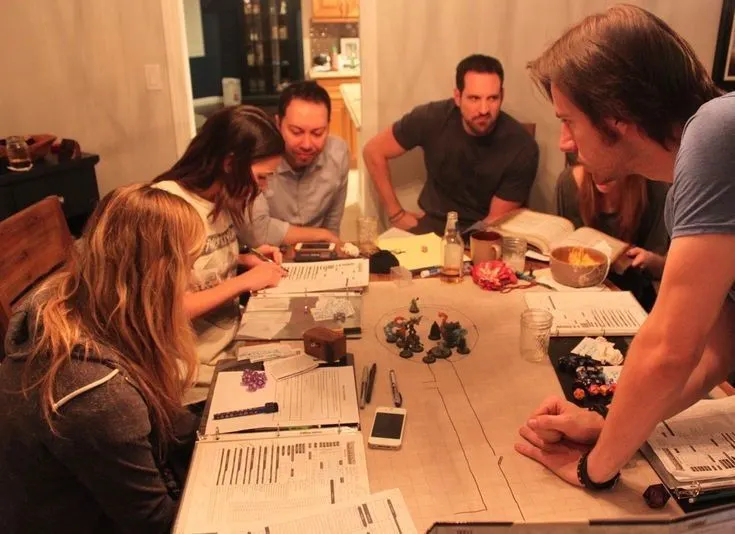
A gaming session from Critical Role — critrole.com
There is a particular kind of silence that falls over a room when six people are trying to decide whether to open the door.
The door is not real. It is a rectangle drawn on a battle mat in dry-erase marker, and behind it, according to the person at the head of the table, there is either an unimaginable treasure hoard or something evil with far too many teeth. Nobody in the room has checked a phone in forty minutes. Someone has made a joke that will be repeated at this table for the next three years. A twenty-sided die is about to be thrown, and for the length of its tumble across the vinyl, six adults who met as strangers are entirely, unselfconsciously present with one another while they hold their breath.
This scene is playing out on a Tuesday night, in a strip mall, above a laundromat, in the back room of a shop that sells themed plastic soldiers and colorful boxes full of cards. It is playing out in thousands of such rooms. And it represents something considerably larger than a hobby having a good decade.
What is happening in those rooms is the reconstruction of a piece of civic infrastructure that America let fall down.
I. A Thing Named Just as It Started to Disappear
In 1989, the sociologist Ray Oldenburg published a book called The Great Good Place, and gave a name to something everyone had always had and no one had ever needed to describe. Home was the first place. Work was the second place. The third place was everything else that mattered: the tavern, the barbershop, the general store, the coffeehouse, the front stoop, the lodge hall. It was where you went when you were not obligated to be anywhere.
Oldenburg was specific about what qualified. A true third place is neutral ground, meaning no one is host and no one is guest, and anyone may come and go without needing an invitation or an excuse. It is a leveler, where the status you carry at work does not follow you through the door. Conversation is the main event. It is accessible, close by, and open at the hours when people are actually free. It has regulars, whose presence sets the tone and who make newcomers feel that showing up again is a reasonable thing to do. It keeps a low profile, is plain rather than grand, and is playful in mood. And it functions as a home away from home, a place where you can be at ease among people who are not your family.
Read that list against the last twenty years and it reads less like sociology than like an inventory of losses.
Oldenburg wrote his book at the exact moment the thing he was describing began its long slide. Eleven years later, Robert Putnam published Bowling Alone, documenting the collapse of the associational life that had filled American calendars for a century: the lodges, the leagues, the committees, the card parties, the endless meetings of the endless clubs. Putnam’s argument was that Americans had not become less social by temperament. They had lost the containers that made socializing automatic.
Since then the containers have kept breaking, and the breakage has become measurable in ways Putnam could only estimate.
II. The Retreat, in Numbers
The American Time Use Survey has asked a nationally representative sample of Americans to account for their days, hour by hour, every year since 2003. It is not a poll about how people feel. It is a ledger of what they actually did. And the ledger is unambiguous.
Average time spent socializing in person, according to the writer Derek Thompson, found that between 2003 and 2024, the time Americans spent attending or hosting a social event of any kind fell by half. Face-to-face socializing overall dropped about twenty percent, and for unmarried men and for people under twenty-five, the drop exceeded thirty-five percent.
The most revealing detail is not the pandemic. It is what happened after. Older adults cut their social time sharply in 2020 and 2021 and then climbed most of the way back. Teenagers and young adults did something else entirely: their social time barely moved during the lockdowns, and then declined further in 2023 and 2024, as the world reopened. Whatever was pulling them away from each other was not a virus, and did not end when the masks came off.
The consequences arrived as if on schedule. In May 2023, the United States Surgeon General issued a formal advisory titled Our Epidemic of Loneliness and Isolation, the sort of document normally reserved for tobacco and opioids. About one in two American adults reported experiencing loneliness, a fact to many that seems too absurd to even bother reporting on. The advisory, however, placed the mortality impact of social disconnection in the same range as smoking fifteen cigarettes a day, noted a roughly thirty percent increase in premature death risk, and put the excess Medicare spending attributable to isolation among older adults at about six point seven billion dollars a year.
Underneath the health statistics sits a plainer erosion. The Survey Center on American Life found that the share of American men reporting no close friends at all rose from three percent in 1990 to fifteen percent in 2021, a fivefold increase. The share of men with six or more close friends fell by half over the same period, from fifty-five percent to twenty-seven percent. Researchers took to calling it the friendship recession, and the term stuck because it described something people recognized immediately: not a tragedy, exactly, but a slow subtraction that no one had voted for with real and measurable health consequences.
III. Why the Old Anchors Let Go
Three institutions carried most of the weight of American third places for most of the twentieth century, and all three have thinned.
The first was religion. Gallup has asked Americans about membership in a church, synagogue, or mosque since 1937, when the figure stood at seventy-three percent. It hovered near seventy for six decades. Then it fell: to sixty-one percent in 2010, and to forty-seven percent in 2020, the first time in the history of the measure that a minority of American adults belonged to a house of worship. Regular attendance followed the same path, from about forty-two percent attending weekly or nearly weekly two decades ago to about thirty percent in the early 2020s. Among adults under thirty, more now claim no religious preference than identify with any single tradition, and only about twenty-two percent attend services regularly.
Whatever one believes about the theological stakes, the civic arithmetic is simple. A congregation is a recurring, unpriced, multi-generational, geographically local gathering with a built-in reason to see the same people every seven days. Tens of millions of Americans no longer have one, and nothing automatically replaced it.
The second anchor was alcohol, and the buildings organized around it. Here the shift is recent and startling. Gallup’s July 2025 Consumption Habits survey found that fifty-four percent of American adults said they drink at all — the lowest figure in nearly ninety years of tracking, down from sixty-two percent in 2023 and fifty-eight percent in 2024. The decline is sharpest among the young: among adults under thirty-five, the share who drink fell from fifty-nine percent to fifty percent in two years, dropping below middle-aged and older adults for the first time. Those who do drink are drinking less. Average consumption fell to two point eight drinks in the past week, the lowest since 1996 and roughly half the 2003 peak of five point one. A majority of Americans, fifty-three percent, now say that one or two drinks a day is bad for your health, up from forty-five percent a year earlier.
A bar is a third place with a business model that requires you to keep buying a socially acceptable depressant. When half of the young adults walking past the door have decided they are not drinking tonight, possibly that they prefer not to drink at all, that model stops functioning as social infrastructure at least, and the alcohol industry is still in denial about the long term implications.
The third anchor was ordinary commercial space, and it was not abandoned so much as re-engineered. Coffee shops, diners, and food courts spent the 2010s optimizing for throughput: mobile orders, grab and go, drive-through, fewer chairs, harder chairs, no outlets. Lingering customers became a cost center so they were quietly discouraged from staying longer than they needed to just buy something and move along.
The clearest evidence that something was lost is that the largest operator in the category is now spending heavily to buy it back. Since taking over as chief executive of Starbucks in September 2024, Brian Niccol has built his revival around a phrase borrowed directly from Oldenburg. In his first earnings call, he said the company was “reclaiming the third place” so its cafés would feel like the coffee houses customers remembered, and promised to revise store designs to bring back comfortable seating and amenities so people would want to sit, work, and meet. What followed was a catalog of reversals: ceramic mugs and glass cups for customers staying in, self-serve condiment bars restored, handwritten notes on the takeaway cups, free refills for anyone sitting down, softer seating, warmer lighting, locally inspired art, with roughly a thousand more coffeehouse refreshes slated through the end of 2026.
A company does not spend that kind of money to restore an atmosphere unless it has concluded that the atmosphere was the point all along.
IV. The Substitute That Wasn’t
The standard story about what replaced all this is that the internet did. It is more accurate to say that the internet replaced the feeling of it, and that the substitution was close enough to fool people for about fifteen years.
Online communities can satisfy several of Oldenburg’s criteria. They are accessible, cheap, and low-profile. They have regulars. They can be playful. What they cannot easily reproduce is the specific magic of unplanned company: the thing where you go somewhere with no agenda, encounter people you did not arrange to meet, and stay longer than you meant to.
Three structural features got in the way.
The first is the algorithm. A feed is a private theater. Two people can spend an evening in the same app, in the same city, on the same topic, and never once occupy the same room. Matchmaking systems in online games do something similar: they produce a technically social experience with strangers who are, by design, interchangeable and gone forever at the end of the round. There is no “next time” with those people. There is no reason to behave as though there might be.
The second is the audience. Third places are supposed to be low-stakes, but the platforms that absorbed social life are functionally acting as performance venues where every remark is potentially permanent, screenshot-able, and addressed to an unknown crowd. Oldenburg’s rule that conversation is the main activity assumed conversation among people who could see each other’s faces and give each other space and an implied kind of privacy. Broadcast rewards a different behavior entirely.
The third is the absence of a threshold. A physical third place has a door, and the door does something important: it marks the boundary between being there and not being there. Digital space has no closing time and no walk home. It fills the gaps in a day rather than occupying a block of it, which is why people can spend four hours a night in social software and end the week having had no social occasions. They never arrived, they never left, they just managed a queue that felt, at first, like socialization.
The result was a generation with enormous connectivity and shrinking company. And the response, when it came, was not a rejection of technology. It was more specific and more interesting than that: a migration toward activities that could not be done alone, could not be done through a screen, and could not be finished in a scroll or a swipe.
V. The Unlikely Winner
If you had been asked in 2005 to nominate the institution that would emerge as one of the most durable third places of the 2020s, the shop selling cards and plastic figures would not have made the shortlist.
For most of its history, the hobby game store was a defensive space. The games it sold carried a stigma that ran from the moral panics of the early 1980s through decades of shorthand about basement-dwelling adolescents. The stores were built accordingly: cramped, dim, unwelcoming to anyone who did not already know the lingo or the regulars. They were clubhouses for people who had been told, repeatedly, that they were strange, and for them it was their castle.
Several things happened at once to change that. Here is one such story, but there are more.
In 2014, Wizards of the Coast released the fifth edition of Dungeons and Dragons, a version of the game explicitly redesigned to lower the arithmetic and raise the storytelling. In 2015, a group of voice actors began streaming their home game under the name Critical Role, and made watching other people play a spectator category. In July 2016, Netflix released Stranger Things, whose emotional center is a group of children around a game table. By 2024, on the fiftieth anniversary of the game’s publication in a house in Lake Geneva, Wisconsin, Wizards of the Coast was claiming more than fifty million fans worldwide.
The scale of the cultural shift is easiest to see in a single number from 2019. When the Critical Role cast asked their audience for seven hundred fifty thousand dollars to fund a twenty-two minute animated special, the campaign passed a million dollars in under an hour and closed on the nineteenth of April with eleven million, three hundred eighty-five thousand, four hundred forty-nine dollars pledged by eighty-eight thousand, eight hundred eighty-seven backers — at the time the most-funded film or television project in Kickstarter’s history. Amazon acquired the series that November. A hobby that had spent thirty years apologizing for itself had become a property that outbid Hollywood pilots.
The commercial trend lines tell a similar story, albeit less dramatically. ICv2, which has tracked the hobby games trade for decades, estimated sales in the United States and Canada at over three and a half billion dollars in 2025, growth of about forty percent, achieved in a year that included steep new import tariffs beginning in April and the bankruptcy of a major distributor. Trading card games alone now account for roughly two-thirds of hobby game dollars. Miniatures, the most labor-intensive category in the business, reached about five hundred eighty-five million dollars, up over seven percent.
The most telling figure in that report is not about products at all. Sales through the hobby channel — that is, through local game stores rather than mass retail or online — rose nearly a third, in what ICv2 counted as the seventeenth consecutive year of growth. Store counts were up. In an era that has hollowed out bookshops, record stores, and video rental, seventeen straight years of growth in small, independent, physical retail is not a market anomaly. It is a signal that the shops are offering something other than merchandise, and people are catching on.
The miniatures business makes the point most starkly. Games Workshop, the Nottingham company behind Warhammer, joined the FTSE 100 in December 2024. Its core revenue reached five hundred sixty-five million pounds in the financial year ending in June 2025, and the company estimated core revenue of not less than six hundred twenty-five million pounds for the year ending in May 2026, with pre-tax profit of not less than two hundred sixty-five million. Its products are expensive boxes of unassembled grey plastic figures that require glue, a craft knife, paint, several evenings, and, ideally, an opponent with the same hobby. This is the opposite of frictionless. That is the point.
VI. The Architecture of Easy Company
Ask people why adult friendship is hard and they will describe a scheduling problem. It is not, primarily. It is a scaffolding problem.
Friendships form under three conditions that social scientists have identified repeatedly: physical proximity, repeated unplanned interaction, and a setting that permits a little vulnerability. Childhood supplies all three by default, which is why almost everyone’s oldest friendships date from a period when they had no say in whom they saw. Adulthood supplies none of them. In their absence, connection has to be manufactured deliberately — texted, scheduled, rescheduled, confirmed — until seeing another human being acquires the emotional texture of a dental appointment.
What a game table does is restore the scaffolding in a natural way, and with a precision that no amount of good intentions can match.
Start with the entry problem. Walking into a bar alone requires the newcomer to invent a reason to speak, choose a target, and absorb the risk of rejection in public. Walking up to a table of strangers who are about to play a game requires none of that. There is a shared objective. There are turns, which are a rationing system for attention: everyone gets some, no one has to seize it. There are rules that supply an inexhaustible topic of conversation, and the rules are external, which means disagreement is about the rules rather than about each other.
Unlike conventional social protocol, there is no requirement for direct eye contact. Sustained face-to-face gaze is the highest-intensity form of human interaction, and for many people, especially in a first meeting, it is exhausting. Around a table, the shared focal point is the board, the cards, the dice, the map. Attention rests on the object between the players rather than on the players themselves, and conversation happens sideways. This is the same principle that makes long drives and shared manual work such reliable conditions for people opening up. It is also why silence stops being a threat. In unstructured socializing, a lull is a small emergency or at least incredibly awkward. At a game table, a lull just means somebody is thinking.
The formats themselves have been engineered, sometimes explicitly, to protect newcomers. Friday Night Magic, the weekly in-store event program that Wizards of the Coast runs through its network of local retailers, is deliberately positioned at the bottom of the competitive ladder. It runs at what the company calls Regular Rules Enforcement Level, where judges and players are expected to fix mistakes without penalty wherever possible. A missed trigger is not a loss; it is a teaching moment. The store picks the format its community actually enjoys. Almost everything about the design is a mechanism for making it safe to be bad at something in public, in front of people you will see again next week.
That last phrase is an important point to call out. Oldenburg’s category of “the regulars” is the part of the third place concept that modern life has the hardest time replicating, because regularity cannot be manufactured on demand. It is produced by cadence. Friday Night Magic is on Friday. Commander night is on Wednesday. The campaign meets every other Sunday at two. The painting table is open all day Saturday and nobody has to say a word to anybody if they do not feel like it.
That predictability does something that no amount of enthusiasm can substitute for: it converts acquaintance into friendship through sheer repetition, without anyone having to make a move. You do not have to ask a person from Tuesday night to hang out. You will see them Tuesday. After four Tuesdays you know how they take bad luck, what they do for work, whether they have a sick parent. After forty Tuesdays, they are the people who show up when something happens to you, and who ask about you if you’re gone.
There is one more feature worth naming, because it is a return to form from the forced optimization of the last decades: nothing is being sold to you at the moment of connection. You buy the box, or pay the table fee, or spend twenty dollars on a booster, and then the evening simply proceeds. Four hours pass with no upsell, no autoplay, no infinite scroll, and no metric being optimized against your attention. In 2026 that is close to a luxury good.
VII. The Weight of Owned Things
Running underneath the social story is a second one, quieter and angrier, about property.
For most of the last fifteen years, the direction of consumer technology has been from ownership toward access. Music, film, books, software, and games moved to subscription and license. The convenience was real and enormous. The trade was mostly invisible, right up until the moment it wasn’t.
In December 2023, Sony notified PlayStation users that it would be removing purchased Discovery content from their libraries after a licensing agreement lapsed, a decision reversed only after public outcry. In Germany and Austria, PlayStation Store users permanently lost access to hundreds of films they had paid for. Similarly, in the spring of 2024, Ubisoft shut down the servers for The Crew and revoked the licenses, leaving people who had bought the game a decade earlier with nothing at all — not a degraded version, not an offline mode, nothing.
The reaction was disproportionate to the individual sums involved, which is how you know the injury felt personal rather than financial. People discovered, all at once and by demonstration, that the word “buy” on a storefront button had been doing work it was not entitled to do, and your digital license wasn’t worth the screen time it took to get to the end and click “Accept.”
The legal system began to respond. On September 24, 2024, California’s governor signed Assembly Bill 2426, which took effect on the first of January 2025 and added a new section to the state’s false advertising law. It prohibits sellers from using words like “buy” or “purchase” for digital goods whose access can be revoked, unless the seller either obtains an explicit acknowledgment from the customer that they are acquiring only a license, or provides a clear and conspicuous statement to that effect with a link to the actual terms. The bill’s author cited the Ubisoft and Sony episodes by name. This wasn’t a remedy but it was an acknowledgement that a clear line must be drawn and that the terms of ownership don’t apply.
The response in Europe was larger. A European Citizens’ Initiative called Stop Destroying Videogames, known to its supporters as Stop Killing Games, collected nearly one and a half million signatures before its deadline at the end of July 2025, and the initiative was formally submitted on the twenty-sixth of January 2026. On the sixteenth of June 2026, the European Commission replied that it could not propose a legal obligation requiring publishers to keep games playable after commercial end of life, citing intellectual property and copyright constraints, and offered instead to convene industry and consumer groups to draft a voluntary code of conduct by the end of the year. The British government had reached a similar conclusion after a parliamentary debate the previous November. This wasn’t the result anyone hoped for, and a voluntary code of conduct is about as enforceable as an eye-roll.
Set that alongside a shoebox of cards.
A Magic collection, a painted army, a shelf of rulebooks, a bag of dice: none of these can be patched out, delisted, sunset, region-locked, or repossessed by a licensing dispute between two companies in a country the owner has never visited. They can be lent, traded, sold, customized, and given to somebody’s kid. A Warhammer army carries the physical evidence of the hours spent on it — the paint scheme chosen at two in the morning, the conversion made from three kits and a paperclip, the model that is slightly worse than the others because it was the first one. Value accrues to it in a way that is legible to its owner and to no algorithm.
This is not nostalgia for objects. It is a rational response to a decade of proof demonstrating that access can be withdrawn. When the terms of digital ownership turned out to be softer than advertised, a certain number of people went looking for the hardest possible version of the thing — and found it in a hobby where the product is manifestly, stubbornly, inconveniently physical, and ownership is something no one could revoke.
VIII. Making the Story Instead of Receiving It
The third strand is about what people do with their leisure, as opposed to what is done to them.
Algorithmic media perfected a specific mode of consumption: continuous, personalized, frictionless, and solitary. Its defining characteristic not too many people consider is that the experience is complete without you. The feed runs whether you engage or not. The show ends the same way for everyone. Your role is to be present at the moment of delivery and to optionally register a reaction.
A tabletop campaign is the inverse in every respect. Nothing happens unless the people in the room make it happen. The plot has no existence prior to the decisions made at the table. When the party ignores the obvious hook and goes to burgle a bakery instead, the story is now about a bakery. The dice introduce genuine chance, which means the outcome is unknown to everyone present, including the person running it — a condition that scripted entertainment can only simulate.
What this produces, and what people are actually returning for, is shared memory of a particular kind. The single most valuable output of a long-running game is not the story. It is the inventory of moments that a specific set of people own together and nobody else can access: the critical failure at the worst possible instant, the improvised line that ended the session because nobody could speak for laughing, the character death that landed harder than it had any right to. These are not anecdotes about media. They are anecdotes about the people in the room, and they function exactly like the shared history and urban legends that used to accumulate on sports teams, in church basements, and on shop floors.
The craft dimension amplifies it. Assembling and painting miniatures, building and refining a deck, drawing a map, sewing a costume — these are slow, absorbing, hand-based activities with visible results, undertaken in the company of other people doing the same thing. Hobby nights in game stores work on the principle that has always made quilting circles and workshops function: parallel work is the least demanding social format ever invented. You may talk, or not. You are together regardless, and that matters.
IX. The Wider Pattern
Tabletop gaming is the clearest case, but it is not the only one, and zooming out to the broader movement brings into focus the actual thing people seem to be looking for.
Consider the sport of running. Strava’s annual report, released in December 2025, found that the number of clubs on its platform nearly quadrupled during the year, passing one million in total. Running clubs grew three and a half times over; hiking clubs, the fastest-growing category, grew nearly six times over; club-organized events rose by half. The previous year’s report had already recorded a fifty-nine percent rise in run clubs, with fifty-eight percent of surveyed users saying they had made new friends through one. Among Gen Z respondents, one in five had gone on a date with someone they met through exercise, and they were four times more likely to say they would rather meet people while working out than at a bar.
Consider the board game café, a format that barely existed in North America two decades ago. Ben Castanie and Aurelia Peynet opened “Snakes and Lattes” in Toronto on the thirtieth of August 2010 with forty-five seats, a library of games, and — deliberately — no Wi-Fi, on the theory that the point was to play and talk. Within a year it had grown to a hundred fifty seats. “The Uncommons” opened in Manhattan in 2013, funded partly by Kickstarter, in the space vacated by the old “Village Chess Shop.” The model spread through a dozen countries.
Consider, too, the quieter institutions absorbing the same demand without press coverage: public libraries running weekly game nights and craft hours, climbing gyms whose real product is the fifteen minutes of conversation between attempts, community kitchens, repair cafés, run-and-swim clubs, community choirs and theater troupes.
The common structure across all of them amounts to nothing short of a design specification for a modern third place.
There is an activity at the center, which removes the burden of inventing a reason to interact. The activity has a fixed, recurring time, which converts strangers into regulars without anyone having to take a social risk. The cost of attending is low and, crucially, not per-hour, so that lingering is free. Alcohol may be optional if allowed, certainly not structural. Physical presence is required, which rules out the substitution of a feed. And there is a host — a store owner, a club captain, a librarian, a dungeon master — who takes responsibility for the room.
That last element is the one most often left out of the analysis, and it is the one that determines whether a space works, because leadership and accountability doesn’t happen automatically.
X. What Makes It Fragile
It would be a mistake to treat this revival as either inevitable or self-sustaining. The economics are thin and the social conditions are delicate.
The businesses at the center of it are small independent retailers operating on modest margins in expensive real estate, and they are being asked to donate their most expensive resources — floor space and time — to activities that generate no direct revenue. A table of six people playing for four hours is, in retail terms, six people occupying prime square footage while buying nothing. The model works only because those six become the customers who buy the next box and the next case and bring their friends. It is a long-cycle bet on community, made by owners who often could earn more doing something else, and it risks breaking the moment rent outweighs loyalty.
The last two years have not been gentle. ICv2’s account of 2025 describes a market that grew despite serious disruption: steep new import taxes from April that slowed product flow and forced publishers to choose between raising prices, changing sourcing, or absorbing the cost, and the bankruptcy of a major comics and games distributor, Diamond Comics, that disrupted supply and left consignment inventory tied up in litigation. Growth in that environment reflects real demand, but it does not mean the underlying businesses are comfortable.
The social risks are subtler. The very quality that makes a third place valuable — regulars who set the tone — is the quality that turns it into a clique. A room where everyone already knows each other reads to a newcomer as a closed door, and the difference between a welcoming community and an intimidating one is often nothing more than whether a single person notices someone standing near the entrance and says hello. The stores that have thrived in this period are, almost without exception, the ones that treated hospitality as an operational discipline rather than a personality trait: bright lighting, clean bathrooms, seating that accommodates different bodies, published codes of conduct that are actually enforced, staff who are trained to run a demo game for a stranger without condescension, and beginner-friendly events that are not merely tolerated but scheduled and staffed.
None of this is automatic, and none of it is free. A third place is not a building. It is a building plus continuous, mostly invisible, mostly unpaid labor by someone who cares whether people feel welcome. That was true of the tavern keeper and the parish secretary and the lodge treasurer, and it is true of the shop owner who stays open until eleven on a Friday for a tournament that nets forty dollars.
XI. What Was Forgotten
The last twenty years ran an unintentional experiment on the question of what human beings need from each other, and the results are now in.
The experiment removed friction. It made contact instant, made entertainment infinite and personalized, made everything available without leaving the house, and made ownership unnecessary by making access universal. Every one of those changes was, taken on its own merits, basically an improvement. Taken together they dissolved the conditions under which ordinary companionship used to occur, and did it so gradually that the loss registered only as a vague, widespread, hard-to-name fatigue.
What is being rediscovered now is not a hobby, and not a nostalgia. It is a set of design principles that older institutions embodied without ever articulating: that people bond over shared activity rather than shared conversation about themselves; that showing up at the same time every week does work that no amount of intention can do; that being physically present in a room imposes accountability which anonymity dissolves; that owning something you made or paid for is psychologically different from renting access to it; that a story you participated in belongs to you in a way that a story you watched never will.
Those principles have been rebuilt, without any coordinating plan, in some of the least likely venues imaginable. A generation raised on infinite content is paying money to sit at folding tables with cardboard and dice. A generation raised on dating apps is instead meeting people at six in the morning in the rain because it’s time to run. A generation told that physical media was obsolete is buying armies of plastic soldiers and painting them one at a time.
None of this is a rejection of the digital world; the people at these tables found each other through group chats and forums and streaming shows, and they will post photographs of tonight’s game before they go to bed. It is something more precise than rejection. It is a correction — a recognition that connectivity and company are different substances, and that only one of them can be delivered, the other must be attended.
The die is still tumbling across the board. Six people are watching it. Whatever comes up from that roll, the group knows they will be here again next Tuesday, and that, far more than the outcome of any roll, is the thing that was almost lost.
Sources and References
On the concept of third places and civic decline
- Ray Oldenburg, The Great Good Place, first published 1989 — the Da Capo edition is available from Hachette Book Group
- Robert D. Putnam, Bowling Alone: The Collapse and Revival of American Community, 2000 — the revised edition is available from Simon & Schuster
On loneliness, time use, and friendship
- Office of the U.S. Surgeon General, Our Epidemic of Loneliness and Isolation, U.S. Department of Health and Human Services, May 2023
- National Association of Counties, summary of the Surgeon General’s advisory and National Strategy, May 2023
- Axios, Americans of all ages are spending less time socializing, July 2026, drawing on the American Time Use Survey
- Derek Thompson, The Death of Partying in the U.S.A. — and Why It Matters, July 2025
- Generation Tech, It’s not just you: Americans are still not hanging out, October 2025
- Daniel A. Cox, American Men Suffer a Friendship Recession, Survey Center on American Life, 2022
On religious participation and drinking
- Gallup, U.S. Church Membership Falls Below Majority for First Time, March 2021
- Gallup, Church Attendance Has Declined in Most U.S. Religious Groups
- Gallup, U.S. Drinking Rate at New Low as Alcohol Concerns Surge, August 2025
On commercial third places
- Nation’s Restaurant News, Is a third-place coffee shop still relevant in 2025?
- Starbucks, How “Back to Starbucks” is reshaping every aspect of the coffeehouse experience, December 2025
On the tabletop games market
- ICv2, Big Growth in Hobby Games in 2025, April 2026
- ICv2, Miniatures Show Solid Growth in 2025, March 2026
- ICv2, 2024 Was a Year of Stabilization in Hobby Games Market, March 2025
- Games Workshop Group PLC, trading statements and half-yearly reports
- City AM, Games Workshop shares tumble despite Warhammer sales surge, January 2026
- Hasbro / Wizards of the Coast, Dungeons & Dragons Celebrates 50th Anniversary in 2024 with More than 50 Million Fans, February 2024
- CNBC, Dungeons and Dragons Kickstarter breaks record with $11.3 million campaign, April 2019
- Wizards Play Network, Friday Night Magic event guidelines
On digital ownership
- Office of Assemblymember Jacqui Irwin, Governor Newsom Signs AB 2426 into Law, September 2024
- Morgan Lewis, California Becomes First State to Pass Law Targeting Advertising of Digital Media Licenses, October 2024
- Lewis Silkin, European Commission stops short of imposing mandatory requirements following citizens’ Stop Destroying Videogames initiative, June 2026
- PC Gamer, Stop Killing Games says “the fight goes on” after European Commission rejects proposed rule changes, June 2026
On adjacent third places
- Strava, 12th Annual Year In Sport Trend Report, December 2025
- Canadian Running Magazine, Strava’s year-end trend report shows run clubs are in, nightclubs are out, December 2024
- Background on the origins of the North American board game café, including the August 2010 opening of Snakes and Lattes in Toronto and the 2013 opening of The Uncommons in Manhattan, is drawn from the Snakes & Lattes and The Uncommons entries and the sources cited within them