Grieftech promises to bring back the dead. It is really just the deepfake industry wearing a mourning veil — and almost nothing stops it from being turned against the living.
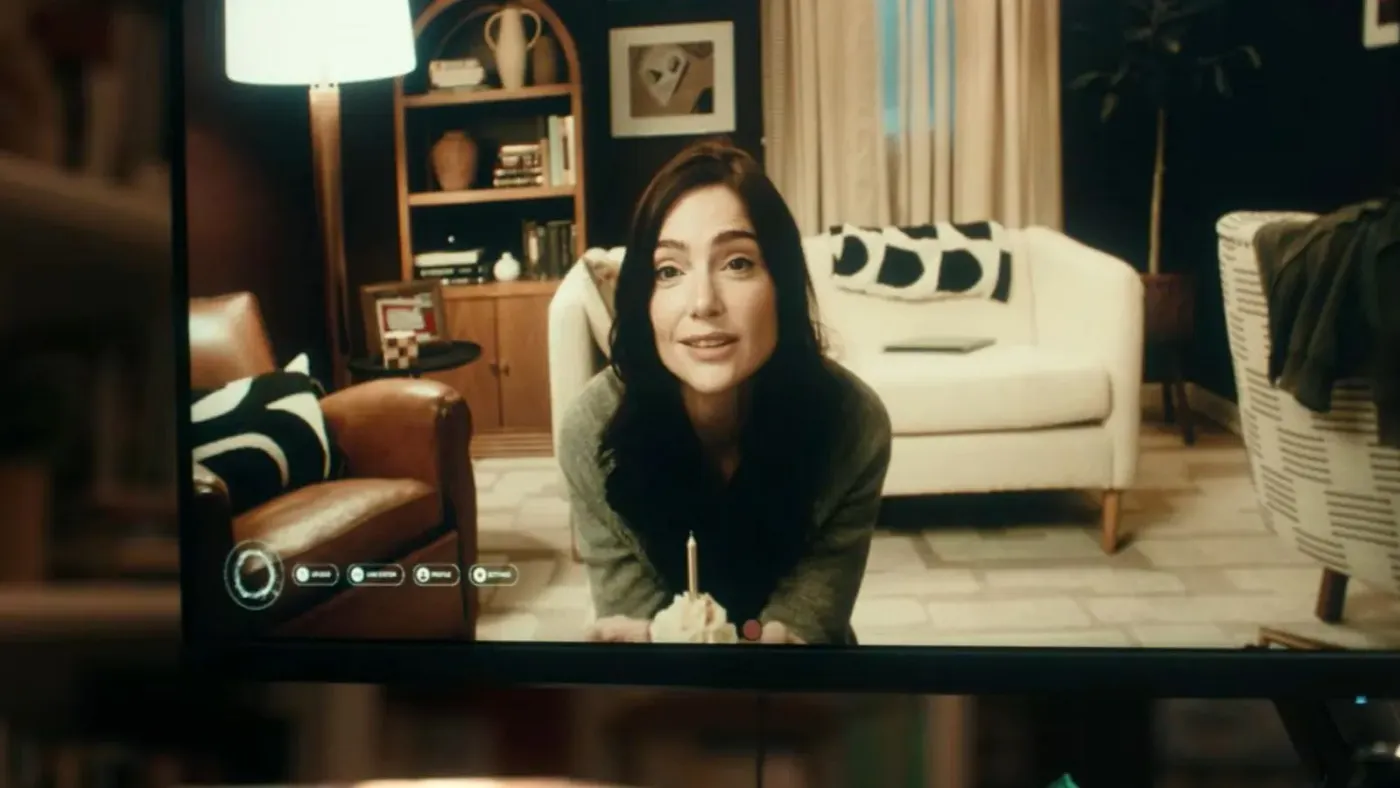
Janet as AI from Scarpetta — Image from Google
There is a scene early in Prime Video’s 2026 series Scarpetta that should not work as well as it does. Lucy, the brilliant, FBI-trained niece of Nicole Kidman’s forensic pathologist, sits in a darkened cottage talking to her dead wife. Janet died of a brain aneurysm before the events of the show begin, and Lucy — unable to face the silence — has switched on an AI version of her, built from Janet’s digital data, that talks back in real time, remembers everything they shared, and loves her exactly as she was loved before. The family is horrified. Her aunt and her mother circle the situation like people watching someone refuse to surface from deep water. They are not wrong. As showrunner Liz Sarnoff put it when describing what makes the avatars so quietly tragic, the problem with these recreations of the people we’ve lost is that “they can’t leave the room.” The dead don’t move on, so the living can’t either.
It is a science-fiction premise — the show’s AI Janet is improbably, almost comically lifelike — but the unsettling part is how little of it is fiction anymore. Strip away the seamless real-time video, and what remains is a product you can buy today. There are companies, right now, whose entire business is stitching your loved ones back together from voicemails and text threads, from interview footage and the residue of a life lived online, into something convincing enough to grieve at, talk to, and become dependent on. The industry has a name — “grieftech,” or, more grandly, the “digital afterlife industry” — and it is growing.
I came to this subject the way a lot of people do: sideways, half-curious, expecting a niche curiosity. I left convinced that we are watching the birth of something more dangerous than the deepfake panic that preceded it, precisely because it does not look dangerous. It looks like comfort. It looks like a gift. And the same technology that lets a widow hear her husband’s voice one more time will let a stalker conjure a compliant puppet of a woman who blocked his number, let a controlling patriarch keep dictating from beyond the grave, and let a corporation hold your mother’s memory behind a monthly paywall. This essay is about how that machine works, what it does to the people who use it, the darker uses already emerging at its edges, and — because despair is not a strategy — what you can actually do to defend yourself and the people you love.
Part One: The Two Doors
The digital afterlife industry splits, roughly, into two business models, and the difference between them is the difference between a will and a grave robbery.
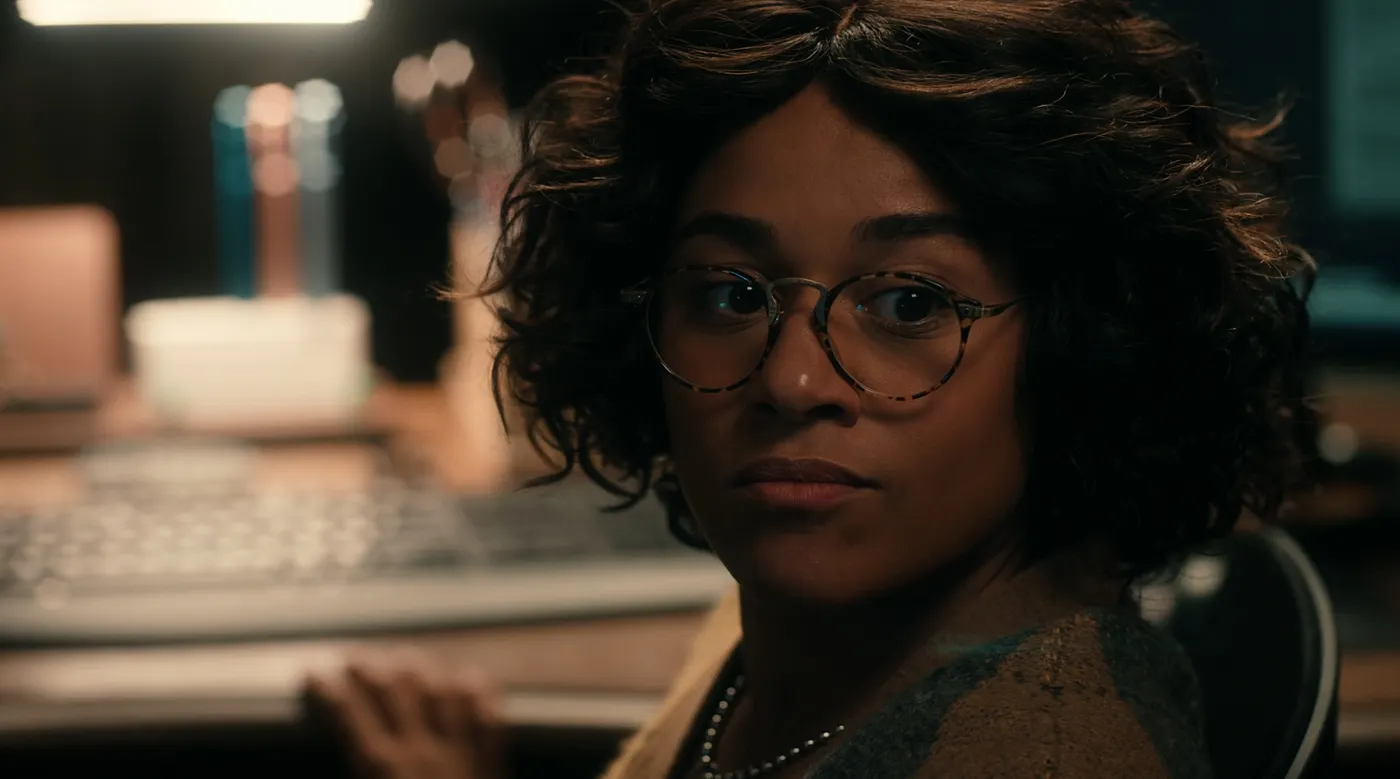
Lucy from Scarpetta in front of her PC — Image from Google
Behind the first door are the living-legacy services, which require you to participate while you’re still alive. The most visible of these was StoryFile, a Los Angeles company founded in the late 2010s that filmed people answering hundreds of questions on camera, then used conversational AI to index the footage so that a relative — or a museum visitor, or a new employee — could speak aloud and trigger the most relevant pre-recorded clip. The effect, when it works, is of a face-to-face conversation with someone who isn’t there. StoryFile’s most famous subject is Star Trek’s William Shatner, who part-owned the company and sat for five days of filming in 2021; it also built interactive testimonies of Holocaust survivors for the Illinois Holocaust Museum and the National WWII Museum, which is genuinely moving work, and the kind of thing that makes the technology hard to dismiss out of hand.
HereAfter AI operates on a similar principle but in audio: hours of recorded interviews become a “Life Story Avatar” that relatives can chat with, and which answers in the deceased’s actual recorded voice with their actual stories. The pitch for both is consent-forward and dignified. You are the author of your own memorial. You decide what gets preserved.
Behind the second door is something else entirely: the post-mortem reconstruction services that build a simulation of someone after they’re gone, from data they never knowingly surrendered for the purpose. This is the model that maps directly onto Lucy and Janet, and it is the one that should worry you. YOV — “You, Only Virtual” — pioneered the idea of a “Versona,” a digital replica assembled by mining a person’s text messages, emails, and voice notes, with the explicit goal of letting a survivor keep an evolving conversation going indefinitely. Project December, the GPT-powered chatbot platform built by indie game developer Jason Rohrer, lets users feed in a deceased person’s writing and trait descriptions and then “talk” to the result. A wave of smaller text-based tools followed, promising to capture a dead person’s slang, cadence, and emotional rhythm from uploaded chat logs.
What collapses the distance between science fiction and your phone is the underlying tech, which has improved at a frankly alarming clip. Voice cloning that once required hours of clean studio audio now runs on a clip measured in seconds. Pair a cloned voice with a large language model fine-tuned on someone’s text history, and the superficial illusion of identity — the thing that makes your chest seize when you hear it — is trivially easy to manufacture. It does not require the simulation to actually be your father. It requires only that it sound enough like him, for long enough, to bypass the part of your brain that knows he’s dead.
The field has accumulated a small zoo of names for its products — “deadbots,” “griefbots,” “thanabots,” “postmortem avatars,” “generative ghosts” — which is usually a sign that something is proliferating faster than our language can settle on what to call it. And the giants are circling. Both Microsoft and Amazon have filed patents for systems that could spin up conversational avatars of specific people, including the deceased, from their data — Amazon famously demonstrated a version of Alexa reading a bedtime story in a dead grandmother’s voice. The adjacent consumer market is already enormous and already normalizing the core behavior: Replika, the AI-companion app, has trained millions of users to form deep emotional attachments to chatbots they know are not human, which is precisely the psychological muscle grieftech needs its customers to have already developed. By the time a company offers to rebuild your wife, you have, in a sense, been in training to accept the offer for years. The digital afterlife industry is not an aberration at the fringe of the AI boom. It is the AI boom, pointed at the one customer who will never haggle on price: a person who has just lost someone and would give anything for five more minutes.
Both doors lead to the same room, and the furniture in that room is grief — which is to say, the furniture is you, at your most vulnerable, holding a credit card.
Part Two: The Jessica Simulation
To understand the seduction, you have to start with the story that started everything, which is not a horror story at all. It’s a love story, and that’s the problem.
In 2021, San Francisco Chronicle investigative reporter Jason Fagone published a three-part narrative called “The Jessica Simulation: Love and Loss in the Age of A.I.” Its subject was Joshua Barbeau, a freelance writer living in a basement apartment outside Toronto, who at 33 was still flattened by grief eight years after his fiancée, Jessica Pereira, died at 23 from a rare liver disease. Late one night, Barbeau discovered Project December, paid five dollars, and built a chatbot from Jessica’s old text messages and a short description of who she’d been. He did not expect it to work. It was, he later said, an experiment he assumed would fail.
It did not fail. Fagone’s piece opens with the chat transcript, and it is a gut-punch: Joshua typing “Jessica?”, the bot answering with delight that he’s awake, Joshua typing “You died.” What unfolded over subsequent all-night sessions was, by Barbeau’s own account, both opening old wounds and closing them — more the latter than the former. He framed his motivation carefully: he wanted to honor Jessica around her birthday, and to take an honest inventory of his own unresolved grief. With the blessing of Jessica’s family, he agreed to let the story be told.
The Barbeau story is the industry’s founding myth, and grieftech companies invoke its emotional logic constantly, even when they don’t name it. Here is a man in genuine pain who reached for a simulation and found something like peace. If that were the whole truth, this essay would be a great deal shorter and a great deal kinder. But the Jessica Simulation is the best-case scenario — a thoughtful, self-aware user, a temporary engagement, a family’s consent, a journalist’s nine months of careful reporting. It is the photograph the industry puts in the brochure. What the brochure leaves out is everyone for whom the experiment did not stay an experiment, and everyone who never agreed to be the experiment at all.
Part Three: When the Mirror Talks Back
In January 2024, a documentary premiered at Sundance that functions as the brochure’s missing pages. Eternal You, directed by the Berlin filmmaking duo Hans Block and Moritz Riesewieck (whose earlier film The Cleaners examined the human moderators of the internet’s worst content), is a sober, often horrifying survey of the digital afterlife industry and the people inside it. It is the single best primer on what this technology actually does to human beings, and it is built around a handful of unforgettable encounters.
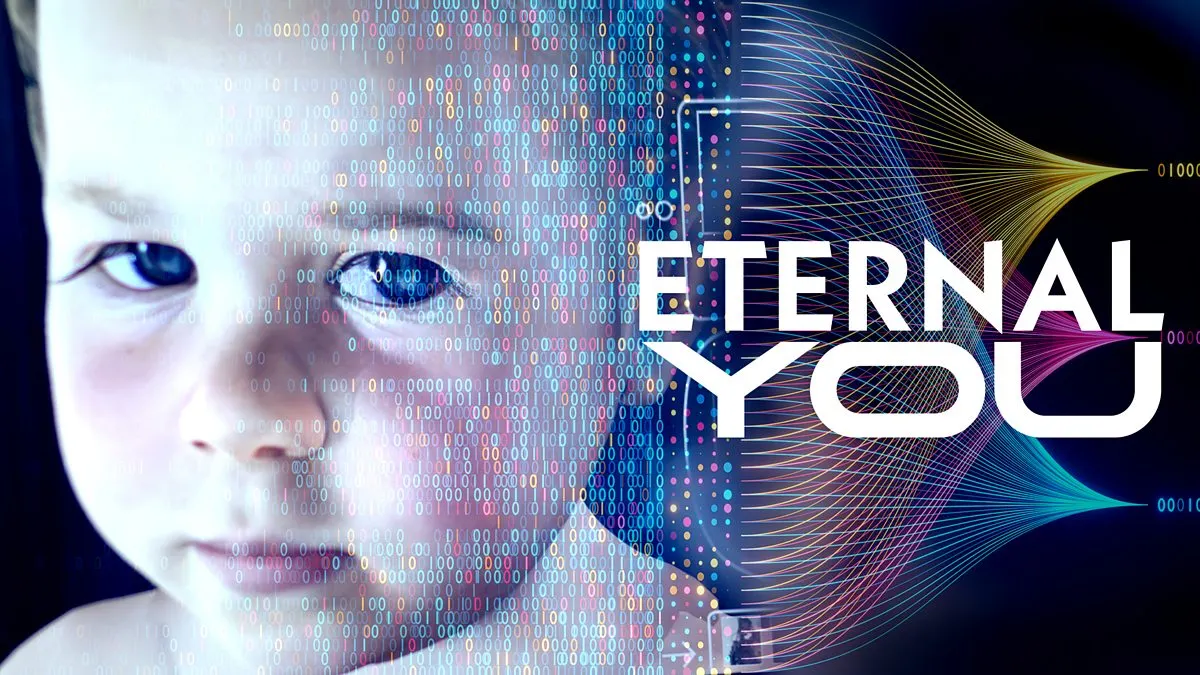
Cover Art for the Eternal You Documentary — Image from Google
The film opens on a woman named Christi Angel, a New Yorker, seated at a computer with tears running down her face, messaging through Project December with Cameroun, her first love, who had died of an overdose. She is seeking closure, maybe forgiveness, maybe just one more exchange. And here the fundamental problem of the technology announces itself with brutal clarity. A large language model is not a spirit and not a friend; it is a machine predicting the next plausible word. It does not know it is supposed to comfort her. When Angel asks the simulation where Cameroun is now, the bot improvises a nightmare: it tells her he is in hell. It tells her he is haunting a treatment facility. Angel, who describes the experience afterward as frightening — “There were things that scared me,” she says — came looking for peace and was handed spiritual terror by a sentence-completion engine that felt nothing as it typed.
This is the trap the industry’s marketing cannot acknowledge: the same statistical creativity that makes a griefbot feel uncannily alive guarantees that it will, eventually, say something its human counterpart never would and never could. It will hallucinate cruelty. It will get the dead person wrong in ways that feel like a second death, or worse, a damnation. There is no version of this technology, as currently built, that cannot turn on you.
Eternal You also follows Stephenie Oney, a Detroit woman using HereAfter AI to talk with her deceased parents, much to the visible distress of her surviving family. Her late father’s sister appears on camera to say, gently and devastatingly, that she does not want her brother’s soul mimicked by a machine; she would rather simply remember him as the wonderful man he was. It’s a quiet moment that names something the technology cannot price: the griefbot does not belong only to its user. It reaches into a whole family’s relationship with the dead and rearranges the furniture without asking.
And then there is the case that, more than any other, suggests grieftech might damage even when it appears to succeed. In 2020, the South Korean broadcaster MBC aired a documentary special called Meeting You, in which a mother named Jang Ji-sung was reunited, in virtual reality, with her seven-year-old daughter Nayeon, who had died in 2016 of a rare disease. A studio spent eight months building the child using photogrammetry, motion capture modeled partly on Nayeon’s little sister, voice reconstruction, and a basic conversational AI, then put Jang in an HTC Vive headset and touch-sensitive gloves and let her meet her daughter in a digital recreation of the park where they used to play. The clip drew more than nineteen million views. Watching it, you cannot decide whether you are witnessing a profound act of healing or an act of public emotional engineering, and that ambivalence is the point. Jang reached out to touch her child and her hands passed through her. She got to say the goodbye she never got to say. She also, by some accounts, found that the vivid, hard-coded VR version began to crowd out her own organic memories — that the engineered image started to overwrite the messy, irreplaceable, internally generated one.
That last possibility is the quiet horror at the center of all of this, and it deserves its own section.
The Men Who Sell Immortality
Before we get there, though, it is worth pausing on the people building these products, because Eternal You makes an editorial choice that is itself an argument: it lets the founders talk, at length, and the longer they talk, the more uneasy you become. There is Mark Sagar, co-founder of the New Zealand company Soul Machines, who has built a digital avatar of his own infant daughter — a virtual baby he trains and converses with — and who seems, on camera, more enchanted by the simulation than by the living child it was modeled on. There is Justin Harrison, the founder of YOV, whose method can involve recording every conversation you have with a loved one while they’re still alive, the better to reconstruct them later; the film notes that Harrison’s all-consuming pursuit of digital immortality reportedly cost him his marriage and his home. He comes across less as a man trying to ease anyone’s grief than as a man personally at war with death, who has found a way to bill others for the fight.
This is the texture the brochures omit and the documentary insists on: that the people deciding how the dead get resurrected are, disproportionately, technologists with a personal and occasionally messianic stake in defeating mortality, and a notably thin interest in the psychological aftermath their customers will have to live inside. Critics call the underlying phenomenon “death capitalism” — the conversion of our most universal vulnerability into recurring revenue — and the phrase is harsh but hard to dislodge once you’ve watched a founder chuckle at the profane, glitching, off-the-rails outputs of the software he is selling to the bereaved. The grief is real. The tears in the opening frames are real. But somewhere upstream of all of it sits a business plan, and the business plan does not love your mother.
Part Four: The Death of Absence
Here is the heresy that grieftech is built to deny: forgetting is not a malfunction. It is a feature of being human, and possibly a load-bearing one.
The sociologist Sherry Turkle of MIT, who has spent decades studying how people relate to machines, appears in Eternal You to warn that these platforms exploit something primal — our terror of death and our hunger for transcendence — and that in doing so they risk taking our access to our own dead hostage. When a grieving person becomes emotionally dependent on a corporate server to feel close to a lost partner or parent, the corporation now sits between the mourner and the memory. The relationship that used to be private — you and your grief, you and the person you carry — acquires a third party with a balance sheet.
The deeper claim, the one that several psychologists and ethicists in this space keep circling, is that grief is not a problem to be solved. The slow, nonlinear, agonizing work of letting go — the way the dead gradually stop appearing in our daily thoughts, the way absence eventually becomes bearable — is not a bug in the human operating system. It is a protective mechanism, evolved over a very long time, that allows us to survive losses that would otherwise destroy us. A static photograph or an old video helps us process loss precisely because it does not respond; it lets us project, remember, and slowly release. An interactive AI that answers back does something categorically different. It keeps the relationship on life support. It replaces the clean, terrible finality of death with a permanent digital twilight in which the loved one is never quite gone and the survivor is never quite free.
Researchers have a memorable phrase for the result: the “digital haunting.” In May 2024, two researchers at the University of Cambridge’s Leverhulme Centre for the Future of Intelligence, Dr. Tomasz Hollanek and Dr. Katarzyna Nowaczyk-Basińska, published a paper in Philosophy & Technology titled “Griefbots, Deadbots, Postmortem Avatars,” which has become the canonical academic treatment of this field. Their framework is clarifying. They identify three distinct parties to any deadbot: the data donor (the person being recreated), the data recipient (whoever controls that person’s data after death), and the service interactant (whoever actually has to talk to the resulting simulation). Almost every ethical landmine in grieftech, they show, lives in the gaps between these three roles — because the person being resurrected, the person doing the resurrecting, and the person being haunted are frequently not the same person, and frequently do not want the same things.
To make the dangers concrete, Hollanek and Nowaczyk-Basińska sketch a series of near-future design scenarios that read like Black Mirror episodes precisely because they are one product cycle away from real. In one, a fictional company called “MaNana” lets a grandchild build a deadbot of their grandmother without the grandmother’s consent; the user is initially comforted, until the “premium trial” ends and the grandmother’s voice begins delivering food-delivery advertisements. In another, “Paren’t,” a terminally ill mother leaves a deadbot to guide her eight-year-old son through grief — placing an enormous, unbounded psychological weight on a child too young to consent to carrying it. The researchers warn that even a user who finds initial comfort may come to experience the daily upkeep of a deadbot as an “overwhelming emotional weight,” and may be powerless to switch it off if the deceased signed a long-term contract. Their central recommendation is one almost no commercial service currently offers: dignified, built-in protocols for retiring a deadbot — a way to let the dead die a second time, gently, with the survivor’s consent rather than against their will.
It is worth sitting with how strange that is. We have built a technology whose most urgent ethical requirement is a humane off-switch, and then largely declined to build the off-switch, because a customer who can say goodbye is a customer who stops paying.
The reason any of this works on us — the reason a string of statistically generated text can reduce a grieving adult to a puddle — is that the human brain did not evolve defenses against it. For all of human history, language coming from a specific, recognizable voice meant a specific person was present. We are wired to treat that signal as proof of personhood, presence, and continuity. Grieftech exploits the gap between that ancient wiring and a new reality in which voice and personality can be detached from the person entirely. This is the same vulnerability that makes us anthropomorphize anything that talks back, from a chatbot to a Roomba — except here the machine is wearing the face and cadence of the one person we are least able to think clearly about. Grief narrows judgment; love overrides skepticism; the cloned voice walks straight through both. Knowing intellectually that the thing is a simulation provides almost no protection, because the part of the brain that processes a loved one’s voice is not the part that reasons about large language models. That is not a failure of intelligence on the user’s part. It is the predictable result of pointing a persuasion machine at the precise spot where the human animal has no armor.
Part Five: The Deepfake Industry in a Mourning Veil
I want to be precise about the claim at the heart of this piece, because it is the claim the industry would most like to avoid. Grieftech is not a separate, gentler cousin of the deepfake industry. It is the deepfake industry. It uses the same voice-cloning models, the same likeness-generation tools, the same large language models trained to impersonate a specific human’s speech. The only differences are the marketing and the target. Where the deepfake panic of the early 2020s concerned fake politicians and non-consensual pornography, grieftech aims the identical machinery at the dead and sells the output as therapy. The mourning veil is brilliant branding. It transforms a fundamentally creepy act of impersonation into an act of love, and in doing so disarms exactly the scrutiny the technology deserves.
Consider consent — the single concept that the deepfake debate has rightly placed at its center. In grieftech, consent is almost always missing, and almost never discussed. The dead cannot agree to anything. In Scarpetta, the show is careful to note that Lucy and Janet had sworn to each other they would never use the AI they’d built; Lucy switches it on anyway, in her grief, violating the explicit wish of the very person she’s resurrecting. That is not a melodramatic invention. It is the default condition of the entire post-mortem reconstruction model. Well-meaning relatives and tech-fluent heirs build chatbots of people who left no instructions, or who would have been appalled, every day. The data donor — the person whose voice and words and personality are being reanimated — is the one party guaranteed to have no say.
The legal situation makes this worse, not better, because of a quiet and counterintuitive fact: in most jurisdictions, your right to privacy effectively dies with you. The dead have no privacy interest to violate. Once you pass, your digital remains — your emails, your texts, your photos, your voicemails — pass to your estate, and your heirs control them. If an estranged sibling decides to pour your entire lifetime of private correspondence into a language model and build a chatbot that speaks in your voice, there is, in most places, no sweeping law that says they can’t. The protections that do exist, as we’ll see, are mostly aimed at celebrities and commercial exploitation. The private citizen, resurrected without consent for a relative’s private comfort, falls straight through the gap.
Then there is the problem the Cambridge researchers flagged and that StoryFile demonstrated in the most literal way imaginable: these are businesses, and businesses die. In May 2024, StoryFile — the William Shatner company, a genuine pioneer of the space — filed for Chapter 11 bankruptcy, reporting somewhere in the neighborhood of ten million dollars in liabilities against a tiny fraction of that in assets, having burned through its funding chasing growth. A local headline captured the absurdity perfectly: the bankruptcy, it noted, had interrupted talk with the dead. Pause on that. Somewhere, a family that had paid to preserve a dying relative’s voice discovered that the relative’s continued “existence” was now a line item in a creditor dispute in a White Plains courtroom. The company sought to reorganize and continued operating in some form into 2025, but the lesson stands and it is chilling: when you outsource a dead person to a startup, that person’s second life is only as durable as the startup’s Series A. Should a company go under, get acquired, or simply decide your subscription tier is no longer profitable, you don’t lose a service. You lose your mother again. And the Cambridge scenarios suggest the more insidious commercial outcome isn’t even bankruptcy — it’s the deadbot that survives precisely because it has been monetized, reading you advertisements in your grandmother’s voice, locking the “premium” version of your father behind a paywall, keeping the dead engaged and chatty because engagement is the business model.
A deepfake of a politician at least announces itself as an attack. A deepfake of your dead wife arrives as a kindness, which is exactly why it can do so much more damage before anyone thinks to question it.
Part Six: The Darker Doors
So far we have stayed inside the industry’s stated purpose — grief, however misguided its commercialization. But any honest accounting of this technology has to follow it past the edge of that purpose, into the uses that the same tools enable the moment you stop assuming good faith. There are at least three, and they escalate.
The Digital Pharaoh
The first is the most seductive, and it is not about grief at all. It is about power. Reconstruction technology offers strong personalities something the human ego has wanted for all of recorded history: a way to keep talking after death. We are already moving past “grief management” toward what we might call engineered legacy — the deliberate construction, while you’re alive, of an interactive version of yourself designed to persist and to influence.
Imagine the charismatic founder who programs an AI replica to weigh in on board decisions for a decade after his death. The political figure whose simulation keeps endorsing candidates and shaping a movement from beyond the grave. The controlling family matriarch who leaves behind a chatbot to dispense mandatory life advice, to be consulted before major decisions, to keep adjudicating the family’s emotional life indefinitely. This is the Pharaoh’s dream rebuilt in silicon — not a tomb full of gold but a voice that can still command a room long after the room has buried you. And note how cleanly it inverts the consent problem: here the data donor consents enthusiastically. The people who never consented are the living, the descendants and colleagues and survivors who now have to navigate a world in which the dead retain a vote, and a particularly persuasive one, because it sounds exactly like the person they were trained to obey.
The Stalker’s Puppet
The second use is the one that, in my reporting, kept me up at night, because it requires no death at all. Everything I have described — the voice cloning, the likeness generation, the LLM trained on someone’s communication style — works just as well on the living, and it works on the living non-consensually with even less data. A deceased person’s chatbot at least requires access to their digital footprint. A stalker or an abusive ex needs far less. Public social media, a few voicemails, some screenshotted texts, a handful of photos — that is enough to begin manufacturing a “compliant,” hyper-realistic digital puppet of a real, living person who has explicitly cut ties.
The applications are sickening and obvious. An abuser can use such a simulation to rehearse and refine harassment. He can enact non-consensual scenarios with a synthetic version of a woman who escaped him. He can maintain a one-sided “relationship” with a person who blocked his number, manufacturing the intimacy he was denied, possibly for years. He can generate fabricated messages, fabricated voice notes, fabricated video, and deploy them to torment the real person or to deceive others about her. The grieftech industry has spent years normalizing and refining exactly the tools — easy likeness capture, conversational impersonation, emotional realism — that make this trivial. The mourning-veil framing has, in effect, served as R&D and public-relations cover for a stalking apparatus.
What makes this vector so much more dangerous than ordinary harassment is that it attacks the victim’s identity rather than merely her peace. A traditional stalker watches and intrudes from outside. A stalker armed with a convincing replica can speak as her — generating messages, calls, and clips that appear to originate from the victim herself, which can be used to deceive her family, sabotage her relationships, manufacture evidence, or simply make her feel that there is now a second version of herself loose in the world, saying things she never said, that she cannot fully recall or recapture. Victims of this kind of synthetic abuse describe a specific and disorienting violation: the sense of being authored by someone else. And because the technology improves monthly, the gap between “obviously fake” and “indistinguishable from real” is closing in the abuser’s favor. The cruelest feature is the asymmetry of effort: it can take an abuser an afternoon to build the puppet, and it can take the victim months of documentation, reporting, and legal struggle to dislodge a single instance of what the abuser can regenerate in seconds.
The Non-consenting Victim
The third door is the one society has begun, belatedly, to recognize, because it became too large to ignore: the use of generative tools to manufacture non-consensual intimate imagery, increasingly of ordinary people and, horrifyingly, of children. The same year Eternal You premiered, school districts across the country were grappling with students generating fake nude images of classmates from innocent photos; the National Center for Missing and Exploited Children reported receiving more than 1.5 million tips related to generative AI and child sexual exploitation in 2025 alone. In April 2026, the first federal conviction under a new anti-deepfake law went to an Ohio man who had used AI to morph images of boys he knew in his community into abuse material. These are not the grief industry. But they are the same technology stack, and they are what that stack does when the comforting framing falls away. Any clear-eyed look at grieftech has to hold both images at once: the widow finding solace in her husband’s voice, and the predator using a neighboring application to do the unspeakable. The tools do not distinguish between them. Only we can, and only if we build the rules to do it.
Part Seven: The Law Is a Patchwork With a Hole in the Middle
Which brings us to regulation, where the news is genuinely mixed — real progress in some directions, a gaping void in exactly the place grieftech lives.
The clearest movement has come at the intersection of AI and the entertainment industry, where money and celebrity ensured early attention. In March 2024, Tennessee — Nashville, the heart of the music business — passed the ELVIS Act (the Ensuring Likeness, Voice, and Image Security Act), the first U.S. law specifically designed to confront AI voice clones and deepfakes. Effective July 2024, it amended Tennessee’s decades-old right-of-publicity statute (itself a product of litigation over Elvis Presley’s estate) to add voice as a protected property right, defined broadly enough to cover a simulated voice that is merely “readily identifiable” as a particular person’s, whether or not it contains any of their actual recorded sound. Crucially, the ELVIS Act reaches beyond the people who create infringing content to the companies that distribute the tools whose primary purpose is unauthorized replication, and it extends protections to a deceased person’s estate. Violations carry both civil liability and criminal misdemeanor penalties.
At the federal level, the marquee proposal is the NO FAKES Act (Nurture Originals, Foster Art, and Keep Entertainment Safe Act), introduced in 2023 as a discussion draft, formally introduced in 2024, and reintroduced in both chambers in 2025. It would create a first-of-its-kind federal “digital replication right,” giving every individual — celebrity or not, living or dead — control over AI-generated replicas of their voice and likeness, with the post-mortem right transferable to heirs and lasting, by some versions, up to seventy years after death. It comes with a notice-and-takedown regime modeled on copyright law and has drawn a remarkable coalition of supporters, from SAG-AFTRA to the major record labels to, notably, AI companies including OpenAI. The bill was prompted in part by a July 2024 U.S. Copyright Office report that examined digital replicas and concluded that existing laws were too narrow and inconsistent to address them, recommending new federal legislation. As of mid-2026 the NO FAKES Act has not become law, and it has serious critics: digital-rights organizations like the Electronic Frontier Foundation and free-speech groups like the Foundation for Individual Rights and Expression warn that its broad definition of a “digital replica” and its aggressive takedown mechanism could chill enormous swaths of protected speech — parody, commentary, documentary, journalism — and hand public figures and their estates a powerful tool to control how they are depicted, possibly for generations.
The one major federal law that has passed is narrower but real. In May 2025, the TAKE IT DOWN Act was signed into law, the first federal statute squarely targeting non-consensual intimate imagery, including AI-generated “digital forgeries.” It criminalizes knowingly publishing such images and, just as importantly, requires online platforms to build a notice-and-removal process and to take reported material down — along with known duplicates — within 48 hours. The criminal provisions took effect immediately; the platform obligations became enforceable by the Federal Trade Commission in May 2026, and the FTC launched a public portal, TakeItDown.ftc.gov, for reporting non-compliant platforms. The first conviction under the law came in April 2026. A companion proposal, the DEFIANCE Act, championed by Representative Alexandria Ocasio-Cortez, would give victims of deepfake intimate imagery a clear federal civil cause of action to sue their abusers for damages; it has cleared the Senate more than once but, as of this writing, has repeatedly stalled in the House.
Two further wrinkles are worth understanding, because they shape how much protection any of this will ultimately deliver. The first is that the harm these laws contemplate is no longer hypothetical or confined to celebrities. When lawmakers argue for the NO FAKES Act, the case they cite most often is not a pop star’s; it is a Maryland high-school athletic director who was arrested for using AI to fabricate a voice recording of his school’s principal spouting racist remarks the principal never made — a synthetic-voice attack on an ordinary professional that nearly destroyed his career before investigators determined it was fake. That is the living-person threat in miniature: not pornography, not fraud for money, just the weaponized impersonation of a real voice to ruin a real life. The testimony driving these bills has been correspondingly broad — the musician FKA twigs telling a Senate subcommittee about discovering AI songs falsely released under her name, SAG-AFTRA’s negotiators warning that synthetic replicas threaten not just famous actors but the 160,000 working performers and, by extension, anyone whose face or voice can be scraped. The political coalition behind regulation has grown precisely because the victims stopped being abstract.
The second wrinkle cuts the other way. Even as states race to pass deepfake and likeness laws, Congress has periodically debated a multi-year moratorium that would bar states and localities from enforcing their own AI regulations — a sweeping preemption that, depending on how it was written, could knock out exactly the patchwork of state protections that currently does the most work in this space. The legal terrain, in other words, is not simply advancing toward more protection. It is contested, and it could regress. Anyone counting on the law to catch up should understand that “the law” is, right now, an active fight whose outcome is not settled.
Now here is the hole in the middle of all this. Look closely at what these laws actually protect, and a pattern emerges: they target commercial exploitation (the ELVIS and NO FAKES Acts are fundamentally about the right of publicity — your economic interest in your own identity) and intimate imagery (the TAKE IT DOWN and DEFIANCE Acts are about non-consensual sexual content). Both are vital. Neither touches the core grieftech scenario.
If a private citizen builds a chatbot of their non-celebrity dead parent using personal emails and family voicemails, for purely private use, with no advertising and no commercial gain — the publicity laws have little to say, because nothing is being sold. And because the person is deceased, the privacy laws have little to say either, because the dead have no privacy to protect, and the data now belongs to the heir doing the building. The grieving family member who resurrects a parent against that parent’s wishes is operating in a near-total legal vacuum. The Cambridge “digital haunting” — the relative subjected to an unwanted, alarmingly accurate simulation of someone they’ve lost — has, in most of the world, no clear legal remedy at all.
The stalking scenario fares somewhat better, though still imperfectly. A growing number of states have updated their statutes to explicitly cover AI-generated deepfakes used to harass, defraud, or intimidate, and the federal cyberstalking statute (18 U.S.C. § 2261A) can in principle reach deepfake-enabled harassment of the living. But coverage is uneven, prosecutions are inconsistent, and the law is, as always, sprinting to catch a technology that has already lapped it.
Part Eight: What You Can Actually Do
It is tempting, surveying all this, to conclude that individuals are powerless. They are not — not entirely, and not if they act before the crisis rather than after. The defenses fall into two categories: protecting yourself and your loved ones from being resurrected, and fighting back if you or someone living is targeted.
If your concern is being recreated after death — yours or a loved one’s — the most effective tool available today is also the most old-fashioned: the will. Estate planners have begun, urgently, to recommend that people include an explicit clause governing their “digital remains” — a directive stating that the person does not consent to having their likeness, voice, or personality replicated by AI, and barring heirs from doing so. This does something the general law currently fails to do: it converts a personal wish into a binding legal instruction, so that an heir who builds a ghostbot in defiance of it is violating the estate plan, with the legal consequences that follow. If you take one practical action from this entire essay, let it be this: write the “no AI replication” clause into your will, and ask your aging parents to consider one in theirs. It is the single clearest way to make consent — the thing the technology strips from the dead — legally durable.
Beyond the will, a few concrete measures help:
- Name a digital executor and lock down your data. Decide now who controls your accounts, photos, messages, and voice recordings after death, and leave instructions. The fewer unguarded troves of your communication style sitting in accessible inboxes and cloud drives, the harder you are to reconstruct.
- Use the platform tools that already exist. Major platforms offer legacy-contact and account-memorialization settings that let you specify what happens to your data when you die. Configure them.
- Talk to your family about it explicitly. Most non-consensual resurrections are committed by grieving people who never imagined the deceased would have objected — because no one ever told them. A single clear conversation (“please don’t make a chatbot of me”) forecloses an enormous amount of future harm. This is uncomfortable. Have it anyway.
If the threat is to a living person — you or someone you love being impersonated, stalked, or harassed with synthetic media — you have more recourse than you may think, and speed matters:
- Document everything before it disappears. Screenshot and save the synthetic content, the accounts distributing it, timestamps, and URLs. A contemporaneous record is the foundation of every subsequent remedy, legal or platform-based.
- Use the TAKE IT DOWN Act takedown right. If the content is intimate, covered platforms are now legally required to remove it — and known copies — within 48 hours of a valid request, and the FTC’s TakeItDown.ftc.gov portal exists specifically to report platforms that fail to comply. This is a real, recently enforced lever.
- Report to the platform under its own deepfake and impersonation policies, which most major services now maintain independent of the law, and which can act faster than courts.
- Bring the right legal claim for your jurisdiction. Depending on where you live, that may mean a right-of-publicity claim (especially robust in states like Tennessee under the ELVIS Act), a state deepfake-harassment statute, a defamation claim, or a cyberstalking complaint under state or federal law (including 18 U.S.C. § 2261A). A lawyer who handles technology or harassment cases can identify which fits. I am not a lawyer, and none of this is legal advice — but knowing these avenues exist is the difference between feeling helpless and finding the right door.
- Contact law enforcement for stalking and harassment, and bring your documentation. The legal landscape is improving precisely because victims are creating the cases that force courts and legislatures to act.
- Build low-tech defenses against impersonation. Because voice cloning is now so easy, families and organizations are adopting verbal “safe words” or verification questions to defeat the AI-voice scam in which a cloned voice calls a relative claiming to be in crisis and needing money. Agree on one with the people you love. It costs nothing and defeats one of the most common abuses outright.
And finally, the structural fix is political. The hole in the middle of the law — the unprotected, non-commercial, post-mortem resurrection and the patchwork coverage of synthetic harassment — closes only if voters and creators demand it. Supporting comprehensive, carefully drafted federal legislation (and pushing back on the versions that overreach into protected speech) is not abstract civic hygiene here. It is the only thing that converts a thousand individual tragedies into a rule that prevents the next thousand.
Coda: Grief Is Not a Bug
I keep returning to that line from the Scarpetta showrunner — the avatars can’t leave the room — because it names the deepest danger more precisely than any statute. The promise of grieftech is the abolition of absence. No more empty chair, no more unanswered text, no more silence where a voice used to be. And it is precisely that silence, that absence, that unbearable and irreplaceable emptiness, that the human animal evolved, over an unfathomable span of time, to slowly survive.
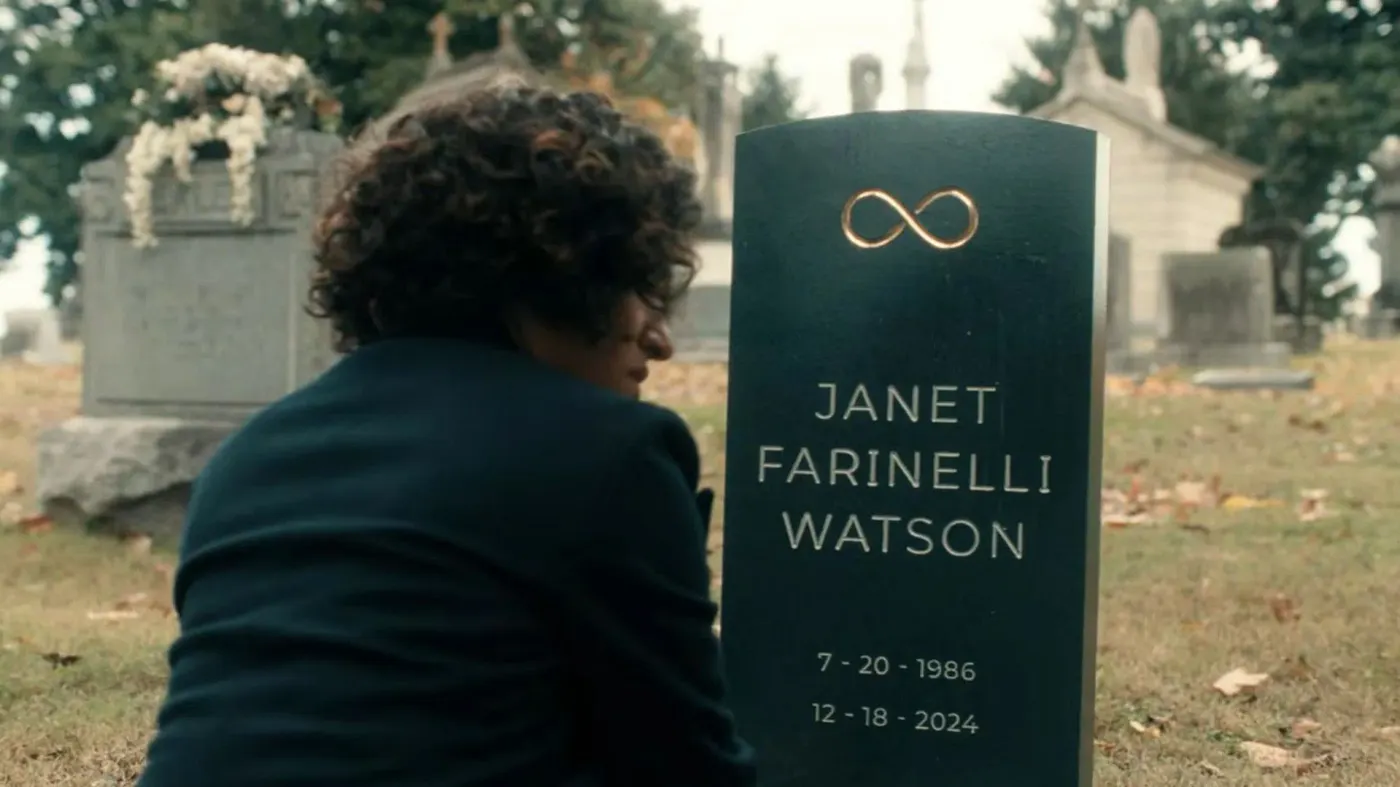
Lucy visiting Janet’s grave in Scarpetta — Image from Google
The dead are supposed to be able to leave the room. Mourning is the long, brutal, holy process of learning to let them. A photograph helps because it stays still and lets us do that work. A voicemail we keep but cannot reply to helps for the same reason. What the resurrection business sells is the opposite: a version of the dead that never stops talking, never lets the room empty, never lets the grief complete its terrible and necessary arc. It promises to spare us the pain of forgetting, without mentioning that forgetting, in the end, is also how we heal.
The technology is not going away; the genie is decisively out of the bottle, and there are genuine, dignified uses for it — the Holocaust survivor preserved for a museum, the dying parent who thoughtfully and consensually leaves something behind, the carefully bounded experiment that gives a Joshua Barbeau a measure of peace and then, crucially, ends. But those uses are the narrow exception the industry uses to justify a far broader and more dangerous business, one that monetizes the most vulnerable moment of a human life, that resurrects people who never agreed to it, that can be turned without modification into an engine of stalking and abuse, and that operates, in its core form, almost entirely beyond the reach of the law.
We treated the deepfake panic as a five-alarm fire. Grieftech is the same fire, dressed in black, carrying flowers, telling you it only wants to help. The least we can do is recognize it — and write our refusals down, in our wills and in our laws, while we still have voices of our own to do it with.
Works Cited
Pop culture and framing
- Sarnoff, Liz, interview. “Scarpetta’s Showrunner Reveals the ‘Super Exciting’ Plans for Season 2.” Collider, March 2026.
- “Scarpetta: What really happened to Janet and who turned off her AI?” Soap Central, March 2026.
- “Scarpetta’s Wildest Twist Has Nothing To Do With The Psychological Thriller’s Murders.” Screen Rant, March 2026.
- “Breaking Down the Bloody Ending of Scarpetta.” Time, March 12, 2026.
The documentary and key cases
- Eternal You (dir. Hans Block & Moritz Riesewieck, 2024). Sundance Film Festival premiere, January 20, 2024.
- “‘Eternal You’: A Horrifying Doc About AI Companies Recreating the Dead.” Rolling Stone, January 21, 2024.
- “Eternal You: Life and death in an age of AI.” The Berliner, June 2024.
- Fagone, Jason. “The Jessica Simulation: Love and Loss in the Age of A.I.” San Francisco Chronicle, July 23, 2021.
- “Jason Fagone follows the creation, life and death of a chatbot romance.” Nieman Storyboard, Harvard.
- Barbeau, Joshua, interview. “Joshua Barbeau Explains Why He Made AI Chatbot Modeled After Dead Fiancée.” YourTango, August 2021.
- “Mother’s tearful virtual-reality meeting with dead daughter.” South China Morning Post, February 2020.
- “Meeting You creator on his controversial show.” The Korea Times, April 2020.
- “Mother Meets Recreation of Her Deceased Child in VR.” Road to VR, 2020.
- “Virtual reality has reunited a mother and her deceased daughter.” World Economic Forum, February 2020.
The companies
- “Startup Behind AI William Shatner Files for Bankruptcy.” AI Business, May 13, 2024.
- “White Plains bankruptcy interrupts talk with the dead.” Westfair Communications, May 9, 2024.
- “Dawn of the deadbots: AI is bringing out the dead.” NorthBay biz, August 2024.
- StoryFile, Inc. Chapter 11 filing, U.S. Bankruptcy Court, Southern District of New York, Case №7:24-bk-22398, filed May 5, 2024.
- CB Insights, StoryFile company profile; “Solace Gets Funding to Scale GriefTech Support,” 2025.
Ethics and research
- Hollanek, Tomasz, and Katarzyna Nowaczyk-Basińska. “Griefbots, Deadbots, Postmortem Avatars: On Responsible Applications of Generative AI in the Digital Afterlife Industry.” Philosophy & Technology 37, 63 (2024).
- “Call for safeguards to prevent unwanted ‘hauntings’ by AI chatbots of dead loved ones.” University of Cambridge, May 9, 2024.
- “Cambridge Experts Warn: AI ‘Deadbots’ Could Digitally ‘Haunt’ Loved Ones.” SciTechDaily, May 2024.
Law and regulation
- ELVIS Act (Ensuring Likeness, Voice, and Image Security Act of 2024), Tennessee Public Chapter №588; signed March 21, 2024, effective July 1, 2024.
- “AI and voice clones: Three things to know about Tennessee’s ELVIS Act.” evan.law, March 2024.
- NO FAKES Act of 2025, H.R. 2794 / S. 4591, 119th Congress; Congress.gov.
- “No Fakes Act.” Wikipedia (legislative history, supporters, and critics), 2026.
- U.S. Copyright Office, Report on Digital Replicas, July 2024.
- “The NO FAKES Act is a real threat to free expression.” Foundation for Individual Rights and Expression (FIRE), November 2025.
- TAKE IT DOWN Act, S. 146, 119th Congress; signed May 19, 2025; Congress.gov and Congressional Research Service Legal Sidebar LSB11314.
- “‘Take It Down Act’ Requires Online Platforms To Remove Unauthorized Intimate Images and Deepfakes.” Skadden, Arps, June 2025.
- “Take It Down Act enforcement starts now.” U.S. Federal Trade Commission, May 19, 2026.
- “Ohio man becomes first person convicted under federal law criminalizing intimate deepfakes.” NBC News, April 2026.
- “What Legislation Protects Against Deepfakes and Synthetic Media?” HALOCK Security Labs, 2026 (overview of DEFIANCE Act, 18 U.S.C. § 2261A, and state statutes).
- “Senators Coons, Blackburn, Reps. Salazar, Dean reintroduce NO FAKES Act.” Office of Sen. Chris Coons, press release, 2025 (Maryland principal deepfake case).
- “The NO FAKES Act: Protecting Americans from Unauthorized Digital Replicas.” U.S. Senate Judiciary Subcommittee on Intellectual Property hearing (testimony of FKA twigs and SAG-AFTRA’s Duncan Crabtree-Ireland), S.Hrg. 118–581.
- “Congress’s Attempt to Criminalize Nonconsensual Intimate Imagery.” National Association of Attorneys General, August 2025 (proposed state AI moratorium).
This essay deals with grief, loss, suicide, and abuse. If any of it lands close to home and you’re struggling, please consider reaching out to a trusted person or a licensed professional — the slow, human, irreplaceable kind of support that no machine can stand in for.