Where It Comes From, How to Spot It, and How to Outlast It
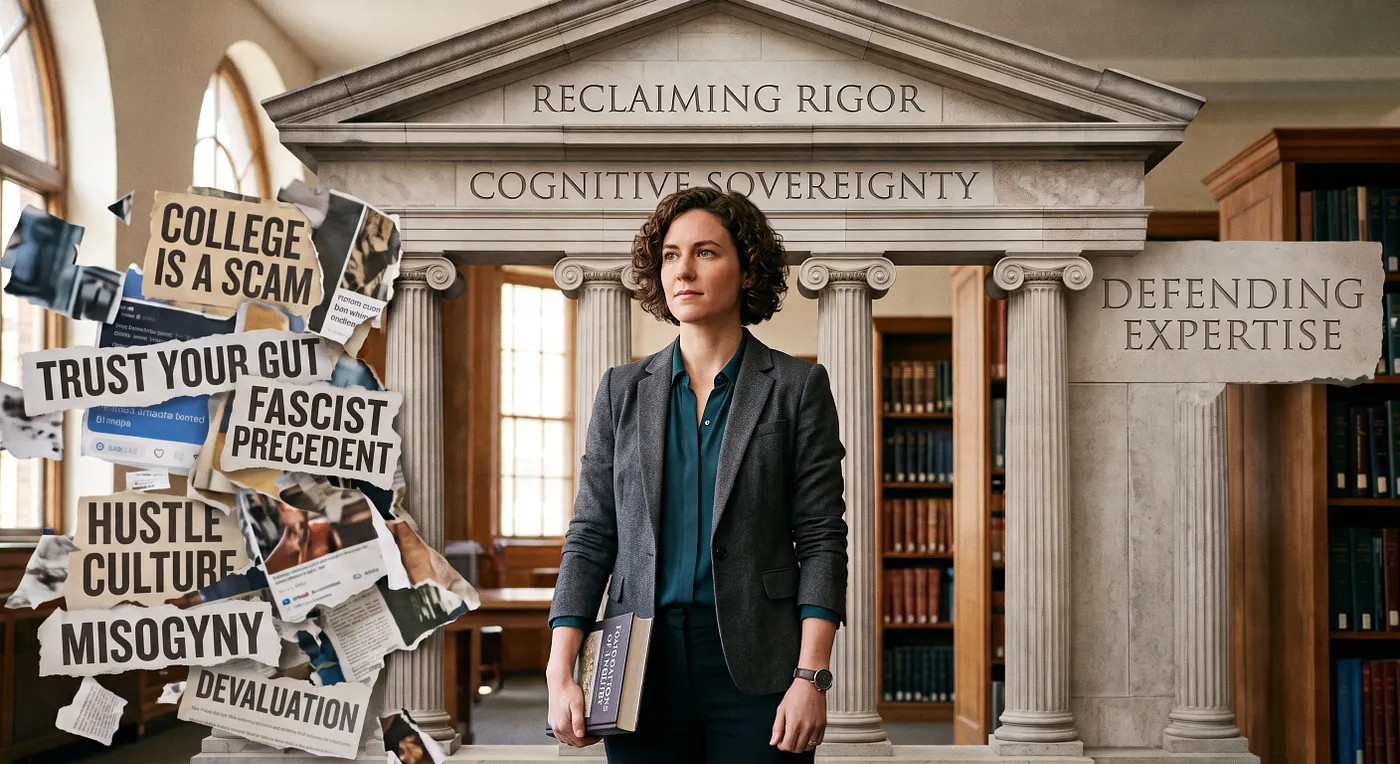
The media increasingly tells us to skip college, but there’s a much darker history behind it. — Image from Gemini
On November 2, 2021, a Senate candidate from Ohio closed his keynote at the National Conservatism Conference in Orlando with a line he borrowed from Richard Nixon: “The professors are the enemy.” The speaker was J.D. Vance, now Vice President of the United States. He graduated from Ohio State University and Yale Law School, and his speech was titled “The Universities are the Enemy.”
Four and a half years later, in a CNBC interview on March 12, 2026, Palantir CEO Alex Karp said artificial intelligence disrupts humanities-trained, largely Democratic voters and reduces their economic power. He predicted it would increase the economic power of “vocationally trained, working-class, often male” voters, and he didn’t present this as a problem to solve. Karp holds a law degree from Stanford and a doctorate in social theory from Goethe University Frankfurt.
Both men spent years in seminar rooms, and both have publicly written off the people who still work in them. That contradiction is the key to what is happening. Today’s anti-intellectualism doesn’t come from people who never had access to knowledge. It is a political project run largely by people who have plenty of it, aimed at an institution that has quietly changed who fills its classrooms.
The institution is higher education, and its students are now mostly women. To understand the backlash, you have to look at who got educated.
An Old Suspicion With a New Target
Distrust of intellectuals is nothing new in America. In 1963 the historian Richard Hofstadter published Anti-Intellectualism in American Life, which won the Pulitzer Prize the following year. He traced a national suspicion of the educated mind back through evangelical revivalism, a business culture that prized practical results over reflection, and a democratic streak that treated expertise as a kind of aristocracy.
What Hofstadter could not have foreseen was how completely the demographics of learning would flip. In the 1949 to 1950 academic year, women earned just under 24 percent of the bachelor’s degrees awarded in the United States. By 2021 to 2022, according to the National Center for Education Statistics, women earned 58.5 percent of bachelor’s degrees, 62.6 percent of master’s degrees, and 57 percent of doctoral degrees. Women have earned a majority of doctorates every year since the mid-2000s.
In a single lifetime, the university went from a mostly male institution to a mostly female one. Over the same lifetime, attacks on the university went from a fringe complaint to a governing agenda. The timing is not an accident, and history shows why.
The Fascist Template
In 1995 the Italian novelist and semiotician Umberto Eco published an essay called “Ur-Fascism” in The New York Review of Books. He listed recurring traits of fascist movements, and several of them concern the mind. Fascism, Eco argued, distrusts the intellectual world, treats critical thought as a threat, calls disagreement betrayal, and prizes action for its own sake over reflection. Among the same traits he named a cult of machismo that carries contempt for women.
The philosopher Jason Stanley developed the connection in his 2018 book How Fascism Works, which gives one chapter to anti-intellectualism and others to patriarchal ideals and sexual anxiety. In his account, attacks on universities, experts, and gender are parts of one strategy rather than separate grievances. Each weakens a source of authority that might challenge the leader’s version of reality.
Germany in 1933 shows the pattern in practice. In early April, the Nazi government passed antisemitic legislation to purge Jewish faculty from German universities. On April 25 it passed the Law against Overcrowding in Schools and Institutions of Higher Education, which sharply limited the number of Jewish students. Under that law, the regime then turned to women.
In January 1934, the American ambassador in Berlin sent Washington a dispatch describing the next step. The Reich Interior Minister had capped new university admissions for 1934 at roughly 15,000, which meant about two-thirds of secondary students preparing for college could not go. The ambassador noted that, in keeping with the Nazi belief that a woman’s place is in the home, female admissions were capped at 1,500, or 10 percent of the total.
The stated justification is worth noticing. The ambassador reported that the order’s main purpose was to reduce a surplus of graduates who could not earn a living, and to push more young people into handicrafts or commerce. The argument that the country has too many degree holders and should steer its young people toward the trades is familiar today. It was also part of a policy that cut women’s access to higher education down to a tenth of the seats.
Skilled trades are honorable, necessary, and often lucrative, so the problem is not the trades. The problem is presenting learning and labor as opposing sides, and then using that division to decide who may think for a living.
Follow the Gender Line
Sociologists have a name for what happens when women enter a field: devaluation. The key evidence comes from a 2009 study by Asaf Levanon, Paula England, and Paul Allison in the journal Social Forces. They followed U.S. Census data from 1950 to 2000 and used fixed-effects models to control for stable features of each occupation. They found substantial evidence that a rising share of women in an occupation lowers its pay, and only scant evidence for the opposite explanation, that low pay drives men out and draws women in.
The work itself doesn’t change when this happens. What changes is who is doing it, and the market marks the work down to match.
Computing shows the same process running in the other direction. The first programmers of ENIAC, the landmark American computer of the 1940s, were six women. Early programming was often treated as clerical work. Historians such as Nathan Ensmenger, in The Computer Boys Take Over, and Mar Hicks, in Programmed Inequality, have documented how the field gained prestige as it was rebuilt around a masculine image, and how women were pushed out along the way. Women’s share of computer science bachelor’s degrees peaked at 37.1 percent in 1984, then declined for about a quarter century before leveling off around 18 percent, roughly half the peak. The decline started around the time personal computers arrived in American homes, and they were marketed almost entirely to boys.
The bias goes beyond who does the work. It also shapes what kind of knowledge counts. A Stanford Graduate School of Education team studied nearly a million doctoral dissertations from U.S. universities, filed between 1980 and 2010. Scholars whose abstracts used words like parenting, children, or relationship had weaker career prospects than scholars who used words like algorithm, efficiency, or war. Researchers whose topics and methods were implicitly associated with women were 12 percent less likely than average to become faculty advisors, a strong sign of long-term academic success. The bias was actually stronger in fields with deep traditions of women’s research, such as sociology, than in male-dominated fields like mechanical engineering.
Put these findings together. Work loses value when women do it. Knowledge loses value when it sounds like something women care about. The university is now an institution where women earn most of the degrees. The theory predicts what comes next: the institution itself gets marked down. It gets called soft, frivolous, indulgent, or dangerous, and treated as something to defund rather than reform.
The Decision Before the Decision
Public debate about college tends to fixate on price tags and paychecks: tuition, debt, and the earnings premium. Those questions matter, but they arrive too late in the story to explain the gender pattern. Long before a student compares financial aid offers, most have already absorbed a sense of which fields are for people like them. No law assigns men to engineering or women to nursing. The sorting happens through upbringing, praise, guidance, and example, until the choice feels entirely personal.
The process starts remarkably early. In a 2017 study published in Science, psychologists Lin Bian, Sarah-Jane Leslie, and Andrei Cimpian tested children between the ages of 5 and 7. At age 5, boys and girls showed no difference in which gender they expected to be “really, really smart,” the child-friendly version of brilliance. By age 6, girls were less likely than boys to believe that people of their own gender were really, really smart. At the same age, girls began avoiding games described as being for really smart children, while showing the same interest as boys in games described as being for children who try hard. One year of childhood was enough for a cultural message about genius to change what girls wanted to play.
The sociologist Shelley Correll has shown how messages like these become career paths. Her 2001 study in the American Journal of Sociology examined how biased self-assessments shape the career choice process, and her survey research found that men rate their own mathematical ability higher than women do, which helps explain why more men persist toward science, math, and engineering careers. In a 2004 experiment published in the American Sociological Review, Correll had undergraduates complete a task after telling some of them that men tend to be better at it. In that group, men rated their own ability higher than women did, even though every participant received the same score, and men also reported stronger aspirations for career activities that required the skill. When participants were told instead that men and women perform equally well, the differences in self-assessment and aspiration disappeared.
The title of that 2004 paper captures the whole mechanism: “Constraints into Preferences.” A belief imposed from outside becomes a desire that feels like one’s own. The same gap shows up worldwide. In the international mathematics assessment known as TIMSS, nearly every participating country shows a larger gender gap in how students rate their own math ability than in how they actually perform.
Boys are sorted too, in the opposite direction. Researchers studying ninth and tenth graders in Berlin noted that boys are less likely than girls to aim for jobs in social and human services. A boy who learns early that caring work is for girls, and that school success is a little suspect, carries both lessons into adolescence. Families reinforce the pattern in small, practical ways. Researcher Jane Margolis, interviewing computer science students at Carnegie Mellon, found that families were far more likely to put the home computer in a son’s bedroom than a daughter’s.
This is why today’s anti-intellectual campaign falls so neatly along gender lines without ever needing to say so. A policy that devalues nursing, teaching, and social work does not have to mention women, because childhood has already filled those fields with them. A podcast that tells young men college is a feminized waste of money does not have to argue from scratch, because the ground was prepared years earlier. Debates about cost and earnings are real, but they describe the last step of a sorting process that began in kindergarten.
Policy Follows the Pattern
That markdown now appears in measurable form.
The Academic Freedom Index is compiled by researchers at Friedrich-Alexander University Erlangen-Nuremberg and the V-Dem Institute. Its 2026 update found that the United States’ score for institutional autonomy fell from 3.3 in 2019 to 1.7 in 2025, on a scale where 0 is the most restricted and 4 is fully free. The researchers found that the American decline was faster and more pronounced than in other major autocratizing countries, a comparison group that includes Hungary, India, and Turkey.
Research funding tells a similar story. In early 2025, the National Institutes of Health abruptly terminated 2,291 active research grants, withdrawing 2.45 billion dollars. A study published in the Proceedings of the National Academy of Sciences found that early-career investigators and women were hit disproportionately, and that women’s projects were more concentrated in training and transition awards. Among assistant professors, 59.8 percent of the terminated projects were led by women. Women’s grants also had a larger share of their funds still unspent when they were cut, 57.9 percent compared with 48.2 percent for men, so more ongoing research and staff support stopped mid-stream.
Student lending shows the pattern most plainly. On April 30, 2026, the Department of Education finalized its RISE rule, which left nursing off its list of professional degree programs. Graduate nursing students were capped at 20,500 dollars a year and 100,000 dollars in total, half the 200,000 dollars available to students in law, medicine, and dentistry. The list of degrees eligible for the higher limits also left out advanced practice nursing, physical therapy, occupational therapy, respiratory therapy, and physician associate programs, among others. Theology made the list.
Nursing is one of the most female-dominated professions in the country, and so are social work and teaching. The fields left off the list heavily overlap with the caring professions that girls are steered toward from childhood. Anyone looking for evidence of the devaluation hypothesis in federal policy can find it here.
The nursing profession responded, and its response is part of the hopeful side of this story. More than 245,000 nurses and nurse advocates signed the American Nurses Association’s petition against the exclusion. In May 2026, 25 states and Washington, D.C., sued to challenge it. A separate lawsuit from nurse practitioner and physician associate groups won a preliminary stay before the rule’s July 1 effective date, so schools have relied on the Department’s interim guidance since June.
A Generation Split Down the Middle
The effects are sharpest among the young. Gallup found that the ideological gap between women and men is widest among adults aged 18 to 29, where 40 percent of women identify as liberal compared with 25 percent of men. Gallup attributes the widening gap to women becoming more liberal faster than men, rather than the two groups moving in opposite directions.
Education has become one of the sharpest lines in American politics. In the 2024 election, Donald Trump won voters without four-year degrees 56 percent to 42 percent, double his 2016 margin, while Kamala Harris won college graduates 57 percent to 41 percent. In a country where women hold most new degrees, an attack on degrees works as an attack along gender lines, whatever its stated goal.
Trust has eroded across the board. In a June 2026 survey, 38 percent of American adults said they had a great deal or quite a lot of confidence in higher education, down from 57 percent when Gallup first asked in 2015. Among Republicans, confidence has fallen 33 points since 2015, to 23 percent, and among Democrats it dropped this year to 50 percent, a record low for the group. People who lack confidence most often say colleges push political agendas, cost too much, and prepare students poorly for work.
Many young men who hear the anti-college message are not villains. Nearly half of men aged 18 to 29 told the Survey Center on American Life they had experienced discrimination, the highest share of any male age group surveyed. A young man who was taught as a child that school belongs to girls, and who now feels left behind by it, will listen to anyone who tells him the institution was never worth joining. The answer to that pitch is a better invitation, not contempt.
A Field Guide to Anti-Intellectual Messaging
Researchers have found a practical defense against manipulation: learn to recognize the technique before you meet the specific claim. Cambridge researchers designed five short “prebunking” videos that teach viewers to spot manipulative techniques, including false dichotomies. The videos were shown to five million YouTube users, one million of whom watched them, and they helped people identify misinformation both in controlled experiments and in real-world use. The researchers reported that the effect held for both liberals and conservatives. Not every scholar is convinced. Cornell psychologist Gordon Pennycook has argued that general inoculation of this kind may do more harm than good. Still, the principle is useful: a technique becomes easier to resist once you can name it.
Here are the techniques to watch for in anti-intellectual messaging.
The expert as enemy. Healthy skepticism asks whether an expert might be wrong. Anti-intellectualism assumes the expert is an adversary. When a speaker calls researchers, teachers, librarians, or doctors enemies, traitors, or elites plotting against ordinary people, the conversation has moved from evidence to allegiance.
The false choice. You will hear it framed as trades versus college, common sense versus experts, or real skills versus useless degrees. Societies need electricians and epidemiologists, welders and historians, and many people are more than one of these over a lifetime. When someone insists you must pick a side, ask who benefits from the split. The 1934 German admissions order used the same framing.
The gendered sneer. Pay attention to how a field is described when most of the people in it are women. Nursing gets treated as less than professional. Teaching is dismissed as babysitting. Social science becomes “soft,” and the humanities become an indulgence. Palantir’s UK chief executive, Louis Mosley, called the professional class the “lanyard class” in an essay predicting that artificial intelligence would come for its jobs. If a slur reduces a whole workforce to an accessory it wears, notice who that workforce is.
The scapegoat. Complex problems like wage stagnation, housing costs, and loneliness have many causes. Anti-intellectual messaging usually blames one group, often professors or “the credentialed,” and offers punishing that group as the fix.
Urgency over evidence. Content built on outrage, fear, or humiliation is designed to make you share it before you check it. The stronger the emotional pull, the more carefully you should read.
The closed loop. The phrase “do your own research” sounds like intellectual independence. When the research never leaves one creator’s channel or one platform’s recommendations, it is actually dependence. Professional fact-checkers show how to break the loop. Stanford researchers Sam Wineburg and Sarah McGrew studied 10 PhD historians, 10 professional fact-checkers, and 25 Stanford undergraduates as they evaluated information online. The historians and students were often fooled by official-looking logos and domain names because they read vertically, staying on a site to judge it. The fact-checkers read laterally: they left the site after a quick scan and opened new tabs to see what others said about it, and they reached better-supported conclusions in a fraction of the time.
The credential double standard. Watch for speakers who mock credentials in others while relying on their own. A person with an Ivy League law degree or a European doctorate who tells you degrees are a scam is not rejecting education. He is limiting who else can have it.
The quiet steer. The most effective messages never announce themselves. Listen for the offhand remarks that tell children what they are suited for: that a girl is so caring she should be a nurse, that a boy is too restless for books, that math just isn’t her thing, or that reading is for girls. Each remark seems harmless alone. Together, repeated over years, they make a decision for a child before the child knows a decision is being made.
Rejecting It Without Becoming It
The obvious counterattack is condescension, and it fails. The Cambridge team noted that telling people too directly what to believe can trigger psychological reactance, where people feel their freedom of choice is threatened, dig in, and reject new information. Calling someone ignorant rarely makes them curious.
Rejecting anti-intellectualism well means keeping the conversation on the real question. Cost, debt, and credential inflation are genuine problems, and they deserve solutions. But a debate that begins and ends with tuition and salary leaves the deeper pattern untouched: who was told, as a child, that the life of the mind was meant for them, and which kinds of knowledge were quietly marked as lesser. You can believe college is too expensive and still believe a nurse practitioner deserves the same loan access as a lawyer. You can believe a campus needs more viewpoint diversity and still oppose closing its research labs.
The strongest reply to anti-intellectualism is to show what learning looks like in practice. Change your mind in public when the evidence calls for it. Say “I don’t know” without embarrassment. Ask questions that open a conversation instead of ending it. Curiosity spreads through example more than argument.
A Resilience Plan
Awareness is only the first step. The next step is building habits that keep a thinking life going under pressure. Here is a practical plan at five levels.
In your own mind. Read something long every day, even for twenty minutes. Books and long articles build the sustained attention that feeds the mind and short clips wear down. Write regularly, whether in a journal, letters, essays, or notes on what you read, because writing shows you what you actually think. Make lateral reading a reflex: before you share a claim, open a new tab and check who is behind it. Once a week, read the strongest version of an argument you disagree with, written by someone who believes it. And take an honest inventory of the choices you made young. Ask which subjects you were told you were good at, which you were told were not for you, and whether those verdicts were ever true.
In your household. Read aloud to children, and keep doing it after they can read on their own. Praise effort and curiosity in daughters and sons alike, and be careful with the word “smart,” since children learn early whom it seems to describe. Offer building sets and books, science kits and caretaking play, to every child in the house. Treat the dinner table as a place for friendly debate, where the goal is understanding rather than winning. Let children see adults look things up, admit mistakes, and change positions. Talk with boys specifically about the content they watch. Ask what they like about it and what it asks them to believe about girls, teachers, and school.
In your credentials. The value of expertise depends on being able to verify it. If you hold a license or degree, keep your records current, keep official copies, and use digitally verifiable credentials when your school or licensing board offers them. Join your professional association, which is how nurses turned individual frustration into a quarter-million signatures and several federal lawsuits. If you are thinking about more education, weigh cost and outcomes carefully, and treat community colleges, apprenticeships, and graduate programs as complementary paths rather than competing camps.
In your community. Get a library card and use it; circulation numbers help protect library budgets. Attend school board and library board meetings, where decisions about books and curricula are often made in half-empty rooms. Ask your local schools how they guide students toward courses and careers, and whether boys hear about nursing and teaching as often as girls hear about engineering. Support public lectures, local museums, and adult education. Mentor a young person, especially a young man who has been told school is not for him. Comment on federal rules when they are open for public input. The Department of Education received more than 80,000 comments before finalizing its loan rule. The rule stayed essentially unchanged, but those comments created a record that courts and Congress can now use.
In your civic life. Vote in the elections that shape education most directly: state legislatures, governors, school boards, and university trustees in states where the public elects them. Support candidates of any party who fund research, protect academic freedom, and treat nursing, teaching, and social work as the professions they are. Speak up for disciplines you never studied, because an attack on one field of knowledge usually tests how far the next one can go.
The Long View
The picture looks bleak up close. From farther back, it looks different.
Women’s access to education survived the Nazi admissions caps, and the regime that imposed them did not survive. Hofstadter’s book appeared at a low point in American respect for intellect, and a great expansion of American higher education followed. The research on early stereotypes carries its own good news: in Correll’s experiment, the gender gap in self-assessment vanished the moment participants heard that men and women were equally capable. What culture teaches, culture can unteach. Americans themselves still see the value of learning. The College Board’s Education Pays 2026 report confirmed that a degree still carries a substantial earnings premium over a high school diploma, and a New America survey found that roughly three in four Americans still consider higher education a good investment.
There is also a structural reason for hope. As machines produce endless plausible text, the scarce skills become the ones anti-intellectualism dismisses: judging evidence, weighing an ethical question, checking a source, and staying with a hard problem long enough to understand it. The humanities-trained, caring-profession, research-minded workers some executives expect to become obsolete may turn out to be the people a flood of synthetic content needs most.
A society that defunds its thinkers doesn’t become more practical. It loses its ability to notice when something has gone wrong. What is under attack is not a class of elites but a habit of mind anyone can keep: reading, questioning, checking, writing, and arguing in good faith. It belongs to every child, whatever that child was told at age six. People who keep that habit, and teach it to others without first deciding who deserves it, keep the work of understanding going.