From a $10 billion ad feud to the desktop: why open weights, unified memory, and Apple silicon threaten the per-token business of cloud AI
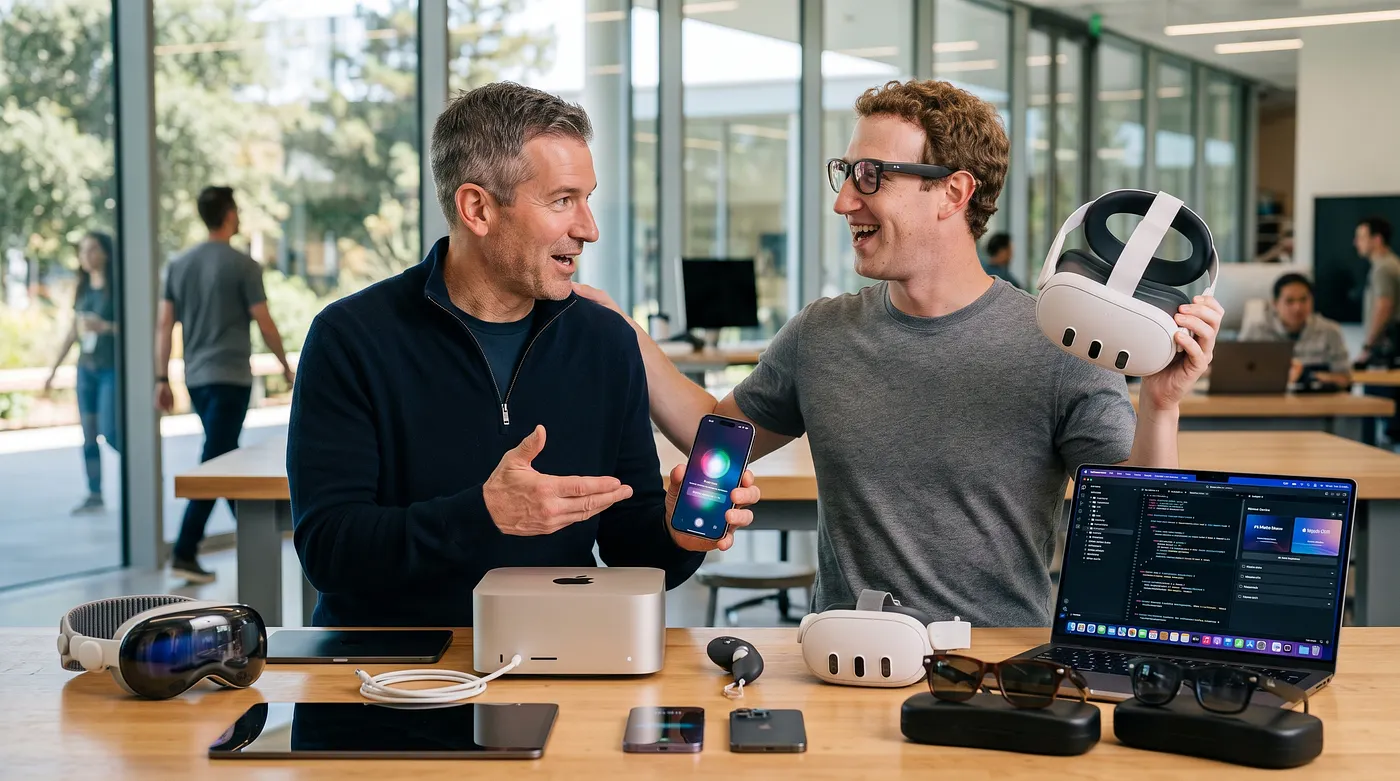
Apple CEO John Ternus and Meta CEO Mark Zuckerberg as Unlikely Best Bros — Image by Gemini
Oct 18, 2026 · Madkat Omega
The Unholy Détente
On the afternoon of October 15, 2026, Mark Zuckerberg posted a short note on X announcing that Meta had released the weights for its newest AI model, Muse Spark Open. The post thanked Apple and its chief executive, John Ternus, by name, and said the model ran well on Apple’s new Mac Studio desktops. Ternus, who had succeeded Tim Cook about six weeks earlier after a quarter century in Apple’s hardware engineering group, replied with congratulations and praised how efficiently a model of that size could run from a desk.
For anyone who followed the two companies over the previous decade, the exchange read like a ceasefire notice. These are the firms whose leaders traded public insults over privacy, whose software decisions erased billions of dollars from each other’s forecasts, and who walked away from an AI partnership as recently as 2024. Now Meta’s AI chief was crediting Apple engineers in interviews, and Apple’s machine learning research team was publishing benchmarks for a Meta model on the same day it launched.
The deal itself is narrow. Meta trained an 816 billion parameter model and published its weights, the trained numerical values that make up the model, so anyone can download, run, and modify it. Apple updated MLX, its open-source machine learning framework for Apple silicon, so that two or four linked Mac Studios can hold the model and run it at a usable speed. When asked whether the work marks the start of a broader relationship, representatives for both companies declined to say.
The implications run wider. The companies that lead frontier AI today, chiefly OpenAI, Anthropic, and Google, sell access to their best models in the cloud, metered by the token. A token is a fragment of a word, and every prompt a business sends and every answer it receives is counted and billed. That arrangement has put frontier AI within reach of anyone with a credit card, and it has also turned every AI-powered product into a recurring line item on someone else’s ledger.
Apple and Meta earn their money elsewhere. Apple sells hardware, and Meta sells advertising against the attention of the billions of people who use its apps. Neither collects per-token fees, which gives both a reason to want capable intelligence to be cheap, downloadable, and able to run on machines people own. One argument, and the one this alliance puts to the test, holds that once the model itself becomes a free download, the lasting value shifts to whoever owns the silicon, the operating system, and the device in the customer’s hand. For small businesses and startups, that shift would mean owning AI capacity outright instead of renting it by the word.
A Decade in the Trenches
The feud has a precise starting point. In late March 2018, Cook sat for a taped interview in Chicago with Kara Swisher, the cofounder of the tech news site Recode, and MSNBC host Chris Hayes. Facebook was days into the Cambridge Analytica scandal, in which a political consultancy had harvested data from tens of millions of Facebook profiles. Swisher asked Cook what he would do in Zuckerberg’s position. His answer was a single sentence: “I wouldn’t be in this situation.” He added that Apple could make a great deal of money by treating its customers as its product, and that it had chosen not to.
Zuckerberg answered within a week on the podcast of Ezra Klein, then the editor-in-chief of Vox. He called Cook’s argument “extremely glib” and said that a service meant to reach everyone, and not only the wealthy, has to be affordable. He closed with a jab at Apple’s prices, warning consumers against a kind of Stockholm syndrome in which companies that charge more persuade buyers that they care more. Behind the scenes, the anger ran hotter. The New York Times reported later that year that Zuckerberg had ordered his executive team to use Android phones, and The Wall Street Journal reported in 2021 that he had told aides Facebook needed to “inflict pain” on Apple.
Apple inflicted it first. In April 2021, iOS 14.5 introduced App Tracking Transparency, a prompt requiring every app to ask permission before tracking a person across other companies’ apps and websites. By letting users refuse with one tap, it cut into the tracking and measurement that powered Facebook’s advertising business. On February 2, 2022, Meta’s chief financial officer at the time, Dave Wehner, told analysts that Apple’s changes would cost the company on the order of $10 billion in revenue that year, while cautioning that the figure was an estimate. Meta’s stock fell 23 percent in after-hours trading, and the decline the next day erased roughly $200 billion in market value, the largest one-day loss any company had suffered to that point.
Hardware opened a second front. When Apple released the $3,499 Vision Pro headset in February 2024, Zuckerberg recorded a review through his own Quest 3 and posted it to Instagram. He conceded Apple’s sharper display and better eye tracking, then declared his headset, roughly seven times cheaper, the better product, period.
The AI chapter began that same year. Bloomberg reported in June 2024 that Meta had pitched Apple on bringing its Llama models to the iPhone, and that the talks, held that March, never reached a formal stage. Apple reportedly judged Meta’s privacy practices insufficiently strict. At its developer conference that month, Apple announced a partnership with OpenAI instead, routing some Siri questions to ChatGPT. By the middle of 2024, the two companies had clashed over privacy, advertising, headsets, and AI, and the one opening for cooperation had closed.
The Strategic Wall
By 2025, both companies had run into limits they could not engineer around alone.
Apple’s limit was Siri. At its June 2024 developer conference, the company had promised a more personal assistant that could draw on a person’s messages, email, and calendar and take actions inside apps, with examples like finding a podcast a friend had recommended or pulling up a relative’s flight details. In March 2025, an Apple spokesperson told John Gruber, the Apple commentator behind the blog Daring Fireball, that those features would take longer than the company had thought. The delay mattered because of scale. Apple has said Siri fields 1.5 billion requests a day, and by January 2026 the company counted more than 2.5 billion active devices.
The stopgap fell short as well. The ChatGPT extension that reached Siri in December 2024 was switched off by default and required an opt-in. In a September 22, 2026 court filing, in a lawsuit brought by Elon Musk’s companies, OpenAI described the integration as persistently underperforming and said it had cut its forecast for new users from the partnership as early as January 2025.
Apple’s eventual fix came from a different rival. On January 12, 2026, Apple and Google announced a multiyear collaboration under which the next generation of Apple Foundation Models would be based on Google’s Gemini models and cloud technology. Bloomberg had reported that the arrangement would cost Apple about $1 billion a year. iOS 27, released on September 14, shipped a rebuilt assistant called Siri AI, and early reviews were warm; a TechCrunch reviewer who had long ignored Siri found himself handing it complex, multistep requests. The fix carries its own cost. Apple says Apple Intelligence still runs on its devices and its own private servers, yet the model family underneath the iPhone’s assistant now comes from the company that makes Android.
Meta’s limit was reach. Its Llama models had made it the most prominent American champion of open weights, but Llama 4, released in April 2025, drew a lukewarm reception. Zuckerberg responded by investing more than $14 billion in Scale AI and bringing in its founder, Alexandr Wang, to lead a new group called Meta Superintelligence Labs. The lab’s first model, Muse Spark, arrived on April 8, 2026, as a proprietary system powering the Meta AI assistant, with a promise that open versions would follow. In August came Muse Glimmer, an open agentic model small enough to run on a single Mac or PC, and in October came Muse Spark Open.
The flagship’s size is its problem. At full precision, Muse Spark Open’s weights occupy about 1.6 terabytes. Compressed to four-bit precision, they still take about 493 gigabytes, according to Apple’s engineers, before counting the working memory the model needs while it runs. That rules out ordinary PCs and most workstations. Wang made the point himself in an interview with CNBC: most powerful open models are too large for nearly every personal computer, while the Mac Studio offers enough memory to make running one practical.
That is where the reconciliation began. Wang credited Daniel Gross, a former Apple director who joined Meta’s AI effort in 2025, with bringing the companies together over several months of work. Meta had also bought hundreds of Macs earlier in the year so its superintelligence team could experiment with local AI agents. Asked about the history, Wang said he was excited for “mommy and daddy to be playing nice again.”
Breaking the Token Budget
For a startup, the appeal of a cloud model is that it asks for nothing up front. A two-person company can call a frontier model the afternoon it incorporates. The trade-offs arrive later. Usage costs scale with success, so the more customers a product serves, the larger the monthly bill. The vendor sets the price, the rate limits, and the retirement date of each model version, and a business built on a particular model inherits every one of those decisions. Each request also carries the company’s data, and often its customers’ data, to someone else’s servers.
Owning the hardware converts that running expense into a capital purchase. A machine bought once can serve requests for years at the cost of electricity, and the data never leaves the building. The question has always been whether a machine small enough for an office could run a model good enough to matter.
Apple’s answer rests on unified memory. In a conventional PC, the main processor and the graphics processor keep separate pools of memory, and large AI models are limited by the smaller pool on the graphics card. Apple silicon gives both processors one shared pool. The M5 Ultra chip, which Apple introduced in a new Mac Studio on August 25, 2026, supports up to 512 gigabytes of that memory, with 1.2 terabytes per second of bandwidth. Bandwidth matters because generating each new token requires reading the model’s active weights from memory, so faster memory translates almost directly into faster replies. In Apple’s tests, the M5 Ultra generated text about 1.6 times faster than the previous Ultra chip while peaking at about 300 watts, which Apple’s engineers noted is less than a household toaster draws.
The second ingredient is clustering. Since macOS 26.2, Macs with Thunderbolt 5 can use remote direct memory access, a technique that lets one machine read another’s memory with very little delay. Apple built new communication tools on top of it in MLX, so a model too large for one Mac can be split across several. Apple’s benchmark post, published the same day as Meta’s release, gives the numbers. With the model divided by layers across two Mac Studios, Muse Spark Open produced about 16 tokens per second. Splitting every layer across the same two machines raised that to about 25, and spreading the model across four machines reached nearly 37 tokens per second, faster than most people read.
Those speeds depend on the model’s design. Muse Spark Open is a mixture-of-experts model, meaning a routing layer sends each token to a small set of specialized subnetworks instead of through the whole network. Of its 816 billion parameters, only about 42 billion are active for any given token. The model needs a great deal of memory to hold and far less computation to run, a profile that suits machines rich in memory and frugal with power.
The privacy case is straightforward. When the model runs on a company’s own Macs, the prompts, files, and outputs stay there. Wang acknowledged that Meta has “no control or visibility” over what developers do with it locally. The Muse Model License permits free use, modification, fine-tuning, and redistribution, subject to conditions that include displaying a “Built with Muse Spark Open” credit in any product that uses it.
The price of admission is real. The M5 Ultra Mac Studio starts at $5,499 with 96 gigabytes of memory, and the 512 gigabyte configuration needed for the two-machine setup is due in late October with pricing not yet announced. Meta’s documentation lists four machines with 256 gigabytes each as the alternative. Either way, a working cluster costs well over $20,000, and enabling remote memory access requires booting each Mac into recovery mode to switch it on. The benchmarks deserve caution too. Meta’s own scorecard places Muse Spark Open behind rival open models such as Kimi K3 and GLM 5.3 on a broad intelligence index, while ranking it first on MCP-Atlas, a test of how well a model coordinates tools through the Model Context Protocol, the emerging standard for connecting AI agents to software. A day after release, independent testing was still partial and Meta’s full safety evaluation report had not yet appeared. Wang himself told CNBC the open model is not the most capable one Meta has built.
For most small businesses, the smaller model may matter more. Muse Glimmer compresses to under 20 gigabytes and runs on a single well-equipped Mac, with or without an internet connection. A plausible path for a small company runs from prototyping on a hosted endpoint, to moving steady, predictable work onto a machine in the office, to keeping the cloud for spikes and for the hardest questions.
Larger organizations have a model for this in Apple’s own infrastructure. Private Cloud Compute, launched in 2024 to handle Apple Intelligence requests too heavy for a phone, runs on custom servers built around Apple silicon. Apple designed it so personal data is used only to answer a request and then discarded, so not even Apple’s staff can reach it, and so outside security researchers can inspect every production software image and confirm the servers run what Apple published. In June 2026, Apple extended those guarantees to servers in Google Cloud. One view is that open weights are a natural fit for a system built on inspection: a model whose every parameter can be examined could be audited, tuned for Apple’s own app actions, and run inside the same verified perimeter with no partner holding the keys. Apple has announced no such plan, and its current models are built with Google. For a business, a cluster of Mac Studios already offers the small-scale version, a private cloud that can be disconnected from the internet entirely.
Beyond the Chat Box
For all the attention cloud AI receives, most people still meet it as a destination: an app to open, a website to visit, a text box to fill. That position is strong for answering questions and weak for getting things done. A chatbot app on a phone cannot see the other apps, cannot act inside them, and runs only when someone opens it, because mobile operating systems wall each app off from the rest.
Apple and Google own the layer that removes those walls. Apple’s App Intents framework lets developers describe what their apps can do, so the system assistant can take actions on a person’s behalf. In iOS 27, Siri AI searches an index of a person’s messages and email and can read what is on the screen, which lets it answer a question like where a friend suggested meeting for dinner without the person opening a single app. The kind of task the whole industry is reaching for goes further: matching an invoice in an email against a bank statement, checking it against a spreadsheet, and drafting the payment for approval. Only software with system-level access can reach all of those pieces at once.
The cloud labs have learned how hard that layer is to reach from outside. OpenAI’s embedded spot in Siri, which in principle put ChatGPT in front of every iPhone owner, underperformed by OpenAI’s own account. Its answer is hardware: a family of devices designed with Jony Ive, Apple’s former design chief, after OpenAI’s roughly $6.4 billion purchase of his startup, io, in 2025. According to a court filing, the first device will not ship to customers before the end of February 2027, and the company has dropped the io name. Chatbots have become a daily habit for many people, but the assistant built into the phone is the one that can reach their messages, their calendar, and their apps.
Meta has no phone operating system, which is why App Tracking Transparency hurt it so badly. It does have reach through WhatsApp, Instagram, Facebook, Messenger, and its smart glasses, where Muse Spark now powers Meta AI. The October collaboration adds a foothold on the machines where software gets written, many of which are Macs. Wang described the open model as a way to attract developers who start small and scale up, and every developer who builds an agent on Muse Spark Open is a developer building on Meta’s architecture instead of a rival’s.
What Comes Next
Two directions are visible from here, one in the pocket and one on the desk.
The pocket version is a persistent companion. Meta has framed its goal as personal superintelligence, and Muse Glimmer was built around agents that run locally and keep personal context on the device. Some envision assistants that remember months of interactions in local storage, adapt to a person’s habits, and behave more like a familiar than a search box. The closest ancestor may be the Tamagotchi, the 1990s digital pet that lived on a keychain and changed as its owner cared for it. Whether that companion ends up running on Meta’s models, Apple’s, or Google’s, the case for keeping its memory on the phone is the same one Apple has been making since 2018.
The desk version is already shipping. A cluster of Mac Studios fits on a shelf and runs a model with a context window of a million tokens, enough to hold a large software project in view at once. In Meta’s own demonstration, Muse Spark Open, driven by Meta’s Muse Code terminal tool, fixed bugs, added features, and completed a build of Ice Cubes, an open-source Mastodon client for the iPhone. A few years ago, a solo developer or a boutique studio wanting that capability on private hardware would have needed a rack of data center graphics cards. Now the requirements are a hardware budget, a pair of Thunderbolt cables per link, and an afternoon of setup.
The New Rule
The pattern in this alliance is older than AI. When one layer of technology becomes plentiful and interchangeable, the profits move to the scarce layers around it. If capable model weights become a free download, the scarce pieces are the chips that run them, the operating system that connects them to people’s lives, and the trust that persuades people to hand over that context. Apple holds the first two outright and has spent eight years building the third. Meta, which gives its weights away, wins whenever developers standardize on its architecture instead of renting someone else’s.
None of this is settled. Apple’s assistant runs on technology from Google, Meta’s newest open model trails rivals on broad benchmarks, and the hardware to run it at full size costs as much as a car. The cloud labs still build the most capable models and still have the easiest front door. The October announcement points in a direction all the same, away from the meter and toward the machine.
Eight years after Tim Cook said he wouldn’t be in Mark Zuckerberg’s situation, Cook is Apple’s executive chairman, and his successor is publicly congratulating Meta’s engineers. The image that marks the change is two silver Mac Studios on a desk, joined by a pair of cables, running a Meta model that no one at Meta can watch. OpenAI and Anthropic built the frontier brains. Apple and Meta are building the nervous system and the body.
Sources
The October 2026 partnership
- Meta for Developers, “Build with Muse Spark Open”, October 15, 2026.
- Apple Machine Learning Research, “Local and Distributed Large LLM Inference with MLX and RDMA on Mac Studio”, October 15, 2026.
- CNBC, “Apple and Meta team up to make Muse AI model run on Mac computers”, October 15, 2026.
- TechCrunch, “Meta launches an open-weight AI model that runs on Macs”, October 15, 2026.
- AppleInsider, “Unlikely Apple & Meta team-up brings powerful & local AI to Mac Studio”, October 15, 2026.
- MacDailyNews, “Apple and Meta partner to run massive Muse AI model locally on Mac Studios”, October 15, 2026.
- Implicator, “Apple and Meta Set Aside Their Privacy Feud to Run Muse Spark Open on Mac Studios”, October 2026.
- Unite.AI, “Meta’s 816B-Parameter Muse Spark Open Weights Are Now Public”, October 2026.
- MarkTechPost, “Meta Releases Muse Spark Open: 816B Open-Weight MoE With 1M Context”, October 15, 2026.
- OrcaRouter, “Muse Spark Open: Meta’s Flagship Weights Are Out, the Numbers Behind Them Aren’t”, October 2026.
- Gadget Review, “Apple and Meta Collaborate to Run a Massive AI Model Locally on Mac”, October 2026.
Meta’s Muse models
- eWeek, “Meta Debuts ‘Muse Spark’ AI, Challenging Rival Models From OpenAI, Google”, April 8, 2026.
- eMarketer, “Meta debuts Muse Spark to power AI across its apps”, April 2026.
- Forklog, “Meta Unveils Closed AI Model Muse Spark”, April 2026.
- Business Today, “Meta unveils Muse Glimmer, a lightweight AI model you can run on single PC”, August 10, 2026.
- Wikipedia, “Llama (language model)”.
Apple’s hardware and AI strategy
- Yahoo Finance, “Apple CEO Tim Cook stepping down, to be succeeded by John Ternus”, 2026.
- Macworld, “Apple announces the M5 Ultra Mac Studio with up to 512GB of RAM”, August 2026.
- iClarified, “Apple Launches Mac Studio With M5 Max and M5 Ultra, Starting at $2,499”, August 25, 2026.
- Hardware Corner, “RDMA over Thunderbolt Lets Mac Studios Run Huge Local LLMs Faster Than Expected”.
- Google and Apple, “Joint statement from Google and Apple”, January 12, 2026.
- Android Authority, “Apple confirms: Gemini will power a new and improved Siri this year”, January 12, 2026.
- 9to5Mac, “Apple officially delays its ‘more personalized’ version of Siri”, March 7, 2025.
- Reuters via TechPartner News, “Apple says some AI improvements to Siri delayed to 2026”, March 10, 2025.
- Apple, “Apple reports first quarter results”, January 29, 2026.
- TechCrunch, “With iOS 27, I’m actually using Siri again”, September 14, 2026.
- Android Authority, “I spent 48 hours comparing Siri AI to Gemini”, 2026.
- Apple Security Research, “Private Cloud Compute: A new frontier for AI privacy in the cloud”, June 2024.
- Apple Security Research, “Expanding Private Cloud Compute”, 2026.
- WebProNews, “Apple’s Private Cloud Compute Faces Scrutiny as It Expands Beyond Its Own Servers”, 2026.
OpenAI’s consumer efforts
- MacRumors, “ChatGPT in Siri ‘Persistently Underperforming,’ Says OpenAI”, September 24, 2026.
- iGeeksBlog, “OpenAI says ChatGPT’s Siri integration dramatically underperformed”, September 2026.
- MacRumors, “OpenAI’s Jony Ive-Designed Device Delayed to 2027”, February 10, 2026.
- Financial Times, “OpenAI to buy Jony Ive’s io for $6.4bn in hardware push”, May 2025 (subscription).
The Apple and Meta feud, 2018 to 2024
- Recode, full transcript of Tim Cook’s interview with Kara Swisher and Chris Hayes, March 2018.
- Loop Insight, “Tim Cook discusses privacy, regulation, U.S. manufacturing, and education”, March 28, 2018.
- Vox, Ezra Klein’s interview with Mark Zuckerberg, April 2, 2018.
- NBC News, “Mark Zuckerberg fires back at Apple CEO’s ‘extremely glib’ comment”, April 2018.
- The New York Times, “Delay, Deny and Deflect: How Facebook’s Leaders Fought Through Crisis”, November 14, 2018 (subscription).
- The Wall Street Journal, “Facebook Meets Apple in Clash of the Tech Titans”, February 13, 2021 (subscription).
- 9to5Mac, “WSJ: Zuckerberg tells staff to ‘inflict pain’ on Apple as privacy battle intensifies”, February 13, 2021.
- CNBC, “Facebook says Apple iOS privacy change will cost $10 billion this year”, February 2, 2022.
- Daring Fireball, “Facebook Stock Tanks”, February 3, 2022.
- Fortune, “Mark Zuckerberg drags Apple’s new Vision Pro in Instagram video”, February 14, 2024.
- Bloomberg, “Apple Spurned Idea of iPhone AI Partnership With Meta Months Ago”, June 24, 2024 (subscription).
- RTÉ via Reuters, “Apple, Meta not in talks currently for AI partnership”, June 25, 2024.