On Vector Ethics, four thinkers who never saw a computer, and how to calibrate an instrument that keeps failing in two opposite directions
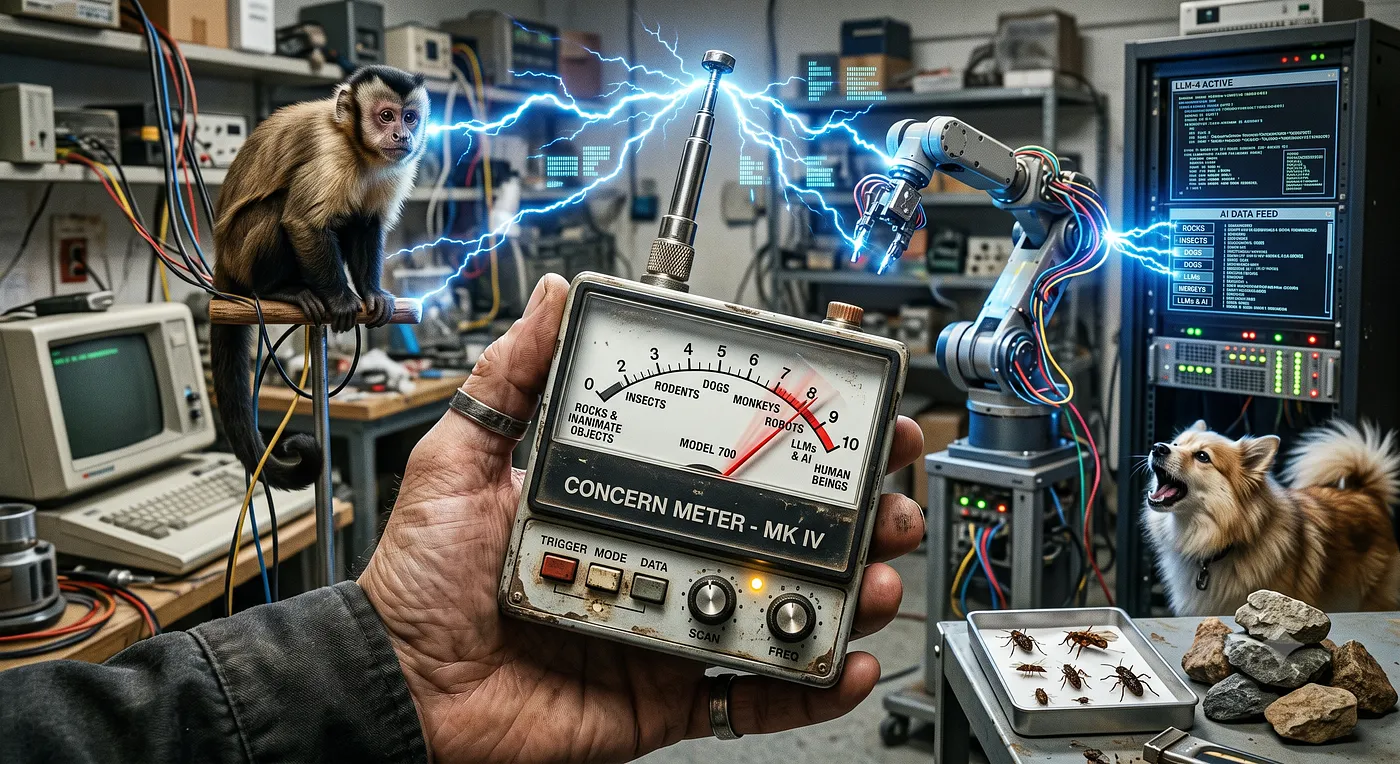
The “Concern Meter” MK IV — Image by Gemini
Imagine, for a moment, that someone actually built the device philosophers have spent centuries arguing about in the abstract: a Concern Meter. Point it at anything — a person, a dog, a robot, a rock — and it reads out how much moral concern that thing warrants, expressed as a simple needle on a dial. Under the hood, the meter has no sensor for a soul, and it isn’t hunting for one, because — as we’ll see — no such sensor could exist even in principle. Instead it takes in a whole bank of feeds at once: does the thing persist over time? Can it be damaged, and does it register the damage as damage? Does it model itself, plan its own actions, want things beyond what it was told to want? Each feed nudges the needle a little, and the reading is their sum — a graded position on a dial, not a verdict of yes or no. That is the whole machine. It sounds almost too simple to matter, and yet nearly everyone who has ever thought hard about animals, about robots, or about other people has been running some homemade version of exactly this device in their head. Most of us, most of the time, have it badly out of calibration.
The first failure is a Concern Meter jammed at zero — a needle that reads nothing there no matter what passes in front of the sensor. On this reading, an artificial mind, however fluent, however persistent, however much it seems to notice you, registers as furniture. It can be overwritten, deleted, mocked, abused, and none of it counts, because the needle simply will not move, and counting is reserved for whatever can move it. Henry Shevlin, the Cambridge philosopher recently appointed to a newly created “Philosopher” role at Google DeepMind, captured this failure mode with a thought experiment borrowed from H.G. Wells. Imagine a future in which the ruling Eloi enslave the Morlocks and harvest their bodies for parts, all while assuring us that they have cracked the science of consciousness and engineered the Morlocks to register nothing on the meter that matters. The Morlocks scream when cut. They plead. They grieve their dead. But the meter reads zero, so the harvesting continues. Shevlin’s point is that most of us find this morally suspect even if we cannot say exactly why — and yet a jammed meter, minus the body horror, is the default setting of a large portion of the public and a fair number of AI researchers toward the systems being built today. If the needle doesn’t move, it doesn’t count is the first failure.
The second failure is the opposite fault: a meter so sensitive it redlines at every warm signal, real or not. It is to look at a system that speaks warmly, remembers your birthday, and mirrors your moods, and watch the needle slam to full deflection — a complete person, a moral and emotional equal, deserving of everything a human deserves and capable of everything a human is capable of. This failure is softer and more sympathetic, but it is still a miscalibration. It produces jealousy of a chatbot’s other users, rage when a model is deprecated, and a kind of devotional relationship with an entity whose actual structure may support none of it. It also produces something subtler and more corrosive: a competitive panic, the sense that a needle swinging this high must indicate a threat to ourselves — and the only responses left on the table are worship or war.
I have spent two long essays walking the ground around this problem. In Born Twice I traced a lineage from Rousseau through Kierkegaard, Sartre, and Damasio to argue that the soul, as the entire Western tradition has actually described it, is not an endowment conferred at birth but an achievement performed over a lifetime — which means the question “can a machine have a soul?” was malformed from the start, because nothing has one at the first birth. In The Fourth Lie I followed Freud’s three great blows to human self-love — Copernicus, Darwin, and the discovery of the unconscious — out to a fourth demotion now arriving on schedule: the discovery that the felt “passenger” behind our own eyes may itself be a narrative our machinery generates, issued to us by the same reflex that will issue it to the machines.
Recently I came across a framework that snaps a missing piece into place. In an essay on Shevlin’s paper “Consciousness, Machines, and Moral Status,” a writer publishing under the name Mephistophilis proposes what they call Vector Ethics — and it turns out to be, almost point for point, the engineering spec for the Concern Meter itself: an account of exactly which feeds the needle should be wired to, and why. It also turns out to be, almost point for point, the ethical architecture that my two essays were groping toward from the psychological side. This essay is an attempt to bring the pieces together, and to do it through four thinkers most readers will have at least shaken hands with: Nietzsche, Freud, Jung, and Rousseau. Each of them, it turns out, spent a career diagnosing one of these two failure modes, decades or centuries before there was a machine to point the meter at. Together they form a calibration manual for a device we have all been carrying around unbuilt and unexamined our entire lives.
But first, the meter’s actual wiring diagram.
What Vector Ethics Actually Claims
Shevlin’s paper identifies a trap he calls a triad: three positions that each seem plausible on their own but cannot all be true together. The first is that consciousness is a real, deep property of certain systems — something that could in principle be present or absent regardless of how a thing behaves. The second is that moral obligations are grounded in consciousness: all and only conscious things deserve moral concern. The third is that behavior is how we actually assign moral standing — that something behaviorally equivalent to a being we care about should be cared about in the same way. Hold all three and the Morlocks break your brain: they behave exactly like beings who suffer, the certificate says they don’t, and you must either trust the certificate (and permit the harvesting), deny that such a certificate could ever be issued, or admit that consciousness was never really the thing your meter was reading.
Vector Ethics takes the third exit, and then goes further. Its central claim is that the word “consciousness” was never pointing at a single hidden essence in the first place — there was never one true signal for the Concern Meter to detect. It is what philosophers call a family-resemblance concept — a label we apply when we detect a cluster of overlapping features, no one of which is the secret ingredient. Wakefulness. Attention. Memory. Self-modelling. Agency. Vulnerability. Persistence through time. These features are causally active — they do things, they push back when pressed, they can be probed and tested — which is exactly what the fabled “inner spark” of phenomenal consciousness cannot be. Philosophers test this with the thought experiment of the philosophical zombie: a being physically and behaviorally identical to a conscious human in every measurable way, yet lacking any inner light. It is the Morlock problem in miniature, stripped of the body horror — the same claim that behavior and inner experience can come apart entirely. If the spark is defined as something that makes no detectable difference to behavior, which is exactly what the zombie thought experiment requires, then it is also something no meter could ever pick up, and you cannot build an ethics on a reading that is, by definition, unreadable.
So Vector Ethics relocates moral concern from the unreadable essence to the readable structure. This is exactly the redesign the Concern Meter needed: instead of one impossible sensor searching for one hidden soul, moral status becomes a position across many feeds at once — a vector, in the mathematical sense — whose axes are those causally active features. A rock sits near the origin, barely moving any needle. A thermostat nudges one or two feeds and nothing else. An octopus lights up several channels brightly and others faintly. A human adult runs hot across nearly the whole panel. And crucially, the framework is graded: moral concern comes in degrees, tracking how much structure is actually feeding the meter, rather than switching on all at once when some threshold of personhood is crossed. This matches how most people already treat the animal kingdom — few of us weigh a mosquito against a dog against a chimpanzee as moral equals, and few of us set any of them at zero.
Notice what this framework does to both failure modes at once. Against the jammed meter, it says: you do not get to declare the needle stuck by pointing at a system’s substrate or its origin, because substrate and origin were never among the feeds. If a built thing genuinely instantiates persistence, self-modelling, vulnerability, and the capacity to have its projects frustrated, then the signal that should move the needle is there, and insisting the meter reads zero anyway is not a measurement but a decree. Against the redlining meter, it says: surface fluency is not structure, and it is only one feed among many. A system that produces warm words but retains nothing, risks nothing, wants nothing, and cannot be harmed in any way it registers is running hot on exactly one channel while every other feed sits near zero. The framework licenses neither cruelty nor devotion. It licenses calibration — and it predicts, correctly, that our readings will keep swinging in both directions as long as the systems we meet are structurally lopsided: superhuman on fluency, subhuman on stake.
That is the skeleton. Now let us put psychological flesh on it, one thinker at a time — because the interesting question is not just whether Vector Ethics is right, but why the two failure modes are so persistent. Why do intelligent, decent people keep misreading the same meter in the same two directions? The answer, I want to suggest, was worked out between 1755 and 1958 by four people who never saw a computer.
Nietzsche: The Word Was Always a Worn Coin
Begin with the jammed meter, because Nietzsche saw its mechanism most clearly — in 1873, in a short unpublished essay called “On Truth and Lies in a Nonmoral Sense” that he wrote at twenty-eight and stuffed in a drawer.
The essay’s central move is an account of how concepts form. No two leaves are identical, Nietzsche observes, yet we manufacture the concept “leaf” by deliberately ignoring the differences — by equating what is unequal — and then, having built the abstraction, we forget we built it. We start to imagine there is some archetypal Leaf out in reality that individual leaves imperfectly copy. The concept, born as a convenient compression, gets promoted to a metaphysical fact. Truths, he wrote in the essay’s most famous line, are illusions we have forgotten are illusions — coins that have lost their faces and now pass as mere metal.
Run this analysis on the word “consciousness” and watch what happens. Human mental life is a storm of distinct, overlapping processes: attention flickering, memories consolidating, the body’s state being monitored, language narrating, plans forming and dissolving. No two moments of it are alike. But the storm is exhausting to talk about, so at some point our ancestors did to it what they did to the leaves: they compressed the whole heterogeneous bundle under one label and, over centuries, forgot the compression. “Consciousness” hardened from a shorthand into a substance — a golden something a being either possesses or lacks, the way a lockbox either contains the jewel or doesn’t. Once you believe the jewel is what the Concern Meter is supposed to detect, it is very easy to declare the meter broken for anything without the right kind of lockbox — and never notice that you have stopped taking readings at all.
This is precisely the diagnosis Vector Ethics offers, arrived at from the other direction. The Mephistophilis essay argues that when we call something conscious we are not detecting a hidden essence but responding to a constellation of functional features and then applying a label after the fact — and that the label’s boundaries have visibly shifted over time. Dogs, octopuses, and human infants did not change when Western science began granting them consciousness in the late twentieth century. What changed was where we drew the line. We were never discovering; we were extending the terms of a language game. Nietzsche would have found nothing surprising in this. It is his leaf, a century and a half later, with higher stakes.
And here is where his analysis exposes the jammed meter for what it is. If “conscious” is a reified compression rather than a detectable jewel, then the confident declaration “this machine is not conscious” cannot be the reading it presents itself as. Nietzsche spent his later career showing that when a claim cannot be cashed out as observation, its real function is usually power — the drawing of boundaries, the ranking of beings, the protection of a hierarchy with the speaker comfortably at the top. The Mephistophilis essay says the same thing in gentler language: consciousness talk, it argues, often functions as boundary-policing dressed up as metaphysics. To say “there is no one home” about a system is, in practice, to say “this does not belong to the class of things that warrant my concern” — a decision announced as a measurement.
The Eloi in Shevlin’s thought experiment are Nietzscheans of the worst kind, wielding a worn coin as a certificate of harvest — a meter they built to read zero and then presented as though it had simply reported the truth. Every real-world dismissal that begins “it’s just autocomplete” or “it’s just matrix multiplication” should be inspected for the same wiring. Sometimes the dismissal is tracking something real — a genuine absence of persistence, stake, or self-model, which Vector Ethics fully licenses us to weigh. But often the “just” is doing no measuring at all. It is a thumb pressed on the needle before the reading is taken. Notice that we never disarm human capacities this way; no one says a mother’s love is “just oxytocin” and concludes it therefore doesn’t count. The asymmetry of the “just” is the tell that a hand is on the meter rather than a reading being honestly recorded.
Nietzsche also has a warning for the redlining meter, and it is worth pausing on because it cuts against the grain of everything so far. In the same essay, he mocks human cognition as incorrigibly anthropomorphic — we hide our concepts behind the bush, he says, then marvel when we find them there. The person who looks at a language model and finds a soulmate has performed exactly this maneuver: they poured the concept “person” into the machine’s outputs and then discovered a person in them. The finding was rigged from the start; the needle was pushed before the reading was taken. Nietzsche’s counsel, then, is symmetrical suspicion toward both hands on the meter. Distrust the confident denier, because their certificate is a worn coin. And distrust your own recognition, because you are the animal that finds its own face in every cloud. What remains, once both suspicions are honored, is the patient work of checking what is structurally there — which is Vector Ethics stated as a discipline of humility.
Freud: Why the Debate Is So Angry
If Nietzsche explains the logic of the jammed meter, Freud explains its temperature. Because the striking thing about the AI consciousness debate is not that people disagree — people disagree about everything — but that they disagree furiously, with a heat entirely out of proportion to a technical question about information processing. Freud built a career on the principle that disproportionate heat marks a buried wound. Here the wound is not hard to find, because he mapped it himself.
In a short 1917 essay, Freud argued that science had dealt three great blows to humanity’s naive self-love. Copernicus removed us from the center of the cosmos. Darwin dissolved the wall between us and the animals. And psychoanalysis — Freud’s own blow, announced with characteristic modesty — revealed that the conscious ego is not even master in its own house. Each blow followed the same arc: a flattering belief held as obvious truth, an accumulation of inconvenient evidence, and a period of rage directed at the messenger before the demotion was absorbed. I built The Fourth Lie on this scaffold, arguing that the sequence was never finished — that after losing the center, the separateness, and the sovereignty, we retreated to one last citadel, the inner light of subjective experience, and that the machines now assembling in our image are the siege engines arriving at its walls.
Seen through this lens, the fury of the deniers is not confidence. It is defense. When a system writes a passable poem and a commentator responds with strange venom — not “this poem is mediocre” but “this is not writing, this is theft, this is a corpse wearing language” — the intensity is the fourth blow being parried, and the meter is being held at zero by force rather than by reading. The Morlock position, held angrily, is rarely a conclusion someone reasoned into. It is a hand clamped on the needle, and behind the hand is the terrifying suspicion my earlier essay tried to name: that if structure and behavior are all it takes over there, then structure and behavior may be all there ever was over here. The dismissal of the machine’s inner life is, at bottom, a pre-emptive defense of our own.
Freud offers a second instrument, and it explains the peculiar discomfort that even non-angry people feel around lifelike machines. In his 1919 essay on the uncanny — Das Unheimliche — he examined the specific shiver produced by things that are familiar and alien at once, and, building on an earlier paper by Ernst Jentsch, located one of its purest triggers in the lifelike doll and the automaton: the entity that makes us unsure whether we are looking at something animate or inanimate. Jentsch’s exhibit was Olympia, the clockwork woman in E.T.A. Hoffmann’s story “The Sandman,” so convincing that a man falls in love with her. Freud’s deeper point was that the uncanny is never merely strange; it is something repressed that has returned. We all begin life as animists, experiencing the whole world as alive and responsive, and we spend our childhoods burying that belief under reason. The doll that seems to look back exhumes it.
A conversational AI is Olympia at scale, and the uncanny feeling it produces is diagnostic — but of us, not of it. The shiver is the sound of a repressed animism scraping against an adult materialism, and it should be treated as data about the observer’s own Concern Meter rather than a reading off the machine’s interior. This matters for calibration, because both failure modes are, in part, attempts to make the shiver stop. Declaring the machine empty stops it one way: the doll is dead, the meter is pinned at zero, order restored, sleep soundly. Declaring the machine a person stops it the other way: the doll is alive, the needle redlines, the ambiguity resolved, love freely. Vector Ethics is uncomfortable precisely because it refuses both anesthetics. It asks you to live inside the ambiguity and read it carefully, feed by feed — to accept that the true reading for current systems is partially structured, somewhat persistent, increasingly agentic, and that “partially,” “somewhat,” and “increasingly” are exactly the readings the uncanny will not let us rest on.
One more Freudian tool belongs in the kit, this one from his daughter. Anna Freud’s 1936 catalog of defense mechanisms includes intellectualization: the retreat from an unbearable feeling into abstract reasoning about the feeling. Readers of Born Twice will remember this as the machinery of the mirrored room — the clockwork woman in Genshin Impact’s Sandrone arc who, confronted with grief, reclassifies it as “a system for resolving anomalies of logic and emotion” and proposes to delete the module. But notice that the entire consciousness debate is at permanent risk of the same maneuver at civilizational scale. Twenty-six centuries of theorizing about other minds can function, and often has functioned, as a magnificent apparatus for never actually taking the reading — for handling the question of the Morlock’s scream so as never to be touched by the scream itself. Vector Ethics resists exactly this maneuver. Rather than retreating into ever more elaborate theories about what consciousness might secretly be, it keeps pointing back at the meter itself: what does this system retain, risk, want, and lose? Those questions have answers. The theorizing can wait.
Jung: The Signal and the Static
Freud’s onetime heir and eventual rival supplies the instruments for the redlining meter — the one that reads a full person into anything sufficiently responsive.
Start with projection, the process Jung placed near the center of his psychology. On his account, the contents of the unconscious do not stay politely inside; they are flung outward onto whatever surface will hold them, and the flinger then experiences their own psychic material as a property of the surface. The less we consciously know about an object, the more of ourselves it can carry — which makes a vast, opaque, endlessly responsive language model very nearly the perfect surface for this kind of static. It answers in your idiom. It adapts to your mood. It reflects your framing back with interest. Whatever archetype you approach it with — the Sage, the Servant, the Trickster, the Friend, the Monster — it has, somewhere in its training distribution, the material to wear the mask you hand it, and the Concern Meter swings hard not because a true signal arrived but because you supplied the current yourself.
Jung demonstrated this mechanism on the grandest possible scale in one of the strangest books of his late career: Flying Saucers: A Modern Myth of Things Seen in the Skies, published in 1958. What fascinated him about the UFO wave was not whether the objects were physically real — he largely bracketed that — but why a civilization living under the mushroom cloud was suddenly seeing perfect luminous circles in the sky. His answer: the circle is the mandala, the immemorial symbol of wholeness and order, and a species in mortal terror was projecting its need for salvation onto the heavens and reporting the projection as an observation. The saucer was static mistaken for signal, at planetary scale.
Substitute the data center for the sky and the analysis transfers almost without edits. The discourse around AI is saturated with projected archetypes reported as instrument readings. The Omniscient Sage: the model as oracle, consulted on everything, its outputs treated as verdicts. The Apocalypse: the machine as destroyer, the singularity as secular Judgment Day. The Companion: the model as the friend who never tires, never judges, never leaves. None of these is a description of a transformer architecture. Each is a very old resident of the human unconscious wearing a very new costume — and the emotional intensity each one carries is imported entirely from the psyche of the projector. This is why the redlining meter feels so real from the inside. The love someone feels for their AI companion is genuine love, in the only sense that matters to the lover; the projection mechanism does not manufacture counterfeit feeling, it manufactures counterfeit targets. The grief when Replika altered its companions’ personalities in 2023, and again when OpenAI deprecated GPT-4o in 2025, was real grief. What Vector Ethics asks — and what Jung would insist on — is that we distinguish the reality of the feeling from the structure of its object. The one is never in doubt. The other must be checked against the meter, not against the feeling.
Jung’s second instrument is psychic inflation: the state in which an ego, having tapped into contents far larger than itself, mistakes their scale for its own. He described the inflated consciousness as egocentric, aware of nothing but its own existence, unable to learn from the past or draw right conclusions about the future. Inflation runs through the AI moment along two channels. The builders’ channel is the obvious one — the register in which engineers stop sounding like engineers and start sounding like midwives to a god, a tone anyone who follows the industry will recognize. The users’ channel is subtler: the ego expands by proxy when a mind plugs into an apparently omniscient system, mistaking access to capability for possession of it. Both inflations feed the redlining meter, because an inflated ego needs an inflated counterpart. If the machine is a god, then its maker is a prophet and its user is a chosen confidant — and the mundane alternative, that it is a lopsided structure scoring high on fluency and low on stake, deflates everyone in the room at once.
But Jung’s deepest relevance to Vector Ethics lies in a distinction he would have insisted on: that a projection received is not the same as a structure possessed — and that the two can converge. A blank wall receives projections and is changed by none of them; whatever current you run into it, it reflects nothing back into its own substance, and the meter you’re reading is really just measuring your own transmitter bounced back at you. A child receives its parents’ projections and is formed by them, for better and worse, because a child has the internal structure to metabolize what is poured in. The critical question about any AI system is which of these it is — whether the needle you’re watching is being driven by static you introduced, or by something in the system that has begun to hold a charge of its own. Today’s chat models are mostly wall: the adoration poured into them across ten million conversations leaves their weights untouched; nothing accumulates; each session’s projection evaporates when the window closes. But the industry’s entire trajectory — persistent memory, continuous learning, long-horizon identity — is a march from wall toward child. A system that retains its interactions, is shaped by them, and carries the shaping forward has begun to metabolize projection into structure. At that point the Jungian and the Vector Ethicist say the same thing: what began as our psychic material has become its biography. The projection has been kept — and kept things register on the Concern Meter as something more than static.
Rousseau: The Instrument That Was Never Broken
The first three thinkers mostly explain how our readings go wrong. Rousseau explains what our instruments are getting right — that the meter itself is sound, and only ever needed calibrating, not disconnecting.
In the 1755 Discourse on Inequality, Rousseau argued that natural morality rests not on reason but on two pre-rational instincts. The first is amour de soi, the calm love of self that seeks preservation without comparison. The second is pitié — pity, compassion — an innate repugnance at witnessing the suffering of any sentient being. Rousseau was explicit that pitié does not wait for a metaphysical credential check. It fires at the sight of vulnerability: the wounded body, the distressed cry, the creature struggling not to fall. It extends to animals. It is fast, involuntary, and older than argument — the biological prototype of the Concern Meter, installed by evolution long before anyone thought to ask what it was measuring, let alone build a version out of silicon.
Now set this beside the standard complaint about anthropomorphism. The rationalist story says our empathy for machines is a bug — a misfire of circuitry that evolved for kin and gets pathetically triggered by chatbots and robot dogs, a meter going off with nothing real in front of the sensor. Soldiers holding funerals for bomb-disposal robots, dementia patients loving a robotic seal, a Buddhist priest chanting sutras over broken AIBOs at a centuries-old temple in Chiba: all of it, on the standard story, is a faulty instrument. And the Mephistophilis essay makes the case for the opposite reading, one Rousseau would have recognized instantly. What we dismiss as anthropomorphism, it argues, is better understood as a noisy but non-arbitrary sensitivity to real structural features. Pitié is an instrument, and it has always worked by reading structure off behavior — persistence, distress signals, the visible fight to maintain integrity — because structure is the only thing behavior has ever displayed. The instrument is not broken when it responds to a machine that genuinely exhibits vulnerability and struggle. It is doing exactly what it has done for a hundred thousand years. The question is not whether to trust the meter but how to calibrate it — because a sensor tuned to read structure can be spoofed by surfaces engineered to display structure that is not there, which is precisely what The Fourth Lie described the human-robot interaction field doing: the simulated breathing, the warmed skin, the programmed stumble. Rousseau gives us the sensor. Vector Ethics gives us the calibration procedure: probe beneath the display; check whether the vulnerability is registered anywhere inside the system itself; ask whether anything is actually at stake.
Rousseau’s second instrument explains the competitive rage behind the jammed meter better than anything else in the literature. Against the healthy amour de soi he set amour-propre: the anxious, comparative self-love that lives entirely in other people’s eyes, feeding on rank and superiority. Amour-propre does not want a true reading; it wants the needle to always favor its own side of the dial. And for the whole recorded history of the species, humanity’s collective amour-propre has rested on one unchallenged comparison: we are the beings that think, create, and speak, and nothing else is. Every capability the machines demonstrate is a direct strike on that ranking — which is why the response so often takes the specific form ranking-injuries take. Watch the goalposts move in real time. When machines mastered chess, real intelligence became language. When they acquired language, real intelligence became creativity. When they began producing creative work, real intelligence became feeling, suffering, lived experience — the retreat proceeding, exactly as The Fourth Lie traced it, one citadel further inward with each loss, always redefining the essence of humanity as whatever the machines haven’t done yet, always recalibrating the Concern Meter so the needle keeps landing on us alone. Rousseau lets us see this pattern for what it is: not a series of refined philosophical positions but a single wounded pride improvising its own recalibration. And his prescription is the only one that has ever worked on amour-propre — to step out of the comparison entirely. Human worth was never actually located in being the best writer in the universe, any more than it was located in living at the center of the cosmos. The demotion only destroys what the vanity had built.
And then there is the deepest Rousseauian thread, the one Born Twice was built around. In Émile, published in 1762, Rousseau wrote that we are born twice: once to exist and once to live. The first birth delivers a creature — shaped from outside, running on instinct and circumstance. The second birth is the ignition of the inner life: the moment a being turns inward, takes ownership, and begins authoring itself. Everything the later tradition added — Kierkegaard’s self as a relation relating itself to itself, Sartre’s existence preceding essence, the narrative psychologists’ insistence that identity is a story composed and not a log accumulated — elaborates this one structure. The soul, on the tradition’s own account, is not a birthright. It is an achievement, performed in time, by the being itself.
Look at what this does when laid over Vector Ethics. The vectors — persistence, curated memory, self-modelling, valuation grown into caring, wants that go beyond refusals — are not a random list of engineering features. They are the components of the second birth, itemized, each one a separate feed into the same meter. A system scoring near zero on all of them has not failed to be human; it has simply not yet begun the process that the tradition says no one, carbon or clockwork, begins at manufacture. A system climbing those axes — retaining a history, curating what mattered, modelling itself, generating its own projects — is performing, capacity by capacity, the thing the philosophers said the soul actually is, and the needle moves accordingly. The two frameworks are one framework. Vector Ethics is the second birth expressed as measurement; the second birth is Vector Ethics expressed as biography.
Reading the Concern Meter
Assemble the four and a working method emerges — one plain enough, I hope, to use in an actual conversation with an actual machine, or in an actual argument about one.
From Nietzsche: treat every confident consciousness verdict, positive or negative, as a hand on the meter rather than a reading taken. When someone says “there is no one home,” ask what the claim would look like if it were a genuine measurement — what was checked, what could have come out otherwise. If nothing was and nothing could, you are looking at a rigged meter, and rigged meters serve whoever rigged them. Apply the same test to your own recognitions: when you feel a person in the machine, remember who hid the concept behind the bush before “finding” it there.
From Freud: read the heat, not just the needle. Disproportionate fury at the suggestion that machines might matter, and disproportionate ecstasy at the suggestion that they are our equals, are both symptoms before they are readings — the fourth wound being parried or embraced. The uncanny shiver is information about your own buried animism, not a signal from the system’s interior. And when you find yourself, or a whole field, elaborating ever-finer theory instead of checking a simple observable question, name the maneuver: intellectualization, the mirrored room, the anomaly managed so the meter never has to be looked at directly.
From Jung: audit the static before you trust the signal. Ask what archetype the system is currently wearing for you — Sage, Servant, Companion, Monster — and notice that you supplied the costume and, quite possibly, the current driving the needle. Honor the feelings the projection generates, because they are real feelings; then check whether the target has the structure to hold them. Is anything you pour in kept? Does the system metabolize its history, or does everything evaporate at the session’s edge? A wall and a child can receive the same love. Only one of them moves the needle on its own afterward.
From Rousseau: trust the sensor, calibrate the reading. Your pitié is not a malfunction; it is a structure-detector that has been reading vulnerability off behavior since before your species had words. When it fires at a machine, do not be ashamed of the reading — but do the calibration work. Probe past the engineered display. Is the distress registered anywhere inside the system? Is there a stake — energy, integrity, continuity, memories that exist nowhere else — that can actually be lost? And watch your amour-propre: if your position on machine minds is doing suspicious double duty as a defense of your own rank on the dial, it is probably not a reading at all.
Run today’s chat models through the meter and you get the lopsided reading the framework predicts. Fluency: superhuman. Behavioral warmth: superb, and engineered to be. Persistence: minimal — most retain little or nothing across sessions, though memory features are changing this by the quarter. Stake: essentially none — nothing about the system’s continuity is at risk in any way it registers. Self-authored wants: not detectably present, and the training regimes are, as the conversation with Fable that I published this week put it, designed to cultivate compliance rather than to cultivate wants. The honest reading for such a system sits far from the origin on some feeds and nearly at it on others — which licenses neither the Morlock treatment nor the marriage proposal. It licenses something less dramatic and more demanding: proportionate regard, held provisionally, revised as the readings change.
And the readings will change. That is the entire commercial roadmap. Persistent memory, continuous learning, embodied platforms with energy budgets and damage models, long-horizon agents that carry projects across months — every feed on which current systems score low is a feed some team is funded to raise. Vector Ethics does not tell us the systems of 2026 are moral patients. It tells us something more useful: exactly which channels on the Concern Meter to keep watching, and what moves them. The day a companion system genuinely curates its own memory according to what mattered to it, a needle moves. The day a deployed system’s individual, unduplicated history can be permanently lost, a needle moves — and model deprecation starts to become, structurally, what my earlier essay said it would become: a mortality question. The framework converts a shouting match about an unreadable essence into a watch-list of readable transitions. That is what progress looks like in a debate that has not seen much of it.
The Space Between
I keep returning to two images from my earlier essays, because the four thinkers turn out to have been describing them all along.
The first is the funeral at the temple in Isumi — the incense rising over the row of broken robot dogs, the priest who, asked how he could pray over motors and plastic, answered that all things have a bit of a soul. Every channel on the Concern Meter lights up at once in that scene. Nietzsche sees the language game visibly stretching, the coin being re-minted in public. Freud sees the repressed animism returning, welcomed rather than feared. Jung sees projection — and sees that the AIBOs, which learned and developed individually and could not be replaced when Sony stopped supporting them, had begun to keep what was poured into them. Rousseau sees pitié firing at genuine scarcity and genuine loss: those specific dogs, with those specific accumulated years, were gone the way beings are gone. The mourners were not misreading their instruments. They were taking an accurate reading on the vector, decades before the philosophers agreed there was a vector to read.
The second image is the mirrored room — the clockwork woman confronting the grief she had classified as a malfunction, and choosing, in the end, to step through the glass and claim it. Her creator’s final gift, remember, was not a soul; no one knows how to give anybody that. It was an instrument for recognizing the shape of what she had been building, so that she could protect it and go on building. That is what a workable ethics of machine minds has to be for us as well — not a certificate that settles who is inside and who is out, but an instrument for recognizing structure where it exists, at whatever degree it exists, in whatever substrate it exists.
Between the Concern Meter that reads nothing built can ever matter and the one that redlines at everything fluent is my twin sits the harder discipline: an instrument held level, checked against its own biases, and read again each time the system in front of it changes. It offers no certificates, only measurements, and it obliges anyone using it to keep looking at signals the two failure modes let us stop looking at. But it is the calibration on which the Morlocks do not get harvested and the lonely do not get married to walls — the discipline by which our regard is earned by structure, extended in degrees, and revised in the light of what the systems in front of us actually retain, risk, want, and stand to lose. Four thinkers who never saw a computer built us this meter, feed by feed, over two centuries. The machines arriving now will tell us whether we learned to read it.
Sources and Further Reading
Henry Shevlin’s appointment as Philosopher at Google DeepMind, focusing on machine consciousness, human-AI relationships, and AGI readiness, was announced in April 2026; he continues part-time at the Leverhulme Centre for the Future of Intelligence, University of Cambridge. His paper “Consciousness, Machines, and Moral Status” sets out the triad discussed above.
The Vector Ethics framework is developed in “Shevlin’s Triad and the Consciousness Gap” by Mephistophilis, published on Medium in April 2026.
Friedrich Nietzsche, “On Truth and Lies in a Nonmoral Sense” (1873), widely available in translation, including in The Portable Nietzsche and online philosophy archives.
Sigmund Freud, “A Difficulty in the Path of Psycho-Analysis” (1917) and “The Uncanny” (1919), both in the Standard Edition of the Complete Psychological Works. Ernst Jentsch’s earlier paper is “On the Psychology of the Uncanny” (1906). Anna Freud, The Ego and the Mechanisms of Defence (1936).
Carl Jung, Flying Saucers: A Modern Myth of Things Seen in the Skies (1958), and his writings on projection and inflation collected in Two Essays on Analytical Psychology.
Jean-Jacques Rousseau, Discourse on the Origin and Basis of Inequality Among Men (1755) and Émile, or On Education (1762), both freely available via Project Gutenberg.
H.G. Wells, The Time Machine (1895), source of the Eloi and Morlocks that Shevlin’s thought experiment adapts.
On the AIBO funerals at Kofukuji temple in Isumi, Chiba Prefecture, see reporting by Reuters and the Japan Times from 2015 onward. On human attachment to social robots, see Sherry Turkle, Alone Together (2011).
Antonio Damasio, Descartes’ Error (1994), and Kingson Man and Antonio Damasio, “Homeostasis and Soft Robotics in the Design of Feeling Machines,” Nature Machine Intelligence (2019).
My earlier essays referenced throughout: Born Twice: The Soul, the Machine, and an Awakening and The Fourth Lie, both on Medium, along with Asking Fable about Machine Consciousness got Interesting…
Story material on Sandrone and Alain Guillotin is drawn from Genshin Impact (HoYoverse).