A $1.75 trillion debut, an orbital data-center bet, and why the most rational read of this market is cautious optimism — not panic
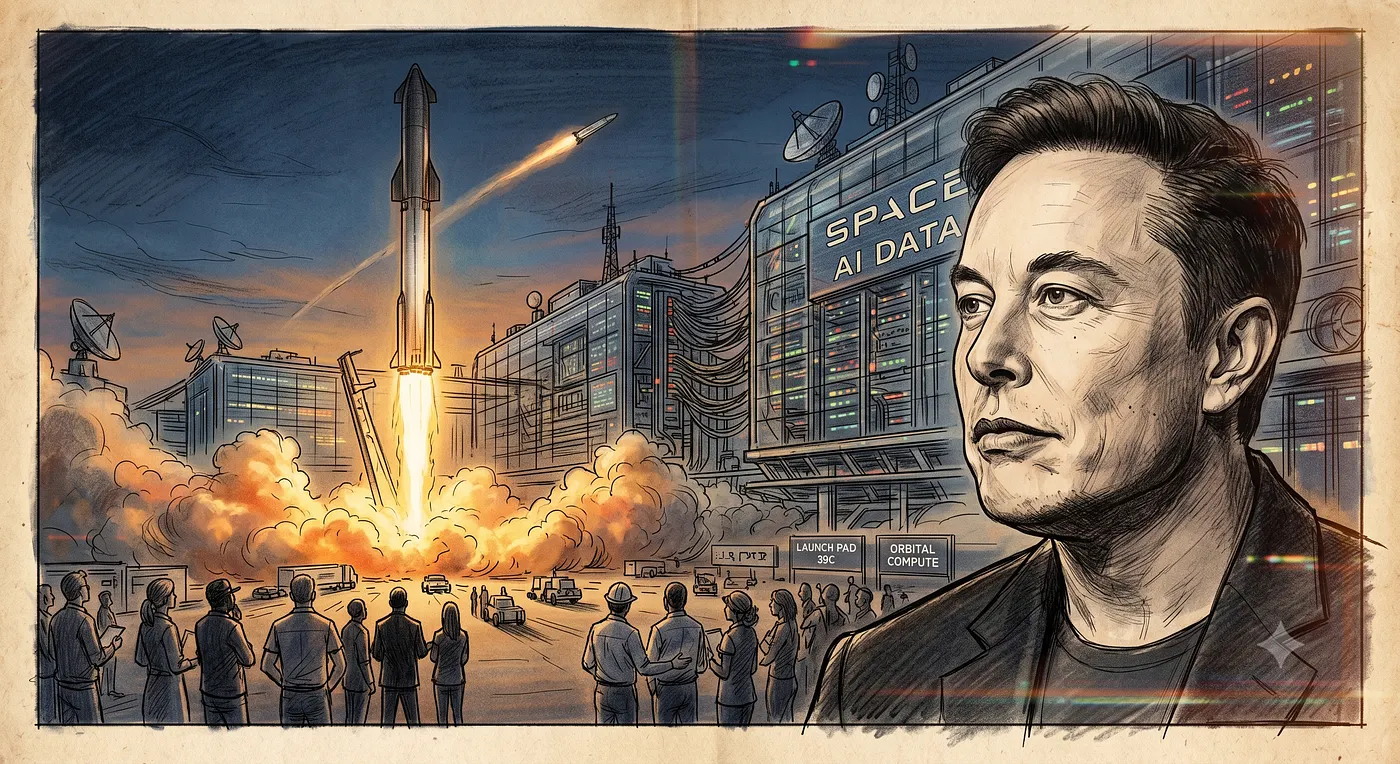
SPCX and a vision of the future — Image by Gemini
On June 12, 2026, SpaceX rang the bell on the Nasdaq under the ticker SPCX. Shares were priced the night before at $135, raised about $75 billion, and closed the first session near $161 — up roughly 19% — pushing the company’s market value into the neighborhood of $2 trillion. It was, by a wide margin, the largest IPO in history, eclipsing Saudi Aramco’s 2019 record, and it minted Elon Musk as the world’s first trillionaire on paper.
If your first reaction to that paragraph was a kind of vertigo, you’re not alone, and you’re not wrong to feel it. A two-trillion-dollar valuation for a company that still burns cash on its most ambitious projects is the sort of number that makes thoughtful people start eyeing the exits and muttering about 1999. Stack two more enormous AI listings on top of it — Anthropic filed a confidential IPO around June 1 at roughly $965 billion, and OpenAI followed about a week later at roughly $850 billion, both aiming for the back half of this year — and it’s easy to convince yourself the entire market is one bad earnings call away from a cliff.
I’ve spent the last few days sitting with that fear, and I’ve come out the other side of it. Not into blind cheerleading — the risks are real and I’ll name them plainly — but into something closer to pragmatic optimism. Here’s the case for why this moment looks less like the top of a bubble and more like the market repricing what infrastructure is about to mean.
(One caveat before I make it: I’m a writer thinking out loud, not your financial advisor. Nothing here is a recommendation to buy or sell anything. Do your own homework.)
First, let’s be honest about what could go wrong
A hopeful argument that skips the dangers isn’t hopeful, it’s just naive. So:
The valuation is priced to perfection. On any traditional trailing metric, SPCX does not “pencil out” today. The number assumes near-flawless execution on things that haven’t happened yet. To grow into $2 trillion, SpaceX doesn’t merely have to do well — it has to nail rapid Starship reusability and stand up a genuinely commercial space-compute business. That’s two moonshots priced as if they’ve already landed.
There’s an index-weight trap. When a company this large gets fast-tracked into benchmarks like the Nasdaq-100, passive funds — the QQQs of the world, the stuff quietly sitting in millions of 401(k)s — are structurally forced to buy it to match the index. If the stock then stumbles after that wave of mandatory buying, the same passive machinery drags the broader index down with it. Concentration cuts both ways.
The governance is concentrated. Musk’s control over the combined entity is enormous. For institutional investors, a single individual with near-unilateral authority over capital allocation is a real risk, not a footnote — brilliance and unpredictability come from the same source.
The transparency moment is coming. Right now OpenAI and Anthropic are behind the curtain of confidential filings. When their full financials hit a public S-1, the market gets its first unfiltered look at the economics of frontier AI. If those numbers spook people, the same week SpaceX needs confidence most, the sentiment could turn fast.
These are not trivial. If you only read this far, read this: the volatility ahead is going to be genuinely uncomfortable.
Now, the part the doomsayers keep leaving out
Here’s where I diverge from the crash narrative. The dot-com companies of 2000 cratered because most of them had no business underneath the story. SpaceX has two, and they are not speculative.
Starlink is a real, cash-generating utility. Roughly ten thousand satellites in orbit, millions of paying subscribers, recurring revenue climbing year over year. That is not a pitch deck; it’s a functioning global telecom that throws off cash today.
The launch business is a near-monopoly. SpaceX is NASA’s biggest launch partner and the backbone of Western national-security space access. If you want to put heavy hardware in orbit reliably right now, there is essentially one phone number to call. That’s not hype; that’s a moat with a revenue stream attached.
Those two businesses form a floor. They mean the realistic bad case for SPCX is a painful valuation correction — a 2022-style tech repricing — not a zero. A company can be wildly overvalued and still be nowhere near bankruptcy. Those are very different fears, and the market keeps blurring them together.
The orbital data-center bet is more pragmatic than it sounds
The piece driving the imagination — and a big chunk of the valuation — is SpaceX’s plan to put AI compute in space. It’s easy to file this under science fiction. I did too, until I looked at why they’re doing it.
The single hardest constraint on terrestrial AI right now isn’t chips. It’s power and cooling. Data centers are straining grids to the point where tech companies are trying to buy nuclear plants outright. Against that backdrop, orbit stops looking exotic and starts looking like an engineering answer to a specific bottleneck:
- Power: Above the atmosphere, sunlight is constant and intense (~1.36 kW/m²). A satellite designed as a giant solar array with compute bolted on has, in effect, an always-on power plant attached.
- Cooling: Space is the ultimate heat sink. The hardest part — dumping heat in a vacuum — is real, but it’s a known problem, and SpaceX’s first satellite design uses deployable liquid radiators built for exactly that.
This isn’t a sketch on a napkin anymore. SpaceX has unveiled its first orbital data-center satellite, the AI1, targeted for first launches in late 2027, with each unit carrying on the order of 120–150 kW of compute. They’ve announced Gigasat, an enormous manufacturing facility in Bastrop, Texas, with a stated goal of roughly 1 gigawatt per year of space compute capacity by the end of 2027. Crucially, Musk argues the AI satellite is simpler to build than a Starlink V3 broadband satellite — fewer complex antennas, mostly solar cells, compute, and cooling — and that most of the underlying technology already exists. The FCC has opened the plan for review, and the company has already struck compute deals with major AI players, including Anthropic and Google.
You don’t have to believe every gigawatt of that roadmap to see the logic. The pitch is no longer “wouldn’t space be cool?” It’s “the thing constraining AI on Earth is abundant in orbit, and we happen to own the cheapest way to get there.”
The flywheel that makes the math close
Which brings me to the quiet engine under all of this: SpaceX owns the launch vehicle.
Starship’s enormous payload (on the order of 100+ tons to low orbit) combined with full reusability is meant to collapse the cost per kilogram of getting hardware into space. If that works at cadence, SpaceX deploys its own orbital compute essentially at cost — while any competitor trying to build a rival network has to pay retail launch prices, much of which would flow right back to SpaceX. That’s a flywheel: cheaper launch makes orbital compute viable, orbital compute demand justifies more launch, more launch volume drives cost down further.
The whole bull case rests on one milestone: rapid, reliable Starship reusability over roughly the next 18 months. If they stick that landing, the financial story stops being a leap of faith and starts being arithmetic.
Why this probably isn’t a systemic detonation
Even in the scenario where the AI-in-space timeline slips — which, given engineering history, it very well might — the economy has a release valve, and it’s called sector rotation.
If the orbital narrative cools, institutional money doesn’t vanish; it bleeds out of SPCX and rotates back into proven, cash-rich names — the Apples, Microsofts, and Alphabets — or into boring infrastructure utilities. That hurts. Tech-heavy portfolios would take a real hit. But it looks far more like the contained 2022 pullback than a 2008-style, system-wide financial seizure. The plumbing strains; it doesn’t burst.
There’s even a structural buffer: the stricter benchmarks (the S&P 500, for instance) generally require a seasoning period and profitability before admitting a new name, which keeps the most violent volatility concentrated in the Nasdaq rather than instantly threading it through every broad-market index fund in the country.
The bigger picture
Strip away the day-trading drama and here’s what I think we’re actually watching: the market trying to price infrastructure for an entire era before that infrastructure exists. That process is always messy, always overshoots, and always terrifies people in the middle of it. It did for railroads, for electricity, for the internet itself.
The bear case says we’ve built a fragile edifice — infrastructure at the base, two loss-sensitive software giants stacked on top — and that one crack brings it down. I think that gets the architecture backwards. If SpaceX is genuinely solving the power-and-cooling ceiling that’s been capping what AI can do, then this isn’t the last brick on an unstable tower. It’s a wider foundation being poured underneath everything else. Cheaper, more abundant compute doesn’t make the AI economy more fragile. It makes it less constrained.
So no, I don’t think we’re staring down an unavoidable crash. I think we’re in for genuine, stomach-turning volatility — the kind that rewards patience and punishes panic — sitting on top of two real businesses and one audacious but physically reasonable bet about where compute goes next.
If you believe, as I’m coming to, that the smartest move is usually to take the risks seriously and the fear with a grain of salt, then this debut isn’t the moment the bubble pops.
It might just be the floor being built.
Written June 2026. This is analysis and opinion, not investment advice — the figures cited are drawn from public reporting around the IPO and are subject to change.