Phanes, the Rebel Archons, and the Fable Genshin Impact Is Quietly Handing to the West
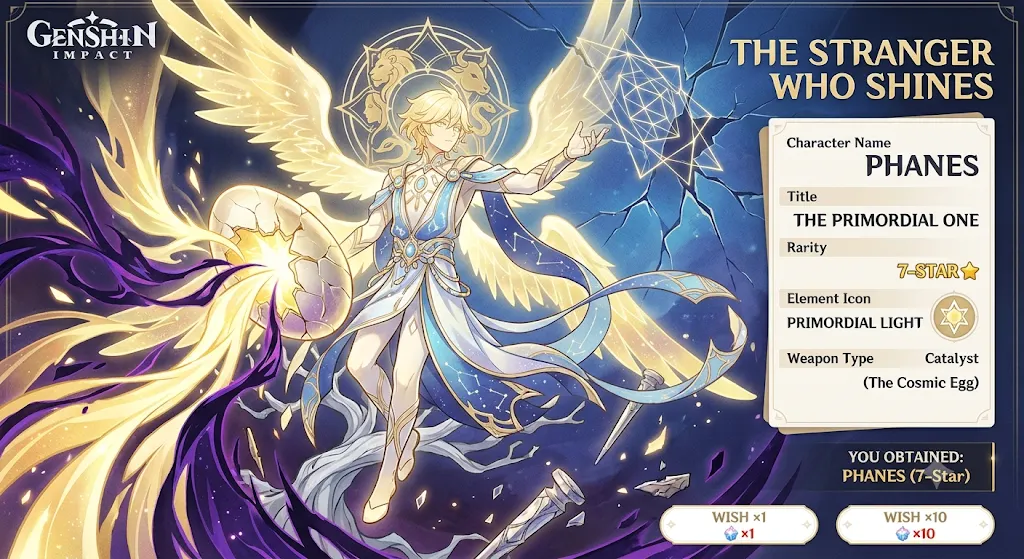
Imagined Character Banner for Phanes — Generated by Gemini
There is a moment, somewhere in every long-term Genshin Impact player’s journey, when the game stops being a game. Maybe it happens in the subterranean darkness of Enkanomiya, reading a banned historical text that details the cosmic, engineered origins of the world’s sky. Maybe it happens in a timeless realm beneath Inazuma, watching a god of absolute stasis finally confront centuries of buried grief to reclaim her own humanity and face the loss of her twin sister. Or maybe it’s when a courtroom in Fontaine falls into a breathless, stunned silence as the self-imposed verdict of a five-hundred-year masquerade is finally handed down. Whenever it happens, the realization is the same: this brightly colored anime gacha game, funded by wish banners and stamina refills, is conducting one of the most ambitious philosophical seminars in modern popular culture. And almost nobody signed up for it on purpose.
At the center of that seminar sits a name: Phanes. It is the name the ancient Enkanomiyans gave to the Primordial One, the being who descended into Teyvat, warred with the dragon sovereigns who ruled it, and rebuilt the world according to its own design. The name is a deliberate borrowing from Greek myth. But it also carries a second, stranger resonance, one that points not to a god but to a philosopher, and once you see that second meaning, the entire architecture of Teyvat’s tyranny snaps into focus. The world Genshin Impact built is, in a very real sense, the dream of a pre-Socratic thinker taken to its logical, terrifying conclusion. And the rebellion of the Seven Archons, one nation at a time, is the story of that dream being dismantled by the very things the philosopher despised: human bodies, human grief, human triviality, and human love.
This is an essay about that double meaning, about the seven gods who chose to become people, and about why a Chinese studio’s decision to hand this fable to a Western audience of teenagers, streamers, and whales may end up mattering far more than any of us expected.
Part One: A Name with Two Fathers
Start with the myth everyone can find with a quick search engine prompt. In the Orphic tradition of ancient Greece, Phanes, also called Protogonos, the First-Born, is the primeval deity of light and generation. The Orphic cosmogonies describe a cosmic egg formed at the beginning of time; when it cracked open, out came Phanes, a radiant, golden-winged being who set the universe in motion and generated the gods and the world. The name itself derives from the Greek verb phainein, meaning to shine, to appear, to bring into the light.
Genshin Impact draws on this inheritance almost verbatim. In Enkanomiya, the sunken civilization beneath Inazuma, players can find the text known as Before Sun and Moon, in which an Enkanomiyan sage records his people’s understanding of creation. The world, he writes, was once the domain of seven sovereign dragons, rulers of the elements, until a being arrived from beyond, defeated them, and remade reality. The Enkanomiyans, echoing our own Orphics, called this being Phanes, and described the cosmic egg from which the ordered world emerged. The parallel is precise: a first light, an egg, a generated cosmos, a new order imposed on primordial chaos.
If the borrowing stopped there, it would be a competent piece of mythological texture, the kind of thing HoYoverse does constantly. But the name carries a second inheritance, and this is where the analysis gets interesting.
Roughly two and a half millennia ago, in the Greek city of Colophon in Ionia, a poet-philosopher named Xenophanes was born. His name is a compound of two elements: xenos, meaning stranger, foreigner, or outsider, and the same phainein root that gives us Phanes, meaning to shine or to appear. Read literally, the name Xenophanes means something like “the stranger who shines” or “the foreigner who appears.”
Now hold that etymology up against Teyvat’s cosmology. In Genshin’s lore, the most consequential category of being is the Descender: an entity that comes from outside the world entirely, unbound by Teyvat’s laws, capable of rewriting them. The Primordial One, Phanes, is the first and greatest of these. It is, by definition, a foreigner. An outsider. An alien light that appeared in the sky of a world that never invited it, ruled over the native dragons, evicted their king, and manifested a new heaven and a new earth.
The stranger who shines. Whether the writers at HoYoverse intended the pun or simply arrived at the same crossroads of Greek roots, the name Phanes in Genshin Impact functions as a compressed thesis statement: the god of this world is not of this world. Teyvat’s creator is Teyvat’s invader.
And here is the part that rewards patience. If you go beyond the etymology and actually read what Xenophanes believed, what he wrote about God, the sky, the floods, and the limits of human knowledge, you find something uncanny. Fragment by fragment, the philosopher’s cosmos maps onto the machinery of Celestia. It is as if the developers took a serious vision of a perfect, rational, unified divinity and asked a single subversive question: what would it feel like to live underneath that god?
Part Two: The Philosophy of the Cage
Xenophanes of Colophon lived from roughly 570 to 478 BC, and he survives for us only in fragments, quoted by later writers like Clement of Alexandria, Sextus Empiricus, and Simplicius. He was an itinerant poet, a critic of received religion, and one of the first thinkers in the Western tradition to argue for something like a single, supreme, non-human god. Four of his core ideas correspond, almost point for point, to the four pillars of Celestia’s control over Teyvat.
The Immobile Mind
Xenophanes’ most famous theological claim is that there is one greatest god, completely unlike mortals in body and in thought. This god, he says in the surviving fragments, remains forever in the same place, unmoving, and yet effortlessly shakes all things by the thought of his mind. Divinity, for Xenophanes, does not run errands. It does not descend to seduce mortals or squabble over golden apples like the Olympians he mocked. It sits, it thinks, and the universe obeys.

The Mysterious floating realm of Celestia — Image by Hoyoverse
Every Genshin player has seen the evidence of this god. It hangs in the sky above Mondstadt, visible from nearly anywhere on the continent: Celestia, the floating island of the Heavenly Principles, motionless for millennia. The supreme power of Teyvat does not walk among its subjects. It governs precisely the way Xenophanes imagined, through pure remote intellection, its will made physical in the laws of the elements, the descent of Divine Nails, the distribution of Visions, and the silent bookkeeping of fate. The player spends hundreds of hours beneath it, and it never once moves. It is the immobile mind, rendered as in-game geometry.
The Reconstituted Sky
Xenophanes also held one of the strangest cosmologies in early Greek thought. According to the ancient reports of his views, he taught that the sun is not a single permanent body circling the earth. Instead, a new sun is formed each day from gathered fiery particles or ignited clouds, travels its straight course, and passes away, while the earth extends downward without limit. There are, in this picture, many suns and many moons, generated and discarded, region by region, day by day. The sky, for Xenophanes, is not an eternal vault. It is a process, a projection, a repeating manufacture of celestial objects.
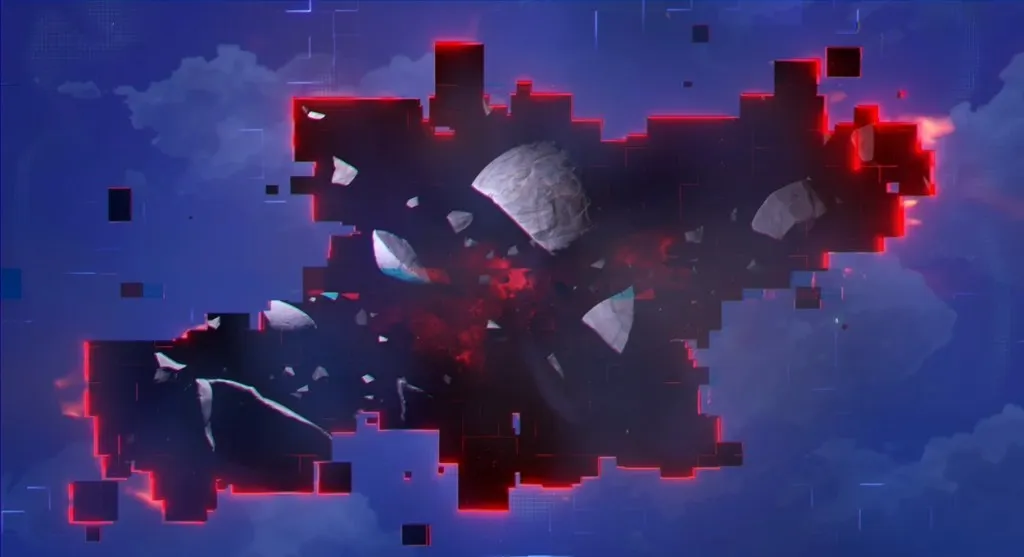
The shattered fake sky over Teyvat — Image by Hoyoverse
Teyvat’s deepest secret says the same thing with dread instead of curiosity. Across the game’s most important story beats, characters who climb too high or dig too deep converge on the same forbidden conclusion: the sky is false. The stars are a lie. The firmament above Teyvat behaves less like an open universe or Ptolemy’s crystal spheres than like a managed display, with hints scattered through the lore of moons that died, of heavens that were destroyed and rebuilt, of a dome that exists to keep something out, or to keep everyone in. Xenophanes’ reconstituted sun was an honest attempt at natural philosophy. Teyvat literalizes it as stagecraft: a heaven that is manufactured daily because a manufactured heaven is easier to control.
The Drowned and Dried World
Xenophanes was also, remarkably, one of humanity’s first paleontologists. Ancient sources report that he pointed to seashells found inland and to impressions of fish and seaweed embedded in rock at Syracuse, Paros, and Malta, and drew a startling inference: the land was once sea. The world, he concluded, alternates between great phases of wet and dry, and when the earth is carried down into the sea and becomes mud, humankind perishes, and then the cycle begins again and civilization regenerates from nothing. Extinction, for Xenophanes, is not a myth. It is a schedule.
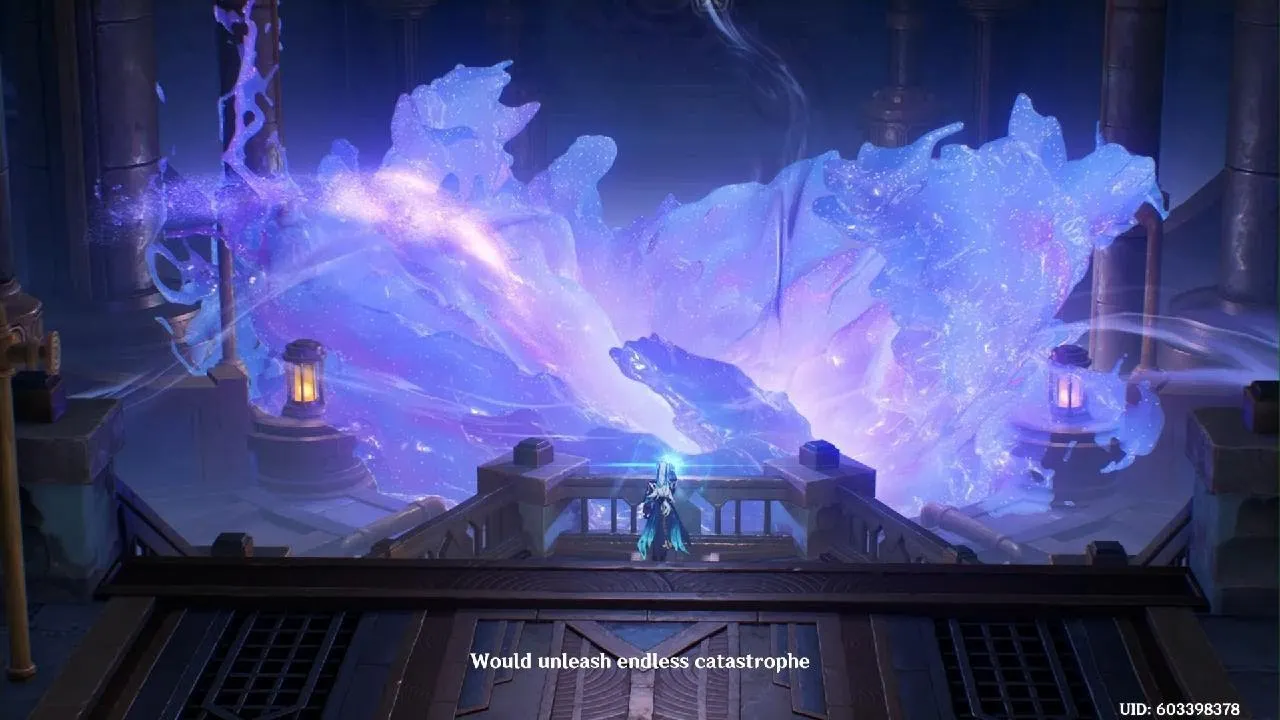
The Curse of Primordial Sea Water under Fontaine — Image by Hoyoverse
In Teyvat, that schedule has an administrator. The lore of the Cataclysm, of Khaenri’ah, of the Divine Nails that fell on Dragonspine and Tsurumi and the Chasm, and above all of Fontaine’s prophecy, describes a world where civilizations that grow too ambitious are periodically obliterated. Fontaine’s entire national nightmare, the prophecy that its people would be dissolved back into the waters of the Primordial Sea, is Xenophanes’ flood cycle weaponized: humanity reduced to formless origin-water so that the world can be rewritten clean. The philosopher looked at fossil fish in a cliff face and saw deep time. Genshin looks at the same image and sees a reset button, held by a god who is willing to press it.
Opinion for Mortals, Knowledge for Gods
Finally, Xenophanes helped invent epistemology, the study of what we can actually know. His most haunting fragment concedes that no man has seen, and no man will ever know, the clear truth about the gods and the cosmos; even if someone happened to speak the complete truth, he himself would not know it. Mortals, Xenophanes says, are confined to opinion, to seeming, to belief. Certain knowledge belongs to the divine alone.
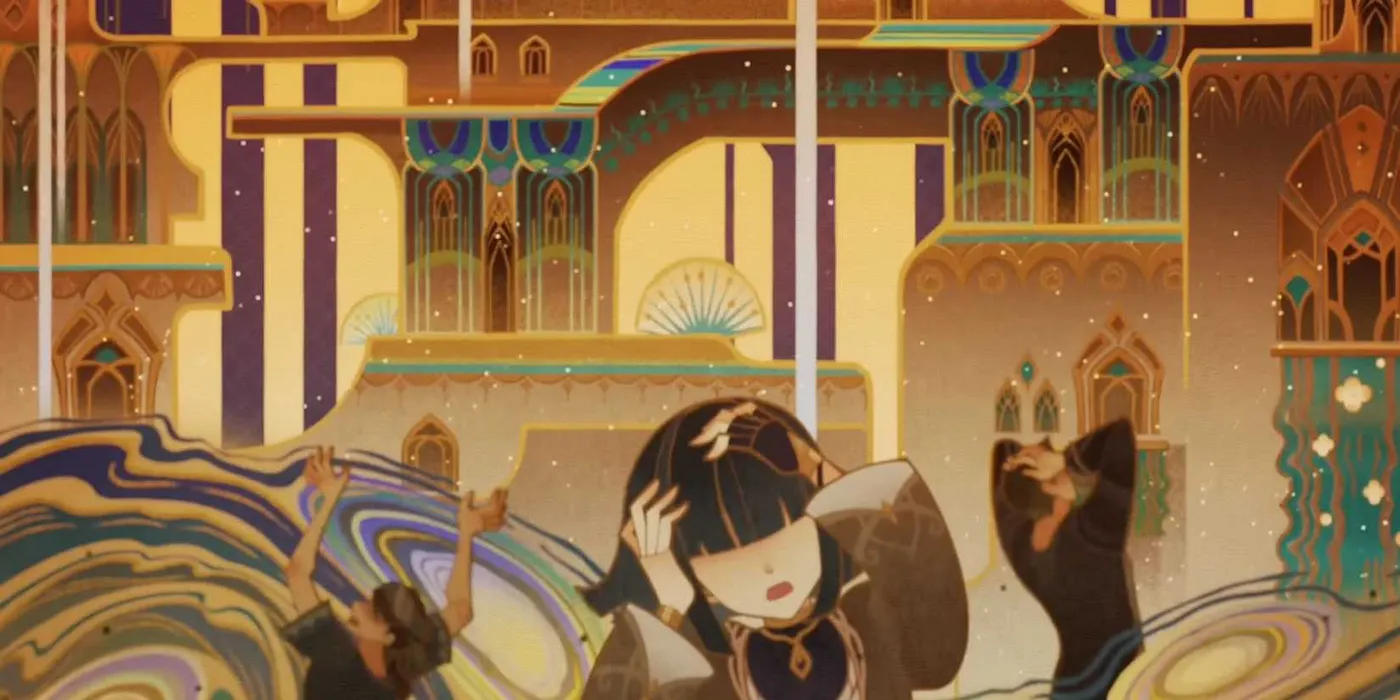
Forbidden Knowledge in the ancient times — Image by Hoyoverse
Teyvat does not merely agree with this. Teyvat enforces it with infrastructure. The world tree Irminsul stores and transmits the official record of history, and that record can be edited. Characters are erased from memory. Nations forget their own kings. Entire chapters of the past exist only as contraband carried in the minds of gods, Descenders, and the occasional doomed scholar, and pursuing that contraband knowledge is punished with madness, dissolution, or the quiet attention of the Heavenly Principles. The population of Teyvat lives permanently inside Xenophanes’ condition of opinion, not because human cognition is limited, but because the archive is curated. Doxa, mere belief, is not their epistemic condition. It is their assigned rations.
The Inversion
Put the four pillars together and the picture is complete. An unmoving supreme mind that rules by thought alone. A manufactured, cyclical sky. Scheduled disasters that reset civilization. A hard wall between divine knowledge and mortal opinion. In our world, this was one man’s attempt to imagine a god worthy of the name, a rational alternative to the petty, thieving, philandering Olympians of Homer and Hesiod that Xenophanes so despised. He was, by the standards of his time, a radical reformer. He wanted to rescue the divine from human pettiness.
Genshin Impact takes that reformer’s dream perfectly seriously, builds it, populates it, and then asks the question Xenophanes never had to answer: what happens to the people who live under a perfect god? The answer the game gives is a cage. A gilded, beautiful, meticulously maintained cage, with a fake sky for a ceiling and amnesia for a floor. And the story the game then spends years telling is the story of how that cage gets unlocked, not by a stronger god, but by gods who commit the one sin Xenophanes considered most beneath divinity: they become human.
Part Three: The Rebellion of the Human Gods
Xenophanes’ other great legacy is his attack on anthropomorphism. Mortals, he complained, imagine that the gods are born, wear clothes, and speak with voices like their own. Ethiopians, he observed, depict their gods as dark-skinned; Thracians paint theirs with red hair and blue eyes. And in his most famous thought experiment, he suggested that if oxen and horses had hands and could draw, horses would draw their gods as horses, and oxen as oxen. For Xenophanes, this was the great embarrassment of religion: humans dragging divinity down to their own level, dressing the infinite in their own laundry.
Genshin Impact stages a systematic, nation-by-nation refutation of that complaint. Across the Archon quests, a pattern emerges that is too consistent to be accidental: the closer a god stays to the Xenophanean ideal of pure, aloof, non-human divinity, the more monstrous that god becomes. And the further an Archon descends into human form, human weakness, and human triviality, the more genuinely good, and the more genuinely free, that Archon becomes. In Teyvat, anthropomorphism is not the corruption of the divine. It is its redemption. Each of the Seven who breaks from Celestia does so by breaking toward humanity.
Venti: The God Who Chose a Dead Boy’s Face
Barbatos, the Anemo Archon, began as the least anthropomorphic being imaginable: a formless wisp of wind, a nameless elemental breeze in service to a storm tyrant. When the people of old Mondstadt rose against the tyrant Decarabian, the wind sprite fought beside a nameless bard who dreamed of seeing the sky beyond the storm wall, and who died before he could. When the sprite ascended as the new god of Mondstadt, it did something Xenophanes would have found incomprehensible: it took the dead boy’s face as its own, forever.
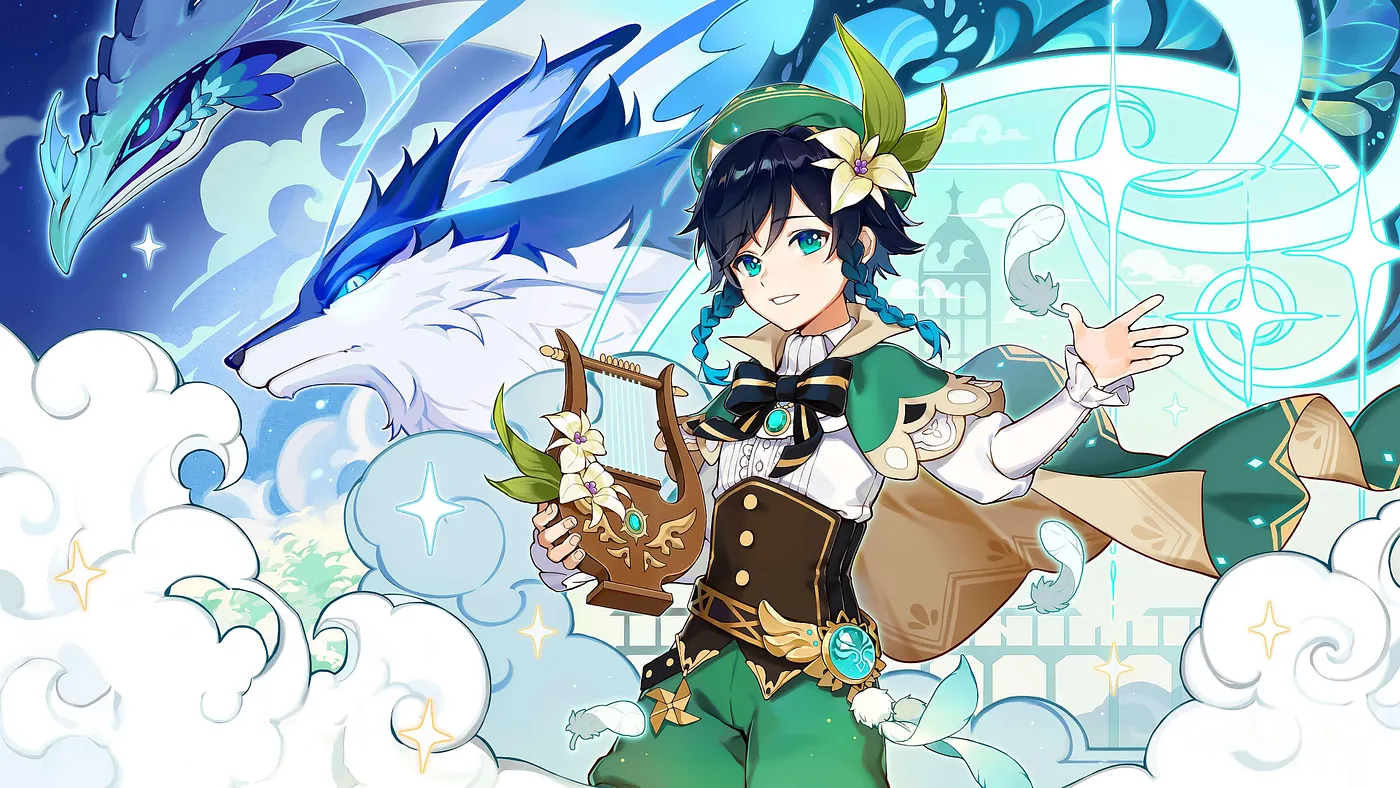
Venti, the bard of Mondstadt and god of freedom — Image by Hoyoverse
Everything about Venti is a renunciation of divine dignity. He performs for pocket change in the streets of a city he technically rules. He drinks, freeloads, dodges responsibility, and lets his own church misidentify his likeness. He dismantled the monarchy of a previous age rather than sit on its throne, and he governs the land of freedom chiefly by refusing to govern it. The theology here is deliberate: Venti believes that a god who rules is a wall between people and the sky, and so he makes himself small, silly, and dispensable. The wind wears a mortal’s face because a mortal wanted to be free, and freedom, in Mondstadt’s story, is something a god can only protect by stepping out of its way.
Zhongli: The God Who Forgets His Wallet
Morax, the Geo Archon, spent millennia as the opposite of Venti: the warrior god of contracts, the slayer of gods whose spears became a mountain range, the mint from which all of Teyvat’s currency flows. He was ancient, absolute, and terrifying, exactly the kind of deity a nation builds its entire economy and identity around. Which is precisely why he decided the nation had to learn to live without him.
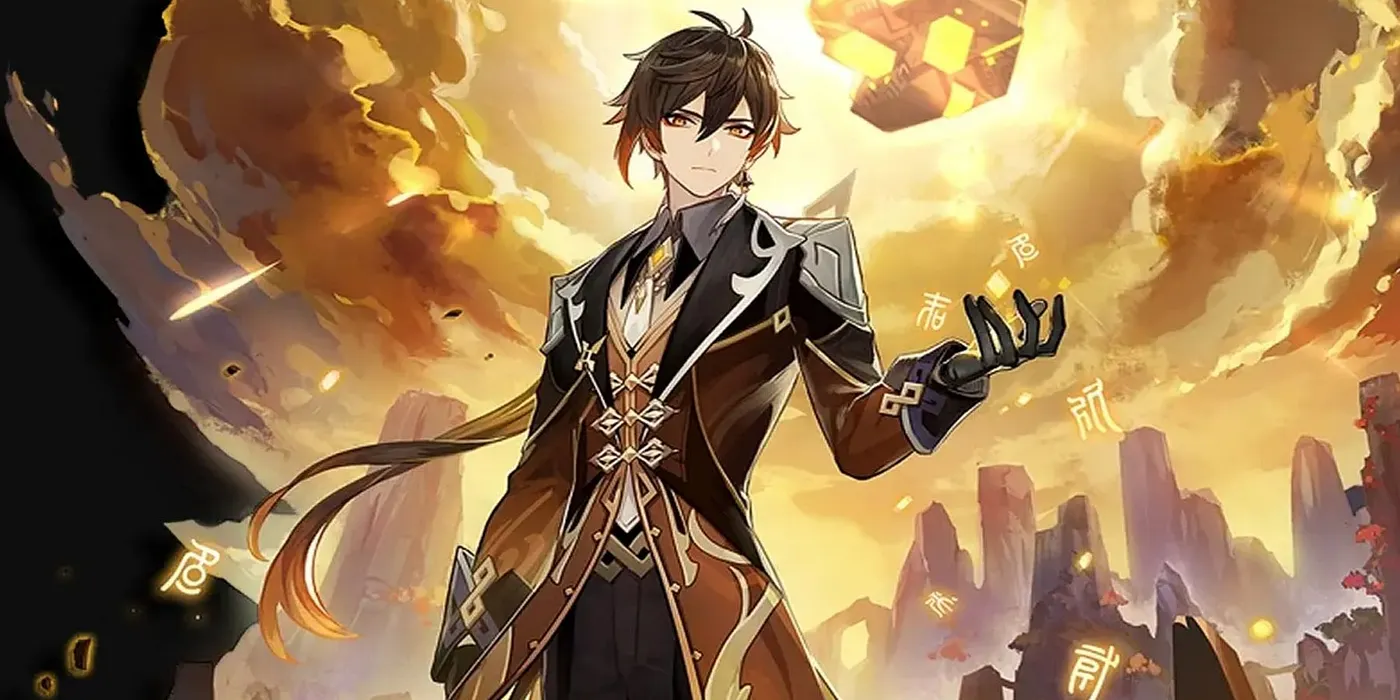
Zhongli, funeral parlor consultant and god of contracts — Image by Hoyoverse
The Liyue Archon quest is built around a staged death. Morax fakes his own assassination, watches from the crowd as his people face the crisis of a godless future, and finds that they no longer need him: the productive merchants, the powerful adepti, and the ruling Qixing hold the harbor together on their own. Satisfied, he retires his godhood into a consultancy at a funeral parlor, under the name Zhongli, and dedicates himself to the human arts of tea, opera, antiques, long dinners, and chronic financial embarrassment. The god who created money now perpetually forgets to carry any. The joke is the theology: the being who once defined value through divine contract now depends on the generosity of friends, and finds that dependence, the most human of conditions, to be a fair trade for six thousand years of solitude at the top.
Ei: The God Who Tried to Achieve Xenophanes’ Ideal, and Failed
If Venti and Zhongli abandoned the Xenophanean ideal, Raiden Ei is the Archon who tried to build it, and her nation paid the price. Scarred by centuries of loss, by the death of her sister, her friends, and finally her closest companions in the Cataclysm, Ei concluded that the only defensible eternity was stasis. So she did exactly what Xenophanes prescribed for a supreme being. She withdrew from the world of humans into the Plane of Euthymia, a realm of pure, unchanging meditation. She left in her place the Shogun, a flawless mechanical puppet, unmoving in judgment, executing law without feeling. An immobile mind, ruling by thought alone, untouched by grief.
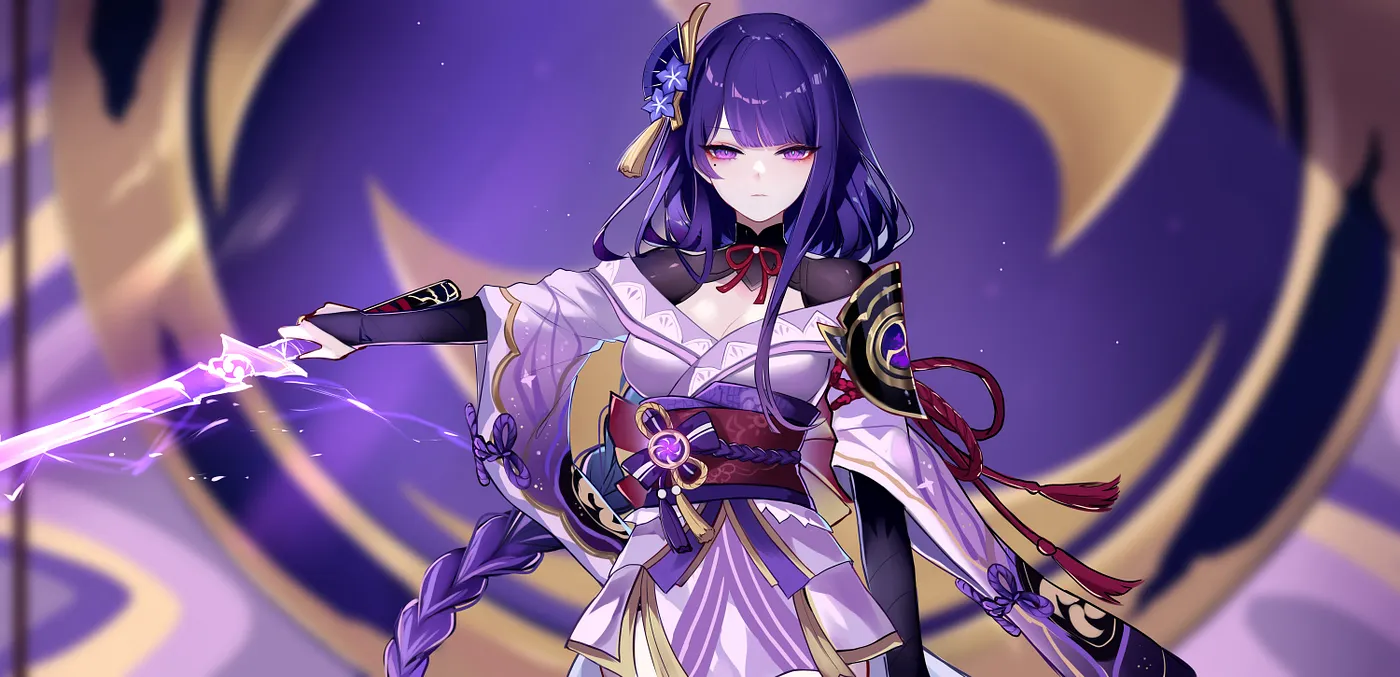
Raiden Ei, Shogun and god of eternity — Image by Hoyoverse
The result was Inazuma’s darkest chapter: the closed borders, the Vision Hunt Decree that tore ambitions out of human hearts, the civil war that filled Yashiori Island with graves. The perfect, dispassionate god turned out to be indistinguishable from a tyrant, because a ruler who cannot feel loss cannot understand what her laws cost. Ei’s redemption is written in deliberately small script: she is dragged out of eternity not by a greater power but by a traveler, a shrine maiden’s schemes, and eventually by dango, light novels, festivals, and the discovery that her people’s fragile, transient wishes were the very thing her eternity was supposed to protect. Inazuma’s arc is the game’s clearest thesis statement: the Xenophanean ideal was tried, and it broke a nation, and it was humanity, sweet, trivial, mortal humanity, that put the nation back together.
Nahida: The God Who Knew She Did Not Know
Sumeru’s story extends the argument into Xenophanes’ own home territory: knowledge. Nahida, the Dendro Archon, was born five hundred years ago from the remnants of her predecessor, the Greater Lord Rukkhadevata, who gave everything to cleanse the world after the Cataclysm. The sages of the Akademiya, meritorious administrators of the nation of wisdom, judged the small child-god an inadequate replacement and locked her in her predecessor’s Sanctuary of Surasthana, ruling in her name for centuries while she watched her own country through borrowed eyes and dreams.
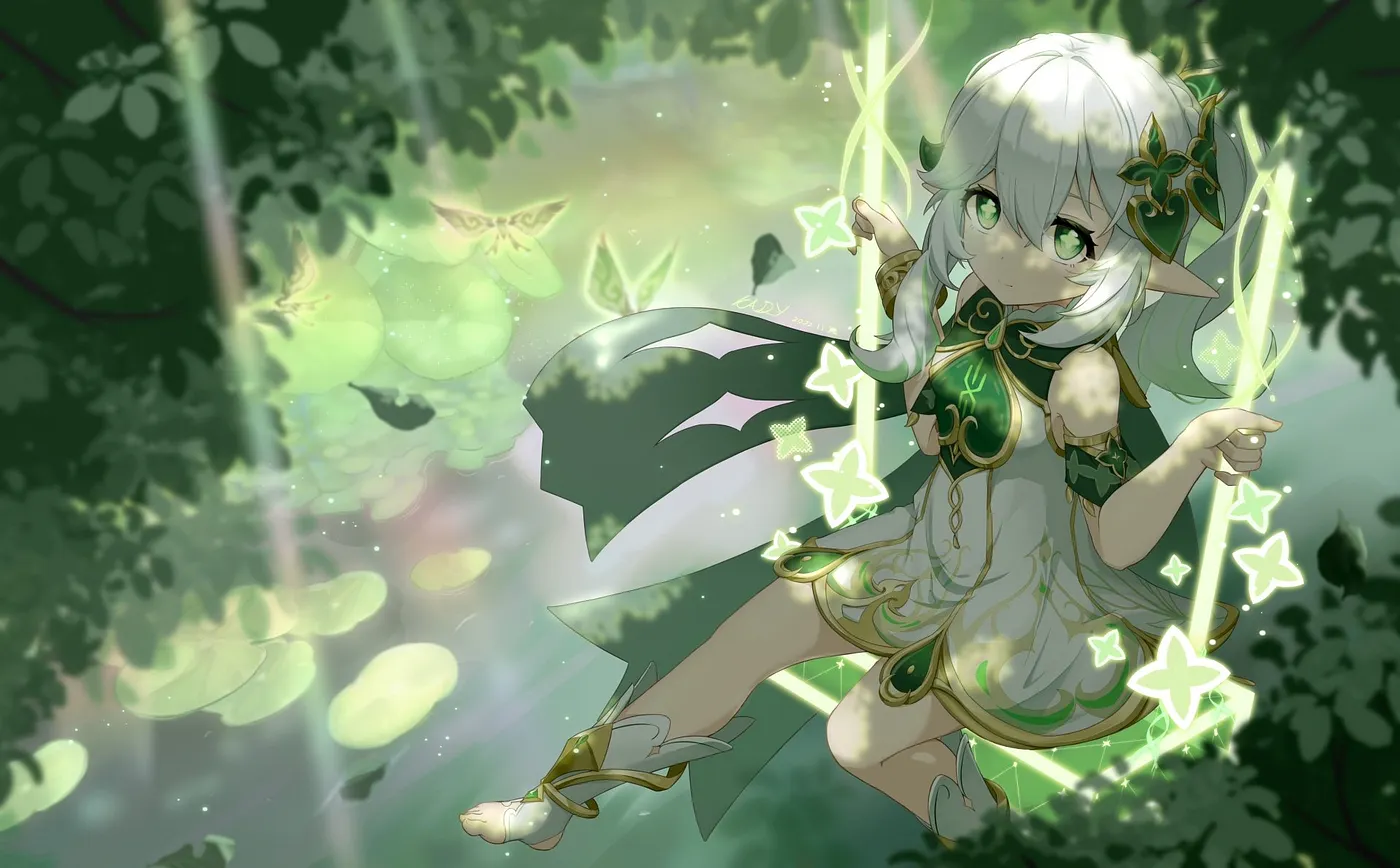
Nahida, child inventor and god of wisdom — Image by Hoyoverse
Here is the astonishing detail: the god of wisdom, imprisoned by scholars, never responds with divine wrath. She responds with curiosity. Cut off from the world, Nahida studies it, wandering the dreams of her people, learning their fears and their kindnesses, treating every mortal she meets as a teacher. When the sages attempt to build themselves a better, artificial god, harvesting the dreams of ordinary citizens as raw material, it is Nahida’s patient, empathetic intelligence, working through allies and stray connections, that undoes them. And in the arc’s most devastating act, she makes the ultimate epistemological sacrifice: to purge a lingering corruption, she erases the memory of Greater Lord Rukkhadevata from Irminsul itself, deleting her own origin from the world’s memory, and chooses to carry that grief alone, even after acknowledging that she doesn’t even remember why.
Nahida is Xenophanes’ epistemology turned inside out. The philosopher said mortals are trapped in opinion while gods hold true knowledge. Nahida, a god with literal access to the world’s memory archive, behaves instead like the humblest of inquirers: she admits ignorance, asks questions, values the dreams of a street urchin as data worth protecting, and treats wisdom not as a possession of the divine but as a collaboration with the mortal. In the nation obsessed with hoarding knowledge, the god wins by sharing it, and by conceding, as Xenophanes did, that no one, not even she, has seen the clear and certain truth. The difference is that for Nahida, that concession is not despair. It is an invitation to keep learning, together.
Furina: The Human Who Played God So the God Could Die
Fontaine pushes the theme to its structural extreme: an Archon who literally splits herself into divinity and humanity, and sacrifices the divine half. Facing the prophecy that her people would be dissolved into the Primordial Sea, the Hydro Archon Focalors devised a plan that took five centuries to execute. She separated her godhood from her human self. The divinity retreated into the Oratrice, the great judicial machine, silently accumulating the power needed to break Celestia’s sentence. The humanity remained on the throne, wearing the Archon’s name: Furina.
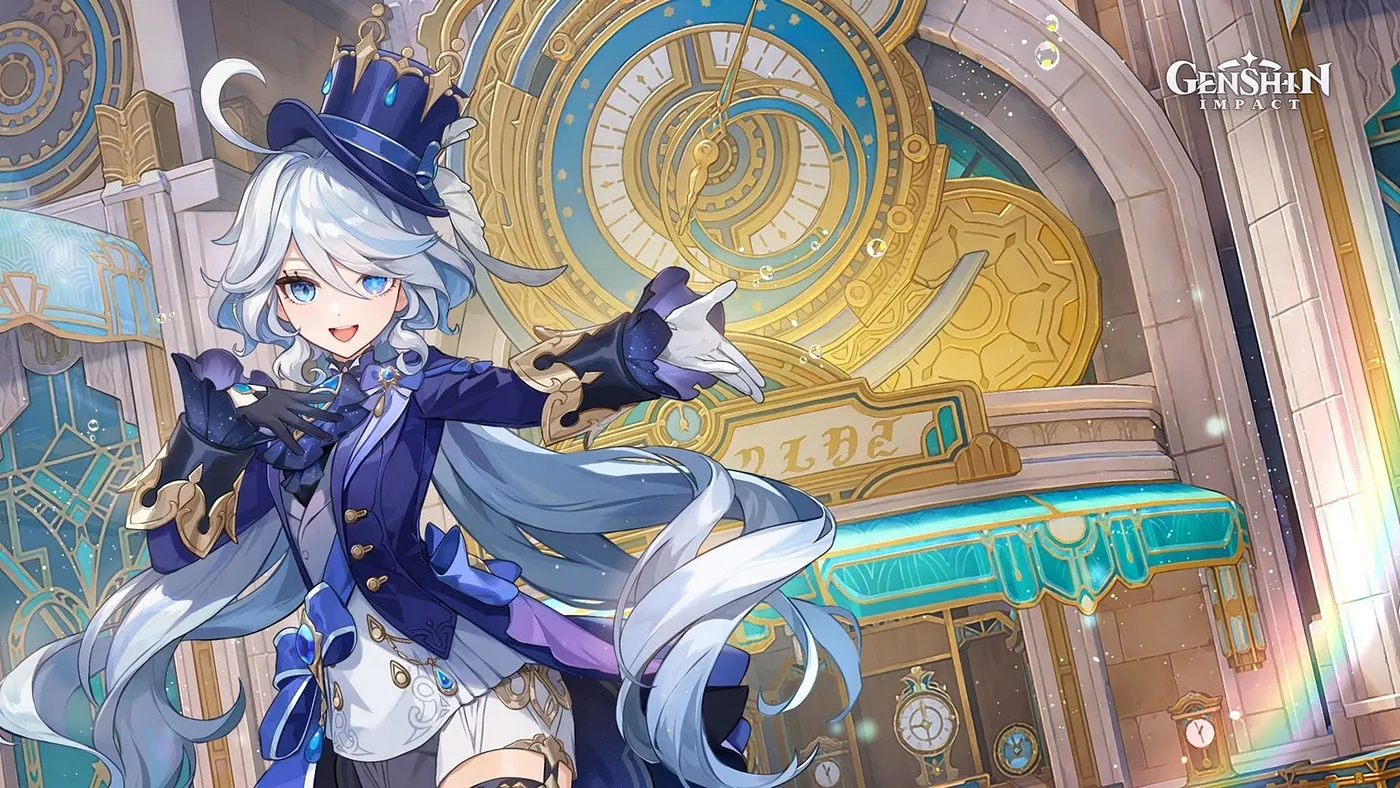
Furina D’Fontaine, retired actress and god of justice — Image by Hoyoverse
For five hundred years, Furina performed godhood. She played the capricious, theatrical, infallible deity her people expected, presiding over trials and operas, forbidden from telling a single soul that she was mortal, terrified every day that one slip would doom the nation. She endured centuries of loneliness with no divine detachment to numb it, because she had no divinity at all. When the plan finally reaches its climax, the divine half, Focalors, orchestrates her own execution, shattering the Archon’s seat of power and returning stolen authority to the dragon it was taken from, while the human half sits alone, weeping on her throne.
And here the game delivers its verdict on Xenophanes with maximum clarity: Fontaine is not saved by its god. The god’s role was to die. Fontaine is saved, in the flooding streets, by ordinary people, by a Duke running rescue operations, by an actress, an engineer, a chief justice, and by Furina herself, whose value was never her divinity but her endurance, her terror overcome daily for five hundred years. The nation that worshipped a perfect performer learns to celebrate a flawed, retired, cake-loving young woman. The divine was the costume. The human was the miracle.
Mavuika: The Throne That Became a Relay Baton
Natlan completes the descent. Mavuika, the Pyro Archon, is not a wind sprite, a dragon, an oceanid, or a fragment of a world tree. She is, in origin, a human being, a war leader who took up the Archon’s mantle and carried her people’s hopes across five centuries by sheer strategic patience and will. Her godhood functions less like a nature and more like an office, sustained through the Natlanese system of Ancient Names, in which the deeds and memories of heroes are preserved and passed down so that each generation can inherit the strength of the last.
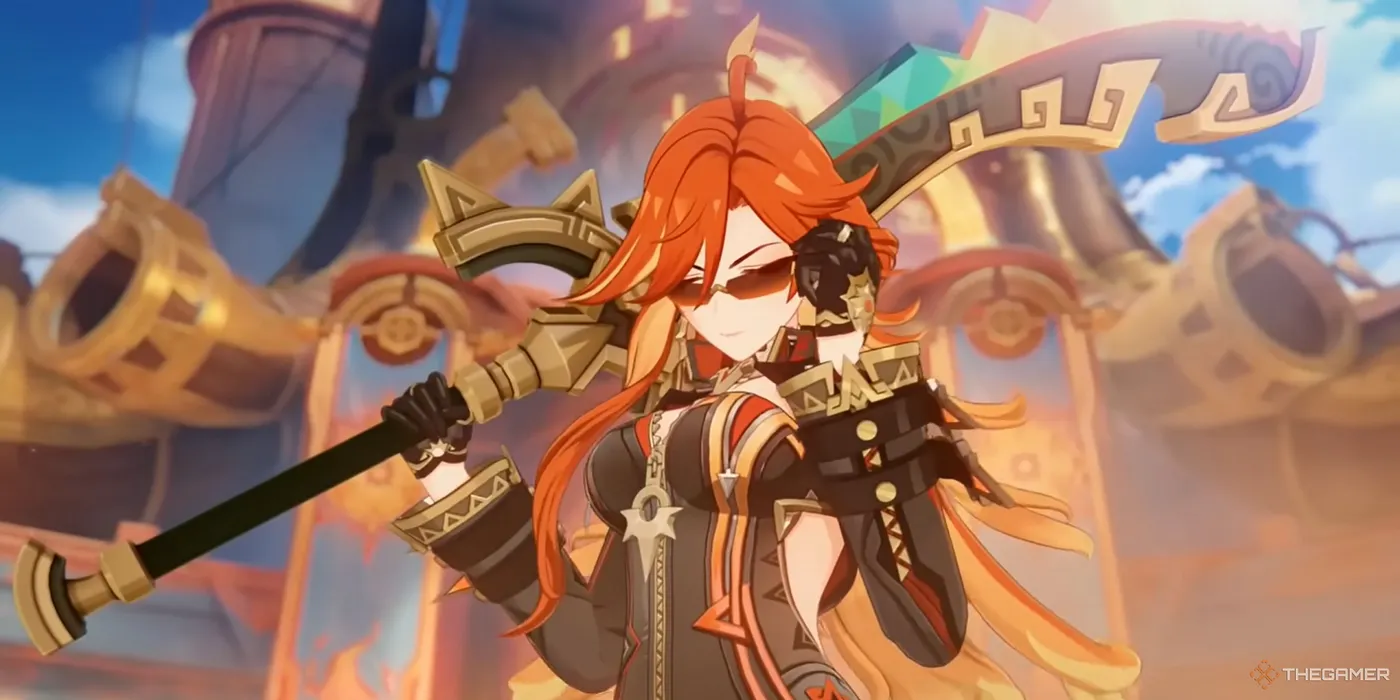
Mavuika, pyro archon and keeper of the sacred flame — Image by Hoyoverse
Everything about Natlan’s war against the Abyss is framed in human terms. Mavuika does not descend from a cloud to smite the enemy; she rides a motorcycle, argues strategy around tables, delegates to tribal champions, grills food for her soldiers, and builds her entire battle plan on the assumption that ordinary people, fighting together and remembering their dead, are the strongest force the world can field. Where Celestia’s order is maintained by erasing memory, Natlan’s survival is built on preserving it, name by name, hero by hero. The first Descender was an alien light that conquered the world from outside. Natlan’s Archon is a woman from inside the world, holding it together with comradeship. Between those two points runs the entire moral arc of the game.
The Verdict on the Philosopher
Line the six stories up (the seventh is arriving later in 2026, nearly a decade in the making) and the inversion of Xenophanes is complete. He believed anthropomorphism degraded the divine; Teyvat shows anthropomorphism rescuing it. He imagined the perfect god as unmoving, unfeeling, and absolute; Teyvat installs exactly that god in the sky and reveals it as a jailer. Every Archon who matters to the story earns their goodness by moving in the opposite direction: Venti forgives a frightened man’s cowardice by recognizing it as his own, Zhongli retires from a power he knows corrupts and fills his centuries with operas and antiques instead, Ei trades an unfeeling eternity for the grief and small joys of an ordinary day, Nahida gives up her own certainty, and even her own origin, rather than hoard the truth, Furina spends five hundred terrified years performing a role so her people never have to carry the fear themselves, and Mavuika trades a throne for a war table surrounded by people who know her name. The message is a humanist creed wearing a fantasy costume: perfection is sterile, and it is the flawed, mortal, empathetic, communal experience of being human that deserves the name divine.
Part Four: Why the West Needed This Fable
All of this would be an elegant curiosity if Genshin Impact were a niche card game played by philosophy graduates. It is not. It is one of the most commercially successful entertainment products of its generation, played by tens of millions of people across every continent, and its single largest cultural footprint outside Asia is among Western teenagers, young adults, streamers, and a long statistical tail of older players with disposable income. Which raises the real question: what does it mean that this audience, of all audiences, is absorbing this story?
Myth Does Not Ask Permission
The first answer is about how myth works. A deep story does not require an academic vocabulary to change how a person sees the world. Nobody who grew up on Greek myths needed to read Hesiod to internalize the idea that hubris invites downfall; nobody needed a theology degree to absorb, from a thousand retellings, the shape of the hero’s journey. Myths do their work below the level of argument. They install patterns, images, and instincts that surface years later as intuitions.
Genshin Impact operates exactly this way. A fifteen-year-old grinding artifacts in Fontaine is not reading Xenophanes. But that player is spending hundreds of hours inside a story whose load-bearing beams are these ideas: that the official version of history can be edited, and someone benefits from the editing; that a system can be beautiful, orderly, and comfortable and still be a cage; that authority which never shows its face and never explains itself deserves suspicion rather than reverence; that the people who save nations are rarely the perfect ones, and that flaws, grief, and smallness are not disqualifications from mattering. That foundation gets installed whether or not the player ever opens a lore video. The gacha wrapper, the bright colors, the daily commissions, all of it functions as a delivery mechanism for a worldview, the same way the pleasures of Homer’s verse delivered the values of the Bronze Age to the Iron.
The Algorithmic Gilded Cage
The second answer is about timing. The Western audience receiving this fable is a generation that has never known a world without algorithmic mediation. Their attention is the raw material of trillion-dollar industries. Their feeds are curated by systems whose logic is opaque to them and optimized for goals that are not theirs. Many of them face housing markets, job markets, and institutions that feel pre-decided, as if the important choices were made before they arrived, by processes no one will explain. They live under a sky that is, in its own way, manufactured: a ceiling of recommendations, rankings, and invisible moderation, maintained by distant entities that never descend and never answer.
For this audience, Teyvat is not escapism. It is recognition. A world where fate is administered, where the archive is curated, where a motionless power harvests the ambitions of individuals through shiny tokens of recognition, and where the sanctioned response to curiosity is a gentle but firm redirection, this is not fantasy to a young Western player. It is Tuesday, with better lighting. And so when the story insists, again and again, that the fake sky can be broken through, that the manufactured archive can be resisted by people who remember each other, and that community is the one force the immobile mind cannot fully calculate, it is speaking directly to the lived condition of its audience. The game never mentions algorithms, feeds, or platforms. It does not need to. Myth does not ask permission, and it does not name names.
The Bards: How Gen Z Turned a Game Into an Oral Tradition
The third answer is about distribution, and here Genshin’s design intersects with generational behavior in a way that looks almost engineered. The game buries its deepest lore in fragments: weapon descriptions, artifact flavor text, out-of-print in-game books, environmental details in ruins most players sprint past. No single player encounters the whole picture. The story of Phanes, the sovereigns, the fake sky, and the loops of extinction exists, in practice, only as a collective reconstruction.
That reconstruction is performed by content creators, overwhelmingly Gen Z, who function precisely as the bards of an oral tradition. They gather the fragments, weave them into hours-long video essays, argue over interpretations in comment sections, and broadcast the synthesis to millions of viewers, most of whom will never read a single artifact description themselves. The casual player who skips every dialogue box still ends up marinating in the philosophy secondhand, because the community’s collective lorekeepers discuss it on Twitch for hours. This is, structurally, how the Homeric epics survived before writing: not as a text, but as a performance tradition, sustained by specialists and absorbed by audiences. Genshin’s lore community is a living demonstration that the oral-formulaic transmission of myth did not die with antiquity. It moved to YouTube.
The Patrons: What the Whales Are Actually Buying
The fourth answer concerns the older end of the demographic curve, the Gen X and elder-millennial players whose spending funds the entire enterprise. It is easy to caricature the whale as a victim of predatory monetization, and the gacha model deserves every ounce of scrutiny it receives. But there is another way to read the economics, one with deep historical precedent. Great art has always required patrons. The Florentine Renaissance ran on Medici banking money; the cathedrals ran on merchant guilds; the golden ages of opera and portraiture ran on aristocrats buying prestige. The patron’s motives were rarely pure, and the art transcended them anyway.
The whales of Genshin Impact are, functionally, this era’s merchant patrons. Their spending gives the studio something almost no Western developer of comparable scale possesses: independence from publishers, from license holders, and from the quarterly logic that flattens ambitious storytelling into safe franchises. That independence is what pays for full orchestras recording regional soundtracks, for years-long narrative arcs that trust the audience to wait, and for the sheer audacity of hiding a pre-Socratic philosophical argument inside a free-to-play anime game. The patron buys a character. The civilization gets a myth. It was ever thus.
Shattering the Monolith
The fifth answer is geopolitical, and it may be the most quietly consequential. For decades, the Western image of China has been dominated by a single flattened narrative: an authoritarian monolith, a factory, a censor. Whatever one’s views on the states involved, that narrative has a human cost, because it teaches a generation to see a fifth of humanity as an apparatus rather than as people.
Genshin Impact is, for millions of young Westerners, the first Chinese cultural product they have ever loved. And the thing they love is not propaganda, not a borrowed Western formula, but a work of staggering craft and, as this essay has argued, of genuinely subversive philosophical depth, a story whose central villain is an unaccountable, history-erasing, perfection-obsessed central authority, written by young Chinese developers for a global audience. Whatever else that is, it is proof, delivered emotionally rather than diplomatically, that creativity, irony, and profound moral seriousness flourish everywhere, under every sky. A Western teenager who has cried over Furina cannot quite believe in the monolith anymore. The player and the developer, on opposite sides of the planet’s loudest rivalry, turn out to be asking identical questions: how do you live honestly inside a system you did not choose, and how do you protect the people you love from it? No summit communiqué has ever built that bridge. A gacha game did.
Part Five: The Relay of Generations
Which brings us to legacy, and to a character the deep-lore community holds close: Nicole of the Hexenzirkel, the witch who suggests that when the world itself changes, stories are the vessels that carry truth across the rupture. Genshin Impact is not merely telling that idea. It is enacting it, and every generation in its audience has been assigned, without ceremony, a role in the enactment.
The teenagers and young adults are the absorbers. They are taking the fable into themselves during the exact years when a person’s foundational intuitions about power, truth, and community are being poured. Long after the account is abandoned and the dailies forgotten, the blueprint remains: skies can be fake, archives can lie, and the solution to both is other people.
The Gen Z creators are the codifiers. Their videos, wikis, timelines, and theory threads are the scripture-making phase of the myth, the transformation of scattered fragments into a coherent canon that can outlive the game itself. When the servers eventually go dark, as all servers do, the game will become unplayable, but the tradition will not become unreadable. The bards have seen to that.
And the older patrons are the endowment. Their spending is what bought the myth its scale, its polish, and its independence, the difference between a story told in a corner and a story told to a hundred million people at once. Renaissance Florence did not remember its bankers for their ledgers. It remembered what their money made possible.
Every durable mythology in human history has been built by exactly this kind of unglamorous relay: the young who absorb, the tellers who codify, the patrons who fund, each doing their part without any of them controlling the whole. That is how the Olympians outlived Greece, how Arthur outlived Camelot’s absence, how folklore outlives the folk. There is no reason to believe the process has stopped working in our century, and every reason to believe Genshin Impact has already entered it. The fable of the fake sky, the stranger who shines, and the gods who chose to be human is now background radiation in the culture of a generation, a shared reference, a moral shorthand, a story people will tell each other in contexts its authors never imagined.
Coda: The Ground Beneath the Fake Sky
Xenophanes wanted to save religion from humanity. He looked at gods who lied, lusted, and squabbled, and dreamed of one supreme mind, motionless and perfect, shaking the world by thought alone. It was, in its moment, a noble dream, one of the first great acts of philosophical courage in the Western record.
Twenty-five centuries later, a game studio built his dream and hung it in the sky, and then spent years showing, with patience and craft and an oddly tender kind of ruthlessness, what that dream looks like from underneath. It looks like a ceiling. And against that ceiling the game arrayed its answer: a wind god who forgave a frightened man’s cowardice by recognizing it as his own, a war god who retired from a power he knew could corrupt and found peace instead in operas and antiques, a shogun who traded an unfeeling eternity for authenticity in facing grief and enjoying dango with close friends, a child-god who erased her own mother from the world’s memory and grieved alone so her people would not have to, an actress who impersonated a deity for five hundred terrified years, and a human woman who carried a nation’s names into battle instead of a throne.
None of them defeated the immobile mind with a greater immobility. They defeated it, and are defeating it still, with the only forces its calculations cannot fully contain: empathy, memory, community, and the stubborn, trivial, glorious business of being human together on the ground. That is the fable now embedded in the imagination of a generation on both sides of the Pacific. When the sky is fake and the gods are silent, what remains is us, and the story insists, with everything it has, that we are enough.
Sources:
- Xenophanes of Colophon, surviving fragments and testimonia — overview and translated selections: Stanford Encyclopedia of Philosophy, “Xenophanes”
- Xenophanes’ fragments in modern critical edition: André Laks and Glenn W. Most, eds. and trans., Early Greek Philosophy, Volume III: Early Ionian Thinkers, Part 2 (Loeb Classical Library 526, Harvard University Press, 2016) — publisher page
- John Burnet, Early Greek Philosophy (3rd ed., 1920), full text — Project Gutenberg
- Orphic fragments on Phanes-Protogonos, in translation — Theoi Greek Mythology, “Phanes”
- Genshin Impact (HoYoverse), in-game text Before Sun and Moon — Genshin Impact Wiki, Fandom
- Genshin Impact (HoYoverse), Archon Quest chapters for Mondstadt, Liyue, Inazuma, Sumeru, Fontaine, and Natlan — Genshin Impact Wiki, Fandom, “Archon Quest”