Physical media is not nostalgia. It is a property claim against the digital landlords.
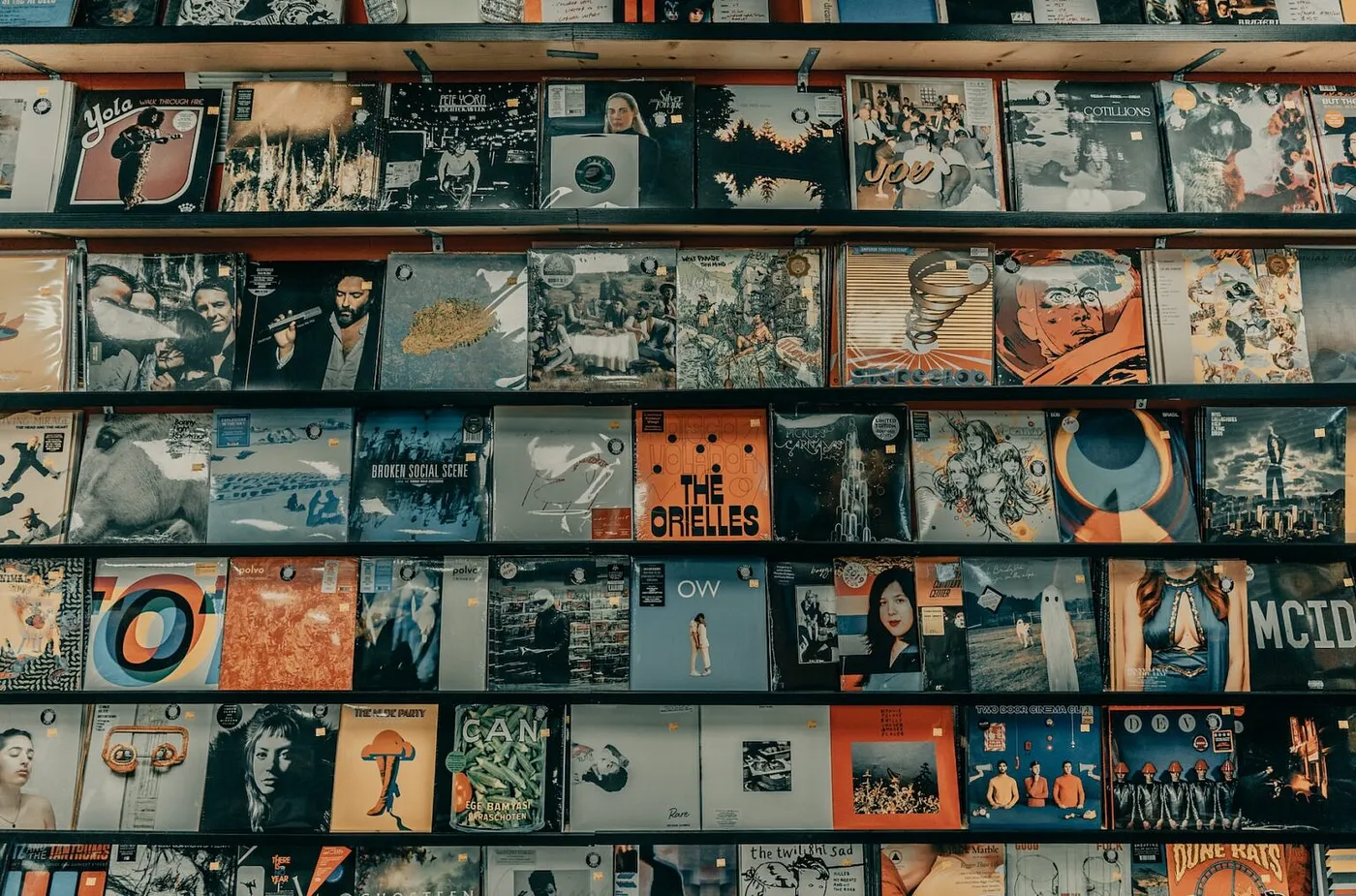
The Albums that Defined “Record Store Day” 2026 — discogs.com
I. The Notice
In late June of 2026, PlayStation customers across the United Kingdom and Europe opened their accounts and found a message waiting. As of the first of September, it explained, they would no longer be able to watch films they had previously purchased from StudioCanal, and those films would be removed from their video libraries. The company thanked them for their continued support.
Five hundred fifty-one titles were on the list. Terminator 2: Judgment Day. Total Recall. Mulholland Drive. Apocalypse Now. Paddington. Bridget Jones’s Diary. The first three Rambo films. Some customers had paid for these more than a decade earlier. No refunds were offered, and none were required, because Sony’s terms of service have always said what nearly every digital storefront’s terms say: the use of words like “purchase” or “buy” does not mean or imply any transfer of ownership. What you bought was a non-exclusive, revocable license, and the license had reached the end of its term.
This was not the first such notice. In 2022, Sony removed StudioCanal titles from the libraries of customers in Germany and Austria, three hundred fourteen films in one country and one hundred thirty-seven in the other, citing evolving licensing agreements. In December of 2023, the company announced it would delete roughly thirteen hundred seasons of Discovery-owned television from PlayStation libraries — MythBusters, Deadliest Catch, How It’s Made, Cake Boss — and reversed course only after a public backlash produced an eleventh-hour renewal with Warner Bros., which the company described as guaranteeing access for at least the next thirty months. The reprieve was itself a lease.
Then, on the first of July, 2026, Sony announced that it would stop manufacturing physical discs for all new PlayStation games beginning in January of 2028. The company framed this as a natural adaptation to consumer preference, noting that demand for digital significantly outpaces demand for discs. On the same day, it announced that the PlayStation 3 and PS Vita storefronts would close, in most countries by July of 2027.
Read together, those two announcements in a single week form the clearest statement of the arrangement now on offer. Your purchases can be revoked when a contract lapses, and the alternative to purchase — the object on the shelf that no contract can reach — is being discontinued for your convenience.
It is against this backdrop that the return of physical media deserves to be understood. Not as a wave of sentimentality among people who miss the smell of a record sleeve, though that is real enough, but as something closer to a property claim: a wager that the only reliable form of access is the kind that does not require permission.
II. The Anatomy of Decay
Cory Doctorow coined the word in 2022, and it has since escaped him entirely. The American Dialect Society named “enshittification” its word of the year for 2023. Australia’s Macquarie Dictionary named it word of the year for 2024, both by its expert committee and by popular vote, defining it as the gradual deterioration of a service or product driven by profit-seeking. In October of 2025 Doctorow published a book under that title, subtitled Why Everything Suddenly Got Worse and What To Do About It, which was longlisted for the Financial Times and Schroders Business Book of the Year.
The argument has a shape that is easy to remember and unpleasantly easy to verify. A platform first behaves generously toward its users, in order to lock them in. Once they cannot easily leave, it degrades their experience to favor the business customers who pay it. Once those customers are also locked in, it squeezes everyone to maximize the value it extracts for itself. Doctorow’s sharpest observation is that these companies are not too big to fail. They are too big to care.
The digital media library is where this logic touches the individual most directly, because it is where the promise was most explicit. The pitch of the streaming era was not merely convenience. It was permanence at scale: every film, every album, every book, always available, for a modest monthly fee. Shelves were reframed as clutter. Ownership was reframed as inefficiency.
What arrived instead was a system of revocable access, and the revocations began in earnest once the growth-at-all-costs era ended and Wall Street started asking about margins.
Consider what happened at Warner Bros. Discovery. In August of 2022, the newly merged company pulled thirty-six titles from HBO Max, twenty of them originals, including the animated series Summer Camp Island, the teen drama Generation, and a Sesame Street spinoff, along with more than two hundred episodes of Sesame Street itself. That December, Westworld, The Nevers, Raised by Wolves, The Time Traveler’s Wife, Minx and others were removed from the service. The already-completed film Batgirl had been shelved before release as part of an eight-hundred-twenty-five-million-dollar content write-down. A securities filing later disclosed that content impairments and development write-offs tied to the merger would run somewhere between two-point-eight and three-and-a-half billion dollars.
Reporting at the time was blunt about the mechanism. Removing streaming originals lets a studio cut expenses immediately and stop paying residuals. The company saved tens of millions of dollars by eliminating content. Some of the work that vanished had never received a physical release and had no legal home anywhere else. It simply stopped existing as a thing a person could watch.
The same logic reaches into books. On the twenty-sixth of February, 2025, Amazon discontinued the “Download and Transfer via USB” option for Kindle titles. The feature dated to the earliest Kindles, built for a world before ubiquitous wireless, and it had one consequential side effect: it let a reader pull a purchased file onto a personal computer and keep it. Its removal applied to every Kindle ever made. Delivery now requires a connection to Amazon. Books can still be sent to a device; they cannot be retrieved from the account. The practical effect is that a Kindle library exists only inside Amazon’s permission structure, which is precisely the arrangement that made possible the incident everyone still cites — the night in 2009 when Amazon reached into customers’ devices and deleted their copies of 1984.
Aaron Perzanowski and Jason Schultz opened their 2016 book The End of Ownership with that episode, and the decade since has functioned as an extended proof of their thesis. Their argument was not that digital distribution is bad. It was that ownership performs functions that licensing cannot: it enables preservation, resale, lending, annotation, repair, and above all the ability to make lawful use of a thing without asking anyone. Strip those out and you have not sold someone a book. You have rented them a view of one.
Yanis Varoufakis pushed the same observation into political economy in Technofeudalism, arguing that the platforms have displaced markets and profits with fiefdoms and rents, and that users function less like customers than like tenants working land they will never hold title to. One need not accept the full thesis — many economists do not, and there is a serious argument that platform rents are simply monopoly profits wearing a costume — to notice that the metaphor lands because the experience matches it. You do not own the field. You have a license to stand in it, revocable at the landlord’s discretion, for as long as his arrangements with other landlords hold.
There is a second decay running alongside the legal one, and it is aesthetic. Kyle Chayka’s Filterworld traced how algorithmic recommendation, sold as personalization, produces homogenization instead — a culture that converges on the least disruptive, least ambiguous option, because that is what the feed is optimized to promote. The relevant point for our purposes is not that algorithms have bad taste. It is that a recommendation system is a form of curation you cannot inspect, cannot argue with, and cannot inherit. It shapes what you encounter without ever telling you what it declined to show you.
Put those two decays together and you get the condition that has driven people back toward objects. The online library can be edited. The platform’s catalog can be flattened. Neither process asks your consent, and neither is required to send you a report.
III. The Barnes & Noble Paradox
For twenty years the conventional wisdom about physical bookselling was that it was a liquidation in slow motion. Borders was gone. Barnes & Noble had been shrinking for more than fifteen years, closing well over a hundred and fifty locations since 2009. Amazon controlled roughly half the book market. The trajectory looked settled.
It was not settled. In December of 2025, Barnes & Noble operated seven hundred twenty-one bookstores across all fifty states and U.S. territories and announced it would open sixty more in 2026. Nineteen of those were open by midyear, with forty-one more scheduled by mid-November. That would make three consecutive years of roughly sixty openings. In 2024 alone, between fifty-seven new stores and the acquisition of Tattered Cover’s four Colorado locations, the company opened more bookstores in a single year than it had in the entire decade from 2009 to 2019. Elliott Advisors, which bought the chain in 2019, has been weighing a public offering of the combined Barnes & Noble and Waterstones businesses.
The turnaround is usually credited to James Daunt, the Waterstones managing director whom Elliott installed as chief executive, and the mechanism he used is worth stating precisely, because it is frequently described in vaguer terms than it deserves.
The old model ran on co-op: publishers paid for placement, and those payments determined what greeted a customer at the front of every store in the country. A shopper in Boston and a shopper in Phoenix walked into the same display because the same publisher had bought the same table nationally. The store was not a bookshop. It was retail square footage rented out by the linear foot, and the person managing the store had no say in what it contained.
Daunt dismantled that. Buying authority moved to store level. Local managers and booksellers got control over what their stores stocked and how they arranged it. New locations are smaller and deliberately less uniform — high shelves, winding paths, themed tables built by the people who work there. The company’s own framing is that it handed control of each bookstore to its local booksellers, and that this is why the growth happened.
What that change actually did was restore a function the algorithm cannot perform, and it is worth being precise about what that function is. It is not that human beings have better taste than software. Sometimes they do not. It is that a human curator is accountable and legible. You can see the whole shelf, including the parts that were not chosen for you. You can ask the person who built it why. You can disagree with them. You can notice a book they did not mean you to notice, sitting adjacent to one they did. Serendipity is not a mystical property of paper; it is a structural property of a browsable, finite, physically arranged collection assembled by someone with an authentic point of view.
The independent sector tells the same story with more force. The American Booksellers Association counted three thousand four hundred seventeen member stores as of May 2026, spread across more than three thousand locations — an increase of more than five hundred in a single year, nearly triple the count of a decade earlier, and the association’s highest membership since the late 1990s. In 2025, six hundred five new brick-and-mortar, pop-up, and mobile stores opened across the country; ABA membership grew nineteen percent that year and has grown one hundred fifty-one percent over six years. Chief executive Allison Hill has noted that people routinely offer her condolences about her industry, assuming it is disappearing.
Hill has also been clear that the growth is not the whole picture. She has described 2025 as simultaneously a banner year and the most difficult on record for independent booksellers, citing rising costs, tariffs, book bans and challenges, free speech harassment, climate disruption, and what she has called Amazon’s monopolistic chokehold on the industry. Both things are true. A sector can expand rapidly and still remain structurally precarious.
The underlying book market is likewise more stable than triumphant. Print unit sales tracked by Circana BookScan reached seven hundred sixty-two point four million in 2025, up three-tenths of a percent — the second consecutive annual increase, though still below the pandemic peak of nearly eight hundred forty million in 2021. The first quarter of 2026 was down three-point-one percent against a quarter that had carried several blockbusters. What the industry’s own analysts describe is not a boom but a resettlement at a higher baseline: adult fiction volume running nearly fifty percent above 2020, books holding up as discretionary spending elsewhere contracts. At the American Booksellers Association’s Winter Institute in February of 2026, a Circana analyst categorized books among consumers’ passion purchases and placed them within a broader appetite for analog living.
IV. The Music Renaissance, Complicated
Music is where the physical revival is least ambiguous and most instructive, partly because the numbers are unusually good and there are some surprising reasons why.
Start with vinyl, which is now on a nineteen-year run. Luminate’s year-end report for 2025 put U.S. vinyl sales at forty-seven point nine million units, up eight-point-six percent, the nineteenth consecutive annual increase. Total U.S. physical album sales rose six-and-a-half percent. Digital album sales — the download, the format that was supposed to have killed the disc — fell nearly sixteen percent. The Recording Industry Association of America, which measures wholesale revenue rather than retail units, put vinyl at forty-six point eight million units and just over one billion dollars for the year, up roughly eight percent in units and nine percent in revenue.
Then came the compact disc, which nobody was expecting.
Luminate’s midyear report for 2026, released in mid-July, found that U.S. CD sales surged sixteen percent in the first half of the year, to sixteen point three million units. Vinyl grew two-point-four percent over the same period. That is a growth rate roughly seven times higher for the format everyone had written off, and it prompted the report’s own headline: CD sales growth outpacing vinyl nearly seven to one.
There are three caveats, however.
The first is K-pop. Strip out those releases and CD growth falls from sixteen percent to six-point-seven percent. That is still nearly three times vinyl’s rate, so the trend is real and broader than one fandom, but K-pop is what turned a steady rise into a headline. Mass-market retailers — Target, Walmart — captured close to thirty percent of physical album sales, driven by elaborate packaging, alternate covers, and collectable photo cards designed so a single album can be bought more than once.
The second is that the two major data sources disagree. Luminate tracks retail sales and consumption; the RIAA reports wholesale figures net of returns. For calendar 2025, the RIAA had CDs down about twelve percent in units and eight percent in revenue. Luminate has them up sixteen percent through the first half of 2026. Both are accurate as they are measuring different things over different windows, so the statistics should be read carefully understanding the nuance.
The third caveat is the most interesting, and also the most surprising. Roughly half of Gen Z and Millennial CD buyers do not own a CD player. Many of them buy the disc as a collectable and then stream the album.
If half of new CD buyers cannot play the object they bought, then playback is not what they are purchasing. Luminate’s own framing is that buying physical music is as much about aesthetic ownership and direct financial support for the artist as it is about listening to the product. The disc is functioning as a certificate — of belonging, of patronage, of having been there. That is a genuinely different behavior from the one romanticized in essays about dropping the needle and sitting still for forty minutes, while compelling and still very true, this is a new reason.
It is also the most useful thing in the data, because it isolates the motive. Strip away playback and you are left with whatever else the object was doing — and whatever that is, it is strong enough to move sixteen million units in six months.
There is a quieter constituency underneath all of this that the growth narratives ignore entirely. Research cited alongside the Luminate figures found that sixty-nine million Americans listened to a CD at least once in 2025, more than forty million of them in a car, with over twenty million treating the disc as their primary format behind the wheel. Those listeners never left, which is exactly why they do not register as a revival. They are not collectors making a statement. They have a disc in the dashboard of a car too old for Bluetooth and have no reason to change.
Two things are therefore happening at once: a stable base of people who kept using the format, and a new cohort buying it as an artifact. Neither group is behaving irrationally. Both are, in different ways, making a decision to support holding onto something physical.
V. The Stockpilers
Film is the exception that has not been affected in the same way, because here the physical market is not recovering in any meaningful sense. Total U.S. consumer spending on DVD, Blu-ray, and 4K Ultra HD discs came to eight hundred seventy million dollars in 2025 — down roughly eighty-six percent from the six point one billion dollars spent on discs a decade earlier. Subscription streaming took more than ninety-two percent of American home entertainment spending in the same year. Best Buy stopped selling discs in 2024. Netflix ended its DVD-by-mail service in 2023. Sony will stop pressing PlayStation game discs in January of 2028. Almost no new 4K players have been announced in several product cycles, which means a format whose software sales are stabilizing has a hardware horizon.
Nobody should call that a revival, it is quite the opposite.
But something specific is happening inside the wreckage, and the motive is pure and easy to understand. The 4K Ultra HD category returned to growth in 2025, up twelve percent after declining nearly every year since 2018 — the one segment holding flat or rising in every quarter. That growth is being produced almost entirely by boutique labels: Criterion, Arrow Video, Vinegar Syndrome, Shout! Studios, Severin, Kino Lorber, Radiance, and a steady arrival of new imprints. They release restorations with commentaries and printed essays, in limited pressings, for films that streaming services either do not carry at all or carry in compromised transfers. In the United Kingdom, roughly one in ten 4K releases now ships as a steelbook, and those editions account for close to a fifth of format spending.
These are not people buying movies. They are people acquiring the only edition that will ever exist, at the moment it exists, because they have watched what happens to titles that have no physical home. When Warner Bros. Discovery pulled work off HBO Max for accounting reasons, some of it had never received a disc release and simply ceased to be available anywhere, legally, in any form. The lesson collectors drew was not aesthetic. It was actuarial: buy it now, because out-of-print arrives faster than you think and there is no second chance.
That is a niche of a niche — a few hundred thousand people behaving like private archivists. It will not reverse a market. But it is the clearest available demonstration of what physical media is actually for once convenience is off the table, which is the question worth spending the rest of this on.
VI. What the Object Actually Does
Half of young CD buyers cannot play their CDs. That single finding does more analytical work than any sales chart, because it removes the obvious explanation and forces the real one into view. If the disc is not being bought for sound, then whatever people are paying for is something a streaming account structurally cannot provide. There turn out to be five such things, so lets take a closer look.
It pays somebody, visibly. Streaming royalties for recorded music run somewhere in the neighborhood of a third to half a cent per play, before the deductions that take a share to the label, the distributor, and the publisher. The industry’s own accounting convention treats fifteen hundred on-demand streams as the equivalent of a single album sale. Run that arithmetic and a listener who plays an album twice a week for a year has generated something in the range of a few dollars, shared out among everyone with a claim on it. That same listener buying the record once, for fifteen dollars, moves substantially more money and moves it immediately. This is why Luminate’s own language about physical buying puts direct financial support alongside listening as a motive. Twenty percent of American listeners now qualify as superfans by the firm’s definition, engaging with artists in five or more ways, and twenty-two percent qualify specifically as purchase-based. Those are not people confused about the technology. They are people who have worked out that streaming is a distribution channel and buying albums actually does more to support the artist.
It is a membership token. The mass-market channel — Target, Walmart — took close to thirty percent of American physical album sales in the first half of 2026, on the strength of releases packaged with alternate covers, photo cards, and variant editions that reward buying more than one copy. Cultural critics treat this as a scam, and in commercial terms it plainly is a mechanism for extracting multiple purchases from one fan. But the fan is not being deceived, and the behavior is not irrational once you accept that the object is functioning as a badge rather than a delivery mechanism. Buying four copies of an album is absurd if you want the songs. It is perfectly coherent if you want to be counted, to have contributed to a first-week number, and to hold the physical proof of it. Scarves get sold at soccer grounds on exactly this logic and nobody writes essays about the epistemic confusion of supporters.
It is finite, and someone chose it. A shelf is a bounded set assembled by a person with a point of view — the bookseller in your town, the boutique label’s editorial staff, or by you in your own home. A feed is an unbounded set assembled by a system optimized for retention, which is not the same as being optimized for you. Kyle Chayka’s argument in Filterworld was that algorithmic recommendation, sold as personalization, tends to converge on the least disruptive option and flatten difference in the process. The deeper problem is not taste but perspective: you can see a whole shelf, including the parts nobody paid to place in front of you, and you can ask the person who built it why. You cannot inspect a recommendation engine, cannot argue with it, and are never told what it declined to show you. Barnes & Noble’s recovery is the commercial proof of this. It did not out-recommend Amazon. It stopped selling front-table placement to publishers and handed the decision to the person standing in the room, and seven hundred twenty-one stores’ worth of customers responded.
It can be given away. This is the plainest advantage and the one that gets the least attention. You can lend a record to a friend, resell a book, leave a collection to somebody. A digital library terminates with the account, and the account terminates with you. Used bookshops, garage sales, the crate at the back of a charity shop, the box of albums that arrives when a relative sadly passes away— an entire secondary culture exists because ownership of a physical copy is transferable, and none of it has a digital equivalent. A person building a shelf is doing something a subscriber structurally cannot: accumulating an estate. The oddity of the modern arrangement is not that streaming is rented. It is that the rental was marketed using the vocabulary of ownership, rather than the awkward temporary privilege that is actually granted.
It cannot be revised. Everything in the first half of this essay reduces to this point. A book on a shelf cannot be quietly edited by an update. A record does not stop working when a contract lapses. A disc cannot be removed from your collection because a studio wanted a write-down or a distributor’s licensing deal expired. The object is unchangeable, and that is the feature. Perzanowski and Schultz made this argument a decade ago in The End of Ownership, and the intervening years have functioned as its proof: what ownership actually secures is not possession but immunity from revision by a third party who has no obligation to tell you first.
Underneath all five, there is a constituency that never made any of these arguments because it never left. Research alongside the Luminate figures found that sixty-nine million Americans listened to a CD at least once in 2025, more than forty million of them in a car, with over twenty million using the disc as their primary format behind the wheel. Nobody counts them as part of a revival because their numbers have not moved. They are not collectors making a statement. They have a disc in the dashboard of a car too old for Bluetooth, and they have never once had to think about whether it would still be there tomorrow.
That is the whole of it, really. The stockpiler buying a Vinegar Syndrome limited edition, the K-pop fan buying a fourth photo card variant, the reader driving past two chain stores to reach an independent shop, and the commuter with the same six CDs in the glovebox are doing recognizably different things for recognizably different reasons. What unites them is that none of them will lose the ability to enjoy their media as long as their disc remains intact.
VII. Reclaiming the Material World
None of this adds up to a reversal of the digital transition, that isn’t what this is about. Print sales are roughly flat and fell three percent in the first quarter of 2026. Disc spending declined nine percent last year on a base already gutted. Vinyl’s growth has slowed to a crawl. Streaming took ninety-two percent of American home entertainment dollars. What is forming is not a comeback but a new floor — a durable minority practice running alongside the dominant one, made up of people who have read the terms and declined them.
But that floor is legible in the numbers, and the numbers are not small. Sixty new Barnes & Noble stores a year for three consecutive years. Three thousand four hundred seventeen independent bookshops, the most since the late 1990s and nearly triple the count a decade ago. Nineteen straight years of vinyl growth. Compact discs up sixteen percent in half a year, in a format that had been declared dead twice. A twelve percent rise in 4K disc spending after seven years of decline, produced by labels restoring films no platform would carry.
The change that produced all of this happened quietly and without anyone’s consent. The transaction was reclassified. What used to be a sale became a license, and licenses expire, and the word on the button never changed. That reclassification was not inevitable and it is not natural. It is a product of specific contracts and a legal environment that treats a digital copy as a categorically different object from a physical one — different enough that the old principle, the one holding that a seller’s control over a copy ends when the copy is sold, simply does not travel across the gap. That principle is why used bookstores exist, why you can lend a record, why a garage sale is legal. It is one of the quiet load-bearing structures of cultural life, and the digital transition routed around it entirely.
Buying an object is one of the few ways an ordinary person can decline that arrangement without a lawyer. It is not a complete answer and treating it as one is a mistake. But it registers immediately, it requires nobody’s permission, and it is the only vote in this market that cannot be reversed after it has been cast.
There is a version of this argument that leans on warmth — the smell of paper, the ritual of the needle, the bookseller who knows your taste. All of that is real but it misses the point. The point is structural, and it survives without any sentiment at all.
On the first of September, several hundred thousand people across Europe will discover that films they paid for are gone. They will not be able to appeal it and they will not be refunded. Every one of those films exists somewhere on a disc that nobody can reach into and delete.
That is not nostalgia. That is just the difference between having something and being allowed to see it.
Sources
Music and physical sales data
- Luminate, 2026 Midyear Report: Trends in Music, Television & Film (July 15, 2026) — luminatedata.com
- Variety, “Led by Taylor Swift, U.S. Vinyl Sales Rose for 19th Consecutive Year in 2025: Luminate Year-End Report” (January 2026) — variety.com
- Billboard, “Luminate Midyear Report 2026: R&B/Hip-Hop Falls, Dance Rises, CDs Surge 16% & More” — billboard.com
- Headphonesty, “CD Sales Are Growing Six Times Faster Than Vinyl in 2026, but There’s a Catch” (July 2026), including MusicWatch listenership figures — headphonesty.com
- ecoustics, “U.S. CD Sales Surge 16% in 2026 as Vinyl Growth Slows to 2.4%” (July 2026), including RIAA 2025 comparison figures — ecoustics.com
- Luminate, “Is DVD the New Vinyl? The Silver Lining to Spiraling Disc Spend” (March 2026) — luminatedata.com
- Ditto Music, “How Much Does Spotify Pay Per Stream in 2026,” on per-stream royalty ranges — dittomusic.com
Home video and physical disc market
- FlatpanelsHD, “UHD Blu-ray returned to growth in 2025,” reporting Digital Entertainment Group year-end data — flatpanelshd.com
- Digital Entertainment Group, Year-End 2025 Digital Media Entertainment Report — degonline.org
- What Hi-Fi, “4K Blu-ray sales are on the rise, but one key ingredient is missing for a vinyl-level revival” — whathifi.com
- Film Threat, “The Resurgence of 4K UHD, Blu-ray, and DVD in 2026,” including U.K. ERA figures and steelbook share — filmthreat.com
- Tom’s Guide, “4K Blu-ray sales are in free-fall,” on 2024 DEG figures and retailer withdrawals — tomsguide.com
Digital revocation and platform behavior
- Kotaku, “PlayStation Is Deleting Terminator 2 And 550 Other Movies” (June 26, 2026) — kotaku.com
- Notebookcheck, “PlayStation to wipe 551 films from customers’ accounts” (June 28, 2026) — notebookcheck.net
- Variety, “PlayStation Store Pulling Access to Purchased StudioCanal Movies Next Month” (2022) — variety.com
- GamesHub, “PlayStation no longer removing Discovery content” (December 2023) — gameshub.com
- PlayStation.Blog, “Physical disc production ending in January 2028 for new games releasing on PlayStation consoles” (July 1, 2026) — blog.playstation.com
- CNBC, “PlayStation will end physical disc production for new games in 2028” — cnbc.com
- CNBC, “Streaming services are removing tons of movies and shows — it’s not personal, it’s strictly business” (May 2023) — cnbc.com
- NPR, “HBO Max cuts dozens of titles in a cost-cutting move before a merger with Discovery+” (August 2022) — npr.org
- NPR, “Popular titles are vanishing from HBO Max after merger” (December 2022) — npr.org
- Good e-Reader, “The Amazon Kindle Download and Transfer via USB is Discontinued” (February 26, 2025) — goodereader.com
- TechRadar, “Amazon just killed a useful Kindle USB feature” — techradar.com
Bookselling
- Forbes, “Barnes & Noble Preps For An IPO Amid Plans To Open 60 New Stores In 2026” (December 2025) — forbes.com
- Fox Business, “Barnes & Noble to open 60 new stores in 2026” — foxbusiness.com
- Retail Dive, “Barnes & Noble plans 60 store openings in 2025” — retaildive.com
- American Booksellers Association, “ABA CEO Allison Hill’s Letter from the 2025 Annual Report” — bookweb.org
- Entrepreneur, “This Independent Industry Is Making a Comeback. Here’s Why.” (May 2026), on ABA membership figures — entrepreneur.com
- Publishers Weekly, “Print Book Sales Rose Slightly in 2025” — publishersweekly.com
- Publishers Weekly, “Print Sales Fell 3.1% in the First Quarter of 2026” — publishersweekly.com
- Publishers Weekly, “Book Sales Bolstered by ‘Passion Purchases,’ Interest in ‘Analog Living’” (Winter Institute 2026) — publishersweekly.com
Books
- Aaron Perzanowski and Jason Schultz, The End of Ownership: Personal Property in the Digital Economy (MIT Press, 2016) — mitpress.mit.edu
- Cory Doctorow, Enshittification: Why Everything Suddenly Got Worse and What To Do About It (Farrar, Straus and Giroux / Macmillan, 2025) — us.macmillan.com
- Yanis Varoufakis, Technofeudalism: What Killed Capitalism (Melville House, 2024) — mitpressbookstore.mit.edu
- Kyle Chayka, Filterworld: How Algorithms Flattened Culture (Doubleday, 2024) — penguinrandomhouse.com
- Macquarie Dictionary Word of the Year 2024, “enshittification,” as reported by AFP — malaymail.com