The Land-Use Crisis No One Talks About
There is a crisis unfolding across America’s rural counties, farmland corridors, and post-industrial communities that receives far less attention than the AI electricity and water debates, but is no less consequential. It is a land-use crisis, and it is accelerating. As the explosive growth of artificial intelligence and cloud computing drives an insatiable demand for new infrastructure, developers have been depleting the most obvious supply of large, flat, well-connected land. The traditional playbook — find a cheap, untouched rural plot, clear the trees, grade the land, and build — is colliding with a wall of grid bottlenecks, environmental review timelines, agricultural preservation laws, and community resistance so organized and so legally sophisticated that it is now costing the industry billions of dollars and years of delay.
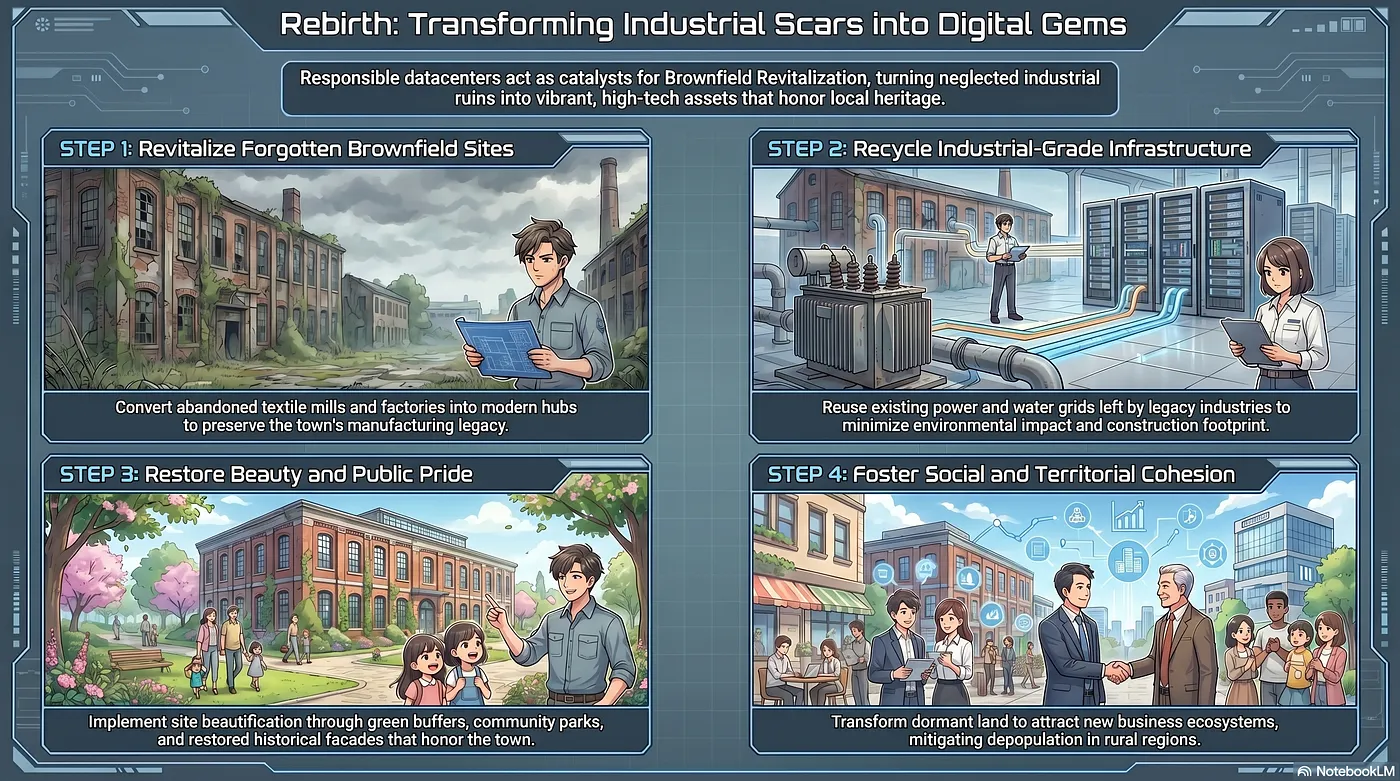
Rebirth: Transforming Industrial Scars into Digital Gems — Generated by Google Gemini
The American Farmland Trust reports the loss of roughly two thousand acres of farmland every single day to non-agricultural development across the United States, with USDA data showing a cumulative loss of approximately seventy-five million acres of agricultural land between 1997 and 2022. Data centers are not the only driver of that loss, but they are an accelerating one. In Logan County, Illinois — where glacial deposits created some of the world’s richest soil and corn fields yield more than two hundred thirty bushels per acre — an AI infrastructure developer recently proposed covering two hundred acres of prime farmland with a five-hundred-megawatt data center campus. In Montour County, Pennsylvania, farmers who have operated alongside existing transmission corridors for decades are now contending with rezoning applications that would consume hundreds of acres of corn and soybean ground. These are not isolated cases. They are the logical endpoint of a decade-long greenfield development strategy that the infrastructure industry has treated as the path of least resistance, even as that path has grown more obstructed, more expensive, and more politically dangerous with each passing year.
The argument of this essay is neither that data centers are a threat to rural America, nor that infrastructure development should be stopped. It is precisely the opposite. The argument is that the infrastructure sector’s continued dependence on greenfield land is both strategically unnecessary and increasingly self-defeating, and that the United States already possesses a vast, underutilized inventory of former industrial sites that are better suited — technically, economically, regulatorily, and socially — for the hyperscale data centers of the AI era than any untouched field or forest. By pivoting from greenfield expansions to brownfield redevelopments, the datacenter industry can bypass crippling power grid queues, unlock unprecedented federal tax incentives, and fulfill a vital social contract — transforming America’s decaying industrial rust belts into proud, high-tech hubs of the twenty-first-century economy.
Part One: The Greenfield Approach and Its Mounting Costs
The Grid Queue Problem
The single most damaging consequence of greenfield datacenter development is not the land it consumes or the communities it upsets. It is the time it wastes. A greenfield site, by definition, lacks the heavy electrical infrastructure that a hyperscale data center requires. Building a new one-hundred-megawatt or larger facility on previously undeveloped agricultural or forested land means entering the most backlogged utility interconnection queue in the history of the American electrical system.
As detailed in the second pillar of this series, PJM Interconnection — the regional transmission organization serving sixty-seven million people across thirteen states — saw projects that became operational in 2025 wait an average of eight years from application to commissioning. That figure is not an anomaly or a temporary processing backlog. It reflects structural scarcity: a fixed grid built for a different era of load distribution, now being asked to serve gigawatt-scale concentrations of compute at locations where the transmission infrastructure simply does not exist. The Lawrence Berkeley National Laboratory’s 2024 report projects that U.S. data center electricity consumption will rise to between 325 and 580 terawatt-hours by 2028, roughly doubling or tripling from the 176 terawatt-hours consumed in 2023. Every megawatt of that growth that tries to land on a greenfield site must first wait for a substation to be engineered, permitted, funded, and built. In the PJM territory that encompasses Northern Virginia, PJM has approximately 40 gigawatts of data center capacity in various stages of contracting with Dominion Energy alone, according to Dominion’s 2025 integrated resource plan filings.
A greenfield project must also build its own interconnecting transmission lines. This means new right-of-way acquisition, new tower foundations, new permitting under state utility commission rules, and often new NEPA environmental review — a process that, for significant transmission projects, routinely extends three to five years before a single bolt is tightened. When a project encounters wetland crossings, agricultural prime farmland designations, or historic preservation buffers — as the proposed Prince William Digital Gateway in Virginia encountered near the Manassas National Battlefield Park — the litigation can add years more.
The Community Opposition Crisis
The Prince William Digital Gateway is the canonical cautionary tale of 2025. In December 2023, after a twenty-seven-hour public meeting, the Prince William County Board of Supervisors narrowly approved the rezoning needed to authorize what was proposed to be the world’s largest data center campus: thirty-seven buildings across more than two thousand acres of rural and agricultural land in Manassas, Virginia, planned by QTS Realty Trust and Compass Datacenters. The project, backed by Blackstone, had been through years of public controversy over its visual impacts on Civil War heritage sites, its energy demand, its water consumption, and its proximity to the Manassas National Battlefield Park.
In August 2025, Circuit Court Judge Kimberly Irving voided the rezoning on the grounds of insufficient public notice. The Virginia Court of Appeals upheld that ruling. Compass Datacenters subsequently withdrew from the project entirely. QTS and associated landowners are still locked in litigation. A project that represented what developers hoped would be a defining next chapter in Northern Virginia’s data center geography has been, for practical purposes, halted by a combination of procedural failure and community resistance so organized that it spawned dozens of allied activist groups across the region.
According to a Data Center Watch report covering the period from May 2024 to March 2025, community opposition has blocked or delayed more than sixty-four billion dollars in data center investment across the United States — eighteen billion dollars in blocked projects and forty-six billion dollars facing active delay. The report identified 142 organized activist groups operating across 27 states. In Fauquier County, Virginia, actor Robert Duvall joined hundreds of residents in opposing an Amazon data center proposal in Warrenton, citing the character of the rural landscape. In Culpeper County, Virginia, a proposed development near the newly established Culpeper Battlefields State Park — created in 2024 to protect the site of the largest cavalry battle in North American history — has drawn fierce pushback from preservation groups. In Franklin Township, Indiana, nearly five hundred acres of farmland proposed for rezoning sparked petition campaigns, yard-sign drives, and packed public hearings. In Tucson, Arizona, as detailed in the first pillar of this series, the city council voted seven to zero to reject Project Blue, a 290-acre campus that would have consumed thousands of acre-feet of desert water.
Loudoun County, Virginia — long the world’s most permissive major data center market — ended that posture in March 2025, eliminating by-right development for data centers and requiring legislative Special Exception approval for every new project. Fairfax County imposed two-hundred-foot setbacks from residential properties, one-mile buffers from Metro stations, and full equipment enclosure requirements in September 2024. These are not the acts of anti-technology counties. These are the acts of communities whose political capacity to resist has caught up with the pace of development.
The political consequence is measurable. A January 2026 poll commissioned by CCAN Action Fund and conducted by Global Strategy Group found that seventy-three percent of Virginia likely voters blame data centers for rising electricity costs. A Washington Post–Schar School poll conducted in April 2026 found that voter comfort with a new data center in their community had fallen to thirty-five percent, down from sixty-nine percent in 2023. Three years. Thirty-four percentage points. That is the speed of a social license collapse.
The Farmland and Ecological Cost
Beyond grid delays and community politics, the greenfield model carries a third cost that is increasingly difficult to defend: the permanent conversion of productive agricultural land and functioning ecosystems into impervious industrial surface. The American Farmland Trust’s standing estimate — two thousand acres of farmland lost every day to non-agricultural development — is a national figure, but the contribution of data center development to that loss is rising. In Logan County, Illinois, one proposed five-hundred-megawatt campus would cover two hundred acres of ground that yields more than two hundred thirty bushels of corn per acre annually. In Ohio, a state that offered $2.5 billion in data center tax incentives between 2017 and 2024, the conversion of prime agricultural soils to industrial use has become an explicit legislative concern. In Montour County, Pennsylvania, farmers who grow corn, soybeans, and hay are fighting proposed rezonings that would permanently remove their land from agricultural production.
The ecological consequence of greenfield clearing is less economically legible but no less real. Clearing forested or wetland land triggers NEPA review obligations, sometimes U.S. Fish and Wildlife Service consultation under Section 7 of the Endangered Species Act, and frequently state-level environmental impact assessment. These processes can add twelve to thirty-six months to a project timeline even in the absence of formal opposition — and in politically contested areas, they become the legal mechanism through which opponents slow projects that have received local zoning approval. A greenfield development is, by definition, asking regulators to authorize the disturbance of land that has not previously been disturbed. A brownfield development is, by definition, proposing to clean up and reuse land that has already been disturbed, often severely.
Part Two: The Brownfield Inventory and Its Advantages
What America’s Industrial Legacy Left Behind
The United States Environmental Protection Agency estimates that more than 450,000 brownfield sites exist across the country. The term, defined in the Small Business Liability Relief and Brownfields Revitalization Act of 2002 — which amended the Comprehensive Environmental Response, Compensation, and Liability Act of 1980, commonly known as CERCLA or Superfund — refers to real property whose expansion, redevelopment, or reuse may be complicated by the presence or potential presence of a hazardous substance, pollutant, or contaminant. These range from small urban gas stations occupying less than one acre to former steel mills, chemical processing complexes, aluminum smelters, and coal-fired power plants spanning hundreds or thousands of acres.
The geographic distribution of that inventory is one of the most structurally important facts in the data center siting story. The heaviest concentrations of large industrial brownfields are precisely the regions that have suffered most from deindustrialization over the past half-century: the Rust Belt of Pennsylvania, Ohio, Indiana, Illinois, and Michigan; the coal belt of West Virginia, Kentucky, Alabama, and Wyoming; the former textile manufacturing corridors of the Carolinas and Georgia; and the chemical processing corridors of Texas, Louisiana, and New Jersey. These are communities where plants employed thousands of workers for generations, then closed, leaving contaminated soil, stranded infrastructure, eroded tax bases, and structural unemployment. They are also communities where large industrial sites were built with exactly the kind of power, water, transportation, and industrial zoning that a data center requires — and where that infrastructure, minus the generating equipment, is often still in place.
The Grid Interconnection Advantage
Of all the advantages brownfield sites offer, the most time-critical is the one that matters most in the current infrastructure race: pre-existing, high-capacity electrical grid interconnection. When a coal-fired power plant, aluminum smelter, steel mill, or chemical plant closes, the generation equipment is decommissioned, but the transmission lines, substations, switchgear, and points of interconnection to the regional grid typically remain. These assets represent billions of dollars of sunk investment. They are already permitted, already connected, and already capable of handling the kind of electrical load that a hyperscale data center requires — sometimes hundreds or even thousands of megawatts.
The Pacific Northwest National Laboratory, in its September 2024 brief “Redeveloping Coal Power Plants: Data Centers,” published with DOE’s Industrial Efficiency and Decarbonization Office, identified three specific reuse pathways for retired coal plant sites, all of which center on leveraging the existing electrical point of interconnection. The brief’s framing captures the essential logic: a data center installed on the brownfield site of a retired coal power plant can reuse the electrical point of interconnection to draw power from the grid without entering the interconnection queue, procure new clean energy through a corporate power purchase agreement, and potentially add on-site clean generation later. The DOE explicitly cited “leveraging energy community opportunities to re-use infrastructure at retired coal facilities for data centers and associated power infrastructure” as one of its primary recommended strategies for managing data center electricity demand growth in its January 2025 release of the LBNL 2024 data center energy use report.
According to GAI Consultants’ 2025 industry analysis, approximately one hundred twenty coal-fired power plants in the United States have retired or are in the process of retiring as of 2025, with capacity auctions at PJM already reflecting an eight hundred percent jump in capacity pricing for the 2025/2026 delivery year. Each of those retired plants represents a potential brownfield data center site with substantial existing transmission assets. For developers who cannot afford to wait eight years in a greenfield queue, this inventory is not a secondary consideration — it is a survival strategy.
The brownfield advantage extends beyond former power plants. Aluminum smelters were among the most electricity-intensive industrial operations in American history, consuming hundreds of megawatts for the electrolytic reduction process that turns alumina into aluminum. When these facilities closed — as Alcoa’s Eastalco Works in Frederick County, Maryland, did in 2010 — they left behind not only contaminated land, but also the massive electrical infrastructure that had been built specifically to feed those smelters. Steel mills, similarly, consumed vast quantities of electricity for electric arc furnaces and rolling operations. Chemical processing complexes built industrial-grade utility systems as foundational infrastructure, not afterthoughts. Each represents a category of brownfield site whose grid interconnection advantage can be measured in years of queue time saved.
Zoning, Water, Transportation, and Speed
Beyond electrical infrastructure, former industrial sites typically offer a suite of secondary advantages that are individually valuable and collectively decisive. Industrial zoning is the most politically significant. Brownfield sites zoned for heavy industry do not require the rezoning fights, the public hearings, the environmental impact assessments, and the legal challenges that accompany the conversion of agricultural or residential land to industrial data center use. Loudoun County’s new Special Exception requirement, Fairfax County’s setback rules, and Prince William County’s voided rezoning all apply to applications for new industrial use on land that was not previously so designated. A brownfield site in an existing heavy industrial zone bypasses that entire process.
Water access is the second major advantage, directly relevant to the water sustainability arguments made in the first pillar of this series. Former industrial sites were built with industrial-grade water supply and treatment infrastructure. Coal plants had river intakes and cooling water permits. Chemical plants had permitted discharge points and water treatment systems. Aluminum smelters had cooling and process water agreements. A data center that adopts closed-loop, zero-evaporation liquid cooling — as the first pillar argues all new facilities should — requires far less water than the industrial operation it replaces, yet inherits the water rights and access infrastructure of a far more water-intensive predecessor. This is not a marginal convenience; in water-stressed regions like Arizona, Nevada, and the Colorado River basin, inheriting a pre-existing water right rather than having to obtain a new one can be the difference between a project that is permitted and one that is not.
Transportation infrastructure at former industrial sites — rail lines, heavy-load roads, barge access, fiber conduit corridors along existing rights of way — compounds these advantages. Google’s Gary Demasi, then Director of Global Infrastructure, explicitly cited the rail lines into the Widows Creek site as a conduit for the fiber-optic cable the data center would require: “There are existing rail lines into the Widows Creek site, so Google will likely be able to access buried conduits along the tracks to run fiber optic cable.” The fiber conduit problem — which drives data center colocation economics in ways that are invisible to outside observers — is solved at former industrial sites in exactly the same way the grid interconnection problem is solved: by inheriting infrastructure that took decades and billions of dollars to build, rather than procuring it from scratch.
Part Three: Case Studies in Brownfield Redevelopment
Google at Widows Creek, Alabama: The Proof of Concept
In June 2015, Google announced a $600 million data center investment on the grounds of the Widows Creek Fossil Plant in Stevenson, Jackson County, Alabama — a site that the Tennessee Valley Authority had operated since 1952 and was in the process of retiring. The final generating unit, Unit 7, had a capacity of 460 megawatts; the earlier units had been retired progressively as EPA coal combustion rules and the economics of cheap natural gas made the plant uncompetitive. TVA’s closure left the site — 320 to 350 acres of developed industrial land with transmission lines, substations, rail access, and water supply — available for reuse.
Google’s decision was not primarily sentimental or symbolic, though Gary Demasi’s language at the announcement captured an ethic that would define the brownfield datacenter movement: “We see a lot of value in redeveloping coal plants and other industrial sites. Decades of investment in infrastructure shouldn’t go to waste just because a site has shut down.” The decision was primarily practical. The site offered existing transmission access to TVA’s grid — one of the most reliable utility systems in the country — along with water supply infrastructure and the kind of site area (320-plus acres in a single parcel) that would take years to assemble from smaller private agricultural tracts in more contested markets. Google used the existing interconnection point and contracted for solar energy to help power the facility, achieving its hundred-percent renewable energy commitment without having to build new transmission.
The economic impact on Jackson County was immediate and substantial. The investment created seventy-five to one hundred permanent jobs with an average salary of approximately forty-five thousand dollars — more positions than the ninety jobs the coal plant had supported at the time of its closure, with higher average wages — plus hundreds of construction and mechanical positions during the build phase. Google awarded more than six hundred thousand dollars to local schools and nonprofits. Jackson County’s combination of existing energy infrastructure, developable land at scale, proximity to the regional labor markets of Chattanooga, Huntsville, and Atlanta, and low-cost TVA power made it, in the words of the Greater Chattanooga Economic Partnership’s retrospective, a defining example of how legacy energy infrastructure could be re-purposed as the anchor for a new economic identity.
The Widows Creek project was Google’s fourteenth data center globally and its seventh in the United States at the time of the announcement. It was the first major example of a hyperscaler explicitly choosing a brownfield coal plant site for the infrastructure advantage rather than as a sustainability gesture, and it established the template that dozens of subsequent projects have followed.
Homer City, Pennsylvania: The Rust Belt’s Next Chapter
The former Homer City Generating Station in Indiana County, Pennsylvania, was the largest coal-burning power plant in the state when it opened in 1969, and its 1,217-foot chimney — the tallest in the United States — was visible for miles across the rolling Appalachian farmland of western Pennsylvania. The plant operated for nearly fifty-five years, powering the region and anchoring Indiana County’s industrial identity, until competition from cheaper natural gas and the rising costs of environmental compliance made continued operation uneconomical. The plant was permanently decommissioned on July 1, 2023. The chimney was demolished on March 22, 2025.
What Homer City left behind was, in the data center context, almost ideally configured: a 3,200-acre site with dual interconnections to both the PJM Interconnection and the New York Independent System Operator, existing substations and transmission lines, rail access, water infrastructure from the facility’s cooling systems, and heavy industrial zoning in a county with economic development incentives and a workforce experienced in industrial operations. On April 2, 2025, Homer City Redevelopment and Kiewit Power Constructors announced the transformation of the site into the Homer City Energy Campus — a natural gas-powered data center campus designed to deliver up to 4.5 gigawatts of electricity for AI and high-performance computing workloads. GE Vernova will supply seven hydrogen-enabled 7HA.02 gas-fired turbines, with the first deliveries beginning in 2026 and power production beginning in 2027. The Pennsylvania Department of Environmental Protection has confirmed the redevelopment through a series of permit modification approvals, and the state awarded HCR a five-million-dollar grant to construct an interconnection between the campus and the Texas Eastern gas pipeline system approximately five miles away.
The Homer City Energy Campus, at 4.5 gigawatts, would represent roughly 2.5 percent of the entire projected U.S. data center electricity demand for 2028 on a single formerly contaminated site in Indiana County — a county whose annual median household income is approximately fifty-nine thousand dollars and whose economy was materially dependent on the now-decommissioned plant. HCR projects the creation of more than ten thousand direct on-site construction jobs and approximately one thousand permanent high-paying positions in technology, operations, and energy infrastructure. The total capital investment — the projected cost of the power infrastructure and associated data center buildings — is expected to represent the largest capital investment in the history of the Commonwealth of Pennsylvania.
The Homer City story also illustrates the “brownfield first” logic in its most urgent form. The PJM dual interconnection at the Homer City site — capacity originally engineered and permitted for a two-gigawatt coal plant — would take a greenfield developer many years and hundreds of millions of dollars to replicate. HCR and Kiewit began construction on the assumption that “much of the critical infrastructure for the project is already in place from the legacy Homer City plant, including transmission lines connected to the PJM and NYISO power grids, substations and water access.” That sentence, from the April 2025 HCR-Kiewit press release, is the entire brownfield value proposition rendered in one sentence.
Quantum Frederick, Maryland: Scale, Ambition, and the Lessons of Execution
In June 2021, Quantum Loophole, in a strategic joint venture with TPG Real Estate Partners, closed on the purchase of the former Alcoa Eastalco Works site near Buckeystown in Frederick County, Maryland. The transaction, valued at approximately one hundred million dollars according to Alcoa’s published disclosure — or roughly forty-eight thousand dollars per acre, a fraction of the more than two-million dollars per acre then commanding for prime data center land in Ashburn — gave the joint venture 2,100 acres of former aluminum smelting land located approximately twenty-five miles due north of the heart of Northern Virginia’s Data Center Alley.
The Eastalco Works had been one of the most energy-intensive industrial operations in Maryland’s history. Aluminum smelting requires massive sustained electrical loads for the electrolytic Hall-Héroult process, and the plant had been connected to the regional grid with exactly the kind of high-capacity infrastructure needed to move hundreds of megawatts continuously. The facility, which opened in 1970 under a French-Japanese partnership as the Howmet/Pechiney plant, was acquired by Alumax in 1983 and then by Alcoa in 1998 before closing in 2010. Demolition of the facility was completed in 2017 under the terms of an environmental covenant that obligated the site’s owners to manage legacy groundwater and soil contamination from decades of smelting operations.
Quantum Loophole’s founding CEO, Josh Snowhorn, framed the project’s vision with unusual candor: “I want to take brownfield sites, reclaim them from being environmental hazards and remake them for the future of the Internet as sustainability-focused assets.” The Maryland Department of Commerce, working with Frederick County, announced the acquisition at a press conference in June 2021, citing the state’s recently passed data center sales and use tax incentive program. Officials projected tens of thousands of construction jobs, approximately fifteen hundred permanent positions, and millions of dollars in annual tax revenue for Frederick County.
The project broke ground in 2022 and has since navigated a set of challenges that make it one of the most instructive brownfield datacenter case studies available — instructive precisely because some of its difficulties were foreseeable and some were preventable. In 2023, the Maryland Department of the Environment found permitting lapses and problematic discharges into Tuscarora Creek during construction of the QLoop fiber-optic tunnel under the Potomac River — a project designed to connect the Frederick County campus directly to Northern Virginia’s fiber ecosystem. A proposed settlement of approximately one hundred thirty thousand dollars from twenty-five state inspections documented four “frac-outs” in which drilling fluids entered waterways feeding the Potomac. The Maryland Public Service Commission voted to deny a tenant company’s request to install 168 three-megawatt diesel backup generators, citing environmental rule waivers.
In September 2024, TPG filed a lawsuit against Quantum Loophole seeking to remove the company from its management role, citing concerns about execution experience and alleged misrepresentations; the dispute was settled in early 2025, with Catellus Development Corporation, a TPG affiliate, assuming full management responsibilities. Quantum Loophole itself, in partnership with the University of Maryland, broke ground on a 600-acre Nature Reserve within the campus in April 2024, committing to plant one million native trees to enhance biodiversity and carbon capture — an environmental restoration commitment that exceeds anything required by the environmental covenant.
The lesson of Quantum Frederick is not that brownfield redevelopment is too difficult or too risky. It is that brownfield redevelopment is a specific technical and regulatory discipline, and operators who treat it as merely a real estate transaction rather than an environmental engineering undertaking will encounter the consequences of that mischaracterization. The site’s strategic fundamentals — 2,100 acres with grid interconnection from the smelter era, fiber access to Northern Virginia, industrial zoning, Maryland state incentives, and land prices that are one-fortieth of equivalent Ashburn real estate — remain sound. The fiber tunnel under the Potomac River has been dug. The infrastructure is being built. The project will happen. The cautionary elements of the story concern execution discipline, regulatory compliance, and community engagement, not the brownfield premise itself.
Meta in Forest City, North Carolina: The Confirmed Template
The most concisely documented and EPA-validated brownfield data center case in the United States is Meta’s Forest City campus in Rutherford County, North Carolina — a project the North Carolina Department of Environmental Quality Brownfields Program includes as a success story in its published program materials, and which the EPA itself cites as a model in its January 2026 Guidance on the Redevelopment of Superfund and Brownfield Sites as AI Data Centers.
The site at Forest City had housed a Burlington Industries textile facility from the 1970s through the 1990s, followed by Tracker Marine’s boat manufacturing operations in the 2000s. When Tracker Marine closed in 2008, the site became vacant, and the historic contamination from decades of textile and manufacturing operations rendered it unattractive to conventional commercial and industrial purchasers. The NC DEQ Brownfields Program engaged the site through a Brownfields Agreement in 2012, providing the legal framework for remediation and redevelopment.
Meta — then operating as Facebook — had purchased 150 acres from Rutherford County and saw in the Forest City site what Gary Demasi had later articulated about Widows Creek: the existing manufacturing facility provided existing power and water capacity, with 44kV and 12.5kV three-phase power lines already on site. The location’s brownfield status had, paradoxically, preserved the industrial infrastructure that made it ideal for a data center, since no speculative developer had had the capital or the regulatory knowledge to redevelop it. Facebook invested $450 million in the first North Carolina facility, which broke ground in November 2010 and came online in 2011. Subsequent expansions brought the total campus investment to more than $750 million in North Carolina. The campus is LEED Gold Certified and was recognized at the time of its opening as one of the most energy-efficient data center campuses in the world.
The economic transformation of Rutherford County was of a different order than the facility’s engineering achievements. According to the NC DEQ Brownfields success story documentation, Meta is now the single largest tax revenue source for Rutherford County, accounting for approximately fourteen percent of the county’s total revenue — an extraordinary concentration for a single facility in a rural county with a population of approximately sixty-five thousand. The contaminated brownfield that had sat vacant for four years, generating no tax revenue and remediating no historical contamination, is now the economic engine of a county that had watched its textile and manufacturing base erode for decades.
EPA’s January 2026 guidance specifically cites Forest City as the paradigmatic example of how EPA brownfields assessment funds and a state response program can together support data center reuse: “Meta converted two adjacent brownfield sites into a data center. These sites were previously used for textile and manufacturing operations. EPA funds for Brownfields assessment activities and the State Response Program supported the site reuse.”
Part Four: The Regulatory and Legal Framework
CERCLA, Superfund, and the BFPP Protection
Any discussion of brownfield data center development must engage directly with the legal framework that has historically deterred private investment in contaminated sites — and with the specific protections that allow sophisticated developers to navigate that framework while avoiding its most significant risks.
CERCLA, enacted in 1980, created a regime of joint, several, and strict liability for contaminated sites. Under the original statute, any party who purchased property with knowledge of contamination could become an owner or operator liable for cleanup costs, regardless of whether that party had caused the contamination. This regime effectively froze hundreds of thousands of industrial sites out of the private development market; rational buyers simply refused to acquire properties that might carry open-ended environmental remediation obligations.
The 2002 Small Business Liability Relief and Brownfields Revitalization Act amended CERCLA to create three new landowner liability protections: the Innocent Landowner, the Contiguous Property Owner, and the Bona Fide Prospective Purchaser. The BFPP provision — codified at 42 U.S.C. § 9601(40) — was the most significant. As EPA’s own published guidance confirms, it allowed for the first time a party to purchase property with actual knowledge of contamination and obtain protection from CERCLA liability, provided the party meets specific pre-purchase and post-purchase conditions.
To qualify as a BFPP, a purchaser must, before acquiring title, perform All Appropriate Inquiries into the property’s prior ownership and uses. AAI is standardized in ASTM International’s E1527–21 standard, which defines Phase I Environmental Site Assessment procedures. A Phase I ESA involves a review of historical records, regulatory databases, aerial photography, and site reconnaissance to identify recognized environmental conditions — typically completed in two to six weeks at a cost of two thousand to ten thousand dollars depending on site complexity. If the Phase I identifies conditions warranting further investigation, a Phase II ESA proceeds to actual soil, groundwater, and material sampling, at considerably greater cost and time, to characterize the nature and extent of any contamination.
After acquisition, a BFPP must continue to satisfy conditions that are summarized in EPA’s 2019 “Common Elements” guidance — formally titled “Enforcement Discretion Guidance Regarding Statutory Criteria for Those Who May Qualify as CERCLA Bona Fide Prospective Purchasers, Contiguous Property Owners, or Innocent Landowners.” These include taking all reasonable steps to stop continuing releases, preventing threatened future releases, and complying with any institutional controls or engineering controls already established at the site. For a data center developer, this means ensuring that construction activities do not disturb capped soils, active groundwater extraction wells, soil vapor extraction systems, or other engineered barriers that are part of an existing remediation system. It means that the pile driving, utility trenching, and foundation work that are standard in large-scale industrial construction must be coordinated with the environmental covenant or remediation plan governing the site.
The Consolidated Appropriations Act of 2018 (the BUILD Act) extended the BFPP defense to tenants as well as owners, an important development for colocation data center operators who may lease rather than own brownfield sites. The Brownfields Reauthorization Act, introduced in Congress in January 2026, proposed to double maximum cleanup grants and increase state funding to align with current construction costs and project sizes — a legislative signal that brownfield redevelopment is a federal priority in the AI infrastructure era.
The EPA’s 2026 AI Data Center Guidance
In July 2025, the Trump administration issued Executive Order 14318, “Accelerating Federal Permitting of Data Center Infrastructure,” which included a specific directive to the EPA Administrator to “expeditiously identify Brownfield Sites and Superfund Sites for use by Qualifying Projects” and, within 180 days, to “develop guidance to help expedite environmental reviews for qualified reuse and assist State governments and private parties to return such Brownfield Sites and Superfund Sites to productive use as expeditiously as possible.”
EPA fulfilled that directive in January 2026 with the release of “Guidance on the Redevelopment of Superfund and Brownfield Sites as AI Data Centers,” Publication Number EPA-540-S-26–001. The guidance is significant for several reasons. First, it provides explicit regulatory authorization for state and tribal governments, community members, property owners, and potential developers to consider AI data centers as a legitimate and desirable reuse for contaminated sites — not as an exceptional or controversial repurposing, but as a standard pathway within EPA’s existing brownfields and Superfund redevelopment programs. Second, it explicitly reaffirms that neither Executive Order 14318 nor the guidance eliminates CERCLA obligations or liability, establishing that the path forward requires genuine regulatory engagement rather than regulatory circumvention.
Third, and most practically, it establishes that the same BFPP protections, All Appropriate Inquiries requirements, institutional control obligations, and “No Further Action” letter processes that have governed brownfield redevelopment for the preceding two decades continue to apply — with the significant addition that EPA is now actively encouraging developers to pursue these pathways for data center projects, and that EPA’s Brownfields and Superfund programs are explicitly resourced to support them.
The National League of Cities analyzed the guidance in a March 2026 publication, noting that it “helps local leaders build these developments on designated Superfund or brownfield sites,” and that “while there are many factors that determine whether a community may decide to host an AI or hyperscale data center in general, the inclusion of Superfund or brownfield sites offers another option to revitalize these properties for economic development purposes.”
EPA Administrator Lee Zeldin stated in a September 2025 op-ed in The Hill that Executive Order 14318 “promotes using remediated Brownfield and Superfund sites under EPA’s purview for data center development” as part of the administration’s goal to make the United States “the artificial intelligence capital of the world.” This is the first time in the history of the federal brownfields program that the EPA Administrator has publicly positioned contaminated site redevelopment as a national AI competitiveness strategy.
The IRA Energy Communities Bonus and Its Current Status
The Inflation Reduction Act of 2022 included in its original form an Energy Community Tax Credit Bonus that provided one of the most powerful financial incentives ever created for development on brownfield and coal-impacted sites. As defined by the IRA and in the initial Treasury Department guidance released in April 2023 and supplemented in June 2024, the bonus applied up to ten percentage points to Investment Tax Credits and a ten-percent increase to Production Tax Credits for qualifying projects located in energy communities. Brownfield sites were explicitly defined as one of three qualifying categories, alongside coal closure census tracts and statistical areas with significant fossil fuel employment.
The May 2025 “One Big Beautiful Bill Act” — the Trump administration’s comprehensive tax bill — enacted sweeping changes to the IRA’s clean energy incentives, including an early termination of the energy community adder. The Center for American Progress, analyzing the bill in July 2025, noted that this provision “harms historical energy-producing communities and will raise electricity prices for families.” The programmatic implications of this change for on-site clean energy generation at data centers are real, but should not be conflated with the broader brownfield siting opportunity: the BFPP legal framework, the EPA January 2026 guidance, the state brownfield programs, and the grid interconnection advantage of former industrial sites all remain fully in force regardless of the tax credit status.
State-level incentives for brownfield data center development are in many cases more immediately accessible than federal tax credits. Maryland’s data center incentive program offers exemptions from the state sales and use tax for qualifying data center projects — the statute that attracted Quantum Loophole to Frederick County in 2021 and that the Maryland Department of Commerce and Secretary Kelly Schulz explicitly cited as a competitive factor in the announcement. North Carolina’s State Response Program, as demonstrated by the Forest City case, provides the regulatory structure for brownfield agreements that clear the path for redevelopment while managing environmental liability. Pennsylvania’s Land Recycling Program, known as Act 2, provides liability release certificates for sites remediated to applicable standards, creating the legal certainty that the Homer City Redevelopment project depends upon. Virginia’s VDEQ Voluntary Remediation Program offers similar pathways. Each of these programs represents a state-level regulatory architecture purpose-built for the situation that data center developers now face.
Part Five: The New Social Contract
The Extractive Legacy and the Obligation to Repair
To understand why brownfield data center development is more than a site selection strategy — why it represents a genuine social contract rather than merely a regulatory convenience — it is necessary to understand the communities these industrial sites left behind.
When a coal plant retires, or a steel mill closes, or an aluminum smelter shuts down, the economic wound it leaves is not merely the loss of the jobs that worked inside the facility. It is the loss of the property tax revenues that funded the schools, the loss of the supplier ecosystem that supported the local economy, the loss of the professional identity and community pride that came from being a working industrial town, and the inheritance of contaminated soil and groundwater that makes redevelopment by ordinary private parties all but impossible. In communities like Stevenson, Alabama, where the Widows Creek plant had operated since 1952, the closure left a sixty-three-year-old economic anchor removed from the community almost overnight. In Homer City, Pennsylvania, the 3,200-acre site at the center of Indiana County’s identity sat decommissioned for two years before Homer City Redevelopment assembled the capital and the partnership to bring it back into productive use.
The data center developer who chooses a brownfield site in one of these communities is not doing the community a favor by tolerating its environmental legacy. The developer is accepting a responsibility — the responsibility of a Bona Fide Prospective Purchaser under CERCLA — to take reasonable steps to prevent ongoing releases, comply with institutional controls, and not disturb engineered barriers. But the developer is also, in a deeper sense, accepting a civic responsibility: to use its capital, its technical capacity, and its long investment horizon to clean up a site that the departing industrial operator left behind and that the local government cannot afford to remediate on its own. EPA’s brownfields program was designed precisely on the premise that the cleanup of contaminated industrial sites is a public good that the private sector, given the right legal framework and financial incentives, is better positioned to accomplish than the government alone.
Rutherford County, North Carolina, is now the clearest illustration of what a completed social contract looks like in this domain. A site that had been contaminated by decades of textile and marine manufacturing operations, that had sat vacant and untaxable for four years, that the county had been unable to attract private investment to, is now the single largest tax revenue source in the county — fourteen percent of total county revenues from a single facility that employs forty-five to one hundred permanent workers and provides Wi-Fi connectivity to thousands of local families and students through the community investment program that Meta built alongside the data center campus. The contamination is gone. The infrastructure is productive. The tax base is restored and then some.
The Limits of the Social Contract: What Went Wrong at Quantum Frederick
The Quantum Frederick story is essential precisely because it demonstrates where the social contract can break down, even on a brownfield site with sound strategic fundamentals. The environmental violations during QLoop cable installation — the frac-outs that sent drilling fluids into waterways feeding the Potomac — were not abstract regulatory technicalities. The Potomac River is the primary drinking water source for approximately five million people in the Washington metropolitan area, as detailed in the first pillar of this series. Quantum Loophole’s contractor introduced drilling contaminants into streams feeding that watershed on a site governed by an environmental covenant specifically because of the site’s industrial contamination history. The Maryland Department of the Environment found twenty-five instances of non-compliance in inspections conducted over fourteen months. The $130,000 settlement proposed was, to many local observers, insufficient for the gravity of the violation.
The lesson is not that brownfield redevelopment is too dangerous to attempt. It is that brownfield redevelopment requires a specific operational discipline — one in which the environmental covenant is treated as a fundamental constraint on construction methodology, not an administrative formality. Josh Snowhorn’s statement of purpose — “I want to take brownfield sites, reclaim them from being environmental hazards and remake them for the future of the Internet” — was admirable in its ambition. It was not matched by execution that honored the complexity of the regulatory obligations the site carried.
The social contract on a brownfield site is not merely a political aspiration. It is a legal framework with specific obligations that run with the land. Developers who understand this and design their construction programs accordingly earn the community trust, the regulatory cooperation, and the accelerated permitting timelines that make brownfield sites such powerful competitive assets. Developers who treat the environmental covenant as an administrative burden to be minimized will find themselves in exactly the position that Aligned Data Centers found itself: denied operating permits by a utility commission that took the environmental rules seriously, even when the developer apparently did not.
Part Six: The Regulatory Horizon and the Call to Action
What the Pattern of Opposition Predicts
The trajectory of state and local data center regulation in 2024, 2025, and 2026 points in one direction. Loudoun County, the world’s largest data center market by density, ended by-right development in March 2025. Fairfax County imposed setbacks and buffers in September 2024. Prince William County’s most ambitious greenfield expansion was voided by a court, then abandoned by one of its two major developers in 2026. Tucson rejected Project Blue. Mesa restricted large-scale water users. Fauquier County residents organized with sufficient political force to attract nationally prominent opposition. More than 142 active datacenter opposition groups now operate across 27 states, according to Data Center Watch. Community opposition has blocked or delayed $64 billion in projects.
The inference is clear. The political economy of greenfield data center development in the United States is shifting against the industry, and the shift is accelerating. Each project that is blocked, delayed, or litigated generates local organizing experience, legal precedent, and media templates that make the next opposition campaign more effective. Each data center that is cited for environmental violations — cooling water overuse, diesel generator emissions, groundwater impacts — adds to the political case for moratoriums and restrictive zoning. The industry does not have the luxury of assuming that the regulatory environment will stabilize at its current level of restrictiveness. The most plausible trajectory is toward more restrictions, not fewer.
The brownfield path is the most direct way out of this dynamic. A data center on a former coal plant site in Jackson County, Alabama, does not require the county to rezone agricultural land. It does not displace productive soil or destroy wildlife habitat. It does not introduce an industrial complex into a community that has no prior experience with industrial operations. It brings tax revenue and employment to a community that is still recovering from the departure of a prior industrial employer. It has pre-existing grid infrastructure, pre-existing industrial zoning, and pre-existing community memory of industrial operations. The political arithmetic is different. That difference is compounding.
Brownfields as Competitive Strategy
The competitive case for brownfield siting in the current environment is ultimately reducible to a single variable: time. In the PJM territory, greenfield interconnection queues run five to eight years. A brownfield site with pre-existing interconnection can support a data center in twelve to thirty-six months, depending on the remediation status and the scope of construction. The Homer City Redevelopment team committed to beginning power production by 2027 from an April 2025 announcement — a roughly two-year timeline for the nation’s largest planned data center power campus, achieved by leveraging infrastructure that took sixty years and billions of dollars of prior investment to build. No greenfield project in PJM territory can match that timeline.
The land cost advantage at brownfield sites in deindustrialized regions is similarly significant. Quantum Loophole acquired 2,100 acres in Frederick County for approximately one hundred million dollars — forty-eight thousand dollars per acre — at a time when prime data center land in Ashburn commanded more than two million dollars per acre. The electricity price at the Frederick County site was quoted at 4.4 cents per kilowatt-hour, a rate competitive with the most favorable data center electricity markets in the country, available precisely because the site sits within TVA-adjacent utility territory rather than in the constrained Northern Virginia grid zone where Dominion’s rates are subject to the rate-increase pressure documented in the JLARC December 2024 report.
The total cost calculus — land, grid interconnection, permitting, community acceptance, regulatory cooperation — consistently favors brownfield sites for developers who have the technical capability and regulatory knowledge to execute on them. The developers who lack that capability, or who treat brownfield redevelopment as an exotic risk to be avoided rather than a discipline to be mastered, are leaving years and billions of dollars on the table while waiting in greenfield queues for infrastructure that brownfield sites already have.
The Warning: Regulatory Compulsion Is Coming
The social contract argument of this essay is not merely aspirational. It carries a practical warning that the most powerful financial interests in the technology industry would be wise to take seriously. The data center industry has, in too many cases, operated on the assumption that its economic importance to local governments provides it with indefinite political cover for resource extraction, community disruption, and environmental impact. That assumption has been invalidated, rapidly and publicly, in the jurisdictions where the consequences of the extractive model were most visible.
Virginia’s SB 253, signed into law in 2026 to shift grid-upgrade costs from residential ratepayers to large data center customers, was not an accident of progressive politics. It was a direct consequence of a JLARC finding that data center load growth could add fourteen to thirty-seven dollars per month to a typical residential Dominion bill by 2040, combined with a January 2026 poll showing that seventy-three percent of Virginia voters blamed data centers for rising electricity costs. When an industry’s practices produce that level of public opposition in what had been its most accommodating market, the regulatory response is not a question of whether — it is a question of how much.
The brownfield pathway is the most credible demonstration available to the data center industry that it is capable of operating as a civic partner rather than an extractive industry. It is a demonstration that does not require a press release or a sustainability pledge — it is the act of choosing to take on the environmental liability of a community’s industrial past, to invest in cleaning it up, and to build a sustainable economic future on the foundation that legacy industry built. That act, performed at scale across America’s deindustrialized communities, is the most powerful argument available against the regulatory compulsion that is otherwise coming.
When an operator replaces a smokestack with a server cluster, they are doing more than securing megawatts. They are making a statement about what the technology industry believes its obligations are — to the land, to the communities that depend on that land, and to the history that produced the infrastructure they are now inheriting. The operators who understand that statement, and who honor it with the execution discipline it demands, will find that the regulatory environment, the permitting timelines, the community relationships, and the competitive position all bend toward them. The operators who do not will find that the extractive model’s days are numbered — not by the aspirations of environmental advocates, but by the arithmetic of a democracy whose citizens have begun to notice exactly how much they are being asked to pay.
Recommendations for Infrastructure Planners
For developers evaluating new data center sites, the operational framework for brownfield-first site selection should begin with a structured inventory of former industrial sites within the target service region, prioritizing those with documented grid interconnection capacity at or above the planned facility’s demand, industrial zoning designations, and Phase I ESA data already on file with a state environmental agency. The DOE’s “Cleanup for Clean Energy Initiative,” which identifies 35,000 acres across five former nuclear weapons sites for clean energy development, and the DOE’s Request for Information on federal lands for data center co-location, provide federal-level inventories of publicly owned brownfield candidates.
For any site identified through this inventory, the development timeline should be structured around the environmental regulatory pathway as a critical-path item, not an afterthought. Phase I and Phase II Environmental Site Assessments under ASTM E1527–21 should be commissioned before any land-use application is filed. The BFPP conditions under CERCLA should be documented before closing. An environmental covenant review should be incorporated into the construction planning process so that earthwork, utility trenching, and foundation design all respect existing engineering controls. This is not optional compliance. For a developer who wants to maintain BFPP status and avoid CERCLA liability, it is the cost of entry.
For state legislators and local planning officials, the model is the brownfields agreement programs of Virginia, Maryland, North Carolina, and Pennsylvania — programs that provide the regulatory certainty developers need while ensuring that cleanup standards are actually met. Complementing these programs with explicit zoning frameworks that recognize former industrial sites as the preferred location for large-scale data center development — and that require brownfield assessment documentation as part of any data center conditional use permit application for facilities above twenty megawatts — would align local planning objectives with the federal incentive structure and the competitive realities of the current market.
The physical architecture of the AI cloud is not yet written. The sites that anchor it will define the communities that host it for a generation. The choice between greenfield and brownfield is not simply a siting decision. It is a statement about what kind of neighbor the data center industry intends to be, and about what America’s industrial past is worth — whether it is a problem to be abandoned, or an inheritance to be honored.