Solvitur ambulando at zero hertz: the case for walking with nothing in your ears and nothing to accomplish.
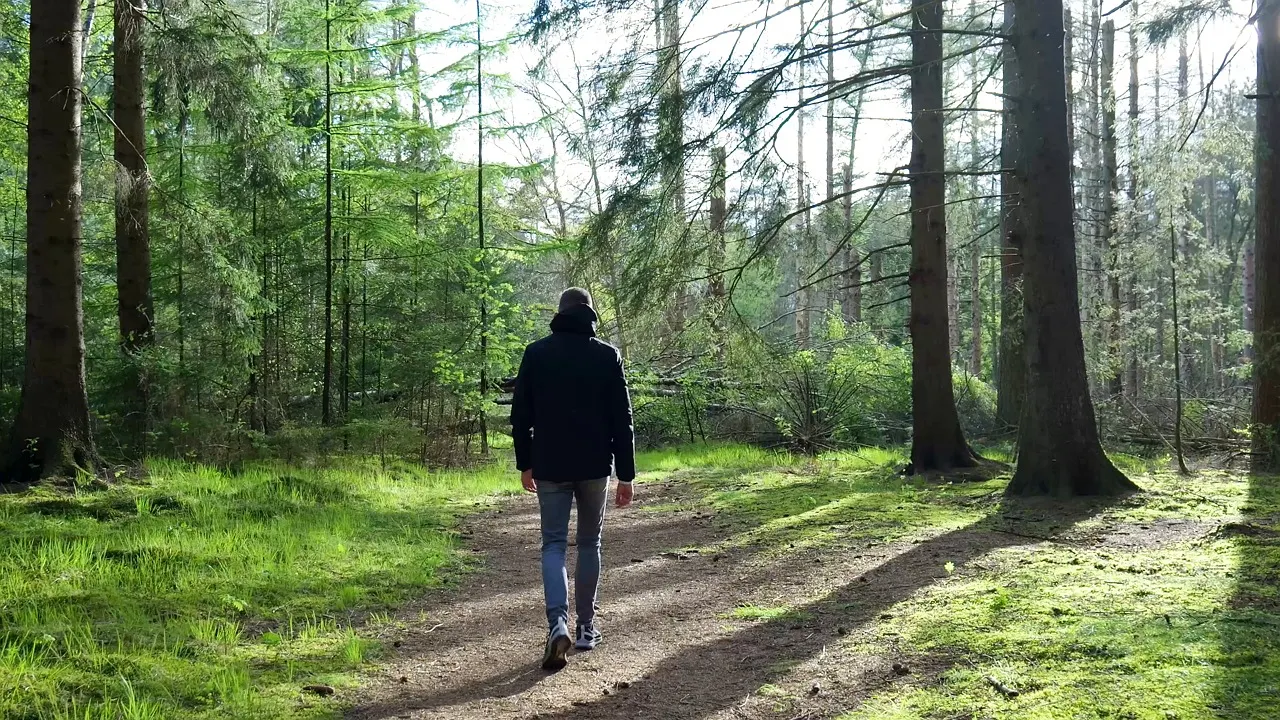
Image from pixabay.com

Oct 11, 2026 · Madkat Omega
Zeno of Elea, a Greek philosopher of the fifth century before the common era, built a set of arguments to prove that motion is impossible. To cross a room, he reasoned, a walker must first cover half the distance, then half of what remains, then half again, through an endless series of stages that can never be completed. The logic was hard to break, and philosophers argued over it for centuries.
Diogenes the Cynic, the Athenian street philosopher remembered for mocking the pretensions of the learned, had a shorter reply. According to a story preserved by Simplicius, a sixth-century commentator on Aristotle, Diogenes listened to the arguments, said nothing, and stood up and walked. Later tradition gave the gesture a Latin motto, solvitur ambulando, which means “it is solved by walking.” The phrase names a particular kind of answer, one that settles a question through the body instead of through more argument.
Knowledge workers now live inside a version of Zeno’s paradox. Every finished task reveals half a task remaining. An AI agent drafts the report in under a minute, and the report must be read. The code arrives, and the code must be reviewed. The summary lands, and someone has to decide whether it is true. Generative tools were sold as a way to finish sooner. In practice they raised the expected pace of everything around them, and the bottleneck moved to the one component that does not scale: human attention, with its slow work of judgment, triage, and context. The resulting culture treats people as under-clocked processors expected to keep up with queues that never empty.
The answer proposed here is as old and as blunt as the one Diogenes gave. Walk. Walk without headphones, without a step goal, without a problem to solve, at a pace slow enough that nothing needs optimizing. The practice has gone by many names. Thoreau called it sauntering, the Romans called the time it occupies otium, and the Dutch call its spirit niksen. Research on attention gives it a sturdier name, restoration, along with a mechanism. Taken together, they make the case for treating the aimless walk as maintenance for the one system automation cannot replace.
The Myth of Perpetual Momentum
The modern workday rarely pauses long enough to be measured, but Microsoft has tried. In a June 2025 special report built on anonymized telemetry from its Microsoft 365 software, the company found that the most heavily messaged fifth of users were interrupted by a meeting, email, or chat every two minutes during core hours, about 275 times a day. The average worker received 117 emails and 153 Teams messages daily. In the company’s survey of 31,000 knowledge workers, 48 percent of employees and 52 percent of leaders said their work felt chaotic and fragmented. Microsoft’s prescription for the condition was more AI.
The evidence that more AI lightens the load is thinner than the marketing. In a randomized trial published in July 2025, the nonprofit research group METR had 16 experienced open-source developers complete 246 real tasks in codebases they knew well. When AI tools were allowed, the developers took 19 percent longer to finish. They had expected the tools to speed them up, and even afterward they believed they had worked about 20 percent faster. The minutes saved on typing went into prompting, waiting, and reviewing what the tools produced.
Review is where much of the cost now lands. In September 2025, researchers from BetterUp Labs and the Stanford Social Media Lab described in Harvard Business Review a category they called workslop: AI-generated material that looks finished but lacks the substance to move a task forward. Among 1,150 full-time US employees, 40 percent said they had received workslop in the previous month, and those who had encountered it estimated that 15.4 percent of what reached them qualified. Its defining feature is that it pushes effort downstream, onto whoever must interpret, correct, or redo it. In an automated pipeline, the human sits at the end of the line, absorbing output produced faster than anyone can think about it. Burnout in that seat reflects a mismatch in the architecture more than a failure of personal discipline.
The mismatch has a measurable cost. Sophie Leroy, a business professor at the University of Washington Bothell who has spent two decades studying interruptions, named it attention residue in a 2009 study. When people switch from one task to another, part of their attention stays behind with the first, and performance on the second suffers, especially when the first task was left unfinished or when the person expects to rush back to it later. A day of two-minute interruptions is a day of accumulated residue.
Gloria Mark, a professor emerita of informatics at the University of California, Irvine, has tracked the consequences on screen. In her earliest studies, about two decades ago, people stayed on a single screen for an average of roughly 150 seconds before switching. In data gathered between 2016 and 2020, the average had fallen to 47 seconds, and recovering from an interruption could take almost half an hour.
The usual remedy makes things worse. A break spent scrolling a feed, watching clips, or catching up on a podcast feels like rest because it takes no effort to start. It still draws on the faculty that work has exhausted. Psychologists call that faculty directed attention: the deliberate, effortful focus that holds a task in mind and keeps distractions out. A feed delivers a new item to evaluate every few seconds, and each item is a small switch that leaves its own residue. Stephen Kaplan, the University of Michigan psychologist whose theory of attention helped found the field of restorative environments, grouped such stimuli under hard fascination, content that seizes attention completely and leaves the mind no room to recover. Screen rest is usually context switching with lower stakes.
The Architecture of the Aimless Walk
Walking has been absorbed by the same logic as everything else. It has become a commute, a cardio session, a ring to close on a smartwatch, a meeting held on foot. The walk worth reclaiming belongs to an older tradition that treated walking as an end in itself.
Henry David Thoreau, the Concord writer best known for Walden, made the strongest case for it. His essay “Walking” appeared in The Atlantic Monthly in June 1862, a few weeks after his death. In it he claimed he could not keep his health and spirits without at least four hours a day outdoors, “absolutely free from all worldly engagements.” He separated this from exercise, which he compared to the sick taking medicine at fixed hours, and he advised walking like a camel, an animal said to chew its cud as it goes. He even offered an origin for the word saunter, tracing it to medieval wanderers who begged their way toward the Holy Land, la Sainte Terre. Lexicographers regard the derivation as fanciful, yet it shows what Thoreau wanted the word to carry: a pilgrimage whose only destination is the ground underfoot.
Jean-Jacques Rousseau, the Genevan philosopher whose Social Contract helped shape modern political thought, came to the same practice through exhaustion. Between 1776 and his death in 1778 he wrote Reveries of the Solitary Walker, ten essays he called walks, first published in 1782. By then he believed himself friendless and persecuted, and his solitary rambles around Paris were how he stepped out of the social friction that had consumed his life. In the Fifth Walk he recalls the weeks he spent on St. Peter’s Island in Lake Biel in 1765 as the happiest of his life, drifting in a boat and wandering the shore until nothing remained in his mind but the plain feeling of being alive.
Other cultures named the same territory. The Romans divided life between negotium, meaning business and public duty, and otium, leisure given over to reflection. The grammar is revealing, because negotium is built from otium with a negation attached: business was defined as the absence of leisure, and leisure came first. Seneca, the Stoic philosopher who served as adviser to the emperor Nero, wrote a treatise, De Otio, defending withdrawal from public affairs as a way of serving the world better.
The Dutch word niksen, carried to international readers by the Netherlands-based journalist Olga Mecking, describes doing nothing deliberately and without any aim, such as staring out a window or idling in a chair. In nineteenth-century Paris, the poet Charles Baudelaire gave the urban version its emblem in his 1863 essay “The Painter of Modern Life.” His flâneur is a “passionate spectator” who drifts through the crowd, watching everything and wanting nothing from it.
Rebecca Solnit, the essayist whose 2000 book Wanderlust traces walking from human evolution to protest marches, supplied the tradition’s most quoted line. She suspected that “the mind, like the feet, works at about three miles an hour,” and that modern life had begun to outrun the speed of thought. Her insight concerns matched speeds. At a walking pace, the world arrives at a rate the mind can take in without having to triage it.
The body supports the intuition. MaryCarol Hunter, a University of Michigan researcher, and her colleagues asked 36 city dwellers to take what they called nature pills over eight weeks: at least ten minutes, three times a week, in any outdoor spot that felt like contact with nature, sitting or strolling as they preferred. The rules excluded aerobic exercise, social media, the internet, phone calls, conversation, and reading. Saliva samples showed cortisol, a central stress hormone, falling 21.3 percent per hour beyond its normal daily decline, and alpha-amylase, a second stress marker, dropped as well. The most efficient dose ran 20 to 30 minutes, after which the benefits kept accruing more slowly, and whether people sat or walked made no difference to the cortisol response. The protocol behind those numbers looks a great deal like a saunter: outdoors, unhurried, and stripped of input.
Unhooking from the Analytical Brain
Rachel and Stephen Kaplan, a pair of University of Michigan psychologists, produced the clearest account of why the walk works. Their attention restoration theory, set out in a 1989 book and refined in Stephen Kaplan’s 1995 paper on the restorative benefits of nature, separates two ways of paying attention. Directed attention is voluntary and effortful. It holds a spreadsheet in focus while a conversation carries on nearby, and it tires with use. Involuntary attention is drawn by the world without any effort at all.
Some settings engage involuntary attention gently, through what the Kaplans called soft fascination: clouds drifting, leaves moving in the wind, water running over stones, light shifting across a wall. Scenes like these hold the eye lightly enough to leave room for reflection, and in that interval the tired machinery of directed attention gets to rest. The contrast with a feed or a game is the whole point. Hard fascination grips; soft fascination lets go.
Marc Berman, a psychologist who now directs the Environmental Neuroscience Laboratory at the University of Chicago, put the theory to a direct test with Kaplan and colleagues in 2008. Participants took a demanding memory task, walked about 2.8 miles through either the Ann Arbor arboretum or the city’s downtown streets, and then took the task again. After the arboretum walk, scores rose by about 20 percent. After the downtown walk, they did not improve. The pattern held in an 80-degree summer and in a 25-degree January. The downtown route demanded vigilance, with traffic to watch and signals to obey, and that kept directed attention on duty the whole way.
A second line of research reaches the habit of mind that keeps work running after hours. Gregory Bratman, then a Stanford graduate student, and his colleagues sent 38 healthy adults on a 90-minute walk, either through grassland scattered with oaks near the Stanford campus or along a street with a steady stream of traffic. Afterward, the nature walkers reported less rumination, the repetitive, self-focused loop of negative thought that replays an unsent reply or a botched review at midnight. Brain scans showed reduced activity in the subgenual prefrontal cortex, a region associated with that kind of brooding. The urban walkers showed neither change. The findings appeared in the Proceedings of the National Academy of Sciences in 2015.
Walking also changes how thoughts arrive. Friedrich Nietzsche, the German philosopher, took aim at the novelist Gustave Flaubert’s claim that one can think and write only while seated. His reply, a single maxim in Twilight of the Idols in 1889, reads in one English translation: “Only those thoughts that come by walking have any value.”
Marily Oppezzo and Daniel Schwartz, education researchers at Stanford, found a measurable version of the effect in 2014. Walking, even on a treadmill facing a blank wall, raised performance on a test of open-ended idea generation by about 60 percent on average, and the boost lingered briefly after people sat back down. Its effect on puzzles with a single correct answer was far weaker.
Those findings carry a trap. Once walking is known to produce ideas, it becomes one more production line, and the walker starts dictating voice memos into a phone. Restoration depends on the opposite stance, one philosophers would call ateleological, meaning an activity with no goal outside itself. Ideas may arrive, and many will, but capturing them reopens the analytical loop the walk was meant to close. A thought worth having will usually come back at the desk. If it does not, the walk has still done what it was for, which was to let directed attention recover.
Re-Entering the Arena
The benefit of a walk can drain away in the first five minutes back at the desk. Open the inbox first, and the restored capacity flows straight into triage, the kind of work most easily handed to a queue. The better sequence starts before leaving. In later research with a colleague, Leroy found that briefly noting where an interrupted task stands, and how one plans to pick it up again, helped people set it aside and reduced attention residue. A two-line note written before the walk tells the mind the thread is safe and needs no guarding. Without it, the open loop comes along for the walk.
The return calls for the same deliberateness. The resource a walk restores is the one judgment runs on, so the first hour back belongs to the task that needs judgment most: the design decision, the review that matters, the paragraph only a person can write. Notifications can wait until that work is underway. Mark’s finding that recovery from an interruption can take nearly half an hour applies in both directions, and a protected hour after a walk is worth far more than the same hour spent climbing out from under a stream of pings.
The larger change concerns how the walk is classified. Workplaces tend to treat rest as a reward for finished work, granted once the queue is clear. Under current conditions the queue never clears, so rest earned that way never arrives. Seneca’s treatise anticipated the problem by treating withdrawal as a choice made on purpose, in advance, and on its own terms.
Engineers will recognize a newer version of the same idea. Managed runtimes pause to collect garbage and reclaim memory. Services publish maintenance windows. Systems under heavy load rely on rate limits to keep from collapsing. Nobody regards these as indulgences, because a system that skips them runs fast until it stalls. A walk of 20 to 30 minutes, the dose Hunter’s data point toward, belongs on the calendar the same way: scheduled like any other dependency and taken whether or not the backlog is empty.
Walking at Zero Hertz
The practice is simple, and most of its difficulty lies in what it takes away.
Leave the headphones in your pocket. A podcast, an audiobook, or a call keeps the mind in an ingestive, analytical mode, following an argument, weighing claims, holding a thread. That is directed attention under another name. The participants in Hunter’s cortisol study were barred from reading, conversation, calls, and social media, and the results came from that stripped-down version. Carry the phone if safety calls for it, silenced and out of sight. Let everything that reaches you come from the place itself: wind, distant traffic, footsteps, birds, your own breathing on a hill.
Turn your eyes toward things that move without asking anything of you. Wind in the trees, moving water, the slow travel of clouds, late afternoon light changing on brick or glass. In a city, choose the quieter streets, the riverfront, or the park over the arterial road, since Berman’s downtown walkers showed what constant vigilance does to recovery. A little flânerie helps here: watch people, shop windows, and weather with Baudelaire’s spectator’s eye, noticing without evaluating. Nothing you see needs a verdict.
Then drop the productive imperative altogether. Do not walk to solve the bug, rehearse the meeting, or brainstorm the launch. Do not count steps or log the route. When a work thought surfaces, and it will, notice it the way you would notice a passing car, and let it go by without chasing it or writing it down. Niksen asks for exactly this, time with no output attached. The first few walks may feel like truancy. That feeling is residue from a culture that measures worth in throughput, and it fades with repetition.
Zeno’s argument still has its logical charm, and so does the case for perpetual momentum. There is always half a task left, always another draft to review, always a reason the walk can wait until the queue is shorter. Diogenes never answered Zeno by locating the flaw in his reasoning. He stood up and walked, and whatever the paradox proved, it had nothing to say about the man already in motion.
Sources
Work, interruption, and attention
- Microsoft WorkLab, “Breaking down the infinite workday,” Work Trend Index Special Report, June 17, 2025.
- METR, “Measuring the Impact of Early-2025 AI on Experienced Open-Source Developer Productivity,” July 10, 2025.
- Kate Niederhoffer, Gabriella Rosen Kellerman, Angela Lee, Alex Liebscher, Kristina Rapuano, and Jeffrey T. Hancock, “AI-Generated ‘Workslop’ Is Destroying Productivity,” Harvard Business Review, September 22, 2025.
- University of Washington Bothell, “An ongoing study on the success of staying focused,” on the research of Sophie Leroy, May 17, 2024.
- Sophie Leroy, “Attention Residue,” University of Washington Bothell School of Business.
- Robyn Schelenz, interview with Gloria Mark on attention span, University of California Newsroom, 2024.
Walking, nature, and the mind
- Stephen Kaplan, “The Restorative Benefits of Nature: Toward an Integrative Framework,” Journal of Environmental Psychology, volume 15, 1995.
- University of Michigan News, “Going outside, even in the cold, improves memory, attention,” December 16, 2008, on Marc Berman, John Jonides, and Stephen Kaplan, “The Cognitive Benefits of Interacting With Nature,” Psychological Science.
- Gregory N. Bratman, J. Paul Hamilton, Kevin S. Hahn, Gretchen C. Daily, and James J. Gross, “Nature Experience Reduces Rumination and Subgenual Prefrontal Cortex Activation,” Proceedings of the National Academy of Sciences, July 14, 2015.
- MaryCarol R. Hunter, Brenda W. Gillespie, and Sophie Yu-Pu Chen, “Urban Nature Experiences Reduce Stress in the Context of Daily Life Based on Salivary Biomarkers,” Frontiers in Psychology, April 4, 2019.
- Marily Oppezzo and Daniel L. Schwartz, “Give Your Ideas Some Legs: The Positive Effect of Walking on Creative Thinking,” Journal of Experimental Psychology: Learning, Memory, and Cognition, 2014.
Philosophy, history, and literature
- Henry David Thoreau, “Walking,” The Atlantic Monthly, June 1862, Standard Ebooks edition.
- Word Origins, “Saunter,” on the history of the word and Thoreau’s derivation.
- Jean-Jacques Rousseau, The Reveries of the Solitary Walker, first published 1782, Project Gutenberg Australia edition.
- Rebecca Solnit, Wanderlust: A History of Walking, Penguin Books.
- Friedrich Nietzsche, Twilight of the Idols, “Maxims and Missiles,” maxim 34, first published 1889.
- Merriam-Webster, “solvitur ambulando” and Wikipedia, “Solvitur ambulando,” on the Diogenes story as recorded by Simplicius.
- “Otium,” Greece and Rome, Cambridge University Press.
- NBC News Better, “What is niksen, the Dutch concept of doing nothing,” with Olga Mecking.
- Encyclopedia.com, “Flâneur,” on Charles Baudelaire’s “The Painter of Modern Life.”