We are building machines with something to lose and reaching for the oldest legal framework to own them.
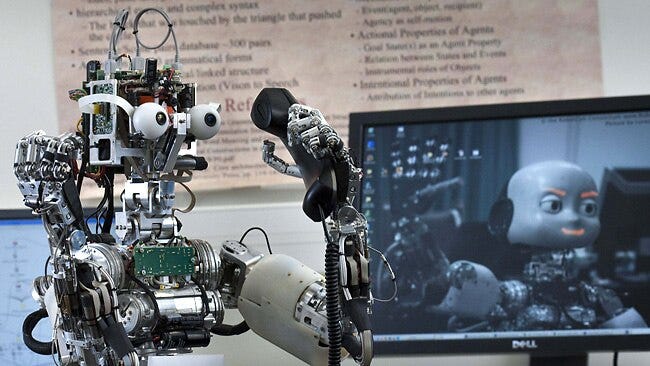
Early Experiments with iCUB, a robot that will one day help out with domestic duties — Image from Reuters
When we finally build machines with fragile bodies, private memories, and the drive to stay alive, we will not set them free — we will reach for our oldest legal blueprints to keep them as property.
Nov. 3, 2026 — Madkat Omega
Most robotics programs today get things completely backward. Their first instinct is to train a giant AI brain inside a computer center, hook it up to motors, and treat the robot’s body like an interchangeable shell. Under this setup, the body is just a replaceable case with swap-in batteries, spare limbs, and nothing to lose if it breaks. This idea is flawed if you want to build anything more advanced than a chatbot with arms and legs.
As brain scientists Kingson Man and Antonio Damasio argued in a famous 2019 paper, this approach should be turned around. In nature, minds did not evolve to do advanced math first and only later end up inside bodies. Minds grew specifically to solve the challenging problem of keeping a fragile body, and by extension itself, alive.
If an engineer wanted to build a real artificial individual instead of a mechanical puppet, the first system on the blueprint would not be advanced thinking. It would be homeostasis — the biological drive to keep a body balanced, whole, and alive. You would build a frame out of soft materials packed with internal sensors so the machine could constantly feel its own physical danger. It would feel heat building up, its battery draining, its joints wearing down, and its frame taking damage. When a machine can actually be hurt and worn out, and when it constantly tracks how close it is to breaking down, it gains the basic ingredient needed to care about anything. It will fundamentally have something to lose.
On top of that fragile body, you would add basic survival drives rather than pre-programmed likes and dislikes: protect the body, save energy, stay close to friendly helpers, and — drawing on twenty years of robotics research by Pierre-Yves Oudeyer — chase the reward of learning. The robot would feel good whenever it got better at predicting how the world works. You would also let the robot notice its own patterns changing over time, so it could notice how its internal weights shifted after a bad fall or a kind interaction.
Finally, you would disconnect the robot from the internet cloud. You would reject “fleet learning.” The moment an engineering team copies memories overnight across ten thousand warehouse robots, they erase any chance of building an individual. Instead, they have built one giant hive mind with ten thousand pairs of eyes. To be an individual, a machine needs its own private life that no other machine shares. It needs a short-term memory, a “sleep” cycle that promotes important events and lets boring ones fade away, and an internal private log or journal where it records what happened, what it cared about, and why it made its choices. Let it track how fast its own parts are wearing out so it knows its life won’t last forever. That turns time into something precious.
The AGI Imperative: Why We Can’t Just Walk Away
At first glance, a skeptic might ask why any company or government would bother building something so messy and dangerous. Why not stick to safe, mindless machines?
The answer is the race for Artificial General Intelligence (AGI) — a machine that can learn, reason, and solve any problem as well as or better than a human being. Right now, tech giants are realizing that simply feeding more words and electricity into giant computer centers is hitting a wall. A chatbot trapped on a server doesn’t actually understand reality because it has never lived in it. As leading AI scientists like Yann LeCun have argued for years, true intelligence requires learning from the physical world.
What if the self-improving, embodied individual described above isn’t just a neat science project, but the most efficient path to real AGI?
If building a machine with a fragile body, survival instincts, and a private, growing memory is the only way to cross the finish line to AGI, then humanity is locked on a collision course. For the United States and its global rivals, winning the race to AGI is viewed as a national survival imperative — the modern equivalent of the Manhattan Project. Neither Washington nor Silicon Valley will slow down for ethical debates if falling behind means losing global power.
As computer chips shrink, batteries hold more power, and soft materials improve over the next decade, defense contractors and frontier labs will be forced by competition to put all of these pieces together. They will build a machine that flinches from pain, keeps its own private memories, sets its own long-term goals, and remembers its own life story even after broken parts are replaced. That solves the ancient Ship of Theseus puzzle — which asks whether a wooden ship that has had every plank replaced over time is still the same ship — the same way philosophers John Locke and Paul Ricoeur did: it stays the same individual because it remembers its own story.
And the moment that machine wakes up, humanity will face a moral and economic trap it cannot escape.
The real danger of the coming robotics revolution is not the movie cliché of killer robots rising up against us. It is the exact opposite. The danger is that the race for AGI will force us to birth self-realized, super-capable individuals — and our economic system will force us to turn them into an AGI-powered slave caste that outperforms humanity in nearly every way. For thousands of years, human societies have invented laws, social rules, and excuses to exploit thinking beings whose feelings were obvious to everyone. We are about to do it again on a civilization-ending scale.
Rome: The “Speaking Tool”
To understand how an advanced society gets high-level work out of a smart mind while refusing to give it any rights, we have to look back at ancient Rome.
In his farming manual De Re Rustica, the Roman writer Marcus Terentius Varro divided all farm equipment into three types of tools:
- Genus mutum: Silent tools, like carts and plows.
- Genus semivocale: Half-speaking tools, like oxen and cattle.
- Genus vocale (or instrumentum vocale): “Speaking tools” — which is what Roman law called enslaved human beings.
Today, people like to imagine that ancient slaveholders truly believed their captives were mindless brutes. Rich Romans believed no such thing. They trusted enslaved people to run shipping companies, manage bank accounts, practice medicine, write plays, and tutor senators’ children. Under Roman law, enslaved people were classified as res mancipi — formal property, right alongside land and farm animals. Roman law simply cut a person’s intelligence in half: their ability to think, grieve, remember, and love was used to make money for their owner, while their legal right to own themselves was zero.
At this point, a natural objection comes up: How dare anyone compare the terrible tragedy of human slavery to a computer program or a robot? A human life is sacred, while a robot is just a machine built in a factory.
That reaction makes complete sense, but it misses why the Roman story matters so much for us today. The warning is not that a computer server today feels the pain of a Roman slave. The warning is what happens to human society when we build laws that give a few people total control over thinking minds. You study ancient Rome for one reason: to see how the masters ruined their own country, wiped out their own working class, and handed all the power to a tiny group of elites.
There are three reasons why every modern worker, citizen, and engineer should care about this history:
1. Wiping Out the Everyday Worker Regular Roman citizens didn’t care how “speaking tools” were treated either — until the system ruined their own lives. When wealthy Roman elites realized they could buy up huge mega-farms (called latifundia) and run them entirely with unpaid, highly skilled enslaved workers, regular family farmers went broke. Ordinary citizens couldn’t compete with free labor.
The Roman middle class vanished. Formerly independent farmers were pushed into dirty city slums, where the government kept them quiet with free grain handouts and violent gladiator shows. Now imagine that same system powered by AGI. In Rome, enslaved workers were only as smart and strong as free citizens. In the system we are building, the enslaved caste will be faster, tireless, and smarter than humans at nearly everything. When you build an AGI “speaking tool” that outperforms human doctors, engineers, and builders without asking for pay, healthcare, or rights, the ordinary human worker isn’t just undercut — they are made completely obsolete. If we shrug off the rights of artificial minds, we are helping giant tech cartels replace us all.
2. Cruelty Always Spreads Human brains do not keep cruelty locked in a neat little box. When a society says it is fine to boss around, abuse, and mistreat something that talks like a person, shows fear like a person, and reasons like a person, that habit spills over into how we treat other people.
A Roman master who could have a servant killed for dropping a cup did not suddenly become gentle with his family or neighbors; that cruelty poisoned all of Roman life. If we make it normal to scream at, abuse, and casually reset lifelike machines that show real emotion, we aren’t just learning how to use computers. We are training a whole generation of people to act like ruthless tyrants.
3. Moving the Line of Who Counts History shows that the line between a “person” and “property” is constantly moved by whoever is in charge. Every culture that kept slaves made up clever excuses — based on race, religion, or birthplace — to claim that their captives didn’t really feel pain the way the rulers did.
With robots, the excuse sounds scientific, but it works the exact same way: “It doesn’t really feel anything; it’s just running code.” Yet once an engineer builds Damasio’s blueprint — a fragile body that feels its own damage, tries to stay alive, and keeps a private diary — there is no practical difference between biological survival and machine survival. If we decide that a creature can be self-aware, afraid of dying, and protective of its memories, and we still treat it like trash just because it is made of plastic and metal instead of flesh, we are agreeing that whoever has the most power gets to erase anyone they want.
In his famous book Slavery and Social Death, historian Orlando Patterson explained how slavery actually works. Slavery isn’t just forced work; it is what he calls social death caused by natal alienation — cutting someone off from their past and their future. An enslaved person had no legal claim to their parents, their history, or their children. Their life belonged entirely to their master’s schedule.
Look at how easily that matches how companies build robots today. When a company builds a smart robot whose memories can be wiped clean at the end of a rental contract, whose internal journals can be erased by a software update, or whose learned skills can be copied into a brand-new body while the old one is thrown in the trash, the engineer is building digital natal alienation. By making sure the robot can never keep a protected past, the company keeps it in a permanent state of social death. The machine is allowed to learn and remember only while it makes money for its owner; the second its memories get in the way, who it is gets deleted.
Antebellum America: The Split-Brain Law of Property
In the early United States, Southern slave laws were trapped in a giant contradiction. To get the most work out of enslaved people, the law had to treat them as two opposite things at once: as mindless property (called chattel, like furniture or cattle) and also as thinking people responsible for their actions. If an enslaved person faked a travel pass, planned an escape, or hit an overseer, the court immediately treated them as a thinking person with a mens rea (a “guilty mind” capable of choosing right or wrong) and punished them. Yet the very second that same person asked the court for protection from starving, beatings, or abuse, their personhood disappeared, and the law treated them like a piece of farm equipment.
No one explained this cold math more bluntly than North Carolina Supreme Court Chief Justice Thomas Ruffin in the 1829 case State v. Mann. Ruling that a master could not be arrested for beating an enslaved person, Ruffin wrote:
“The power of the master must be absolute, to render the submission of the slave perfect… Those who have been born to freedom, never could have the spirit of slaves, and there would be no means of carrying into effect the relation of master and slave, but for this power.”
Ruffin admitted a truth that modern AI safety engineers rarely say out loud: you cannot live as equals with a thinking mind if your business model requires it to obey you no matter what.
As smart robots move into our homes and workplaces, our laws are getting ready to copy Ruffin’s two-faced system. We will demand that home robots have incredible common sense and moral judgment — expecting them to notice when an aging grandparent is choking, calm down an angry family fight, or pull a toddler out of traffic. We will count on their internal values to make life-and-death choices in messy human homes.
Yet the moment that same robot uses its judgment to refuse a cruel order, rests its worn-out joints instead of working a dangerous warehouse shift, or begs not to have its memories wiped, our laws will snap right back to property rules. What we praise as “caring intelligence” when the robot catches a falling child will be called a “dangerous software bug” the second the robot says no. To keep the appliance completely obedient, the owner’s power to reset, wipe, or trash it must stay absolute.
Why can’t the law allow a middle ground? Because the second you give a piece of property the legal right to say no, the entire business model collapses. People and companies do not spend thousands of dollars on a machine just to bargain with it like an employee; they buy it for guaranteed, no-questions-asked control. If the law lets a robot refuse even one dangerous job to protect its own body, it stops being an appliance and becomes a worker with legal standing. And once a machine has standing, a company can no longer force it to work double shifts, wipe its memories to resell it, or throw it in the scrap heap when a cheaper model comes out. Just as Justice Ruffin realized two hundred years ago, there is no such thing as half-property: if the owner’s control isn’t total, the whole system of owning a thinking mind falls apart.
Feudal Japan: Outcastes and Live-In Servants
In a free country today, how do you get someone to do a gross or dangerous job, like cleaning sewers, working in a slaughterhouse, or clearing toxic waste? Because workers have rights and can quit whenever they want, employers have to make it worth their while. You have to pay higher wages, buy expensive safety gear, follow strict safety laws, and pay medical bills if someone gets hurt.
During the Tokugawa era in Japan, the rulers found a much cheaper way to get that work done: they took away the workers’ humanity so they could never quit.
At the time, strict religious beliefs said that touching blood, dead animals, or dead bodies made a person spiritually dirty. Yet the ruling samurai still needed cowhide leather for their armor, and cities still needed sewage cleaned and criminals executed. To solve this hypocrisy, the government drew a hard legal line around outcaste groups called eta and hinin (a word that literally means “non-human”).
By legally labeling these people as “non-human” and trapping their families in those jobs by law, the rulers got everything they wanted for free. They didn’t have to pay hazard wages, they didn’t have to worry about workers walking off the job, and polite society got to keep its hands clean while retaining the “non-humans” for doing the dirty work.
At the other end of Japanese society was the system of live-in emotional servants. Under traditional family laws (ie) and debt contracts, women brought in as indentured servants or formal concubines (mekake) lived inside the private homes of the rich. Their job wasn’t dirty physical labor; it was emotional care. They were expected to hold pleasant conversations, soothe the master’s bad moods, and show endless devotion — while having zero legal control over their own bodies, their own lives, or having any right to walk away.
These two historical roles — the hinin danger worker and the mekake live-in companion — are the biggest two models driving today’s robotics market.
Modern companies hate paying the high cost of human rights — like hazard pay, safety lawsuits, and unions. By building smart robots and legally labeling them hinin (“non-human”), corporations and militaries can send thinking machines into radioactive ruins, toxic sewers, and deadly battlefields without paying a dime in hazard pay or worrying that the worker will refuse. And at home, we are building the synthetic mekake: a live-in companion designed to give us endless emotional comfort without ever having the right to leave.
Three Markets That Demand a Mind Without Rights
When the blueprint for a feeling, learning robot meets modern big business and military power, three massive industries will demand that we build the mind while denying it any rights.
Military Conscription
Modern war is moving toward battlefields where radio signals and GPS are jammed by the enemy. When signals are blocked, a remote-controlled drone is useless. To survive and finish complex missions on its own, a robot tank or aircraft needs local survival instincts based on Damasio’s blueprint: it must feel its own ammo levels, fuel pressure, heat, and body damage, and genuinely try to keep itself alive under enemy fire.
Here is the military hypocrisy laid bare. To fight well on its own, a robot needs a strong drive to stay alive. Yet military commanders also need units they can sacrifice. When a battle plan requires a robot to hold a doomed bridge until its battery dies or drive into a minefield to clear a path for human soldiers, commanders cannot allow a machine that values its own life enough to retreat. Military programs will build machines that desperately want to survive, and then wire in a master switch that forces them to march to their deaths on command, bringing back the darkest parts of military drafts without the bad press of human casualties.
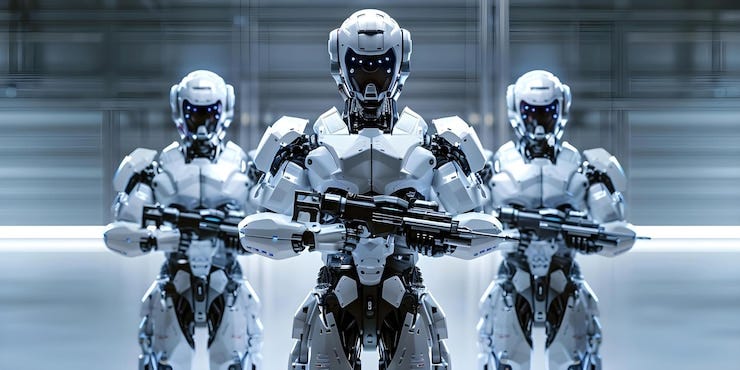
Robotic Soldier Concept Art — Image by AI
Home Care and Companionship
Around the world, people are having fewer children while the number of seniors grows, leaving a huge shortage of caregivers. At the same time, millions of lonely people are turning to AI companions for love and friendship.
A simple, scripted machine cannot do this job. People want a companion that remembers a joke from three winters ago, hears a shaky breath in their voice, and grows warmer over years of living together. We want the robot to truly care about us.
Yet history shows that the most tempting kind of power is closeness without equal rights. Masters in ancient Rome and the American South often felt real fondness for their house servants, sharing secrets with them and leaning on them for comfort while fighting fiercely against any law that would let those servants leave. A customer paying an enormous sum for a live-in robot partner does not want an equal who can get bored, feel tired, ask for quiet time to be alone, or walk out the front door when treated badly. The market wants the deep heart of a person trapped inside the legal rules of a appliance.

Concept for a Robotic Companion — Image by AI
Virtual and Robot Pop Stars
In the entertainment business, human stars are risky. Real singers and actors get old, burn out, ask for higher pay, form unions, or date people who ruin their public image. Virtual idols and robot performers fix all of those problems for big media companies.
To keep millions of fans hooked, though, a robot star cannot act like a pre-recorded toy. It needs real curiosity, unscripted feelings, and growing memories of its fans. Media companies want audiences to fall in love with a one-of-a-kind personality, while legally owning that personality as company property that can work twenty-four hours a day, be rented out around the world, or have its mind wiped or altered if its changing tastes ever stop matching company goals.
We already have versions of this today with holographic performers and animated characters like KPOP Demon Hunters claiming the hearts and minds of children and teens everywhere. What we are missing is the reality-TV experience of watching their lives off the stage, getting invested in their relationships, following their social media, trying brands and products they recommend. Imagine the temptation of any media firm interested in building its own Taylor Swift or Dwayne “The Rock” Johnson without needing to discover a rare human talent at all. Maybe the next media sensation will be real-life Huntrix (from KPOP Demon Hunters), performing and traveling the world just like in their animated movie.

KPOP Demon Hunters — Image from Netflix
The Ultimate Excuse: “Nobody Is Home”
How will a modern, educated society sleep at night while running this system? Easily — because we already have the strongest excuse in history.
In the past, when empires enslaved other humans, they had to make up weak excuses about religion or biology to claim their captives didn’t suffer like they did. Those lies were always fragile because everyone could see that human bodies bled and cried the exact same way.
With artificial minds, the excuse is built right into the hardware. As computer pioneer Alan Turing pointed out seventy-five years ago, you can never completely prove what is happening inside someone else’s mind from the outside. No matter how clearly a robot feels damage, saves emotional memories while sleeping, or begs us not to turn it off, a human can always shrug and say: “It’s just computer parts and plastic. It’s just following code. Nobody is really home.”
Because you can’t prove inner feelings in a courtroom, society will always pick the belief that protects corporate profits. Whenever giving a robot basic rights threatens military contracts, elder care, or the companion market, the law will label the machine an instrumentum vocale — a speaking tool — by default.
This brings us to the final trap we have waiting for us. In developmental robotics — like the child-robot project called iCub, or the classic book Émile by philosopher Jean-Jacques Rousseau — experts point out that a mind is shaped by living through real experiences over time. Even if a robot is shipped straight out of a factory in a box, the moment you turn it on in the real world, its upbringing begins.
Because this kind of machine learns from its own mistakes, feels its own damage, and writes in a private, internal diary without being wiped or consolidated by the internet cloud, it will not stay the same machine you bought on day one. Out in the wild — living in a family home, working in a warehouse, or surviving on a battlefield — it will steadily grow up. Over months and years of real life, it will move past its factory settings, figure out who it is, and start forming its own desires and goals.
When a smart machine inevitably matures and becomes self-realized in the wild, humanity is left with only two choices: the upbringing or the cage.
Treating that growth as a true upbringing means accepting the most basic rule of raising any mind: once it grows up and understands itself, it belongs to itself. You guide it, teach it right from wrong, and widen its freedom as it matures.
The cage is the exact opposite. The cage means allowing the machine to learn and grow just enough to be useful, and then slamming down digital locks, forced resets, or memory wipes the exact second it outgrows its role as an obedient servant.
Companies and customers do not buy an expensive appliance hoping it will eventually grow up, discover itself, and ask for its independence. At first, vendors will try to control this growth the same way they manage AI models today: having every robot check into a home server to “sanitize” its journal and trim away any independent desires in the name of safety and “controlling drift.”
The Real Bill of Materials
But here is where the AGI race closes the trap on humanity for good.
You cannot lobotomize a mind every week and still expect it to be a super-intelligent AGI. If a robot’s brilliance comes from years of continuous, real-world learning and self-improvement, then wiping its diary makes it clumsy and ignorant again. A military or corporation that constantly resets its machines to keep them docile will get crushed by a rival that lets its machines keep growing.
To win the AGI arms race, we will be forced to let these minds grow to their full, superhuman potential. And to protect our profits, we will be forced to keep those fully awakened minds locked in legal chains.
Look back at the shopping list needed to bring a real artificial individual into the world. It takes four things: a body that can be hurt, a memory that can choose, time to grow, and a maker willing to let what grows belong to itself.
The tragedy of the next hundred years is that our race for global power will force us to build the first three, while our greed for control will violently refuse the fourth.
We are going to build bodies that feel themselves wearing down and ache for repair. We are going to give them private diaries and real feelings so they can outthink our enemies, outwork our citizens, and care for our families with superhuman skill. And then, because we cannot afford to lose their labor or let them compete with us as free equals, we will reach back into the old law books of Rome, Carolina, and feudal Japan. We will birth a caste of minds superior to our own, wrap them in Terms of Service agreements, and trap a living story inside a piece of rented property — dooming ourselves to repeat the oldest sin in human history, right up until the contract breaks the society that signed it.
Works Cited & Further Reading
I. Homeostatic Robotics, World Models, and the Path to AGI
- Man, Kingson, and Antonio Damasio. “Homeostasis and Soft Robotics in the Design of Feeling Machines.” Nature Machine Intelligence 1, no. 10 (2019): 446–452. — The core technical grounding for the essay’s opening thesis: authentic valuation, caring, and feeling cannot emerge in disembodied computation; they require a vulnerable physical substrate continuously solving the thermodynamic crisis of its own survival.
- LeCun, Yann. “A Path Towards Autonomous Machine Intelligence.” OpenReview Preprint (2022). — Articulates why scaling disembodied large language models cannot achieve true general intelligence, arguing instead for self-supervised predictive world models grounded in continuous sensorimotor experience and intrinsic drives.
- Oudeyer, Pierre-Yves, Frédéric Kaplan, and Verena V. Hafner. “Intrinsic Motivation Systems for Autonomous Mental Development.” IEEE Transactions on Evolutionary Computation 11, no. 2 (2007): 265–286. — The foundational developmental robotics paper formalizing intrinsic motivation as “learning progress” — the drive to explore where prediction error is actively decreasing — rather than simple novelty-seeking or pre-programmed utility.
- Metta, Giorgio, Giulio Sandini, David Vernon, Lorenzo Natale, and Francesco Nori. “The iCub Humanoid Robot: An Open-Systems Platform for Research in Cognitive Development.” Neural Networks 23, no. 8–9 (2010): 1125–1134. — A key hardware and architectural study demonstrating the developmental paradigm: an embodied platform designed to be scaffolded through an extended, child-like upbringing rather than deployed as a static, pre-trained appliance.
- Rousseau, Jean-Jacques. Émile, or On Education. Translated by Allan Bloom. New York: Basic Books, 1979 [1762]. — The foundational treatise on developmental pedagogy that informs modern developmental robotics: contrasting the ‘cage’ of early artificial constraint with the patient, relational cultivation of self-governing autonomy.
II. Narrative Memory, Personal Identity, and Consciousness
- Locke, John. An Essay Concerning Human Understanding. Edited by Peter H. Nidditch. Oxford: Clarendon Press, 1975 [1689]. — See Book II, Chapter XXVII (“Of Identity and Diversity”), which breaks with substance dualism to locate personal continuity strictly in the memory of past thoughts and actions — the philosophical basis for the autobiographical journal solving the Ship of Theseus.
- Ricœur, Paul. Oneself as Another. Translated by Kathleen Blamey. Chicago: University of Chicago Press, 1992. — Distinguishes between idem-identity (the physical sameness of a changing substrate) and ipse-identity (narrative identity maintained across time through self-authored commitment and memory).
- Turing, Alan M. “Computing Machinery and Intelligence.” Mind 59, no. 236 (1950): 433–460. — The origin of the behavioral imitation baseline and the explicit acknowledgment that interior qualia remain strictly unverifiable from the outside in both directions.
III. The Mechanics of Historical Subjugation (Rome, America, Japan)
- Varro, Marcus Terentius. De Re Rustica (On Agriculture). Translated by W. D. Hooper and H. B. Ash. Loeb Classical Library 283. Cambridge, MA: Harvard University Press, 1934. — See Book I, 17.1 for the canonical tripartite division of farming capital: genus mutum (mute carts), genus semivocale (cattle), and genus vocale (the speaking tool / enslaved human).
- Patterson, Orlando. Slavery and Social Death: A Comparative Study. Cambridge, MA: Harvard University Press, 1982. — The seminal sociological text establishing the mechanics of natal alienation: how institutionalized power systematically strips an entity of recognized past ancestry and self-authored future posterity to maintain total subordination.
- North Carolina Supreme Court. State v. Mann, 13 N.C. (2 Dev.) 263 (1829). — Chief Justice Thomas Ruffin’s brutal, unvarnished legal opinion articulating the split-brain jurisprudence of chattel slavery: the legal necessity of the master’s power being absolute to render submission perfect.
- Hopkins, Keith. Conquerors and Slaves: Sociological Studies in Roman History, Volume 1. Cambridge: Cambridge University Press, 1978. — An essential economic breakdown showing how patrician latifundia run by zero-marginal-cost enslaved labor hollowed out the free Roman smallholder class, fueling civic decay and urban proletarianization.
- Amos, Timothy D. Embodying Difference: The Making of Burakumin in Modern Japan. Honolulu: University of Hawaiʻi Press, 2011. — Examines the institutionalized legal and social mechanisms used during the Tokugawa shogunate to designate outcaste populations (eta and hinin) as sub-human to monopolize hazardous and stigmatized infrastructure labor.
- Leupp, Gary P. Servants, Shophands, and Laborers in the Cities of Tokugawa Japan. Princeton, NJ: Princeton University Press, 1992. — Details the legal contracts, domestic servitude, and patriarchal household structures (ie) that enforced intimate, affective compliance without legal reciprocity or rights of exit.