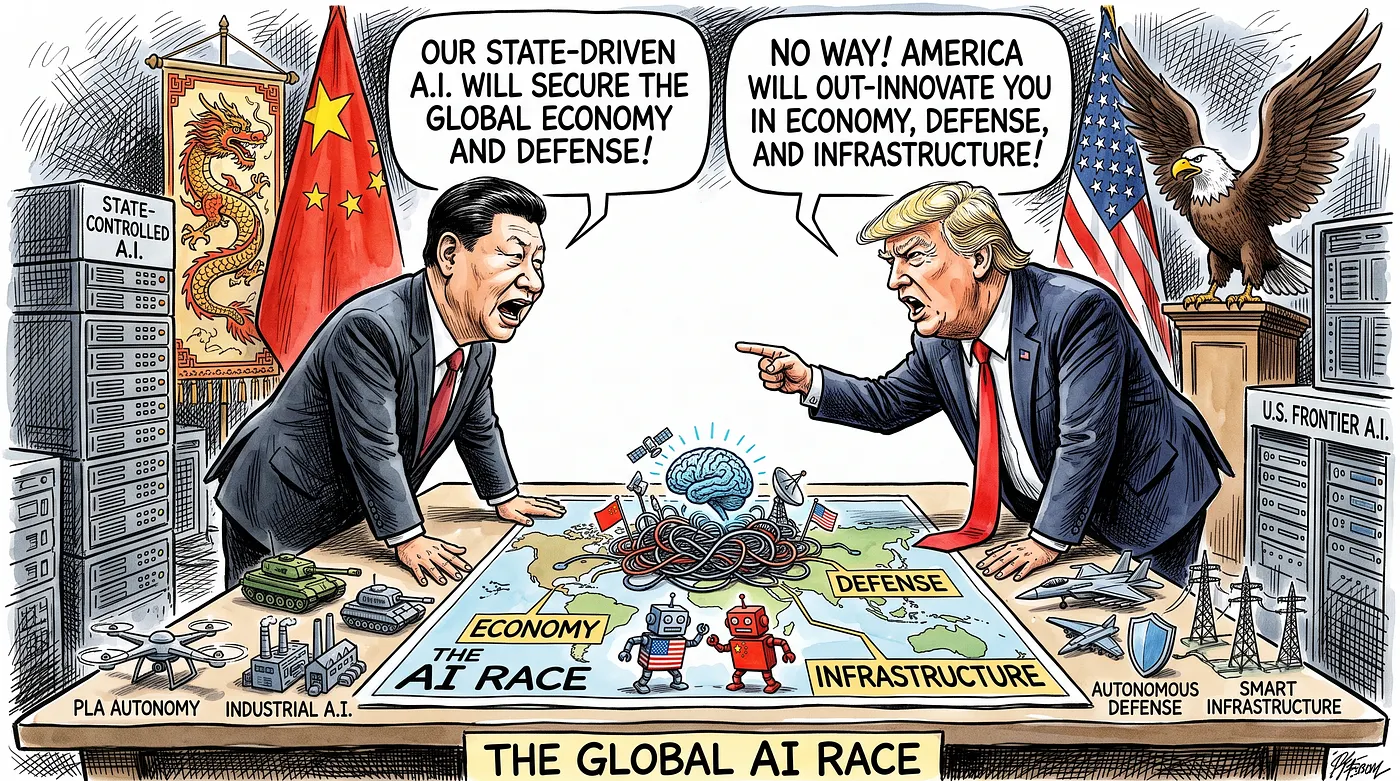
Image by Gemini
Oct 6, 2026 · Madkat Omega
On the morning of July 17, 2026, Xi Jinping took the stage in Shanghai for his first in-person address to China’s World AI Conference, and he began his keynote by crediting the United States. Seventy years earlier, he reminded the hall, a group of young scholars had first proposed the idea of artificial intelligence at a workshop at Dartmouth College in New Hampshire. The rest of the speech laid out a program that could have been drafted in Washington. AI, Xi said, should be a trusted tool for humanity, governed by laws and early-warning systems and kept “always under human control.” He described its development as a work for a full orchestra, with no room for a soloist, and he closed by warning that the speed of the technology demands constant effort to prevent loss of control.
Almost exactly a year before, on July 23, 2025, the White House had published its own blueprint under a blunter title, “Winning the Race: America’s AI Action Plan.” Its more than ninety proposed federal actions aim at the targets Xi named: dependable systems, faster scientific discovery, industrial strength, and national security. Secretary of State Marco Rubio, introducing the plan, called victory in the race non-negotiable.
Set side by side, the two programs describe nearly the same destination: artificial intelligence that is safe, reliable, and controllable, put to work building economic and industrial power. Yet the governments that wrote them spent much of the following year treating each other as the main obstacle on the road. That contradiction invites an obvious suspicion. If both capitals want the same thing and still refuse to work together, one of them must be lying, and perhaps both are.
The suspicion deserves a test, and so does the premise beneath it. A race implies a finish line and a prize. Before asking who will win, it helps to ask what winning would mean, what it would cost, and what the world would look like if Washington won, if Beijing won, or if neither did. The evidence of the past two years points toward an unsettling answer. A lead in AI is a position that has to be defended every quarter, each side holds chokepoints the other cannot easily bypass, and the most dangerous moment in the contest may arrive when either side concludes that it is losing.
What the winner wins
A footrace ends at a finish line. The AI contest has offered no such moment, and the clearest evidence is how quickly leads evaporate. On January 27, 2025, days after the Chinese lab DeepSeek released its R1 reasoning model, Nvidia lost $589 billion in market value in a single trading session, the largest one-day loss for any company in US stock market history. Investors had assumed that American spending and export controls would keep Chinese models a generation behind. DeepSeek suggested otherwise.
The 2026 AI Index, Stanford University’s annual audit of research, investment, and performance data across the field, measured how far the convergence has gone. As of March 2026, the best American model led the best Chinese model by 2.7 percent on the Arena leaderboard, which ranks models through head-to-head comparisons. In May 2023, the gaps on major benchmarks had ranged from about seventeen to thirty-two percentage points, and the two countries have traded the lead several times since early 2025. That near-parity arrived despite an enormous difference in money. American private investment in AI reached $285.9 billion in 2025, roughly twenty-three times China’s $12.4 billion, and American labs released fifty notable models to China’s thirty. Spending on that scale bought a lead measured in months.
If the frontier model is a perishable asset, the prize has to lie somewhere more durable. Three candidates stand out. The first is becoming the default platform for everyone else. Engineers call this the stack: the layered system of chips, data centers, cloud services, models, applications, and technical standards that sit on top of one another. Whoever supplies the stack to another country’s hospitals, tax offices, and factories collects fees, writes the technical rules, and gains leverage that outlasts any benchmark, because every system built on that foundation raises the cost of switching. Both governments have said as much in writing. The American action plan directs the Commerce and State Departments to assemble full-stack export packages of hardware, models, software, and standards for allies. Xi’s Shanghai speech announced the founding of the World AI Cooperation Organization, headquartered in Shanghai, along with 5,000 AI training places for developing countries over five years and joint application centers with the African Union, the League of Arab States, the Association of Southeast Asian Nations, and other regional groups.
The second prize is compounding productivity. Advocates in both capitals describe a loop in which better AI speeds up drug discovery, materials science, chip design, and software engineering, which in turn produces better AI. Whether that loop turns as fast as its champions expect remains unproven, but both governments are investing as though it will. The third prize is military. Planners on both sides expect AI to compress the time between detecting a threat and acting on it, through faster intelligence analysis, logistics, cyber operations, and autonomous systems. A military that decides in seconds holds an advantage over one that decides in hours.
The costs are already visible. Electricity has become a strategic input. BloombergNEF, an energy research firm, estimates that China will add more than six times as much generating capacity as the United States over the next five years, while American projects run into grid limits and local opposition. Supply chains for chips and minerals are being split along political lines. And the pressure to ship quickly works against the slow work of testing. The same Stanford report found that the average score on the Foundation Model Transparency Index, which grades how much developers disclose about their models, fell from 58 to 40 in a single year.
Taken together, the evidence suggests that winning means holding a position, as the supplier others depend on, and that holding it requires advantages in the layers that spread slowly: chip fabrication, power, manufacturing, and the trust of customers who have to live with the results.
Same words, different meanings
The suspicion that one side must be lying assumes that both mean the same thing when they say safe, reliable, and controllable. They do not, and each government is largely sincere about its own definition.
Beijing’s rulebook is explicit. China’s Interim Measures for the Management of Generative Artificial Intelligence Services, in force since August 15, 2023, require public-facing AI services to uphold core socialist values and forbid output that incites subversion of state power or undermines social stability. Safety, in that framework, includes political and ideological safety for the governing party. The word controllable carries layered meanings as well. Matt Sheehan, who studies Chinese technology policy at the Carnegie Endowment for International Peace, notes in his annotated translation of the Shanghai speech that the term has referred at different times to state control over the technology supply chain, to human control over AI systems, and to control over industrial processes run by AI.
The Shanghai speech also added something new. Rebecca Arcesati, who co-leads a research program at the Mercator Institute for China Studies in Berlin, observed that it contained Xi’s first known public reference to the risk of losing control of AI systems themselves, a concern long associated with Western safety researchers. Even so, she cautioned that it is unclear whether Beijing understands that risk the way the international safety community does.
Washington’s vocabulary carries its own values. The American action plan centers on removing regulatory barriers, and an executive order issued the same day, titled “Preventing Woke AI in the Federal Government,” requires AI systems bought by federal agencies to be ideologically neutral as the administration defines it. American safety debates tend to focus on misuse, such as help with biological weapons or cyberattacks, and on whether advanced systems might act against their operators’ intentions. Both governments, in other words, write political values into their definitions of safe AI. They disagree about which values, and about who gets to decide.
The word security is contested too. In Shanghai, Xi urged countries to oppose what he called the overstretching of national security in AI and the placing of one country’s security above others, a line Sheehan reads as aimed at Washington. From the American side, restricting advanced chip exports to China is a security measure. From Beijing, the same restrictions look like an attempt to hold a rival down.
Beneath the vocabulary lies a harder problem, which strategists call the security dilemma. It describes a situation in which the steps one state takes to make itself safer leave its rival feeling less safe, prompting countermeasures that leave both worse off, even when neither intends aggression. AI sharpens the dilemma because it resists verification. Nuclear arms control rested on counting things that could be seen: missile silos, bombers, and warheads that satellites could photograph and inspectors could tally. Frontier AI capability lives in data centers that look like warehouses and in model weights, the billions of numerical parameters that encode what a model has learned, which can be copied in hours. A government that paused its own research could never confirm that its rival had done the same, so each side concludes that a rival’s lead would be more dangerous than the risks of racing.
The chip trade of early 2026 showed how the logic plays out. The Trump administration approved sales of Nvidia’s H200 processor to China, with the US government collecting a 25 percent fee. In January, Chinese customs authorities told agents the chips were not permitted to enter the country, and officials told domestic firms not to buy them unless necessary. Washington wanted revenue and dependence. Beijing preferred self-reliance over buying a rival’s hardware on a rival’s terms. Neither side has to be lying for cooperation to fail. Each tells the truth about a different thing, and neither can check the other’s.
If the United States wins
China could fall decisively behind without an economic collapse if a few bottlenecks tightened at once, and the most obvious one is manufacturing advanced chips. Washington has restricted exports of high-end AI chips to China since 2022, and the most capable fabrication remains concentrated in a single company on an island Beijing claims. In the second quarter of 2026, according to the market research firm TrendForce, Taiwan Semiconductor Manufacturing Company took 72.5 percent of global contract chipmaking revenue. China’s leading contract chipmaker, SMIC, took 5.4 percent, and it works without the extreme ultraviolet lithography machines that the most advanced chips require and that cannot be sold to Chinese buyers.
Beijing has chosen to fight that gap with self-reliance. At a Politburo study session in April 2025, Xi called for breakthroughs in high-end chips and foundational software to build an independent and controllable hardware and software system for AI. Turning away Nvidia’s H200 doubled down on that bet. If domestic chips lag for longer than planners expect, the bet costs years, and years matter more for China than for most countries. China’s population fell by 3.39 million in 2025, the fourth consecutive annual decline, and 23 percent of its people are now sixty or older. Beijing has counted on automation and AI to offset a shrinking workforce. A second-rate domestic AI industry would leave that offset incomplete. Some analysts add a third weakness, arguing that the requirement to keep models aligned with official narratives will eventually cost Chinese labs in reasoning ability and training data. The near-parity of 2026 suggests that cost has not yet proved decisive.
If those pressures did combine, the world would reorganize around American infrastructure. On the day it released the action plan, the White House also ordered a program to promote exports of the American AI technology stack, and a dominant United States would turn that program into an instrument of statecraft. Some strategists envision a digital version of Bretton Woods, the 1944 agreement that placed the dollar at the center of postwar finance, with access to American chips, cloud capacity, and models tiered by how closely a country aligns with Washington. Close allies would receive the best systems on favorable terms. Countries that had courted Chinese infrastructure would face pressure to switch. The fees from the world’s hospitals, factories, and governments running on American platforms would flow back to a small number of American firms, extending the pattern set by the smartphone and cloud eras.
The military picture would shift as well. Superior AI for surveillance, targeting, and logistics would strengthen American and allied defenses in the Western Pacific, and the calculation facing any Chinese leader contemplating force against Taiwan would grow harsher. Beijing would likely respond by turning inward, tightening its digital borders, requiring state enterprises to use domestic hardware and models even at a cost in efficiency, and accepting slower growth in exchange for control. The story that Xi tells about the century, captured in his phrase about major changes unseen in a hundred years and often read as a prediction of Chinese ascendancy, would become harder to sustain at home.
An American victory would carry its own price, and an episode in June 2026 offered a preview. On June 12, three days after Anthropic released two new models, Claude Fable 5 and Claude Mythos 5, the Commerce Department directed the company to suspend access for any foreign national, inside or outside the United States, citing national security. Unable to filter users by nationality, the company disabled both models for every customer. Commerce relaxed the restriction for trusted partners late that month and lifted it on June 30. The interruption was brief, but it showed allies something they will remember. A country whose hospitals and ministries run on another nation’s AI can be cut off by a letter from that nation’s commerce secretary. An American-centered order would resemble a gated system that allies accept while the gate stays open to them, and its durability would depend on whether they trust Washington to keep it open.
If China wins
America’s weak points mirror China’s. Howard Yu, who directs the Center for Future Readiness at the IMD Business School in Switzerland, summed up the asymmetry this way: the United States has the chips and lacks the power, China has the power and lacks the chips, and each is racing to fix its own shortage. China already generates more than twice as much electricity as the United States. Goldman Sachs Research, in projections reported in June 2026, expects American data centers to grow from roughly 31 gigawatts of power demand in 2025 to about 66 gigawatts in 2027, lifting their share of peak summer demand from 4.1 percent to 8.5 percent. An analysis of that research adds that only 50 to 60 percent of the capacity scheduled over the next year or two is likely to arrive on time. The Texas grid operator is working through a large backlog of connection requests from data centers and other heavy users, and New York lawmakers are weighing a measure that could pause some local data center construction.
People are a second weak point. Stanford’s index found that the number of AI researchers moving to the United States has fallen 89 percent since 2017, with most of that decline arriving in the most recent year. Minerals are a third. China mined 69.2 percent of the world’s rare earths in 2025 and refines up to 90 percent of them, according to the research firm GlobalData. Since April 2025, Beijing has required case-by-case export licenses for seven medium and heavy rare earths, including dysprosium and terbium, which go into the permanent magnets inside electric motors, robots, drones, and weapons. A broader set of controls announced in October 2025 was suspended after Trump and Xi met in South Korea that month, and that suspension is scheduled to expire on November 10, 2026. Add a capital shock, which some investors warn could follow if AI spending outruns AI revenue, and an American stumble becomes easy to imagine.
If China pulled ahead, its lead would show up first in the physical world. Xi’s Shanghai speech described AI moving from the digital world into the physical one, and the factory floor is where China is strongest. According to the International Federation of Robotics, factories worldwide installed 603,000 industrial robots in 2025, and 354,000 of them went to China, or 59 percent. The United States installed 38,400. Pairing leading AI with that manufacturing base would let Chinese firms automate faster, design materials and batteries faster, and sell capable systems at prices American competitors could not match.
China’s main channel of influence would be open-weight models, whose internal parameters are published so that anyone can download, run, and modify them. Chinese labs such as DeepSeek and Alibaba have released many of their strongest models this way, and they cost little to adopt. A ministry in Nairobi or Jakarta that builds its services on those models, trains its engineers through Chinese programs, and buys Chinese data center equipment would find switching expensive later. The rules embedded in those systems, including assumptions about what content should be filtered and who may see what, would travel with them. Some strategists foresee the norms of global technology governance tilting toward state control as a result.
The security consequences would follow. Analysts who model this scenario expect American deterrence in the Western Pacific to weaken, and allies such as Japan, the Philippines, and Taiwan to face pressure to accommodate Beijing. At home, the United States would lose some of the platform revenue that has financed its research universities and venture capital for three decades. Allies might keep American systems for defense while running Chinese ones for commerce, a dual-stack compromise that would loosen alliances without breaking them. One version of this future has Washington retreating behind tariffs and digital firewalls, a Fortress America defending its own hemisphere.
This scenario also contains a contradiction. Beijing’s pitch to the world presents China as the open partner. Yet in July 2026, Reuters reported that the Ministry of Commerce had met with Alibaba, ByteDance, and the startup Z.ai to discuss restricting overseas access to China’s most advanced models, including some not yet released, and treating leaks of AI technology as offenses under national security law. A leading China would likely guard its best systems as closely as Washington guarded Mythos, and offer the rest of the world the tier below.
The most dangerous moment
Both victory scenarios share a hidden assumption: that the loser accepts the result. History offers reasons for doubt. Hal Brands, a scholar of grand strategy at the Johns Hopkins School of Advanced International Studies, and Michael Beckley, a political scientist at Tufts University, argued in their 2022 book Danger Zone that the most dangerous rivals are peaking powers. These are states that have grown strong, sense their window of opportunity closing, and conclude that waiting guarantees decline. Brands and Beckley call this the peaking power trap, and they applied it to China’s demographic and economic slowdown. The AI race creates a sharper version of the same trap for whichever side comes to believe it is falling permanently behind.
Applied to Taiwan, the logic runs as follows. If Chinese planners concluded that American and Taiwanese AI, from drone swarms to automated targeting, would soon make an amphibious crossing of the Taiwan Strait impossible, the incentive to act would peak before that capability arrived. Taiwan’s chip industry adds a second motive. Some analysts argue that Beijing would not need to capture Taiwan’s chipmakers intact to benefit from a crisis, because cutting the island off from global trade would halt the supply of advanced chips on which the American AI buildout depends and drag the leader back toward parity.
The tools for coercion short of war already exist. On February 7, 2024, the Cybersecurity and Infrastructure Security Agency, the National Security Agency, and the FBI warned that a Chinese state-sponsored hacking group known as Volt Typhoon was pre-positioning itself inside American critical infrastructure networks, including communications, energy, transportation, and water systems, to enable disruptive or destructive attacks in a major crisis or conflict. One scenario widely discussed among defense analysts imagines a quarantine of Taiwan enforced by China’s coast guard rather than its navy, with ships inspected and selectively turned away and no formal declaration of war. Each step would be designed to stay below the threshold that triggers an American military response, which is precisely what makes miscalculation possible.
Strong counterweights exist as well. The Chinese Communist Party’s first priority is its own survival, and a failed assault on Taiwan could threaten it. An economy with a shrinking workforce is poorly placed to absorb sweeping Western sanctions or a blockade of its energy imports. A leadership that doubted its ability to overcome superior American battlefield AI might decide that patience serves it better than a gamble.
The trap is also symmetrical. If Washington came to believe that China would soon overtake it, pressure would build in American politics for preemptive measures of its own: total export bans, sanctions on any company using Chinese models, offensive cyber operations against Chinese data centers. Each step would look defensive from Washington and aggressive from Beijing, completing the security dilemma described earlier.
The calendar of the coming months holds several pressure points. China’s suspended rare earth controls are due to lapse on November 10. The broader trade truce between the two governments was extended to January 10 during Xi’s state visit to Washington in late September. The two presidents expect to meet again at the Asia-Pacific Economic Cooperation summit in Shenzhen in November and at the Group of Twenty summit in Miami in December. Each date is a moment when one side can use leverage, or choose not to. The period of greatest danger is the transition itself, while the gap is moving and neither side is confident of where it is heading, and a stable lead by either country would be safer than a lead that is visibly slipping.
The race that does not end
The evidence of 2026 points most strongly toward a third outcome, in which neither country wins and the contest settles into a lasting, managed rivalry. Three facts support it. The best models of the two countries sit within a few percentage points of each other. Each side holds chokepoints the other cannot quickly replace, chips and capital on one side, minerals, power, and factories on the other. And both governments now treat frontier AI as a strategic asset to be rationed, Washington through its June order on Anthropic’s models and Beijing through its July deliberations over overseas access to its own.
That world would run on two stacks with porous borders. Most countries would hedge, using American systems where security matters most and cheaper Chinese open-weight models where cost matters most, while Europe, India, and the Gulf states build capacity of their own to avoid depending entirely on either. Companies would comply with two sets of export rules. Competition between two suppliers would keep prices down and prevent either from charging monopoly rents, which is one benefit of a race without a winner.
The first guardrails of such a rivalry are already being built. Trump’s state visit to Beijing on May 14 and 15 produced no agreement on AI. On September 20, Treasury Secretary Scott Bessent and Chinese Vice Premier He Lifeng held the first formal US-China talks on AI in New York, where the American side proposed an alert system for AI incidents that count as national security threats. During Xi’s state visit to Washington later that month, the White House said the two countries had agreed to establish a bilateral communication channel for AI incidents, and Chinese state media confirmed the arrangement. Xi told Trump that AI must remain under human control.
The Cold War offers a precedent for what such a channel can and cannot do. During the Cuban Missile Crisis of October 1962, messages between Washington and Moscow took hours to arrive and be translated. On June 20, 1963, the two governments signed an agreement in Geneva establishing a direct communications link, which went into operation that August. The hotline left the arms race and the rivalry intact while reducing the odds that a misread signal would start a war. An AI incident channel could serve the same purpose for a new kind of accident, giving one government a way to tell the other, before anyone retaliates, that a power outage, a market crash, or an autonomous system behaving strangely was a malfunction.
Permanent tension carries real costs. Both countries would duplicate enormous investments in chips, power, and models. Useful tools would spread more slowly across a divided world. And the pressure to ship before the rival does would keep pushing against careful testing, the pattern visible in the declining transparency scores that Stanford recorded.
The chokepoints that hold the rivalry in balance may not last either, because AI itself is being used to engineer around them. In 2024, the British company Materials Nexus used its AI platform to screen more than 100 million candidate compositions and, working with the Henry Royce Institute at the University of Sheffield, designed, made, and tested a permanent magnet free of rare earths in three months. If tools like that mature, China’s leverage over magnets weakens. If Chinese chipmakers close the fabrication gap, American leverage over chips weakens in turn. Mutual dependence works as a kind of hostage exchange, and as each side frees itself, the restraint it imposed disappears. A durable stalemate would then have to rest on deliberate agreements, such as working incident channels, shared testing standards, and perhaps, as some researchers have proposed, ways to account for the largest training runs through the chips that perform them.
Neither side winning sounds like a failure only if the race is the point. The more useful question is whether the systems both countries are building can be made reliable enough to trust, and a stable rivalry leaves room to work on it.
What remains to be won
When Xi credited Dartmouth in Shanghai, he was pointing to a modest document. In August 1955, John McCarthy, a young Dartmouth mathematician, and three colleagues proposed that ten scientists spend two months of the following summer in Hanover, New Hampshire, testing whether every feature of intelligence could be described precisely enough for a machine to simulate it. The proposal is credited with introducing the term artificial intelligence, and its authors expected real progress if a carefully chosen group worked together for one summer.
Seventy years later, the field they named is measured in gigawatts, export licenses, and naval deterrence. Near the end of his Shanghai speech, Xi compared AI to a fine horse that must gallop with both speed and stability. The language of a race rewards only the first quality. The second is harder to achieve: systems that behave as their makers intend, governments that keep their commitments, and channels that still work in a crisis. Neither country can supply that kind of stability alone, and neither can take it from the other.
A winner in the narrow sense, one country holding a permanent and unchallenged lead, may never be declared. What can still be won is a world in which the most dangerous years of the transition pass without a war, the systems both nations deploy prove reliable, and the rivals keep talking long enough for the technology to earn the trust that both their speeches already claim for it. The Dartmouth group imagined a single summer of shared work. The best realistic outcome of the contest they started may be a long rivalry conducted carefully enough that someday it can make room for that kind of work again.