A plain-language guide to where AI is today, where quantum computing actually stands in 2026, and why the most interesting story in technology right now is the one happening at the seam between them.
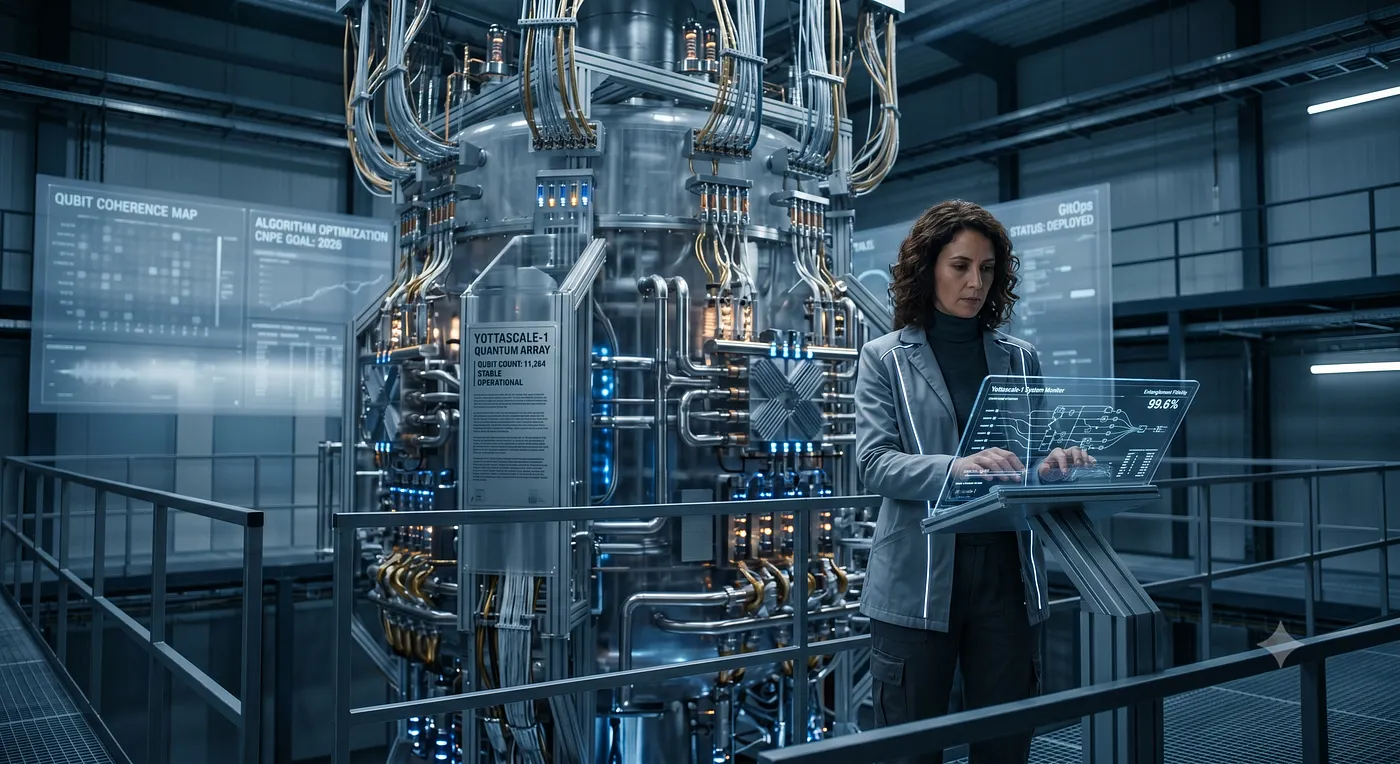
Engineering a Quantum Artificial Intelligence — Image from Gemini
There are two technology stories dominating this decade, and for most of their history they have been told separately.
The first is the story of artificial intelligence, which over the last few years stopped being a research curiosity and became something you talk to every day. The second is the story of quantum computing, which for twenty years lived under a quiet curse: it was always, eternally, “about ten years away.”
Here is the thing almost nobody noticed until recently. Those two stories have started bending toward each other. The people building the world’s most advanced AI models are running into physical walls made of electricity and heat. And the people building quantum computers have discovered that the single best tool for taming their famously unstable machines is, of all things, the same kind of AI that powers a chatbot. The two fields have begun trading techniques, sharing hardware, and borrowing each other’s vocabulary.
This is a long read, and it’s written for the curious person who has never taken a physics class and never wants to. There will be no formulas, no charts, and no jargon left unexplained. By the end you should understand what a large language model really is under the hood, what a quantum computer really is, and why the convergence of the two might end up being more consequential than either one alone.
Let’s start with the machine you already use.
Part One: What a Large Language Model Actually Is
When you type a question into an AI assistant and it answers in fluent, structured paragraphs, it feels like there’s a mind on the other side. There isn’t. What’s actually happening is both simpler and stranger than a mind, and understanding it is the key to everything that follows.
At the center of every modern AI model is an architecture called the transformer. It was introduced by Google researchers in 2017 in a paper with the now-famous title “Attention Is All You Need,” and essentially every major AI system since then is a descendant of that idea. The name matters, because the whole trick of the transformer is a mechanism called attention, and attention is going to turn out to be the bridge between AI and quantum computing later in this story. So it’s worth getting right.
Start with how the model sees language. It doesn’t read words the way you do. Text is first chopped into small pieces called tokens — sometimes a whole word, sometimes a chunk of one, sometimes just a punctuation mark. The model then turns each token into a long list of numbers. You can think of that list as a set of coordinates, a way of placing every word in a vast, invisible space of meaning, where words that mean similar things sit near each other and words that mean different things sit far apart.
Now comes attention. When the model is processing a sentence, it doesn’t treat each word in isolation. Instead, every word gets to “look at” every other word and decide how relevant each one is to its own meaning. In the sentence “the trophy didn’t fit in the suitcase because it was too big,” attention is what lets the model figure out that “it” refers to the trophy and not the suitcase. The model is constantly asking, for every word, which of the other words should I be paying attention to right now, and how much? It computes a web of these relationships across the entire passage, and it does this many times over, in parallel, through layer after layer.
That’s the engine. Now, what is the engine actually doing with all that machinery? Something almost comically humble: it is predicting the next token. That’s it. A large language model is a spectacularly sophisticated guessing machine whose only native skill is looking at a stretch of text and estimating what word most plausibly comes next. It writes a sentence one token at a time, each guess feeding into the next.
The magic — and it really is a kind of magic, in the sense that nobody fully predicted it — is that when you make this guessing machine large enough and feed it enough of the written world, the act of predicting the next word starts to require genuine competence. To reliably continue a paragraph about thermodynamics, the model has to have absorbed something about thermodynamics. To finish a line of computer code, it has to have internalized the grammar of that programming language. Skills that look like reasoning, translation, and summarization all emerge as side effects of getting very, very good at “what comes next.”
It’s worth pausing on how counterintuitive this is, because it’s the source of most of the confusion about AI. There is no module inside the model labeled “logic” and no separate compartment for “French.” There is only the one objective — predict the next token — pursued across a network so large that, somewhere in the process of satisfying it, the model built internal representations that behave like understanding. This is also why these systems can be brilliant and foolish in the same breath: a model that has learned the statistics of correct reasoning will usually produce correct reasoning, but when the patterns mislead it, it can state a falsehood with exactly the same confidence, because it has no separate sense of “true” sitting outside the prediction. It is mimicry that became competence by sheer scale, which is both the great surprise of the last decade and the great caveat hanging over everything these systems do. This is what people mean when they talk about a model’s parameters — the billions of internal numerical dials, tuned during training, that encode everything the model has learned. Training is the slow, enormously expensive process of nudging all those dials until the predictions get good. Once trained, the model is frozen; running it to answer your questions is a separate, much cheaper step called inference.
Hold on to two facts from this section, because they matter enormously later. First, attention is fundamentally about measuring relationships between things in a high-dimensional space of meaning. Second, the whole enterprise is built on linear algebra — on multiplying enormous grids of numbers together, billions and billions of times. Both of those facts are going to come back when we get to quantum.
Part Two: The Scaffolding Around the Model
If a raw language model is just a next-word predictor, how do we get from that to an AI that can search the web, remember your preferences across months, manage a multi-step project, and use tools on your behalf? The answer is that almost none of that lives inside the model itself. It lives in a layer of engineering built around the model, and the last two years of AI progress have been as much about that scaffolding as about the models. Four pieces of it are worth understanding.
The first is the context window. This is the amount of text the model can hold in its working attention at one time — its short-term memory, in effect. Everything in the context window is “visible” to the model as it generates its next word; everything outside it might as well not exist. Early models could only hold a few paragraphs. Today’s leading models can hold the equivalent of entire books, hundreds of thousands of words, all at once. That expansion is a big deal, but it comes at a steep price, and the price is exactly where quantum will re-enter the conversation. Remember that attention works by relating every token to every other token. If you double the length of the context, you don’t double the work — you roughly quadruple it. The cost of attention grows with the square of the context length. Bigger memory means dramatically more computation, more electricity, and more heat. The very feature users love most is the one straining the hardware hardest.
The second piece is retrieval-augmented generation, usually shortened to RAG. A frozen model only knows what it absorbed during training, which means it has a knowledge cutoff and no access to your private documents. RAG fixes this by bolting a search step onto the front of the model. When you ask a question, the system first goes and fetches relevant material — from the web, from a company’s internal files, from a database — and then stuffs that fresh material into the context window before the model answers. The model isn’t recalling the answer; it’s reading source material you just handed it and synthesizing a response. Notice what’s at the heart of RAG: a search for relevance, a way of finding which documents, out of millions, are closest in meaning to your question. That “closeness in meaning” is measured, once again, as distance in a high-dimensional space.
The third piece is long-term memory. Context windows reset; they’re short-term. To give an assistant continuity across days and months — to let it remember that you’re allergic to shellfish or that you’re three chapters into writing a novel — systems store summaries and facts in an external memory and pull the relevant ones back into context when needed. It’s a filing cabinet bolted to a goldfish. The model itself doesn’t change, but the scaffolding gives it the appearance of an evolving relationship with you.
The fourth and most consequential piece is the agentic workflow. This is the shift from AI that answers to AI that acts. An agent is a model placed inside a loop: it’s given a goal, it breaks that goal into steps, it takes an action — searching, calling a tool, writing code, checking a result — observes what happened, and decides what to do next. Instead of producing one reply, it runs through many cycles of think-act-observe to accomplish a multi-stage task. Agents are why people now talk about AI “doing” things rather than just “saying” things, and they are the architecture behind the current wave of AI that can book travel, debug software, or run research.
To make that concrete: imagine you ask an AI agent to find out why your company’s sales dipped last quarter. A simple model would just guess at plausible-sounding reasons. An agent instead plans. It queries the sales database, notices the dip concentrated in one region, pulls the weather and news for that region, cross-references a shipping-delay report it found, drafts a hypothesis, checks that hypothesis against a second data source, and only then writes you a grounded answer. Each of those steps is a separate trip through the model, with the results of one step shaping the next. The intelligence isn’t in any single reply; it’s in the loop. And notice the crucial property of that loop: at any step, the agent can reach for an external tool — a calculator, a database, a piece of code, a web search — when the task calls for something the model itself can’t do well. Keep that idea of “reaching for the right specialized tool” in mind. It is exactly the slot a quantum computer will eventually fill.
Here’s the unifying observation. Every one of these four technologies — long context, retrieval, memory, agents — is a strategy for handling more. More information held at once, more knowledge pulled in, more history carried forward, more steps chained together. The trajectory of modern AI is relentlessly toward bigger. And bigger runs directly into a wall made of physics.
Part Three: The Wall
For most of computing’s history, “just use more computers” was a perfectly good plan. It is starting not to be.
The numbers around AI’s appetite for electricity have crossed from impressive into alarming. The International Energy Agency estimated that the world’s data centers consumed roughly 415 terawatt-hours of electricity in 2024, and projected that figure to climb past 1,000 terawatt-hours during 2026 — a doubling in just a few years, driven overwhelmingly by AI. To put a single facility in perspective: a large AI data center can draw between 100 and 300 megawatts of continuous power, where a traditional data center might use 10 to 50. These campuses are roughly ten times as power-hungry as the ones that came before them.
That demand is now colliding with grids that were designed for a slower world. In the United States, PJM Interconnection — the grid operator serving 65 million people across thirteen states — has projected that it could fall several gigawatts short of its reliability requirements by 2027. Retail electricity prices have climbed sharply, rising more than 40 percent since 2019 in the regions absorbing the most data center growth, and the strain has become a genuine political issue in both parties. Northern Virginia, home to the densest concentration of data centers on Earth, has utilities requesting emergency rate increases and fast-tracking new gas plants just to keep up.
Two details make the squeeze worse than the headline numbers suggest. The first is that inference has overtaken training as the dominant consumer of energy. It’s tempting to imagine the power is all spent up front, in the big one-time effort of training a model. But once a model is deployed and hundreds of millions of people are using it every day, the cumulative cost of answering all those queries surpasses the cost of training. The energy bill never stops; it grows with adoption. The second detail is heat. Every watt of electricity that goes into a chip comes back out as heat, and packing thousands of the latest AI accelerators into a single rack creates thermal density that ordinary air conditioning can no longer handle. A large and growing share of a data center’s power is spent not on computing at all, but on cooling the things that compute.
So the modern AI project faces a fork. The demand curve points relentlessly upward — bigger models, longer contexts, more agents, more users. The supply curve, made of power plants and transmission lines and cooling systems, simply cannot bend that fast. You cannot permit and build a power plant in the time it takes to train a new model. Something has to give.
This is the precise moment at which a strange and underappreciated fact about quantum computers becomes relevant. But to see why, we first need to understand what a quantum computer actually is — and, just as importantly, what it isn’t.
Part Four: What a Quantum Computer Actually Is
The single most common misconception about quantum computing is that a quantum computer is just a really fast regular computer. It is not. It is a fundamentally different kind of machine that is spectacularly good at a narrow set of problems and completely unremarkable at everything else. Understanding that distinction is the whole game.
A normal computer stores information in bits, each of which is either a zero or a one. Everything your laptop does is ultimately a vast cascade of switches flipping between those two states. A quantum computer stores information in qubits, and qubits play by the rules of quantum mechanics, which are deeply unintuitive and, for our purposes, boil down to two strange properties.
The first is superposition. A qubit, before you measure it, is not simply a zero or a one. It exists in a blend of both possibilities at once, with certain weights. The usual metaphor is a spinning coin: while it’s spinning, it isn’t heads or tails but somehow both-and-neither, and only when it lands — when you measure it — does it commit to one answer. A single qubit in superposition holds a sliver of two possibilities. But qubits compound: two qubits represent four possibilities simultaneously, ten qubits represent over a thousand, and three hundred qubits could represent more combinations than there are atoms in the observable universe. The space of possibilities a quantum computer can hold in play at once grows explosively with each qubit added.
The second property is entanglement, which Einstein famously distrusted and called “spooky action at a distance.” When qubits become entangled, their fates are linked: measuring one instantly tells you something about the others, no matter how the rest of the system is arranged. Entanglement is what lets a quantum computer weave its qubits into a single coordinated whole rather than a pile of independent coins, and it’s the source of the genuinely new kinds of computation quantum machines can perform.
Put those together and you can almost see the appeal. A quantum computer can, in a sense, explore an enormous landscape of possibilities all at once rather than checking them one by one. For certain very specific problems — simulating the behavior of molecules, searching for hidden mathematical structure, solving particular kinds of optimization — this offers a path to answers that no conceivable classical computer could reach in the lifetime of the universe.
Now for the catch, and it is an enormous catch. Qubits are almost unimaginably fragile. The same delicacy that lets them hold superposition makes them exquisitely sensitive to the slightest disturbance — a stray vibration, a flicker of heat, a passing cosmic ray. Touch a qubit the wrong way and its quantum state collapses into useless noise. This is why most quantum computers live inside elaborate refrigerators chilled to a hair above absolute zero, colder than deep space, shielded from the world. And even then, errors creep in constantly. A quantum computation is a race against the inevitable corruption of its own delicate state.
This fragility is why the field describes its current moment as the NISQ era — Noisy Intermediate-Scale Quantum. “Noisy” because the qubits make errors. “Intermediate-scale” because we have hundreds of them, not the millions a truly world-changing machine would need. The central engineering struggle of quantum computing is the war against this noise, and that struggle has a name: quantum error correction.
The key idea behind error correction is to stop relying on any single physical qubit and instead bundle many fragile physical qubits together to act as one sturdy logical qubit. The group holds the information redundantly, so that if a few members get corrupted, the rest can vote to recover the true state. The dream is a machine of logical qubits reliable enough to run long computations without collapsing — what’s called a fault-tolerant quantum computer. Hold on to this concept of correcting errors in a noisy quantum system. It is about to become the single most vivid example of AI and quantum computing fusing together.
Part Five: Where Quantum Computing Actually Stands in 2026
For two decades the honest answer to “how’s quantum computing going?” was “it’s promising, check back later.” In 2026, the honest answer has finally changed. Not to “it’s solved” — we are nowhere near that — but to “it is genuinely, measurably working for the first time on real problems.” Several things happened in close succession to shift the mood.
In late 2025, Google’s Quantum AI team ran an algorithm they call Quantum Echoes on their 105-qubit Willow chip and reported the first instance of a verifiable quantum advantage — a calculation, relevant to understanding molecular structure, that ran roughly thirteen thousand times faster on the quantum machine than the best classical supercomputers could manage. The word “verifiable” is the important one. Quantum computers have claimed speed records before, but skeptics could argue the tasks were contrived or the results impossible to check. This one could be checked, and it held up. Many observers consider it the first real-world quantum application rather than a laboratory stunt.
IBM, meanwhile, has been pursuing a different philosophy — less a single dramatic moment, more a relentless industrial roadmap. At its 2025 developer conference the company unveiled a processor called Nighthawk, built with 120 qubits and an improved web of connections between them, and declared a target of demonstrating clear quantum advantage by the end of 2026 and a fault-tolerant machine by 2029. IBM has been notably good at hitting its self-imposed milestones, which lends the timeline credibility. Just as significant as the qubit count was a quieter announcement: a processor called Loon demonstrated a new style of error correction, decoding errors in real time in under 480 nanoseconds, a milestone the company says arrived a year ahead of schedule. The race is no longer only about how many qubits you have. It’s about how well you can keep them honest.
It’s worth knowing that there isn’t just one kind of quantum computer. IBM and Google build superconducting qubits, tiny circuits chilled to near absolute zero. Companies like IonQ trap individual ions — charged atoms — and manipulate them with lasers. QuEra and PASQAL use neutral atoms held in place by light. A Danish company we’ll meet shortly, Sparrow Quantum, builds photonic machines that compute with particles of light and need far less extreme cooling. Each approach has its own tradeoffs in speed, stability, and scalability, and it is genuinely unclear which will win — or whether different kinds will dominate different jobs. The field is in something like the 1950s of classical computing, when it wasn’t yet obvious that silicon transistors would beat vacuum tubes.
The shorthand worth remembering is this: quantum computing in 2026 has crossed from “perpetual potential” into “narrow, real, and verifiable advantage on specific high-value problems,” while remaining far from the general-purpose, fault-tolerant machines of the long-term dream. We are in the awkward, thrilling middle.
It’s worth being honest about what that middle actually feels like in practice, because the press coverage tends to skip it. You cannot buy a quantum computer for your office, and you wouldn’t want to. The machines that exist are accessed over the cloud, booked in slices of time, and they spend much of their effort fighting their own noise. A typical quantum program today is short — it has to finish its work before the fragile quantum state decays — and its results come back as probabilities that must be gathered over many repeated runs and then cleaned up by classical software. This is not the seamless, instantaneous oracle of science fiction. It is closer to a temperamental scientific instrument in a specialized lab, one that occasionally does something no other instrument on Earth can do. The progress is genuine, the verifiable advantages are real, and the trajectory is steep — but the day-to-day reality is painstaking, and anyone who tells you otherwise is selling the dream rather than describing the machine.
Part Six: The Energy Surprise
Now we can return to the wall that AI is hurtling toward, because quantum computing carries a property that sounds almost too convenient given the moment: quantum computers barely sip electricity.
The most powerful classical supercomputers are gluttons. Frontier, at Oak Ridge National Laboratory, draws around 21 megawatts. El Capitan, the fastest supercomputer in the world as of late 2025, draws nearly 30. Running one of these machines costs tens of millions of dollars a year in electricity alone, and most of that energy ends up as heat that itself must be expensively pumped away.
A quantum computer, by contrast, is a featherweight. QuEra’s 256-qubit Aquila machine — one of the largest publicly accessible quantum computers in the world — consumes less than 7 kilowatts. Even the most power-hungry superconducting machines from IBM, Google, and others land in the range of 10 to 25 kilowatts. That is on the order of a thousand times less power than a top supercomputer. And here’s the part that matters most: because of how the physics works, that power draw barely grows as you add qubits. Researchers have estimated that even a hypothetical machine with ten thousand qubits — vastly more capable than anything today — would still consume only around 10 kilowatts, a rounding error next to a supercomputer’s appetite. One detailed study of atom-based machines found that the quantum approach becomes more energy-efficient than a classical supercomputer for its target task at a threshold of just 39 qubits, after which the gap only widens.
Now, intellectual honesty demands a large asterisk here, and it’s the kind of asterisk that separates a sober analysis from a hype piece. Quantum computers are wildly efficient only for the specific problems they’re suited to. They are not general-purpose. You cannot run a web browser, a video game, or, crucially, a language model directly on a quantum computer and expect to save energy. For the overwhelming majority of computing tasks, a quantum machine is useless and a classical chip is the right tool. Worse, today’s quantum computers lean on racks of classical processors to perform their error correction, which adds back some of the energy they save. The efficiency is real but conditional.
So the energy story is not “quantum computers will replace data centers and solve the AI power crisis.” That would be false. The accurate, more interesting story is this: there exist specific, valuable computational tasks buried inside the modern AI pipeline that a quantum machine might one day perform at a thousandth of the energy cost — and as the power wall rises higher, the incentive to find and offload those tasks grows by the month. Which brings us, at last, to the heart of the matter: how do these two worlds actually plug into each other?
Part Seven: The Two-Way Street
The most important idea in this entire piece is that the relationship between AI and quantum computing runs in both directions at once. AI is being used to build better quantum computers. Quantum computers are being used to enhance AI. Each improvement in one feeds back into the other, forming a loop that accelerates both. Let’s take each direction in turn, because both are already real, with names and results attached.
Direction one: AI for quantum
Recall the central agony of quantum computing — qubits are noisy, and the whole field hinges on correcting their errors faster than they accumulate. This is, at its core, a pattern-recognition problem. You have a flood of messy signals coming off the hardware, and you need to infer, in real time, what errors are occurring and how to fix them. Pattern recognition under noise happens to be precisely what modern AI is best at.
The flagship example is a system called AlphaQubit, built by Google DeepMind together with Google’s Quantum AI team and published in the journal Nature in late 2024. AlphaQubit is an AI decoder: its job is to look at the stream of measurements from a quantum chip and figure out where the errors are so they can be corrected. And here is the detail that makes this story almost poetic — AlphaQubit is a transformer. It is built on the very same architecture that powers large language models. The thing that lets a chatbot weigh the relationships between words is being repurposed to weigh the relationships between quantum error signals. The team trained it first on simulated data, then fine-tuned it on the real, idiosyncratic noise of Google’s hardware, the same pretraining-then-fine-tuning recipe used to build language models. The result outperformed the best human-designed decoding algorithms, cutting errors meaningfully and adapting to messy real-world effects that hand-written methods struggle with. A neural network, in other words, turned out to be better at keeping a quantum computer stable than the equations the experts wrote by hand.
AlphaQubit isn’t the only example. DeepMind, working with the quantum company Quantinuum, also produced a system called AlphaTensor-Quantum that uses reinforcement learning — the same family of trial-and-error learning that taught computers to beat humans at Go — to redesign quantum programs so they require fewer of the most expensive operations, making computations cheaper to run. Elsewhere, researchers use AI for what’s called Hamiltonian learning: intelligently calibrating the knobs on a noisy quantum machine by navigating a space of possibilities far too vast to search by brute force. The pattern across all of it is the same. The problems that make quantum hardware hard — noise, calibration, error, optimization — are exactly the high-dimensional, pattern-soaked problems that AI eats for breakfast. AI is becoming the indispensable control system for quantum machines.
Direction two: quantum for AI
Now flip it around. Can a quantum computer make AI better? The answer, carefully stated, is: for specific subtasks, increasingly yes — and the most successful approach is not replacement but partnership.
The breakthrough framing here is the hybrid workflow, and the cleanest real-world demonstration of it comes from a 2026 collaboration between the consulting firm KPMG, IBM, and a Berlin-based quantum software specialist called Kipu Quantum. Their test case sounds mundane — classifying tree species from satellite imagery — but it was chosen precisely because it’s a hard, high-dimensional problem that strains classical AI. They combined several kinds of satellite data: radar, multispectral imagery, and high-resolution aerial photos, drawn from a benchmark dataset built for exactly this kind of evaluation.
Their method is the template worth understanding. First, a standard, well-respected classical AI model — a workhorse image network called ResNet50 — does the initial heavy lifting, extracting the primary features from the raw imagery. On its own, this classical model reached about 84 percent accuracy. Then comes the quantum step. Those features are handed to an IBM quantum processor, which encodes them into a quantum state and uses the strange geometry of quantum mechanics to tease out subtle relationships in the data that classical methods tend to miss. Finally, these “quantum-enriched” features are handed back to a classical model for the final classification. The result of the full hybrid pipeline: roughly 87 percent accuracy. A gain of three percentage points.
Three points may sound trivial until you sit with what it means in the right setting. In climate risk assessment, in medical diagnostics, in fraud detection, in semiconductor inspection — domains where Kipu has reported even larger gains — three points of accuracy is not a rounding error. It is the difference between catching and missing a tumor, between approving and denying the wrong loan, between billions saved and billions lost. The quantum processor wasn’t replacing the AI. It was acting as a specialized accelerator, called in for one subtask at which it has an edge, then stepping aside. Kipu has since productized this approach under the name Rimay and reports that real enterprises — a mining company in Peru, a data firm across Europe and Latin America, energy companies hunting for pipeline leaks — are already running it on IBM’s quantum hardware over the cloud.
Now let’s map this back onto the AI vocabulary from the start of the piece, because the parallels are striking and they point at where this is all heading.
Remember that attention — the beating heart of the transformer — is fundamentally about measuring relationships between things in a high-dimensional space. A quantum computer is, at its essence, a machine for manipulating states in an exponentially large space. The match is so natural that an entire research subfield has sprung up around it. There is now a substantial body of work on quantum transformers and quantum attention, including the first comprehensive academic survey of the area, published in 2025, which catalogs dozens of approaches to rebuilding the attention mechanism using quantum circuits. The theory is that quantum systems might compute certain kinds of attention — certain measures of how strongly two things relate — in ways that are awkward or expensive for classical hardware.
It helps to have an intuition for why anyone thinks this could work, even without a single equation. Recall that attention boils down to measuring similarity: how related is this word to that one, this feature to that one. Classical models measure that similarity by projecting everything into a space of a few thousand dimensions and comparing positions there. A quantum computer, by its nature, operates in a space whose dimensions explode with every qubit added — a space so large that a few hundred qubits describe more directions than there are particles in the universe. The hope is that some relationships which look tangled and hard to separate in a few thousand classical dimensions become clean and obvious when lifted into that vastly richer quantum space, the way a knot that seems hopeless on a flat table can come apart easily once you’re allowed to move it in three dimensions instead of two. Mathematicians call this trick, in its classical form, a “kernel method,” and quantum versions of it are among the most studied ideas in the whole field. Whether the advantage survives the messy realities of loading data into a quantum state and reading results back out is the open question researchers are now wrestling with — but the underlying intuition is sound, and it is why so many serious people are chasing it.
This isn’t only theory. A team at Yale, working with NVIDIA, built a hybrid quantum-classical version of the self-attention mechanism and wired it into a transformer decoder — the exact architecture underlying large language models — then used it to design new molecules, reporting results published in a chemistry journal in 2025. Another group built a Molecular Quantum Transformer that uses quantum circuits for its attention step and reported beating the classical transformer at predicting the energies of small molecules. A separate strand of work has embedded language tokens into a quantum space and reported that the resulting “quantum attention” produced more globally coherent results while using fewer parameters. These are early, small-scale, and far from production — nobody is running your chatbot on a quantum computer, and won’t be for years. But the conceptual bridge is no longer hypothetical. The single most important idea in modern AI has a natural quantum expression, and serious labs are building it.
The mapping extends to the rest of the scaffolding, at least in theory. The deep problem behind huge context windows and long-term memory is one of representation and retrieval — storing rich information compactly and finding what’s relevant in a vast space. This is worth dwelling on, because it’s where the strain on today’s AI is sharpest. Remember that attention’s cost grows with the square of the context length, which means every doubling of an AI’s working memory roughly quadruples the bill. Researchers have long speculated that quantum systems, which can hold and manipulate enormous superposed states, might one day represent that working memory far more compactly, or perform the relevance-search at the heart of retrieval — finding the closest match among millions of documents — using quantum properties rather than the brute-force comparison classical machines rely on. The relevant idea even has a name, quantum random-access memory, or qRAM, though it remains largely a blueprint rather than a built thing. And the linear algebra that forms the literal computational backbone of every neural network — the endless multiplication of giant grids of numbers — is exactly the territory of quantum algorithms designed to solve such systems efficiently, the most famous of which can in principle handle certain linear-algebra problems in time that grows only with the logarithm of the problem’s size, a pace classical methods cannot touch. There are heavy caveats on these algorithms; they require fault-tolerant hardware we don’t yet have and data-loading tricks that are still being worked out. But they sketch the long-term shape of the thing: a future where the most expensive mathematical guts of an AI model are offloaded, subtask by subtask, to a quantum co-processor sitting beside the GPUs.
Picture the endgame the way the field increasingly does. Not a quantum computer that replaces your AI data center, but a quantum processing unit racked alongside the graphics processors, the way a GPU today sits alongside an ordinary CPU. The classical machine runs the bulk of the model and orchestrates everything. When it hits a subtask with the right shape — a particular optimization, a specific kind of feature enhancement, a chunk of linear algebra — it dispatches that piece to the quantum unit, gets the enriched result back, and carries on. In the language of AI agents, the quantum computer becomes one more tool the agent can reach for. It is, fittingly, an agentic workflow where one of the agent’s tools happens to bend the laws of physics.
Part Eight: Who Is Actually Building This
It’s easy to wave at “researchers” in the abstract, so let’s name the players turning these ideas into hardware and results, because the seriousness of a field is best measured by who is spending real money on it.
Google DeepMind and Google Quantum AI are the clearest embodiment of the two-way street, building both the Willow quantum chip and the AlphaQubit AI that keeps such chips stable. Having the world’s leading AI lab and a frontier quantum lab under one roof is a structural advantage, and the AlphaQubit result is what that integration looks like in practice.
IBM is running the most aggressive public roadmap in the industry, marching through processors named Heron, Nighthawk, Loon, and the forthcoming Kookaburra toward its stated goal of fault tolerance by 2029. Crucially, IBM has positioned its machines as cloud-accessible accelerators rather than lab curiosities, which is why so many of the real-world hybrid experiments run on IBM hardware. Its long-running partnership with the vaccine maker Moderna, begun in 2023, pairs IBM’s quantum systems and generative AI models to explore the design of next-generation messenger-RNA medicines — a direct bet that the molecular simulation quantum computers are good at will accelerate drug discovery.
Kipu Quantum, the small Berlin firm behind the tree-classification result, represents the specialist-software layer that makes hybrid quantum-AI workflows usable by ordinary enterprises, abstracting away the physics so a company can simply send its data and get an enhanced result back.
In academia, the action is spread across institutions. The Yale group working with NVIDIA on quantum attention for molecular design shows the chip-maker most associated with the AI boom hedging into quantum. And the steady drumbeat of papers — the quantum transformer survey, the molecular quantum transformer, the quantum-enhanced attention work — signals a research community that has moved past asking whether the two fields connect and is now busily mapping how.
Then there’s the money, which often tells the truest story about where insiders think things are heading. Novo Holdings — the investment arm behind the Novo Nordisk Foundation, and the controlling shareholder of one of the world’s most valuable pharmaceutical companies — has built a quantum investment portfolio that reached roughly 100 million euros within a year, explicitly framed around the convergence of quantum computing, AI, and life sciences. Among its bets is a direct investment in Sparrow Quantum, a Danish company spun out of the Niels Bohr Institute that builds photonic quantum chips — machines that compute with light and promise to feed exactly the kind of quantum-optimized machine learning we’ve been describing. When a pharma-rooted investment giant starts buying quantum hardware companies in the name of AI, the convergence has left the lab and entered the spreadsheet.
Part Nine: The Honest Ledger — Pros and Cons
Any technology essay that only sells you the upside is doing you a disservice. So here is the balanced accounting, the case for embracing this convergence and the case for caution, laid side by side.
Start with the genuine promises. The energy argument is the most timely: as AI smashes into the limits of power and cooling, the prospect of offloading specific heavy subtasks to machines that use a thousandth of the electricity is not a luxury but a potential pressure-release valve, and the incentive to pursue it grows with every spike in your utility bill. The new-capability argument is the deepest: quantum computers don’t just promise to do familiar work faster, they promise to make tractable certain problems — in molecular simulation, materials discovery, and optimization — that are effectively impossible for any classical machine, which could unlock medicines, batteries, and materials we otherwise would never find. The reciprocal-loop argument is the most underrated: because AI is making quantum computers better while quantum computers stand to make AI better, progress in either field now lifts the other, a flywheel that tends to surprise people with its speed. And the hybrid-pragmatism argument is the most reassuring: nobody serious is proposing to throw away the technology stack we have. The realistic path is additive, a quantum accelerator slotting in beside existing hardware, which lowers the risk of betting on it.
Now the genuine perils, stated just as plainly. The hype-and-disappointment risk is real and historically grounded: expectations have run far ahead of delivery before, and if the splashy projects of this moment underdeliver, investors could pull back and trigger what the field nervously calls a “quantum winter,” in which funding dries up for exactly the patient, foundational research that quantum requires. The narrowness caveat bears repeating until it sticks: quantum advantage today exists for a handful of specific tasks, not for computing in general, and anyone promising a quantum machine that simply makes everything faster is selling something. The overhead problem is sobering: the error correction that makes quantum computers usable currently demands so much supporting classical computation that some of the celebrated efficiency is eaten back, and we do not yet have the fault-tolerant hardware that the most exciting quantum-for-AI algorithms actually require.
Then there are the risks that have nothing to do with whether the technology works, and everything to do with what happens if it does. The security threat is concrete and looming: a sufficiently powerful quantum computer could break the encryption that currently protects nearly all digital communication, banking, and infrastructure, which is why governments and companies are racing — not always fast enough — to adopt new “post-quantum” cryptography before that day arrives. The unsettling wrinkle is that the threat is partly retroactive: adversaries can harvest encrypted data today and simply store it, waiting to decrypt it years from now once the hardware matures, which means secrets stolen in the present are already at risk even though the machine that cracks them doesn’t yet exist. The black-box problem compounds as we hand quantum control over to AI: if an opaque neural network is tuning a quantum machine and something goes wrong, diagnosing the failure in a system that is hard to inspect on both counts is genuinely difficult. The legal vacuum is widening: when a hybrid quantum-AI system invents a novel molecule, our patent and intellectual-property frameworks, already strained by the question of AI inventorship, have no settled answer for who owns it. And the concentration risk may be the most consequential of all: this technology is so expensive and so demanding that it could consolidate inside a small handful of nations and corporations, producing a winner-takes-all dynamic that widens the gap between the technological haves and have-nots rather than narrowing it.
The honest synthesis is that this is neither salvation nor snake oil. It is a powerful, early, uneven, and genuinely consequential shift, carrying real benefits and real hazards in roughly equal measure, and deserving of exactly the kind of clear-eyed attention that resists both breathless evangelism and reflexive dismissal.
Part Ten: What to Actually Take Away
If you remember nothing else from this long walk, remember this. For twenty years, quantum computing and artificial intelligence were separate stories told by separate people. They are now one story, and the plot is convergence.
AI has hit a physical wall built of electricity and heat, and it is searching for any way to do more with less. Quantum computing has spent two decades fighting a war against noise, and it has discovered that its single best weapon is the same AI that’s hitting that wall. So the two have started trading gifts. Transformers — the architecture behind every chatbot — now keep quantum computers stable. Quantum processors now sharpen the feature-finding of classical AI models, three valuable percentage points at a time. The most important concept in modern AI, attention, turns out to have a natural home in the exponentially large spaces that quantum machines inhabit. And the money, the labs, and the published results all point the same direction.
None of this means the singularity is next Tuesday. We are still in the noisy, intermediate, awkward middle — real verifiable advantage on narrow problems, surrounded by enormous unsolved challenges and a fair amount of hype that deserves your skepticism. The fault-tolerant machines that would make the grandest quantum-for-AI dreams real are years away, and may arrive later than the roadmaps promise. The right mental model is not a finish line being crossed but an inflection being reached: the moment a long-flat curve starts, finally, to bend upward.
The question that organizations are now being forced to ask themselves — quietly, in strategy meetings, away from the press releases — is no longer whether quantum and AI will matter together, but whether they want to be building the literacy and the partnerships to use that convergence early, or whether they would rather wait and let their competitors prove the advantage first. There’s no shame in waiting; much of the technology genuinely isn’t ready. But there is a real cost to mistaking “not ready yet” for “not coming,” because the people who understand a wave before it breaks are rarely the ones it knocks over.
The marathon that quantum computing has been running for two decades hasn’t ended. But somewhere in the last couple of years, without most of us noticing, it broke into a sprint — and it’s now running stride for stride beside the fastest-moving technology of our age. Where the two of them are headed together is the most interesting question in computing. The honest answer is that nobody knows for certain. But for the first time, it’s a question worth watching closely, because the answer is finally starting to arrive.