- America’s AI buildout is on track to consume the freshwater equivalent of a mid-sized country by 2030, and the largest share of that footprint is not the cooling tower next door but the power plant on the horizon — Bluefield Research projects that 72% of total datacenter water consumption in the United States will occur off-site, embedded in electricity generation, by the end of the decade.
- The technology to eliminate the on-site portion almost entirely already exists — Microsoft’s closed-loop, chip-level liquid cooling design, adopted as the standard for all datacenters it began designing in August 2024, is engineered to avoid more than 125 million liters of evaporative water use per facility per year — and a peer-reviewed Cornell study in Nature Sustainability shows that coordinated siting, grid decarbonization, and operational efficiency can together cut datacenter water use by 86% versus the worst-case trajectory.
- The policy and social license windows are closing fast: Northern Virginia datacenters consumed close to 2 billion gallons in 2023 (a 63% jump from 2019), Tucson’s city council voted 7–0 to reject Project Blue, Meta abandoned its Zeewolde campus under Dutch political pressure, and more than 230 organizations have petitioned Congress for a national moratorium — operators that cannot demonstrate zero-water impact will increasingly find themselves unable to build.
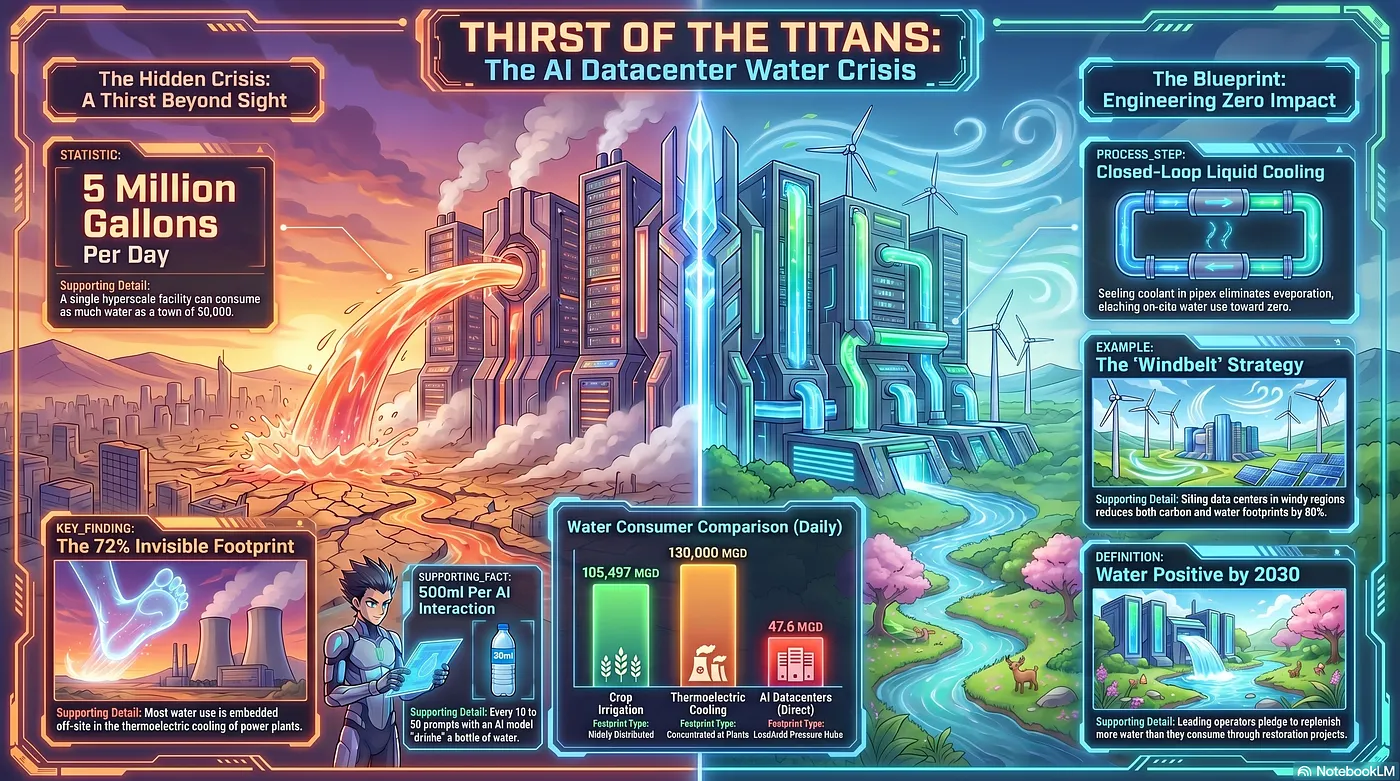
Thirst of the Titans — Infographic generated by Google Gemini
Key Findings
The water problem facing artificial intelligence is not a future hypothetical; it is already a measurable, regulated, and contested feature of the American landscape. A medium-sized enterprise datacenter consumes between 300,000 and 500,000 gallons of water per day for cooling, while a hyperscale facility can consume up to 5 million gallons per day — equivalent to the daily water use of a town of 10,000 to 50,000 residents, according to the Environmental and Energy Study Institute. In Newton County, Georgia, a Meta datacenter completed in 2024 consumes roughly 500,000 gallons per day — about ten percent of total county water consumption — according to local utility director Mike Hopkins, as reported in The New York Times investigation by Eli Tan in July 2025.
The aggregate United States numbers are now beginning to come into focus. According to the Lawrence Berkeley National Laboratory’s 2024 United States Data Center Energy Usage Report, datacenters consumed approximately 176 terawatt-hours of electricity in 2023, or 4.4% of total U.S. electricity, with projections rising to between 6.7% and 12% by 2028. Bluefield Research, in its 2025 insight report The Water-Power Nexus: How Data Centers are Reshaping the U.S. Water Landscape, projects that the on-site cooling water consumption of U.S. datacenters will rise from 22 billion gallons in 2025 to 34 billion gallons by 2030, while indirect water consumption embedded in their electricity supply will rise from 54 billion gallons to 91 billion gallons over the same period. That is the foundation for Bluefield’s headline finding — that 72% of total datacenter-related water consumption in the United States will occur off-site by 2030, more than double the projected on-site cooling demand.
This is the water-power nexus that defines the first pillar of any Responsible AI Datacenter Blueprint. Zero Water Impact is not simply a question of choosing the right cooling method. It is a coordinated commitment to direct cooling that does not evaporate freshwater, to electricity that does not require cooling of its own, to site selection that does not concentrate either burden on a stressed watershed, and to disclosure that allows communities to verify all three.
Details
Section 1 — The Problem: Datacenter Water Consumption
The historical baseline and the scale of evaporation
For most of the modern datacenter era, the workhorse of thermal management has been the evaporative cooling tower. The physics are seductive in their simplicity: hot air drawn from server halls is passed through a stream of water; the water evaporates; the latent heat of vaporization carries the heat away into the sky; and the residual stream of cool water is recirculated. Done well, evaporative cooling is the lowest-energy way to dump waste heat from a warehouse full of computers. The catch is that the water is gone — vented as vapor, never to return to the local watershed in any meaningful timeframe.
For a single hyperscale facility, the volumes are eye-watering. Sustainability Magazine reports that a single hyperscale datacenter can consume up to 1.5 million liters of water per day. Microsoft’s own disclosure, in the December 9, 2024 Microsoft Cloud Blog post by Steve Solomon, Vice President of Datacenter Infrastructure Engineering, was that its facilities prior to the August 2024 design transition consumed more than 125 million liters per year per datacenter. That number — about 33 million U.S. gallons — is the volume of water Microsoft now claims its closed-loop chip-level cooling system will avoid evaporating annually at every new facility.
Hyperscaler disclosures have been climbing in lockstep with their AI ambitions. Google’s 2024 Environmental Report disclosed that its self-owned datacenters withdrew nearly 8 billion gallons of water and consumed more than 6 billion gallons of freshwater for on-site cooling in 2023, with 31% of those freshwater withdrawals coming from watersheds of medium or high water scarcity. Google’s 2025 Environmental Report updated the figure to approximately 8.1 billion gallons of water consumed across data centers and offices in 2024. The company says water stewardship projects replenished 4.5 billion gallons in 2024 — about 64% of freshwater consumption, up from 18% in 2023 — toward its publicly stated goal of replenishing 120% of freshwater consumption by 2030.
Amazon Web Services, in contrast, has been less specific about absolute volumes and more focused on its Water Usage Effectiveness metric. According to the AWS Sustainability page, the company achieved a global datacenter WUE of 0.15 liters of water withdrawn per kilowatt-hour of IT load in 2024, a 17% improvement over 2023 and a 40% improvement over its 2021 baseline of 0.25 L/kWh. AWS reports it was 53% of the way toward its water-positive-by-2030 commitment as of 2024, up from 41% in 2023, and that it already uses recycled water for cooling at 24 datacenters globally with plans to expand to more than 120 U.S. locations by 2030.
Meta — the latest to publish detailed water data on December 4, 2025 in its “Advancing Water Stewardship in Our Data Center Communities” post — reports that its operational water restoration projects returned more than 1.59 billion gallons of water to high and medium water-stress regions in 2024. Meta’s water-positive commitment, made in 2022, targets restoring 200% of consumption in high water-stress regions and 100% in medium water-stress regions by 2030.
The Northern Virginia anchor case
Nowhere in the United States is the datacenter water question more concentrated than in Northern Virginia, the world’s largest datacenter market by a substantial margin. According to a Nature Forward analysis published in 2025, “Collectively, Northern Virginia data centers consumed close to 2 billion gallons of water in 2023 — a 63% increase from 2019 — and it is estimated data centers make up around 3% of total water consumption in the Potomac River Basin.” The 2 billion-gallon figure is also corroborated by a Financial Times investigation, which confirmed more than 1.85 billion gallons of water in 2023 via freedom-of-information requests to six regional Virginia water authorities, up from approximately 1.13 billion gallons in 2019.
The Virginia Joint Legislative Audit and Review Commission (JLARC), in its December 9, 2024 report mandated by the General Assembly, found that Virginia data centers consumed roughly 2.1 billion gallons of water in 2023, an 86% increase over 2019. Loudoun County alone — home to “Data Center Alley” in Ashburn — reported approximately 899 million gallons of potable water used by data centers in 2023, a roughly 250% increase over earlier years, according to a Center for Secure Water analysis at the University of Illinois.
The Interstate Commission on the Potomac River Basin (ICPRB), in its 2025 Washington Metropolitan Area Water Supply and Demand Study, reported that average daily consumptive use by datacenters in the Washington Metropolitan Area was approximately 4 million gallons in 2025, with a peak of 14.3 million gallons. The Commission projects those figures will rise to 16 million gallons average and 58 million gallons peak by 2035 — pushing datacenter water consumption from approximately 8% of the metropolitan area’s total today to 25% by 2035. Alimatou Seck, the ICPRB senior water resources scientist who led the analysis, told the Bay Journal that under an unconstrained growth scenario using standard cooling technologies, the datacenter share could surpass 33% by 2050, requiring 200 million gallons of Potomac water per day.
The water-power nexus
The most consequential discovery of the last five years of datacenter water research is that most of a facility’s water footprint is invisible from the property line. The Environmental and Energy Study Institute, citing the U.S. Geological Survey, reports that “in 2022, 40% of all total U.S. annual water withdrawals, or about 48.5 trillion gallons, were made by coal and gas power plants. Of those 48.5 trillion gallons, 962 billion gallons of water were consumed and were no longer available for direct downstream use.” A subsequent USGS-affiliated peer-reviewed study, published in PMC under the title “Impact of Thermoelectric Power Plant Operations and Water Use Reporting Methods on Thermoelectric Power Plant Water Use,” places the share at “over 41% of total U.S. freshwater withdrawals.”
The carbon-water coupling here is brutal: coal plants require approximately 19,185 gallons of water per megawatt-hour of generation, while combined-cycle natural gas plants consume approximately 2,800 gallons per megawatt-hour, according to EESI’s analysis. By contrast, rooftop solar and wind require essentially no operational cooling water. This is why Bluefield Research concludes that by 2030, with U.S. datacenter electricity demand rising from 4.4% of total U.S. consumption in 2023 to 8.9% by the end of the decade, 72% of the sector’s water footprint will be embedded in its electricity supply. Near-term measures to meet that electricity demand — delaying coal plant retirements, recommissioning nuclear facilities, and accelerating natural gas — all carry, in Bluefield research director Amber Walsh’s words, “significant water costs with long tails.”
The AI-specific multiplier
The AI workload is what has transformed a slowly-rising problem into an acute one. Shaolei Ren, an associate professor of electrical and computer engineering at the University of California, Riverside, and his collaborators Pengfei Li, Jianyi Yang, and Mohammad A. Islam published the seminal study, “Making AI Less ‘Thirsty’: Uncovering and Addressing the Secret Water Footprint of AI Models,” initially on arXiv in 2023 and in final form in Communications of the ACM (DOI 10.1145/3724499). The study found that training GPT-3 in Microsoft’s state-of-the-art U.S. datacenters “can directly evaporate 700,000 liters of clean freshwater,” enough to fill a backyard swimming pool three times over or, in Ren’s evocative comparison, to manufacture roughly 370 BMWs or 320 Tesla electric vehicles. Operating ChatGPT, Ren and colleagues calculated, consumes approximately 500 milliliters of freshwater — about one standard 16-ounce bottle — for every 10 to 50 user prompts. A more recent analysis updates that figure to 519 milliliters per 100-word GPT-4 response.
The Lawrence Berkeley National Laboratory’s 2024 report goes further. Adapting bottom-up modeling pioneered by Arman Shehabi and colleagues, the LBNL team projects that if current trends continue, U.S. datacenter water use could approximately quadruple by 2028, “further stressing the water infrastructures,” in the report’s own language. A widely cited downstream analysis published by Apstech Advisors places direct U.S. datacenter water consumption at approximately 66 billion liters in 2023 — and indirect, electricity-embedded consumption at nearly 800 billion liters, with 80% of total water consumption hidden in the grid.
Local strain, vivid comparisons, and the moratorium wave
What the macro statistics flatten, the local stories make legible. The Lincoln Institute of Land Policy notes that defenders of datacenters often point out that Americans use more water to irrigate golf courses (more than 500 billion gallons per year) and lawns (more than 2 trillion gallons) than AI datacenters use. The retort offered by water experts cited in the same article is that “America has a well-documented addiction to green grass that is also not serving us well. The solution lies in water conservation and consumer education, not comparing one wasteful use to another.”
In Mesa, Arizona, the city council approved in May 2022 the Project Redale data center — widely understood to be a Meta facility — that requires up to 1.25 million gallons of water per day. A previously approved Google facility in Mesa is projected to consume up to 4 million gallons of water per day, according to Bloomberg reporting. Vice Mayor Jenn Duff voted against the project, citing the “driest 12 months in 126 years,” declaring data centers “an irresponsible use of our water.” Down the road, Chandler, Arizona, has taken the opposite tack: a 2015 ordinance restricts new water-intensive businesses unless they create thousands of jobs, effectively excluding datacenters in favor of semiconductor fabs.
In Tucson, the resistance went further. On August 6, 2025, the Tucson City Council voted 7–0 to reject the annexation of land for “Project Blue,” a 290-acre, up-to-600-megawatt datacenter campus developed by Beale Infrastructure (an arm of Blue Owl) with Amazon Web Services as the original anonymous end-user. The proposal would have made the campus Tucson’s single largest water customer at roughly 2,000 acre-feet per year. Mayor Regina Romero told residents: “Tucsonans have spoken out loudly and clearly and I hear you… It is my responsibility to create guardrails to protect Tucson from this industry that is already here in Arizona.” Forty-two days later, in a September 17, 2025 letter to Pima County Administrator Jan Lesher, Beale Infrastructure announced it would shift to a closed-loop air-cooled design: “Beale’s air cooled design will consume no water, potable or otherwise, for industrial cooling. Water will be used for domestic purposes, such as kitchens, bathrooms, and fire suppression.” Pima County’s Board of Supervisors approved the revised Memorandum of Agreement on December 16, 2025 by a 3–2 vote — though AWS had by then quietly pulled out as the named tenant.
The pattern has continued. In December 2025, more than 230 environmental organizations, led by Food & Water Watch and Don’t Waste Arizona, signed a letter to Congress requesting a national moratorium on the approval and construction of new datacenters. In Bessemer, Alabama, a city council vote to rezone agricultural land for a datacenter divided the community over water and electricity concerns. In Newton County, Georgia, The New York Times reported in July 2025 that nine companies had applied to build datacenters, some requesting up to 6 million gallons of water per day — more than the county’s entire daily usage. Mike Hopkins, executive director of the Newton County Water and Sewerage Authority, told the Times: “What the data centers don’t understand is that they’re taking up the community wealth. We just don’t have the water.” Chris Manganiello, water policy director of Chattahoochee Riverkeeper, told the same publication of one Georgia datacenter applicant seeking 9 million gallons per day — equivalent to the consumption of roughly 30,000 households — “It is a tremendous amount.”
The most acute U.S. case of opaque corporate behavior arose in The Dalles, Oregon. In 2021 the city sued The Oregonian/OregonLive on Google’s behalf to prevent disclosure of how much water Google’s data centers were using locally — arguing the information was a trade secret. After more than a year of litigation supported by the Reporters Committee for Freedom of the Press, the city settled in December 2022 and agreed to disclose ten years of water-use data and to provide annual usage going forward. The newspaper’s subsequent reporting revealed that Google’s water use had nearly tripled over the previous five years and consumed more than a quarter of all water used in the city. Google subsequently announced that site-level water-use numbers would no longer be treated as trade secrets at any of its U.S. datacenters.
Internationally, the cautionary tale of Meta’s Zeewolde, Netherlands, project is essential to understand. After two years of negotiations, the Zeewolde municipal council approved Meta’s 200-megawatt, five-hall hyperscale datacenter in December 2021. The Dutch Senate passed a motion in March 2022 calling on the national government to use its powers to block construction. After Minister Hugo de Jonge announced in March 2022 that the project was “highly questionable,” Meta paused and ultimately abandoned the project. The Dutch government simultaneously imposed a nine-month national moratorium on hyperscale datacenter permits.
Section 2 — The Regulatory Environment (US Focus)
State legislation: Virginia leads, but most reform bills die
The single most active state legislative theater for datacenter water policy is Virginia. The 2024 General Assembly session saw dozens of datacenter reform bills introduced; the only one that survived was HB 338, which permits localities to conduct site assessments evaluating a proposed datacenter’s potential impact on water usage and carbon emissions. The remaining bills were carried over pending the JLARC study, which released its 196-page Data Centers in Virginia report on December 9, 2024 — finding that just over one-third of datacenter water use in Virginia was already supplied via reclaimed water, that data centers’ share of statewide withdrawals remained under 0.5%, but that average daily building-level use of 18,000–38,000 gallons could spike to 88,000 gallons on peak days and create severe local stress.
The 2025 General Assembly session followed with more than 40 datacenter-related bills, but only four passed — most stripped of water-disclosure or moratorium provisions. HB 2084, signed into law, directed Virginia’s State Corporation Commission to evaluate whether non-data center customers were subsidizing data center energy costs and to consider creating a separate ratepayer class for data centers. JLARC found that absent rate reform, the average Dominion Energy residential customer could see generation- and transmission-related costs rise by $14 to $37 per month by 2040 (independent of inflation). Bills that would have required water disclosure, such as Senator Danica Roem’s SB 285 to require disclosure of water and power usage at full build-out, were continued or defeated.
The state-by-state map is broader than Virginia. According to a March 2025 analysis by the National Caucus of Environmental Legislators, at least 22 states introduced more than 60 bills in 2025 to address the grid, energy, and environmental impacts of datacenters. Georgia’s SB 34 would prohibit data-center-specific grid costs from being passed down to ratepayers. Oregon’s HB 3546 would direct the public utility commission to create a special rate class for datacenters. Utah’s SB 132 passed both chambers, enabling direct contracts between power suppliers and datacenters. By April 2026, according to the MultiState policy tracker, 27 states were considering legislation targeting “large load” customers, with reporting requirements often beginning at energy loads as low as 10 MW — far below the 100 MW threshold of the federal executive order.
In Arizona, water utilities for Mesa, Avondale, and the city of Phoenix have passed ordinances that cap usage for industrial facilities and require developers to purchase supplemental water supplies if they want to exceed those caps. Mesa told Grist that large water users have provided the city with approximately 7,800 acre-feet of additional water supplies. Chandler’s 2015 economic-development ordinance effectively prevents new water-intensive uses that do not generate substantial employment.
Federal policy: an executive order accelerator, no water disclosure mandate
The federal policy landscape changed substantially on July 23, 2025, when President Trump signed Executive Order 14318, “Accelerating Federal Permitting of Data Center Infrastructure,” part of the Winning the Race: America’s AI Action Plan package. The order revoked President Biden’s Executive Order 14141 (Advancing United States Leadership in Artificial Intelligence Infrastructure, January 14, 2025), established a $500 million investment threshold for qualifying projects, and directed federal agencies to identify NEPA categorical exclusions, to expedite Clean Water Act Section 404 nationwide permits with reassessment within 180 days, and to consider data centers on appropriate federal lands. The Department of Energy on July 24, 2025 announced four candidate sites: Idaho National Laboratory, Oak Ridge Reservation, Paducah Gaseous Diffusion Plant, and Savannah River Site.
Crucially, the executive order does not address water consumption or conservation. As the MultiState policy analysis notes, while the order “directs EPA review of the Clean Water Act, that law governs discharge of pollutants into water, not water consumption or conservation.” Food & Water Watch, in its December 2025 analysis, observes that the order “does nothing to prevent local communities from exercising their existing powers to protect water, public health, or energy. It doesn’t outlaw moratoriums, or halts, on new data centers.” A separate executive order issued in December 2025 directed the Secretary of Commerce to publish a list of state AI laws deemed invalid; as of mid-2026, that list has not been published.
Disclosure frameworks and the WUE metric
The Green Grid, a global IT-industry consortium, introduced Water Usage Effectiveness (WUE) in its White Paper #35, “Water Usage Effectiveness (WUE™): A Green Grid Data Center Sustainability Metric,” released in February 2011 and edited by Michael Patterson of Intel with contributions from Symantec, Microsoft, and Emerson Network Power. WUE is calculated as annual site water usage (in liters) divided by annual IT equipment energy consumption (in kilowatt-hours), with units of L/kWh. The metric’s central limitation, as Datacenter Dynamics notes, is that it does not account for the water embedded in off-site electricity generation — precisely the 72% of total water footprint that Bluefield Research identifies as the dominant 2030 risk.
Industry-average WUE has settled, according to Sunbird DCIM, at approximately 1.8 L/kWh — a figure also cited as the Department of Energy estimate for an average evaporative cooling datacenter. Microsoft’s 0.30 L/kWh fleet average for fiscal year 2024 represents a 39% improvement over 2021’s 0.49 L/kWh, and the company reports an 80% reduction in WUE since the early 2000s. AWS’s 0.15 L/kWh is now the lowest publicly reported hyperscale figure. The National Renewable Energy Laboratory’s Energy Systems Integration Facility achieves a WUE of approximately 0.7 L/kWh in combination with a 1.06 PUE.
Mandatory disclosure remains rare. The CDP (formerly Carbon Disclosure Project) Water Security questionnaire is voluntary. The European Union’s Energy Efficiency Directive recast (2023/1791) requires datacenters above 500 kW to report energy and water consumption — a precedent without a U.S. equivalent.
Section 3 — The Solutions: Closed-Loop and Advanced Cooling Technologies
The technical answer to the on-site half of the problem is, by 2026, beyond academic debate: liquid cooling in closed loops eliminates evaporative water consumption while accommodating the extreme rack densities of AI training clusters. According to Mordor Intelligence’s current Data Center Liquid Cooling Market report, the market “was valued at USD 5.52 billion in 2025 and estimated to grow from USD 6.77 billion in 2026 to reach USD 18.79 billion by 2031, at a CAGR of 22.65% during the forecast period (2026–2031).”
Direct-to-chip liquid cooling
Direct-to-chip (also called cold-plate) cooling routes a non-evaporating coolant — typically a water-glycol mixture — through micro-channels bonded directly to CPUs and GPUs. The heat is carried out of the server rack to facility-level coolant distribution units (CDUs) and then dissipated through dry coolers or chillers. Because the loop is sealed, the water within it is filled once at construction and recirculated indefinitely; there is no evaporation, and thus a true on-site WUE near zero.
The leading vendors are well-established. CoolIT Systems, founded in Calgary in 2001 and agreed to be acquired by Ecolab in March 2026 (Ecolab’s Form 8-K of March 20, 2026 disclosed the $4.75 billion all-cash purchase from funds managed by KKR, with closing expected in the third quarter of 2026), is the primary partner for nearly every major server OEM and reports deployments in 300 datacenters globally. Its CHx1000, launched in November 2024, is the world’s highest-density liquid-to-liquid CDU. Vertiv, headquartered in Westerville, Ohio, was selected in March 2024 as a primary partner for NVIDIA’s GB200 NVL72 reference systems and offers a portfolio of CDUs up to 2.3 megawatts of cooling capacity per unit. Schneider Electric integrates rear-door heat exchangers and direct-to-chip solutions with its EcoStruxure platform. Asetek, a long-established Danish company, has expanded from PC and HPC markets into rack-level data center cooling. Supermicro, the high-velocity AI server vendor, has integrated cold plates for CPUs, GPUs, and DIMM memory in single-vendor liquid-cooled racks.
Real-world deployments at hyperscalers are now routine. Microsoft, which began designing all new datacenters with chip-level closed-loop liquid cooling from August 2024 forward, will see its first such facilities come online in Phoenix and Mt. Pleasant, Wisconsin in 2026, with the full design rollout by late 2027. NVIDIA’s flagship GB200 NVL72 system ships as a liquid-cooled reference design, ensuring that essentially every Tier-1 AI training facility built from 2025 onward incorporates direct-to-chip cooling at the rack level.
Immersion cooling: single-phase and two-phase
Immersion cooling takes the concept further by submerging entire servers in a dielectric (electrically non-conductive) fluid. Single-phase immersion uses an engineered fluid or mineral oil that remains liquid throughout the cooling cycle; pumps circulate the fluid through external heat exchangers. Two-phase immersion uses a fluid with a low boiling point (3M’s Novec 7000 boils at 34°C) that vaporizes on the chip surface, rises to a condenser coil at the top of the tank, and returns as liquid in a passive convection loop. The leading immersion vendors are Submer (Barcelona, single-phase), LiquidStack (Hong Kong/Houston, two-phase), Green Revolution Cooling or GRC (Austin, single-phase), and Asperitas (Netherlands, single-phase).
The water savings claim for immersion is straightforward: because the system rejects heat through dry coolers without evaporation, there is no on-site water consumption for cooling — a true WUE of zero is achievable. LiquidStack’s documented case studies report PUE values as low as 1.02 in two-phase deployments, and the company’s CEO Joe Capes has emphasized that “two-phase cooling can reject heat without using water” — a feature he believes has driven LiquidStack’s most high-profile customer relationship, with Microsoft at its Quincy, Washington datacenter. Green Revolution Cooling reports that single-phase immersion can reduce cooling power consumption by up to 95% and server power consumption by 10–20%, with PUE below 1.08.
Microsoft’s immersion deployments — 18 datacenters and approximately 22% of GPU capacity as of late 2025, per Mordor Intelligence reporting — represent the largest single hyperscaler adoption. GRC’s October 2025 contract for an Abu Dhabi AI campus with 8,000 single-phase tanks, valued at $120 million, is the largest single immersion deployment publicly announced.
Two-phase direct-to-chip refrigerant systems
A newer class — two-phase direct-to-chip cooling, pioneered by Accelsius (an Austin-based 2022 spin-out of Bell Labs technology) with its NeuCool platform and by ZutaCore with its Hyperdry system — uses a low-boiling-point dielectric refrigerant that vaporizes inside cold plates and condenses elsewhere. Because the refrigerant is not water, there is no risk of leakage damaging electronics, and because there is no evaporation, on-site water consumption is essentially zero. Both Accelsius and ZutaCore report WUE values approaching zero, with PUE in the 1.05–1.1 range.
Microsoft’s zero-water cooling: the canonical case
The Microsoft announcement merits a careful, primary-source reading. In a December 9, 2024 Microsoft Cloud Blog post, Steve Solomon, Vice President of Datacenter Infrastructure Engineering, wrote: “Beginning in August 2024, Microsoft launched a new datacenter design that optimizes AI workloads and consumes zero water for cooling. By adopting chip-level cooling solutions, we can deliver precise temperature control without water evaporation. While water is still used for administrative purposes like restrooms and kitchens, this design will avoid the need for more than 125 million liters of water per year per datacenter.” Microsoft confirmed that all datacenters designed from August 2024 onward will incorporate the zero-water cooling design, with first deployments at Phoenix, Arizona and Mt. Pleasant, Wisconsin pilot sites in 2026 and full operational rollout from late 2027. The trade-off is acknowledged: PUE will see a “nominal increase” because mechanical cooling without evaporative assist requires more electricity than evaporative cooling.
The original water-positive commitment, made by Microsoft President Brad Smith in a September 21, 2020 blog post titled “Microsoft will replenish more water than it consumes by 2030,” remains the goal that the zero-water design is intended to support. In Smith’s words: “By 2030 we will be water positive, meaning we will replenish more water than we use. We’ll do this by putting back more water in stressed basins than our global water consumption across all basins. The amount returned will be determined by how much water we use and how stressed the basin is.”
Google, AWS, and Meta: parallel commitments, divergent paths
Google’s water disclosure has been comparatively granular. Beyond the 8.1 billion gallons consumed and 4.5 billion gallons replenished in 2024 — covering 64% of consumption against the 120%-by-2030 target — Google’s 2025 Environmental Report describes 112 active water stewardship projects spanning 68 watersheds. Once fully operational, the company estimates these projects will have annual capacity to replenish 8 billion gallons, but Google has explicitly stated that “water cooled data centres are here to stay, for a while at least” because of energy-water tradeoffs in some climates.
AWS’s evaporative cooling architecture in many of its older facilities, paired with a “free-air cooling” system that uses outside air for 95% of the year in Ireland and Sweden, has produced the lowest-published hyperscaler WUE — 0.15 L/kWh in 2024. AWS reports that switching from existing cooling to direct evaporative cooling at its Santa Clara facilities reduced annual water use by 85%, and 24 of its data centers currently use recycled or reclaimed wastewater for cooling, with expansion to more than 120 U.S. data centers planned by 2030.
Meta’s December 4, 2025 disclosure represents the strongest engineering pivot. The company’s Beaver Dam, Wisconsin datacenter, currently under construction, “will feature this closed-loop, liquid-cooled system with dry coolers, and the total estimated annual water use for the data center, once operational, is anticipated to be less than that of two full-service restaurants in a year.” The El Paso, Texas facility uses an analogous closed-loop liquid cooling system designed to operate without water intake under normal conditions. Meta’s water restoration portfolio, including a 10-year partnership with Phytech in Tulsa on a 1,500-acre plant-sensor irrigation project expected to save more than 50 million gallons annually, and an N-Drip / Colorado River Indian Tribes flood-to-drip conversion in Arizona projected to save 65 million gallons per year, is on track to restore 2.9 to 3.4 billion gallons annually once fully implemented.
Reclaimed water, dry coolers, and the air-cooled path
For facilities that cannot fully eliminate water — and there are still locations where evaporative cooling delivers material electricity savings during peak summer load — reclaimed water and dry coolers offer middle-ground architectures. Loudoun Water’s reclaimed water program in Ashburn, Virginia, constructed beginning in 2010, now operates 20 miles of pipeline and delivered 736 million gallons of reclaimed water to data center customers in 2024 — water that would otherwise have been discharged into the Potomac River and Chesapeake Bay. Mike Beardslee, executive director of technology services for Loudoun Water, described the arrangement to Broadband Breakfast: “The data centers get the cooling water they need at a reduced rate, and we’re getting paid for reclaimed water that would otherwise be discharged into a stream.” Named participating customers include Amazon Web Services (the first AWS facility to use reclaimed water with direct evaporative cooling came online in 2020) and the NTT/RagingWire campus.
Dry coolers, which dissipate heat from a closed water loop entirely through air-side heat exchangers, are now the dominant non-evaporative thermal solution at facilities where ambient temperatures permit. The ICPRB notes that roughly 40% of Northern Virginia datacenters currently rely exclusively on air cooling, with many others using a hybrid approach that takes advantage of “free cooling” in cooler months. Site-level water-use intensity ranges from 100–1,600 gallons per day per megawatt of IT load on average, but evaporative facilities can reach 8,500 gallons per day per megawatt at peak. Dry-cooled facilities sit at the low end of that range, effectively at WUE near zero.
Section 4 — Broader Context and Call to Action
The Cornell roadmap
The single most important academic contribution to the AI water debate published in 2025 is the Nature Sustainability paper by Tianqi Xiao, Fengqi You, and colleagues at Cornell University’s Process-Energy-Environmental Systems Engineering lab, titled “Environmental impact and net-zero pathways for sustainable artificial intelligence servers in the USA,” published November 10, 2025 (DOI 10.1038/s41893–025–01681-y). The paper projects that the deployment of AI servers across the United States could generate annual carbon emissions of 24 to 44 million metric tons of CO2-equivalent and an annual water footprint of 731 to 1,125 million cubic meters between 2024 and 2030. The paper’s central optimistic finding: a coordinated strategy combining smart siting, faster grid decarbonization, and operational efficiency could reduce CO2 emissions by approximately 73% and water consumption by approximately 86% compared with worst-case scenarios. Professor You’s framing: “There isn’t a silver bullet. Siting, grid decarbonization and efficient operations work together — that’s how you get reductions on the order of roughly 73% for carbon and 86% for water.”
The Cornell team identifies the Midwest and “windbelt” states — particularly Texas, Montana, Nebraska, and South Dakota — as having the best combined carbon-and-water siting profile. Locating facilities in regions with lower water stress combined with cooling efficiency improvements can alone slash water demands by approximately 52%, the paper finds. The corresponding alternative — current concentration in water-scarce regions like Arizona, Nevada, and parts of Northern Virginia — is the trajectory that produces the worst case.
Industry frameworks and the business case
The hyperscaler “water positive by 2030” commitments — Microsoft (September 21, 2020), Google (September 2021), Meta (2022), and AWS (November 2022) — share a common structure: efficiency, sustainable water sourcing, on-site reuse, and watershed replenishment. The CDP Water Security questionnaire is the leading voluntary disclosure framework. The Green Grid’s WUE remains the operational benchmark despite its limitations.
The business case for water efficiency now extends well beyond ESG narrative. The Project Blue rejection in Tucson cost Beale Infrastructure at least four months of permitting delays and substantial reputational damage; the project ultimately moved forward, but with a fundamentally different cooling architecture and a smaller social license. Meta’s Zeewolde project represents an outright write-down. JLARC’s finding that Virginia’s data center sales-and-use tax exemptions reached more than $1.9 billion in fiscal year 2025 indicates the scale of public subsidy at stake, with state legislators in both parties now scrutinizing whether the social bargain remains intact.
A specific industry analysis underwrites the cost case: ICF’s August 2024 report “Power surge: Navigating US electricity demand growth,” authored by Shankar Chandramowli, Patty Cook, Justin Mackovyak, Himali Parmar, and Maria Scheller, found that “the cost many utilities pay for electricity could increase by an average of 19% by 2028.” The March 4, 2026 Ratepayer Protection Pledge — signed at the White House by seven companies (Amazon Web Services, Google, Meta, Microsoft, OpenAI, Oracle, and xAI), described by President Trump at the signing as a commitment to “fully cover the cost of electricity production required for AI data centers” — represents an industry attempt to head off state legislation, though it lacks legal enforcement.
Projected futures: convergent warnings from independent analysts
The forward-looking estimates from independent analysts now align with remarkable consistency. The Lawrence Berkeley National Laboratory’s 2024 report projects U.S. data center electricity rising to 325–580 TWh by 2028. The International Energy Agency’s Energy and AI special report (2025) finds that “Data centres accounted for around 1.5% of the world’s electricity consumption in 2024, or 415 terawatt-hours (TWh)” and that “Data centre electricity consumption is set to more than double to around 945 TWh by 2030.” Bluefield Research’s 72%-off-site water projection assumes data centers reach 8.9% of U.S. electricity demand by 2030. The Cornell Nature Sustainability analysis projects 731–1,125 million cubic meters of annual U.S. water consumption by 2030, “on par with the household use of 6 to 10 million Americans,” in the words of Yale Environment 360. A Houston Advanced Research Center analysis projects that Texas data centers alone will consume 49 billion gallons of water in 2025 and as much as 399 billion gallons in 2030, according to the Lincoln Institute of Land Policy.
These projections are not catastrophe forecasts. They are projections of what continuing on the current trajectory will produce. The Cornell finding — that coordinated action can reduce the water footprint by 86% — is the alternative path. The pieces required for that alternative are now commercially available: closed-loop direct-to-chip cooling, immersion cooling, dry coolers, reclaimed-water programs, renewable-powered electricity, and disciplined siting in low-water-stress regions.
Recommendations
The first pillar of a Responsible AI Datacenter Blueprint — Zero Water Impact — should be operationalized as a staged commitment that any new U.S. facility can credibly adopt and that any existing facility can credibly retrofit.
Stage 1, within 12 months of facility commitment: Publish a baseline. Adopt The Green Grid’s Water Usage Effectiveness metric as a floor; voluntarily extend it with a Total Water Footprint figure that includes off-site electricity-generation water consumption (the 72% of the problem Bluefield Research has identified). Disclose monthly water withdrawals to local utilities and to a public registry. Threshold for moving to Stage 2: published WUE within one year and a third-party-verified water risk assessment of the host watershed.
Stage 2, by groundbreaking on any new facility designed after January 1, 2027: Specify a closed-loop liquid cooling architecture — either direct-to-chip cold plates, single- or two-phase immersion, or two-phase refrigerant direct-to-chip — sized to an on-site WUE no greater than 0.10 L/kWh, with a stretch target of 0.0 L/kWh in non-arid climates where dry coolers can be used year-round. Microsoft’s August-2024-forward design standard is the reference architecture; the engineering risk has been retired. Threshold for moving to Stage 3: commissioning of at least one zero-evaporation pilot loop and signed power-purchase agreements for at least 80% carbon-free electricity.
Stage 3, by 2030: Achieve full water-positive operation — meaning replenishment of at least 100% (200% in high water-stress basins, following Meta’s framework) of consumed freshwater through verified watershed projects using the Volumetric Water Benefit Accounting methodology. Pair the on-site closed-loop cooling with off-site power that does not embed thermoelectric cooling water — meaning wind, solar, or geothermal generation procured through additional, time-matched power-purchase agreements rather than unbundled renewable energy certificates. Threshold for retaining social license: zero unresolved community water complaints and no use of potable water for cooling.
For developers entering water-stressed regions: Default to dry-coolered closed-loop chip-level liquid cooling with reclaimed-water makeup only. Follow the Loudoun Water reclaimed-water model in jurisdictions where utility-side investment is feasible. Pre-publish water permits before any zoning vote.
For state legislators: Adopt Virginia’s HB 338 site-assessment model, but extend it to mandatory disclosure of water withdrawals and watershed impacts at facilities above 10 MW (the threshold most state bills already use). Pair with a ratepayer-class separation along the Virginia HB 2084 model to prevent residential subsidization of datacenter-driven grid expansion.
For Congress: Notwithstanding Executive Order 14318’s permitting acceleration, the underlying Clean Water Act and NEPA frameworks do not address water consumption. Federal disclosure should be mandatory for any data center receiving DOE federal-lands siting, federal financial support, or qualifying-project designation under FAST-41.
Caveats
Several data points used by advocates in this debate warrant explicit caveats. The headline “ChatGPT consumes 500 milliliters of water per 10–50 queries” figure is from Shaolei Ren’s 2023 arXiv paper, refined in the Communications of the ACM version, and is contingent on assumptions about Microsoft’s U.S. datacenter locations and weather conditions; values in other geographies vary substantially. The “32 billion gallons by 2028” U.S. AI water figure originates from LBNL projections that come with explicit uncertainty ranges (325–580 TWh of total electricity). The 86% Cornell water-reduction figure is relative to the worst-case scenario in their model, not relative to today’s baseline — a critical distinction in advocacy contexts.
The Bluefield Research projection that 72% of datacenter water consumption will occur off-site by 2030 is one analyst’s model. It is broadly consistent with the LBNL and IEA findings but should not be cited as a settled fact. The “global data centers consumed 560 billion liters of water in 2023” IEA figure is drawn from a partial sample and does not include all jurisdictions.
The “Northern Virginia data centers consumed close to 2 billion gallons in 2023” figure is corroborated by both Nature Forward (~2 billion gallons) and the Financial Times FOIA investigation (1.85 billion gallons) and JLARC’s slightly higher 2.1 billion gallons; the 63% increase from 2019 is also widely sourced, though one Center for Secure Water analysis cites an 86% increase using slightly different inclusion criteria. The differences trace to which counties and which water-supplier categories are included.
Microsoft, Google, AWS, and Meta have all faced criticism that “water positive” framing relies on replenishment projects (irrigation efficiency, watershed restoration) that produce water benefits in geographies and at moments not always synchronous with the consumption being offset. The Volumetric Water Benefit Accounting methodology developed by Reig and colleagues at WRI provides a defensible framework, but it is not yet a universally accepted standard. Independent verification of replenishment claims remains an area where industry voluntary disclosure has not yet caught up to public expectations.
Finally, the Trump administration’s December 2025 executive order directing the Secretary of Commerce to publish a list of state AI laws deemed invalid had not been published as of mid-2026; the legal and political environment for state-level water disclosure laws may shift substantially before any of the recommendations above can be fully implemented.